Home Blog Page 466

Board Shorts: November 1

0
Image: Irene Lo

By: Paige Riding, News Writer

Note: The Rotunda groups discussion and vote that was at this meeting was covered in separate articles here and here.

World University Services of Canada (WUSC) Spring 2020 Referendum

The SFSS Board of Directors voted to hold a Spring 2020 referendum to increase the levy for World University Services of Canada (WUSC). The referendum will ask students to increase WUSC’s $2.50 per term levy to a doubled $5 for students enrolled in full-time classes, and from $1.75 to $2.50 for those enrolled part-time. 

The program supports refugee students in their endeavors to complete their post-secondary education at SFU. Without this increased fee, the program would not be able to continue to sponsor the number of undergraduate students they currently do.

Student Advocate position endorsed by Board

The Board of Directors voted in favour of endorsing a pilot project to hire a Student Advocate, and for Executive Director Sylvia Ceacero to present a business plan for the implementation of this position in the Spring semester. 

As part of this proposal, the Board heard from Laura Reid, SFU Ombudsperson, about what her position entails. The Ombuds Office is an “independent, impartial, and confidential resource for students,” according to their website. Located in Maggie Benston Centre room 2266, the Ombudsperson is not an advocate but a “confidential and impartial resource to learn self-advocacy skills.” While Reid cannot advocate on behalf of students, she can inform and guide graduates and undergraduates on what policies and approaches they should know about.

The advocate will work to ensure that the university treats graduate and undergraduate students fairly in disputes with the university such as academic or non-academic misconduct, housing appeals, parking disputes etc. They will also provide guidance on policies and emotional support during these kinds of disputes.

Board Approves a Coordinator for the First Nations Student Association

The First Nations Student Association (FNSA) received approval from the Board to hire a Coordinator to support their organization and regular operations. The Coordinator will be a paid employee financed from the SFSS’s general operating budget. Until now, FNSA has been completely run by students. 

“It has been very inequitable for the First Nations Student Association. As you can imagine, not having a Coordinator while being internal to SFSS is quite astonishing and shocking, to be frank. We look at areas such as Out On Campus and Womens’ Centre and they have multiple staff members supporting them,” said an FNSA representative that was present at the meeting.

Provincial Lobbying 2019 Report

Vice-President External Relations Jasdeep Gill and Vice-President Student Services Christina Loutsik reported on their recent lobbying trip to Victoria. While they met with many lawmakers and elected representatives, they mentioned that during their trip to Victoria, 22 parliament members canceled previously scheduled meetings with Gill and Loutsik.

On a more positive note, Gill said that “Premier John Horgan and Minister Melanie Mark did indicate that they are in support of dedicating funds to the needs-based grant program.” 

Gill added “they don’t just want to rebrand the current funds that they invest into the completion grants [ . . . ] they’d like to add additional money that would benefit student financial aid.” 

Further, she reported that some MLAs indicated that the interest on the federal portion of student loans may be eliminated in the future. The provincial representatives said that they plan to continue to push the federal government on this issue.

Gill and Loutsik also discussed the harm caused by the high tuition fees for international students, with the MLAs they met with. Part of the solutions they proposed included increasing the maximum hours an international student can work, from the current limit of 20 hours a week.
Tuition Freeze Now holds Town Hall to discuss affordability

0
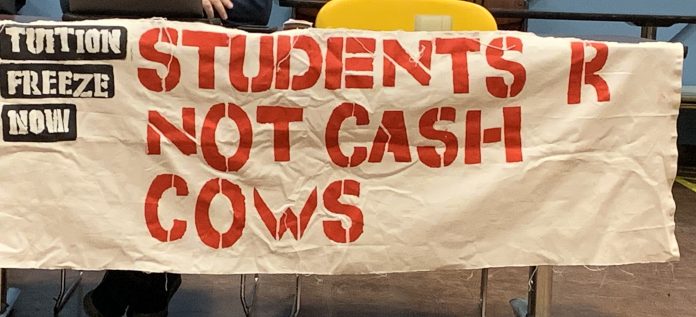
TFN’s slogan “Students are not cash cows” on a banner on display during the event

By: Paige Riding, News Writer

Tuiton Freeze Now, an activist group at SFU, held a campus Town Hall on October 29. The Town Hall was held in Forum Chambers in the basement of the Maggie Benston Centre, where TFN representatives and interested guests joined together with the goal of spreading information and discussing the direction of TFN’s future campaigns. Core goals for TFN in the near future include speaking to the BC government about a two-year tuition freeze and increased funding to post-secondary institutions. 

At the event, representatives from TFN presented statistics about tuition fees and the results of the surveys they conducted related to unaffordability for students (ongoing on their website). The survey results overwhelmingly showed students feeling that tuition was too costly at SFU, which lead to significant hardship.

Representatives from TFN also spoke about ways to campaign against further hikes on tuition in the future. TFN was at the forefront of protests in the spring semester, when SFU passed a 2% hike in tuition for domestic students, and up to a 20% increase for international students depending on their faculty. Since then, TFN has continued to campaign for better consultation with students with regards to the cost of attending SFU.

TFN organizer Quentin Rowe-Codner spoke to The Peak via email about the event. 

“Now that we have the information from the university on the next tuition hike, we can now start to structure and plan out how we’re going to go forward in terms of messaging, in terms of demands and that sort of thing.” 

In October, SFU held budget consultations with the SFU community to discuss the upcoming 2020 budget.

Following the presentation, there was a general discussion period in which attendees broke into groups to brainstorm ideas for future TFN campaigns. Some suggestions included targeting and gearing campaigns towards specific campus populations, like teaching assistants (TAs). In this way, TAs may be able to bring this information to their tutorials, speaking directly to students about the goals of TFN. Another group mentioned the benefit of having TFN advocates present and vocal at SFU Board of Governors meetings. 

TFN organizer Annie Bhuiyan also spoke to The Peak via email. 

“Even though we have certain representatives who are talking to the Board of Governors, talking to the administrator, telling us about what’s going on and representing us, we still don’t know anything,” Bhuiyan wrote. “And for the most part, from what we understand, they don’t really know much either, so it hasn’t been a completely democratic process.”

Bhuiyan continued: “That’s why we called the Town Hall: so we can be democratic about it. Also, tuition is already too high. It can’t keep going up higher. This is something we need to keep fighting against until we get a tuition freeze and then we can push for things that are more affordable like more supplementary funding— eventually free tuition.”

Rowe-Codner added, “We’re definitely going to try and get the word out a lot more because SFU doesn’t do a very good job at letting students know what’s happening with regard to tuition, so it’s really on us unfortunately to have to do a lot of that awareness spreading and information campaign.” 


Carpool group emerges on Facebook in response to transit strike anxieties

0
SFU students are banding together to carpool to campus

By: Jess Dela Cruz, News Writer

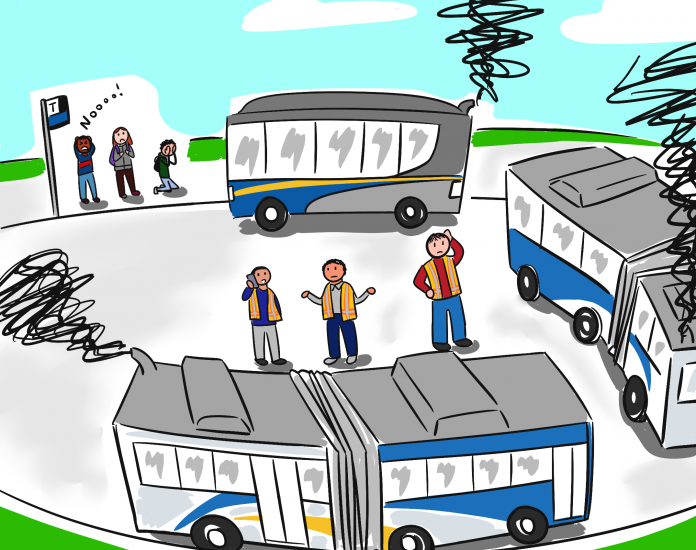
On October 28, Translink workers under Unifor issued a 72-hour strike notice against Coast Mountain Bus Company (CMBC). With SFU being largely a commuter campus, students rely heavily on transit to get to and from campus.

Shortly after the notice was released, Vice-President Finance & Administration Martin Pochurko sent a mass email to all SFU students regarding the strike. He wrote, “in the event of transit disruptions, operations at SFU will continue as usual [ . . . ] with that in mind, students, faculty, and staff who regularly rely on transit are encouraged to consider alternate transportation methods. ” 

Many students took to the myriad of SFU Facebook groups to discuss how their commute to school would be affected. Second year biology student, Natasha Wong, decided to address the panicked discussion many students were having on the strike. 

“[With] an influx of posts asking for rides to and from SFU all over [the Facebook] groups [ . . . ] I thought it would be best to centralize it,” she told The Peak in an email interview. Within one hour, she claims that over 400 members had joined. That number has now increased to over 1,200 members. 

The page’s description encourages members to make their posts in the following format: offering a ride/seeking a ride, area, day, and time. Many students from all over the Lower Mainland have offered to pick up others along their route, including specific skytrain stations or intersections. Some drivers required a certain amount of payment either per head or to chip in for gas money. For others, a cup of coffee would suffice. 

A student, who wished to remain anonymous, told The Peak how he used the carpooling group to find someone who could help them get to campus. 

“My driver has the same class time in the morning, didn’t look sketchy, and also happened to pass right by my house on her way to school.” The student added, “I actually really enjoy carpooling. My driver was super friendly and chatty, and it was a really nice change from sitting on the bus by yourself in silence. SFU has always been called the lonely commuter campus [ . . . ] in my experience so far, [this] has been a really good way to break the cycle.” 

Sixth year student and driver, Elda Hajdarovac, offered her assistance as a driver because “ I used to take transit in my first and second year and I know how hard it can be to try and get to campus. Plus I feel it’s a great way to create a sense of community and positivity in light of a difficult situation for all.” 

And while many students are providing or seeking rides, some students are wanting to show support and solidarity with the bus drivers. Third year Beedie student Sophia, along with her ethics class, used their class project assignment to spread awareness about drivers’ conditions. With this project, Sophia “hope[s] students can gain some empathy towards bus operators and voice their support and concerns to Translink, CMBC, and the cities affected by the strike.” The students did this with an information table at West Mall Centre with information, template letters, and Unifor petitions for students to participate in. 

The Facebook page is under: SFU Carpooling Group if you would like to provide a ride or require one to campus. 


Research Roundup

1
Courtesy of SFU News

By: Alice Fleerackers, SFU Student

A deep dive into digital addiction

sleeplessness, anxiety, relationship issues — these are just a few of a long list of outcomes associated with digital addiction, according to new research by SFU Beedie professor Leyland Pitt and his colleagues.

The study, published in the Journal of Public Policy and Marketing, examined the consequences of society’s growing reliance on digital devices, as well as the factors that contribute to it. 

Marketers and app developers, the researchers found, play a key role in encouraging digital addiction. Companies use tactics like gamification and “freemium” subscriptions to keep customers coming back for more, keeping them plugged in to their devices—whether they like it or not. 

The implications for health and productivity can be major. 

“Digital experiences, like social media, are linked to decreased productivity in the workplace and it’s already costing the U.S. economy $997 billion,” Pitt told SFU News. “Today, texting while driving is now six times more dangerous than drinking and driving.” 

But although digital addiction may be on the rise, the researchers believe there are solutions. They conclude their article with several public policy recommendations for how to combat the phenomenon, such as enforcing mandatory app labeling and disclosures in advertising. 

Signs of human life in Haida Gwaii more than 2,200 years earlier than expected 

A team of researchers led by SFU paleobotanist Rolf Mathewes has uncovered evidence of human life in Haida Gwaii dating back 13,000 years — more than two centuries earlier than previously believed.

The study, published in Vegetation History and Archaeobotany, was conducted at Kilgii Gwaay on Ellen Island, one of the oldest known archaeological sites on the archipelago. Past excavations of the site have unearthed artifacts and fossils from approximately 10,800 to 10,500 years ago, the earliest recorded signs of human activity in the area. 

But by analyzing sediment from an ancient buried pond at Kilgii Gwaay, Matthewes and his team were able to uncover evidence that humans were in Haida Gwaii long before then. 

“The most remarkable finding,” Matthewes told SFU News, “was when we discovered high concentrations of charcoal in the core that point to man-made fires 2,200 years before the known occupation.” 

The team’s work extends previous research in the area, providing a deeper understanding of the first people who called the coast home. 


How the SFU community reacted to the canceled ‘gender debate’ at Harbour Centre

0
The Transgender Pride Flag

By : Jess Dela Cruz, News Writer

Due to significant controversy and outcry from the public, an event that was scheduled to be held at SFU Harbour Centre on November 2, “How media bias shapes the gender debate,”  was relocated last minute to the Crystal Pavilion at the Pan Pacific.

SFU student groups and community members had been planning counter-events, protests, and writing open letters criticizing the SFU administration for holding the event in the first place, all urging them to do better by it’s LGBTQ2+ communities. 

Out On Campus (OOC), an LGBTQ2+ resource group, helped to organize a protest on the day of the event. Ashley Brooks, OOC Coordinator, worked with students on organizing the protest and creating signage to “educate passersby on why we were protesting.” The initial focus of the protest was on SFU’s decision to give the space and not on the attendees of the event specifically. Brooks emphasided how this approach would “minimize hostile interactions with the event attendees and would put further pressure on the university to improve its trans inclusion.” 

Brooks worked with Campus Public Safety “so that our group could know what to expect from those staff, and importantly, know what was unacceptable conduct.” Brooks also contacted the Vancouver Police Department given concerns over the possible sidewalk and road blockage that the protest may cause. Reportedly, this caused backlash from “grassroots activists who claimed that we were working with police to get external protestors arrested” which Brooks argues, “couldn’t be further from the truth.”  

High-level SFU administration, like president Andrew Petter and vice-president Jon Driver were  approached with concerns about the event, either in writing or in-person meetings, by the Simon Fraser Student Society (SFSS), Graduate Student Society (GSS), and OOC. Brooks stated that they “raised numerous concerns about the message that holding such [an] event at SFU would send to [the] trans community members.” However, the administration continued to hold the event, and wrote a letter on its website stating it’s support for ‘freedom of expression.’ 

Many departmental student unions did make efforts to publicly condemn the event and state their allyship with the trans community. The Gender, Sexuality, and Women’s Studies Student Union (GSWSSU) Executive Team released an open letter to SFU administration, faculty, and students that was distributed via social media. The executive teams from the Sociology and Anthropology Student Union (SASU), Criminology Student Association (CSA), Word Literature Student Union (WSLU), English Student Union (ESU), and History Student Union (HSU) were included at the end of the letter as supporters. 

Giving brief explanations of the panelists, the GSWSSU took their stance and wrote that “We call on you to take action, be allies to the LGBTQ2IA+ community, and stand up for what is right.” They also called out the university to “provide more financial resources and support to organizations on [the] campus which are actively working to affirm and uplift the trans community. Alongside the members of our SFU Community we will come together and call out our institution and the message they are sending by still continuing this event.” 

Vice-President of Operations of the WSLU, Kayla Tso, told The Peak, “I feel that it is important for all people to feel safe and included in their communities. Regardless of their gender, race, sexual orientation, religion, opinions, or anything else, the inclusion of everyone is the basis of human equality.” 

Katie Bruyneel, President of SASU, said “We were unhappy with the message this event was sending that SFU is a space that will allow this type of discrimination to take place . . . we feel very strongly that trans and gender-non conforming students belong at SFU and have the right to live and learn in spaces that support them and their needs.” 

The Teaching Support Staff Union (TSSU) also released a statement which reports, “As a feminist union, the TSSU denounces the #GIDYVR event, stands in solidary trans and non-binary people, and calls on the univeristy to cancel this event. We further stand with [GSWS, OOC,] and all other members and groups who have spoken out against this event. SFU must live up to its values and take accountability for the harm the event will cause to the communities on campus.” 

The Peak contacted Lara Campbell, chair and professor of the Gender, Sexuality, and Women’s Studies Department, for further details on the counter-event they held, “Supporting Trans Inclusion in Every Life,” three days prior to the protested event. She explained how “The Department decided to organize [the event]to articulate and amplify an alternative vision that reflected our core values: that gender and sex are not binary and that trans people are exactly who they say they are.” 

The reactions to their event was positively overwhelming and filled with support from members of the SFU community. They wanted their expert panelists and focus of discussion to cover health, law, Two-Spirit communities, municipal policy, anti-violence work, and religious faith. The panelists included Dr CJ Rowe (Sexual Violence and Prevention Office; Director, SFU), Lisa Salazar (Pastoral Leadership, Vancouver Coastal Health), Laura Track (Community Legal Assistance Society: Human Rights Protections for Trans People; Lawyer and Director of Education), Harlan Pruden  (Two Spirit Activism and local, national and international policy advisor), and Dr. Tiffany Muller Myrdahl (SFU Senior Lecturer: Trans inclusive municipal policies). 

The panelists main messages covered that though “counter-events are important and necessary, they cannot replace the hard, difficult, and day-to-day work that goes into building a truly inclusive world” says Campbell. She further described the main messages of the panelists who reminded guests the importance of treating other people with respect in everyday life, no matter where we are, through the relationships we have with other people. 

Brooks concluded his interview by saying that, “It’s a shame that SFU did not have the courage to stand up for what was right — and the trans community sees this.” 


Research assistants launch unionization campaign in search of better pay and working conditions

1
SFU Research Assistants are in the midst of a unionization campaign

By: Jess Dela Cruz, News Writer

“Research is work!” states the slogan of the campaign for SFU’s Research Assistant’s to unionize with the Teaching Support Staff Union (TSSU). 

SFU’s Research Assistants hope that by collectively organizing, they will have more control over their workplace conditions, pay, and benefits. According to the campaign website, unionization “allows workers to fight for respect, fairness, and dignity in [their] workplaces without fear of unjust persecution or dismissal by employers.” The campaign brochure also explains how RAs want better benefits similar to those that TSSU members have, such as, “MSP coverage, tuition deferment, sick leave, childcare, clear paystubs, guaranteed pay dates, and more.” 

The Peak interviewed Matt Greaves, who recently completed his PhD in communications. Greaves assists with the unionization campaign’s communications, strategy, and organization. He has also been on numerous committees in the TSSU and has been a sessional lecturer, TA, and RA himself. 

On why RAs decided to unionize with the TSSU and not create their own separate union, he said that through a partnership “there would be no need for RAs to establish administrative, research, advocacy, and organizing divisions, which TSSU has already developed.” 

SFU’s RAs also hope to have a greater sense of security and solidarity in their jobs at SFU.  The website states: “RAs are often paid sporadically, or not, for months at a time. Others have struggled with overwhelming workloads, abusive managers, and toxic work environments — issues resolvable through TSSU.” 

Greaves further states that through the TSSU, which is a direct democracy, “RAs would immediately be brought into the decision-making fold; and as a very significant voting bloc given their numbers.” 

He adds, “not only would RAs be able to collectively bargain the terms and conditions of their employment with the university, then, they’d also help to set the course.” 

 He describes the inequalities RAs face compared to current TSSU members. Greaves says, “RAs have no job protection, have no benefits [such as] tuition deferment, extended health care, or sick days, are frequently subject to wage theft in the form of delayed-payment [ . . . ] and aren’t afforded the same safety protections.” 

Ezra Yu, an RA in the Faculty of Health Sciences (FHS), spoke to The Peak and has found that being an RA has been beneficial for his career prospects. Yu has weekly meetings with his supervisor to discuss how his research is going, does literature review around his given research question, and will soon work on writing a scientific research paper as part of his work. He believes that RA work will benefit him academically in becoming a published scholar, and professionally in becoming a health data analyst and researcher. 

Yu is able to grow his network and build connections with professors of his faculty. Furthermore, he has applied for Health Sciences honour programs, the vice-president undergraduate research award, and is constantly looking for more staff and research positions at SFU to build his resume and experience.

Another RA, Alicia Fahrner, works as an RA in the Department of Psychology, looking at “parental learning, how and where parents get their parenting knowledge from within their communities and wider areas.” Seeing as Fahrner was awarded an Undergraduate Research Award from SFU, she must work 17.5 hours weekly. Fahrner works closely with Dr. Michelle Kline and views her as “a mentor, providing learning opportunities for [her] and other research assistants.” 

While Fahrner is satisfied with her RA experience, she supports unionization. “We as students are often left in the dark, and therefore do not know the proper protocol and rights that we deserve as employees of SFU [and] research labs. By being part of the TSSU, I think it would shed some light into the benefits that we as research assistants deserve.” 

According to Greaves, the Research is Work campaign has had 90 days since August to gain the support of 45% of RAs, demonstrated through the signing of union cards. In late November, an all-campus vote will occur to determine if RAs will unionize, administered by the BC Labour Relations Board.  

Undergraduate, graduate, international, and non-student research assistants are eligible to sign the union card should they wish to join the campaign.  Greaves is happy with the efforts he has seen thus far. 

“RAs and their union allies in TSSU are standing up for one another as working people. It’s inspiring.”

Boy sues WikiHow for failing to get him out of the friend zone

0

Written by Vivien Ying Qi Li, SFU Student

WikiHow, a website infamous for its informative articles on first-world problems, is currently getting sued for providing “false and misleading” information. 

Bryce Lee, 23, filed a lawsuit against the multimillion-dollar company last Monday after one of its articles called “How to Escape the Friend Zone” failed to help him do that very thing. According to the lawsuit, Lee, who had been stuck in the friend zone for four years, had decided to turn to WikiHow for advice. 

WikiHow did successfully get Lee out of the friend zone. Unfortunately, the “falsified information disseminated by the alleged guide” led him out of said friend zone and straight into a restraining order.

“I did everything the website told me to,” says Lee. “I waited outside her house every morning, called her twice a day, and broke the touch barrier just like Wiki said to do. This is total bullshit!”

Lee’s case seems to be just one among many. Throughout the years, the friend zone has housed millions of horny, self-proclaimed “nice guys” worldwide. 

“I’m glad someone is finally taking action over this atrocity,” one self-identified victim told The Peak, when asked about his thoughts. “WikiHow is such a scammer, but honestly, girls like that are even bigger scammers. These girls expect us to — what? Listen to their problems? Watch movies with them? Buy them coffee? Show basic human morality and decency? All while they’re off with some other dude . . . ridiculous. 

“Who are they to treat nice guys like us like that? It’s just unfair.”

This WikiHow lawsuit has caused quite a stir in the community, as males from all around the world continue speaking up about their own experiences with the friend zone. Twitter has been blowing up for the last week, as the hashtags #imaniceguy and #stopleadinginnocentmenon continue trending. 

 @NickisNice: 

My female friend keeps breathing in my general direction every time we talk. When I asked her out though, she said she only saw me as a friend. WTF #imaniceguy #stopleadinginnocentmenon

While some users took to the hashtags to express their sadness, others were furious. Tweets included claims that “nice guys always finish last” and that it wasn’t fair how they never got “what was owed” to them.

Lee, meanwhile, argues that he is owed $2.5 million as compensation for the “emotional and mental trauma caused.” A hearing on the matter has yet to be scheduled. 

The Peak will continue to cover this issue in future articles.

Couple breaks up after one lover is caught texting their fave YouTube videos to their side pieces

1

Written by Jennifer Low, Peak Associate

BURNABY, BC — “We are so over!” Ashley Johnston’s voice could be heard echoing down the hallways of the Academic Quadrangle (AQ) last Monday evening as she screamed at Chad Summers. The sound startled dozens of SFU students, many of whom mistook the noise for the piercing sound of the fire alarm and promptly evacuated. 

A source close to the couple calls Johnston and Summers’ relationship a “modern love story.” A month ago, the two SFU students met in the YouTube comments section of a water bottle trickshot video, and they bonded over a mutual love of Vine compilations. 

Reportedly, Johnston called it quits after discovering that Summers was secretly showing her favorite YouTube videos to his other lovers. 

“Chad is a jerk!” says Polly Shorts, a second-year communication major. Shorts is a close friend of Johnston and a self-described love expert: she recently interned with the crew of Are You The One? and watched over 20 different authentic reality television relationships unfold.

“[Chad] knew what mattered most to Ashley, like The Bachelor fan-takes and cat videos, and used them against her,” she explained. “This is a disgusting betrayal! She was blindsided!”

Summers, however, seemed surprised by the accusations. 

“I thought I was coming clean about my other lovers when I decided to have a serious talk about our relationship,” Summers told The Peak. “ I never thought exclusivity extended to favorite YouTube videos! She should take it as a compliment; my side pieces really enjoyed her Youtube recs.” 

“It was a devastating blow,” Johnston confesses in an emotional interview to The Peak, “Those videos were sacred to us. I thought he was the one, the subscriber to my life, the view that I could always count on!” 

When asked if she suspected a break-up was coming, Johnston replied, “When I looked at his viewing history, I knew something was up because he never watches PewdiePie videos without me. But he was watching them . . . all of them . . . all of them without me.” 

Through tears, she continues: “‘Thomas Sanders Vines compilation from 2018’ was our thing! You know most of the time he couldn’t even quote it right without the subtitles on!” 

Johnston’s interview had to be cut short so Peak staff could comfort her through this difficult time. 

The Peak reached out to Summers’ “side pieces”: Genevieve Parker, Jamie Hart, and Georgie Hunter. However, all three declined to comment. It is unclear whether this is because they did not appreciate being called side pieces. 

What has been confirmed is that all Summers’ lovers have severed ties with him. Though sources claim that Parker, Hart, and Hunter are all subscribed to the same YouTube channels liked by Johnston’s account. 

How I got involved with SFU’s Red Backpack Cult

0

Written by Paige Riding

I joined the SFU Athletics cult and all I got was this stupid red backpack.

It happens to the best of us. I’m but a simple, sheep-like student attending this large, daunting university. The concrete jungle of education gets lonely. And amongst the grey, amongst the construction signage and rainy skies, like a beacon of light, a warm smile, a comforting hug, there they are . . .

The red backpacks.

This was the accessory of my dreams and I needed it. The Nike check mark placed pointedly on the front of the bag provides the message that I needed to “Just Do It.” Who am I to refuse? I had to do it. I required that check mark with me, by me, around me. 

The bags are such a crisp red . . . red of the blood of all the athlete dropouts after their seventh year on academic probation. These martyrs died so the bag could live. The bag matched none of my outfits. And yet, I needed it.

My problem was that I hadn’t played an organized sport since the ninth grade. I was in no position to apply for that NCAA life. I couldn’t even tell you the difference between Gatorade flavours . . . I just drink the blue ones to cure hangovers. 

The only solution? Make enough connections that I could sneak my way into the group without the slightest amount of physical aptness to my name. I needed a way in.

The first attempt failed. I tried to grab one of the backpacks left behind in Dining Hall — or so I thought it was left behind. Turns out the basketball player who owned the bag was just grabbing some cookies for dessert. When I went to pick up the stylish accessory, I felt my fingers begin to burn. 

Was it a mental thing from the glare I received from the point guard returning to his seat? Or did he actually activate his heat vision? I will never know. At that point, I just needed to head back to the old drawing board and try again.

The second try happened organically. I was heading back from class and a group of the backpack cult were standing in the middle of the hallway, obnoxiously as possible. Those that tried to get by had to shuffle awkwardly, side-step with concentration, or scream “EXCUSE ME” about four times for any of them to move at all. 

So what did I do? I joined them. I stood there with them. The hallway became clogged even more, and part of the congestion was birthed from me.

None of the backpackers spoke. The moment needed no context. We all understood the intimate moment we were sharing. Before I knew it, I looked over my shoulder and there it was: the bag of my dreams. The red backpack.

What followed was the best season of my career. I drank a lot of water because I always kept my Gatorade water bottle in that handy little side pocket. Not all of my textbooks fit in the single pocket with my uniform and gym shoes, so I got serious gains from carrying them. It was great . . . for a time.

Once I had the bag, the grind really lost its lustre. It’s exhausting kissing all my teammates good night, every night. I went to practice and my butt hurt from warming the bench. I needed out, I realized. 

I tried leaving my bag in the gym. Fourteen athletes ran in a horde to return it to me after I tried to bail. I tried throwing the bag in the pool. It hovered over the surface, waterproof, and floated through the air back to me. 

As a last resort, I knew what I had to do. I traveled all the way to the bottom of the mountain, where no athlete has ever ventured, and left it there in the rain. It was a sad moment, sadder than a lost football game. But I did what I had to do. I just did it.

I thought I chose the backpack life, but, indeed, the backpack life chose me, and I could not handle it.

Students shouldn’t be sharing memes that trivialize violence

0
Making light of serious issues isn’t as funny as you think it is. Text by Marissa Ouyang / The Peak. Image courtesy of Sunrise.

By: Jess Dela Cruz, News Writer 

With over 5,000 members, SFU Dank Memes Gang is a popular Facebook page that acts as an outlet to complain about life at SFU. School administration and the never-ending construction are frequent and fair targets of this humour. The memes posted share in the struggles of student life and the rivalry between aculties and other post-secondary institutions. Even the gondola is fair game for either praise or mockery. 

The Facebook page has a mix of humourous and questionable memes. Those that cross a line are ones that make light of personal safety, sexuality and sexual identity, sexual assault, suicide, and gun violence. Because these are such sensitive topics that some group members could have intimate experience with, these subjects should not be publicized into offensive jokes and photos on social media.

When memes make fun of personal safety, such as one depicting a man with his eyes closed with a subtitle on the photo: “[sobbing] Please don’t eat my ass, spirits,” and an indication that the area around the residence buildings are unsafe, they aren’t actually funny. This is a real safety concern for many students, and we shouldn’t be making fun of this situation. The more we joke about real risks like this, the less likely we are to take people seriously when they report instances of assault on campus.

This meme made me extremely uncomfortable and disturbed. I didn’t find this at all funny when it brought to mind all the memories being followed home by men — including one who went right up behind me to my doorstep. I need many more fingers and toes than I have to count the number of times men have walked quicker and closer behind me, how often I’ve had to call male friends on the phone or even pretended to make a call, turn off the music in my headphones to be more aware of my surroundings, walk to the other side of the street, or even run home. With all that in mind, these memes aren’t even remotely funny to me. Campus safety? What’s that? Getting to residency and other locations on campus at night time has been such a safety concern that there was a petition to keep the campus shuttle around for safety reasons. But yes, the danger students feel in their everyday lives is sooo funny. Hear me laughing — ha. ha. 

Rather than pushing the envelope of funny with dark and questionable memes, be mindful of what messages are conveyed, as they can normalize the trivialization of hard subject matters. Remember that there are real people who deal with these troubling issues and the fall out that comes from that trauma. Think twice before clicking “generate meme.”