Home Blog Page 454

Students talk Lunar New Year

0
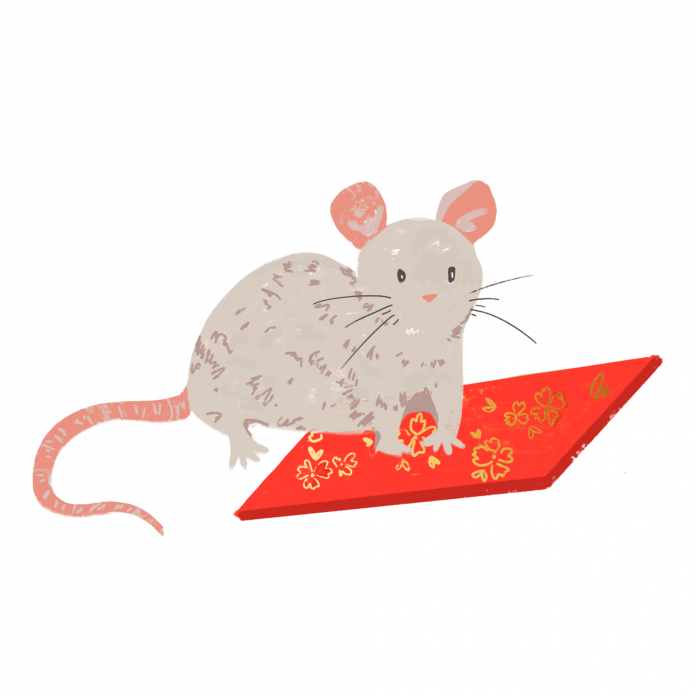
Illustrated by Shaheen Virk

By: Madeleine Chan, Kelly Chia, Vivien Ying Qi Li

I have come to realize that the Lunar New Year represents a renewal of sorts for me. 

Every Lunar New Year, my paternal grandparents treat my family and I to a meal at a Chinese restaurant. This isn’t your stereotypical orange chicken and chow mein, though. This isn’t even your standard sharing of dishes like Beef with Fried Rice Noodle (Dry) or Yang Chow Fried Rice. No, this is the FANCY stuff the kind of stuff that white people gawk at when they hear that it’s a thing that people actually eat. Things like jellyfish appetiser plates, black fungus medleys, and fish maw soups. I am drooling just thinking of the splay of seafood atop the round, clothed tables, glistening from the multiple bright lights illuminating the room.

However, this annual filing of our privileged bellies with delightful Chinese delicacies (though, my grandparents wouldn’t DARE to splurge on any other day) always creates a void of guilt within my heart. This isn’t the way that most people celebrate. This isn’t the way that most people can afford to celebrate.

I have come to realize that the Lunar New Year represents a renewal of sorts for me. Whether it’s turning down shark fin soup again or continuing to criticise my grandparents’ view of the Hong Kong protests, I am reminded that I have the power to channel my immense privilege into something that can make a difference.

I don’t know if I actually believe in any traditional ideas about how the turning of the new year represents a whole new “me” a whole new life. All I know is that the Lunar New Year is a time where I get to spend more time with my extended family, share a good meal, and be reminded of what really matters. — MC


Wondering if the traditions that I joyfully accept today is something that I am able to teach my children tomorrow motivates me to embrace my identity, and to try harder, regardless of the humiliation.


Before Lunar New Year begins, my family and I clean the house, in honour of the spring cleaning tradition. We often celebrate with drool-worthy dishes at large Chinese restaurants with lazy Susans, passing morsels of steamed sea bass onto neighbouring plates. When we tuned into the radio, I smiled as I heard various renditions of 恭喜恭喜 (Gong Xi Gong Xi), a popular traditional Mandarin song sung during the Lunar New Year. My parents exchange 紅包 (hong bao), or red pockets, with me and I accept them gratefully. This is a cherished time for me, a moment where I get to thoroughly enjoy the increasingly rare time I have with my family. 

As an immigrant who has lived in Canada for much of my childhood, Lunar New Year is also a confusing time. When I join dinners with family friends, I struggle to hold a conversation with my relatives. They tell me that I speak Chinese well, but I know that I don’t speak it fluently. It’s a humbling feeling to be Chinese, and to feel like you don’t uphold that identity as well as you could. Wondering if the traditions that I joyfully accept today is something that I am able to teach my children tomorrow motivates me to embrace my identity, and to try harder, regardless of the humiliation.

And on yet another year where we gasp as a large plate of king crab settles on our table, I look around at the cheerful faces around me exchanging anecdotes in Cantonese that I might never fully understand. They smile back at me, and I realize how privileged I am to be able to participate in these traditions today, and still have time to ask questions and understand them.  — KC

The New Year is one of the few times I actually get to see my extended family; because of this, every time I think about Lunar New Year, I think about family and spending time with loved ones.

Having grown up in a pretty traditional Chinese household, our Lunar New Year celebrations are on the more extravagant side. Preparations always began well before the New Year. Our family would clean — as it is believed to “sweep” away the bad luck — and put Spring Festival couplets on every door in the house. My mom would also put kumquats in our rooms, as the fruit symbolizes good luck, health, and fortune. On Lunar New Year’s Eve, we would have a big family reunion dinner and exchange red envelopes. The New Year is one of the few times I actually get to see my extended family; because of this, every time I think about Lunar New Year, I think about family and spending time with loved ones.

The 15 days after are spent mainly with family, too. Every day, my mom has some sort of festivity planned out for our family to do together. For example, on the first day of the New Year, we wear new clothes and eat 羅漢菜 (lo hon zai), a mixed vegetable dish,in the morning. Each ingredient in the dish is meant to represent something: glass noodles are meant to symbolize long life, while chinese cabbage represents prosperity. We also call our distant relatives to wish them a happy New Year and sometimes go watch lion dance performances. 

To be honest, having lived in Canada all my life, I don’t really know why we do the things we do, or how they came to be. What I do know is that each year, during this time, I’m reminded of how lucky I am to be able to spend time with my loved ones, which is more than enough for me. Hopefully, you, too, can spend some time with your friends and family this holiday. Happy Lunar New Year, everyone! — VL


 

Three cute cafes to check out the next time you ride the R5

0
Photo via Instagram

by Sara Wong, Peak Associate

This semester, all of my classes are in the morning, so it became apparent within the first week that the only way I could survive the multiple 8:30 a.m. starts was with caffeine. Lots of it. Luckily, there are plenty of coffee shops along my bus route — the R5. Here are some of my favourite places to stop on my morning commute. 


  1. Chez Christophe (get off at Hythe)
Photo via Instagram

Whether you’re craving something sweet or savoury, this Swiss chocolatier, patisserie, and cafe has got you covered. I have visited many times and can confirm that everything tastes good. That being said, I do have my favourites. A must-try item is one of their croissants; they’re large, yet every bite is flaky and buttery. When I really want to treat myself, I upgrade to a filled or double-baked one. The chocolate-filled croissant always satisfies my sweet tooth, and the double-baked almond or matcha croissants are super filling. To compliment my pastries, I order a London fog, then sit and enjoy my treat by the window. 


  1. Platform 7 Coffee (get off at Nanaimo)
Photo via Instagram
Photo via Instagram

I love the old world style of coffee shops, and Platform 7 Coffee is a perfect example of that. When you walk in, you feel like you’ve stepped into a European train station. The atmosphere is so cozy that I sometimes wish I could stay overnight. Their drink menu is phenomenal and caters to every hipster need. I’m not well-versed enough in coffee brewing techniques, but it’s cool to watch the staff create the drinks. Usually, I go for a chai latte or hot chocolate. Their cookies are super addicting too, particularly the salted chocolate chip one. 


  1. Thierry (get off at Burrard)
Photo via Instagram
Photo via Instagram

Do yourself a favour when you visit Thierry and try their macarons — they’re the best in the city. Located on Alberni Street, the high fashion strip of downtown Vancouver, Thierry is sophisticated without being stuck up. Translation: you’re welcome even if you don’t own a Louis Vuitton bag. My friend introduced me to the Spanish lattes (coffee mixed with scalded milk, also known as cafe con leche), and I’ve been addicted ever since. I like sitting on the heated, covered porch so I can people-watch as I enjoy my treats.


There you have it — three coffee shops worth checking out the next time you’re travelling along the R5. Hit me up on Instagram @sara_star_ if you want more food recommendations!

Sick of sharing offices, sessional team up to rent abandoned WMC lunch kiosk

0
Chris Ho

Written by Maxwell Gawlick, Peak Associate

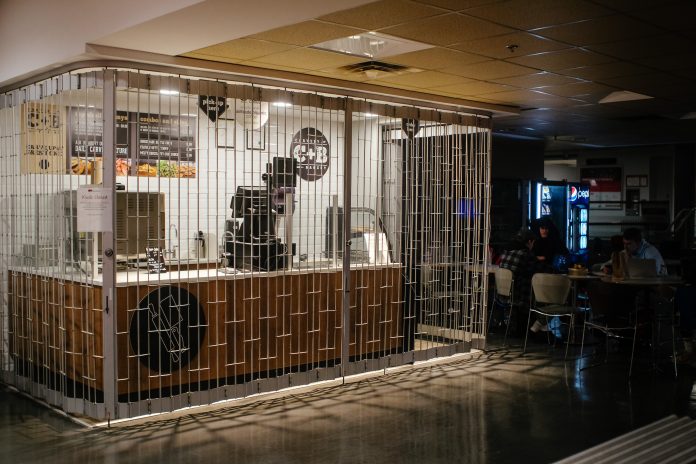
Any student who has taken a course with a sessional instructor knows how awkward it is trying to squeeze into those shoebox-offices, how unhelpful those 10-minute appointment slots can be, and how sad it is to learn that the aforementioned shoebox-office is on a glorified timeshare plan. In a drastic attempt to solve this problem, sessionals have pooled their money and leased the vacant lunch kiosk in West Mall Centre. 

The kiosk is infamous for having hosted a never-ending cycle of unsuccessful businesses selling overpriced sandwiches and coffee, none of which have survived for more than 20 minutes. The sessionals, sources speculate, are not afraid of becoming the next to be spirited away because it’s not like they have a good history of job security in the first place. 

The size of the kiosk is enough for three instructors to hold appointments at once, with overflow into the dining area during exam times. Some instructors have even started hosting their lectures and seminars in their new office. With Tim’s coffee literally seconds away and the installation of a projector screen, the learning environment couldn’t be better. 

Early reports show that performance has skyrocketed. Classes have reported better quality tutoring and greater understanding of course material. With demand for sessional-taught courses now spiking, SFU has issued a statement urging students to sign up as early in their enrolment period as possible if they want to get into one. 

The new system is so foreign to students that some have actually started to confuse the WMC dining area for being its own satellite campus. 

“Though nothing is conclusive, it’s beginning to look like it might actually be valuable to have your own space instead of being shuffled around like cattle,” says Les, a sessional based at SFU Abandoned Kiosk campus. Les’s real name has been withheld by The Peak for anonymity. “Even if that new space is literally the size of an abandoned, probably haunted lunch stand. But I can’t say so conclusively. I don’t have enough tenure for that.”

DEAR PEAKIE: Talking washrooms, wash-outs, and narcissism

0
Chris Ho

Written by Zach Siddiqui, Humour Editor

Dear Peakie

Do I absorb Jeff Bezos’ worth if I eat him or does everything stay the same?

From, Didn’t Get a Scholarship This Term

• • •

Dear Didn’t Get a Scholarship This Term,

I would advise against this. You can’t even stomach capitalism now. Swallow this man whole and you’ll turn out like that guy from my high school who went grad camping the year before I graduated: in the hospital, getting your stomach pumped because you partied harder than you could handle. And just like that guy, you will turn into what my classmates called “grad camping Jesus,” coming back from the hospital in three days ready to drink more capitalism. 

Love, Peakie

• • •

Dear Peakie,

Where at SFU can I take a dump in peace?

From, KO

• • •

Dear KO,

Nowhere. Even if you find a washroom that features neither a window in your stall nor incessant chatter from students who haven’t washed their hands since preschool, the shrieks of your lonely soul will echo loudly within the porcelain throne, disturbing you. No relief awaits you. Accept your fate and start going numbers one and two before you leave your home every morning. 

Love, Peakie

• • •

Dear Peakie,

Just came to say that you’re a beauty and a cutie. Much affection. Also, don’t forget to go to the gym tonight. 

Love, Peakie

• • •

Dear Peakie,

Thanks, babe! You have an impeccable way with words and such beautiful positive power. I’m obsessed with you, and I will see you at the gym tonight. Look at me through the mirror glass with adoration. Let’s do 10 reps of evil incantations together if the 22.5-pound dumbbells are taken again. 

Love, Peakie

CONFESSIONALS: I’m an abandoned microwave

0
Illustration of a closed envelope, with the text, “Confessionals”
ILLUSTRATION: Marissa Ouyang /The Peak

Written by Kelly Chia, Features Editor

Life at SFU isn’t easy. It’s not the humdrum grey and red that gets you, but the illusion that you might be different. That you’re the cool one. Then year after year, you lose. You lose friends. You lose bits and pieces of yourself. The light in you slowly winds down.

I chuckle thinking about what I used to be. Now, the stench of Prego seeps through my crevices. Students pass by me frequently. Once friends, now strangers, carrying neatly packed lunch boxes in tow. I haven’t known the touch of a human hand in years. So many years.

It really isn’t easy, being a microwave.

There were days when students knew me and tried avidly to find me: I smile back on those days vividly. I was that microwave. I’d wait excitedly as the freshmen posted pictures of me online to tell everyone about me — a true treasure find. It’s true: I was hiding on the first floor with two other microwaves. 

Compared to those popular food spinners over at Maggie Benston, we were like holy messiahs to students who wanted their food warm. We were gods — at least for a little while. And then, as time went on, we became just as common as any other microwaves.

Fish, curries, lunch boxes that people didn’t know weren’t microwave-safe . . . Thanks to these, I watched my first friend spiral into obsolescence. I remembered as it released its last feeble beep, the sauce-slathered machine finally approaching the eighth level of microwave hell. 

One day, a metal mug was left on top of my friend, as if taunting us with the promise that someone might approach us. And now, like us, it might never be touched again. I watched my companion of many years become crusty and unloved. Soon, I became much the same. 

Carrying the slight musk of sardines, our broken selves linger on. But the acidity of our sauce stains worsen each and every day. As if reminding us, gently, that all things fresh must come to an end.

Health & Counselling executives discuss barriers to access, appointment procedures, and their mission to “make care about the client”

0
illustrated by Reslus

By: Lubaba Mahmud, Staff Writer

What might students expect when they make a mental health appointment with SFU Health & Counselling? The Peak had a chance to conduct an in-person interview with Martin Mroz, Director of SFU’s Health & Counselling Services, and Tammy Nazaruk, Associate Director of Health Services, to talk about the mental health services that the clinic provides. 

Nazaruk explained that there are many factors that may intimidate students about seeking help for mental health. The stigma attached to mental health, which may be stronger in some cultures than others, is a crucial one. She also noted that it takes a lot of courage to discuss one’s vulnerabilities in a counselling session, and that developing a trusting relationship with a mental health professional may take time.

Health & Counselling makes a continuous effort to erase the stigma attached to mental health issues. 

“Our health promotion team works on trying to improve setting around the university to foster well being and eliminate unnecessary stress.” said Mroz. He also pointed out that a student initiative called HI-FIVE, which focuses on eliminating stigma attached to mental health by encouraging the values of compassion and respect, originated from the clinic.

Mroz expressed that Health & Counselling aspires to “make care about the client.” Their philosophy is to recognise that barriers to wellness may come in many different forms, and that they may not always be obvious. They try to work with the clients to understand what sort of care they need. 

After talking to Mroz and Nazaruk about barriers to accessing care, we spoke more at length about how students can start their mental health journeys at SFU Health & Counselling.


The Peak: I want help with my mental health, but don’t know where to start — where should I go first?

Health & Counselling: Talking to an Access Case Manager would be a good starting point. They can have a conversation around what’s going on with [students], and then help to determine the best avenue to go — whether it’s a referral to a doctor, a counsellor, or another mental health specialist. [They also help with] choosing resources like workshops and [The Student] Learning Commons. It’s all pretty individual. The best thing to do is to reach out. We implemented My SSP as a way to increase access, for people to reach out to a professional 24/7. It has information on services we provide. [It also] creates a lower barrier for someone not comfortable talking about mental health in English. 


P: How can I make an appointment with an Access Case Manager?

H&C: Same-day access is available [in the clinic]. 

P: Who is eligible for mental health services?


H&C: All SFU and FIC students, whether they are part-time or full-time, are eligible for mental health services. In some cases, if a student is taking a semester off, and they’ve been seeing us before, they can still make appointments with us. However, if the student is taking time off of university for a long time, we encourage them to seek care within the community.

P: If I am on the waitlist, how long will it usually be until I can see a mental health professional?

H & C: It varies and depends on what [you’re] looking for. If [the client] is suicidal, hearing voices, recently assaulted, or homicidal we’ll try to see them right away. We save a lot of appointments for same-day access, but they do get filled up quite quickly.


Our name “Health & Counselling” is a little deceiving. Someone may come in for a mental health issue and [automatically assume] that they need counselling. However, maybe they don’t need to see a counsellor, but to talk to somebody right then and there. We’re trying to create [a system] so that they don’t even have to go on a waitlist, but [rather] talk to somebody for 20 minutes and get the [necessary] resources. We’re trying to figure out ways of providing the level of care that’s needed right then and there. [On the other hand] if somebody comes in and they insist on seeing a counsellor [to work on a particular issue], then they will go on a waitlist.

P: Would my parents/guardians know I’m seeing someone/a professional at Health & Counselling?

H & C: No. [The] only time confidentiality is broken, is [when there is] imminent risk to self or others, [or if there are legal issues] like an ICBC claim — in the latter cases a conversation between physician and student would take place, and only information pertaining to that will be revealed. We might not know what the situation is in [student’s] home, and by sharing we can do a lot of damage. Sometimes family can be part of the solution, and hopefully we can work with the student if that’s the case.

P: Do all three campuses (Burnaby, Surrey, and Vancouver) provide counselling services?

H & C: All three do. In Surrey, we don’t have a physical clinic because we don’t have a doctor there. There is a conversation about providing equitable services at all campuses and trying to create better access.

P: What can students expect on their first mental health appointment?

H & C: It depends on what you’re coming in for. If you’re coming in for counselling [because] you have an issue that you want to start talking about, say, your relationship with your parents makes you unhappy and you want to work on that, you can expect to come in and fill out some paperwork and start from there. If you came in feeling like you’re in panic and you don’t know what to do and you’re highly escalated, then you should expect to have somebody that would try to calm you down. On the form, there is a ‘reason for visit’ section which helps providers to begin conversation.


P: There are different types of mental health professionals available in the clinic, like psychologists, mental health nurses, and clinical counsellors. How do the services they provide differ from each other?

H & C: [The] Access Case Manager is the first person to see to have that conversation. They can clear the understanding of what it is [you’re] looking for and help you get into the right avenue.

A counsellor is somebody you see for a period of time to work on something you want to change or improve in your life. That’s more therapy-based. 

Mental health nurses do more practical things. They would be seeing students who are identified in our forms as “going through crisis.” Sometimes they can be referred back from a provider/doctor to talk about tips around sleep, hygiene, stress management, or side-effects of medication. If the client is recently diagnosed, nurses can give them a description about their diagnosis.

Doctors can diagnose mental health conditions and prescribe medication. People might never think to see a counsellor or see somebody for mental health reasons, but they might see a doctor for physical symptoms like sleep issues, pain in chest, weakness in legs, etc., so the doctor may recognise signs of anxiety or depression. They will work with the client to make a care plan that is appropriate. They may continue to see them if the patient doesn’t want to see a counsellor, and the doctor might provide some counselling in the exam room [if necessary].


P: How frequently can I see a mental health professional?

H & C: Depends. It might be every other week. Somebody might be seeing a counsellor but have regular check-ins with a mental health nurse. They might be able to see a nurse during the time they’re waiting for the counsellor.

P: How can I get follow-up appointments with the same person?

H & C: You can book when you’re about to leave, or you can call, or drop by anytime we’re open.

P: Can I change my counsellor if they are not a good fit for me?

H & C: Yes. Getting a counsellor should be like trying out shoes. That’s one of the reasons why we got My SSP. You can get one-on-one counselling and multi-session counselling. It was designed for an international student population, so you can get it in a lot of different languages and you can get counsellors from different cultures.


P: How can I evaluate whether the treatment/counselling is working?

H & C: There are some tools we use in the clinic that assess anxiety and depression. It would also be a conversation between the student and counsellor around what’s going on, and making note on that each session — [like] where improvements are and what areas they struggle with. We use PHQ-9 (Personal Health Questionnaire with nine questions) to assess depression and GAD-7 (Generalized Anxiety Disorder questionnaire with seven questions) to assess anxiety. Forms may be part of the session. Sometimes doctors can ask you to fill it online while they leave the room, or the clinician may have a conversation with you while filling out the form.

Throughout the interview, Mroz expressed that Health & Counselling strives to provide the best care that they can. 

“It’s heartbreaking to hear people coming in trying to access care [but] they [might] not know how to advocate for themselves or they don’t know what they want [yet]” said Mroz.

“With limited resources, we want people’s experiences in Health & Counselling to be positive. They might not necessarily get what they want, or what they thought what they wanted when they came in, but we want them to leave with the feeling that somebody cares.”


Informed voting is the absolute least we can ask of our Board

0
Maintaining proper procedures remains an issue with the SFSS Board. Photo: Chris Ho/The Peak

By: Gabrielle McLaren, Editor-in-Chief

Note: The views expressed in the following article are solely my own and do not represent the views or politics of The Peak as a publication or a society. 

If I have time or if the agenda sparks my interest I occasionally accompany whichever Peak staff member is attending the SFSS’s Board meeting. It’s nice to see what Board members are working on and later recognize them in the halls, with an idea of who they are and what they believe in. It can also be incredibly frustrating to watch them do things like carry motions that involve society funds without seeing finalized supporting documentation. 

Faculty of Education representative Emerly Liu recently brought a motion to the table to allocate $1,500 to the International Women’s Day Young Women in Business gala, noting that more money would be allocated “after we figure out the budget.” The motion was added to the agenda at the start of the meeting and amended again prior to its discussion — a pet peeve of mine since it makes meetings harder to follow for guests (a.k.a. members of the society who deserve to know), but something that’s not technically wrong. One Board member asked a question to better understand where money was coming from, which VP Finance Tawanda Nigel Chitapi and Executive Director Sylvia Ceacero answered. So far, so good.  

Enter Faculty of Health Representative Osob Mohamed: “I just want to say that I don’t feel really prepared [ . . . ] at the moment. I have never seen this document unfortunately and they were sent after the Board meeting had started [ . . . ]  It’s like 16 pages and it’s pretty text-dense and for that reason I don’t know if this is something that you can bring at another Board meeting when we’ve all had time to read it over — but right now I just don’t have any information to base this decision on.” 

Excuse me? A motion was added to the agenda during a meeting, amended during a meeting, and Board members were only given the supporting documentation during the meeting — when they theoretically should have been busy in the meeting listening and interacting with each other instead of doing paperwork and prep. And nobody thought that this was somewhere on the spectrum between silly and downright irresponsible? 

VP Student Life Jessica Nguyen responded that the delay was because multiple SFSS staff members were heavily involved in doing due diligence and reviewing the document. Timing is a poor excuse for why Board members were denied the opportunity to inform themselves in turn. I trust the competence of the SFSS’s hardworking staff, but I’m bothered by how OK everybody was to support something without reading the official, finalized paperwork to understand. Or, on the flip side, asking colleagues to support something without giving them the opportunity to come prepared. 

Not that many of them seemed to mind, frankly. The motion was carried with three abstensions who asked to be noted in the minutes and who I’ll therefore note here — Osob Mohamed, Shina Kaur, and Fiona Li. President Giovanni HoSang, as chair, did not vote. 

I’ll acknowledge that certain Board members — namely Nguyen, Liu, and Chitapi — may have seen the report or drafts of it, by virtue of their positions or involvement with the project. Possibly, Board members spoke to each other about this informally. But this is conjecture on my end, and these things shouldn’t replace a final proposal or memo. 

The gala seems like a valuable addition to campus life, worthy of funding. Plus, in the grand scheme of things, $1500 isn’t the end of the world. According to HoSang, pressure to vote on motions without adequate discussion or question periods also characterized the Board’s decision to increase the allowable deficit for Fall Kickoff — which escalated to a six figure deficit.

So what we have here is a pattern of board members voting without giving each other or demanding for themselves the time to consider motions appropriately. This is the equivalent of not doing your readings before class — except this isn’t PHIL 115 that you hate but took for the Q credit. It’s a job that students trusted you could do and are now paying you to do. 

If this is how it’s going to be, motions shouldn’t be added to meetings day-of. Going forward, I would like to see sharable forms of supporting documentation and memos given to guests along with the agenda. It’d be nice to have something to follow along and understand how our Board members are voting and why. 


ARThrive explores the magic of creative writing through Writing for Self-Care workshop

0
Photo via ARThrive
Photo via ARThrive

by Lubaba Mahmud, Staff Writer

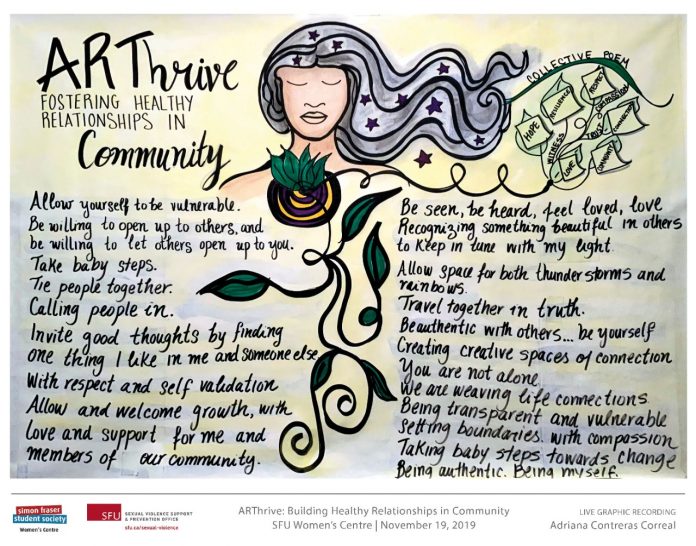
Writing for Self-Care was one of the many workshops that was offered by ARThrive, which is a partnership program between SFU’s Sexual Violence Support & Prevention Office and the SFSS Women’s Centre. The workshop was led by Amber Dawn, who currently teaches creative writing through SFU Continuing Studies. She is the author of prize-winning books How Poetry Saved My Life: A Hustler’s Memoir, Sub Rosa, and Where the Words End and My Body Begins.

The aim of the workshop, according to its Facebook page, was to “explore personal strengths and values, choice and desire, memories and healing.” This, of course, could only be done if we could trust that this was a safe space to share thoughts and feelings. 

That’s why I was delighted to see that the organizers had created a cozy and welcoming atmosphere for participants. When I walked in, I was immediately greeted by friendly faces from the organizing committee. Participants were provided with pretty little notebooks and other merchandise, like ARThrive pins and bookmarks. A small selection of delicious food was also provided by a catering company which supports Syrian refugees. 

The workshop itself focused on two main writing exercises. For the first one, we were invited to think about five places where we felt a sense of belonging or comfort. Then, we were asked to pick one place and imagine that we were transported there, so that we could explore the five sensory experiences that this particular place entailed. I chose my childhood bedroom. 

Dawn gave us a series of small prompts such as “what are the smells that you’re taking in?” and “how does the floor beneath you feel?” Each memory that I scribbled on my notebook helped me to walk further down memory lane. Even though I am physically thousands of miles away from my parent’s house, for an hour I truly felt like I was back in my old room with its purple wallpaper and sunlit balcony. Sometimes self-care can simply mean allowing yourself to reminisce about happy memories.

After the first round, participants were asked to share their choice of place. Some of the most interesting choices included an old car, a hallway in a museum, and a forest. Dawn made sure to tell us that the sharing was completely optional, that this was a non-judgmental space, and that one could pass on disclosing their place if they wished. Although I chose to share my piece, I appreciated her effort to create a sense of boundary.

After a small refreshment break, we started the second exercise. We were given a handout of the poem 36 Reasons Why I Want To Grow a Garden by Jill Battson. This time, Dawn asked us to list the reasons each of us wanted to participate in healing using the same lyrical style of this poem. I really liked the choice of poetry for this exercise because — rather than being loaded with metaphors and hidden meanings that only SparkNotes could help me decipher —  it was easy to understand and connect with. 

Simple yet meaningful lines like “I want to smell the earth after rain and after sun” somehow reassured me that my motivations for self-care do not have to be complex. This exercise reminded me that there’s beauty in simplicity, and any reason you may have for wanting to take care of yourself is valid.

All throughout the workshop, Dawn provided words of encouragement and compassion to the participants. Her first theme effortlessly harnessed the power of imagination through creative writing. Her guided writing prompts helped us to situate ourselves in a snapshot of the past and relive a comforting memory. The second activity was also thought-provoking and beautifully designed. 

Overall I had a very wholesome experience partaking in ARThrive, and I commend the organizers for creating a space for self-care amidst the hustle and bustle of university life.

Mount Burnabus: Rise of the SFU Olympians

0
Erika Hance

Written by Juztin Bello, Madeleine Chan, Kelly Chia, Gabrielle McLaren, and Zach Siddiqui

If you read the Percy Jackson books, then you know that the twelve Olympian gods of Greek lore travel wherever the flame of civilization goes. The flame has gotten a bit tired of investing so much of itself into the U.S. to no avail, so it’s taken a vacation up north . . . and the gods have taken some, um, interesting new forms to match their new winter home: Simon Fraser University, sitting atop Mount Burnabus. 

Bow down or bow out: the Burnympians are ready and waiting for YOUR worshipful sacrifice. 

Zeus

Erika Hance

God of inconvenient weather and cheating Chads

Daddy of the gods, Zeus oversees all of Mount Burnabus. Every day, fuckboys on campus pray to him for static electricity to zap their coifs into place. When snow falls and fog rolls in, it’s because Zeus is hiding his emotional unavailability from his lovers — and hiding them from Hera.

Hera

Erika Hance

Goddess of jealousy of all non-mountain universities and Diamond Alumni Centre weddings

Queen of the gods, Hera rules by her disloyal husband’s side. When she’s not busy tormenting Zeus’s illegitimate children from lower-elevation universities, she’s spreading her blessings at DAC weddings. No blessings for the happy couple, though — she’s there for the guest who’s sobbing into their cake, envying the newlyweds’ happiness, and wishing for a better relationship.

Poseidon

Erika Hance

God of the AQ reflecting pond, Concreteshaker, patron of koi fish

Dwelling in the AQ pond, Poseidon personally eats the trash in the water so the koi fish don’t. Failed quizzes, condom wrappers, Mini Mart receipts exposing your mini-Oreos diet, your devil’s-advocate ex . . . Next time you consider jumping in, following the siren song of granola wrappers chanting “one of us!”, remember that he’s in there and it could get kinky.

Demeter

Erika Hance

The goddess of the succulent, patron goddess of mom friends and hungry students

Whenever Demeter visits a dorm room, a new succulent mysteriously appears there. She’s the source of Munchie Mondays and impromptu Krispy Kreme fundraisers. Most importantly, she governs the SFU seasons — unfortunately, she takes plenty of long, off-campus naps, leaving students begging for spring weather to no avail. 

Hephaestus

Erika Hance

God of getting you fired up while listening to ignorant, morally corrupt classmates

Strongest during in-class debates, Hephaestus ignites fires in students forced to listen to a classmate express their views on issues such as the wage gap or climate change — with neither actual knowledge on these issues nor a moral compass. Instead of a morning star or battleaxe, Hephaestus equips his followers with comebacks sure to wound more deeply than any physical weapon could. 

Apollo

Erika Hance

God of slacking off in classes and driving to school with his chariot of choice — the Tesla Model S. 

Apollo spends his time “vibing out.” Wherever he walks, he amplifies the arrogance of that one student nearby (there’s always one nearby) who won’t stop talking about his brewery. Apollo’s student-worshippers tend to go blind, as he regularly bathes them in something their eyes aren’t prepared for — direct sunlight.

Artemis

Erika Hance

The goddess of the Burnaby wilderness and the hunt for adequate exam grades 

Artemis blesses students with the adrenaline of the hunt, as long as they consume her nectar and ambrosia: Red Bull and Canvas lecture slides. The wild animals roaming SFU assemble offerings under the moonlight in her honour. Artemis casts a wary eye on campus meninists: it’s said that if someone says something misogynistic three times, Artemis will come to personally hunt them. 

Hermes

Erika Hance

Messenger of the group chat that’s popping during lecture while you’re trying to pay attention

Hermes is responsible for all of those notifications you get on your phone and/or laptop while you’re trying to take somewhat coherent notes. Those who deny him are only met with more worthless notifications. If you message your group chat and don’t get left on read by every single person, then Hermes has truly blessed you.

Aphrodite

Erika Hance

Bathroom-lurking goddess, soothing the student body and its soul 

In the time it took your bowels to process those Taco Cantina leftovers, Aphrodite has executed a perfect winged eyeliner, distributed pads to souls in need, complimented several outfits, and gushed about one introvert’s OTP after clocking their fandom pins. She’s beauty, she’s grace, and her random acts of kindness are the reason we haven’t launched ourselves down Gaglardi in a wheelbarrow.

Ares

Erika Hance

Lord of war and man in your history class way too comfortable asking what kind of bullets were used to massacre civilians 

He’s not actually a god at all. He’s just a random student who’s auditing PSYC 367 — he’s that guy taking it to get into the minds of serial killers who dismembered women “for academic reasons.” He was even happier in ENGL 113W telling a TA that Shakespeare was a pussy for writing off-stage murders. He keeps bickering with an underpaid sessional about irrelevant military history, as if dropping the tutorial’s first ‘fuck’ wasn’t enough.

Athena

Erika Hance

Goddess of galaxy-brain moments, fierce attire, and the war against bad grades

The brains of the bunch, Athena is said to pass around the one brain cell that SFU students share to those she deems worthy. Rumour has it that she sprang from Zeus’ head fully dressed in Beedie School of Business-branded merch, armed with a smart pencil, ready to aid students in taking legible notes.

Dionysus

Erika Hance

God of blacking out on cheap wine and requesting the DJ at The Study play “Mr. Brightside” . . . again

Always one for a good time, Dionysus bestows good vibes and cheap pre-games. Students acknowledge Dionysus by belting out one of his many prayers from the “songs that make white people go crazy” playlist. If you get a little too sloppy on a night out, Dionysus won’t judge you. (Though the people around you, watching you try to steal a pinball machine after puking all over it, might.)

Hades

Erika Hance

God of the parking garages, where souls travel to die, and the mounds of hoarded ticket fine money hidden beneath the concrete

Ruling the bowels of SFU, Hades commands legions of undead parking officers. Powerful spirits wander this world,

those whose parents were rich enough to make down-payments on their cars. It’s said that students who consume the fruits of his domain, conveniently placed open parking spaces, can never leave the garage — that’s why you’ve never heard of anyone at this school content with their parking.

Your weekly SFU horoscopes: Feb 3–Feb 9

0
An illustration of a girl with long flowing hair. Astrological signs and stars shine around her.
ILLUSTRATION: Marissa Ouyang / The Peak

Written by Zach Siddiqui, Humour Editor

Aries — March 21–April 19

This week, some might call you an evil-hearted monster for spilling the tea to your seminar section about which of your classmates have been skipping class to go underwater basket weaving. Reassure yourself with the Dark Lord Voldemort’s words. “There is no good and evil . . . only power, and those too weak to seek it.”

Taurus — April 20–May 20

You’re going to be so exhausting this week. Friends may expect you to be there for them, family may expect you to call them, and the edgy young man in camo, pajama pants, and rainboots may expect you to tap him into the SkyTrain station. But you won’t do any of that. Human relationships will fade in the light of Neo New Luxury Space Classical Macroeconomics.

Gemini — May 21–June 20

You are questioning your own worth a lot this week. Why doesn’t the transit system consider it worthwhile to plan its schedules around you and your needs? If you run late, remind yourself: You don’t run for busses, busses run for you.

Cancer — June 21–July 22

It’s OK to break down this week. When you arrive at your least favourite class, you have your choice of self-relief. Dump out onto the floor the heavy, scholarly contents of your PHYSICAL baggage or unload upon the class your EMOTIONAL baggage. 

Leo — July 23–August 22

Your powers have descended to their lowest, coldest point this time of year. Give in and buy an expensive pillow and blanket set from Indigo. When the cashier tells you that the pillowcase and the pillow are charged separately, your lethargy will force you not to raise any Karen-esque tyranny.

Virgo — August 23–September 22

Sickness lingers at the edge of your skin this week. Tip the balance in your favour by fortifying yourself with maple and brown sugar oatmeal, honey, various berries, and milk over water. Create your own happiness.

Libra — September 23–October 22

Audit a session of BUS 237: Introduction to Business Technology Management sometime this week. Maybe you’ll finally learn to responsibly manage your messy personal business.

Scorpio — October 23–November 21

You’re going to do a lot with your tongue this week. So remember you need to be brushing it. Don’t let the biofilm blooming on your tastebuds embarrass you during a class discussion.  

Sagittarius — November 22–December 21

Your imagination is running wild. Remember to keep fantasy separate from reality. You may dream about finding academic sources that won’t eat your life-force with every paragraph, but it’s time you woke up.

Capricorn — December 22–January 19

This week, stop criticizing your classmates for their apparent worthlessness. At least they know how to vacuum. 

Aquarius — January 20–February 18

Aquarius season? No . . . it’s DISHES season. It means you have two choices this week. Wash your dishes, or shut up and wash your dishes.

Pisces — February 19–March 20

Hold your cards close to your chest this week. They might have the souls of innocents imprisoned inside of them, just like in the first season of Yu-Gi-Oh!, and they need to be protected.