Home Blog Page 446

Star Wars: The Rise of Skywalker offers pure unadulterated fan service

0
Courtesy of Disney
Courtesy of Disney

by James Conn, Peak Associate

I truly cannot put into words how much the Star Wars franchise has meant to me over the course of my life. Some of my earliest memories as a child are watching both the original and prequel trilogies. Needless to say, I was excited when Disney bought Lucasfilm back in 2012 and announced they will be making more Star Wars content. I mention all this to prove that I am a massive Star Wars nerd who is a fan of it all, including all the highs and lows. Fortunately, the latest film in the sequel trilogy, The Rise of Skywalker, is one of its high points. It is beautiful, poetic, and a satisfying way to end the Skywalker Saga.

The Rise of Skywalker at its core is a film about identity; about how our characters navigate both their internal and external conflicts and choose who they are and not what others want them to be. Structurally, the movie is paced very well with non-stop action, a fairly cohesive story, and only a few plot holes. Sonically, John Williams memorable score is a testament to the emotional impact this composer’s music can have on the viewer. Visually, the film is absolutely gorgeous, with jaw-dropping CGI and masterfully crafted shots. 

But what makes this movie great is the cast. Rey (Daisy Ridley) and Kylo Ren (Adam Driver) stole the show for me. Their dynamic is fantastic, and the relationship they have formed over three movies comes to a head here in the conclusion. Finn (John Boyega) and Poe Dameron (Oscar Isaac) are both utilized incredibly well. Finn is loyal and caring, and Poe has this charming swagger to him. I particularly love their friendship and how it is focused on in the film. Chewbacca (Joonas Suotamo) is used sparingly, but remains lovable, nonetheless, and of course, the return of Billy Dee Williams as Lando Calrissian was heartwarming to see. And the adorable droids R2-D2, BB-8, and newcomer D-O are all incredibly cute and have their moments to shine. Another standout droid in the film is C-3PO (Anthony Daniel), the talkative protocol droid whose journey in this film was quite captivating. 

Last but not least, the film’s bold move in bringing back the late Carrie Fisher’s Leia Organa with archived footage paid off. Leia plays a far more active role in the story than I thought she would going into the film, which I personally felt was respectful to Fisher’s memory.     

Overall, the film is fun and entertaining with an engaging plot and likeable cast of characters. However, it is far from perfect. It feels like the director J.J. Abrams went online and found a list of episode VIII demands written by a disgruntled fan and wrote the screenplay to appease them. Artistically, it bothers me to think that the filmmakers oversaturated this film with fan service to appease fans who disliked The Last Jedi. Additionally, the film was predictable and a tad cliché. The messages the film expresses are positive ones about heroism, redemption, and friendship. However, these are nothing new and at no point was I challenged or even remotely surprised over the course of its run time. 

Regardless, I still feel that it is a great cinematic experience. With this film needing to accomplish the tall task of concluding the nine main line Star Wars movies — a journey that has crossed literal decades — it is incredible that Disney and Lucasfilm were able to deliver such an entertaining and fulfilling ending. Although the movie is far from perfect, it was able to be everything I needed it to be and more. 

SFU needs to be more considerate of its neurodiverse community during construction

0
It’s impossible to find a quiet space or clear path through campus. Photo: Izaz Zubayer / The Peak

By: Sarah Duncan, SFU Student

Disclaimer: Everyone is different, so there are bound to be different experiences for people with SPD and sensory sensitivities. Don’t take my word as the only one!

I get it, construction is annoying. A survey was even sent out earlier this semester asking for feedback on the construction’s impact on students’ mental health, which at least shows that it’s a problem worth considering. What isn’t being considered as obviously is that SFU, like the rest of the world, is a very neurodiverse place. The constant noise and smells from construction can become a type of hell for those neurodiverse individuals with sensory sensitivities. How can SFU promote mental health awareness if it doesn’t also address the sensory-related consequences of construction?

Sensory sensitivity is a trait associated with roughly 20% of people. It is similar to a neurological condition called sensory processing disorder (SPD), which, according to Dr. Elaine Aron, involves “random and disorganized processing of external stimuli,” causing “great distress, intensity and overstimulation.” Sensory sensitivity is not an isolated condition, and is a huge part of the mental health umbrella. It can affect anyone, such as people on the autism spectrum or people with PTSD. 

So why should SFU care about folks with sensory sensitivities? Well, something as simple as a loud noise can feel a thousand times worse than nails on a chalkboard to people with sensory sensitivity. Additionally, strong scents like perfume or hot tar can be very intense and cause physical reactions like headaches and nausea. That’s part of why many places, including SFU, have banned people from using strong scents in certain areas. YouTube has some good videos that can simulate what it’s like to be sensory sensitive for some perspective. 

Many of the construction projects on campus release intense odours or produce a ton of noise. Heating asphalt roofing tiles releases toxic fumes that can cause skin rashes and respiratory irritation. The rental fence ostensibly separating the fumes from the campus community has no insulating properties. To make matters worse, often the only accessible pathways through campus are plagued with mysterious construction fumes, noise, and dust, making escape impossible. 

Previous sensory-reduced havens such as The Women’s Centre (which even had free ear plugs to hand out) and Out On Campus used to provide a safe space for people with sensory sensitivities. However, these spaces are no longer sensory-reduced as they are next to the current Rotunda construction, where workers are pounding concrete and sawing materials during peak hours on campus. 

The university should do more to keep construction from negatively affecting students and faculty, especially those who may have sensory sensitivities. Even temporarily providing construction-free rooms, or a list of spaces to avoid if the construction environment is proving to be detrimental to community health, can pave the way (metaphorically, no construction here please) to addressing the needs of neurodiversity.

As it stands right now, there are very few dedicated, genuinely quiet spaces on campus for sensory sensitive folk.

Expanding the university is great. However, without the proper considerations from the administration on how to deal with construction itself, the campus can turn into a highly distressing environment. This has a big impact on peoples’ ability to learn and work. 


SFU’s Got Talent 2020 proves that SFU really does got talent

0
Chris Ho / The Peak
Chris Ho / The Peak

by Lubaba Mahmud, Staff Writer

The Peak had a chance to go to SFU’s biggest musical production, SFU’s Got Talent, on March 6. The club Peak Frequency organized the show in collaboration with the SFSS and Global Student Centre. 

All judges were SFU students with considerable experience in the music industry. According to the event’s Facebook site, the judges were Tawanda Nigel Chitapi, co-founder of an entertainment company (and is also the SFSS’ VP Finance), Andrea Tabo, a YouTuber who posts covers with 30,000 subscribers, and Jamie De Guia, lead vocalist and keyboardist for the professional jazz band Clavinova Nights.

The organizers created a very lively atmosphere, and the audience’s enthusiasm was visible from the beginning. All of the acts were very enjoyable, as each participant clearly performed with heart and soul. While there were many splendid musical covers, performers that displayed individuality, be it with completely original pieces or self-choreographed dance routines, stood out the most. Here’s some of the highlights of the show: 

  • Mylles Mondragon performed an original piano piece called “ABABCB No.1 in C minor.” It was a dramatic and intense performance, one that clearly showed the strong command he had over the piano.


  • Kaitlyn Yap dedicated her original traditional Chinese dance to her mother, who had passed away due to cancer. She delivered a heart-wrenching and captivating performance as she danced to the instrumental version of “Missing You” by John Waite.


  • Brian Warui’s self-choreographed break dance to Justin Bieber’s “Where Are Ü Now” seemed incredibly effortless, yet sleek and elegant. The judges commended him for tailoring a lot of the moves to the song’s lyrics and for having good connection with the audience.


  • Devin Lu and Bohan Jiang’s (who are both part of the West Coast Groove) beatboxing act was simply incredible. Tawanda commented that they were better than a beat-machine, and the audience’s cheer clearly expressed wide approval.


  • Patrick Juan’s rendition of “Running Up Freestyle” by Megan Thee Stallion was a crowd-favourite as he engaged the audience with his charming personality.


  • Shawn Liu introduced the audience to the Chinese erhu instrument, and then proceeded to treat the audience to a unique take on Ed Sheeran’s “Perfect.” His performance showcased a harmonious blend of western and eastern music. Liu also expressed the need for positivity in the midst of the racial hate going on because of COVID-19. 


  • SFU alumni Kevan “Scruffmouth” Cameron performed two original spoken word poems titled “Seven Laws of Spit” and “Wordsmith.” His witty pieces of poetry and exemplary storytelling had both the judges and audience hooked from the beginning. 


  • Shina Likasa’s mash-up of “Breathin’” by Ariana Grande and “I Know a Place” by MUNA garnered high praises from the judges for her impressive voice control, runs, and overall perfect execution.

The People’s Choice winner, as decided by online voting, was Patrick Juan. Kaitlyn Yap was second runner’s up while Kevan “Scruffmouth” Cameron became third runner up. Shina Likasa was the overall winner of SFU’s Got Talent 2020. 

In case you missed it, you can view the livestream of the event on the Humans of SFU Facebook page. 

Long Story Short: Getting tattooed is like decorating an apartment

0
Illustrated by Tiffany Chan

By: Molly Lorette, SFU Student

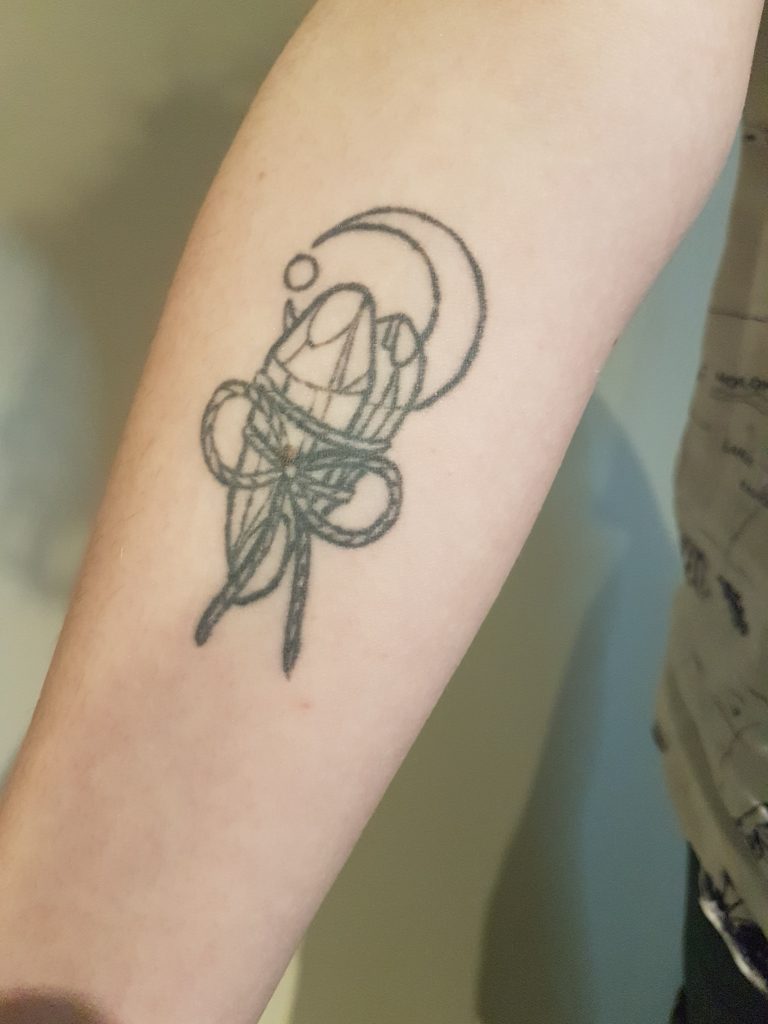
When I was younger, I had a bit of a phobia of needles. Whenever we had our vaccines in school, I would have major anxiety and would more than likely cry. Naturally, I never thought that I would ever get any tattoos, nor did I really have much of an interest in them. Then, a close friend of mine got her first tattoo when we were around 17. After that, I began toying with the idea of getting one of my own. Growing up I had always been the kid that drew on themselves, so why not make that childhood whimsy into something a bit more permanent than a Sharpie marker?

Finally, a few weeks after my 19 birthday, I was finally able to afford one of my own. Admittedly, it isn’t one of the nicer pieces of art I have on my body today. Looking at it now, it has some line weight inconsistencies, some parts where the ink has since faded into my skin, and a slight blowout or two (that’s when the ink spreads underneath your skin, creating a shadow-like appearance). But that day, I had never felt more confident. For months after, I loved pulling up my sleeves to my elbows to show off my new skin-friend. Nothing felt better than showing off. I thought, “Hey, look at me! I braved a tattoo needle! I have art on my body!” Within the next two months, I had already booked my next tattoo appointment. 

Photo: Molly Lorette

A little over two and a half years later, my current tattoo count is at around eight, with my ninth booked in and my deposit sent. While I wouldn’t necessarily consider myself a true “tattooed person,” I’ve certainly been under the needle a fair amount, and have several visible pieces in my day-to-day life. When you hear that tattoos can be addicting, they really aren’t kidding. The rush of finding a tattoo artist, saving up, and getting that sick post-tattoo high is unlike anything else I’ve really experienced. While I love the process itself, nothing is better than having an expression of yourself on display to the world. I know that it’s a common misconception that tattoos have to mean something, but even if it’s just something that sparks joy, it is still something that holds significance.

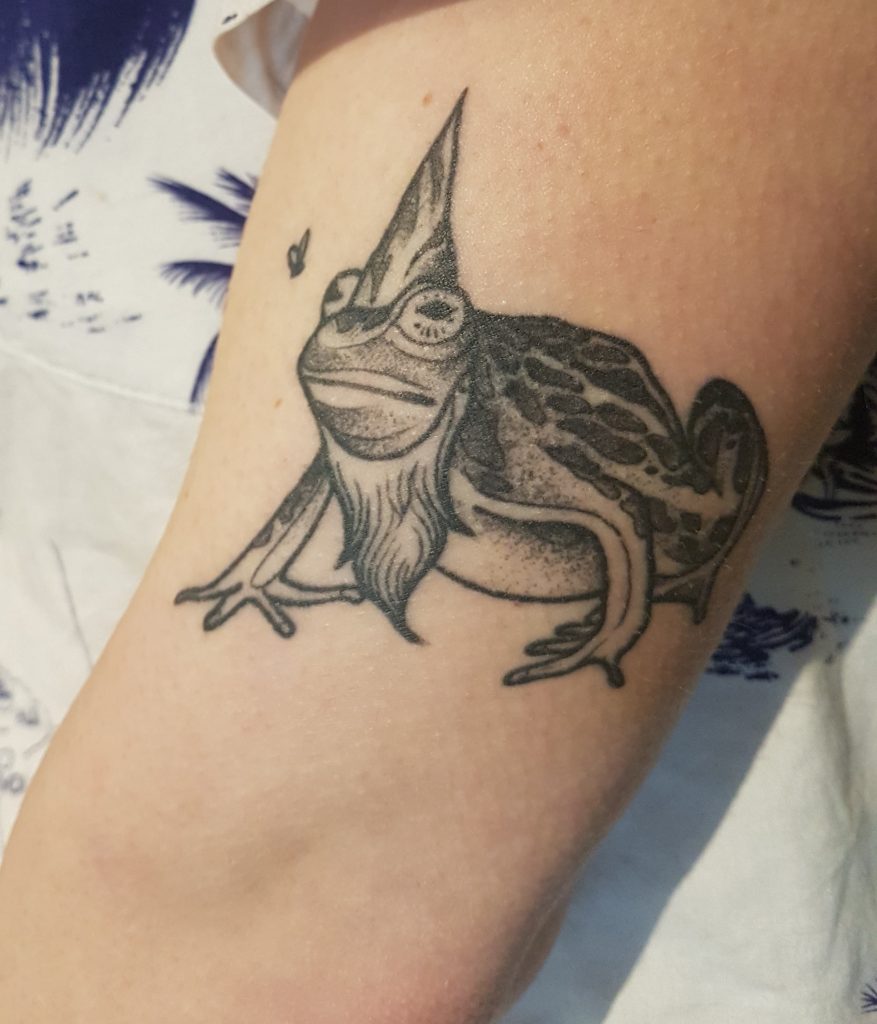
To use my own tattoos as an example, I literally have a frog with a pointy hat and a beard tattooed right smack dab in the middle of my arm. Why? It was such a fun idea that made me smile whenever I thought of it that I absolutely had to get it. #NoRagrats. Do I still look at it and crack a grin? Hell yes. 

Photo: Molly Lorette

As someone who has issues feeling at home within my own skin, there’s something therapeutic about placing decorations within my space. It makes me that much more excited about having a physical, fleshy form. Even if there are certain body parts that I don’t like as much as others, it’s fun to have a beautiful piece of artwork to look at instead. I like to think of it somewhat as if I am moving into a new apartment: while it could be totally different for somebody who has a minimalist aesthetic, and in this analogy, doesn’t like tattoos, I don’t feel as though I can really live to my fullest potential without a bit of personality in my space. Even if it isn’t my ideal living condition, it makes me feel a little bit more in control. Same deal with tattoos! Empowerment can come in many different forms, and as someone who has always found joy in aesthetics, this is simply one more medium for me to utilize.

Political Corner: The real economic threat of COVID-19 is a global lack of paid sick leave

0
SARS-CoV-2’s high rate of transmission makes staying home while sick vitally important. Illustration: /The University of Tampa

By: Kelly Grounds, Peak Associate

As the number of coronavirus (COVID-19) cases surpasses 100,000, the economic impacts of the virus are becoming clearer. Worldwide markets have repeatedly dropped, suffering losses not seen since the last decade’s Great Recession, as anxiety about the pandemic broadens its reach. Amazon has seen price inflations of up to 2,000% for common products like hand sanitizer, while also trying to increase their stocks to keep up with demand. But the economic crisis being overshadowed during this epidemic is the one impacting workers across the globe: a lack of paid sick leave.

In an ideal world, if a worker felt sick, they would be able to call into work and stay home, recuperate, and not risk the health of their coworkers, themselves, or the general public. This is not the case for many workers who feel required to attend work while ill due to a lack of paid sick leave. The group most likely to not have sick leave are low-wage service workers who regularly deal with customers, products, or food. This is problematic enough during the regular flu season, but now that the world is grappling with a global pandemic, going to work while sick can be dangerous.

Health officials recommend a 14-day self-quarantine for individuals suspected of coming into contact with the COVID–19 virus. This allows time for potential symptoms to emerge to avoid spreading the virus. However, without paid sick leave or substantial job security, what is a necessity from a public health perspective becomes an impossibility from a financial one.

The heart of the problem is worker inequality. There are no federal laws in Canada to protect workers’ rights to paid sick leave, and as a result, most employers treat it like an optional benefit rather than a necessity. But in these extraordinary circumstances, businesses may be forced to help workers stay home sick to curb the spread of the virus. BC Premier John Horgan recently called on businesses to consider increasing the employee incentives to stay home while sick. This could help curb the spread of COVID–19, however, we shouldn’t need to wait until the cusp of a global health crisis to afford workers basic rights.

The Peak rounds up SFU community’s responses to COVID-19 or Coronavirus

3
COVID-19 has affected operations at SFU

By: Gurpreet Kambo, News Editor and Gabrielle McLaren, Editor-in-Chief, with files from Harvin Bhathal, News Writer

With confirmed cases of COVID-19, or coronavirus, in Vancouver, potential outbreaks on campus have been a frequent discussion topic through both official school channels and on social media. The offices of Andrew Petter, SFU President, and Jon Driver, Vice-President Academic and Provost pro tem, sent out multiple emails during the week of March 9–13 addressing concerns about COVID-19 at SFU. 

This article rounds up these emails, SFU’s institutional response, its student societies’ voices, and the online community’s concerns.   

SFU responds to Instagram and Facebook reports of student self-isolating after potentially being in contact with COVID-19 

A screenshot of a Canvas message to a BISC 303 class was seen circulating on social media. The screenshot revealed that a class member was self-isolating after potentially being in contact with someone who had tested positive for COVID-19. The story was picked up by news outlets such as Burnaby Now. 

In an email sent on March 11, Vice-President Academic and Provost pro tem Jon Driver addressed this post. He stated that the student in question had not been on campus since March 3, was in self-isolation, and was getting tested. The email emphasized that the individual is not confirmed to have COVID-19, did not have any symptoms when attending class on March 3, and that all surfaces in that lab where the student worked have been deep-cleaned.

“We realize that there is heightened concern about COVID-19. We are committed to protecting our students, faculty and staff and letting you know if there are any cases of COVID-19 among our community,” said Driver. 

SFU decides to “move away” from in-person instruction

On the evening of March 13, the office of SFU President Andrew Petter sent out an email stating that SFU “will be moving away from in-person instruction beginning next week for the remainder of the term.” 

It further stated that students should wait to hear from instructors about how to proceed with classes, and that the Centre for Educational Excellence would assist instructors with alternative delivery methods for classes.

All SFU campuses will remain open in the meantime.

Earlier in the week, two online petitions had circulated amongst students, calling for SFU to cancel classes. The larger of the two petitions had 8,336 signatures when it was closed in response to SFU’s announcement. 

A similar petition was circulating amongst UBC students. The Daily Hive reported that the school was currently making plans to host online lectures and courses. 

____________

During the preceding week, the offices of Petter and Dr. Jon Driver, Vice-President Academic & Provost pro tem had sent out multiple emails. 

Petter stated in his email dated March 12 that SFU has “convened a COVID-19 operational response team under the leadership of Dr. Jon Driver, Vice-President Academic & Provost.” Petter added that this team is supported by SFU Safety & Risk Services to work on reducing risk of transmission at SFU. 

“This group is working closely with health organizations and other Canadian universities to gain expert guidance on how best to manage this situation.” 

Petter further added that “SFU’s Emergency Operations process has also been activated, and an Executive Committee established to approve policy decisions and resources required to respond to the situation as it evolves, and to prepare for future actions that may be required to ensure the health and safety of our community.”

Driver sent out multiple informational emails to the SFU community as well. The first email, sent on March 9, requested that all community members register international trips on the SFU Travel Registry, found on SFU’s Safety & Risk Services website. 

According to Driver, precautionary measures taken across SFU campuses include promoting good hygiene practices such as frequent hand washing, and “appropriate cleaning and maintenance of SFU premises to prevent the spread of communicable illnesses.”

The Peak has reached out to SFU for additional details on what ‘moving away from in-person instruction’ entails.

What students in SFU Residence & Housing should know

Vice-President Academic and Provost Pro Tem Jon Driver’s email stated that anyone living in residence who needs to self-isolate due to symptoms of COVID-19 should email Residence and Housing at [email protected] for information.

In an email interview with The Peak, Driver responded to questions about long-term plans. 

“We have planning groups working on a wide range of scenarios, and those plans will be implemented if required. With regard to people living on campus, the university will continue to provide accommodation in residence buildings as well as access to food and other necessary supplies and services.” 

Study Abroad participants advised to monitor the situation 

As of March 12, SFU Study Abroad’s page noted that: “As partners make decisions on future programming or as travel advisories change and risk levels change, the University may decide to cancel SFU study abroad programs.” 

Currently, all Summer 2020 Field School programs have been cancelled. Student travel has been restricted to Northern Italy and China until further notice. 

Students impacted by any cancellations will be contacted directly and updates will be made online. If exchange programs are cancelled before a student leaves SFU, Study Abroad will work with students on a case-by-case basis. 

For students whose programs are cancelled part-way through terms and for whom completing the academic term is not possible, International Student Services would refund the full tuition and student fees associated with the exchange. Students enrolled in fee-paying programs, such as those at the Beijing Institute of Technology or the University of California, Berkeley, “would be subject to [their] host institution’s refund policy.” 

“The options available would depend on the timing of the cancellation and other factors at the time,” they write. 

Students currently on exchange are encouraged to work with their host institutions and contact [email protected] if they are considering an early return to Canada. Study Abroad’s website also outlines how future exchange students can cancel their exchange (and what is or is not refundable), defer their exchange, or request a change in exchange locations.

SFU Athletics 

The Great Northwest Athletics Conference and the National Collegiate Athletics Competition, in which SFU athletes compete, have both announced that they were suspending all athletic competitions until further notice, as of March 12. 

SFSS shuts down operations for time being

The Simon Fraser Student Society (SFSS) has decided to shut down operations temporarily as of March 13 at 4 p.m. The SFSS’s Executive Committee passed a motion that mandated that all SFSS offices be closed, with the expectation that they will be reopened on March 30. 

It further directed all clubs, departmental student unions, faculty student unions, and constituency groups to cancel all further activities and to plan no new events for the time being. 

All SFSS Board meetings will be held remotely, and SFSS staff will be working remotely as necessary. 

_________

SFU’s largest faculty student union, the Society of Arts and Social Sciences, canceled one of its major events of the year, FASS On a Boat: A Masquerade Night. The event, which was a formal party on a Harbour Cruises boat, was scheduled to occur on the evening of March 20. According to an email sent by Jess De La Cruz, Engagement Programming Assistant for the Faculty of Arts and Social Sciences, the event was cancelled as per the SFSS’s advice. Tickets will be fully refunded.

__________

The Graduate Student Society provided a list of resources about COVID-19 to their members.

SFU has posted a COVID-19 FAQ that can be found online.

Changes in the SFSS’ food sale policy lacked clarity and transparency

0
Sudden and confusing changes to fundraising protocol has left clubs in uncertainty. Chris Ho/The Peak

By: Naomi Torres, SFU Student

As a student union executive, I’m used to dealing with the day-to-day workings of SFSS policy. Recently, the SFSS sent an email to all student union executive members stating: “Effective immediately, groups will no longer be allowed to sell or hand out perishable food or drink items on campus. This includes but it is not limited to bubble tea and home baked goods.” It continued, “groups may still fundraise using other FDA approved, single-serve, pre-packaged food items, with ingredients listed in English.”

One week later, they sent another email under the subject header “Clarification Regarding Fundraiser Updates.” Since the email began by acknowledging that “it has come to our attention that there are many misunderstandings around the [previous] message,” I expected there to be a clarified list breaking down items that are restricted and allowed. Instead, the majority of the email covered the basic processes on how to book tables, rooms, and spaces through the SFSS and Meeting, Event and Conference Services (MECS). 

Only two points in the clarification email discussed food, which told clubs and student unions to obtain a Fraser Health food permit if fundraisers include food/beverages. 

This lack of clarity by the SFSS is part of a pattern of poor communication with clubs and departmental student unions (DSUs), one that is currently putting small-group funding on campus at risk.

Clubs and DSUs are extremely underfunded by the SFSS. The core and grant funding available to student groups is quickly eaten away by even modest event planning, given how expensive it is to hold events on campus. Core funding in particular is determined by how many students are enrolled in a given department’s classes, or are officially a part of its program. This leaves smaller DSUs perpetually starved for funding. For example, the Gender, Sexuality, and Women’s Studies Student Union only receives $300 in core funding per semester. By restricting what students can and cannot sell, the SFSS limits the variety of food students can turn to for their fundraising — hurting DSUs’ chances to raise money that would go toward student events and community building.

This decision came out of nowhere and without any input by club or student union executives — though Council later discussed the policy change. The two emails contained broad and generalized statements that provided no clarity to students and only created worry and confusion for student groups who had fundraising dates planned (like the Taiwanese Association, who wanted to host a bubble tea fundraiser, and the Society of Arts and Social Sciences, who planned to sell Krispy Kreme donuts). Though both student groups still continued with their fundraiser, their planning was momentarily disrupted by the SFSS’s sudden restrictions and lack of all transparency. 

And though I do appreciate the SFSS for being cautious of the potential for allergic reactions amongst students, this leaves me wondering where the sudden urge to send these announcements came from. Could it be to prevent the spread of COVID-19? Is it possible that SFU food vendors are complaining that students are taking away their business? Since the SFSS’s “clarifying” email did very little clarifying at all, club and DSU executives have little way of knowing the rationale behind the decision.

As a student union executive, this is frustrating because planning fundraisers is remarkably hard. Passing a motion and deciding exactly what to sell takes time. Students then have to go pick up (or make) the items, book and set their tables, and extensively advertise so folks are aware of what is happening. Furthermore, there is a risk in fundraising. The possibility of not being able to break even or make a profit  is always there.

Still, fundraising is an amazing way to help students groups obtain money without being beholden to the bureaucracy of the SFSS. Now though, the Student Society is making even this difficult for us. We need the SFSS to be clearer and more transparent with us so we can do our jobs efficiently.


SFU Athletics events cancelled or postponed indefinitely due to COVID-19 pandemic

1
The SFU Athletics logo. — Photo: SFU Athletics

By: Dylan Webb, Sports Editor

Amidst widespread uncertainty in the sports world due to the deepening of the COVID–19 pandemic, all SFU Athletics events scheduled for at least the remainder of the month have been postponed indefinitely. This includes softball, track and field, women’s golf, and hockey. 

The GNAC released the following statement regarding the postponement of all athletic events: “In the interest of the safety of our student-athletes and the public at large, the Great Northwest Athletic Conference is suspending spring conference athletic competitions until further notice. This suspension is effective on Friday, March 13.” 

The NCAA is also subject to widespread cancellations, including “Division I men’s and women’s 2020 basketball tournaments, as well as all remaining winter and spring NCAA championships.”

SFU Hockey will also be unable to participate in the British Columbia Intercollegiate Hockey League (BCIHL) playoffs given that the league has decided “to postpone [their] post-season effective immediately and to re-evaluate the situation in the coming weeks.”

Check out the SFU Athletics and BCIHL websites for the most recent updates on this constantly evolving situation. 

SFU Hockey wins final game of regular season to secure second place

0
The Clan scored a total of 16 goals in the final two games of their regular season — three were scored by Lacasse. — Photo: SFU Hockey

By: Dylan Webb, Sports Editor

An offensive outburst by the SFU Hockey team on the final weekend of the British Columbia Intercollegiate Hockey League’s (BCIHL) regular season allowed the Clan to secure second place in the league standings. While playoffs are postponed due to concerns regarding the COVID-19 pandemic, they have technically secured home ice advantage should they ever hit the ice. 

After embarrassing the last place University of Victoria Vikes in a resounding 7–2 victory, the Clan travelled to Nanaimo for a showdown with the Vancouver Island University (VIU) Mariners. With the right to host at least two playoff games at the Bill Copeland Sports Centre on the line, the Clan came out with their most dominant performance of the season and thumped the Mariners 9–1 in both teams’ final regular season game. 

Arriving in Victoria knowing that the result of their weekend’s first game was of little consequence to their aspirations for home ice advantage in the playoffs, the Clan were able to maintain focus to sweep their six-game season series with the Vikes. Led by a three-point night from forward Jacob Lacasse, the Clan built momentum for their season’s most important game the following night. 

In stark contrast to the relative insignificance of the match-up with the Vikes the night before, the Clan arrived in Nanaimo for a showdown with their first round playoff opponent. It was important for the Clan to come out with a strong performance against a team they had struggled to beat all season. Thanks to another three-point night from Lacasse, the Clan secured a dominating win over the Mariners. 

While the Clan’s offensive outburst was central in the lopsided win, another important achievement for SFU was the fact that the team only took a single minor penalty in the entire game. With a torrid offense, impeccable goaltending, and a team-wide commitment to discipline, the Clan primed themselves for the playoffs as thoroughly as possible. 

Should the BCHIL 2019–2020 playoffs ever be played, the Clan will have home ice advantage. Check out the league website for the most recent updates. 

Peak Speaks Podcast – Have you ever worked retail?

0

Listen here: https://pod.link/1464226637