Home Blog Page 384

Experiencing a suicidal crisis as an SFU student

0
Photo courtesy of Surrey Now-Leader.

By Anonymous

Content warning: suicidal ideation, prescription drug use, institutionalization

I was first diagnosed with disabilities during my first year at SFU. While coming to terms with the diagnoses themselves was difficult, it was nothing compared to the medications and crises I have endured throughout my undergrad. 

I have been on more medications than I can count — and they all end the same way. They either have enough side effects that I want to forget that I ever took them, or they make me forget everything that has occurred in recent memory. Eventually, I stop taking them due to the side effects and am immediately punished for being “non-compliant with treatment.” 

Then all of the effects of withdrawals set in. These include feeling disoriented, issues with my vision, feeling electrical shocks in my brain, cold sweats, severe mood swings, and suicidal ideation. 

But it doesn’t stop at withdrawal; the guilt I have from each perception of myself that I hold in my mind reminds me each day as I wake, that my health (or lack thereof) is a result of my own incompetence. 

The combination of the mental and physical symptoms creates the perfect storm for a crisis. 

Although in retrospect the crisis is predictable, there’s nothing I can do in the moment. Every thought in my mind is debilitating and only further integrates my perceived incompetence into reality. 

The only thing I’m fully aware of is that my state of mind is at the point where institutions have to treat me as a potential liability. If I am honest with a health professional at SFU, I’ll be threatened with a call to the police and eventual committal to an institution. 

Being the property of individuals who systematically oppress members of the BIPOC and disabled communities is not an option. Neither is being in an institution where I am constantly medicated to the point of barely having a grasp on consciousness. 

So, if I see a counsellor or a doctor, I have to minimize my pain at minimum and lie outright if necessary. But what’s the point if I’m not communicating how I truly feel? Besides, I have enough commitments as it is. I have class, work, and volunteering, and there isn’t enough room in my head for anything else. 

So when the dread of another day in the realm of the living hits me at 6:00 a.m., I get ready for class. Just in case I do have to go through a crisis today, I ensure that I live up to the label of having “invisible” disabilities. I pick out an outfit that will avoid bringing any attention to myself, keep my head down, and try to avert my gaze when I can. 

There is a type of privilege with having invisible disabilities, but the erasure of identity and lack of empathy offsets this. I feel as though I carry more pain in my eyes than some able-bodied individuals carry in their bodies and I’ve given up hoping someone will notice that. Therefore, I arrive to campus, forcing myself to look to the floor.

In lecture, I have a radius of 20 empty seats surrounding me. I simultaneously hope with all my will that no one will fill a single one of seats and that someone will sit next to me. 

Every one of the hundreds of thoughts that run through my head pick me apart and I agree with all of it. I am worthless, ignorant, attention-seeking and will never amount to nothing. 

I’m doodling possible ways out of this nightmare on my lecture slides while trying to remember what the first hour of lecture was about. The professor asks the class to organize themselves into small groups and I suddenly realize that everyone has come to the conclusion that I am a fraud. 

They don’t know that I am disabled, but I’m sure they know that I am lying about it nonetheless. The lecture hall of 300 are all staring at me and I cannot disappear fast enough as I try to catch my breath while running up the stairs.

I am desperately searching for a place to panic or cry. The posters of mental health support groups, phone applications, and crisis lines feel more condescending than ever. What’s the point? I don’t want someone to recite their script of “I understand, that must be difficult, how does that make you feel?” at me. I want someone to listen and empathize with me, but that isn’t possible, not here at least. 

I find the nearest accessible washroom, lock the door, and look up at the ceiling. This washroom doesn’t have any pipes or beams that could bear my weight, I wonder if I move one of the ceiling tiles that a way out would be revealed. It’s something I try to keep in the front of my mind as I breakdown and try to avoid any visible markers of a crisis. 

I place my hands on either side of the sink and try to stabilize myself as I see my reflection in the mirror. I have a comprehensive understanding of how hopeless, pitiful, and what a waste of space I am. 

For the first time in weeks, I am thinking clearly and know what I have to do to feel better. I have to go home, count the pills I have left over from whenever I discontinued use and make a decision — to take one one of them or all of them.
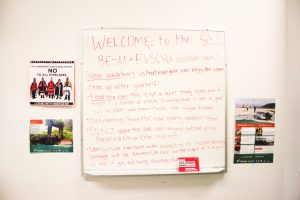
The EVSCSU and BESU receive eviction notice from School of Environmental Science

1
PHOTO: Gudrun Wai-Gunnarsson / The Peak

Written by: Serena Bains, Staff Writer 

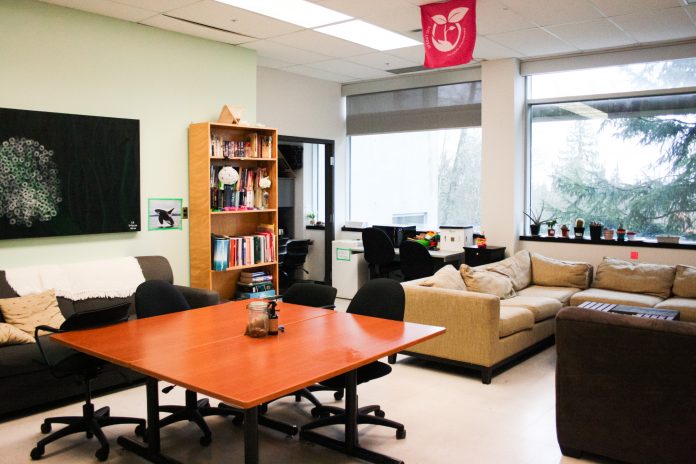
The Environmental Science Student Union (EVSCSU) and Bachelor of Environment Student Union (BESU) recently learned of the School of Environmental Science’s plan to repurpose their common room and convert it into a lab space for environmental science research. Neither the EVSCSU or BESU were consulted regarding the eviction of the groups from the common room, according to the student unions. 

Initially, there was no replacement for the common room nor a rationale given for what prompted the decision. The EVSCSU and BESU were given the suggestion to use the bookable rooms in the Student Union Building. However, this would require constant relocation and provides limited storage space. 

According to Nathan Zemp, President of the BESU, and Paolo Orosa, webmaster of the EVSCSU, the School of Environment assumed that the common room was underutilized, were unaware of the community the room provided, and didn’t know of the investments made by the EVSCSU and BESU into the space. Furthermore, the faculty was unaware that BESU was one of the resident student unions of the common room, meaning that it was BESU’s only common space for events and gatherings. Zemp expressed that “the common room is [their] second home” and that “it’s a meeting space for all of the students in our majors, it’s a place where you can always go.” 

PHOTO: Gudrun Wai-Gunnarsson / The Peak

As detailed in the annexation statement put out by the EVSCSU and BESU on November 13, the BESU remains unnotified of the eviction, which was three weeks away at the time the statement was written. The School of Environmental Science conveyed that the common room was meant to be a temporary space, where this decision was being contemplated for the last five years however, this was not communicated, as expressed by Orosa.

B-Jae Kelly, the Associate Director of Facilities and Technical Operations of the Faculty of Environment, remarked that there is a solution in the works. Additionally, Kelly stated that they are happy to consult with student unions in the future to prevent any further miscommunication. 

“In more recent communications, they have appeared more supportive and understanding. The initial notice was quite blunt. Since they’ve heard how important this room has been to us, they are open to some dialogue,” said Zemp. 

In terms of an alternative space, the EVSCSU and BESU have been provided some options. All options, however, would be approximately a 50% reduction in size compared to the common room because “given the size of the student unions, [the faculty] can’t justify giving [them] a larger room,” as noted by Zemp.

While the EVSCSU and BESU acknowledged that the School of Environment was unaware of the significance of the space to either student union, they do not blame any individual for this disconnect. They hope that with continued dialogue with the faculty, all parties can come to an agreement for a feasible replacement of the common room. 

PHOTO: Gudrun Wai-Gunnarsson / The Peak

Kelly stated that the faculty is also committed to finding a solution that is suitable for all parties. The faculty believes that there is currently a solution in process — a tentative solution is that student space would be administered out of the Dean’s office to fit the needs of the student unions currently housed in the common room.

The EVSCSU and BESU also acknowledge that the School of Environment is under fiscal pressure by SFU as there is a shortage of lab space for professors, as there is no greater funding being provided to the school. Zemp explained that, “SFU is now charging them for potential space. So, if they don’t utilize the space that they have they won’t be able to get anything else.

“We are hopeful, we’ve seen some good signs that the faculty is listening to us [ . . . ] It’s not hopeless, if you get evicted there are things you can do and there are ways to stick up for yourself and if you engage with the faculty in dialogue and act respectfully, you can achieve positive results — we’re hoping.”

For more information on the EVSCSU and BESU and their negotiations, visit their Facebook page.  

UPTOWN BOYBAND discuss their sound, bilingual music, and the Canadian music scene

0
These artists are embracing their identity and creating versatile music. Photo courtesy of Mimi Vuong

By: Michelle Young, News Editor

Editor’s note: Some of the answers below have been edited for length and clarity.

Toronto-based UPTOWN BOYBAND released their first album, CLUB UBB, on November 20. It’s a concept album that’s divided into two parts, HEARTTHROB and HEARTBREAK, and showcases the band’s musical versatility. 

Comprised of Roc Lee, Joe Rascal, and Justin Trash, the band has been releasing singles since early 2020 — like groovy and upbeat “SAILORMOON” and hard-hitting “CHUMCHURUM.”

The Peak had the opportunity to interview the band over Zoom to discuss their new album. 

The Peak: Why did you decide to break the album into two concepts? 

Justin: The album is inspired by K-pop music, and [in] K-pop, there are so many genres within each song: you can get a trap feel, you can get an EDM feel, a pop feel. For us, we really wanted to divide into pop and trap music because of our upbringing as musicians. When we were performing [ . . . ] we would start with a pop song, then just end the show with a full trap set. I think it was important for us to hit every aspect of trap music and every aspect of pop music to show that versatility. 

P: Adding onto the idea of versatility, what are your thoughts on genres? As a band, your sound has blended a lot of different genres together. Do you think genres will eventually fade away — or does it simply depend on the artist? 

Roc: I think it really depends on the artist, because not every artist is willing to be as experimental as we are. Like Justin mentioned before, we were influenced a lot by K-pop, and K-pop is famous for literally taking a lot of different sounds from all over the world and making them fit cohesively in one song. We really thought that was something we wanted to do with our music. We’ve always wanted to be different and to showcase our versatility.

Joe: I really think that every year, the music industry is always changing, and therefore, people are always coming up with new ways to express themselves because now the audience has new ways to find who to listen to. I feel like a lot of artists now are trying to be more personal [ . . . ] I feel artists now can express themselves more freely, hence why they can branch out with more genres. 

P: Do you have any specific sounds/genres you’d like to try or experiment with?

Justin: Well, we definitely won’t do country music. Over my dead body.

Joe: You know what, though, you never know. 

Justin: I know. 

P: Going off of that, do you ever clash on which sound you want during recording?

Roc: I think usually in sessions, we get along well and have a similar vision of what we want to sound like and the sounds we want to create. We also bring our individual strengths to the table — Justin’s really good at writing, Joe’s very good with that soul, the melody.

Justin: At the end of the day, if it sounds good, it sounds good.

P: What is your creative process like? Has COVID-19 changed the way you write and produce music?

Justin: Initially, when we originally recorded the first album, CLUB UBB, we had a simpler approach to it where someone would come up with the hook and we would kind of build around that concept. But now with [COVID-19] hitting, we still have that similar structure but more resources to use in terms of working and collaborating with other producers and writers. Now, we’re able to write for each other and we kind of get what sounds good with other things. 

P: Various artists of colour have commented on media placing emphasis on their identity instead of their music, however, you’ve spoken about embracing your Korean identity. What are your thoughts on placing emphasis on identity versus the creative process in interviews?

Justin: I feel like when we say we’re embracing our background, it comes from our upbringing — there are times where we’ve felt shameful about being who we are, but I guess what we’re actually embracing is more the identity of being Koreans living in Western culture and being raised in that with the same cultural discipline we get at home. But also when we go outside we have a total different experience, where maybe our non-Korean friends or [friends who aren’t people of colour] wouldn’t get.

Roc: And I also think it’s because we wanted to represent something bigger than music [ . . . ] We wanted to represent that [East] Asian culture, that upbringing, because we didn’t have a lot of role models growing up in Toronto and we haven’t seen a lot of Asian-Canadian and Asian-American artists doing well. I mean, now we have a lot of great artists coming up, but we wanted to represent that culture. 

P: Many Asian-Americans/Asian-Canadians have been putting out bilingual music. Do you plan to put out any Korean releases? Do you think multilingual music will eventually make its way to the mainstream music scene?

Roc: Even now you see K-pop songs getting number one, like BTS, Blackpink — and people have no idea what they’re saying.

Joe: Sound has been with us since the beginning at time, whether there was language or not, and it can sound good, and we’ll just love it because sonically it sounds good — so I think it doesn’t matter what language or culture you’re bringing up. It’s the sound of what you love to make. 

Justin: To answer your question though, yes, we’re really interested in doing it, and we’re planning on doing it on our second project. 

P: UBB has been dubbed as “an alternative” to K-pop is that something that you initiated or a label thrown onto you?

Justin: Hey, if that’s what they’re saying, that’s what we are. We’re totally open to the term “alternative K-pop” because the way we are taking our direction is we’re so heavily inspired by K-pop, but yet we’re not K-pop, right? We’re so heavily inspired by Western music, but we’re not fully there yet, so we’re taking the alternative route of the K-pop discipline, the musicality of both sides.  

P: What changes do you hope to see in the future Canadian music scene? 

Roc: I want to see more different types of languages incorporated in music and just having different cultural influences in Canadian music. I feel like it is very black and white with a lot of music that is coming out, and we hope to be a part of that change. 

P: Is there anything else you would like to say to our readers?

Justin: Go stream CLUB UBB. Stan us, stream us, follow us. Stay healthy, stay safe, wear a mask, don’t be an asshole. 

CLUB UBB is available on all streaming platforms. Follow Uptown Boyband on Twitter  and Instagram


The Queen’s Gambit is a coming-of-age drama that’s making all the right moves

0
Who knew chess could be so gripping? Courtesy of Netflix

By: Alyssa Victorino, SFU Student

I have not played a single game of chess in my life. However, after watching The Queen’s Gambit, I am suddenly itching to play, eager to learn all the nuances of the game. Though an intellectually stimulating drama, this Netflix show does a remarkable job of balancing both comedy and emotion, making it clever and heartfelt all the same. 

Earning a 100% rating from Rotten Tomatoes, the limited series tells the gripping tale of Elizabeth (Beth) Harmon (played by Anya Taylor-Joy), a gifted chess player, and her tumultuous journey to becoming a grandmaster of chess. Adapted from Walter Tevis’s 1983 novel, The Queen’s Gambit, the show follows nine-year-old Beth from a Kentucky orphanage in the 1950s as she comes of age. It is at the orphanage that her talent is realized, though it is also there that she develops a drug addiction that follows her into adulthood. 

The cinematography, in addition to the screenplay, is exceptional in the way it fully immerses the audience into Beth’s life, throughout all her success and failure. The shots are beautifully framed and coloured, and with every close-up, Beth’s facial expressions and mannerisms are pronounced and consistent. Perhaps the most impressive way that this show was structured is how the pace of each episode mimics the essence of the chess term it is named after. These parallels between the narrative and the filmmaking are one of the reasons the series is so memorable.

Each episode is truly just as riveting as the last. Beth’s focus on winning is unwavering, and it is what keeps her paradoxically steady yet erratic. Her quiet demeanour is also strategically reflected on the board during times of suspense, making it hard not to be fully involved in the diegesis. Despite the palpable tension during games, there was a dedicated focus on the movement of the meek chess pieces, mirroring Beth’s contrived tranquility in the face of her inner turmoil. 

Asked to provide commentary about the show, real-life chess champion Jennifer Shahade explained how the beauty of chess with its disinterest in traditional gender constructs is a theme that is persistently represented on-screen. Though the game does not rely on gender norms, the same cannot be said for chess culture, with Shahade noting that it remains a male-dominated sport. Despite Beth’s evident gift in logical reasoning, her stardom was predominantly built upon the novelty of being a good female chess player, a source of significant annoyance for the young protagonist. Shahade, however, expressed her excitement over the added publicity for women in chess and her hopes that it encourages young women to find a place in not just the game, but in other areas where they may feel they don’t belong. 

As astounding as the show is, it is not without weakness. Critics have pointed out that Jolene, Beth’s primary confidant in childhood, was not given enough attention. Moses Ingram’s incredible portrayal of Jolene was a major talking point for the show, though it seems her role just marginally escaped the played-out trope of a Black woman only existing in the narrative to further the interests of white characters. Although an inherently feminist story, this raises a pertinent question: What is feminism if not intersectional?

While the representation of women of colour could have been improved, The Queen’s Gambit is a refreshing story about friendship, created families, womanhood, and the mess that is growing up, seamlessly woven into the pensive world of chess. It is enjoyable from start to finish, told with the help of a fantastic cast, purposeful camera work, fashionable costumes, and a genuine love for the game. Though it surely features hardship, the series deviates from feigned adversity for the sake of drama. There is no fuss — it is simply chess and it is simply life, and it is beautiful.

SFU gerontology department hosts information session

0
PHOTO: Bruno Aguirre / Unsplash

Written by: Mahdi Dialden, News Writer 

SFU department of gerontology hosted an information session for students interested in the program on November 5, 2020. The Department Chair Habib Chaudhury, Graduate Program Chair Barbara A. Mitchell, Department Manager Anne Marie Barrett, Graduate Program Assistant Sasha Gill, and alumni speakers all gave insight to prospective students. 

Gerontology is “a study of the aging process and individuals as they grow from middle-age through later lives,” which includes “investigation of changes in society resulting from aging populations.” The social science focuses on the psychological aspects of aging and the policy and programs associated with it. 

The department provides three different programs including a one-year post-baccalaureate diploma (PBD) program, a Masters (MA) program, and a PhD in gerontology. These programs provide an interdisciplinary workload with “both quantitative and qualitative research skills.”

Each program includes its own set of requirements and course work. The PBD program requires the “completion of a four-year undergraduate degree from a recognized university, with a minimum grade point average of 2.5.” The masters program requires “an undergraduate degree in a related discipline,” and “must satisfy the general admission requirements for graduate studies.” The PhD program requires a Masters degree in gerontology or a discipline that includes aging-related coursework with a minimum of 3.5 GPA. A practicum component for PhD students “would include a volunteer or unpaid position that would provide services to older adults.”  

The gerontology department is a “smaller unit within SFU, and by virtue of that, [they’re] able to give higher quality interaction with the students both in terms of the size of the classes and the interaction that we have from faculty and staff, with the students.”

There are 12 awards that are specific and exclusive to gerontology students. These awards range anywhere from $500 to $2,000, and can be found on the SFU Graduate Awards’ application system. 

The program is increasingly relevant because 18% of the Canadian population are 65 and over, and “in 20 years, about 68% more than what we have now,” according to Chaudhury. 

Eireann O’Dea, a current PhD student and master’s graduate in gerontology said, “One of [her] favourite things about the program I would say is that it’s highly interdisciplinary. And [ . . . ] for someone like me who often has trouble choosing a singular topic of interest or one area to focus on, I found [it] really valuable.”

What Grinds Our Gears: Packaging that is unnecessarily complicated to open

0
PHOTO: James Yarema / Unsplash

by Michelle Young, News Editor

For the past few years, my hands and wrists haven’t been doing too well. Due to a mixture of overuse, hypermobility, and a small frame, my hands have become significantly weaker, lost some of their fine motor skills, and have posed a series of challenges to my daily life. One of these challenges is the struggle to open things that, to me, were not previously difficult to open. I don’t just mean pickle jars and excessively sealed packages — I also mean pop cans, twist tops, and cereal boxes.

The thing that is so frustrating about packaging is that I shouldn’t need an exuberant amount of strength to open a jug of orange juice. I understand that the twist-and-pop cap is supposed to indicate that a product is still fresh, but the juice boxes that flip open with the little plastic-peel off are truly much easier for me. Why is there so much unnecessarily tight packaging, that when I’m left home alone, my meal options have suddenly become limited to avocado toast? (I mean, I have a few more options, but still.

I recognize that I’m privileged to only be experiencing this in the past few years, when there are others who have likely been struggling with this for their whole lives. However, I’ve found it increasingly concerning that companies don’t seem to take into consideration the amount of assistance that one may need to open their products — whether that be food, cosmetics, or other essential items. So, I’m asking everyone to look critically at the products they consume and consider whether their design is accessible, because not everyone has the same abilities, and I guarantee that there’s an alternative.

Senate Report: November 2, 2020

0
Photo from Peak archives

Written by: Serena Bains, Staff Writer 

SFU reopens some Athletic & Recreation programs 

During the question period, Senator Colin Percival asked if there were any plans to reopen Athletic & Recreation programs. Vice-President, Academic and Provost pro tem Jonathan Driver responded by stating that the gym and pool were open through appointments, where other safety protocols — such as sanitizing stations — are in place as well for students who live on residence and staff and faculty who work on campus. Following the BC health orders announced on November 7, SFU Athletics & Recreation announced that the Fitness Centre and Aquatics Centre reopened on November 12. Consult with the SFU Athletics & Recreation website for updated safety protocols.

President Joy Johnson added that some of the SFU athletics teams — such as football, soccer, and track and field — have been training on campus and discussions are currently underway regarding whether athletic competitions will be available next term. She also recognized that athletics includes the additional challenge of athletes having to travel across the border.

Expectations for professors regarding remote course delivery

Senator Lyn Bartram posed a question about how professors are expected to deliver courses to students who are working from home all around the world. 

Bartram expressed that for the first time, she had to describe whether her course would be taught synchronously or asynchronously. She recognized that some students will be joining from outside of the lower mainland, but that with some aspects of the course requiring real-time communication, Bartram felt that she’s teaching two courses with the blend of synchronous and asynchronous components. 

Bartram added it now takes two to three times more effort to deliver a course, not taking into consideration the time it takes to prepare. 

Driver responded by stating that SFU is currently working with the faculty association on this issue. Professors who are pre-tenure (meaning that they have not been offered a permanent contract) have been given flexibility so they can delay tenure. Delaying tenure, however, means that professors can be terminated without justifiable cause. Senator Rob McTavish commented in the chat that delaying tenure for professors who are pre-tenure is a difficult decision, as it can have long-term consequences on salary and pension. 

There are options to modify study leave plans and performance review processes, and there is a review occurring of support that has been implemented at the faculty level, which includes financial assistance to hire more teaching assistants, among other accommodations. 

President Johnson responded that there is recognition for professors who have gone above and beyond and that the workload has increased for everyone during these difficult times. 

Senator Pablo Nepomnaschy spoke to the impact that COVID-19 has on research, and agreed with Senator Bartram that teaching online takes three times the amount of effort. In addition to this, professors who work abroad or at field schools have seen a negative impact on their research as they can no longer travel. Professors explained that this problem also extends to their graduate students and that there needs to be a solution.

Postponing external reviews for 2020–21 academic year

Senator Wade Parkhouse explained what an external review consists of. The purpose of external reviews are to assess the strengths and weaknesses of each academic unit, gain the perspective of external experts, and support future planning. Academic units are reviewed by external reviewers not only from Canada, but across North America. This usually includes a social event, in-person meetings with faculty members, and a review of documents and reports. All units were allowed to delay the review, except for the units who postponed the reviews in the previous year. Geography and Physics would go forward in 2021, most likely later in the year. 

Top Ten ways to help lockdown go by quicker

0
Very calm, very cool. Nothing wrong here. Illustration: Siloam Yeung / The Peak

By: Juztin Bello, Copy Editor

  1. Hit up your ex

Since dating your ex ended up being a waste of time despite your initial thoughts, inserting yourself back into their life during lockdown truly lives up to the “unprecedented times” we’re currently in. You want “unprecedented?” Try giving the guy with poor morals and worldviews (and an even poorer hairline) who broke up with you over the phone another chance. Now that’s unprecedented. Just remember to cut things off once lockdown ends, because as self-inserted Presidential-elect Kanye West once said: “keep your love lockdown.” 

2. Maximize on sleeping

Parents may often warn you that by sleeping in ‘til noon, you’re “wasting the day” or “lazy” and “a total waste of human life, Jared. Also, when are you going to find a job so you can move out of this house, for Christ’s sake?” But don’t listen to them (unless you’re Jared). Sleeping is a perfect way to help time move by faster, since your unconsciousness inhibits you from noticing how slowly the days go by. All of those useless hours can instead be spent dreaming about a blissful, COVID-free life — or they can be an endless array of anxiety dreams triggered by your reluctance to confront problems with your mental health that you should really deal with and talk about. But that’s an awake you problem! Sweet dreams! 

3. Lay in bed and rotate through the same five apps, day in and day out

If this feels like a very specific callout, I’m here to tell you it is. As you’re reading this, you’ve just closed Instagram to look at Twitter, even though you just closed Twitter to look at Facebook and then went right to Instagram. I’m looking right at you, lying in the darkness on your side with a pillow between your legs and/or nestled between one arm and your head. Your iPhone screen and cheap lights you ordered because everyone on TikTok had them illuminate your face. Oh? Did your attention span just subside and you no longer want to look at Twitter? Close that app and go back to Instagram, you coloured-haired, validation-craving Tumblr dweeb.

4. Sell your soul to Chronos, God of Time

People who say you can’t buy your way out of a problem have clearly never considered how expensive a human soul is to beings who see humans as expendable. No, not your fabricated Tesla and Amazon capitalist overlords; I’m talking about actual gods. Take that expensive soul of yours and offer it up to Chronos, God of Time. Ask him to bestow onto us measly mortals the gift of moving forward to a time beyond lockdowns and plagues. Hopefully, if he’s kind, he will comply with your weak demands. And if he looks anything like his depiction on the hit Canadian cartoon Class of Titans, tell the God of Time that my soul and body are ready for him, anytime

5. Attempt time travel

Anyone who said you can’t learn anything from TV and movies is, frankly, a giant LOSER and probably a nerd — unlike you. Take some inspiration from the classic time-travel trope to fast forward right to when lockdown is over. You could try driving a car super fast to replicate Back to the Future, cryogenically freeze yourself like Fry in Futurama or Walt Disney (look it up), or pray that whoever is controlling the simulation decides to pull an Animal Crossing-style time travel. Just don’t make that stupid fucking “where are we, more like when are we” time travel joke when you eventually succeed — you don’t need need to travel forward in time to know the joke didn’t land. 

6. Run absurdly fast around the entire Earth

Not to get scientific on main, but technically the way we tell time is because of the Earth rotating, right? So who’s to say that if you run super fast around the world, you can’t help speed up rotation and thus make time go by faster? Just strap on those gym shoes unused during and before this quarantine began, stick your arms backwards Naruto-style for speed, and fucking book it. And before any of you flat Earthers come for me, maybe take that energy you use to argue about the shape of our literally proven-to-be-round planet and worry about flattening a different curve. 

7. Just like, start a hobby! 🙂 

TBQH, why try any of this other junk when you could just start a hobby! 🙂 It’s like, so cooky to get caught up in something like knitting and using it as a replacement for stitching together a personality 😀 Isn’t it so quirky to just get into arts and crafts, or like, baking just for fun?! :3 Oh, and then starting an Instagram account for your hobby because you think people actually care? :} Or is it, like, just actually super juvenile and an unrealistic practice that people who jerk it to 5 Minute Crafts on YouTube preach as being self-care because they think they’re better than you? :] Oh, and you should totally like, start an Etsy or advertise your stuff on Facebook Marketplace too, capitalism is sooooo cute right now. :*

8. Change the date on all of your devices

Let’s get honest for a second here: time is just a concept. You’re telling me that randomly twice throughout the year time moves backwards an hour and then miraculously an hour forwards? Why can’t we just pull the same shit with lockdown? That’s right, it’s because that’s what the man says. It’s all Big Business brainwashing us. Be complacent no longer! Just move your calendars forward to lockdown’s end, throw the first authority figure that classic middle finger, and light a cigarette as you kick-flip and ride your skateboard into the night. But then again . . . what does “night” even mean . . . 

9. Begin your character-development training arc to trigger a time-skip 

A classic anime trope, if you want to speed your story up a bit, just go off to train off-screen for an unspecified amount of time and come back when lockdown is over. Your muscles will be unrealistically bigger, your hair will be spikier, and your latent abilities that will help you defeat the forces of evil will be awakened. Also all of your friends’ will have grown at least three cup sizes — just roll with it, it’s for the fans. Just don’t be alarmed by your friends, allies, and enemies suddenly looking dramatically different — they changed illustrators between the lockdown and somehow expected you to accept it and not notice. 

10. Wear a fucking mask and stay inside

Alright, no more beating around the bush. You want this pandemic to end so you can go back to breathing down people’s necks on the bus while you refuse to put your backpack on the ground? You want to start catching people’s spit in your mouth while you dance to an over-saturated EDM song at The Pint? Try staying inside and actually following the rules, Khymberleigh. And if you absolutely must go outside (for valid reasons such as work or your education, not to hook up with Cradley AKA the guy who still visits his high school even though he graduated five years ago), wear a fucking mask.

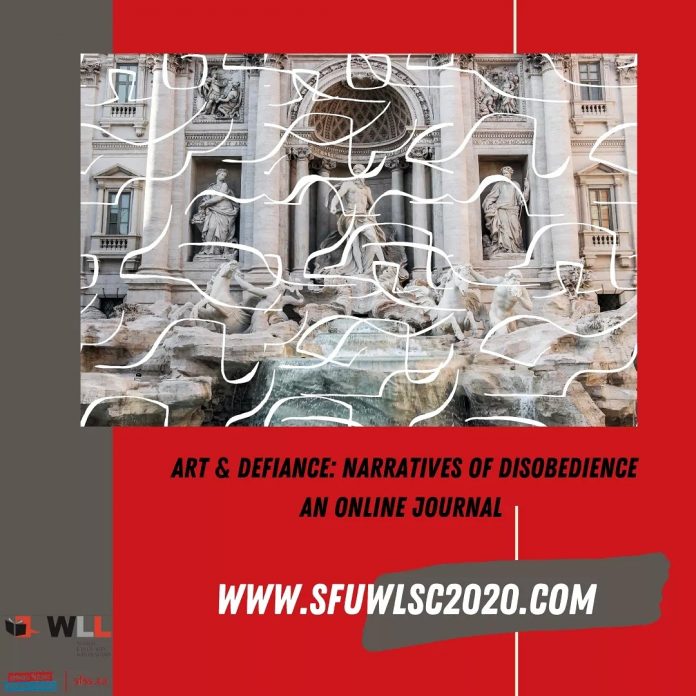
Art and Defiance: Narratives of Disobedience facilitates important dialogues around rebellious narratives

0
Interact with the Art and Defiance online journal and then attend the Q&A on November 20. Photo courtesy of the 2020 WLSC Communications & Design Team

By: Yelin Gemma Lee, Peak Associate

Editor’s note: Yelin Gemma Lee is involved with the 2020 WLSC as the Director of Communications and Design.

The World Languages and Literatures Student Union (WLLSU) presented the 6th annual World Literature Student Conference (WLSC) as an online journal, Art and Defiance: Narratives of Disobedience, on November 15. The conference, which typically occurs each spring, was postponed to the fall semester due to COVID-19, and then had to be reimagined through a virtual format. The WLSC team was dramatically reduced from over 40 members to 16 members, but this small but mighty team adamantly got back to work rebuilding the 2020 conference from the ground-up. 

Despite challenges such as these, the WLSC team decided on a dual-conference format that included the online journal, as well as a live Q&A over Zoom, set to occur on November 20 at 3:30 p.m. WLLSU president and 2020 conference producer Mizuki Giffin talked to The Peak about what this year’s experience has been like.

“We not only adapted to an online world, but we took the opportunity to thrive in this virtual environment,” explained Giffin. “We didn’t want to just transplant the in-person conference to Zoom, but rather to come up with a conference structure that was more exciting, interactive, and engaging for presenters and audience members alike.” 

The WLSC is known for offering students from all disciplines the opportunity to gain experience presenting their papers in a professional, academic setting — an experience that is invaluable on a resume or CV, but difficult to come by as an undergraduate student. The new virtual format, in addition to offering students the opportunity to be published academically, had the major benefit of opening submissions up to any virtual format including pre-recorded lectures, film shorts, poetry, photography, and more. 

“These were some of the best works we’ve seen because the presenters were really able to show[case] their creativity this year [ . . . ] The online journal [format] really allowed for such creativity,” said Giffin.

Art and Defiance: Narratives of Disobedience is both the name of the journal and its theme — a topic with as much relevance to current events as historical ones. The WLSC’s 19 published works are split into three sub-categories on the journal website: Resilient Voices, Media and Modernity, and Historical Defiance, each consisting of short films, short essays, narrated PowerPoints, poetry, and more that explore the subtopic.

This journal is a multimedia vortex of engaging niche discourse on how art propels narratives of disobedience, and explores what we consider “art” and the potential it has to act as sociocultural activism. Unlike a typical academic journal, the journal doesn’t read as block after block of text (as if any of us need any more of that right now), and is an innovative way to present student scholarship outside of the classroom setting. 

The dual-conference structure was created to make sure engagement with the material was a priority: the WLSC team didn’t want to lose this with the transition to a virtual event. The Q&A event is planned as a panel discussion, where audience members will have the opportunity to engage with the contents of the journal and the creators behind the work. Additionally, the contact section of the website also encourages any commentary and questions directed to the individual projects of the journal prior to and after the Q&A.

“It was both daunting and exciting to go off the script [ . . . ] The final 2020 conference is really the result of many students putting their ideas together and that’s what makes it so special,” Giffin says proudly.

The WLSC team, made up entirely of students, is showing event organizers transitioning into the virtual realm that there are ways to turn this obstacle into an opportunity to break new ground and try out new ways of engagement. 

The Q&A webinar requires registration through their Eventbrite page. Regular updates and details on the WLSC can be found through their Instagram @sfuwlsc. The 2021 WLSC is currently planned to progress in a similar format with a new call for submissions and call for volunteers in Spring 2021. 


Plot-heavy porn soars in popularity as the pandemic leaves population lonely

0
PHOTO: Charles Deluvio / Unsplash

By: Sarah Russo, SFU Student

VANCOUVER, BC — A wholly baseless study done by two horny dudes on Reddit revealed that their equally horny online friends recently started searching for porn with painfully lengthy intros “just to feel something” this past week.

u/gumcuzzler69 and u/asunamorelikeassuna teamed up to deliver this breaking news that no one asked for with a sample too cheap and unethical to pay for their porn, starting with a thread on the notorious social media site.

“yall what is it with the horrid acting at the start of this video that gets me off. there sitting on a couch breaking the 4th wall every 20 seconds by staring at the camera while talking to each other. ,, i miss talking to people” one friend wrote on the page.

“ya i feel u sometimes i watch videos with a girl in a laundry machine in the thumbnail not to watch them smash but just cause i know the two actors will prolong the agony with the ‘oH no I aM StUcK’ and then i think about my ex who did my laundry sometimes. and then i go, ‘maybe I should call her,’” replied another.

Seeing this trend, the two Reddit users asked around and discovered a correlation between the loneliness and the length of the porn videos watched. 

When they asked if live cams that involve watching and interacting with sex workers was on the table, a whopping 99.4% of respondants said “no” and that “bro those cost money idgaf.”

Instead, participants reported scouring free sites on Incognito mode, checking the length of the video for promising plotlines that promised some sort of lengthy introduction.

It’s fake, fabricated, false, but hell, it hits the spot. Yeah, twink, you struggle to open that pickle jar. I also struggle. It’s like I’ve found a new, relatable friend. The sex is a bonus or whatever, but those moments before when I hear someone talking . . . It’s like they’re talking to me,” wrote u/horndogcorndog22. 

It’s like that Rihanna lyric that says, “sticks and stones may break my bones, but discussions between BDSM actors in sweaty pleather surrounded by a nine-person crew in a poorly decorated staged home excite me.”