Home Blog Page 367

Need to Know, Need to Go: February 15–21

0
Illustration of a blue calendar, with "Need to Know, Need to Go" written on top
Arts & Culture events to catch around the city. Image courtesy of Brianna Quan

By: Charlene Aviles, Peak Associate

Performative Allyship versus Authentic Allyship, A Modern Look at How to Distinguish Harm in Marketing | Microsoft Teams | February 17 from 12 – 1 p.m. | FREE with registration

As part of the Museum of Surrey’s Anti-Racism Speakers Series, keynote speaker Dominique Jacobs’ talk will focus on differentiating between performative and authentic allyship in marketing and the impacts of both on the BIPOC community. Jacobs is currently the communications & resource development coordinator for the Support Network for Indigenous Women and Women of Colour. Registration is available by phoning 604-592-6956.

Introducing Kung Jaadee: 2021 Indigenous Storyteller in Residence | Zoom | February 18 from 7 – 8 p.m. | FREE with registration

In support of Indigenous storytelling traditions, the Vancouver Public Library began hosting the Indigenous Storyteller in Residence program in 2008. To start the 2021 program, Kung Jaadee will engage the audience with storytelling and drumming. Jaadee, a Haida language teacher and children’s book author, is from the X̱aayda (Haida), xʷməθkʷəy̓əm (Musqueam), and Sḵwx̱wú7mesh (Squamish) First Nations. Participants of all ages are welcome to register online.

Artist Talk with Tom Patterson – Khat-ku’uss | Online | February 20 from 1 – 2:30 p.m. | FREE with registration

The Bill Reid Gallery presents an Artist Talk with Tom Patterson, an artist who draws inspiration from his Nuu-Chah-Nulth culture. Patterson will present his silkscreen print, Khat-ku’uss. Registration for the event is available via Eventbrite.

Moxie’s Virtual Cooking Class | Online | February 20 from 3 4 p.m. | FREE with registration

Moxie’s Grill & Bar will be hosting an online cooking class with their executive chef Brandon Thordarson. Participants will be taught how to make an appetizer of roasted tomatoes with whipped feta along with a shaken lime margarita. The registration link and the list of required ingredients are available on Moxie’s website.

SFU gender and health equity researchers discuss sex work inequities during COVID-19

2
PHOTO: Mathilde Langevin / Unsplash

by Dev Petrovic, Staff Writer

SFU assistant professor in the faculty of health sciences, Shira Goldenberg and her research assistant, Jennie Pearson, spoke with The Peak about some of the issues facing sex workers due to COVID-19. This includes sex work criminalization, inaccessibility to government supports, and negative impacts on living stability. 

Their research is derived from “An Evaluation of Sex Workers Health Access (AESHA),” a community-based research project that works with cohorts of cis and trans-women sex workers across various work environments in Metro Vancouver. Goldenberg explained that they have been working with the women for about 10 years and have continued to follow-up with them throughout the COVID-19 pandemic, gathering preliminary findings for the research from them. 

Under current laws, many aspects of sex work are criminalized, leaving sex workers to navigate the health and safety inequities caused by stigma, policing, and different types of surveillance. 

Goldenberg explained that due to COVID-19, there is higher surveillance in the public health sphere. She added that “it has amplified these inequities — for not only sex workers — but other kinds of precarious workers too.” Goldenberg noted that in findings from around 200 workers, a third of workers had reported a complete loss of employment and a quarter had reported a reduction of work. Overall, it “resulted in a near-total loss of income for many.”

“One thing [sex workers] are also experiencing are safety concerns related to their work, including enhanced security, police surveillance, and kind of all under the guise of COVID-19 related measures,” reported Goldenberg, elaborating that there is also a significant lack of access to personal protective equipment.

Pearson added that sex workers in formalized venues have had difficulty retaining business during COVID-19 and that they “have been treated a little more harshly than other work industries in terms of how they are being policed and surveyed during the pandemic.” She explained that that the criminalization of sex work “has meant that sex work venues are excluded from work place safety standards, so sex workers haven’t had much official guidance in how to do their work safely during COVID-19 times.”

Goldenberg expressed that the impacts of COVID-19 have been different for various sex workers. For those “who are in informal spaces, there’s an intersection between housing policy and safer sex workspaces right now. So, you have policies that limit how many people can be in the building,” she said. “That’s their workplace, and that’s their income, and that’s all been taken away, that can be hugely problematic.”

Sex workers also continue to face barriers in accessing the technology to work online. Additional factors include a lack of private space, consistent internet access, and the criminalization of online advertising of sex work — including censorship policies. “The way that sex workers are still being removed from online platforms continues to hinder this potential avenue for sex workers to diversify their income [and] reach out to clients from a safer distance,” reported Pearson.

Pearson added that “folks have also experienced extreme [sic] negative changes to their food security, so access to essential services have suffered due to loss of income and changes to their housing environment and support services.” 

In their preliminary findings, Pearson shared that they found a majority of workers have not accessed or successfully received the Canada Emergency Response Benefit (CERB). Others have been cut off from CERB or are discouraged from applying due to the stigma of their occupation and potential repercussions, such as when filing taxes. This has resulted in many sex workers working in unsafe conditions or without income. 

“Our major policy recommendation always comes down to decriminalizing all aspects of sex work,” said Pearson. “We understand that this is a longer-term goal, so right now in the face of a pandemic, it’s important that sex workers have access to emergency supports and financial supports that are offered by the government,” Pearson explained. 

“It would be nice to see the government scale up available resources so that community groups, who are often best positioned to work in safe, non-stigmatizing, and non-threatening ways with the community — could distribute that safely without all the formalized requirements of the government,” explained Goldenberg. 

“We added a new piece to the study during the COVID-19 pandemic,” Goldenberg reported. “These preliminary findings suggest that workers are definitely experiencing serious concerns over reduced food insecurity, mental health, access to safe and supportive workspaces, and inequitable access to emergency supports, like CERB.” 

Some organizations that can benefit from external support, such as volunteers and donations, include PACE Society, WISH Drop-in Centre, SWAN, SWAV, and Him and Hustle


Monday Music: Feeling Yourself

0
"Monday Music" in giant yellow block letters with a red background
Monday Music: your weekly themed playlist. Image courtesy of The Peak.

By: Emma Jean, Staff Writer

Making yourself feel good can take many different forms. No matter what they are, having a slick, catchy soundtrack can make it even better. From strutting around the house in a new jacket to enjoying time as your own best sex partner, these danceable jams are all you need to feel sexy. 

Blow” — Beyoncé

Image courtesy of Columbia Records

A sleek, danceable ode to owning your own pleasure; no one does sexy bops like Beyoncé. Her sultry vocals over Pharrell-produced guitar licks and grooves make for a song that’s just as good to dance to as it is to do. . . other things. With lyrics about getting your “Skittles” eaten, it’s also an all-time contender for the grooviest song about getting eaten out. No matter what this song inspires, you know it’ll be good. 

Taste” — Betty Who

Image courtesy of Betty Who

The rhythmic beat and rising backup vocals dress this minimalist pop track, in which Betty’s growly and sometimes breathy vocals describe the sometimes complicated lengths she’ll go to satisfy herself. It feels like the more polished sibling of Florence + The Machine’s perennial banger “Bedroom Hymns,” but with a darker, poppier aura. To top it off, the steamy music video features two versions of the singer, one of who is literally seducing the other. If that isn’t self-love, I don’t know what is. 

Masseduction” — St. Vincent 

Image courtesy of Loma Vista Recordings

This growly, ominous track almost sounds like Prince wrote a Disney villain song. The title track from electro-rocker St. Vincent’s latest album is full of guitar shredding, synthesizers, and an overall feeling of both losing and gaining total control as St. Vincent yells “I don’t turn off what turns me on.” It’s a song that leans into an edgier side of self-love; just lip-sync along to the booming titular refrain to understand why. To quote Bill Hader in an immortal GIF, “Mark me down as scared and horny!” 

DMSR” — Prince

Image courtesy of NPG Records

It would be impossible to do a playlist like this and not include a track from the king of sexy jams himself. With the title standing for Dance Music Sex Romance, it’s hard not to get into the mood for one or all of those things while listening to this steady, slick synth marathon decorated with Prince’s rich, throwaway vocals. There are hundreds of articles about how sexy Prince songs are for a reason. Move your body to the beat as the High Priest of Funk intended. 

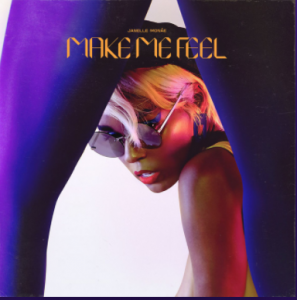
Make Me Feel” — Janelle Monáe

Image courtesy of Atlantic Recording Corporation

No one does electrifying jams like Janelle Monáe, but this one takes the cake. There’s not much to be said about this perfect banger, but it’s the ultimate way to feel cool as hell. The layered levels of keys, guitar riffs, and hushed vocals over a beat made up of Monáe’s own tongue clicks make for, as the song puts it, an “emotional sexual bender.” It’s a modern classic for a reason; let it take you away and see what it makes you feel. 

Online dating needs to be friendlier for trans and GNC folks

0
Identities outside of the gender binary aren’t welcome on apps like Bumble and Tinder. ILLUSTRATION: Siloam Yeung / The Peak

by Ciara Reid, SFU Student

Not long after hitting download on both Bumble and Tinder, I was faced with a problem I had not encountered in my last downloading spree, not being fully out to myself or others at the time. After taking the extra step of setting my gender to “non-binary,” I was confronted with a choice: do I want to be found when people search for men, or women? It was a slap in the face, but it was only one of the multiple issues I encountered as a queer person navigating dating apps designed for cis-heterosexual people. This issue higlights the considerable amount of work to be done in making online dating truly accessible for trans and gender non-conforming (GNC) people.

As journalist Mary Emily O’Hara confirmed in the Washington Post, apps like Bumble and Tinder “aren’t built to meet queer needs.” There are certainly queer and trans-friendly apps out there, such as HER and OkCupid, but given that Bumble and Tinder are the heavy hitters of the online dating world, it is unacceptable that their design is so ignorant of trans and GNC users’ needs. 

Some may think the issue I encountered wasn’t such a big deal. But giving us the option of correctly defining ourselves as non-binary, gender queer, agender, or in anyway gender transgressive, and then immediately asking us to make ourselves “findable” as either men or women delegitimizes our experience. It asks us to reduce ourselves in order to fit back into boxes that we have already shown do not apply. It effectively conveys what bigots on the internet tell us every day: that no matter how deeply we know who we are, we will never be seen as who we are. This exclusion demonstrates that online dating apps continue to both perpetuate and tolerate discrimination towards many trans and GNC people. 

I greatly appreciate the queer-specific apps available to us, and we should maintain them just as we maintain our own queer spaces. But we should not tolerate the marginalization that still exists in the online dating world. As drag performer Continental Breakfast told the Georgia Straight, simply moving to more inclusive platforms suggests accepting displacement over dealing with intolerance, as they did after being censored on Facebook. Indeed, mainstream society has long dealt with their discomfort of queer and trans presence by displacing us. Resisting this displacement and loudly calling attention to it is the only way we’ll see change.

To enact this change, let’s start by removing gender limited searches from apps all together. I know that this could add a lot of swiping labour as we would have to sift through a lot of folks we really aren’t interested in. However, it would prevent those of us with gender identities outside of the binary from having to diminish ourselves in order to play the dating game. 

In this lonely pandemic, many of us have been forced online in our searches for love and connection. At the very least, apps like Bumble and Tinder should ensure that none of us have our identities challenged or delegitimized in the process.

Your sexy SFU Horoscopes: February 15–21

0
An illustration of a girl with long flowing hair. Astrological signs and stars shine around her.
ILLUSTRATION: Marissa Ouyang / The Peak

By: Charlotte Gravert, SFU Student

On top of social distancing measures and a general lack of lust, Mercury is also in retrograde during this sex issue’s shelf life. With the planet of communication going bananas and love planet Venus moving into independent Aquarius, the only answer is to date yourself!

ARIES: Not only do you know exactly what you want, you also see no shame in always coming first. For your self-date, test your patience and see where it takes you. How far down your “Slow Sex” Playlist did you make it? Did you skip “Mr. Brightside”?

TAURUS: Your persistence, endurance, and stamina can be so annoying, but can also work in your lovers’ favour. Life is rough, but do you always need to be?

GEMINI: For your self-date, dive into whatever roleplay you’ve always been too scared to admit lives in your head rent-free. Remember those first butterflies in your stomach watching Simba grow up in the Lion King? Go. For. It.

CANCER: Let it all out boo. Crying is allowed here. Your self-date is all about holding space for yourself. Let the emotions flow. Don’t forget to bring tissues, they might be useful beyond dabbing your tears off. It’ll be a real tearjerker.

LEO: You are the master of self-pleasure and confidence. If viewing your own Zoom box isn’t enough for you, you can look up tutorials of making life-size cutouts of people. Anime fans have done it for years with their favourite characters, so why not? You are the main character.

VIRGO: Notoriously in need of control, this is the perfect date for you. Go to town with your shopping list of favourite treats (where’s that coupon?), create a spreadsheet of your favourite naughty Netflix scenes down to the seconds, and enjoy the meticulously timed evening all to yourself.

LIBRA: Yes Libra, you can have it all. Want to slouch in your sweats nerding out over your favourite fan-fiction AND be a Greek god yourself? Fictitious or for real, do it. Write about it on Wattpad (what was your password again?) . . . Unrelated, but can you send us the link after?

SCORPIO: Deep and dark Scorpios, buckle up for your personal pleasure séance. Make sure to lock the door so you remain unbothered while reaching the deepest level of your unconscious. Tell your catboy maid demon I said hi.

SAGITTARIUS: Freedom-loving archers, you don’t need Cupid to shoot an arrow! You received all the blessings from the sky to be your commitment-fearing self! Go window shopping on dating apps, but keep it fair and write in your bio that you “like adventures” so no one gets their hopes up about you.

CAPRICORN: Conservative Capricorns, stop hiding while you eat those Hershey’s Kisses and candy hearts! With no social norms to oblige or impressions to make, take up the challenge to do something just for you and not your reputation. Try some toys people have been buzzing about, instead!

AQUARIUS: Thriving in isolation is only one of your many talents. Hiding from the world is in style now, but you’ve been doing it for years! In the spirit of retrograde, make your date about opening up. Open that damn message you’ve left on delivered for four days already.

PISCES: This one is for all of you empaths out there! Shut off your phone, don’t let anyone taint your aura on your self-date. Get unapologetically creative. Let out your inner artist. How about writing some Terry Fox and Avocado fan-fiction? #Tervacado? #Avorry?

A summary of the 2021 SFSS candidate debate

0

by Jaymee Salisi, News Writer

On February 11, 2021, the Simon Fraser Student Society (SFSS) held a candidate debate for their 2021 Executive Committee elections. The Executive Committee is elected by the student body to represent undergraduate students and advocate on their behalf with SFU administration and governing bodies outside the university. Candidates introduced their platforms and answered questions from other students regarding their potential plans with the SFSS. The Elections Chief did not approve all candidates simultaneously, which may have affected campaigns. The Peak reached out for more information, but did not receive a response.    


President

Current Vice President (VP) University Relations, Gabe Liosis, stated that he is running because he believes that “students deserve a Board that embraces student unions and activism.” 

He added that he has “the knowledge and the information necessary” to lead the SFSS under its new governing system. He explained that the position of VP Equity and Sustainability will be introduced in May to the Executive Committee. Additionally, the new structure will have seven people on the committee who will be accountable to the legal Board of Directors.

He aims to bolster the tuition freeze movement by pushing the government to provide more public funding to post-secondary institutions. 

Liosis also stated his commitment to continue pushing for the pass/credit/no credit system for all courses, stop exam proctoring, and aid in the implementation of the Burnaby Mountain Gondola project. 

He explained he would give historically silenced voices, such as Students of Caribbean and African Ancestry, Out on Campus, the Women’s Centre, and First Nations Student Association, guaranteed seats on the decision board. According to Liosis, the university’s relationship with the RCMP can be harmful to students so he plans to find “different forms of community policing that aren’t harmful to BIPOC communities.”

There were no other candidates for this position. 


Vice President of Internal & Organizational Development

Previously the VP Finance and Services, Corbett Gildersleve cited his experience in reducing the administrative budget by $400,000 and stated his plans to “modernize the SFSS, develop workshops to train core student union executive positions, and continue to make the SFSS more open and accessible.” He stated his intent to do this by using his involvement in anti-oppressive committees to develop and integrate equity-focused training for the Board.

While Ronit Chawla was absent from the debate, his online platform outlined his involvement in leadership at SFU as VP Finance for the SFU Cricket Club and VP Planning for SFU Fashion Week. He hopes to work towards a tuition cap and work/study program that gives all students a chance to participate. Details were not provided. Students are encouraged to contact Chawla with further questions through the email listed online.


Vice President of Finances & Services

Cole Gorst explained that his experience with general accounting for the Newton Canadian Baseball Association would make him qualified for the position. Gorst’s platform states that the SFSS has not financially aided students. He plans to change this by reducing fees using the financial surplus of the SFSS and increasing communication and engagement with the student body.  

On his online platform, Gorst expressed that the SFSS “failed to provide students with the full story and immediately jumped to conclusions without first properly researching the issue,” regarding the December 2020 arrest of the Black alumnus on campus. He stated he would “encourage responsible representation of SFU students through fair, unbiased, and professional communication.”

An anonymous attendee claimed that his platform was reactionary and centred around white supremacy. Gorst responded, “Trust me I’m more diverse than you think.” He welcomed others in the chat to speak more about his plans on social media.

With a background in human resources and bookkeeping, Almas Phangura’s platform stated her commitment to increasing student support and funding for student advocacy activities by creating a three-year financial plan. She also committed to creating an international student fee cap. Details were not provided. Phangura did not attend the debate, but students are encouraged to discuss her plans further through email or social media.


Vice President of University and Academic Affairs

Serena Bains was the only candidate for this position. They stated that in the past, they advocated for the needs of marginalized students as a SFU Disability and Neurodiversity Alliance Representative for the SFSS. To move towards making academia accessible for everyone, Bains explained that they have begun creating an accessibility bursary without a GPA requirement for students. 

“As a disabled student, this is an area that’s really important to me, so it’s definitely a priority of mine to try and center disabled students at SFU and to try to ensure that academia is accessible to all.”


Vice President of External and Community Affairs

As the current VP Student Relations, Matthew Provost outlined his experience building relationships with the community at large and advocating for change based on their needs. He plans to collaborate on “climate justice initiatives with groups on and off campus.” He also hopes to continue working towards creating equitable and accessible student services by taking into account the “different intersectionalities that students face,” and collaborating with food banks and community groups. 

Karan Sharda currently serves the university as President of the Indian Student Federation, and aims to provide students with financial stability by increasing part-time job opportunities. He looks forward to pushing for a four-year tuition freeze to allow students to plan their expenses ahead of time. No further details were provided. Sharda did not attend the debate but welcomed students to contact him for more information about his plans through the email listed online.


Vice President of Equity and Sustainability

The SFSS’s newest role is responsible for ensuring that all directors, staff, and members receive anti-oppressive training, and that those endorsements are reflected throughout all of their activities. VP Equity and Sustainability must also work with and represent marginalized groups in the Society.

Marie Haddad described her experience as a member of the BIPOC Committee of the SFSS as well as her involvement in changing the SFU athletic team name. She stated her commitment to pushing for systemic change by “redressing Black harm” and amplifying the voices of Indigenous students throughout her service. Haddad stated that she would invite marginalized students to administration meetings to provide their input. 

Avneet Kaur aims to work towards changing SFU’s diversity policies during the recruitment processes for senior leaders. She emphasized that her campaign is not built on previous work in equity and sustainability, but rather about coming to students with an open mind to “have continuous dialogues around equity.” 

During the rebuttal period, Kaur explained that she has addressed her privilege and unconscious biases, “I spent a lot of time educating myself because this was not a part of my culture [ . . . ] back in India.” She believes that students need a leader like herself, who is approachable and willing to learn because every community has different experiences. 


Vice President of Events and Student Affairs

As the current University of Academic Affairs Member-At-Large, Jess Dela Cruz described her plans to bring activity to the SFSS “through an equitable framework.” She stated that she is committed to providing student groups with the resources needed to foster a safe and inclusive environment. 

Moving forward, Dela Cruz plans to encourage student groups to be inclusive by stating their names, pronouns, and access needs in every meeting, and for clubs to provide trigger warnings before potentially harmful content. If elected, she hopes to hold a student appreciation event to credit students, and reduce barriers, and award bursaries.

Experienced with involvement at  Let’s Talk SFU, Jyotnoor Kanwar aims to work on improving mental health initiatives, bursary programs, and engaging events. She shared her plans to create a group for students to have companionship and support during the pandemic. Kanwar said she is committed to collaborating with other executives to provide financial aid for students through bursary funding. She plans to provide students with opportunities to learn from SFU alumni to improve their skill sets. 

Drawing from volunteer experience such as tutoring children and “helping a research team with data management,” Gerard Corr’s platform stated his aim to make himself accessible to students and improve communication between clubs to foster student engagement. He would do this by getting feedback from club leaders and members. Corr also emphasized his goal of implementing mental-health initiatives. If elected, he plans to distribute a survey to find out what kinds of events students wish to see from the SFSS, and organize accordingly. Corr did not attend the debate due to getting his wisdom teeth removed but students are welcome to contact him if they have any questions.

Pooria Arab was also a candidate for this position, but did not attend the debate or submit a platform.


Referendums

Four referendums were announced during the debate: 

  • a housekeeping bylaw to fix typos and clarify processes on the SFSS website
  • re-ordering how bylaws appear in the SFSS bylaw document
  • financial restrictions on administrative wages
  • a policy restriction to prevent future boards from contributing to climate change

Full candidate platforms can be found on the SFSS website, and students can vote from February 16-18 via SFU Mail.


Why voting in the 2021 SFSS executive committee election is important

0
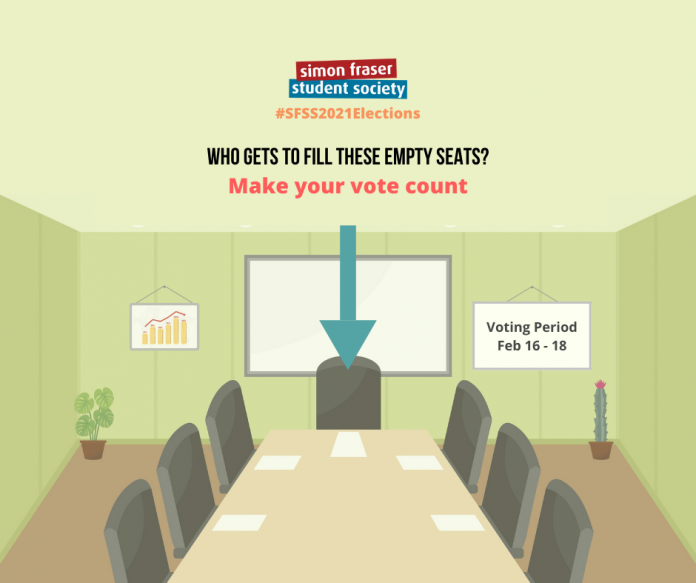
The voting period is open February 16-18 online through SFU Mail. The voting period is open February 16-18 online through SFU Mail. Image courtesy of Simon Fraser Student Society via Facebook

by Madeleine Chan, Opinions Editor

Last Fall’s Simon Fraser Student Society (SFSS) annual general meeting saw over 600 students in attendance one of the largest turnouts since the fervoured attendance of the 2018 impeachment. It seems like students want to, and are becoming more involved with how they are governed at SFU. To continue building this momentum of student engagement, students should be voting in the upcoming 2021 SFSS executive committee election and encouraging other students to do the same.

Voting in this year’s election should be especially desirable for all students considering the amount of discourse around the SFSS in the past year. These opinions have ranged from believing the SFSS is not suitable for governing students to believing that they are incredibly competent. One of the easiest ways students can act on their beliefs is by voting in those who they think are qualified. Directly influencing who constitutes the SFSS’ leadership by voting enables students to have their voices heard at SFU — something that seems to be in short supply when it comes to SFU’s administration. 

Low-turnout rates in previous elections show just how much student engagement has been lacking. Last year, all of the candidates were elected with less than 1,000 votes. Some of the faculty representatives were elected by a difference of a couple dozen votes, with some as low as two votes. This shows just how close the elections can be, and that every student’s vote matters. Previous years haven’t been much different either, with none of the candidates in the past four years being elected with more than 2,000 votes, despite the undergraduate student population of SFU hanging around the 25,000 mark. 

The SFSS is something that students have control over, especially when compared to other forms of government. It’s literally like a mini government that only pertains to, and is run by, SFU students. It’s not like a provincial or federal election where millions of people are voting. There are only a couple thousand that have that power here so each vote has more relative potential for change. This is a democratic power that students have the undeniable right to use, and should take advantage of while they can. 

In addition, this year’s election ballot comes with referendum questions that impact students beyond who leads them. One of these questions asks if students will agree to a new bylaw that would ensure any future investments by the SFSS are “fossil fuel free.” On top of deciding who leads them, students can participate in a decision that takes away any possibility of the SFSS fiscally contributing to greater carbon emissions, and could help BC’s climate plan

There should be no excuse for not voting in the upcoming SFSS executive committee election. The ballot link goes directly to students’ email and candidates’ platforms are readily available on social media pages. Whether students are happy with the direction the SFSS is going in, or looking for change, they should be voting in the upcoming election. This is the time to be heard.

Students can vote from February 16–18 through an SFU Mail link. A list of candidates, platforms, and more information on the election can be found at sfss.ca

QUIZ: What will your first post-COVID romance be?

0
PHOTO: Kelly Sikkema / Unsplash

By: Kyla Dowling, Staff Writer

It’s been the topic of your dreams, daydreams, and occasionally your nightmares, but it’s fine because fear is an aphrodisiac: what will your first love affair in a post-pandemic world be like? As vaccine rollouts continue and people slowly learn not to take off their mask when sneezing, you’ll soon be able to hit a frat boy’s Juul with only the risk of getting mono. By analyzing your fatal flaw, your last sexual experience, and more, we will determine exactly what your first post-COVID romance will be. 

Question 1: If you were a vampire, what kind of vampire would you be? 

A. Thousand-year-old genius stuck in the body of a petulant eight-year-old

B. I would wear only black and live in a castle: sexy, but utterly lonely

C. Edward Cullen, probably

Question 2: Which of these lyrics do you most resonate with? 

A. “I’m a socialist, Marxist, libertarian slut” – “Feel Better” by Penelope Scott

B. “I’m so 3008, you’re so 2000-and-late” – “Boom Boom Pow” by Black Eyed Peas

C. “Pockets on Shrek, rockets on deck. Tell me what’s next? Alien sex” – “E.T. Remix” by Katy Perry and Kanye West

Question 3: What best describes your last sexual experience? 

A. Like Danny Devito. Short, but memorable

B. “Netflix and Chill” while watching Pulp Fiction with a film bro, but he only came when I started talking about how the briefcase symbolizes Wallace’s soul 

C. Wait, you guys are having sex? 

Question 4: If you had to get a tattoo right now, what would it be? 

A. An infinity symbol, because life is an endless cycle and soon I will be reincarnated as a snail whose shell gets pulled off by a snotty third grader, which is probably better than the life I’m living now 

B. A lyric from my favourite emo song that I will certainly regret within five years 

C. A strikingly realistic image of the SFU avocado 

Question 5: What is your default action when you don’t have to put your camera on in lecture? 

A. Shove fistfuls of popcorn into my mouth with the determination of Kirby swallowing his enemies 

B. Plucking a single eyebrow hair every time someone plays the devil’s advocate. I’m in a poli sci class and currently have three strands left 

C. Look at my report card in the fourth grade where Ms. Harmon called me a “pleasure to have in class” and weep at what I’ve become 

Question 6: What is your fatal flaw? 

A. I have about two brain cells, but I lent both of them out. Rebecca, if you’re reading this, I need those and my worm-on-a-string costume back 

B. The fact that I am still attending SFU despite tuition being raised, not getting the classes I wanted, and Joy Johnson personally spitting in my mouth and calling me a whore 

C. This is really hard for me to admit, but . . .  my fatal flaw is that I have a fat ass

Question 7: What tarot card do you resonate with most? 

A. The Hermit. I am simply an old lonely little man. Please do not perceive me

B. The Devil. The only reason I watch reality TV is to see people more miserable than I am

C. The Moon. I too am mysterious, sexy, and prone to obsessive tendencies

Question 8: If you were a cartoon character, what would be your default outfit? 

A. Cat ears and a maid outfit. I’m not saying I’d call Spongebob master, but I’m also not not saying that

B. A long black robe with lace sleeves so I can pretend to be a widow pretending to grieve my partner that I killed instead of the sad university student living on caffeine and tears 

C. I have long ebony black hair (that’s how I got my name) with purple streaks and red tips that reaches my mid-back and icy blue eyes like limpid tears and a lot of people tell me I look like Amy Lee (AN: if u don’t know who she is get da hell out of here!). I’m not related to Gerard Way but I wish I was because he’s a major fucking hottie. I’m a vampire but my teeth are straight and white. I have pale white skin.

Results

If you chose mostly As . . . 

You know what you want in life, buddy, and if there was no pandemic, you probably would have taken over the world (or at least a small country by now). Your first post-COVID love affair will be with someone who can temper your absolute dismissal of the powers that be: an engineering student from UBC. The bridges they build will have more integrity than they do. Have fun!

If you chose mostly Bs . . .

Your first post-COVID infatuation will be ripped right out of your mother’s favourite erotica. As you soak in the tub after a long day of classes, you’ll hear the window of your bedroom creak open. Fearful, yet curious, you’ll wrap yourself in your floral Victoria’s Secret robe and tread carefully into your room, only to find a man dressed in black climbing through your window. “Who are you?!” You’ll gasp. The man will look up at the sound of your voice, and you’ll be immediately disarmed by his chiselled jaw and piercing eyes. “It doesn’t matter who I am,” he’ll say, his voice like liquid nitrogen, his eyes seeming to devour your body. “I want to know all about you.” He’ll walk towards you as you shake with fear — no, anticipation — and … I’ll let you take it from there. 

If you chose mostly Cs . . .

The only love you’re deserving of is the one that you’ve held onto all pandemic: bubble tea. There’s something about your prolonged eye contact with the cashier, the graceful way you stab the straw into the lid and it slides right through, those delicious balls coursing their way down your throat and settling like unused insulin in your pancreas . . . who needs human affection? Who needs a soulmate? Certainly not you (you say between sobs and sips).

Embodiment coach and influencer Tara Teng on breaking out of purity culture

0
With over 12,000 followers, Tara Teng’s sex-positive brand has become a social media sensation. Image courtesy of @misstarateng via Instagram

By: Emma Jean, Staff Writer

“Embodiment” is a key concept in Tara Teng’s work. It’s in the name of her popular Instagram account, part of her job title as an embodiment coach, and all over her website and online presence. But what does it mean? To Teng, it’s many things, but mainly, it’s the act of connecting your mind back to your body. 

“All the messages that I was raised in was [sic] that ‘your body is sinful’ and ‘you can’t trust your body’ and ‘your body is going to lead you astray,’” Teng explained in an interview with The Peak. “Embodiment is the practice of coming back home to your body, living in your body, experiencing the world through your body and noticing that how you navigate the world in your body matters. It’s an essential part of us being human, and yet, in Western culture, we’ve been disconnected from our bodies. [My work recognizes] how political of an act it is to come home to our bodies.” 

It’s clear that Teng’s message resonates. With approximately 12,100 followers on Instagram alone, Teng has built a strong community that connects with her work. Her posts address issues around overcoming sexual shame, deconstructing patriarchal and colonial ideas of sex and gender, and merging her Christian faith with a liberated idea of sexuality — all of which are rooted in listening to the body. Those same concepts are applied through her sessions as an embodiment coach, during which she works one-on-one with clients to guide them to connect with their bodies and work out internalized beliefs that harm their ability to do so. 

Teng explained that she is both a product of the evangelical church and a millennial who grew up in a time of abstinence-only education and a general culture of fear around expressing sexuality. As such, she sees a wide-spread need for the work she does as both sides of her upbringing fall under the category of “purity culture” — a term often used by ex-evangelicals to describe the sexual repression taught by the church and Western culture.

“Fast forward now to today, and we have all of these adults who were raised in purity culture [and] who were taught from a very young age to distrust our bodies, our bodies are sinful, [and] pleasure is something to be ashamed of,” Teng explained. “Maybe they were never even able to explore their sexuality because they were only given a heteronormative narrative, or maybe they were shamed for any kind of exploration of their sexuality so they never learned how to establish their boundaries [or] a healthy sexual ethic.” 

In order to rectify this, Teng describes her coaching role as being a mediator between her clients and their bodies. “I don’t say that I’m a teacher because I don’t think that anybody can teach you about your body or your connection to the divine [ . . . ] My job as an embodiment coach is to help you ask the right questions so you can dive deeper into yourself [to] uncover these things.” 

For individuals trying to break out of a purity culture mindset, she recommended talking to a peer or a professional who can help you to safely explore your discomfort and aid in how to listen to and trust your body. With that, she said, true intimacy with yourself can be established and relationships can be sought from a place of “abundance,” not “scarcity.”

“I don’t have to depend on anyone else to love me because I love me. I don’t have to have anybody else give me orgasms because I give me orgasms,” Teng laughed. “All of that, just being able to stand alone as a person [ . . . ] for people who grew up in purity culture, who were taught that our body doesn’t belong to us, that’s really, really powerful.” 

To find out more about Teng’s work, visit her website, her Instagram @misstarateng, her TikTok @misstarateng, or her Patreon.

SFU professor Dr. Mo Chen appointed as a Canada CIFAR AI Chair

0
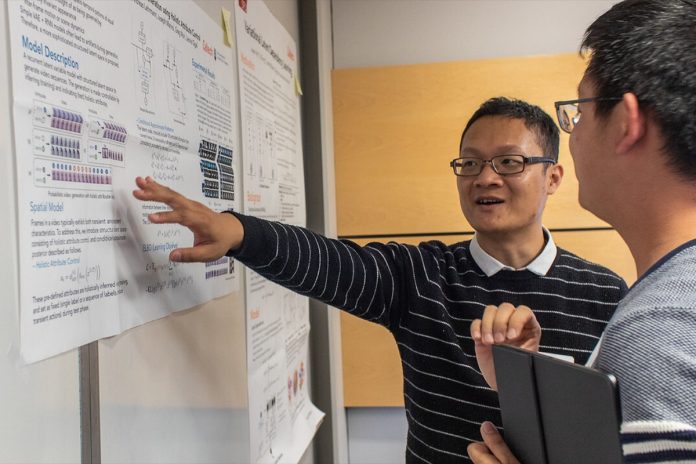
Photo courtesy of SFU News

Written by: Charlene Aviles, Peak Associate 

Dr. Mo Chen, an SFU computing science professor, is researching  algorithms that program robots to anticipate human reactions. He aims to increase the safe interaction between robots and humans so that robots can independently “respond to dangerous situations” and “co-exist with humans.” 

In an interview with The Peak, Chen described plans to further his research. His past work at SFU’s multi-agent robotic systems (MARS) lab included training robots to safely maneuver around obstacles. 

Chen acknowledged that despite the increased reliance on robots, it is “still limited by the lack of safety.” He added that future research needs to identify the “fine balance between being safe enough and being too safe” to allow robots to interact with humans. Chen explained that safe interaction between humans and robots opens the door to many opportunities, such as self-driving shopping carts and robots directing shopping mall customers. 

“When we think about computer programs, AI, or maybe the current robotics, we think of the robots responding to the environment as they sense it, but I think they need to do more. They need to make decisions based on how they think their actions will cause reactions.” 

The Canadian government invested $125 million into CIFAR’s Pan-Canadian Artificial Intelligence Strategy. The Canada CIFAR Chairs program has access to $86.5 million to fund research on AI. As a CIFAR  AI Chair, Chen receives more  funding for his research. 

As the principal investigator of SFU’s MARS lab, Chen also supervises student research on “principled robotic decision making.” He recommends that computing science students take special topics classes before taking Computing Science 415/416, which offer opportunities for lab work. 

He also encourages students to apply for undergraduate student research awards (USRA) to fund their research. 

When asked about his research at the SFU MARS lab, Dr. Chen stated “Different people trust robots more or less [ . . . ] Everyone is entitled to their opinions, but I do want to say that we should all be try to be more educated in this field, so that whether we trust robots or whether we’re skeptical, we do so in an informed way.”

In addition to Chen’s new position as a Canada CIFAR AI Chair, he is also a Alberta Machine Intelligence Institute (Amii) Fellow and NSERC Canadian Robotics Network (NCRN) Distal Fellow. Chen has won numerous awards, which include the UC Berkeley EECS Eli Jury Award and UC Berkeley EECS Demetri Angelakos Memorial Achievement Award.