Home Blog Page 345

The SFSS approves pay raise to align with living wage model

0

Written by: Kelly Chia, Staff Writer 

As of May 2021, the Simon Fraser Student Society (SFSS) Board of Directors and Council merged to form one governing body. They also approved a pay raise for the SFSS members. The Peak spoke to vice president internal and organizational development Corbett Gildersleve on the changes.

He explained that by merging Council and Board together, Council can be more directly involved in the decision-making process. With the new model, alongside traditional responsibilities, some Board members have additional executive responsibilities, like approving the annual budget and long-term contracts and administrative work.

With the new model comes an increase in pay. Last semester, Gildersleve looked at how much money SFSS councillors receive for their work. He discovered their pay hadn’t been changed since 2008. Biweekly stipends amounted to roughly $14.50 per hour which put councillors below the minimum wage for 2021.

The SFSS “has historically been a living wage employer with exceptions for some student staff,” Gildersleve explained. He constructed stipends based on the living wage model and found that they should go up to $17.96 an hour, and then $19.50 in 2022/23. The motion for the raise was approved in April 2021.

Gildersleve said the motion to merge the two bodies started with a review of their administrative and governance structures. 

The previous model was intended to separate the Board of Directors from tasks that could be done by the other SFSS administrative staff while the Board focused on governance work, like reviewing plans and the work of the executive director. 

However, by focusing on governance work, Gildersleve observed that each year, Board members learned less. While “people tend to be on Board because they have passion for the work and want to be able to use their skills to benefit the Society,” the previous model presented limitations to those skills.

The Board wanted to restructure their model so that Board members would still do governance work, but also be more directly involved with student life. “A lot of Board members wanted to be directly involved in planning events, or helping change some rules to help clubs to get grants.”

As the Board began to work on a new model, they worked with Council to ensure they were involved in the consultation process. 

Gildersleve said that up until that point, Council was an advisory body, indicating that they had less say in the decision-making process. While Council had an advisory role — the Board was not required to follow their advice. This resulted in clashes between the two governing bodies. 

“What came out of the discussions with Council was the idea of merging the two together so that Council would have much more of a direct oversight role,” said Gildersleve.   

The Peak reached out to Council for more information, but they did not respond by the publication deadline.
Your new pandemic best friend: the raccoon

0
ILLUSTRATION: Shaheen Virk / The Peak

By: Kelly Chia, Staff Writer 

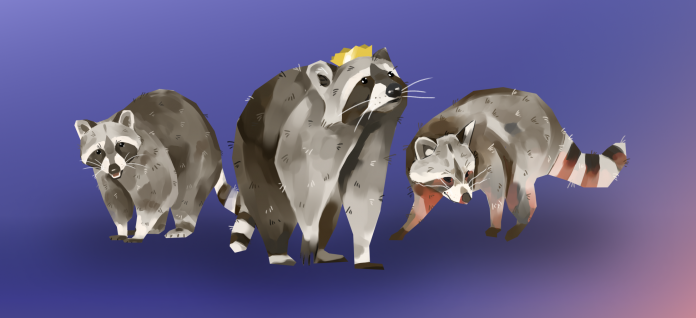
Are you looking for some raccoon therapy? Imagining a domesticated life with our residential furry friends? Well, we’ve made some observations of our most popular raccoons, and we think they’re ready to help you through the new term. 

Trent “Tom Nook” Grubs

ILLUSTRATION: Shaheen Virk / The Peak

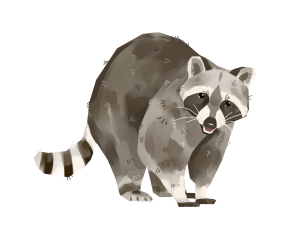
Trent is part two-year-old raccoon and part real estate agent. He has a fluffy coat and a wide grin that is often mistaken for a suspicious-looking grimace. He assesses every newcomer based on three things: their ability to give him food, their ability to give him shelter, and overall swag. Trent has been dubbed our resident “Tom Nook” because he seems to have an amicable relationship with the other raccoons, finding them new homes before rubbing his little paws together greedily. He enjoys affection and a good scratch on his head, but his favourite activity is nestling into discarded print issues of The Peak.

You know how Tom Nook leases homes on endless mortgaging? Trent will also lease your food, and your heart, if you let him. 

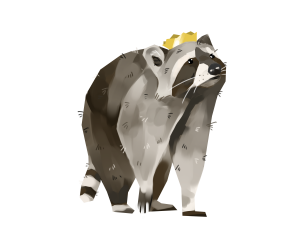
Her Majesty, the Auspicious and Beautiful Marcella XXXIII 

ILLUSTRATION: Shaheen Virk / The Peak

If you look into Marcella’s beady little eyes for too long, you will be swept into the vortex of her stare. There, you’ll find meaning in the quiet and dignified life of our resident princess. Marcella is the most graceful thing you will ever have the privilege of witnessing. She has short claws, but that has not stopped her from her royal duties of being the most good-looking masked creature on campus. She is also our only hoarder. Marcella is all about using crystals to manifest her dream life, and has accumulated an impressive collection of smooth pebbles that she washes. In fact, she washes everything she touches like the pandemic queen she is. Marcella is often spotted taking her snacks and dipping them into the nearby pond to clean them. 

Marcella is eight years young, with a healthy round tummy that suggests she has only ever indulged in the world’s finest recycled goods. She will make a good friend for the student who enjoys just a bit of indulgence.

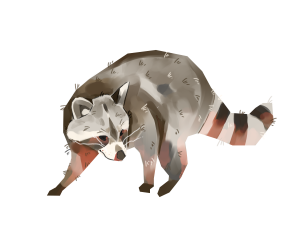
“Curious” George

ILLUSTRATION: Shaheen Virk / The Peak

George is a problem. A menace. We love him dearly. 

You see, George is the sneakiest raccoon you will ever see. All he ever wants to do is steal, and by the time you see his glowing eyes in the dark, it is much too late. 

He will purr. Yes, we did not know raccoons could purr before George here. He will walk up to you, tail swaying from side to side to enchant you. Then, he will take every sandwich meat that you have ever loved before you can even say the word “thief.” 

We often spot him tripping over his own paws as he runs excitedly to greet you, hoping that you have brought him an offering — whether intentional or not.

Yet, despite his thievery, he also seems to be a loyal guy. George tends to shadow you, somehow concealing his skittering, and before you know it, you have a raccoon that is staring at you as though you are the love of his life or a particularly delicious pastry. He will be more loyal and consistent than Canvas maintenance, and would make an excellent pal with whom you can share your time (and snacks).

SFUnexplained: Images Theatre is definitely haunted

0
ILLUSTRATION: Danielle Ragas / The Peak

By: Carter Hemion, Staff Writer

Have you ever wondered why time passes differently in Images Theatre? Have you felt a strange breeze when all the doors were closed, maybe with an unusual smell? (And no, the smell from your classmate’s apple-cinnamon-gasoline-flavoured vape doesn’t count). Have you noticed how the temperature seems different from outside corridors? If you answered yes to any of these questions, you will be glad to know there’s a perfectly logical reason for these phenomena: ghosts.

This lecture hall, with a capacity of 440 living people, is never unoccupied. It holds resentful spirits, likely angered by the constant campus renovations. Ghosts can be awakened by construction, and these university dwellers are no exception to this. 

I recall my first experience with an Images ghost vividly . . . The raccoons were especially distant, not trying to steal my lunch that day, as though they sensed something was off. At first, I thought it was odd there was an extra shadow behind my professor. I figured the lights were broken, just like every vending machine in the AQ. Then it happened. About 10 minutes into the lecture, a pale figure in a black suit slammed the door open, seemed to float down the aisle, and sat in the front row. It was the spitting image of a Beedie student — an overachiever in formalwear — but its eyes weren’t vacant enough to truly be an SFU student. After the break in that lecture, I never saw the figure again. Nobody else seems to remember or recognize the apparition, but I will never forget that gaunt face as long as I live.

If you don’t believe me, put together the evidence yourself. 

Students frequently lose their things in Images Theatre, never to be found again. Every time we leave the theatre, pathways across campus seem to change, with staircases leading nowhere and ladders pointing to nothing. Unusual stains appear, looking like blood but smelling like there was a sale on White Claws at Cornerstone. Pay attention: this is no coincidence.

When walking through the AQ late at night, it always seems relatively quiet . . . except for Images Theatre. Listen closely and you may hear the piano playing “Bring Me To Life” by Evanescence in a botched minor key, or what sounds like students’ voices yelling and watching movies; if you’re lucky, you might even hear faint voices singing old ABBA songs. Since SFU started the pandemic, construction has continued disturbing the spirits. It’s so severe the theatre is completely locked up to contain them. 

If you stand in or near Images Theatre in quiet hours, listen for the unnaturally loud buzz of the lights. If you take lectures there, notice how often your professor struggles with the projector and other technology. It is a comprehensive, respected post-secondary institution staffed with highly educated individuals with decades of experience in education. Therefore, it can only be the ghosts. This is Canada’s engaged university. It easily renovates every building constantly. Its budget grows with every tuition spike. These occurrences cannot be explained naturally. 

The worst part of it all? SFU has never tried to hide the hauntings. It’s called “Images Theatre” after the images of the dead, seen so frequently that even faculty cannot deny it.

Incoming SFSS president Gabe Liosis discusses plans for the upcoming year

0

Written by: Jaymee Salisi, News Writer

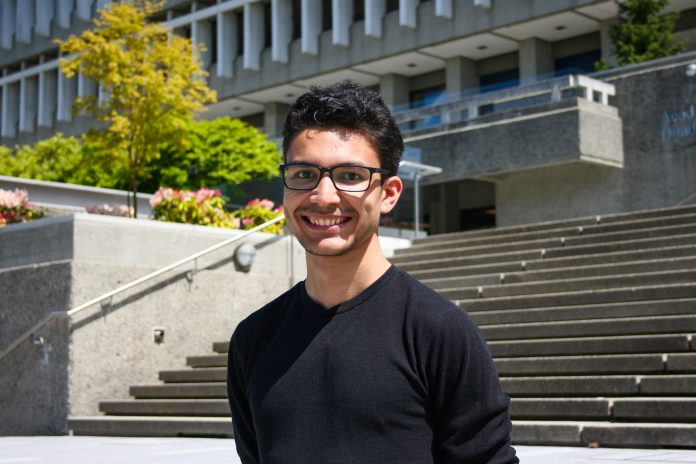
With a focus on equity and amplifying marginalized voices, Gabe Liosis has begun his term as president of the Simon Fraser Student Society (SFSS). Liosis spoke with The Peak about his goals for the 2021/22 year. 

Students deserve a student society that embraces student unionism and activism,” he said. “I [have] a unique knowledge of how the SFSS is structured, how it works, and what is needed to make this new governance system thrive.”

He said he is prepared to provide new councillors with efficient training and support to serve under the new governance structure where Council is “the top decision-making body in the SFSS.” 

Liosis chose to get involved with the SFSS after he observed the 2019/20 Board “intentionally disregarding the impact” of on-campus space for marginalized communities. Because of this, he served as Council chair from January 2020 to April 2020 and continued as vice president university relations in 2020/21.

During his time with the SFSS, Liosis advocated for the Pass/Credit/No Credit grading system, the development of the Burnaby Mountain Gondola, and the end of SFU’s pilot  exam proctoring during remote learning. 

 “By the end of this year, I really hope that we will have built an organization that will perpetually foster advocacy and activism”

“By the end of this year, I really hope that we will have built an organization that will perpetually foster advocacy and activism,” Liosis said. 

Using his knowledge of the SFU bureaucracy, he hopes to make bursaries more accessible, implement a tuition freeze, and distribute emergency funding to support students amidst the COVID-19 pandemic. 

With the consultation of marginalized communities, he also aims to focus on working with SFU to change its policing and safety practices on campus.

As the university plans to reopen for in-person classes, one of Liosis’ priorities is to ensure the return to campus is a safe and positive experience. To do this, he aims to develop a detailed safety plan with the university and province for the Fall 2021 Student Union Building reopening. 

Through his experience as vice president university relations, Liosis said he learned to build solidarity with students, and pushed SFU to support BIPOC community members.

“Mobilizing undergraduate students around fundamental systemic issues is critical,” he said. “The best that you can do in terms of advocating for students is speaking truth to power.”

Liosis aims to contribute to the development of the new Black Student Support Centre and Student Advocacy Office “to further strengthen the SFSS’s advocacy capacity.” The Student Advocacy Office will represent and advocate for students who are in a dispute with the university. 

“When making decisions, I always want to be making them from an equity lens, ensuring that the voices of folks who are most marginalized are being heard.” Leading decisions centred around equity, Liosis said the SFSS needs “bold, radical, and progressive voices” to drive systemic change within the SFU community. 

I hope that the principles of fighting for BIPOC communities who suffer the most from systemic disadvantages are never lost [ . . . ] We need to be very intentional about the spaces we are creating, and how we treat people in those spaces.”

“The Hafu It” podcast educates others on the experiences of mixed-race Japanese Canadians

0
Kiyoko Sugimoto and Sakura Yoshida celebrate Japanese identity both on and off the air. Image courtesy of @hafuit via Instagram

By: Charlene Aviles, Peak Associate

This May, Vancouver is celebrating Asian Heritage Month with a full list of cultural programming. Running until June 10, the 25th annual explorASIAN Festival features museum and art exhibitions, podcasts, performances, and more. One of these special events is a collaboration between The Hafu It podcast hosts, Kiyoko Sugimoto and Sakura Yoshida, and the Vancouver Japanese Language School and Japanese Hall (VJLSJH) — VJLSJH x The Hafu It: A Homemade Pilgrimage

During my childhood, mainstream media had few BIPOC and mixed-race protagonists. What drew me in the most about The Hafu It podcast is that the hosts amplify mixed-race people’s voices. Hafu translates to “half” in English and refers to people who are half-Japanese. In it, Sugimoto and Yoshida detail their experiences of rediscovering their Japanese heritage as mixed-race Japanese Canadians. At the same time, they educate the audience on Japanese culture and history. Although I am not Japanese, I found the experiences described by Sugimoto and Yoshida reminiscent of my own as a Eurasian woman. 

The first episode, “Our Issei,” explains the history of Japanese immigration to Canada, as well as each hosts’ family histories and their experiences with racial impostor syndrome.

Sugimoto and Yoshida begin by recounting the history of Japanese immigration to Vancouver. The first wave of immigrants travelled by boat and built a community concentrated around Powell Street. They gave birth to the Issei, which Sugimoto defines as the “first generation of [Japanese] people to be born in Canada.” But in Vancouver, they faced discrimination and oppression, as reflected by the 1907 anti-Asian riots, limited job prospects, and internment camps. Sugimoto and Yoshida also describe how experiences of “internalized shame” and the desire for assimilation accompanied anti-Japanese racism. 

Determined to teach their culture to their children, internment camp survivors returned to the VJLSJH building in 1949 and re-established cultural and language programs. The VJLSJH continues to grow, and it became a national historic site in 2019. After World War II, several memorials were established addressing the Japanese Canadian internment camps, including the Nikkei Internment Memorial Centre, the Japanese Canadian War Memorial, and the Tashme Historical Project.

Reflecting on fond memories with their grandparents, Sugimoto and Yoshida explained that Japanese culture promotes respect for elders and described their grandparents as sources of wisdom. As they shared their grandparents’ life stories, the hosts highlighted the importance of Japanese Canadians staying connected to their community. Sugimoto and Yoshida explained how, growing up, their passion for learning more about their heritage inspired their elders. “[They realized] life was too short to keep those stories to themselves,” Sugimoto said.

“We’re finally at a time in our community’s history where we can be that for them, we can be the safe place that they entrust their stories to, so that we can hopefully inspire a better future for all of them and for our future generations,” she continued.

The hosts’ experiences of learning their culture through their elders reminded me of the importance of passing on cultural knowledge from one generation to the next. While researching my ancestry for an essay, I realized that I still have a lot to learn about my heritage, as I am still a beginner in my native languages. One of my main motivations to learn these languages is to communicate better with my elders. The hosts’ stories of reconnecting with their grandparents encouraged me to continue learning.

While discussing Japanese culture, Sugimoto and Yoshida also explained how racial imposter syndrome affected them. Racial impostor syndrome describes the self-doubt one feels after having to disprove others’ beliefs about their ethnicity. The Hafu It hosts noted that other people who were made aware of their mixed ancestry often reacted with disbelief. Subsequently, Sugimoto and Yoshida expressed not feeling fully accepted by the Japanese community. Reflecting on this experience, Sugimoto and Yoshida emphasized that, regardless of how much Japanese heritage one has, all should be welcomed. 

Recognition and acceptance of the diversity among Asian cultures and identities is worth celebrating all year round. Asian Heritage Month is simply the beginning. Solidarity for Asian-Canadians requires ongoing activism against anti-Asian racism, and listening to members of the community like Sugimoto and Yoshida is a good place to begin.

For more episodes of VJLSJH x The Hafu It: A Homemade Pilgrimage, visit Buzzsprout every Wednesday until May 26.

COVID-19 could mean the end of the ride for Vancouver’s PNE

0
The PNE has survived world wars and the Great Depression. Can it make it through the pandemic? Photo courtesy of Vancity Credit Union

By: Sara Wong, Arts & Culture Editor

For many Vancouverites, the Pacific National Exhibition (PNE) is synonymous with summer. However, due to the pandemic, the annual fair has been cancelled for the second year in a row. And there’s more than mini doughnuts at stake. 

Currently, the PNE is $8 million in debt, and their projections indicate that the number could increase to $15 million by the end of 2021. Because of its unique governance structure (it operates as a non-profit, but is owned by the City of Vancouver), the PNE has been excluded from any of the existing COVID-19 emergency benefits. 

“[COVID-19] is unprecedented and the PNE needs our help now [ . . . ] To be frank, we risk losing it,” Vancouver Mayor Kennedy Stewart said in an April 30 news conference. “Now we’re asking for the province to step up.”

The PNE permanently closing would be devastating to our city’s arts and culture scene. As a multi-use venue for concerts, festivals, sporting events, and more, this Vancouver landmark holds significance to many people. For me, the PNE represents a place of personal growth. Its Agrodome is where I spent 12 years training as a competitive figure skater and ice dancer. And the proximity to the Hastings Park Farmer’s Market and trade shows like Make It ignited my passion for supporting local businesses. 

While my memories of the PNE are fond ones, I recognize that its 111 year history is not all pleasant. In 1942, the area was transformed into a Japanese internment camp. As detailed by the historical website Hastings Park 1942, the Canadian government detained thousands of Japanese Canadians in PNE facilities, including the livestock buildings. Families were separated, personal possessions were stolen, and many infectious diseases within the camps were left untreated. None of these gross human rights violations were recognized until decades after World War II. 

With Bloomberg recently naming Vancouver the anti-Asian hate crime capital of North America, standing in solidarity with racialized communities is all the more imperative. Today, Hastings Park is transparent about its dark past. Aside from the information on its website, there are plaques around the PNE that explain the conditions of the internment camps, and they include firsthand accounts from the camp’s survivors. If the PNE were to close, we stand to lose this avenue of educating the public on anti-Asian racism.

Another loss would be to our local job market, especially for young adults, seeing as the PNE is BC’s largest employer of youth. In a Global News article, CUPE 1004 labour union president Andrew Ledger said “thousands [ . . . ] depend on the fair to pay for post-secondary education or support their families.”

Recently, the provincial government unveiled a $100 million emergency fund to support “anchor attractions” in BC’s tourism industry. Hopefully, the PNE receives some of this financial aid. Otherwise, Vancouver really will become No Fun City.

Board Shorts — April 23, 2021

0
Image: Irene Lo

Written by Jaymee Salisi, News Writer 

2021/22 financial budget proposal

Simon Fraser Student Society (SFSS) vice-president (VP) finance Corbett Gildersleve brought forward a budget draft for the 2021/22 fiscal year for approval. 

Income from student enrolment and commercial tenants within SFU buildings are estimated to be roughly $3,170,000 in general revenue, according to Gildersleve. 

Expenses are projected to be approximately $3,130,000 as COVID-19 caused a decrease in the cost of events and activities.

Gildersleve said he planned for potential cost changes as collective agreement bargaining is ongoing. The bargaining process covers staff wages and benefits for the new Council, which affects the SFSS budget.

By removing redundant costs and reducing the administrative team “from six people to three,” the SFSS saved $400,000 in comparison to last year’s budget. These funds were shifted to support the cost of new staff, three new departments, and reserved for potential governance changes in the future.

The new departments include the Black Student Support Office, Accessibility Centre, and Student Advocate Office. The SFSS will fund full-time coordinators in these offices as well as program supplies.

To support these departments, Gildersleve said the SFSS “put aside $10,000 for programming initiatives.” Once staff are hired, they will establish the office’s needs and gather supplies accordingly.

An additional $35,000 was set aside to provide small stipends for non-executive students doing valuable work within their committees. The funds could be distributed among 20 committees, allocating $30 per meeting. 

“I think it’s important that we respect the labour of the students at large on these committees [ . . . ] This is a small token of thank you and I hope this becomes the standard for us,” Gildersleve said.

Gildersleve said the 2021/22 budgeting process has been prolonged due to COVID-19, finances associated with the SUB, and ongoing bargaining.

With consideration for incoming executives and potential for expenses to change, Gildersleve said this budget summary is a recommendation which will be finalized by the new Council in the summer term.

The motion to approve the preliminary budget was carried unanimously. 

International student advocacy office

VP external relations Samad Raza raised concerns regarding the challenges international students face such as immigration, higher tuition, and medical fees in comparison to domestic students. 

To support international students, Raza brought forward a motion for the SFSS to endorse a proposal written by the Graduate Student Society “to establish an International Student Advocacy Office in Greater Vancouver.” 

Raza recommended the SFSS make a one-time contribution of $1,000 to the initiative. This would be used to hire part-time staff to raise funds for the office and work as its founding committee for four months. 

In collaboration with the Migrant Student Union, the office will support international students through:

  • The operation of a hotline that provides international students with legal advice and direct assistance
  • On-campus informational presentations
  • Creating campus committees to identify advocacy priorities and ways to accommodate international students
  • Running advocacy campaigns on behalf of international students at municipal, provincial, and federal levels

The office would provide individual and collective support for international students in Greater Vancouver. Graduate Student Societies from institutions including UBC, Douglas College, and Capilano University have also expressed interest in this idea, according to Raza. 

“We will act as a founding member, we will have a seat at the table, and a voice to represent our students,” Raza said.

At-large representative Balqees Jama expressed her support for the motion, “We need a cross-student union advocacy hub and I think this is one step towards that.”

The motion was carried unanimously with plans to discuss further financial details in late May 2021.

Professors should offer more flexibility with final assignments

0
Assignment alternatives accommodate students’ learning style preferences. PHOTO: iakovenko123 / Lightfield Studios

By: Meera Eragoda, Editor-in-Chief

Full disclosure: I am a horrible test-taker. So when I choose my courses for the semester, I look for ones that offer final papers over final exams. For students to really showcase what they’re learning, however, they should have the ability to choose between more than taking tests and writing papers. This is, of course, with the caveat that I’m a history major and I recognize that branching out from options like test-taking may not be possible for departments outside of the social sciences.

Studies have shown that people prefer to learn in multiple ways including being auditory learners, visual learners, kinesthetic (hands-on) learners, as well as through writing and reading. Traditionally, however, post-secondary institutions test people mainly through writing and reading, by way of tests or essays. If people have many learning styles, it does not make sense that students are typically tested in only two main ways. Not only should students not be pigeonholed into having to learn or be tested according to those two ways of learning, but letting them express themselves in different formats opens them up to gaining new skills.

I’ve been lucky enough to take classes where professors have offered final projects with the option of writing a paper or doing alternative assignments such as creating a podcast, comic, or webpage overview. This does not take away from the critical thinking required of students or from their ability to meet learning objectives — my professors would not be assigning these otherwise —  and actually just fosters creativity and out-of-the-box thinking. Additionally, alternative projects encourage students to learn to become familiar with different types of media which becomes vitally important given that media is integral to our lives and to many workplaces.

Without this type of flexibility, I would never have imagined my potential to do anything beyond writing papers or demonstrating written skills. I’ve always enjoyed learning most through auditory formats, so being able to make a podcast as a learning assignment helped me foster and explore new skills. This, in turn, made other technology seem less scary and I managed to complete a personal project on Adobe Premiere Pro. Similarly, being able to apply my course findings through a comic strip helped me gain illustration skills — they’re still not great but surprisingly better than what I thought they were — and now, one of my goals is to someday write a graphic novel. I was able to work on storytelling skills and turn academic information into an accessible comic format. This is something that I would never have thought about if not for assignments like these.

Writing skills are, of course, still important and professors should still assign projects that develop these skills. However, those are not the only skills worth knowing and by being flexible with assignments, professors allow students to explore different options and discover new skills or interests. 

Writing papers and taking exams are not the only ways to show critical thinking skills or to convey information to others. Final papers are usually a huge percentage of students’ grades and giving them the best chance to prove that they’ve learned and succeed is, frankly, a great idea.

Canada announces new eligibility requirements for permanent residency

0

Written by: Charlene Aviles, Peak Associate 

Immigration, Refugees and Citizenship Canada (IRCC) announced on April 14, 2021 that temporary workers in health care and essential services and international graduates may be eligible to apply for permanent residency. 

From May 6 to November 5, 2021, applicants can apply online to their respective categories. Each category accepts a maximum number of applications. For Francophone or bilingual applicants, there are three additional categories without limitations on maximum applications. Prospective applicants can calculate their application fees online

To be eligible for permanent residency, temporary workers must have:

  • A minimum of one year of Canadian health care or essential services work experience within three years before the application date
  • Legal employment in Canada during application
  • Fluency in French and/or English

International graduate applicants must meet the following eligibility criteria:

  • Completion of a Canadian post-secondary program by January 2017 or later at a designated learning institution while having a valid study permit
  • Fluency in French and/or English
  • A valid work permit
  • Temporary resident status (or eligibility to renew this status)

Applicants’ family members who live in Canada during the application date may also be eligible for permanent residence status.

Canadian industries, especially healthcare, have been impacted by labour shortages, according to the IRCC. By recruiting temporary workers and international graduates, they aim to address these labour shortages. Further, the program seeks to promote Canada’s economic recovery and growth and support the 2021 Immigration Levels Plan’s goal to admit 401,000 new permanent residents. 

“These new policies will help those with a temporary status to plan their future in Canada, play a key role in our economic recovery and help us build back better. Our message to them is simple: your status may be temporary, but your contributions are lasting and we want you to stay,” said Honourable Marco E. L. Mendicino, minister of immigration, refugees, and citizenship in a press release.

These immigration policies also target the decreasing employee-to-retiree ratio, which pose a challenge to funding public services.

“In 1971, there were 6.6 people of working age for each senior. Today, there are three — and by 2035 there will be only two. Without newcomers, future generations will end up paying more to sustain the public services we rely on,” said IRCC.

Before these new policies, most permanent residence applicants applied through the Express Entry system, which ranked eligible applicants based on their Comprehensive Ranking System score. 

The Express Entry programs recruited applicants who lived abroad and primarily admitted those working in information technology, business, and finance. The new policies pertain to applicants residing in Canada and international students or temporary workers in health care and essential services. 

The Peak reached out to IRCC for more information but did not receive a response by the publication deadline.

A mother’s laments: one too many mementoes from your school . . .

0
PHOTO: freestocks / Unsplash

By: Kelly Chia, Staff Writer

Ah, it’s already May. The cherry blossoms have given way to verdant greens, the weather is nice enough that you might just want a nice cardigan you’ll regret wearing by 2 p.m., your stunning hydrangeas might just bloom tall enough to be peed on by your neighbourhood’s ravenous Shih Tzus — and Mother’s Day is approaching.

So imagine my pleasant little surprise when a package arrives addressed from the Son of Few Understandings (SFU). I try not to be too harsh on my son. This was his fourth semester, the pandemic had taken his social life into Zoom calls and Discord meetings, and he was adjusting to a new environment living away from home for the first time. But that didn’t stifle the loud groan when I saw that signature red sticker on the cardboard box.

That balmy May breeze had turned into a callous wind as I contemplated each and every gift he had left me from his school. The first gift, a humble scarf, had been cute enough! I thought about wearing it once in a while, but the gray and red colour scheme always clashed. Eventually, it found a home in the back of my closet. But then the sweaters came . . . and the pens, the mugs, the notebooks . . . the mementoes to the restless spirits in SFU construction scaffolding. It got less cute, and more obsessive. I mean, I like to keep an amicable distant relationship with my school, personally. Well, as amicable as it can be; they keep calling me as if I didn’t already thrust thousands of dollars into those grubby moneycats for my BFA . . .

As I unpacked the box, I groaned at the sight of another gray and red shirt and a mug. The shirt irked me. In the middle of the text “Simon Fraser University,” the word “Mom” jutted out, too forcefully for my liking. SFU wasn’t even my alma mater! The mug seemed to jeer at me as it quipped, “engaging the world!”

I had to laugh then! Engaging the world . . . my son hadn’t even engaged in a good conversation with his poor mother about something that wasn’t, “exam season,” or “Moooom, I’m busy,” or, “I think the RCB hall will swallow me whole one day!”.

I read what seemed to be a hastily scribbled thank you card. The first few words were neat, but as the letter progressed, it got messier. The ink bled through the card, like he had forced his hand down.

“Mom, thank you for everything. I Hope you Engage in your cup of coffee as much as I am engaging people in a personaLity built around complaining about Papers!”

“What a weird way to ask for exam help,” I shrugged, chuckling as I assembled the goodies my son had gotten. Though he had only been at SFU for two years, they still formed a small gondola-less mountain. “Liiiiiiinda,” a sing-song voice seemed to rise from the accursed objects.

What. I must have been dreaming. Did I have too much coffee? Missed my son too much? Surely it couldn’t be that eldritch recipe book I had been consulting for Mother’s Day brunch . . .

I crept back as the pile of gifts seemed to edge closer and closer, not sure what I was seeing.

“Come join us!” the complementary ball-point pen seemed to say, as it rolled closer to me.

“Yeah! Let us show you the magic of the raccoons, the unending jokes about the Student Union Building!” the sweater piped, already making its way over my head. Before I could even protest, the ‘gifts’ enveloped me.

I smelled the breeze of construction, of a mountaintop campus that promised fog, mystique, and even communities if you solved the ongoing puzzles of how to find your classes through its cement mazes.

And it came to me with vivid clarity why my son had left these gifts for me. He wanted me to understand that for him, and now for me, school spirit was literal. He was compelled to make exam jokes now; to tell me about staring into the library page hoping that the LiveChat advisor would reach in and hand him the right thesis. This was the agreement that he had made as a student.

As the mailman came to drop off yet another package, I caught a glimpse of a bushy banded tail disappearing into the bushes. I rubbed my head. The gifts had indeed left me changed: I already felt a headache coming on from the ten perpetual assignments that were hidden on Canvas pages that I had forgotten about. The three hours of sleep. The words, “lofi 10 hour mix” came into my head like a chant. It all made sense. I smiled simply, knowing that I now completely understood my son.

I thought I saw the raccoon wink at me from behind the bushes. I tried to wink back.

“What an engaging Mother’s day,” I thought dreamily.