Home Blog Page 31

Asbestos speak out against heartless renoviction from the library

0
Cartoon asbestos particles (little brown specks with googly eyes) walking away from the SFU library building with a bindle upon their shoulders. They have a look of desperation upon their faces.
ILLUSTRATION: Olivia Blackmore / The Peak

By: Heidi Kwok, asbestos tenant advocate

Over the summer, SFU’s asbestos community was served a notice to vacate the fifth floor of the W.A.C. Bennett Library on the Burnaby campus. This eviction coincides with the reopening of the floor on August 25, following a nearly three-year renovation project. Henry J. Asbestos Junior, the primary tenant, and his extended family of over nine and a half million particles (and counting!) have been locked in a bitter eviction battle with the library since November 2022. They allege to have been victims of a targeted renoviction campaign and are demanding justice.

“We are beyond outraged,” said Henry J. Asbestos Junior, a concerned father of 485 asbestoslings. “For six decades, we’ve been model tenants — quiet, respectful, and generous. With open arms and open lungs, we have proudly offered refuge to countless panic-stricken undergrads since our humble floorboard beginnings. Although admittedly, not everyone appreciated our hospitality or our complimentary parting gift basket. It included goodies like chronic chest pain, wheezing, and mesothelioma.” 

The tenants claimed to have entered into a perpetual fixed-term lease contract with the library since 1965. However, Gohar Ashoughian, SFU’s University Librarian and Dean of Libraries, told The Peak otherwise. “The asbestos community has continuously failed to pay rent and strata fees, failed to contribute meaningfully at bi-weekly floor occupant association meetings, and has been unapologetically freeloading off of student health plans. We had to put our foot down on the floorboards.” 

Asbestos Junior showed The Peak what remained of his former home — now a grey, soulless, refurbished office space for the health sciences’ library liaison. “They have ruined everything,” he tearfully said. “Our former home had a certain je ne sais quoi — a distinct charm and character.” Upon walking up to the newly constructed private study room 5063, Asbestos Junior was practically bawling. “This used to be where our community centre was built. We held picnics, book club meetings, Friday night bingos, and barbecues during the summer here. Sometimes, we’d even use the nearby books the librarians so helpfully supplied as kindling.”

The Fifth Floor Fibrous Coalition, a grassroots movement fighting for asbestos justice, has filed a complaint with the BC Residential Tenancy Board and vows to take the library to arbitration. “This is our home. Where else are we supposed to go — the campus dorms? They’re already occupied by a thriving single-family neighbourhood of Moulds. Virtually every corner of campus has been called dibs by other more hostile communities like the Dust Mites Mafia, the Mildew Missionary, and the Raccoon Society,” said a spokesperson from the coalition. “We are living in the worst crisis of gentrification in SFU’s 60-year asbestos history.”

Gossip Peakie: The fall you turned ugly

0
ILLUSTRATION: Yan Ting Leung / The Peak

By: Gossip Peakie 

Hey, Burnaby Mountain dwellers. At this point, you should know who I am (even you first-years). If you don’t, you have a lot to learn about this town, sweetie. Gossip Peakie here — your number one source for all the hot goss on campus. 

Welcome back to another year at SFU, or should I say to another category on my blog page. The title? The Fall You Turned Ugly (who did you get fashion advice from? Your girl Noeka? Barf). How was my summer, you ask? Wouldn’t you love to know. I took a little posting break for an August vacation to Turks and Caicos on my sugar daddy’s dime — because mental health matters. After doing the Gwyneth Paltrow “eat nothing but corn starch and get a beach bod” cleanse, I’m starving for some hot gossip. Watch your backs. 


Spotted: Little Ms. Aritzia Warehouse Sale walking around campus in an Aritzia Super Puff. Girl . . . be so for real for a second. We’re not even in November, and you’re ready for December? All the while, she was wearing shorts. What an . . . interesting outfit choice.

Trust me, peakies. She was sweating to the max. Earth’s in her global warming era — expect 20-degree weather until November. 


Spotted: Lonely Boy takes a day trip to Bellingham just for a Trader Joe’s tote bag. Why? To secure a girlfriend by the end of the calendar year. Apparently, he figured investing $5 was better than spending the same amount every day on matcha to look approachable. 

Sorry, Lonely Boy. Looks like you didn’t study the concept of the performative woman. When he settled into his lecture hall seat, he was immediately met by a group of girls who held up hastily-scribed protest signs. “HEY, HEY, HO, HO! IF YOU SHOP AT TRADER JOE’S YOU’RE A CAPITALIST, BRO!” they screamed. 

The irony? Half of them had a $15 oat whatchamacallit from Starbucks in their hand. I guess a Starbucks gift card is really a “get out of practicing what you preach” card. 


Spotted: An attention-craving couple cosplaying Gilmore Girls in the library. 

“Ugh, you’re being such a Dean, Dean! I can’t believe you don’t get me! I am so studious, I go to Yale!” she screamed, flipping her scarf in a scripted manner and looking around the room to see if anyone was recording this for TikTok. This is SFU, not Yale — sorry to burst your bubble. “Oh, right. I totallyyyy forgot about Yale. Are you making fun of me for being a bag boy? Your nose is alwayssss in a fricking book — it’s not like you’ll get a job in this economy anyway!” The only person to notice this little breakdown was a librarian who shushed them with much enthusiasm. 

That’s all for now, besties. 

You know you love me. XOXO, Gossip Peakie. 

When university completely changes that person you avoided in high school

0
A man facing the camera, with a clone of his body facing away from the camera. It appears to be a clone of himself. Both are wearing business casual clothing.
PHOTO: Jack Thompson / Flickr

By: Katie Walkley, Peak Associate

Some people never change. Some people make it seem like they’ve changed, but it’s actually a disguise that they horrifyingly switch out of when they think they’re alone. 

The other day, I met the latter. It was not pretty.

He was an old acquaintance from my high school. Back when we first knew each other, my favourite conversations were the ones where we never spoke a word. Avoiding conversations in the first place always made my day extra special. He was one of those crypto bros who tried to sell me Pierre Poilievre’s NFT every time we met. I expected our relationship to continue with our anti-social ways after we graduated, but when I saw him at SFU, his usual RBF had been replaced by a smile so jolly that I almost didn’t recognize him. I tried to run — but he caught me first. 

We actually had the most uplifting conversation about how he’s enjoying school and having fun with friends. I was really impressed. How refreshing to see someone who went through an emotional maturation — to see the transformation of someone who used to say phrases like “what’s good my broski,” and now says, “Can’t we just talk about the political and economic state of the world?” 

After catching up, and talking about the importance of a feminist reading of Ibsen’s A Doll’s House, then about how much we hate Poilievre (shocker! He’s changed!), we said our goodbyes in the parking lot. We even made plans for karaoke Friday night. As I gave him an endearing wave, he hopped into the front seat of his car, letting out a sigh. While I walked away, I heard an unusual screeching sound. 

I turned around and saw a transformation that made a lot more sense than whatever emotional transformation he would have had to make to have gotten so cheerful and intellectual since high school. I thought he must have just read a self-help book or something, but the reality was much worse. Eat, Pray, Love was more like Starve, Curse, Hate for this guy.

In the privacy of his car, he screamed and held onto his head in pain. He peeled a suddenly-apparent mask (wtf?) off of his face, and his joyous grin morphed back into a scowl that I knew all too well. He punched the steering wheel so hard that it shook the car and a printed selfie of him with Elon Musk flew out of his sun visor. I hid behind a car so I could see what the hell was happening. He gazed upon the photo and it seemed to help ease the discomfort that escaping from his disguise must have caused him.

“GOD, MOM — what am I going to wear tomorrow now that all of my band shirts are dirty?? How about my The Clash shirt . . .  NO MOM. I need real music, like Radiohead or Death Grips . . . You know what? Just forget it. You suck, Barbara!” he screamed into the phone, his voice shaking the ground beneath me. 

I watched, disappointedly, with the realization that our short time getting along was all a façade. Maybe he adopted this persona to hit on the radical left baddies here (spoiler alert: he found one), or perhaps he’s just having a pre-quarter-life identity crisis? I guess I’ll be singing “Reunited” all by myself for karaoke this Friday. Or who knows, maybe he’ll change back? 


The Peak investigates: The SFU Pisser

0
The AQ pond at night, a shadowy figure walking away from the viewer. An observer is holding a cellphone, filming them.
ILLUSTRATION: Olivia Blackmore / The Peak

By: The Humour Investigator

As I sat at my cubicle in The Peak office, all I could think about was what I used to be. When I was a News Writer, I investigated crime on campus . . . and now I sit in the dark, writing subpar humour that no one actually reads. 

What gives me hope is finding my arch nemesis — the SFU Pisser. I was once a real investigator, not a phony-ass detective wannabe who set up a sketchy Instagram page. If I were to return to my former days of glory, then perhaps it was crucial — no, super-duper crucial — to find out the identity of the pisser. We must stop them before copycats pop up. There are already fan accounts . . . 

Fellow students, I present to you 75 hours’ worth of investigative work. I present to you my shortlist for the identity of the SFU Pisser. 

POSSIBILITY ONE: The Port Moody Pisser 

My doomscrolling tendencies have led me to who I believe is the OG pisser in the Tri-Cities-Plus-Burnaby region. I present to you suspect #1: The Port Moody Pisser, located at Port Moody Secondary School. 

What is interesting about the Port Moody Pisser is that, what I believe to be their most recent pissing post, a video of their yellow urine painting the walls and toilet seat of a high school bathroom, was taken on March 10. The account recently posted another video from the same toilet . . . looks like someone pre-recorded videos and is now releasing them. 

The Port Moody Pisser is a very viable option to be the SFU Pisser. Perhaps the Port Moody Pisser graduated and is now maintaining both accounts? But what would explain the pisser’s shift in pee colour from dark yellow in Port Moody to clear white at SFU? Perhaps they did some TLC and stayed hydrated over the summer. In a statement to The Peak, the Port Moody RCMP also thought that the Port Moody Pisser had crossed the city line, and asked all SFU students who spot yellow pee on a toilet seat to call Crime Stoppers immediately. 

POSSIBILITY TWO: The SFU Investigator 

This would also make sense. Imagine this — you’re an evil comp sci student with nothing better to do than to make up fake characters in an SFU multiverse. The SFU Investigator seriously can’t be this bad at investigating crime on campus. Where are the stakeouts? Where’s the attempt to get CCTV footage? 

It is clear that the SFU Investigator, a no-good Instagram wannabe investigative journalist, is the equivalent of putting a child in Inspector Gadget’s robe. If he is this bad at investigating, then there’s a real possibility that he’s making all this shit up. 

POSSIBILITY THREE: Ex-UBC president Santa Ono wants attention

Santa Ono, the former president of UBC, was once loved by all students. After a tumultuous job search in the States that ended in him rejecting the diversity, equity, and inclusion policies that he once embraced (to kiss the ass of Republicans), he became unemployed. 

Think about it. Santa’s the perfect man for the job: he wants to see higher education suffer for kicking him out of the club, he’s got a desperate need for clout, and had years’ worth of access to campus bathrooms. It is also scientifically proven that after eating like a lavish university executive for two years, your piss will turn clear. Ah-HA Santa Ono! We’ve got you good. 

His motive? Relevance. Maybe we should remove him from our list — 

POSSIBILITY FOUR: The Simon Fraser Student Society (SFSS

The SFSS is officially irrelevant. According to a survey by The Peak, when asked who the SFSS president was, 99% of students answered Joy Johnson. Perhaps the SFSS decided that it was time to become relevant again. Instead of politely taking SFU’s shitty (no pun intended) treatment of students, maybe the group decided to stage a public demonstration. 

Want to raise tuition? Want to ban paper towels? Fine. The SFSS will just piss on the floor. After posting the piss on Instagram, we suspect that he cleans it up. They don’t want to be too disruptive — they’re the SFSS after all. Except, they forgot to attach their name to the piss . . . looks like they need to hire a better PR firm. 

POSSIBILITY FIVE: No one 

Perhaps the pisser is just a figment of our imaginations. Perhaps there are better things to worry about in life than their identity. Nonetheless, I will continue to obsess over this. 

If the SFU Pisser wants a prime-time interview with The Peak — I’m here. I’m waiting. 

Inmate blames prison time on éclair shortage

0
A woman holding a coffee cup and an éclair in her hands, enjoying her bites.
PHOTO: Pvproductions / Freepik

By: Noeka Nimmervoll, Staff Writer

My university life was garbage. Except for that time of the day when I’d find myself in front of my favourite place, Café Pour Moi  — where heaven meets my mouth, where I’d get my little treat of choice, an éclair. That cream that oozed out as soon as you took a bite, the chocolate that crunched just enough, the treat that was carried by the most perfect vessel of pastry encasing a velvety soft egg custard. My éclair was the one perfect thing in my life. 

So, one day, after a morning of boring classes filled to the brim with boring people, I made my way over to the bakery, as usual. I was thinking about it all day. It was the only thing that kept me going. When I got there, there was a sign on the door. 

HEALTH CODE VIOLATION: PERMANENTLY CLOSED. 

Oh no. NO, no, no. This couldn’t be true. Not now. I felt faint. I heard a scream, and then — darkness. I came to, about two hours later, in the driving seat of a car I didn’t recognize. But I knew what I had done. I had stolen a car. Damnit. Don’t ask me how I know. I was a woman depraved. I was capable of many evils.

I thought to drive home in this car, but I realized too soon that there was no way I was going to get away with my crime. I parked the car on the side of the road and pushed it into a nearby ravine. I know — I’m super strong and a crook. What can I say? Without my one dependable, I was running on pure anger. 

The next day, I walked to class despite all the voices in my head telling me to give up. There were flyers pasted everywhere on campus. “HAVE YOU SEEN MY CAR?” they read. God, get a life. Some of us have real problems. 

I finished my morning classes and took one step towards the bakery — and stopped. My heart crumbled as I remembered my bitter reality. I fell apart like a day-old éclair tossed around in my backpack. But there are no more éclairs. No joy. Nothing good anymore. 

I started trying to think of things that could bring me back to life. Something that could provide me with even a fraction of the joy that my dear éclair would give me. I remembered I had a real fondness for a cat I had met once. It lived on the outskirts of Richmond, near the airport. I remembered something from a YouTube video I had seen. Lasers attract cats. I would drive over and find that cat if it was the last thing I did. 

So I drove over to Richmond, laser in hand. It was dark when I got there, and I didn’t really remember where I had met this cat. I wandered around with the laser, shining it here and there. I heard the loud whoosh of a plane taking off from the runway. I startled up and followed my laser on it. The plane lights flooded my vision and I felt faint. I heard a clamor of screams from above. My éclair was the last thing on my mind before I passed out.

I woke up in a jail cell, that’s how this story ends. Apparently, it’s a federal crime to shine lasers at pilots. The judge sentenced me to three years in prison. And prison? It’s shit. Turns out there’s no fucking éclairs in here either. How am I supposed to survive three years in this place? Life’s a tragedy.

SFYou: Steven C. Gull

0
A seagull sitting in front of the koi pond. He’s holding a director’s clapper.
ILLUSTRATION: Angela Shen / The Peak

By: Lucaiah Smith-Miodownik

If you’ve taken some time to explore around SFU, you’ve likely stumbled upon the reflecting pond. This aquatic tapestry is home to many creatures, including koi fish, herons, and even the occasional automobile. The Peak sat down with Steven C. Gull, a local resident, to get the scoop on what life at the pond is truly like.

Please note that this interview has been edited for concision and abundance of squawking. 

Can you start by introducing yourself? Who are you, and how long have you lived at the pond?

“You can call me Steve. I’ve been around for about five years now, but I just officially moved into the pond full-time. I recently wrapped up my English degree here at SFU. I’m a big fan of the classics, you know — FrankenseagullA Christmas CarGull, A Tale of Two Seagulls, those kinds of things.”


What brought you to SFU?

“I grew up about two hours from here as the gull flies. When it came time for university, I wanted to leave the nest and see the world — plus I heard that SFU had a great selection of stray french fries and various bugs. Since graduating, my parents have kind of just been bankrolling me while I try to get my new original screenplay picked up. Listen, it’s not easy being a creative. That’s actually part of the reason I moved down here to the pond from the roof of the library. I needed to get away from all those comforts and really reconnect with nature. My story is about a young crow who falls in love with a robin, but their families have this whole feud thing going on and yada yada . . . I won’t spoil the ending for you. It’s an original plot, one of a kind.

“I thought about migrating down to LA, because my buddy Jonathan Livingston has some connections around there, and he said he could hook me up. But I just couldn’t leave the pond like that. I mean, what can I say? It’s home.”


And you’ve lived here for how long?

“Well, technically, it’s been only two days. I would’ve gone earlier, but I needed the movers to bring in my portable sauna and my cruelty-free, ethically sourced latte espresso machine. Because I’m chill like that. Just the essentials, you know?”


So, how are you liking the pond so far?

“It’s good man, no complaints. Well, maybe just one little thing. I like to get up early and take a dip to start my mornings. It’s supposed to be good for the brain and body, gets the juices flowing. So, the other day, I had my earbuds in and was listening to NPR’s Wait Wait . . . Don’t Tell Me! You know, I love Peter Seagull. Great host. Anyways, I get in for a quick plunge and all of a sudden I bump into this koi fish out of nowhere. Totally messes with my vibe. So I tell him like, ‘C’mon dude, I’m clearly doing something important here.’ 

“Next thing I know he’s got this whole, ‘Hey buddy, I’ve been doing the same commute for 20 years, just trying to get to work and keep my kids fed’ shtick. It’s like, some people really just don’t care about their community at all, you know? Anyways, I’m hoping they could maybe tear down some of these older spots around the pond and bring in something like a Whole Foods or a hot yoga studio. That would really fix things up.”


Thanks for taking the time to talk with us, Steve. Is there anything else you’d like to add?

“Yeah, just keep an eye out for when my new work, Romeo and Gulliet, drops. It’s going to be a real tearjerker.”


Book Nook: A selection of political books from Southeast Asia

0
Books
Photo: Gülfer ERGİN / Unsplash

By: Phone Min Thant, Arts & Culture Editor

From the protests against corruption happening in the Philippines and Indonesia, to armed struggles for democracy in Myanmar, Southeast Asians are exposed daily to the importance of political expression. In a region where authoritarian forces limit such expressions both physically and online, one way these political expressions have been made visible to the outside world is through books. Although there is a huge variety of such books, as someone who has lived through the region’s many turmoils, here are a few of my favourites.

No Bad News for the King by Emma Larkin

Cyclone Nargis is remembered among the Burmese as one of the country’s most destructive natural disasters. In No Bad News for the King, Emma Larkin, an American journalist operating in the Burmese underground, wrote about her experiences travelling around the country in its aftermath. Using first-hand testimonies of victims, eye witnesses from herself and other concerned citizens, and through collaboration with various aid organizations inside Myanmar following Nargis, Larkin documented the Burmese military government’s heavy-handed neglect towards the suffering of its own citizens. Written against the backdrop of massive censorship inside Myanmar, the book is both eye-opening and saddening, and a lot of painful parallels could be drawn from the book towards how the incumbent military government horribly handled the recent earthquakes in Myanmar.

Blood and Silk by Michael Vatikiotis 

Blood and Silk is an underrated gem of a book that, in my opinion, successfully condenses the maze that is modern Southeast Asian politics. Through both scholarly research and his own experiences as a journalist during the region’s many tumultuous periods — from the Indonesian occupation of East Timor to military coups in Thailand — Vatikiotis explores how concepts of power and conflict have been a part of everyday life in Southeast Asia. His analysis is accessible and detailed, looking at historical and cultural processes of conceptualizing power in attempting to explain authoritarian resilience in most of Southeast Asia. He also dedicated a few chapters to explaining how conflict — both intra- and inter-state — works in the region in the 21st century, although I personally preferred his studies on power. I mainly liked how the book did not take a discrete country-by-country analysis but cross-cuts similar themes such as corruption and democracy across multiple states simultaneously.

In the Dragon’s Shadow by Sebastian Strangio

It is almost impossible to talk about Southeast Asia today without taking China into account. A work that inspired my undergraduate Honours thesis in International Studies, the book is the most up-to-date account of how Southeast Asian states interact with their increasingly powerful neighbour. Extremely readable, Strangio’s years of lived experience of correspondence in the region — and its myriad of interviews from village pastors to government bureaucrats — combine masterfully with research and analysis. Strangio shows that diplomacy is not always a simple binary of good vs. bad nor strong vs. weak by looking at the nuances of how smaller Southeast Asian countries manage their relationships with China, each side attempting to take advantage of the other despite objective power asymmetries. 

Revolusi by David van Reybrouck

The Netherlands still struggle with coming to terms with its colonialism. If other works have not proven Dutch colonialism’s horrors enough, Revolusi nails them down. Not sparing the details of the violence that surrounded the Indonesian war for independence, van Reybrouck relied on testimonies of survivors of this tumultuous times — both Dutch and Indonesian — to paint a vivid portrait of the human sacrifices that went towards “the birth of the modern world” in Southeast Asia. While its central focus is on the struggle for Indonesian independence, a caveat is that it is inevitably a heavy book that not only explores colonialism and Japanese occupation, but also the history of the Indonesian people from prehistory

The White Umbrella by Patricia Elliott

A book different from others in the list, The White Umbrella follows the life of the family of Myanmar’s first president through British colonial rule, Japanese invasion, and Myanmar’s path of prolonged military rule. The book dives deep into Myanmar’s conflict-ridden history from the perspectives of the ethnic minority Shan people, from the old palaces of its royalty to government offices of a newly independent nation, to insurgent camps all the way through to Vancouver. While most of the story is based on extended accounts by Sao Hearn Kham, the wife of the first president turned rebel leader and then refugee, The White Umbrella is both tragic and inspiring, offering an intimate outlook on a hopeful nation plunged into an authoritarian disaster bred by colonial legacy. I have spent many evenings following Myanmar’s 2021 military coup, rereading and reflecting on the pages of this book.

A first look at the Gibson Art Museum at SFU

0
PHOTO: Audrey Safikhani / The Peak

By: Noeka Nimmervoll, Staff Writer

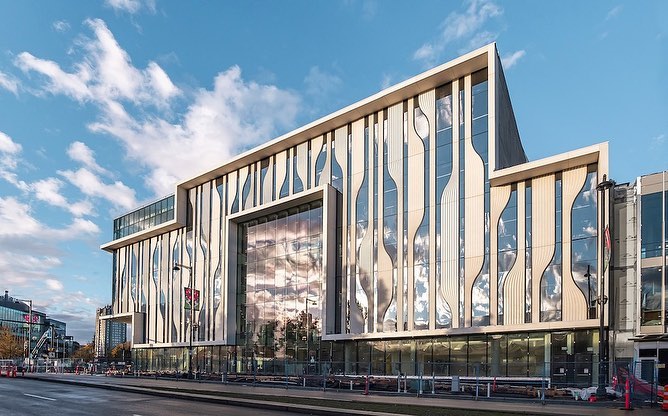
On September 20, 2025, the Marianne and Edward Gibson Art Museum opened its doors to the SFU community and the broader public. Pleasantly, admission to the Gibson is always free, and its operating hours are from 11:00 a.m. to 5:00 p.m., from Wednesday to Sunday. 

The museum is situated directly beside the SFU Transit Exchange, near Strand Hall. The building, an award-winning design by Siamak Hariri, was under construction for 18 months and resulted in an open and beautiful space that encourages movement and curiosity. The forum, which currently features the work Blue Students/Alumnos en azul (1997) by Liz Magor, is visible from the outside through the large glass panels. The inaugural exhibition, Edge Effects, refers to a term in geography describing the change in biodiversity and its subsequent community relationships at the convergence point of two different ecosystems. For the museum as a whole, the concept is a nod to its positioning at the edge of an academic institution and the unique community and exchanges it fosters through its presence.

15 different artists feature their work in the inaugural exhibition, with ten of them commissioned. On the wall of the building’s hearth, a collection of over 40 captivating porcelain creatures and pine preserves make up a forest of tree spirits, or kodama. This commissioned work, is Arboreal Time (2025) by Cindy Mochizuki, is an exploration of trees’ perception of time. In Edge Effects, I enjoyed Lucien Durey’s Dish Rack with Plates, Towel, Rag and Brush (2025), which explores the often gendered task of dishwashing within the context of community support. 

Marianne and her late husband, Dr. Edward Gibson, shared a vision of art’s ability to connect people through culture, ideas, and knowledge. This gallery expands their vision into a lasting legacy. “Our aim is to create a new kind of art museum that lowers barriers to those who have historically felt excluded, embraces intergenerational, decolonial learning, and encourages cross-disciplinary inquiry and meaningful encounters with art,” stated the Gibson.

Opening day at the museum seemed a bustling success. The staff were kind and well-informed. The museum shop, a must-see, is filled with unique ceramics, bags, and other lovely knick knacks. I was intrigued by their eclectic collection of literature: reasonably priced and so niche. A personal highlight of the exhibit was Soupson: eating borscht, an Eastern European beet stew in the gallery’s foyer. It was served in beautiful ceramic bowls, on a food cart/table made by Germaine Koh — what a delicious work of art. I left the opening party excited about the new gallery:

The Gibson team seems to be cognizant of its impact on its surroundings, and aims to be a place of learning as well as teaching.

I was impressed by the level of care they put into the inauguration of this exhibition, and I look forward to visiting again soon. 

Edge Effects runs from September 20, 2025, to February 15, 2026. 


El Jockey blends dark comedy and absurdity

0
IMAGE: Courtesy of Rei Pictures, El Despacho, Infinity Hill, and Exile Content

By: Gurnoor Jhajj, SFU Student

On September 14, the 23rd Vancouver Latin American Film Festival wrapped up its ten-day run full of movies, music, food, and a collective enjoyment of Latin American cinema and its charms. The festival’s closing night featured El Jockey, a peculiar dark comedy by Argentine director, Luis Ortega, featuring music from Collective SUR, a Latin American band consisting of local talent. I didn’t know what to expect walking into the VLAFF for the first time, but by the end of the night, I left with a story, a new perspective on the city I have lived in for the past 19 years, and a newfound love for vintage Latin American music.

Before the screening, the organizers reflected on the festival’s closing night, highlighting all the movies and short films shown from over 15 countries. The Consul General of the Argentine Republic in Vancouver, Ricardo Arredondo, also spoke about Argentine culture, referencing El Jockey in the process. Awards were also presented to shorts and New Directors competition, with Welcome taking home the prize for the former category, and My Chest is Full of Sparks being honoured by the Youth Jury for the New Directors category. These conversations and awards set the scene for the closing film and encapsulated the festival’s celebration of Latin American cinema and the community. 

The film itself is a story set in the world of horse racing, but it quickly shifts into a surreal, complex and absurd dark comedy that makes you rethink everything. Ortega doesn’t follow a simple flow in the movie; instead, he mixes humour and absurdity that makes the audience laugh, yet also unsettles them. The film stars Nahuel Pérez Biscayart, one of Argentina’s most famous actors, as Remo Manfredini, a legendary Jockey, and Úrsula Corberó, famously known for playing Tokyo in Money Heist, as another Jockey and his girlfriend, Abril. After a life-threatening accident, Remo disappears from the hospital and roams the streets of Buenos Aires, leaving his past behind and discovering who he really is. The movie, at its core, is about ambition, morality, and ever changing and unpredictable human nature. 

What stood out to me the most about the movie was the way it mixed comedy with dark undertones. The theatre was frequently filled with laughter at moments, proving that Ortega’s humour struck a chord even across cultural and language differences. These shifts between dark humour and absurdity often left me wondering whether I should laugh, feel uneasy, or both. Biscayart and Corberó also portrayed their complex characters beautifully, depicting the slightest emotions through their eyes. The music score was a major contributor to the film’s mood. It featured Argentine songs from the 1960s, ‘70s and ‘80s, mixing the vintage music with newer sounds from different languages, creating a contrast of both nostalgia and absurdity, matching the scenes. As I went home afterwards, I added the soundtrack to my playlist and logged onto Letterboxd to write a review. This small act reminded me that some movies just don’t end when the credits roll, but they leave the theater with us sneaking into our lives.

The end credits rolled, and the theatre buzzed with a final sense of laughter and conversation, the festival coming to an end. Latin American storytelling shone throughout its ten days, and El Jockey ended it with an unexpected yet memorable twist.

Through humour and sophistication, the film served as a physical reminder of why festivals like this matter. They bring global voices to Vancouver and give the audience a chance to learn, laugh, and live across borders, all on the big screen.


SIGGRAPH 2025: a retrospective

0
ILLUSTRATION: Yan Ting Leung / The Peak

By: Jin Song, Peak Associate

SIGGRAPH (Special Interest Group on Computer Graphics and Interactive Techniques) is the largest computer graphics conference in the world, bringing together scientists, artists, and other professionals working on cutting-edge technologies in the field. It has hosted guest speakers like Mark Zuckerberg and Jensen Huang. This year, it was held in August in Vancouver.

I learned about the conference’s existence and the fact that it would be local in CMPT 361 (Introduction to Visual Computing), which I took last year. I heard about it once more in CMPT 466 (Computer Animation), and my professors — who were also in attendance — encouraged the class to apply to be student volunteers if we were interested. 

Indeed, from a young age, I had been interested in computer graphics (specifically, animation), so I was naturally intrigued. I applied to be a student volunteer and was accepted. It was one of the coolest weeks of my life, and I interviewed three other SFU students about their experiences with the conference.

Michael Xu, a computing science PhD student, gave a presentation on his contribution, PARC: Physics-based Augmentation with Reinforcement Learning for Character Controllers. He said he was motivated by his desire to “have a physically simulated character that can traverse a Minecraft world,” which was not present in past research. PARC is a physics-based method for iteratively training an animation machine learning model. It uses the model’s output as the input for the next cycle, progressively improving and expanding the motion dataset. 

My other two interviewees were my classmates from my computer graphics courses, Tyrus Tracey and Peter Soava. Tracey — who presented a poster at SIGGRAPH — is a fourth-year computing science student like myself, while Soava, a fourth-year software systems major, was another student volunteer.

Tracey described his contribution to the conference, titled Physically-Based Compositing of 2D Graphics, as follows: “It is basically a new type of image editing technique. Given an image, you can insert a new image onto that image. It will conform to, say, the contours of the table or the wall or lighting present, that sort of thing.” He and his classmate built a tool on top of prior work to “process a bit more usable for average people.”

Attending Xu’s presentation, looking at Tracey’s poster, and seeing all of the other SFU contributors at SIGGRAPH 2025, I was hit by a profound sense of awe. On one hand, I was incredibly impressed by the work, on a technical level. These cutting-edge innovations were truly spectacular. On the other hand, I felt proud to be part of the SFU community, and was astonished to see its influence. Having grown up in Vancouver, I had always considered it familiar and homey, so seeing it in this new, influential light was pleasantly surprising to me. 

Soava said, “I think it was really cool bumping into a bunch of industry people. It seems kind of unique because Vancouver is such a VFX hub, like you have ILM, Sony Image Works, Coalition, CD Projekt Red, EA, also headquartered here. It’s just like, you asked somebody who has worked on all these big projects, and it turns out that they were local.”

When asked if they would recommend attending, Soava said, “If you find the stuff even mildly cool, you just spend a week with a bunch of extremely cool people just talking about extremely cool stuff.” Xu said

“If you’re just interested in animation, graphics, and art, SIGGRAPH is a good place because it’s more than just a technical conference.”

— Michael Xu, SFU Computing Science PhD Student


SIGGRAPH 2026 will be held in Los Angeles from July 19 to 23.