Home Blog Page 278

Contract Worker Justice releases report on poor working conditions at SFU

0
Blusson hallway with a cleaner’s cart in the center.
Workers report poor benefits and low wage under the current contract system. PHOTO: Gudrun Wai-Gunnarsson / The Peak

By: Karissa Ketter, News Writer

The Contract Worker Justice (CWJ) group has been pushing SFU to hire their cleaning and food services workers in-house. They recently wrote a report detailing the poor working conditions of these workers and presented it to the SFU Board of Governors (BoG) on January 27, 2022. 

CWJ co-hosted a virtual presentation of the BoG meeting with SFU350. At the meeting, representatives of CWJ presented their findings. The three presenters included co-founder of CWJ and communication professor Dr. Enda Brophy, president of CUPE 3338 Fiona Lenfesty, and SFU dining hall cook Jeremy Ebdon. 

Brophy noted CWJ has been endorsed by all major SFU constituencies (undergraduate students, graduate students, and faculty), the Burnaby mayor, and three Burnaby MLAs. 

University of British Columbia and University of Victoria hire their workers directly. Brophy noted this means their workers “fare better than SFU’s contracted workforce in every single category, including wages, benefits, and access to campus services.

“They can’t even use our libraries or access Wi-Fi on campus,” said Brophy. 

SFU’s workers make less than a living wage, “receive significantly fewer paid sick days than other SFU employees,” and have limited access to health and dental coverage, according to CWJ’s report. This is because the contracting-out system “pushes down wages by incentivising companies to minimize labour costs at the expense of the workers,” according to the presentation.  

While CWJ receives less than a week of paid sick leave, SFU employees are eligible for at least one week of sick leave and up to 26 weeks after more than five years of employment

In an interview with The Peak, PhD student and CWJ coalition member Jade Ho discussed the report in more detail. She explained CWJ conducted interviews with the workers throughout Fall 2021. In these interviews, they found the companies have been telling workers to limit their interactions with others.

According to Ho, “The companies actually have told them things like, ‘We don’t want you to talk to people. When you see them, simply say hello and goodbye,’ and ‘if people come and ask you questions about your work, tell people that you are a new employee and you don’t know anything.’

“They would like to be treated and respected,” said Ho. “There’s quite a lot of separation and silencing.” 

In the report, workers emphasized the lack of respect and dignity in the workplace: “What is probably more important to me is to be treated with some respect, and not be talked to rudely or be disrespected at my place of work. People in the university — students or faculty — can sit at their computers and work only because we do the dirty work and clean up things. Their workspace is safe and clean because we do all the physical labour in cleaning up.”

Ebdon, who is also a member of Local 40, BC’s union for hotel and hospitality workers, said, “Many of our workers are afraid to speak up for fear of retribution from management.” He reported numerous workers are not taking their break time to keep up with operational requirements due to chronic understaffing. 

Ebdon said management has mostly ignored workers’ concerns regarding working conditions. 

Workers expressed concerns for COVID-19 safety while working on campus. “They would daily tell us about the COVID-19 safety regulations and make us sign documents saying we understood the protocols, and then ask us to go work in places where it was impossible to maintain these protocols,” said one worker in CWJ’s report.  

Ho noted that vice-president finance and administration Martin Pochurko responded to their presentation by saying, “I would remind the Board that, of course, the presentation that you’ve seen today is one perspective.” He added the service workers’ employers who were in attendance “would have different views on some of the topics discussed today.”

Ho commented on Pochurko’s response in her interview with The Peak. “We think that we have presented is not just an ‘equal perspective’ to the financial side because this is people’s lives on the line. This is not just people’s working conditions, because people’s working conditions affect their quality of life.” 

In a statement to The Peak, Pochurko wrote, “SFU values the cleaning and food service workers that work on our campuses and it is very important to us that they are all treated fairly. Although we have not been able to validate the accuracy of this report, we are concerned about the experiences described within it,” said Pochurko. 

SFU recently hired another third-party company, Deloitte, to analyze the in-house and contracted working conditions at SFU. While CWJ has previously expressed concerns about this decision, they are waiting for Deloitte’s results and the university’s response, according to Ho. 

Deloitte is a private consulting company with “a tendency towards privatization.”

Currently in progress, Deloitte’s report “includes interviews with key stakeholders, including the Contract Workers Justice leaders, the employee unions and the current companies providing these services. The SFU executive team will be reviewing those findings over the coming months to develop recommendations and next steps,” according to Pochurko. 

Ho encourages students, staff, faculty, and the SFU community to read CWJ’s report. “One of the key things about our report is not just a summary of the things that we found, but some of the specific quotes that are from the workers. So I encourage you to take a look at the report and look at some of those quotes of what the workers have said of each grievance that they have been sharing with the research team.”

Ho reported, “Workers hold an incredible amount of pride in their job. They are passionate about being part of the university community. We asked them, ‘Do you feel like you’re part of the university community?’ and they said, ‘When it comes to our work conditions, we really don’t feel like it.’ But when it comes to interactions with students, they really do feel like they are a part of the community.”

To find out more about the CWJ campaign, visit their website or social media.

Five video games for a cute and cozy date night at home

0
A PlayStation controller lying angled against a purple and turquoise background
Make your next gaming session last all night long. PHOTO: Taylor R / Unsplash

By: Kelly Chia, Staff Writer

My partner and I really enjoy playing games together — solving a puzzle feels much sweeter when you have someone cheering you on, even if they’re chuckling at you a little. Below, I’ve listed games by price, platform, and length. Whether you’re in a relationship or want some wholesome challenges and raucous laughter with your friends, here are some of my favourites to play on date night!  


It Takes Two

$54.99 | Playable on Windows, PlayStation 4, PlayStation 5, Xbox One, and Xbox Series X/S | 2 players | ~6–8 hours

Your protagonists, Cody and May, are a married couple on the brink of divorce. Then, they’re tossed into a fantastical world made by their daughter and are forced to work together. You work with a partner and face funny obstacles like furry gangster squirrel tails. The game is often light-hearted, and the story is well-written. It’s stunningly animated, making every moment a joyful one. 

You can choose to play this game from two separate devices, or play together on one screen with split-screen play. It’s wholesome, sweet, and wonderful to look at! The price is pretty steep, but it’s on sale on Steam often. At the time of writing, it’s $27.49. 


We Were Here
Free | Playable on PC, Xbox, and PlayStation | 2 players | ~2 hours

Where It Takes Two is a whimsical look into repairing a fractured relationship, We Were Here takes a decided swing into an atmospheric thriller. You and your partner are tasked with overcoming puzzles together to escape an abandoned castle. It Takes Two has visuals to guide you, but We Were Here relies heavily on using your voice to help each other through each puzzle. This means you have to work closely in what feels like a two-player escape room! 

We Were Here is the first installment of a series with three sequels: We Were Here Too, We Were Here Together, and We Were Here Forever. If you like this, check those games out too!


Stardew Valley

$16.99 | Playable on Android, PlayStation 4, Nintendo Switch, Xbox One, Mac, Linux, Windows | 1–4 players

I couldn’t not list this game here. Stardew Valley is a classic choice. The two recommendations above are puzzle games, but this is a long-form game you can enjoy with your partner. Basically, your protagonist is despondent with their corporate position and has inherited their grandfather’s old farm. While you can play this as a single-player game, playing it with a friend (or three!) lets you share more resources. Getting to work together to turn your farm from a middling plot to rich fields with all the farm animals is really rewarding.


Heave Ho

$11.49 | Windows, Mac, Nintendo Switch | 1–4 players | ~3 hours

This game is a surprising amount of fun. You have to grip onto each player’s hands to get across the level. You’re basically swinging across all sorts of limbs and platforms trying not to fall. My friends spend a lot of time hollering at each other as we swing! This is the game you want to play when you just want something short and amusing.


Monster Prom 2: Monster Camp

$15.99 | Windows, Linux, Mac | 1–4 players | 1–3 hours

I chose Monster Camp over Monster Prom here because you can interact more with your fellow players. This is a hilarious dating sim where your goal is to ask out a variety of monsters, from the head witch of a coven to a computer. I was drawn to this series for its customization. At the beginning of the game, you choose between four playable characters, and pick pronouns regardless of how the characters present. Your character can then date anyone in the game. There is a broad range of queer representation in these characters. Many storylines explore the characters’ identities and their feelings of romance — and often, world domination! 

It does feel like a long game to play in one sitting because there’s a lot of dialogue, but the narrator’s lines and thirst always make my friends and I laugh.

My first time wakeboarding

0
A woman pictured wakeboarding putting up a 'hang loose' sign to the camera.
Celebrating the little victories can make the journey much more enjoyable. Photo: Ron Lach / Pexels

By: Charlene Aviles, Staff Writer

When I was 16 years old, I started wakeboarding at a church summer camp. At first, I was too shy to join my friends, but with persistence, they convinced me to give it a shot. It took me a while to learn, but any sign of growth, whether big or small, pushed me to keep going.

Everyday, the parent volunteers started the wakeboarding sessions at 7:00 a.m. Since it was my first time, I decided to start by watching my friends. Everyone else on the boat was very experienced, so I felt intimidated to practice in front of them.

Once I was ready to begin, the boat’s owner, Vincent, showed me how to strap my feet to the wakeboard. Then, I gave my friend my glasses and jumped into the water. On top of trying a new sport, I had to guess the direction and speed of the waves.

Vincent instructed me to lay down on my back and bring my knees to my chest. Once I grabbed hold of the rope, he revved the engine. The boat drove forward faster than I anticipated, causing me to fall face first into the water. After seeing my friends glide on the water gracefully, I wondered if I would be able to stand up at all.

The second time around, Vincent instructed me to hold onto the rope tighter. My friends cheered me on. They encouraged me to be patient and keep going. This time I was able to hold onto the rope, but I wasn’t able to stand up. As soon as the boat moved, I collided with the water again.

Wakeboarding was challenging because it was nothing like the other watersports I’ve tried — kayaking, swimming, and tubing. A tight grip and good balance weren’t enough. I needed to match my movements to the speed of the waves, but since it was my first time, I didn’t know what to expect. I tried twice more until my time was up.

Since I couldn’t stand up the first few rounds, Vincent was kind enough to give me another chance, but the result was the same every time. Not to mention, the rope got tangled in the propeller, stalling the boat and prematurely ending my second attempt. 

Later that week, I had the chance to wakeboard again. For the first half, I still couldn’t figure out how to stand up. One of my peers, Jeremy, gave me a few pointers on how to steer myself. To my surprise, something clicked and I stood up! Feeling the adrenaline rush, I screamed so loud in disbelief, proud to have achieved my goal. I didn’t stand for long since steering was new to me, but I took the time to soak every last second of it. Finishing my turn, I enthusiastically hi-fived everyone on the boat.

Even though I started wakeboarding years ago, I still remember the relief of accomplishing what I set out to do. Despite it taking longer than I wanted, and only being able to stand for a few seconds, what’s important is that I followed through on the goal I set for myself. Sometimes half the fun is getting there. 

Mainstream media needs to address its sex stigma

0
A couple are leaning into each other. Both appear somewhat femme, and look like they’re enjoying themselves.
We can’t break down stigma without addressing something directly. PHOTO: Zackary Drucker / The Gender Spectrum Collection

By: Maya Beninteso, Peak Associate

Doing it, the devil’s tango, knocking boots — these are all euphemisms used to avoid a simple three-letter word: sex. Why do we feel the need for all these euphemisms in order to avoid one word? Despite sex being a part of many of our lives, it is heavily stigmatized in culture, conversation, and the media. The best way to combat the taboo nature of sex is to make it less taboo — and start an open conversation. 

So, let’s talk about it.

I understand why sex isn’t necessarily our go-to dinner conversation: the amount of bodily fluids — and the noises — can be unappetizing. However, our habit of hiding sex has translated into a culture of shame. Wanting sex should not evoke discomfort — nonetheless, shame and sex appear to be a common pair. 

The media has an influence on societal views pertaining to sex, and contributes to feelings of shame. The media — and society in general — are especially vocal when it comes to women who choose to engage, or not engage, in sex. These messages swing between prudishness: the resistance to sexual expression, and sluttiness: a slur directed at those who take ownership of their sexualities. Though there is nothing wrong with either behaviour, the lack of space for women to be sexual without stigma is a problem. 

Ideas regarding sex are instilled at a young age. I recall passively listening to T.I’s “No Mediocre” at my high school basketball game and feeling disturbed about the artist’s criticisms of women who have pubic hair. What we need is more songs that send messages of empowerment and that normalize sexual desire — especially in women (such as WAP by Cardi B). 

TV shows and movies need to do their part as well. A good start would be adding discussions surrounding sex, consent, and contraceptives during climactic scenes. I can’t remember the last time I watched a movie with a sex scene that contained a conversation surrounding (or using) protection without plot-based motivation. That is inherently problematic. For one, sexual encounters on the big screen aren’t usually representative of real sexual experiences — and it’s important they begin fostering a culture of consent. 

Sex isn’t always some life-altering event, or “picture perfect” in the way film depicts it to be. Sex scenes are highly choreographed — it is normal for sex to be uncoordinated, light-hearted, and filled with laughter — I wish dramatizations could capture this instead of providing viewers with false expectations. 

If your sexual encounters aren’t intricate dances, you need not feel ashamed. Your sexual experience isn’t the problem — the way film portrays it is. Sex may not always be spontaenous, in reality sex may require a little extra planning and a discussion surrounding safe sexual practices prior to the encounter. The media’s simple addition of the aforementioned steps could aid in normalizing healthy sexual behaviours, and hopefully render the purchase of contraceptives less embarrassing. Engaging in safe sexual practices shouldn’t feel embarassing at all. This is an example of what destigmatization could look like — a world where purchasing contraceptives for safe sexual practices isn’t embarassing. 

At the end of the day, we need to acknowledge sex for what it is. Whether we choose to pursue it or not, sex is a behaviour that is done by just about all multicellular life. Let’s start time-appropriate open conversations even around the dinner table — so that we can all engage in something that’s intended to be pleasurable without shame. 

The stigma ends here — it ends with us.

The Inside Scoop: Super Bowl Edition

0
Up close shot of a football on an NFL field
Matthew Stafford and the Los Angeles Rams have the edge. Photo: Dave Adamson / Unsplash

By: Isabella Urbani, Sports Editor

1.) Who is going to win the Super Bowl? 

Los Angles Rams (67%)

Cincinnati Bengals (33%)

Sample size: 12 

2.) Will the difference in scores between both teams be over or under seven points?

Over (44%)

Under (56%)

Sample size: 9

3.)Will there be more than three interceptions in the game?

Yes (75%)

No (25%)

Sample size: 8 

4.) Will Bengals kicker Evan McPherson miss his first playoff field goal? 

Yes (11%)

No  (89%)

Sample size: 9 

5.) Who will gain more yards for their team? 

Tee Higgins (Bengals) (33%)

Cooper Kupp (Rams)  (67%)

Sample size: 6 


Aaron Ahl sets record at first track meet of season

0
Photo of SFU runner Aaron Ahl leading the pack during an indoor race.
Two-for-one: the SFU runner also picked up GNAC’s Athlete of the Week for his performance. Photo: Howard Lao Photography

By: Charlene Aviles, Staff Writer

Name: Aaron Ahl

Pronouns: He/him

Major: Biomedical physiology, fifth year

Favourite Track and Field Athlete: Matthew Centrowitz 

Aaron Ahl recently set a Great Northwest Athletic Conference (GNAC) record for the second fastest 3,000 m in a time of 7 minutes and 53 seconds at the first track meet of the season. Ahl is a senior on the SFU men’s cross country team and a junior on the men’s track and field team. During the Distance Medley Relay in Boston, he and his teammates set a time of 9 minutes and 38 seconds, breaking the National Collegiate Athletic Association (NCAA) Division II record. In an interview with The Peak, Ahl discussed his love for cross country and track and field.

After playing soccer, he started experimenting with cross country in grade seven. “I noticed I had a talent for running at that point,” he said. From there, Ahl competed on his junior high school team.

“All throughout junior high, I was running on the school’s cross country and track team, but I didn’t actually join a club and start running seriously until high school,” said Ahl.

Since then, his love for both sports has continued to grow. He hopes to become a professional athlete and compete on an international level. “I think right now, that’s one of the biggest things that drive me to train, perform well — to be able to have longevity in sport.”

SFU’s NCAA opportunities and experienced head coach Brit Townsend, who is also a former Olympian, drew Ahl to SFU.

“Being in the NCAA gives us a lot of good racing opportunities that you don’t necessarily get at some other Canadian schools I was looking at. We actually get a full outdoor season, compared to USports [schools], who just get their indoor season,” said Ahl.

Ahl, who grew up in Calgary, Alberta, explained joining the SFU track team in 2017 helped him with the transition to SFU.

“If I wasn’t on the track team, it would be a lot harder to make friends or find a community that you belong in. But being on the track team, you just get put into a group of like-minded people. And basically those people become your best friends,” said Ahl.

Ahl had a strong start to the cross country season during Fall 2021, but realized he needed to make some changes to prioritize his health.

“I was running a lot of mileage week by week. That can take a big toll on your body. I wasn’t getting enough iron in my diet, so I ended up actually becoming anemic,” said Ahl.

He realized this especially affected his performance during the cross country regional competition, but it motivated him to make changes ahead of the track and field season, two months later.

“I think just performing as well as I did gave me a huge confidence boost coming off of such a low after the cross country season,” said Ahl.

Going into this track season, Ahl’s focus is on improving. 

“I would like to win the mile at the national meet. I think I have a really good chance to do that this year, and that’s definitely one of my first goals. I’ve also been eyeing up some of the NCAA  Division II records, both in the 3k and the mile,” said Ahl.

He added, he would like to advise his younger self  “not to be too worried about results as a freshman and just think about long term and development.

“You have to be consistent, because that’s really how you get results. You can’t just expect to show up one day and get majorly better and improve a lot on one day. It’s the accumulation of all your training,” said Ahl.

Ahl and the SFU track team will be in Washington for two meets on February 11 and 12 before the GNAC Championship. 

The state of soccer worldwide and its basic rules

0
A wide angle shot of a soccer game full of fans
Soccer has been dominated by Europe for most of its history, but Canada is starting to gain traction. Photo: Vienna Reyes / Unsplash

By: Greg Makarov, Sports Writer

Overview 

Soccer, otherwise called football in Europe and South America, has been around for centuries dating back to ancient Greece. Of course, the form was wildly different, but the idea of kicking around a ball has survived the creeping of time. In 1863, the game we know and love today was put into writing by the Football Association in London.

Nowadays, soccer is the biggest worldwide spectator sport with an estimated three billion fans around the world — almost half of the planet’s population! A vital factor contributing to its worldwide popularity is its low maintenance. Only a ball and some markers for the net are enough for most, allowing the game to be played absolutely everywhere and at all skill levels. 

Association Football

Due to soccer’s large demographic of players, it was too challenging to democratize the sport into one major league with the same rules. Instead, it was split into regional organizations and leagues. By profit, the biggest leagues are in Europe. They include the Premier League (England), The Bundesliga (Germany), La Liga (Spain), Serie A (Italy), and Ligue 1 (France). Other leagues such as Major League Soccer in North America are also rising in popularity, due in part to a growing fan base.

World and Continental Competition

There’s only one World Cup soccer tournament which occurs every four years and features players playing on their national team. Then there are continental competitions such as the Copa America (South American Cup), Europa (European Cup), and the Champions League, which takes the best teams from leagues around Europe to compete for the title of best team.

Basic Rules 

Even though the rules are not identical across leagues, the basic template is the same: 10 players and one goalkeeper take the field. To win a game, a team must outscore their opponent. A typical game consists of two halves that are 45 minutes long. Unlike hockey or basketball, the timer does not stop when the play stops — this prompts the referee to add additional time at their discretion during the 90 minute mark of the game. Five substitutions (exchanging players from the bench to field) are allowed per team — these may occur at any time. If the ball leaves the pitch (field) on any side during the game, then a throw in is awarded to the other team. If the ball is kicked out at either end (corner) of the pitch, then a goal kick or corner kick is given depending on which team touched it last. Similar to hockey, players must also prevent themselves from going offside by remaining behind the other team’s defense. 

Infractions

For any physical infractions there is a yellow and red card system. Yellow cards are given as cautions for reckless or dangerous play, while red cards are for plays usually resulting in injury. Players who receive a red card are automatically ejected from the game. 

Fouls

For lesser infractions, called fouls, a few mechanisms can occur. The most common is the direct or indirect free kick which is given at the same spot where the foul occurred. A direct kick can be shot at the goal, while an indirect kick must be passed before shooting. If a foul occurs inside the penalty box in front of the net, then a penalty kick is awarded. In this case, the player must shoot the ball from a designated spot 12 yards away from the goal line. Once the ball is touched by the player, the game continues, allowing for rebounds created by the goalie to be scored. 

Wrap-Up

While Europe and South America have been acknowledged for their highly skilled players, other countries are slowly catching up in international competition. For example, the Canadian national team made history this year by going undefeated (so far) in World Cup qualification rounds, to earn a spot in the tournament — the farthest the team has gotten since 1986


The Rundown

0
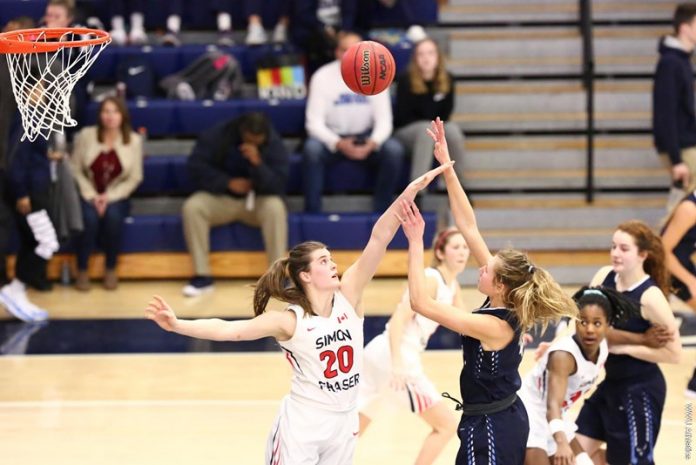
SFU player reaching up with their hand to block an opponent's shot from going in.
SFU stays hot this week racking up victories in basketball, wrestling, and track and field. Image courtesy of SFU Athletics.

By: Isabella Urbani, Sports Editor 

Takedown: SFU’s women’s wrestling team dominates the Golden (bear emoji) Invitational with 67 team points! 28 more than the second place team. 

Megaphone (emoji) Shoutout to seniors Karla GodinezGonzalez, Lauren Mason, and Alyvia Fiske for winning their divisions. 

Date: January 29 

Back at it again: Ahl ran the second-fastest indoor mile in GNAC history. 

Date: January 30 

No surprise here: the SFU women win (winning medal emoji) the Invitational Distance Medley Relay. The team consists of sophomores Megan Roxby and Emily Lindsay and juniors Emily Chilton and Alison Andrews-Paul.

Date: January 30 

Congratulations (confetti emoji) to SFU football (football emoji) linebacker Griffin Barrett for being named as an NCAA Division II All-American Honourable Mention. 

Date: January 31

Congratulations to SFU senior setter (volleyball emoji) Julia Tays who just turned pro, officially signing with Raiffeisen Volley Toggenburg in Switzerland! (Switzerland flag emoji) 

Date: January 31 

(peace sign emoji) wins for the men’s wrestling team who win over Southwest Oregon Community College and Clackamas Community College. They have only lost one meet this season. 

Date: January 31 

Turnaround time (clock emoji): the men’s basketball team win their away game against Western Oregon by a score of 75–73 after dropping two games against Central Washington — including their first loss at home. 

Date: February 1 

Take a bow Wilfried Balata and Julian Roche — SFU’s top performers in a win (gold emoji) against Western Oregon with 19 and 18 points, respectively. 

Date: February 1

Second time’s the charm (gold sparkly emoji): the women’s basketball team gets the victory over Saint Martin’s at home after dropping their last game on the road to them. 

Great showing for sophomore Jessica Wisotzki with 21 points and veteran Jessica Jones with 19. 

Date: February 1 

Heads up SFU: the softball (softball emoji) team will compete in their first game since 2020 against Eastern New Mexico on February 18. We break down the excitement surrounding the trip with sophomore Rebecca Kirkpatrick and junior Lauren Schwartz next week! 

Date: Feb 7 

Weekend swim (water emoji): the swim team will be in Victoria this Saturday and Sunday to take on UVIC. 

Date: Feb 7 


The Inside Scoop

0
A photo of a cartoon character with rosy cheeks, an orange shirt, and brown hair eating a slice of pie with the pi sign carved into it
Numbers dipped below 50% when it came time to the lacrosse questions. Illustration: Maple Sukontasukkul / The Peak

By: Greg Makarov, Sports Writer

  1. ) Will Garret Hilton (hockey) score a goal next game? 

88% yes 

12% no 

16 votes total 

2.) Will the men’s basketball team have a winning recording in February? 

76% yes 

24% no 

17 votes total 

3.) Will the softball team win their first game of the season on February 18? 

88% yes 

12% no 

17 votes total 

4.) Will the swim team win more than four individual races next meet

89% yes 

11% no 

18 votes total 

5.) Will the women’s basketball team score more than 70 points next game? 

72% yes 

28% no 

18 votes total 

Make sure to follow The Peak on Instagram (@peaksfu) to get a chance to vote!

Explaining the general structure of the NHL

0
A photo of the NHL hockey trophy, the Stanley Cup
Taking a closer look at three key elements of the game: puck drop, officiating, and the quest to Lord Stanley. Photo: Josh Appel / Unsplash

By: Greg Makarov, Sports Writer

Puck Drop and Play

Every NHL hockey game begins with the singing of the respective teams’ national anthems before the first faceoff. Faceoffs occur at the beginning of any play after the whistle has been blown. Both centers from each team meet in the middle of the circle on the ice. Once the referee drops the puck, both players attempt to use their stick to push the puck to a player on their own team.

Every game consists of three periods that are 20 minutes long. If there is a tie at the end of the third period, then teams move to five minutes of three on three overtime. If a goal is still yet to be scored, a shootout will begin. In a best-of-three shootout, each team is given a turn to try to score on the opposing goalie from centre ice. However, the player and the puck must always be in constant forward motion

If a deadlock still remains, the shootout continues until a team scores. The team that goes second always has a shot at redemption if the first team scores. Like a win in regular time, the winner walks away with two points. But the losers still walk away with one point for lasting until overtime.

Officials 

There are two linesmen and two referees on the ice. Linesmen are responsible for offsides (entering before the puck) and icings, while referees deal with penalties (player violations of the rules). 

Although referees call penalties, it’s important to understand calls are ultimately based on the referee’s interpretation of the rules. So a tripping penalty in one game might not be called in another — this is unofficially dubbed “game management.”

There are a plethora of penalties and even severity markers when it comes to sending a player to the penalty box. Such as the two-minute-high sticking penalty being converted into a four-minute penalty if blood is drawn. There are also penalties for non-physical infractions such as delay of game, too many players on the ice, and unsportsmanlike conduct. These carry different punishments, ranging from 2 minutes to a misconduct (10 minutes).

In the early days, referees would have to make calls on the go and would not be able to change them afterwards. However, recently certain plays have become reviewable due to controversy in the playoffs when these plays were not caught in time. This prompted the NHL to review certain decisions if challenged by one of the coaches.

Playoffs 

The playoffs are a different beast altogether. The whole league is split into two conferences: Eastern and Western. From there, the Eastern division is subdivided into the Atlantic and Metropolitan, while the Western consists of the Central and Pacific. 

In total, 16 out of 32 teams qualify for the playoffs. The top three teams from each division automatically make the playoffs. Then there are two wildcard spots that are open to the next best division members of each conference, extending the competition and creating balance among teams. 

When playoffs begin in April, the first ranked team in each conference battles eight (worst team), and so on, in a best-of-seven matchup. To win the Stanley Cup, a team must go through four rounds of the playoffs, knocking off the rest of the teams in their conference until the finals.

The Stanley Cup is widely regarded as the hardest trophy to win and even the best regular-season teams are not guaranteed to win anything. For example, the 2018–19 Tampa Bay Lightning won 62 of 82 games during the regular season, which tied the record for most wins ever in the regular season. The team had the league’s best goalie and one of the best defenseman and forward of the year and still massively disappointed fans, as they were swept in the playoffs by the lower-seeded Columbus Blue Jackets.