Home Blog Page 277

Food For Thought: Bánh Mì

0
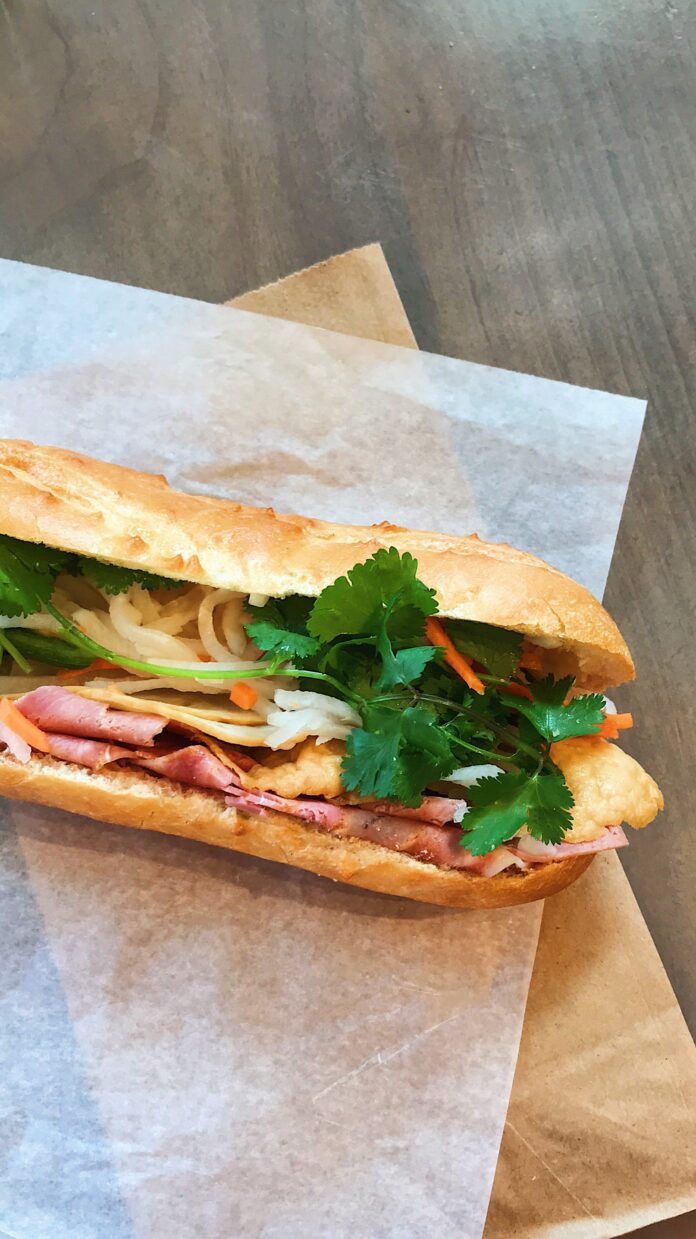
Photo of a bánh mì sandwich on a sheet of parchment paper and a paper bag beneath it.
bánh mì’s history. Photo courtesy of Amy Tran on Unsplash.

By: Michael Le, SFU Student

Being Vietnamese, I grew up eating bánh mì. I still have very fond memories of visiting Ba Le with my mom as a child. My favourite sandwich was the cold cut which included pâté, head cheese (which doesn’t actually have any cheese at all despite the name), chả lụa (boiled pork meatloaf), and assorted sliced ham. It just so happens that this is also the most classic recipe and style of bánh mì. Being that they are flavourful, filling, and cheaper than a Subway footlong, I would argue they are the perfect food — especially for students. But did you ever stop to think about where this perfect sandwich came from?

The first thing that comes to mind when I think of the bánh mì is the baguette. In fact, the Vietnamese word bánh mì literally translates to “bread” and sure enough, the “bread,” or baguette, is not native to Vietnam. The baguette was brought to Vietnam during 19th century French colonization. However, the Vietnamese locals didn’t have access to baguettes: transporting them was expensive and thus this bread was reserved for the French. They were treated as luxury goods. Over time, bread became increasingly accessible to the general public as more staple ingredients like flour were imported to Vietnam to cater to European needs.

In the same spirit of catering to the French, charcuterie, which we now know now as the cold cuts, was added to the sandwich. Still regarded as a luxury item even after the French left Vietnam in 1954, the Vietnamese population continued to have cravings for the cold cuts bánh mì. Because many of the French traditional cured meats were not available in Vietnam, the locals improvised with what they had — mostly pork and pork scraps —  to make cold cuts, pâté (also originated from France), and head cheese.

Having learned about the sandwich’s history from my mom and being exposed to so many bánh mì places here in Vancouver, the sandwich always reminds me that there are history lessons behind food. Reflecting on bánh mì’s history makes me think of how far ours has gone — it wasn’t supposed to be Vietnamese, we made it so. It was brought over to Vietnam only to appease and satisfy the colonizers, but now, the bánh mì fillings we know are inexpensive and available to the masses. Albeit being a bittersweet journey to this savoury food, I realized that claiming our version of a sandwich meant exclusively for the colonizers is synonymous with the claiming of our independence. In my eyes, this simple reclaiming of food was essential to the renouncement of the colonizers’ power.

The struggles from the French colonization of Vietnam helped this classic recipe evolve into, arguably, the perfect sandwich. If you’re in the mood for one, I recommend checking out Pho 99 at Cornerstone Mews on Burnaby Campus, or my personal favourite spot, Lucky Supermarket Deli right beside the Surrey Campus — trust me, you won’t regret it. 

I’ll take mine with extra cilantro, Maggi sauce, and đồ chua (pickled carrot and radish), please.


At the intersections: malas energías, queerness, and shaky hands

0
People of different identities standing at intersections, each marked with street signs that read things like international student, ADHD, etc.
Many people occupy a crossroads of multiple identities. ILLUSTRATION: Stella Nguyen / The Peak

By: Cynthia Piña, SFU Student

Everyone is made up of multiple components and experiences that culminate in a sense of identity. These components can include what we like, the school we go to, and the culture we grew up in. Intersectionality, first coined by Kimberlé Crenshaw, can be thought of as “the interconnected nature of social categorizations such as race, class, and gender.” However, this can also expand to the overlap of things such as culture and religion.  

I’m Latina, queer, and disabled. I don’t think I’ve acknowledged these aspects of myself together — only in individual pieces. I have friends from the Latinx community, queer community, and disability community. However, none of them have really crossed paths. This disjointedness has made me feel like I’m moving from one space to another, spreading parts of myself into different spaces, but never being whole

It’s only in recent years that I’ve even been able to see parts of myself overlap in other people. In 2014, journalist Daisy Hernández published her memoir, A Cup of Water Under My Bed, where she explores ideas of race, class, and queerness. Never before had I resonated with the vivid descriptions of growing up in a Latin American household: the mixture of English and Spanish, “las malas energías” (bad energies), and what it means to be a woman in an immigrant household. 

Not only was it an intimate examination of what it means to be Latina, but it also explored being a bisexual Latina. Because much of my experience at home has echoed the ideas of shame in sexuality and queerness often found in larger Latin American society, I was grateful to find a memoir I could relate to on more than one front. 

Being a part of the diaspora comes with its own issues: clumsy accents, fitting into two different cultures and never really belonging in either, and a disconnection from my history. Even when I tried to look deeper into the roots on my mother’s side, there wasn’t really a trail to follow, since documentation in rural Venezuela was minimal. Birth certificates alone were hard to find beyond my grandmother — her name was changed to a European one in an attempt to find more opportunity. 

While I have found solace in my wonderful Latinx friends who share cultural similarities, I felt left out when considering my queerness and disabilities. Those like Hernández have made me feel all the more comfortable exploring my intersectionalities. However, it can be hard to live in a society that continues to create barriers on various fronts, especially when conversations around identity rarely explore how different identities connect. 

While I haven’t been disabled my whole life, my fine motor skills have generally gotten worse over the past few years. Washing my hair, plucking my eyebrows, and applying cosmetics have left me feeling frustrated. However, the moment I set my eyes on the Rare Beauty line by Selena Gomez, I was overwhelmed with joy. Easy-to-open packaging by someone who has both spoken about her chronic illness and Latin American roots is something I didn’t know I needed. While I’m generally reluctant to promote specific brands, Rare Beauty’s packaging feels like something actionable to help disabled folks and is something that goes beyond sharing experiences. Again, I felt less alone knowing there was someone who shared intersecting identities and has made my makeup routine largely less irritating to my hands. 

Only in recent years have I started to feel the inequities that come from disability, how it’s defined, and how people understand it. What I learned was that people may have a full understanding and acceptance towards one part of you, but they may be very misunderstood about another part. They are for LGBTQIA2S+ rights, but hold internalized racism. They have an understanding of racial issues, but can’t understand the access needs of disabled folks. The list goes on, and while I may feel safe in certain spaces with parts of my identity, I’ve had to advocate for myself on other fronts. 

However, altogether, these experiences have left me wondering, where do I fit in? Do I want to focus on one aspect of myself over others? I had always pushed down these identities and ignored them until I no longer could — so now what? How much space can I claim when others have been advocating for these communities long before me? I don’t particularly have the answers, but I do know it’s important to talk about visibility and the need to create these spaces on all fronts. This way, others can also see parts of themselves in various communities and feel included in their entirety.   

Identities aren’t the only thing that define me, but I am grateful to see how they intersect and how they inform the way I move through the world.

Horoscopes: May 22–29

0
An illustration of a girl with long flowing hair. Astrological signs and stars shine around her.
ILLUSTRATION: Marissa Ouyang / The Peak

By: Isabella Urbani, Staff Writer

Aries
Sweet Aries, you’re toootally not a summer semester person. I know you want to get a move on your degree and more importantly, stop yourself from streaming every Netflix movie possible, but it isn’t working. You already missed your first week of classes and tried to order a Pumpkin Spice Latte at the campus Starbucks. Who does that in summer? Go home and try again in the fall.

Taurus
My Taurus child, your birthday has come and gone and so has the care for your degree. Are you even sure you’re in the right class right now? It might help if you start taking notes instead of filling your online shopping cart with clothes that are way beyond your budget for a non-existent vacation. But, happy belated birthday, I guess??? gingerly showers you in confetti

Gemini
I like your style, Gemini. You take on a realistic course load that allows you time for yourself this summer.You wake up early enough to have breakfast and dress to impress on campus. How the hell are you put together and cheery at a school that looks like a prison? And trust me, I’m not the only person taking notice (winky face emoji). In fact, you’re the cat’s meow on campus.

Cancer
What made you think you could read the student newspaper while you’re on vacation? You’re NOT one of us. You’re getting lost venturing the city, and I’m just lost, period. Classes? Don’t know, haven’t found them yet. Let me take a rain check on that. Oh, and did I mention, it’s still raining!? IN MAY. AT LEAST GIVE ME SOME SUNSHINE! shakes fist angrily

Leo
I put in a good word with the people upstairs to make sure the summer bucket list you created with your middle school friends finally comes true. You may be an attention seeker, but the only person getting your attention lately is your bed. And not for those kinds of reasons, you nasty.

Virgo
Learn how to say no more, Virgo. Look at the mess you’re in! You’re accompanying your friend to all their summer classes when you aren’t even enrolled in any. Don’t tell me — OH MY GOSH, YOU DON’T EVEN GO HERE TOO! Are you seriously taking notes? Put that pen down. Don’t make me rat you out to the professor! Get a grip, go for a walk, and make it far away from all school campuses.

Libra
Libra, Libra, Libra . . . I don’t even know how you’ve found the time to read your horoscope in between the three jobs you’re working this summer. Bless your little heart. They’re all in retail. It’s like you’ve never worked those types of jobs before. Here’s a tip: make them seasonal. I heard Subway is hiring in the fall.

Scorpio
Scorps, take a breather! It’s been one class and you already have the syllabus memorized front and back — all 13 pages. You know the course material better than the professors themselves. That assignment due at the end of the semester isn’t going anywhere. Kick your feet up, but make sure to move the textbooks half-haphazardly scattered around your room — that’s pretty reckless of you tbh. Keep it up.

Sagittarius
So you decided to get a job over the summer and landed on working for the student newspaper? One, ew. Two, you haven’t quit yet? Double ew. What did you say you do again? Write horror stories? No, that’s not it. Something with an “h.” Come on, people only read The Peak for the crosswords, sudoku, and horo—OHHHHH, that’s what you do!

Capricorn
Oh, no Capricorn. Hate to be the one to break it to you, but that one professor you wrote a really bad — but fair — review for has cursed you! Your punishment? You get to take another one of their classes this summer! Seriously, did you even look ahead of time to see who the instructor was? The stars are not on your side. Get out while you can.

Aquarius
Aquarius, you’re going to put the WHORE in HOROSCOPES this summer while respectfully masking up. Who says you can’t do it all with just your eyes? It’s about time you get back on the prowl. Leave your number all over campus — and yes, even in the avocado. Sorry, it’s just that kind of year.

Pisces
Ugh, it’s you again. For the last time, I do horoscopes! I can’t and will not give you the answer key to that upcoming test. It’s easy really: have a night in and stream all your unwatched lectures like they’re the newest season of your favourite tv show. My oh my, does McSteamy from Grey’s Anatomy ever look different!


Upintheair Theatre presents rEvolver Festival 2022: six must-see productions

0
Two individuals standing against a pink background armed with various children’s toy construction tools. They wear shocked and confused facial expressions and blue and pink eyeshadow.
rEvolver festival features inclusive and innovative performances by Canadian artists. Photo courtesy of Mike Tan.

By: Jocelyn Stevens, SFU Student

Upintheair Theatre will be hosting its highly anticipated annual rEvolver Festival at The Cultch in East Vancouver. The 12-day festival returns in-person this year from May 25–June 5. In regards to COVID-19, masks are recommended or mandatory depending on the show, and are provided upon request. The festival presents various performances and events produced by “a new generation of Canadian interdisciplinary artists.” Tickets are priced between the following options: $30, $22, or $15. They also offer ticket packages, with the all-access pass being $120. 

This year’s programming focuses on the theme of interconnectivity and ranges from theatrical performances and stage readings to intimate interactive digital and audio experiences. With such an impressive and inclusive roster this year, the festival is not one to miss.

Gender? I Hardly Know Them by Elena Belyea and Syd Campbell

Photo Credit: Elena Eli Belyea
Gender? I Hardly Know Them is created and performed by comedians Elena Belyea and Syd Campbell from Tiny Bear Jaws in Edmonton. This sketch show is “out to queer the world” through comedy in a fun yet provocative approach. What really interests me about this piece besides it being a comedy — which I’m a big fan of — is that the show is based on the Alberta Prairies. It makes me wonder: “What is it like to be queer in the prairies?” 

You can view this sketch from May 26–May 29.


Holy Moly by Jarin Schexnider

Photo Credit: Jarin Schexnider 

Go find a pair of corded headphones for this next show performed and created by Jarin Schexnider. It is a unique, interactive, “choose your own adventure” production that gives the viewer control on how it plays out. If you attend, you will be given a random audio track from Schexnider’s personal cassette tapes. These cassette tapes are mixed with “jazzercise, cooking shows, and Schexnider’s own childhood field recordings to recover a feeling of holiness.” I’ve never been a part of an interactive performance where the audience decides how the plot plays out, so I’m really excited for this one. 

You can view this performance from May 25–May 29.


Harvesting Ancestral “Tea-Chings” by Siobhan Barker

Photo Credit: Siobhan Barker

This is another interactive performance that includes stories and traditional African cooking from writer, producer, and performer Siobhan Barker. Those who attend will partake in humorous storytelling and cook-along while “exploring known and unknown mixed-racial identity and intersectionality in living with disability.” The goal of this interactive performance is collectiveness and reconnecting with cultural roots. As a Métis person, this piece interests me because it talks about ancestral teachings, displaced and colonized people, and how the “Black/African diaspora carry the land” with them in every form; experiences which are familiar to the Indigenous peoples of Turtle Island (Canada) as well. 

This performance is available May 26–June 5, with an in-person viewing (masks mandatory) available on May 26.


Built Different by Connor Runnings

Photo Credit: Tamara McCarthy

Couch Dwellers Productions presents a play that follows four autistic young adults who bond by reflecting on difficult truths after the passing of their behaviour consultant. This dramedy about “love, loss, and solidarity” will be one that stays with the viewer. This production gives perspective on what dealing with these types of scenarios can be like for an individual with autism. There is a “relaxed performance” viewing where lights will remain partially dimmed and doors will be left open.

This performance will be held from June 2–June 5, with the relaxed viewing held on June 4.


FR (Friendship Ritual) by Calvin Peterson

Photo Credit: Calvin Peterson 

This one I found not only cool, but super cute in the sense that it’s something you can do with your loved ones, whether they are your closest friend, family member, or your partner. Here, you and one other person go through an intimate and interactive 45–60 minute audio experience. The fun audio programme guides you through friendship with art, dancing, and deep reflections. I personally want to give FR a try as its concept centers around encouraging you to appreciate the people in your life that have been with you through thick and thin. 

Another cool note is that this event is free (who doesn’t love free stuff?) and remote, so it’s very accessible and available throughout the entire festival.


New Societies by Re:Current Theatre

This last performance is quite a unique one: a strategic 120-minute long game night moulded into a theatrical narrative that is ultimately created by the players’ choices. Attendees are placed into groups to build their own societies through improv and compete against other imaginary societies. What intrigues me about this piece is that it encourages the players to reflect on how our world and societies operate, which can be something one tries to avoid consciously and subconsciously. It gives players a chance to create a new and, perhaps, a better world: their very own utopia. 

New Societies takes place off-site at Progress Lab 1442 running from June 1–June 4.


To learn more about rEvolver Festival 2022 and to purchase tickets, check out their website and Instagram.

TransLink announces 10 year plan of Transport 2050 priorities

0
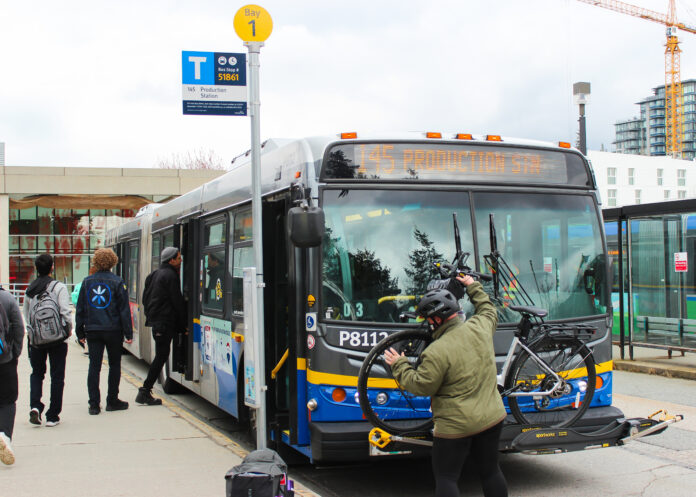
The photo shows the front of a BC TransLink bus. An individual is loading their bike to the front of the bus, as other passengers are boarding.
Addressing climate change and housing affordability are among their top priorities.

By: Karissa Ketter, News Editor

On April 20, 2022, TransLink announced their first 10-year priorities of the Transport 2050 plan. Their press release reported they will double the regional bus services and create “up to 170 kilometres of new rapid transit.”

According to the press release, “The Transport 2050 Strategy concluded that there is an urgent and widespread need to address climate change, housing affordability, and traffic congestion by increasing and improving transit service as quickly and cost-effectively as possible.”

The new rapid transit will be implemented on up to 11 corridors. They will use new zero-emission buses on up to nine of the new Bus Rapid Transit (BRT) routes. The first 10 years of increasing BRT routes brings Metro Vancouver to one-third of their Transport 2050 service goals. 

BRTs provide zero-emission travel through hydrogen power, overhead electricity cables, or battery-electric buses. 

BRTs are reportedly “25 times less expensive per kilometre than SkyTrains.” The construction costs per kilometre of a SkyTrain is $400 million whereas BRTs are $15 million. 

The rapid transit will connect to the North Shore, and the Millennium Line SkyTrain will extend from Arbutus to UBC. 

Provincial minister of environment and climate change strategy George Heyman said in the press release, “Expanding and strengthening our public transit is one of the smartest ways to address climate change, reduce time-wasting congestion and make transportation more affordable and convenient.”

The Transport 2050 plan is considering adding the “new zero-emissions bus-based rapid transit could be deployed along high-demand corridors throughout Metro Vancouver at a fraction of the cost and time compared to rail-based technology.”

They also plan to begin bus fleet electrification which will convert over 460 buses to electric vehicles by 2030. 

TransLink has created the Transport 2050: 10-Year Priorities plan to identify and prioritize the most immediate needs of Metro Vancouver. The 10 year plan includes increasing  HandyDART service by 60% to provide 24 hour service. 

They are also planning to build the Burnaby Mountain Gondola. TransLink has noted for the project to continue, it “must be included” in the investment plan —  approved by the TransLink Board and Mayor’s Council on Regional Transportation. The gondola will run from Production Way-University Station to the SFU bus exchange

TransLink announced they are considering adding SkyTrain stations in Surrey and Port Coquitlam. 

Chair of Mayor’s Council on regional transportation Jonathan Coté said in the press release, “Transport 2050: 10-Year Priorities is an ambitious and necessary plan that outlines more than double the investments from our previous Mayors’ Vision.”

Kevin Quinn, CEO of TransLink, noted, “Our region needs to rapidly invest in transportation improvements to combat climate change, address the housing affordability crisis, and improve congestion in a growing region.”

Everything Everywhere All At Once shows us the weird and wonderful

0
Action shot of middle-aged Chinese woman in a floral shirt and red vest, twisting her arm as though in a fighting position. Background is a darkened office with papers flying around her.
Michelle Yeoh’s shocks and awes audiences with her most recent performance. Image courtesy of A24.

By: Makena Leyh, SFU Student

From the company that created witty comedies like Spring Breakers, heart-wrenching dramas like Moonlight, and terrifying horror films like Hereditary, A24’s most recent cinematic release is truly one to remember. Currently screening in theatres since its debut in early April, Everything Everywhere All At Once is a thrilling concoction of creative production design, a touching storyline, hilariously choreographed fight scenes, and endless interdimensional madness. 

The incredibly talented Michelle Yeoh stars as Evelyn Wang, a first generation Chinese-American woman whose life is quickly slipping out of her control. Her husband, Waymond (Ke Huy Quan), is in the middle of filing for a divorce and her disapproving father (James Hong) has just flown in from China to visit them. Evelyn is struggling to accept her daughter, Joy (Stephanie Hsu), and her new girlfriend, and her family-owned laundromat is in deep financial trouble with an IRS audit. Evelyn’s world is turned upside down and inside out when she learns about the multiverse and how all of the infinite parallel universes are in danger of being eradicated.

Directing duo Daniel Kwan and Daniel Scheinert, collectively referred to as Daniels, take their audience on a wonderfully weird journey where fanny packs and pomeranians make fantastic weapons, an everything bagel is something to be afraid of, and butt plugs are something to be fought over. As absurd as it may seem, the chaotic nature of Everything Everywhere All At Once is one of its greatest strengths. Over the span of the film the audience learns to accept and appreciate the oddities rather than question them. One of the film’s most memorable scenes consists of a heartfelt conversation between two rocks on the cliff of a desert canyon. Yes, two actual pieces of stone silently communicating with each other genuinely brought a tear to my eye. 

The way the Daniels communicate their thrilling yet sentimental story about a woman’s complicated relationships with her family members, particularly the generational divide between her and her queer daughter, is so fresh and riveting that it is impossible to look away. Evelyn’s skepticism of Joy and her new girlfriend is realistically portrayed through a series of microaggressions, rather than overt intolerance. Throughout the film, we get to watch the tension in their relationship rise and fall as the mother and daughter duo slowly come to realize that they can learn from one another, and maybe they aren’t so different after all.

As a film major, I tend to be quite critical of blockbuster movies. However, Everything Everywhere All At Once exceeded my high expectations from the glowing critics reviews. Leaving the theater, I was overwhelmed with a feeling of excitement and inspiration after witnessing such a cinematic treasure. The film’s artistic use of cinematography and production design proved just how powerful the film medium can be. Within a meager two hours, I felt the devastation of a failing marriage, travelled to a universe where people have hotdogs for fingers, and so much more. 

Everything Everywhere All At Once promises a hilarious, action-packed adventure for the critical or casual viewer, and is a great way to support Asian American and Pacific Islander folks in film! 

Everything Everywhere All at Once is currently showing at all theatres, and will be digitally released to Prime Video and iTunes on May 17, 2022.

The meaning of cultural identity: (Re)making Chineseness

0
Event poster on red background, with photographic works by Lu and Choi: a Chinese woman lying on a bed with various fruits scattered around them and a photograph of a collaged picture frame with Chinese women ancestors hanging on a grey cement wall.
Lu and Choi present their meditations on cultural journeys. Courtesy of Greystreet Media and Intersections in Art

By: Kelly Chia, Humour Editor

How does our perception of cultural heritage intertwine with our memories? Canadian artists Lucy Lu and Melanie Choi tackle this question in their photography exhibition, (Re)making Chineseness: Reflections of Cultural Heritage. Visitors can view Lu and Choi’s collections online, titled Da Pi Yuan and Blanket Fort respectively, on the Intersections in Art website between April 23–May 29. Curator Yang Lim describes the exhibit as explorations on Chineseness in Canada, and the ways they are shaped by factors like migration and heritage. 

Lu’s statement on her work titled, Da Pi Yuan (大皮院), is an homage to Lu’s first five years of life in her hometown of Xi’an, China. Lu fondly recalls the time as “nebulous, distinctly [her] own, but of a different lifetime.” Da Pi Yuan captures this exploration in dreamy, melancholic photographs of her hometown. In an email interview with The Peak, she writes about the conflicting sides of her cultural identity growing up in Canada and feeling like an outsider. 

“I tried very hard to be ‘less Chinese’ growing up in an attempt to fit in. Then when I would visit family in China, I felt like a foreigner,” Lu explained. “As I’ve gotten older and explored the topic more deeply, I’ve learned to see it not as two sides in opposition but many aspects of myself and my past existing in harmony.”

Through some discomfort due to her limited fluency in Chinese, Lu lived in Xi’an for three months for her project. “It was definitely healing, it made me realize that preserving my culture takes effort, and isn’t always easy,” said Lu.

One photograph titled, My Parents’ Vase, is especially close to Lu’s heart. The photo is comprised of a new set of silk flowers that adorns a plastic-covered vase.

“My grandparents kept that vase after we immigrated to Canada, and I love that the fake flowers are covered by plastic,” Lu said. “It very much speaks to my own desires to preserve pieces of my past through this project.”

Lu also treasures the portrait of her grandmother, a radiant and resilient figure in burgundy. Lu explained that despite her grandmother’s limited mobility after a stroke, she wanted to pose on her own outside. Da Pi Yuan, then, is Lu’s honest depiction of the nuances in her cultural identity.

Choi reckons with similar questions in determining how identity is defined in her photographic series, Blanket Fort. Choi describes Blanket Fort as a “narrative of Canadian-born Chinese experience.” Choi deals with cultural identity on a personal level while reckoning with the painful marginalised histories of Chinese immigrants in Chinese Canadian history. 

In our email interview, Choi said her work was a response to the confusion many young Asian Canadians may be experiencing. 

Blanket Fort began with anger. “I felt that often the intricacies of my culture could be instantly erased when someone would tell me they loved sweet and sour pork or bubble tea. To have my entire language and culture be simplified to the menu of a Panda Express definitely made me question my existence,” Choi explained. 

When researching Hong Kong textiles for her work, Choi initially wanted to reclaim any vapid stereotypes of her cultural clothing being a costume. This characterized the main tones of Blanket Fort — the relationships between cultural appropriation and appreciation as viewers took in the model in Choi’s photographs.

“I think my favourite of the collection is still the one with the model standing alone in all the wreckage below her,” Choi says. In the photograph, the model distinctly stares at the camera amongst the fruit and flowers underneath her, as if interrupting the softness of the collection. “The model shows no emotion of fear but rather presents an atmosphere of strength and warmth.”

Choi ultimately wants Blanket Fort to be a safe space for other Asian Canadians questioning whether they are enough. “I can speak Cantonese but I can’t read. I love going back to Hong Kong but I’m regarded as a white-washed Chinese. I’m in Canada and people only see me as being Chinese, not even bothering to ask where my family is from,” Choi recalled. But she also remarks that confusion can be comforting and hopes her work provides a refuge for similar feelings.

As I spoke with Lu and Choi, I felt unspeakable nostalgia. Their work speaks to the complicated nuances of how I’ve felt about my culture and hometown as a Chinese migrant — a cultural outsider both at home and in Canada. It embraces those nuances as a valid part of cultural identity. 

Interested parties can view (Re)making Chineseness: Reflections of Cultural Heritage on the gallery website. Lu and Choi’s works can be found on their respective websites.

Opera Mariposa hosts its annual Benefit + Awareness Campaign

0
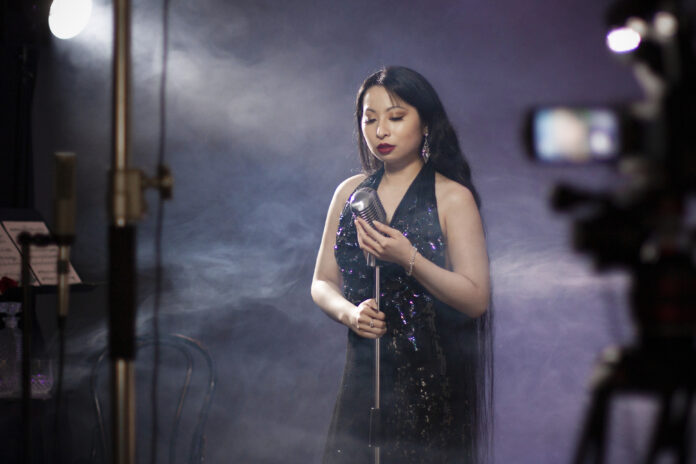
Singer Jacqueline Ko is standing in a sequined dress in front of a vintage microphone. She is spotlighted by a beam of light, against a dark backdrop of purple mist.
The event will be held online and over a month to increase accessibility. Image courtesty of Stephanie Ko

By: Charlene Aviles, Peak Associate

Opera Mariposa, an opera company, is hosting its 10th annual Benefit + Awareness Campaign for myalgic encephalomyelitis (ME) and fibromyalgia (FM) during May 1–June 1, 2022. Their website notes they are “Canada’s first entirely, openly disability-led and run opera company.” 

The virtual campaign will include a music video from singer Jacqueline Ko and interviews with Ko and YouTuber Robin Hahn. Opera Mariposa has also partnered with Christina Baltais — an artist living with myalgic encephalomyelitis who uses paintings, photography, writing, and art to showcase their experience living with chronic illness. 

Opera Mariposa reports myalgic encephalomyelitis can lead to issues ranging from “chronic pain, cardiac issues, and immune problems to neurological symptoms like movement disorders, light sensitivity, and intermittent dyslexia.”

They also note fibromyalgia is characterized by chronic fatigue, widespread pain, brain fog, issues with sleeping, and digestive issues. According to ME | FM Society of BC, “the cause of myalgic encephalomyelitis is not yet known.”

The campaign’s goals are to increase public awareness on myalgic encephalomyelitis and fibromyalgia, raise funds for the ME | FM Society of BC, and build a community.

In an interview with The Peak, Stephanie Ko explained her sister Jacqueline was always passionate about fundraising and educating others on myalgic encephalomyelitis. They realized from first-hand experience how few people were educated on myalgic encephalomyelitis.

“We’ve encountered that first-hand in the medical system trying to seek health care, and then that flows through to family and friends and the public, the lack of understanding, the lack of support,” said Ko.

She added, “There’s an additional urgency now with COVID-19, because the majority of these types of illnesses [can be] triggered by viruses.”

Ko reported, “Researchers are estimating that one in ten folks who get COVID-19, including mild cases and even initially asymptomatic cases, are probably going to develop myalgic encephalomyelitis.”

The response to the annual campaign has been positive. She explained many participants approached her enthusiastically about how the event was the first of its kind in Canada.

“When we started these events, we had folks phoning us up saying that they’d never heard of an event like this and being excited, saying ‘And it’s in Canada where I live!’” said Ko. 

Ko explained the urgency of this cause, especially since many people with myalgic encephalomyelitis and fibromyalgia have difficulty accessing health care resources.

“Myalgic encephalomyelitis is a very prevalent illness. Prior to the pandemic, it affected over half a million people in Canada [ . . . ] but it’s not even talked about in most medical schools. For people, it takes many years to get a diagnosis, and they think about 90% of people with it aren’t even diagnosed.

Statistics Canada showed that myalgic encephalomyelitis and fibromyalgia had the greatest unmet healthcare needs of any chronic patient population in Canada and the highest poverty levels,” said Ko.

At the heart of the campaign is Opera Mariposa’s commitment to accessibility. Taking into account the different aspects of accessibility, the campaign will be online, self-paced, sensory-friendly, and feature closed-captioning, and alt-text.

“To me, temporal access, temporal accommodations, is one of the most invisible but pervasive aspects of accessibility, or the most common friction points, particularly for people with energy limiting illnesses or access needs,” said Ko. Participants will be able to watch the interviews, experience Baltais’ work, and Ko’s music online at their own pace.

Opera Mariposa is accepting donations via Rally Up.

To learn more about the campaign or to purchase entry tickets, visit Opera Mariposa’s website.

Climate Crisis: We can handle worrying about multiple problems — we just lack the time

0
Climate rally sign reading “one world,” written over a drawing of the planet.
Climate action remains on the backburner. Photo: Markus Spiske, Pexels

By Luke Faulks, Opinions Editor

Just over a month ago, the Intergovernmental Panel on Climate Change, the planet’s highest climate research body, released the latest in a series of damning climate predictions. Among the frightening calls to action was their finding that a livable world depends on global emissions peaking in 2025. It gives us just three years to reverse a horrifying upwards trend in planet-warming emissions. The problem is that it’s not resonating with citizens. 

Predictably, researchers have been trying to work out why climate doesn’t animate voters for a while. One idea that’s gained prominence recently is the “Finite Pool of Worry” (FPW) hypothesis. FPW argues that humans have a limited number of issues they can care to stress about at any given time. Though the term was coined in 1991, the hypothesis was first applied to climate change in 2004. The study investigated why climate change remained on the backburner of public opinion. They put a survey to two groups of farmers. Each was presented with a research on seasonal climatic conditions for the coming year, one favourable, one not. It found that beyond ranking climate as a higher concern, the group exposed to the poorer climatic outlook expressed less worry for other factors, like taxes or politics. Basically, “as the concern about climatic risk increased, concern about political uncertainty diminished.” 

The FPW hypothesis has been gaining traction in recent years, even leaping beyond academia to mainstream news outlets. Why the boom? COVID-19. 

Some academics had been worried that stress about COVID-19 would diminish climate anxiety. Instead, the research shows that climate worry stayed high as COVID-19 surged. A survey of the United Kingdom in 2021 suggests that climate has become an “intransigent” worry for citizens. In essence, it’s an issue citizens feel consistently upset about, regardless of the context — including, apparently, a global pandemic. Opinion surveys in Canada support the hypothesis. Early in 2021, before wildfire season and the heat dome, the environment surpassed COVID-19 as Canadians’ “top national issue of concern.” 

The question arises, then, why aren’t we doing anything about it? The answer is we don’t have the time to care. Research, let alone political participation, are luxuries that an overly-busy citizenry can’t afford in an economic system that demands so much of our time. 

Let’s take Canada. Whether it’s taking the time to exercise, to cook, or to lead otherwise healthy lifestyles, Canadians don’t have enough free time on their hands. That might be why, out of 30 countries surveyed this year, Canada ranked among the bottom five states whose citizens are aware of any national climate plan. In a busy country, we don’t find ourselves with the time to engage meaningfully with the issues of the day.  

British labour economist and universal basic income champion Guy Standing has written and spoken about the need to recapture citizens’ time. A new politics based on time, he argues, is necessary to spur citizens’ “community and political engagement.” He’s right. In Canada, politics based on reclaiming Canadians’ time is a necessity for climate action. Only a fully informed citizenry can be fully engaged on climate action, and right now, that’s not us. 

The FPW hypothesis doesn’t account for everyday pressures felt by Canadians. While climate remains ever-present on our minds, our ability to meaningfully engage on the issue, let alone keep it at the fore of our everyday lives, is hamstrung by smaller everyday pressures. Climate change alone is enough of a threat. To have a citizenry that’s meaningfully engaged on the issue, however, means reforming the way we work and live to afford us time. 

SUBstandard: The Student Union Building hours should match the rest of the campus

0
Student Union Building during the evening
The SUB forgets we pay for it. Photo: Jonathan Wong / The Peak

By Nercya Kalino, Staff Writer

How is it that the most student-centric building on campus has the most restrictive hours? Whether it’s during or in-between semesters, most of the Burnaby campus is basically open 24/7. Not so with the Student Union Building (SUB). It’s time for the building’s hours to match the rest of the campus.

To be fair, between 10:00 p.m. and 7:00 a.m, some of the campus’ doors are locked. But there’s always a way to get into campus. It seems like a no-brainer as to why. As students, our schedules vary based on our course load, extracurricular activities, and the lives we have outside of academics. I’m sure you’ll find during your university career that students have some of the weirdest schedules around. The rest of the campus has hours that accommodate students’ complex schedules. Case in point, the AQ is open 24/7

The SUB, it seems, has yet to realize the problem with restrictive hours. Between semesters, the building’s hours are 10:00 a.m. to  4:00 p.m. Fine, I guess. During the semester, though, the building opens two hours after the rest of the campus at 9:00 a.m. Why? That’s not even the worst of it, because the building is entirely inaccessible before then, unlike the rest of the campus.  

It feels like a bait-and-switch. We’ve spent so long waiting for the SUB to fully open, and now it’s opened with restrictive, seemingly arbitrary hours. And that is not all.  Due to this restriction, many of us crowd the building at peak hours in hopes of avoiding traffic in other communal spaces. Earlier this year, the SUB closed to reducing in-person activities due to rising cases of the new Omicron variant, despite the SFSS articulating their concern for the health of students. Not ideal in the middle of a pandemic where we’re apparently supposed to be social distancing. The SUB’s hours make that harder. 

That’s not even to mention the sheer number of critical student spaces the building houses that are off-limits to students thanks to those weird hours. The SUB is supposed to be one of the spaces that indulge students. We have spaces for food, retail, napping, recreation, dining areas, as well as study areas. We’ve also got important groups representing marginalized groups like the Disability and Neurodiversity Alliance, First Nations, Métis, and Inuit Student Association, and Students of Caribbean and African Ancestry residing in the SUB. 

All of this begs the question, “why?” Why the abnormal hours?

 If the SUB’s decision-makers are short-staffed, hire students! We need jobs. There are plenty of students that live on the Burnaby campus surely seeking experience. But if we’re being kept from the building because the SFSS feels overly protective of its new toy, well that’s harder to respect. 

Students don’t have predictable hours and we’re absent any concrete reasoning from the SFSS on why things like $11,000 parties are more important than paying for SUB maintenance staff. While in part, this is speculation, the building’s limited hours continue to feel like bait for something we can’t fully enjoy. The hours of operation remove groups of students that have unconventional schedules. It’s not us, it’s the hours. 

 We’ve paid for the space. We’re still paying for the space. It’s time for the building managers to unclench and line their hours up with the rest of the campus.