Home Blog Page 27

The OneBC party is here to stop Comrade Rustad

0
A middle-aged woman standing in front of the logo of the new OneBC Party
EDIT: Gudrun Wai-Gunnarsson / The Peak

By: Yildiz Subuk, Staff Writer

The leader of the BC Conservative party, John Rustad, has recently lost the plot. He seems to be suppressing the Conservative party’s freedom of speech by not letting members make mockeries out of the trauma faced by Indigenous communities due to the residential school. John Rustad, the person we last expected to jump ship, has clearly joined the radical leftist squad.  

But OneBC will not stand for it. Their movement won’t get rattled easily, even though a lot of their messaging focuses on getting mad at made-up situations.

There is no more true Canadian conservatism. No respect for true conservative values such as: trickle down economics, racism, and bootlicking the elites. Canada is under attack — by the woke, by Chinese communism, and by radical grammar terrorists forcing pronouns on us. There’s an attack on freedom of speech. You can’t say anything without facing “consequences.” 

Yet a beacon of hope exists in this apocalyptic hell — a brand new party. Introducing, OneBC. More radical than the Conservatives and totally not a means to split right-wing votes. 

OneBC is run by a fierce, independent woman. You may be wondering, who is this diva? 

Well, my politically-savvy queens, it’s MLA Dallas Brodie, who scared even the likes of Comrade Rustad with her totally nondiscriminatory and brave comments on residential schools. She was removed from Radical Rustad’s caucus, so what did she do? She formed her own party. The party has gained traction, doubling in size (now having two members), and showing no indication of slowing down.

Brodie is also the primary critic of what is known as the “Reconciliation Industry” — a term she coined herself. We love our entrepreneur queen.

Brodie is now the target of the woke mafia (CBC), but STILL won’t back down. There are so many people who need to understand that large corporations and big investors are not the problem — it’s a group of people, whose culture focuses on sustainability (whatever that means). 

But that’s not all. OneBC is also focused on taking down gender ideology. Joined by Tara Armstrong, another MLA desperate enough — we mean passionate enough — to join the party, has combined forces with Brodie. 

Armstrong is a fierce critic of the BCNDP. Is it because the BCNDP tried to pass Bill 7, a bill criticized as an authoritarian “power grab” move? No, she has bigger fish to fry — like calling out premier Eby’s communist ties to China. Eby, a hardcore Marxist, is trying to destroy our province (while also destroying our environment . . . we give credit when credit is due!). 

The Conservatives have gone woke, and no other party can stand up to Eby the Big (Unfriendly) Giant except for OneBC. Together, the party will stay strong, together it will dismantle minority groups taking advantage of us, and together they will fight communism by maximizing shareholder interests!

PS — we have no idea what communism is, but from what we have heard, it’s dangerous. Don’t ask me any followup questions, I’m totally an independent journalist and not representing OneBC.
Dig, Baby Dig: SFU’s bold economic and educational plan

0
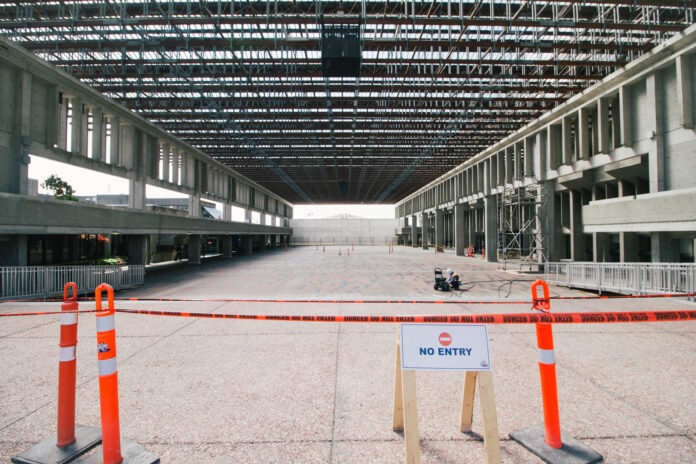
Fog fills the convocation mall as construction blocks off access. This leaves the question — what exactly is going on here?
PHOTO: Andres Chavarriaga / The Peak

By: Corbett Gildersleve, News Writer

Inspired by the rapid passing of BC’s Bill 15: The Infrastructure Projects Act, and the federal Bill C-5: One Canadian Economy Act, SFU has unveiled a new innovative direction for the university titled “Dig, Baby Dig.” This 10-year plan will be led by the university’s new vice-president of early childhood education and economy — who just so happens to be a generative AI created by two drunk guys from the Charles Chang Institute for Entrepreneurship last weekend. 

The strategic plan involves creating a labyrinthian series of tunnels and subterranean chambers under Burnaby Mountain. In a bold shift away from traditional campus construction, SFU will move much of its existing on-campus housing and programs underground. Higher education is so 1965 — welcome to the new age of underground education. 

“For decades, SFU has been engaging the (surface) world, now it’s time to engage the rest of it,” ChatVP stated in a press release.     

Like all generative AI, it drew inspiration for this plan by combining work by others and then claiming it as its own. With limited building space and a significant loss of revenue from the international student cap, ChatVP knew that surface development was ultimately a dead-end. It wasn’t until the rapid passage of the governments’ poorly written infrastructure bills and SFU’s newest phase of student housing and childcare construction that it came up with a solution. 

The Peak spoke with ChatVP about the ambitious plan. “Imagine it, cool temperatures year round, dry benches, ornate carved granite walls, and rock so solid even an earthquake can’t shake,” it said. The VP also claimed that SFU’s science departments already endorsed this new plan as grad students are “used to living in cramped concrete cells in the Shrum science center’s biology wing, hissing when they see the sun once a year to speak with their supervisors.” 

When asked how SFU will kickstart this, ChatVP assured us that “a significant financial investment” has already been provided by the Beedie School of Business. Under conditions of anonymity, a disgruntled professor said that Beedie negotiated the rights to occupy all the abandoned surface buildings on campus, thus fulfilling their desperate need to brand every square inch of the campus with their name. 

“We all know from Minecraft that children yearn for the mines,” said ChatVP when asked about labour costs. “I was inspired by the Wisconsin company, Packers Sanitation Services, who put 102 children to work in their meatpacking plants. SFU already has a childcare centre on campus, but the kids were getting bored.”

When told that it’s illegal to hire children to work in a mine, the VP said, “Digging these tunnels is not work; it’s education.” According to SFU’s strategic plan, each child will receive a specialized curriculum of optimal pickaxe swinging and learn how to cough out coal dust effectively. Welcome to SFU’s new youth-driven civil engineering field school program!

This nightmare of a project has already been approved for streamlining by Premier David Eby and given a federal grant from Prime Minister Mark Carney. In a joint statement, they called on other universities to take bold, new initiatives, saying “SFU is the job creator that we all need right now. Elbows up!”

Changes to supportive housing in Vancouver

0
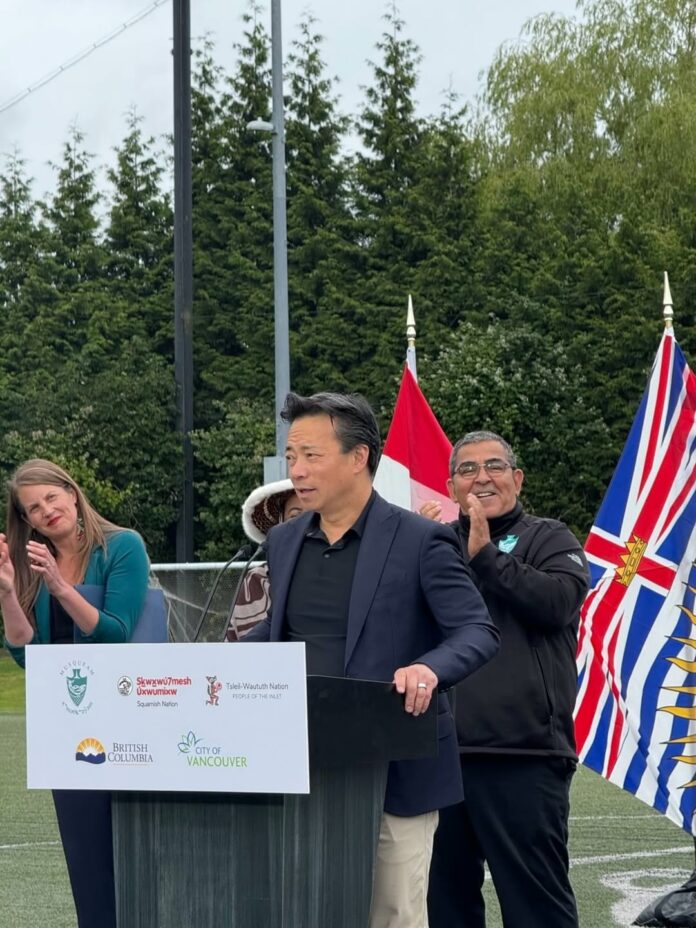
This is a photo of Ken Sim talking at a podium with two people next to him.
PHOTO: Courtesy of @kensimcity / Instagram

By: Lucaiah Smith-Miodownik, News Writer

In Vancouver, the supportive housing saga continues to develop. On July 3, mayor Ken Sim announced that his office has identified five unnamed potential city-owned locations for new supportive housing. This statement comes as the city looks for alternatives to three current supportive housing sites in the Granville Entertainment District as part of Vancouver City Council’s new revitalization plan. Supportive housing is “subsidized housing with on-site supports.”

These three present locations have not been without issues. The Vancouver Sun reported that the Luugat and St. Helen’s Hotel have had a total of 74 fires in the past five years, per mayor Sim. These locations, plus the Granville Villa, have “also been responsible for 1,364 police calls in 2024 alone, according to the city.” The Luugat also saw six deaths, three of which were overdoses, in 2024, according to Atira Women’s Resource Society, which operates the facility. 

The Peak corresponded with the mayor’s office and city councillor Pete Fry for more information on the past, present, and future of supportive housing in Vancouver. 

As to why the potential site names remain confidential, “any information related to potential City of Vancouver real estate transactions” requires a Council vote before disclosure, press secretary Taylor Verrall told The Peak. “Releasing the locations could have a significant commercial impact on the properties in question.”

“There is an effort to kind of sanitize it and gentrify it, which ignores the lived experience and historic reality of what Granville Street has been.” — Pete Fry, Vancouver city councillor

Fry recognized that Vancouver is disproportionately home to more supportive housing than other nearby areas. “The supportive housing in Vancouver is almost exclusively in the Downtown Eastside, which is frankly often to the detriment of the residents,” he added. “There is something to be said for more equitable distribution of supportive housing throughout the region.” Fry told the Vancouver Sun that “many single room occupancy residents wanted to stay in the area, but didn’t want to be housed in the Downtown Eastside.”

However, the Vancouver councillor said mayor Sim’s decision to freeze construction on net new supportive housing with the hope that other areas would step up may have had a reverse effect. 

On whose interests this relocation serves most, “it’s the business interests in the Granville Entertainment District,” Fry said. He also expressed worry that the housing closures could “create a more bland entertainment district that really panders to a very elite subset of the population that doesn’t have the broader kind of accessible appeal to folks.

“When we’re contemplating relocating folks who have lived there, most of that housing predates any of the nightclubs,” Fry added. “In fact, before Granville Street became the Granville Street Entertainment District, there were mostly beer halls and single room occupancy-type hotels,” he said. “So there is an effort to kind of sanitize it and gentrify it, which ignores the lived experience and historic reality of what Granville Street has been.”

With these considerations in mind, Fry explained his greatest concern regarding the plan to relocate these sites is “where we shift them to, and if we end up kettling even more supportive housing and more vulnerable populations in the Downtown Eastside. That is a disservice to the city of Vancouver and on those people we would be relocating,” he said. Doing so “ultimately just compounds a lot of the challenges we have with the Downtown Eastside.”

Understanding Bill C-2

0
This is a photo of a bunch of people protesting, with one large sign reading, “No One is Illegal.”
PHOTO: Maciej Prus / Pexels

By: Lucaiah Smith-Miodownik, News Writer

For many, the newly proposed Bill C-2 (also known as the Strong Borders Act) is cause for concern. According to a joint press release, it has received pushback from over 300 organizations. 

The federal government has touted the bill as a way to “strengthen our laws and keep Canadians safe by ensuring law enforcement has the right tools to keep our borders secure, combat transnational organized crime, stop the flow of illegal fentanyl, and crack down on money laundering.” The bill proposes a wide range of national security measures, including expanded surveillance powers, broader data collection and analysis, enhanced information sharing between federal and foreign government agencies, and changes to asylum claims. 

Among the organizations urging the federal government to withdraw Bill C-2 is the British Columbia Civil Liberties Association (BCCLA), which aims to preserve and further “civil liberties and human rights.” The joint letter describes the bill as “a multi-pronged assault on the basic human rights and freedoms Canada holds dear,” as it “weakens our constitutional foundations on firmly domestic matters, including an enormous and unjustified expansion of power for police and Canadian Security Intelligence Service (CSIS) to access the data, mail, and communication patterns.”

The Peak spoke with Aislin Jackson, a staff lawyer in BCCLA’s policy department, for more information.

Bill C-2 is “an omnibus bill that touches on a bunch of different areas that are only vaguely related to one another,” Jackson said. But, they acknowledged that “some of the information sharing provisions that are in the bill could potentially be defended. When it comes to being able to information share within the government, that could make a lot of sense.” 

However, “on privacy grounds, I would expect there to be constitutional challenges to this legislation,” they said, referencing parts 14 and 15 of the bill. 

Part 14 concerns the “timely gathering and production of data and information during an investigation,” while part 15 establishes the “Supporting Authorized Access to Information Act.”

Jackson said these are “new powers for police and CSIS to demand information, including warrantless powers. The new act in part 15 “would allow for secret orders to be made, requiring companies to potentially gather information they otherwise wouldn’t.” 

This ability “raises the spectre of not only potentially undermining cybersecurity and muzzling these companies from being able to disclose those changes to their clients, but also conscripting these private companies into the surveillance state,” Jackson added.

“The most vulnerable people are affected, but also all of us in terms of our privacy rights.” — Aislin Jackson, staff lawyer, British Columbia Civil Liberties Association

In its current form, the bill would allow companies to not only obtain “information from online service providers, but potentially analog service providers” without “ever going in front of a court to be reviewed for charter compliance.” This includes data from “a niche dating site” or “a support message board for a particular medical condition that you have.” 

So, the act “is in tension with our charter values, especially relating to informational privacy,” Jackson said. The Peak reached out to the Minister of Public Safety, who proposed the bill, and was directed to the Department of Justice Canada. The department said, “The charter statement for Bill C-2 explains some of the considerations that support the reasonableness of the legislative proposals.” They also said “care was taken to strike a balance” between “state interest” and “its impacts on privacy interests” in developing Bill C-2.

“In many ways, it seems like we’re falling into this race to the bottom in terms of privacy protections and also the refugee provisions as well, like the one-year time window that people have from first entering Canada to making a claim.” 

The part of the bill relevant to refugee status referenced by Jackson “means that there we’re not just coming down towards the US level, because they also have a one-year ban,” but becoming even stricter than the US. Under Bill C-2, “asylum claims would also have to be made within a year of entering the country, including for international students and temporary residents.” 

Jackson described a hypothetical scenario in which “someone came here as a tourist, and then years later became a human rights advocate, or perhaps came out as queer, or the conditions on the ground in their country might change due to a foreign invasion or an international coup.” Since a year had already lapsed, that person would not be eligible for asylum despite their need and qualification as a refugee.

“The most vulnerable people are affected, but also all of us in terms of our privacy rights,” Jackson said. “Our behaviour [would be] distorted by the feeling of those eyes on us, even if we’re not actively being surveilled at that moment. It calls to mind Michel Foucault’s idea of the Panopticon,” they added, “a digital panopticon that everyone’s living in at all times.” 

The Peak was also directed to Immigration, Refugees and Citizenship Canada for a statement. They said Bill C-2 will help “streamline the application process at all points of entry; refer complete claims to the Immigration and Refugee Board of Canada more quickly; improve decision timelines and remove inactive cases from the system; [and] facilitate voluntary departures and support vulnerable claimants.” They stated “these reforms reflect the government’s ongoing commitment to a fair, efficient, and rules-based asylum system that meets today’s migration challenges.”

Jackson encourages those concerned to write to their MPs. 

“Public pushback is one of the ways that when really problematic legal access provisions have come up in the past, they’ve been defeated.”

What Grinds Our Knees: Being too tall

0
an illustration of a person laying in bed, under the covers, with their feet sticking out because they’re too tall!
ILLUSTRATION: Victoria Lo / The Peak

By: Daniel Salcedo Rubio, Features Editor

Being tall might be something many want, but honestly, it’s a full-time curse. My knees? Crunchier than a Nature Valley granola bar. Running? Please. I’m one bad jog away from all my joints crumbling like a Nature Valley granola bar. Lower back? Falling apart faster than a Nature Valley granola bar. And to top it all off, I’m also more likely to get cancer just because I have more cells. Like, damn, can I live please?

And it doesn’t end with physiology. The world is just not made for people my height. I know, I’m an outlier, but it’s still so annoying that there are barely any accommodations. Most forms of seated transportation will likely be irritating at best, and nerve-damaging at worst. Once, on an eight-hour bus trip from Paris to Berlin, not a single seat had enough space for me to sit. Can’t sit, yet I can’t stand either — not like I would’ve been able to. So, I cramped my lower body into a seat, knees pressed flat against the seat ahead, calves numb. Any prospects of ever competing in the Olympics are gone. 

Once, while doing a fitting for a disposable hazmat suit for a human tissue culture course, I couldn’t fit into the largest available size and had to be excluded from the practical section of the course — too tall for science.

So yeah, I guess it really is true that the grass is always greener on the other side — or maybe the weather is nicer at another height?

We are the folk: the 48th Vancouver Folk Music Festival returns to Jericho Beach

0
This is a photo of a folk music festival scene
PHOTO: Amar Preciado / Pexels

By: Ashima Shukla, Staff Writer

From July 18–20, the salt-kissed shores of ʔəy̓alməxʷ / Iy̓ál̓mexw (Jericho Beach Park) will become a living, breathing experiment in togetherness — a place where folk music exists not merely as a genre but as a way of being — in an act of community resilience, with a brilliant blur of genres and geographies.

Forefronting Indigenous voices, the festival’s lineup is as sprawling and interconnected as a forest root system. You might want to listen to the electrifying fusion of Moroccan folk and Gnawa rhythm with psychedelic blues-rock by Bab L’ Bluz, or find yourself moved to tears with Elisapie’s hauntingly intimate Inuktitut-language reinterpretations of classic rock songs. Or, you might be drawn to the local folk sounds of Ocie Elliot or the dreamy acoustic harmonies of The Milk Carton Kids

And that’s just the start. Saturday night brings Scottish fusion from Shooglenifty and Sunday the retro-rock yet soulful sounds from the UK-based band, The Heavy Heavy. For the true indie lovers, catch Vancouver’s own high-energy Colombian and Mexican folk fusion from Locarno or Montreal’s Bel and Quinn, who blend Haitian traditions with Jazz, in a reminder of the diasporic spirit of Canada. 

Yes, it is a celebration of traditional and contemporary folk music, with over 40 artists. But it is also a celebration of community, with dancing, storytelling, and food. During the festival, you can visit the Artisan Market and Community Village and learn about diverse organizations building a better world, from West Coast Environmental Law to SFU’s community radio station, CJSF 90.1 FM. Or, amid corporate monopolies, you can shop from ethical local artisans and artists. There is a whole range of these to choose from, including African Fair Trade that imports soap, shampoo, and skin lotion from Senegal and Ghana and Bird Brothers Philanthropic Trading Company that sells hand-made clothing by hill tribe peoples in Southeast Asia such as the Hmong. Through supporting such initiatives, you can participate in building micro-economies of care and support causes and underrepresented voices from around the world. 

In this weekend escape full of life, you might glimpse a way forward — a future made by hands, voices, and shared breath by the southern shores of English Bay.

You’ll also find rich local flavors with vendors like Felt You Up, who use natural dyes and leaves from the Sunshine Coast to print patterns on scarves, or Thundercloud designs, who offer original Anishinaabe art. Each booth tells a story; each purchase allows you to envision a different world. 

Beyond music and culture, the festival honours its commitment to inclusivity with the Little Folks Village, where children of all ages can participate in free-spirited music, storytelling, play, and crafts. All day during the festival weekend, various activities invite you to disconnect from our obsession with productivity. Be on the look out for Pete “Redbird” Graham and his stilting family, juggling and starting sing-alongs, or get grooving with marimba ensembles from the Sarah McLachlan School of Music and the Saint James Music Academy. Learn unexpected lessons about interconnectedness from Kung Jaadee, a Haida storyteller who loves sharing many Haida and Squamish stories, or find yourself mesmerized by Angela Brown’s Nylon Zoo puppet shows. 

For three days, the lines blur between performer and audience, global and local, art and life. Folk music isn’t something we simply stream but something we actively take part in. In this weekend escape full of life, you might glimpse a way forward — a future made by hands, voices, and shared breath by the southern shores of English Bay. 

So come. Stay for a set or a stilt lesson. Stay for the possibility that strangers, songs, and sand might still show us how to be human again.

SFU alum challenges the stigma towards death

0
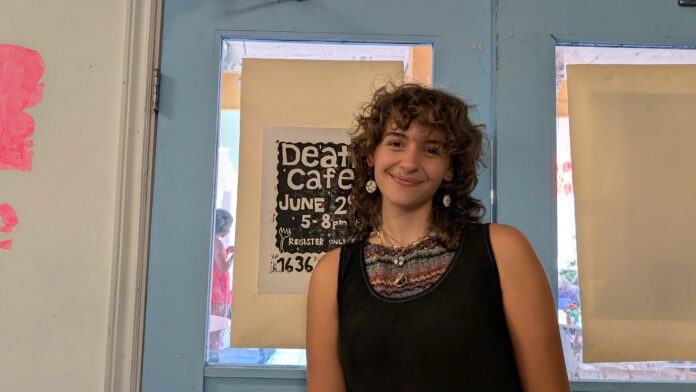
This is a photo of Ava Quissy, organizer of the SFU Death Cafe
PHOTO: Noeka Nimmervoll / The Peak

By: Noeka Nimmervoll, Staff Writer

On Sunday, June 29, Ava Quissy, a recent SFU political science graduate, hosted a Death Café at Slice Vancouver that welcomed all community members. The café hosted group conversations about death, using prompt cards to facilitate smaller group circles. Quissy led the larger group discussions, cultivating an open and grounded communal environment through questions such as, “What makes you feel most alive?” The Peak attended the event and interviewed Quissy to learn more. 

The Café Mortel was the original inspiration for Quissy’s Death Café, pioneered by Bernard Crettaz in 2004. It was a bistro where community members met monthly to talk about death. Jon Underwood developed this idea into the Death Café to further destigmatize death and bring dying back into the hands of the community instead of hospitals. Underwood expanded Crettaz’s project to become a more accessible global phenomenon, bringing conversations of death to all who wanted to partake. The café is based on four requirements: the event must not generate any financial profit, be an accessible hub for discussing death, have conversations led primarily by community members, and offer some form of refreshments. Underwood developed a website that outlines logistical aspects of Death Cafés, including a full guide on how to host your own. 

“I think a lot of people come because they’ve experienced a loss in their life and they felt like they haven’t really processed it” — Ava Quissy, SFU alum

When asked about her attraction to death, Quissy said that it has haunted her since she was 10, when she first realized everyone would eventually die. The anxiety of this inevitable moment was pushed away, at least until she took Jason Brown’s class at SFU called Death, Disease, and Disaster (HUM 330). Quissy said taking this class “changed [her] life,” through the exploration of this niche topic that “transcended education,” and encouraged her to have a greater appreciation of the multifaceted ways death is viewed around the world. Through the class’s topics relating to “how cultures respond to tragedy and dying,” she realized she wanted to have and host conversations around death, stemming from a desire for more cultural understanding and recognition around what she sees as “one of the most natural things” about human existence. 

“It started off as a class project,” Quissy said. “I was super curious to know, especially within my friend group, how other people approach this; if they felt the same way [as me].” Quissy plans to host more events like this, focusing on encouraging youth to come out and talk about death. “I definitely want to be able to inspire conversations [about death] in people that are younger so that they’re not first encountering them when they’re older,” she said. 

Quissy added, “I think a lot of people come because they’ve experienced a loss in their life and they felt like they haven’t really processed it,” owing to how “there’s no unified base for how people should grieve, and so people are just starting to do it in isolation.” Usually in Western cultures, she explained that “death has been sanitized and overly simplified,” which she believes to be detrimental to the individual and the community. Personally, I think Death Cafés provide a space for nuanced, personal conversations in which to grieve and process thoughts communally, and proves as a reminder for every human experience that we are not alone. 

Media about death recommended by Quissy

Die Wise by Stephen Jenkinson
The Wild Edge of Sorrow: Rituals of Renewal and the Sacred Work of Grief by Francis Weller
The Denial of Death by Ernest Becker
Departures (2008) by Yôjirô Takita 
The Order of the Good Death
Death Café

Three films that challenge our perception of war

0
This is a collage of the three movies featured
IMAGES: Courtesy of 1) Belarusfilm and Mosfilm; 2) Hawk Films; 3) Mosfilm

By: Yildiz Subuk, Staff Writer 

Come and See (1985)

Elem Klimov’s film tells the story of a boy named Flyora living in what is now Belarus. Located in a small village, the boy discovers a rifle which propels his eagerness to join his town’s resistance group, with a burning desire to fight against Nazi occupation. What follows, however, is Flyora’s immediate subjugation to the horrifying magnitude of war, fighting against an army with heavier firepower and brutality than his own. 

Come and See is not just visceral in its depiction of war, but the argument the film presents leaves no room to debate the morality of war. To Klimov, war is not just traumatizing but completely pointless. There is no valour, honour, or patriotism when every aspect of Flyora is broken. He loses his humanity as a child, not even given the chance to properly explore any emotion outside of hatred and fear. 

The film’s colour and atmosphere are dreamlike, yet each sequence feels inescapably real. It is almost as if the dream is deteriorating as the film moves forward. Come and See frames war as the decay of the human soul, its horror rooted in futility.

Dr. Strangelove Or: How I Learned to Stop Worrying and Love the Bomb (1964)

A group of insecure men sit in a war room, discussing the necessity of dropping an atomic bomb on the Soviet Union, possibly triggering mutually assured destruction. Stanley Kubrick’s satire captures how the idiocracy of men can quite literally destroy the world. 

Set during the height of the Cold War, the film focuses more on discourse between characters than combat. The entire threat of nuclear annihilation can be traced to General Jack D. Ripper’s inability to accept that his inability to sexually satisfy his partners comes from his old age, as he blames the Soviets for poisoning the water, destroying everyday American life. This hilarious yet infuriating reasoning captures the essence of Dr. Strangelove. It is a deconstruction of the link between masculinity and destruction. War generals who aggressively remind each other of their powers, who treat the threat of mutually assured destruction as a game, are in charge of an entire world’s existence. 

In today’s political climate, Kubrick’s film feels less like an exaggerated joke and more like a prophecy. As tensions of nuclear annihilation arise once again, Dr. Strangelove exemplifies that the real threat to our very existence are petty, insecure men detached from society, ready to press the big red button — because they can.

Ivan’s Childhood (1962)

Director Andrei Tarkovsky’s work is best described as visual poetry, like watching a painting move, layers appearing bit by bit. Ivan’s Childhood tells the story of a young, nimble, and orphaned boy, living amidst the Nazi invasion of the Soviet Union, as he works as a scout, spying and gathering information for resistance groups

The film’s imagery is what carries the story. The dialogue and action is minimal, as Tarkovsky lets the landscapes, and the framing of his characters within it tell the story. Ivan’s Childhood is a film that requires the viewer’s attention, and patience. Some of the most heartbreaking moments, like a soldier holding a girl over a small ditch as they laugh before an invasion, or Ivan discovering the building where his parents died, are conveyed through simple imagery, taking place in silence, or in a way where only the sounds of nature are heard, while dialogue is absent. 

Through slowly engulfing the audience in the story, the film explores grief, and Ivan’s heartbreaking attempts to cope with the loss of his parents, disguised in the image of a young soldier. The film is a haunting visual masterpiece that parallels the beauty of nature and humanity with the backdrop of loss and violence.

Canada should prioritize domestic needs over NATO spending

0
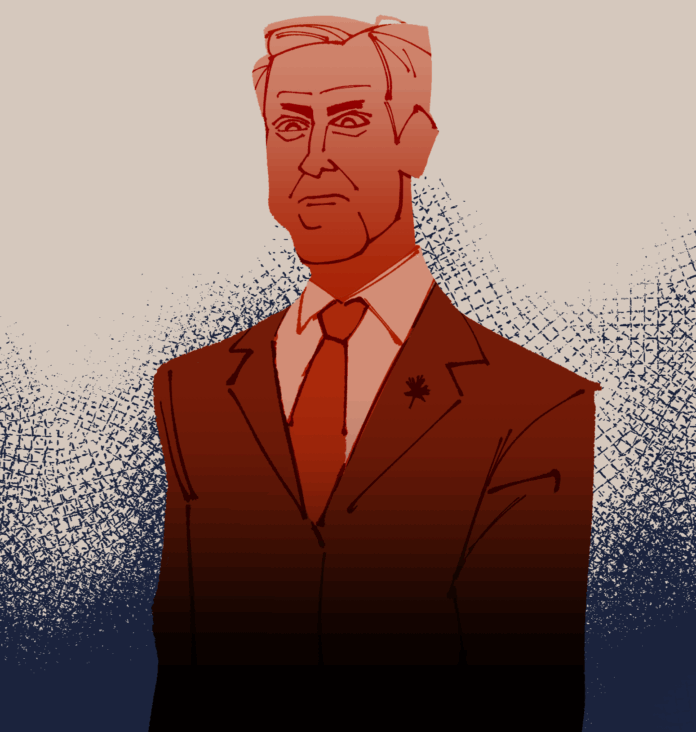
An illustration of Prime Minister Mark Carney in hues of pink and red. He has a maple leaf lapel pin on his blazer.
ILLUSTRATION: Jill Baccay / The Peak

By: Phone Min Thant, Arts & Culture Editor

On June 25, fresh from the North Atlantic Treaty Organization (NATO) Summit, Prime Minister Mark Carney announced that Canada would fulfill its commitments to the alliance’s new defence budget of 5% of annual national GDP by 2035. This was more than double the increase from the previous commitment of 2%, a target set in 2014. Canada’s defence spending has since reached 1.45%, and is expected to increase. Carney commented that the increased spending will be allocated to acquiring new equipment, diversifying Canada’s alliances, and improving pay for Canadian soldiers. Remarks by Carney and his foreign affairs minister, Anita Anand, reveal a vague yet determined drive towards an increasingly militarized Canada

While the government frames this as a necessary commitment to global security, the proposed defence spending comes at a staggering cost. Such an enormous financial commitment could limit future investment in urgent domestic needs. Instead of dedicating $150 billion annually to militarization, the federal government should invest in programs that directly improve people’s lives, including housing, healthcare, food security, and education.

Carney has already hinted that defence spending will come at the expense of government funds from other sectors of Canadian society, a view confirmed by the parliamentary budget officer. It was also speculated that it would result in tax hikes or more government debt. With the Canadian military’s financial management historically having a lot of room for improvement, these costs are only anticipated to spiral upwards. Carney also said that Canada will partially fund these costs through increased mining of minerals and development of infrastructure like ports. While no official defence policy has been published, minister Anand said her main concern is not the possibility of the spending hike but rather the timeline. 

Even ignoring the huge amount of environmental degradation and social costs associated with more mineral mining in Canada, an ironic betrayal of the Liberal party’s empty environmental promises, the new defence spending remains problematic. Canadian leaders should think twice before committing the country to spending money on defence when numerous social and economic challenges sadly remain unsolved. 

It is time for the government to realize that instead of funding massive and unnecessary militarization, they should choose to invest in the people.

The Canadian government can invest in initiatives that impact communities inside the country. For instance, just by extrapolating data from a BC government social housing initiative in Surrey, an affordable apartment complex around $500,000 ea — a direct reallocation of the annual defence funds to such projects could create over 300,000 such housing units across the country, notwithstanding the numerous divergences in costs across different regions. Even if it does not completely resolve the housing crisis in Canada, it will prove to be of great help to houseless communities, with amplified impacts on the economy.

Talking about the economy, the average yearly grocery costs of a family of four in Canada in 2025 is around $17,000. If redirected, the defence funds could subsidize grocery costs for over 88 million families of four for an entire year. This alone can help address Canada’s record-high levels (22.9% of all Canadian households) of household food insecurity today. 

Let’s say the same money is invested in healthcare — attempting to solve Canada’s physician shortages, for instance — the same billions of dollars can fund the recruitment payments of over 10 million urban physicians and more than 4.9 million physicians in rural areas. While these numbers may seem unrealistic, given that Canada only has around 96,000 doctors across the country, a better recruitment budget can mitigate the physician shortage issue. Those funds can, instead, go towards education services, training and incentivization supporting future doctors. 

The list doesn’t stop there — the costs of defence could be channelled towards mitigating many more social issues in the country: shortages of teaching staff and social workers; gaps in emergency services; unemployment benefits; education initiatives, and many more. In every case, this investment would strengthen the well-being and security of individuals — not just the state.

It is time for the government to realize that instead of funding massive and unnecessary militarization, they should choose to invest in the people.

Embark Sustainability hosts “Language as Nourishment” community kitchen

0
This is an absolutely mouthwatering photo of an Indian taco inside a styrofoam container.
PHOTO: Public domain / Picryl

By: Corbett Gildersleve, News Writer

On June 25, Embark Sustainability held a community kitchen event titled “Language as Nourishment.” This event, hosted in the Student Union Building’s community kitchen, was led by Kil Daagwiiya Hooper, an undergraduate student studying political science and Indigenous studies, James Houle, a graduate student in Mathematics, and Marie Haddad, director of engagement at Embark. 

Hooper and Houle are leaders from the First Nations, Métis, and Inuit Student Association. They spoke to the importance of maintaining and revitalizing Indigenous languages as they led the group in making Indian tacos and jum. The Peak attended the event to learn more about the “deep ties between Indigenous languages, food justice, and culture.”

Hooper said there are 12 Indigenous language families in Canada and 36 First Nations languages in BC. However, a number of these languages are endangered due to the impacts of settler colonialism and residential schools. According to Statistics Canada, “First Nations adults aged 65 and older (54.6%) were four times more likely to speak an Indigenous language than children aged 14 and younger (13.7%).” 

These foods “bring the feeling of community — Indian Tacos, as they’re a widely shared comfort food for Indigenous people, and Jum, as it’s a food that she grew up having regularly at home on Haida Gwaii.” — Kil Daagwiiya Hooper, undergraduate in political science and Indigenous studies, FNMISA leader

The number of Indigenous Peoples who learned their language at home as a child has declined by 7.1% from 2016. Hooper told The Peak, “While many Indigenous people want to learn their language, there typically isn’t enough support in place to learn it past basic words/phrases.” She advocated for “more funding provided to language organizations so that they’re able to reduce barriers for language learners.” Current revitalization efforts in BC include the Mentor-Apprentice program, a one-on-one program where First Nations Peoples are paired with a fluent speaker, and the Language Nest program, an early childhood Indigenous language program.  

Hooper and Houle introduced the food the group would make for the evening. Indian Tacos are seasoned meat served on frybread or bannock, while jum is a halibut stew with potatoes, sliced onions and seasoning. They added that depending on which Indigenous community someone is part of, bannock and fry bread could be viewed as the same or distinct. While some view fry bread as fried and bannock as baked, bannock could also be both fried and baked, making for a similar type of bread.

Hooper told The Peak she chose these foods because they “bring the feeling of community — Indian tacos, as they’re a widely shared comfort food for Indigenous people, and jum, as it’s a food that she grew up having regularly at home on Haida Gwaii.” She added that the event is named “Language as Nourishment” as there is an “importance that Indigenous languages have, nourishing our spirit. Similarly, Indian Tacos and um give that same nourishing feeling.”