Home Blog Page 264

The challenges of studying as a student with ADHD

0
a laptop, cup of coffee, notebook and pen, and phone on table
Navigating a university structure not built for your brain can be frustrating. PHOTO: Andrew Neel / Pexels

By: Nercya Kalino, Staff Writer

We’ve all seen the lists of study tips that advocate for strict schedules and the Pomodoro Technique, but most of these tips are designed for neurotypical brains, meaning they don’t work for everyone. The Peak spoke to Adelina Streletskaya to get her perspective as a student who has Attention Deficit Hyperactivity Disorder (ADHD), a “neurodevelopmental disorder that causes various hyperactive and disruptive behaviours.” A behavioural neuroscience student in her second year, Streletskaya spoke about study tips, what diagnosis means to her, and some of the habits she has developed over time for her academics.

Streletskaya explained she was medically diagnosed in September 2021 but first became aware of ADHD in the beginning of 2020. She recalled, “I would get random comments when I was younger from teachers saying that I would talk too much or that I wouldn’t pay attention.” This is an experience that some people may go through due to being unaware of the different ways the symptoms of ADHD can present. Additionally, while boys (or those socialized as boys) are more likely to display hyperactivity and impulsivity, girls (or those socialized as girls) are more likely to display symptoms internally, such as low self-esteem and inattentiveness. Thanks to TikTok, there has been a spotlight on women and girls being underdiagnosed with ADHD. 

Once Streletskaya realized what was happening in her brain was not her fault, it changed  the way she saw herself in academics.

Streletskaya explained she used to be a lot harder on herself for not understanding certain topics the same way her peers did. “I would get really confused as to why someone would be able to just go to a lecture and understand it right away but I wouldn’t be able to do that. Before my diagnosis, I was getting really frustrated with myself [ . . . ] but after the diagnosis it made a lot more sense and I started working on understanding it better and [having] self-compassion.

“It doesn’t mean there’s something wrong with me. My brain just functions differently.” The important thing is to be patient with yourself, she added. 

Now that she knows she has ADHD, Streletskaya has a different way of looking at her studies. She first dedicated time to research ADHD to learn more about the traits behind it. She realized teaching herself about the topic made it easier for her to be calmer with herself. Once she had a better understanding of what this meant, she changed her routine by giving herself more time with tasks and scheduling breaks to avoid being overwhelmed. 

Streletskaya explained she also takes medication for her ADHD. “I think my life changed quite a bit, especially when I started taking my medication,” she shared. 

“One thing that is misconstrued is that medication drastically changes something with people with ADHD and that suddenly your brain is going to be working a million miles an hour and that it’s going to solve all your problems, but medication is more like a band-aid,” she said. 

From her perspective, there is still a lot of adjusting that one has to do, in addition to medication, to change the tendencies that would lead to old habits. 

“Instead of working against my ADHD, I started working with it,” Streletskaya expressed. She explained paying attention to routines is important and understanding she’s a morning person has been key. Now, instead of leaving her studying until the evening, she studies in the daytime. She also recommends having different study spots for different subjects and emphasized the necessity of tackling one thing at a time. She gave the example of the commonly recommended Pomodoro Technique, which alternates set studying times and breaks, as a method that did not work for her. “It just didn’t work for me because that 15 minute break would turn into three hours,” she said.

Another way Streletskaya works with her ADHD is by understanding her symptoms and using them to her advantage. She explained she tends to talk a lot so she integrates this into her study routine by explaining what she’s learned to classmates or friends.

As contrary as it sounds, a routine is an important aspect of working with ADHD — even though ADHD makes it difficult to develop a routine. Medication may help, but for the most part, it’s about understanding how ADHD intertwines with lifestyle. It may be hard at first to let go of habits, but in order to progress with the help of medication, students should take time to observe and take note of the things that are difficult, and start making changes slowly. 

There are challenges in any journey that requires large life changes for a long term impact. For Streletskaya, comparing herself to others is one of those challenges. “It’s really hard to see someone who gets it right away and how it takes way less work for someone to get the same understanding as I do. It gets very frustrating because it almost feels unfair and like they have an advantage,” she said. To an extent, when she reflects on how much others can handle doing in a day, she sometimes feels as if ADHD is a punishment. 

“By the time I plan and schedule and actually study, I don’t have energy for anything else,” she explained.  

Although comparison is a thought process familiar to most students, it is important to remember achievements. A way to do this is by writing down accomplishments and putting them somewhere visible. It is easier to believe that priorities are out of control, but it comes down to finding important tasks and investing time into that. For Streletskaya, that is her academics.

Streletskaya suggested trying multiple ways to figure out what works for your study style with ADHD. She explained Google is the best place to start to find tips but SFU’s Centre for Accessible Learning is another option. She also suggested talking to other people who have ADHD and can validate your experience.

“Don’t be afraid to try anything and everything,” Streletskaya stressed.
SFYou: Dr. Jen Marchbank

0
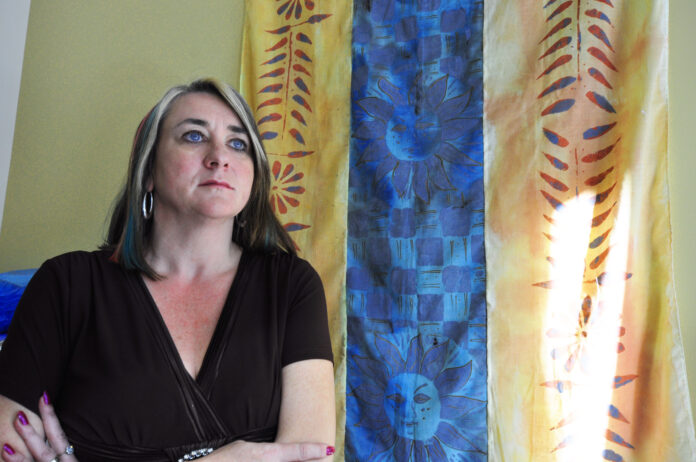
Dr. Jen Marchbank looking into the distance. She has shoulder length brown hair with two blonde streaks framing her face and a black v-neck top.
There are many things to look forward to in Surrey that celebrate LGBTQ history and that Marchbank was heavily involved with. PHOTO: Simon Fraser University - Communications & Marketing / Flickr

By: Yasmin Vejs Simsek, Staff Writer

Editor’s note: The acronym LGBTQ will be used, as is used by the interviewee. This is not meant to diminish or neglect those identifying with IA2S+.

Dr. Jen Marchbank is a professor and graduate chair in the department of gender, sexuality, and women’s studies (GSWS), but her commitments don’t stop there. As a deeply engaged activist for the LGBTQ community, she inspires people to create the change they want to see through innovative teaching practices. On May 26, she received the YWCA Women of Distinction Award for Education, Training and Development. The award ceremony recognized 75 remarkable women in 14 different categories. The Peak spoke to Marchbank to find out more about her accomplishments and the upcoming Surrey Pride Festival she’s putting a lot of effort into planning.  

Marchbank credited her award to her work with NEVR, the Network to Eliminate Violence in Relationships. Marchbank attended the awards ceremony with her wife, Sylvie Traphan, and was thrilled to hear an anonymous donor matched the fundraising. “They had a target of raising $125,000 in that night [ . . . ] and then an anonymous donor matched it, so they got a quarter of a million for purpose-built housing for women and their children in Burnaby.”

 Speaking about the award, Marchbank said, “One of the things I was recognised for was my innovative teaching practice and using things like podcasts, intergenerational oral history, and my research in LGBTQ and trans youth and elder abuse.” Marchbank received the award not just for her work at SFU but also the work she does outside of it. She explained that includes the advocacy she does with Youth For a Change, a Surrey-based organization she founded with Traphan in 2012 to educate and support queer youth, “training them to become social justice advocates themselves.” 

Of all the projects Marchbank has done, one of her favourites came through SFU. “I really liked the elder abuse project that I did with Dr. Gloria Gutman from gerontology, Claire Robson from GSWS, and our artistic director at that time, then PhD candidate Kelsey Blair

“What I liked so much about the LGBTQ elder one was the intergenerational aspect of it, the community level aspect,” Marchbank said. The project was created with both Youth For a Change and Quirk-e, a queer collective for elders. When they began this project, they didn’t realize that no Canadian material existed on the topic. In the end they created Canada’s first educational materials on elder abuse in the LGBTQ community through the creation of five posters in different languages with different cultures represented and three videos. They also toured with members of the collectives to every health authority in BC. 

“And it’s still going! Claire, Gloria, and I are still working as a team and the project’s been morphed into the Indigo Project,” said Marchbank.

 Surrey Pride

This month however, Marchbank is busy with Surrey Pride. As secretary of the Surrey Pride Society, she is deeply involved in the festivities being held at and around SFU’s Surrey campus. She previously served as president and, under her leadership, they changed the name from Out in Surrey Rainbow Cultural Society to Surrey Pride Society. “I used to say after that, my favorite title is past president. I really like being a past president of Surrey Pride,” she joked. 

Marchbank’s journey with Surrey Pride started when she went to their AGM in 2011. Looking around the room, she realised that she and her wife were the only lesbians present. “So, I made a comment: ‘where are all the lesbians?’ Which got me noticed and elected,” she said. After a short hiatus, she is now back on the Board to help Surrey Pride get back on its feet after COVID-19 restrictions. Marchbank’s daughter, Jasmine Brodoer, and Traphan are also on the Board, and it’s jokingly referred to as “the family business.”

 There are many things to look forward to in Surrey that celebrate LGBTQ history and that Marchbank was heavily involved with. A three month long LGBTQ history exhibit, curated by Marchbank, just opened in the first week of June in the Museum of Surrey. Marchbank’s personal archive is now available through her donation to the Surrey Archives.

On June 23, SFU GSWS and Surrey Pride will host the Canadian premiere screening of Nelly Queen: the Life and Times of Jose Sarria, a documentary telling the story of the world’s first openly gay man to run for public office in 1961 San Francisco. The event will take place at SFU Surrey and registration is required. 

Surrey Pride Festival is happening on June 25 at Central City Mall Plaza in Surrey from 4:00–9:00 p.m. This year it’s being held both virtually and in-person with welcome in different languages to recognise Surrey’s diversity. In-person, there will be mobility accessible stages, ASL sign interpreters, and porta potties.

A full list of all the events at Surrey Pride 2022 and information on how to get tickets can be found here: https://www.surreypride.ca/pride-2022.

Exploring Canada’s racist history of drug prohibition

0
a black and white picture of railroads.
BCCDC and SFU health sciences hosted this seminar for Asian Heritage Month. PHOTO: Gudrun Wai-Gunnarsson / The Peak

By: Olivia Visser, Staff Writer

Content warning: anti-Asian racism, anti-Indigeneity, white supremacy, xenophobia, drugs, and drug-related death

This month, BC set out to be Canada’s first province to decriminalize the possession of small amounts of drugs starting January 2023. The decision is a landmark step towards freedom for many British Columbians, but we can’t forget the insidious history of racial discrimination that characterizes Canada’s drug policy. Shila Avissa and Cherlyn Manderson-Cortes addressed this history in their May 27 seminar, “Railroads, Riots and Reefer: A Brief History of How Drug Prohibition Shaped the Early Asian Immigrant Experience.”

Presented by SFU faculty of health sciences and the BC Centre for Disease Control, this seminar was part of a “larger harm reduction workshop” put together by the First Nations Health Authority (FNHA).

Avissa is an Indonesian social worker and researcher and Manderson-Cortes is a Filipinx clinical nurse educator. Having extensive experience and knowledge of drug policy and its impacts, they decided to deliver this presentation to “speak to the toxic and poisoned drug crisis” currently affecting British Columbians. BC declared its first public health emergency from drug-related deaths on April 14, 2016. Since then, 9,400 British Columbians have lost their lives to toxic and illegal drugs. “Those are just the deaths that we know about since we started paying attention,” Manderson-Cortes said.

Manderson-Cortes was first introduced to the “dark roots of drug prohibition” by Janine Stevenson from the FNHA. Drug prohibition, she said, is “a story of oppression and injustice that intersects with Black communities, Indigenous communities, and in the lives of many other racialized folks.” Manderson-Cortes highlighted that many Chinese workers used to work alongside Indigenous people who “were also exploited in the early days of BC’s natural resource industry.” The country’s first drug prohibition was aimed towards Indigenous people with Canada prohibiting them from consuming alcohol in 1868, an exclusion that continued even after the country-wide prohibition was lifted in 1921.

Honouring this intersectionality, they began the seminar with a land acknowledgement. Avissa showed the audience two photos of səl̓ilw̓ət (Burrard Inlet), describing it as a “deeply meaningful place” to both her and Manderson-Cortes. 

“The land that we are on has been the site of human activity since time immemorial,” Avissa expressed, before acknowledging that most of this land is still unceded. She also paid an important tribute to “ancestors of African origin” who were brought to Canada by the Transatlantic Slave Trade.

To start off their presentation, they spoke about how opium and alcohol were the first substances to become illegal. Marginalized groups have suffered and continue to suffer higher rates of criminalization for drug use than white people. For example, Manderson-Cortes said prohibition made the Chinese community “targets for law enforcement.” According to the presentation, substances like heroin and cocaine were regularly prescribed within white communities in the 1800s. Meanwhile, immigrants were starting to see discrimination acted out on their communities through drug legislation.   

The Canadian Pacific Railway (CPR), which facilitated the immigration of 17,000 Chinese men, paved the way for anti-Asian racism. This in turn underlined Canada’s drug prohibition. Manderson-Cortes addressed the discrimination evident in the disparities among Chinese and white CPR workers. She displayed a recruitment ad which offered white workers $1.50 a day and Chinese workers $1. On top of that, Chinese immigrants had to pay for their own food while white workers had provisions covered. 

After the railway’s completion, there was a racist belief there were “too many Asian workers and too many Asian immigrants,” said Manderson-Cortes. This led to the imposition of a $50 head tax on Chinese immigrants, which reached $500 by 1903. When that wasn’t enough, the Chinese Exclusion Act banned nearly all Chinese immigration into Canada by heavily restricting the immigration requirements. The Canadian government’s next, more subtle strategy that targeted Chinese immigrants was the stigmatization of opium, with Vancouver leading the way for Canada to pass the Opium Act of 1908. 

Manderson-Cortes explained opium prohibition normalized racism because it facilitated the mainstream adoption of Chinese exclusion and isolation. The large percentage of Chinese men in BC were scapegoated for introducing opium to Canada and corrupting white women with it — despite the British having controlled the opium trade and popularized it in China. She described prohibition as “the seed from which xenophobia grows, from which paranoia and fear of other cultures grows.” 

Opium used to be legal in the 1800s and was popular among Chinese immigrants, but anti-Asian sentiment was most prominent after the railway’s completion. The drug became a way to justify the targeting that also permeated popular media. The presenters read a few quotations and showed a book cover highlighting the opium stigmatization which targeted the Chinese community. They also used Canada’s first woman judge and famed suffragette, Emily Murphy, as an example of popularized racism. According to Murphy, opium was “an attempt to injure” the white race, furthering the stereotype that Asians brought opium to white people and corrupted them with it. 

“When you stigmatize a substance, you can stigmatize an entire community,” Manderson-Cortes said. Legislators sought to ban opium not because of health concerns, but because of perceived impurities tied to its popularity in Chinese communities. Widespread racism and hatred also contributed anti-Asian riots in San Francisco that led to many Chinese immigrants fleeing the violence by coming to Vancouver.

For Asian immigrants escaping racism, Canada was hardly safer than the United States. Vancouver was home to the Asiatic Exclusion League, an organization led by white men to promote anti-Asian sentiment and lobby for anti-Asian policies. On September 7, 1907, they became a “rightist mob” when they attacked Chinatown, targeting shop owners and destroying property. Their signs read: “For a white Canada.” 

Manderson-Cortes said, “Drug prohibition isn’t entirely about people’s health, and [ . . . ] what it does is support anti-immigration laws and help create new workforces of low paid labor.” Moreover, she said that “disrupting connections between communities” was an effective method of limiting the networking of racialized folks. This is a discrete but powerful form of oppression. 

In the 1960s, Canada targeted migrants who used cannabis as a cultural activity. By the 1970s, there were “over 400,000 convictions per year.” Canada’s history of prohibition lives on in the mass sentencing of members of minority groups.

Manderson-Cortes emphasized “there was always resistance” to the racist, classist, and ableist war on drugs, and “there will always be resistance in the future.” She added this resistance is usually led by those “most impacted by these discriminatory laws,” then gave a few examples of community resistance. 

The South Asian Local Mobilization Outreach Network, or the Salmon Project, was created as a response to the overdose crisis in BC. They offer “life saving education resources” in “culturally relevant ways” that are centred in harm reduction approaches.

Avissa also named a grassroots organization fighting against the war on drugs in Indonesia, the STIGMA Foundation. They offer support to drug-users in Indonesia through various types of community advocacy such as education and community organizing. She called their work a “daily act of resistance and bravery” as drug use is still heavily criminalized in Indonesia. 

Avissa and Manderson-Cortes finished their presentation by encouraging everyone to “stand in solidarity alongside the local, national, and global resistance” against drug prohibition. Their presentation was a deeply informative approach to addressing racism through education and the normalization of drug use.

The Association of Latin American Students (ALAS) welcomes all members with open arms

0
Three members of ALAS stand in front of bags of clothing ready to be donated.
ALAS helps students build networks and remain in the loop about SFU events. PHOTO: SFU ALAS

By: Isabella Urbani, Staff Writer

You hear it said time and time again. Joining a club at any level — high school, university, adulthood — can be a life changing experience. This is true for both domestic and international students navigating post-secondary, and especially beneficial for international students adjusting to the traditions and culture of an entirely new country. 

Arturo Pacheco, president of SFU’s Association of Latin American Students (ALAS) and third year criminology major, has experienced these benefits first-hand. Coming to SFU as an international student from Mexico, Pacheco joined the club back in Spring 2019 to gain new friends. 

“As an international student, the first couple of months are rough because you’re just missing your parents every day or being with people from singular cultural backgrounds. ALAS is a way to feel like you’re back at home,” Pacheco expressed.

Since its beginnings in the 2000s, ALAS has provided a “safe environment for entertainment and a place to share Latin American roots, culture, festivities, food; we want to promote the best of having a multicultural community,” said Pacheco.

Part of having a multicultural community is embracing all identities. ALAS isn’t just home to Latin American students, explained Pacheco. “We don’t really care where you’re from or who you are. We just want to share our cultural backgrounds, and we expect for you to respect our festivities and food. We just want to have a good, healthy, peaceful community.” 

That being said, the club is still dedicated to helping Latin American students gain their footing on campus through running events to help students make connections and making them aware of what the university has to offer. 

Their first event of the semester, which Pacheco described as a “networking, getting to know people from your same background” icebreaker, took place on May 27, but the club has many other events upcoming. “The ones that are already on the table, and waiting for the weather to clear up a bit, are [trips] to Kitsilano beach to play volleyball. We’re going to have volleyball tournaments on Saturdays,” Pacheco said. 

Additionally, to help students to better understand the events and opportunities SFU and the Simon Fraser Student Society (SFSS) have to offer, ALAS vice-president Lester Pino created a podcast called The Latin Corner.

“The main goal of the podcast is to be informative about SFU, SFSS, and experiences on campus,” revealed Pacheco. “We all remember when we first came to campus as an international student, we had no idea what the SFSS had to offer, SFU itself, or even how to connect with people.”

The club has currently released four episodes on Spotify featuring members from Students of Caribbean and African Ancestry, SFU350, and the African Students’ Association.

Much like the club, the podcast isn’t just meant for Latin American students. “That is why we also wanted to touch on other clubs, and give them a platform to introduce themselves, where to find them, and what they do,” said Pacheco. 

He explained the idea for the podcast is to highlight groups who’ve had a “huge impact on campus,” such as SFU350 whose mural protested SFU’s lack of climate action. 

“SFU350 rocked the campus with their protest. That was amazing, I loved the mural! So, that’s why we wanted to get in touch — to give them another platform to show their club and their activities.” 

Connection, collaboration, and community are priorities for ALAS and they have kick-started initiatives to give back to local communities.

“Last winter was super cold and there are some social, economic issues everyone knows about, everyone can see in downtown, and we wanted to do something about it. We’ve come so far from Latin America, we are so happy to be here and give back to the community in any way we can,” he said.

ALAS hosted a clothing drive this past March along with UBC Mexican Student Association. The clothing drive was an idea by Pino, which Pacheco referred to as a “goldmine” for how much they were able to collect. Donations from the clothing drive went to Lookout Society, an organization working to reduce barriers to accessing housing. 

“We arranged for a bucket in the Convocation Mall for people to drop stuff in, mostly winter stuff. We donated 20 killos (44 pounds). Their smile was so heartwarming, it was so worth it,” said Pacheco. 

He added the club has always donated proceeds from ticketed events to various organizations.

Normally, ALAS meets once a week to discuss club matters. As of right now, meetings are hybrid. For those who are able to make it, ALAS meetings take place on the third floor of the W.A.C. Bennett Library in the Media and Maker Commons. However, as the weather heats up, they will be looking to host meetings outside. They also use WhatsApp and Discord for cultural and personal conversations throughout the week and to circulate event invitations. 

For the last three years, Pacheco has made “beautiful connections” thanks to ALAS that have extended past the club. He still goes biking with the former vice president of the club. Pacheco encourages readers to give their events a try. Whether you want to talk about food, culture, or the World Cup Qualifiers — which sparks tons of playful debates among members of the club — ALAS welcomes all. “If you’re a first year student or you feel like you need more interaction, give us a message, reach out; we will do whatever we can to make you feel at home.” 

For more information about ALAS at their future events, check out their Instagram @sfu_alas. They also have their podcast linked for listening in their bio.

SFUnexplained: Joy Johnson is the Editor-in-Chief of The Peak

0
Illustration of Joy Johnson smirking as she reads a cover of The Peak, with an illustration of Joy Johnson on it.
ILLUSTRATION: Shaheen Virk / The Peak

By: Yasmin Vejs Simsek, Staff Writer

Joy Johnson is the president of Simon Fraser University. Or is she? I’ve given this a ton of thought and at this point, there is not a doubt in my mind that Joy Johnson is actually Editor-in-Chief at The Peak. 

Okay, hear me out! First of all, Joy Johnson is like the most powerful person at SFU. I bet you she has people at her beck and call to do whatever she asks. Want a 3:00 a.m. bagel? She’ll probably have it within the hour. Fancy a private whale-watching tour in pouring rain? She’s definitely got a guy on call for that. So, if she wanted to be the boss of the coolest newspaper in town, she could easily take over and completely forget about the yearly hiring process for the Editor-in-Chief. She’s. Got. The. Power.

Second of all, have you ever seen the Editor-in-Chief and Joy Johnson in the same room at the same time? No? Because they are the same person! Joy Johnson might be powerful, but she does not have magical powers and therefore can’t be two people at once. Think about that next time you are in the room with Johnson and the Editor-in-Chief of The Peak isn’t there. Suspicious? I think so.

And don’t even get me started on the amount of jokes The Peak makes about Joy Johnson or past SFU presidents. This is giving me some serious Gossip Girl vibes, where you know, Gossip Girl actually had to gossip about themselves to make sure people will never suspect it is you. And what better way to make sure people talk about you than to make sure the topic is always on you?

Speaking of which, most of the articles The Peak publishes on Joy Johnson are always poking fun of her and who better to make fun of someone, if not themselves? Self-deprecating humour, you guys! Why else would The Peak publish a humor article titled, “SFU gets rid of professors to save president’s salary,” if not to deflect from the fact that it was all true! I’m telling you, it’s all a ruse to throw us off the scent. You see? It all makes sense.

Listen, everyone here at The Peak is so confused. I have never actually met the Editor-in-Chief, the so-called Michelle Young in person. That’s OBVIOUSLY somehow an anagram for Joy Johnson. And like COVID-19 is basically over (another obvious hoax), so why are we still meeting on Zoom? We’re all vaccinated, and it’s not like COVID-19 is rapidly mutating to be more transmissible or anything. EVERYONE else is back in-person (except those people with the worst “seasonal summer colds” of their life) and yet here we are at The Peak stuck in front of our laptops. I bet she’s using a green screen because our Editor-in-Chief does not want to be found out for who she really is! We need to expose her, so please spread the word you guys. I was only able to get this piece through to the Humour editor with fairly little resistance! I wonder why . . .

Sincerely,

A desperate Staff Writer


Comics

0
ILLUSTRATION: Sara Brinkac / The Peak

By: Olivia Visser, Staff Writer
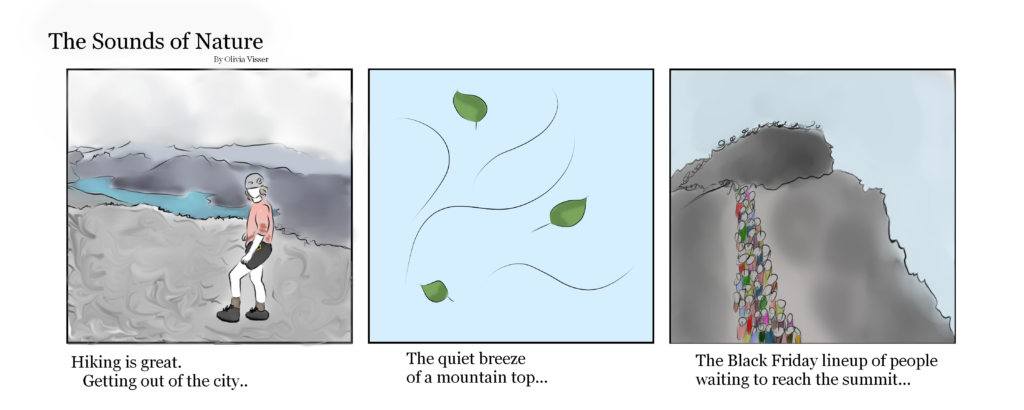
Panel 1: A person stands on a grey rocky mountaintop overlooking a mountainous lake. Beneath the panel is text that reads "Hiking is great. Getting out of the city..." Panel 2: Three green leaves are seen atop a blue sky, indicating a breeze. Beneath the panel reads "The quiet breeze of a mountain top..." Panel 3: A large crowd of people trails from the bottom to the top of a grey rocky mountain, seen from behind. The text beneath reads "The Black Friday lineup of people waiting to reach the summit..."


The monster under my bed won’t pay rent

0
A close-up photo of a green plushy monster staring into the camera
PHOTO: Pixabay

By: Yasmin Vejs Simsek, Staff Writer

Dear Mrs. Goldblum of Goldblum and Sons,

I am writing to seek legal advice. I have this monster under my bed, like I am sure many of your clients have had. While I do not wish to evict him, I do need him to pay rent. My utilities have basically gone through the roof since he moved in, and I cannot carry the financial burden for the both of us, especially not in this economy. It’s quite difficult to communicate with him since he only grunts. Not to mention the cultural barrier of someone who prefers hiding under the bed over having a house meeting.

I have attempted to write up a rental agreement that I would appreciate you looking through and advising me on the next step.

Name: Monster*

Address: 666 Godzilla Avenue, Loch Ness, BC

*Note: I am unsure of Monster’s name, as they simply blurt out unearthly horrors every time I ask.

This is a legally binding agreement between Landlord and Renter. The latter will hereby be referred to as Monster. This contract will outline the rent Monster shall pay Landlord as a fee for moving in under their bed. The contract will be in effect for a month once signed, with the possibility of renewal if Monster agrees to never scare Landlord on purpose and adheres to the following:

Monster agrees to pay Landlord the sum of $1,000 on a monthly basis for their comfortable living quarters under the bed. This includes utilities, water, gas, but not Wi-Fi. Access to Wi-Fi will be an additional $50 a month, considering how many hours Monster spends on Facetime with Big Foot. This can be negotiated if Monster chooses to take said calls at a nearby café and/or agrees to read Landlord a bedtime story every Monday night. Moreover, the rent will include access to Landlord’s Netflix account, so long as Monster promises to only use their own profile and not interfere with Landlord’s algorithm. Landlord is a scaredy cat.

Monster is allowed to have friends over once a week, with the exception of the Boogieman, with whom Landlord has beef. Additionally, Monster shall pay Landlord a security deposit in the amount of $800, in case of any damages Monster might cause with their large presence. The deposit will be returned as long as the premises are returned in the same condition as accepted, including the return of each individual dust bunny. No pets will be allowed, as Monster is technically considered a pet under Canadian law, but a renter under this contract.

Thanks, Ms. Goldblum, I hope you have a terrific—

No, stop Monster. STOP! You can’t eat this letter, it’s official business!


Roe v. Wade: Your religion should not police my body

0
pro-choice protestors at Supreme Court
Anti-abortionists are the result of inconsistent religious moralizing on bodily autonomy. PHOTO: Gayatri Malhotra, Unsplash

By Yasmin Vejs Simsek, Staff Writer

Content warning: Mentions of sexual assault and anti-abortion sentiments

The US Supreme Court has overturned Roe v. Wade. The decision undermines the bodily autonomy of just over half the country’s population. The original 1973 ruling guaranteed people a constitutional right to have an abortion. Flash forward to June 24, 2022 and the Supreme Court has now rewound the clocks by 50 years in an infuriating ruling that takes bodily autonomy away under the disgusting pretense of religious piety.

Zechariah 7:10 says: “Do not oppress the widow or the fatherless, the foreigner, or the poor. Do not plot evil against each other.” God wants his worshippers to take care of the vulnerable, especially children. But the pro-life (anti-abortion) faithful have no interest in actually securing a good life for potential babies, as is evident from the lack of health care, parental leave, daycare, and decent education in the US. Thanks in part to those social failures, maternal mortality is over twice as high in the US compared to the next highest developed country — 17.4 women in every 100,000 in the US die at some point during the childbirth process, compared to 8.7 in France. The failure of American post-natal care extends to the country’s atrocious foster care system. But no calls to address those terrible failures make anti-abortionists’ chants. It’s clear that religious anti-abortionists are not loving their neighbor, nor are they acting as good samaritans by working to help the fetuses they forced birth upon.  

The hypocrisy of failing to care for babies after they’re born is multiplied by the religious hypocrisy that’s shown over the course of the pregnancy. Genesis 2:7 preaches: “Then the Lord God formed man of dust from the ground, and breathed into his nostrils the breath of life; and man became a living being.” You don’t have to have a major in theology to understand that this passage refers to life starting at first breath, but here’s one anyway. Judaism is even clearer — according to the Talmud, the ancient rabbis saw the fetus as part of the mother until birth. Life begins, for them, at the moment of birth. But, as a result of the Supreme Court decision, people who accept this Jewish take on life have their religious freedom undermined. To turn the expression “life begins at conception” into law, is a violation of the freedom of those who say it begins at “first breath.”

Many anti-abortionists will use the phrase, “It is God’s will,” to support their argument. Pregnancies, they’ll say, are the result of divine intervention — whether they’re unplanned, the result of incest, or whether the baby won’t be able to survive in the real world. That argument generates a range of problematic questions. Impotence, for instance, is just as much God’s will as pregnancy, where is the ban on Viagra? Infertility, rape, murder, cancer — are these all God’s will? Absolutely not. Further, it is believed among Christians that an angel came down to ask Mary whether she wanted to carry baby Jesus. Key word, ask. God didn’t just force her to carry a child — He gave her the choice to carry one.

Of course, moralizing on religious thought isn’t the most important thing here. The US is technically a secular nation, which means it constitutionally separates the church and the state. The US should therefore not be able to make laws based on religious teachings, especially when 59% of Christians in the country and 89% of religiously-unaffiliated people did not want to see Roe v. Wade overturned. The freedom of belief stands as it should, but the freedom to not believe is also a constitutional right. If someone tried to impose Islam on Americans, the situation would be pretty different, I’m sure — as has been argued in light of another recent religious-based Supreme Court decision. No one, no Christian, no Muslim, no Jewish person, should impose their religion on someone else’s body.

A country that can now dole out harsher punishments for aborting a pregnancy that occurred as a result of rape, than for the crime itself, is a country that is at war with people who have uteruses.

And that’s the point. 

Religion is being used as a pretext for misogynistic policymaking. It’s a smokescreen for a desire to see pregnant Americans as tools for birthing, rather than people. It’s a way to punish people for their sexuality. That’s why the very same court that just overturned Roe is now setting its sights on the right to contraception. The goal is to reduce agency from the moment of conception to childbirth to when the child reaches adulthood. Don’t be fooled by false displays of religious piety. The end of Roe is the result of a misogynistic push to reduce people to their reproductive organs and ability to give birth. 

We need to keep an eye out for anti-abortionists in Canada. While our population is generally more agreeable towards abortion, we have a weak legal infrastructure that upholds the right to bodily autonomy that leaves us open to restrictions. We need to check those who would use religion as a pretext for reducing our rights. We deserve the choice over our own bodies. It’s an essential part of healthcare, and an essential part of living as a free citizen.

Bright-er Side: At some point, Wikipedia became a partially-reliable website

0
Wikipedia globe sitting on papers
We can cautiously poke it for answers. ILLUSTRATION: Lori Jiang / The Peak

By Bhavana Kaushik, SFU Student

We’ve all heard the warning: “Wikipedia can’t be trusted.” At every level elementary, middle, high, and university we’re warned to stay away from the free online encyclopedia. And so we’ve sadly been slow to learn that, at some point, the site became a partially reliable source. 

Wikipedia is the first click. Not just in terms of Google results, but as a stepping-off point for further research. When you’re curious about any issue (literally, any issue), using hyperlinks to travel through an endless web of curiosity is a fantastic way to spend your time. 

Better yet, the list of references at the bottom of any Wikipedia page. When statements on the site are backed up by academic journals or government documents, it lends credibility to the page on two fronts: first, it assures the reader there’s a good source of information for statements on the site; second, it makes the site useful by providing the reader with a virtual cornucopia of valid virtual sources through which they can search. This is the greatest value that Wikipedia has to offer: aggregating legitimate sources on any given topic under one wiki. 

Now, granted, “anyone in the world can write anything they want about any subject,” so sometimes you’re going to get ridiculous stuff. If you, for example, trawl through the edit history on the “First Law of Thermodynamics” page, you’ll find a 2012 entry that changed the page’s first line to “the [first law of thermodynamics] is do not talk about thermodynamics.” And while I’m inclined to agree because of my hateful relationship with chemistry, the incident underscores the general success of edits to the site. The riff on Fight Club was fixed within a minute!

That’s not to say that the site is a perfect source. Contributors and editors have not prioritized pages about accomplishments by women. The same can be said of other underrepresented groups, including “people of color, people with disabilities, LGBTQ people, [and] Indigenous communities.” It just goes to show that while Wikipedia has made strides in legitimacy, it’s still fundamentally a place to start researching, but not the end. 

However, Wikipedia does offer more in-depth, readable, and widely accessible articles than Encyclopedia Britannica. We need to remain cautious, but we also need to stop utterly dismissing the site as a repository of information and sources. Don’t just take my word for it . . . take a look at the Wikipedia article on the reliability of Wikipedia!

All about drama: SFU needs a theatre club

0
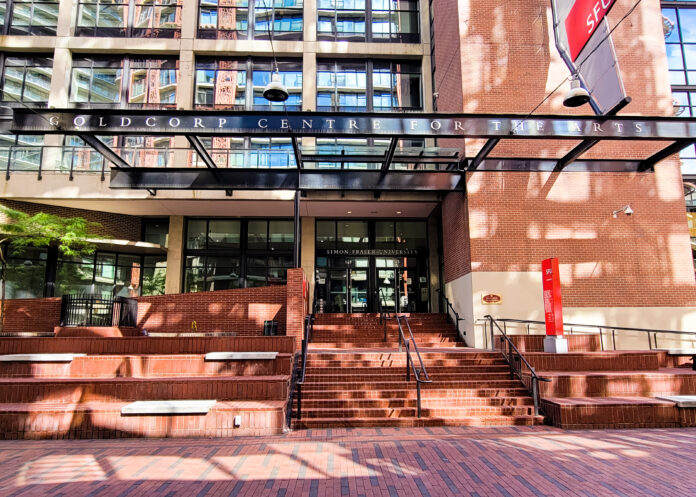
SFU Goldcorp Centre for the Arts
We need more drama! PHOTO: Amirul Anirban / The Peak

By Swagi Desai, SFU Student 

Shakespeare once wrote, “All the world’s a stage, and all the men and women merely players.” But for most SFU students, that line can’t literally be the case. Our school is an outlier in the academic community, hosting no all-major, all-inclusive, no experience needed, judgment-free drama club at any campus. And that’s a shame! 

Now, SFU does have an extensive and excellent list of academic theater programs at the School of Contemporary Arts in Vancouver, but it doesn’t have a widely accessible, all-inclusive, all-major drama club. The University of Waterloo, the University of Toronto, and the University of Victoria all have drama clubs. Why not SFU? To be fair, a few years back, some like-minded individuals started up the SFU Improv Club. But, unfortunately, the group shut down in late 2019. Now, though, as folks have gotten vaccinated, and we can implement the safety plans up our sleeves, students are looking to try out new things!  

Small groups of people from different departments could meet to play theatre games or assemble small productions! They could play their favorite characters or recite their favorite stories. Common interests could be found and friendships could be formed. Original stories could be built by those who have stories to tell. Diverse tales from the participants’ cultures could be showcased. Resourceful participants could throw together makeshift costumes and props. Funny behind-the-scenes stories could make for such wonderful memories. 

The club could help students in non-drama fields, too. Members could get to tackle their stage fear. We could add public speaking to our resumes. All the organizing, scheduling, and managing of affairs could provide several opportunities to improve one’s team-building and leadership skills. 

And as a final call to action, our lack of an inclusive drama club means that we’re falling behind UBC. The UBC Players Club has been in action since 1915. Their club website set out the mission, including their resolve to be a safe, inclusive, and accessible place for students from all majors. Instead of falling short of UBC’s program, we need to kick things up a notch and put together our own drama club! And if not now, then when!?