Home Blog Page 249

The default male

0
A silhouette of a cis man looking out over a lake.
The world is built for men and it’s resulting in some serious consequences for everyone else. PHOTO: Lukas Rychvalsky / Pexels

By: Yasmin Vejs Simsek, Staff Writer

The “default male” is a term that describes males as the norm in our society and in data collection. This results in research being done only on cis male bodies with effects on other bodies not even being considered. You might have heard about the standard office temperature being set for a male metabolic resting rate and therefore being five degrees too cold for cis women. And this, quite frankly, is the least of it.

Caroline Criado Perez has written an incredible, informative book called Invisible Women that explores the gender gap — how society systemically ignores over half of its population, makes us invisible and ultimately how we live in a cis man’s world. It’s also important to note most of the data is focused on cis men and cis women, and while I recognize that we need more research on cis women, the need is even greater for inclusion of non-binary and trans folks.

I recently had a discussion with a cis man. Let’s call him Bo. He argued that cis, white, straight men have it harder in today’s society, due to quotas and the push for representation. One of my many arguments against this bizarre statement was the “default male.” His response — with a victorious look on his face — was that the “default male” also discriminated against cis men, by making kitchen counter tops a more appropriate height for women than cis men so his back hurt when he was in the kitchen. Confused by the fact that this person unknowingly had started arguing my cause by emphasizing the idea that women belong in the kitchen, I said, “Well that’s part of the problem, isn’t it?”

Yes, kitchens have been standardized to fit women bodies — but a supposedly standardized woman body at 5’7”. The average Canadian woman is 5’4”. So even though the sexist intention was there to create a better workspace for the person who is expected to spend most of their time working in the kitchen, it well and truly failed.

I also gave Bo the example of how cis women are more likely to die in car crashes than cis men. Even though cis men are more likely to be involved in a car crash, women are 47% more likely to be harmed in one and a whopping 17% more likely to die in one. When testing out cars with dummies, the US has, since 2003, been considerate enough to also use female testing dummies — in the passenger seat only. The obvious problem with this is it doesn’t reveal the impact of a car crash on women if they are in the driver seat, where there is both a wheel to protect from forward momentum and more control of the situation. Also, female testing dummies are not a replicate of cis women’s bodies, simply a smaller version of the cis male dummy. To top it all off, seatbelts are not effective on pregnant people and no one has bothered coming up with a solution. 

The car is not the only place women are more likely to die than men. The same goes for heart attacks. Research on heart attacks has always been done on cis men even though some of the symptoms can differ from cis men and women. In fact, only one in eight women feel the infamous chest pain associated with heart attacks, but they can feel pain in many other places instead, such as their jaw and back. This results in women receiving worse care, getting poorer aftercare and, in the UK, being 50% more likely to be misdiagnosed. 

The “default male” doesn’t just impact health care but also everyday inconveniences, down to cis women having a harder time reaching every corner of their smartphone. That’s right, smartphones are also designed for the cis male, generally larger hand, so that is why our faithful devices keeps getting bigger. And don’t even get me started on how voice control is 70% more likely to recognize a male voice.

The world is inherently male-focused and a lot of us are working to change our own internalized perspective. I spoke to a man in Nepal in 2016 who posed the question: “Who won the last soccer World Cup?” I cockily answered Germany, and he just shook his head and said, “No, that was in 2014, but the US women’s team won the World Cup in 2015.” I’ve been taught to think that the world is by default male.

There is a war on trans folks, non-binary people, and women. But the gender gap resulting in the default male is probably not some supervillain masterplan to bring down all women. It’s likely that whoever is in charge has simply not thought that it was necessary to include women — if the thought even went that far. Ultimately, it’s the result of a society that has suffered under the patriarchy for way too long. The simple solution is to collect both sex and gender-separated data. To ensure that medicine works the same way on everyone, that cars are safe for everyone, that symptoms are being distinguished between sexes and genders and yes, Bo, also that kitchen counters are a suitable height for cis men.

Army of Lovers celebrates the histories of local lesbian feminists

0
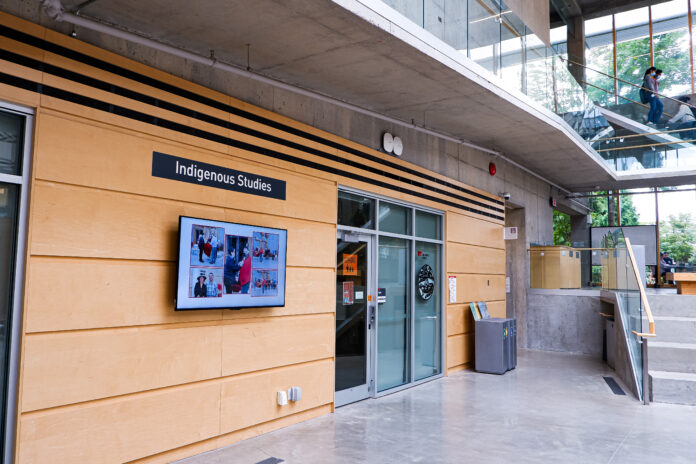
The photo is taken in the hallway of the SFU Vancouver Harbour Centre building. There are three boards that have biographies of Christopher Moore, Nora Randall, and Nancy Pollack.
The exhibit is being held at Vancouver Harbour Centre until August 21. PHOTO: Gudrun Wai-Gunnarsson / The Peak

By: Olivia Visser, Staff Writer

Army of Lovers: Lesbian, Bisexual, Two Spirit, and Queer Women, 1970s and 80s is an oral and visual archival exhibit taking place at SFU’s Harbour Center campus. Running from July 14–August 21, the exhibit focuses on interviews conducted by students in professor El Chenier’s oral history class. 

Chenier explained those who participated in the feminist and lesbian communities in the ’70s and ’80s “have a lot of hard-earned wisdom to share,” and created this project as a two-way conversation between young and old generations. 

The archive itself is a trans-inclusive representation of the narratives that shaped Canada’s early queer and feminist movements. Its in-person component consists of posters lining the halls of Harbour Center, which include short biographies of prominent queer figures and quotations from interviews conducted by students. The content is available in its entirety on the Army of Lovers website, which includes audio recordings taken from the interviews. 

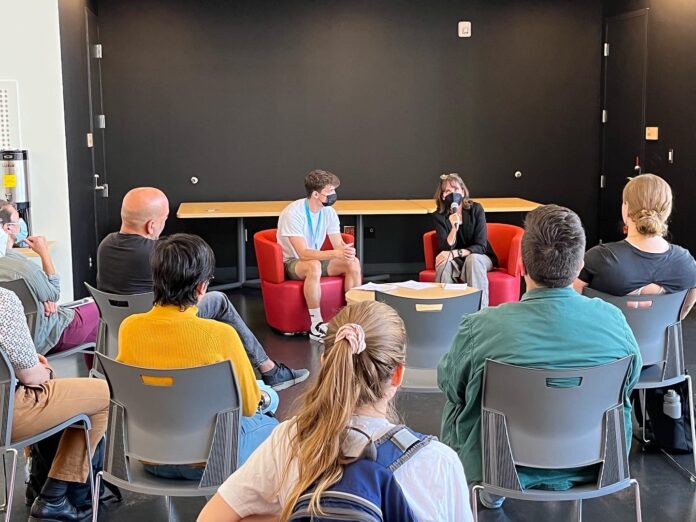
The in-person exhibit included other activists who were engaged with feminism and LGBTQIA2S+ activism. On its opening night, Chenier hosted a panel featuring the stories of Cyndia Cole, Pat Hogan, and barbara findlay. All three are heavily involved in BC’s lesbian and feminist movements, and have made significant cultural and systemic contributions.

Cyndia Cole is a “published writer, an educator, a feminist, an activist, and an artist.” During the Vietnam War, Cole came to Canada as a war resister. She “worked closely with women’s studies founder Maggie Benston” during her time as a SFU student. During the panel, she described her story as interesting because she “became a feminist first” before realizing she was a lesbian. 

Despite being involved in the feminist movement and feeling an urge to participate in the lesbian feminist movement, Cole didn’t believe she belonged in it. She realized she was a lesbian after having a dream about one of her friends, and subsequently sharing a kiss with her after explaining the dream. 

After a lesbian couple was kicked out of Vancouver’s Joe’s Café for kissing in 1990, Pat Hogan opened up Josephine’s Cappuccino Bar for the lesbian community. In addition, she founded the feminist business, Sounds & Furies Productions, as well as BOLDFest Bold, old(er) Lesbians and Dykes. Hogan recounted being involved in the British Columbia Federation of Women, where she was surrounded by lesbians for the first time in her life. She explained that a lesbian caucus formed within the federation because at the time many feminists were in support of women’s rights, but not lesbian rights. 

“Lesbians are no longer willing to lie and hide and live in fear,” read a quote from Nym Hughes, one of the activists featured at the exhibit.

barbara findlay is a queer feminist lawyer who became an activist after her “forced incarceration in a mental health institution for being a lesbian.” After falling in love with a woman for the first time, she “didn’t know that [they] weren’t the only ones.” She emphasized to the younger generations in the audience it was terrifying to “live from one day to the next” when she grew up. People would make educated guesses on others’ sexuality or speak in code, asking questions that referred to queer culture, such as, “Do you know Jane Rule?” Like Hogan, findlay also remembered dealing with homophobia from straight feminists. 

Despite the barriers faced by lesbians in the early feminist movement, the panellists agreed that the lesbian experience still comes with its own joys. Cole and Hogan fondly recalled attending lesbian dances in their communities, while findlay said, “It’s not sex that first comes to mind,” when thinking about the pleasures of being a lesbian. 

“The biggest thing was all of a sudden I had a mirror in which I was reflected,” said findlay. 

Still platformed: You’re not cancelled enough if I’m still subjected to you whining about it

0
"cancel culture" on typewriter
“Cancelled” people usually end up keeping their platforms. PHOTO: Markus Winkler / Unplash

By C Icart, Peak Associate

It’s long past time we stop indulging right-wing pundits and problematic celebrities by pretending cancel culture is real. Reactionaries vehemently condemning cancel culture makes it sound like there is, in fact, an epidemic of liberal Gen Zs ending people’s careers over political correctness. There isn’t. The fact that we keep having to hear problematic influencers and right-wingers complain about being cancelled proves they still have a platform. 

What is cancel culture? Do we need it? Does it work? Is it real? Politicians, commentators, influencers, and celebrities are some of the most outspoken critics of cancel culture. But the fact that we keep hearing their outbursts means that “cancellation” isn’t the calamitous event it’s made out to be. 

The actual act of cancellation refers to the public shaming that happens after a person or company says or does something offensive. It can occur years after the events, often when someone’s old social media posts are uncovered. It can cost people their job or further career opportunities. Being cancelled is also associated with receiving large amounts of hate, mainly online.

The problem is that the term “cancelled” makes it sound like there is no recovery from it; it is the death of that person’s career or social status. But this is rarely the case when it comes to the rich, the privileged, and the powerful. They often find themselves to be even more popular afterwards, as in the case of Joe Rogan. It’s not uncommon for “problematic” celebrities to even claim they’ve been “cancelled” multiple times which of course shouldn’t be possible if the cancellation had the permanent, long-term impact it’s often implied to have. 

So, why are the rich and powerful critical of cancel culture? Because they don’t want their offensive actions being brought up. If you did something to harm someone, we can and should talk about it. Forgiveness and support should be secondary to addressing the hurt and comforting the victim. Receiving criticism and suffering the consequences for your actions is not a bad thing. We need to be able to identify when people are using the phrase “cancel culture” to delegitimize criticism. In part, because the people being silenced are often marginalized citizens trying to speak about oppression

Censorship is a real issue. But if you’re dedicating a comedy special to joking about it, you’re not experiencing it. As of February 14, there were 177 anti-LGBTQIA2S+ bills proposed in the US. These bills propose, in part, bans on books and conversations about LGBTQIA2S+ issues. This should be at the center of discussions about free speech and cancel culture, not Mr. Potato Head

Overemphasizing the need to condemn cancel culture or calling for an endless reservoir of compassion for people who are “learning” only feeds into the rhetoric that the left is too sensitive and this generation can’t take a joke. It also implies that the people negatively affected by offensive jokes or violent behaviour must prioritize the perpetrator’s feelings and well-being and contribute to their “rehabilitation.” 

Sure, Dave Chappelle’s show was moved to another venue due to the “impact” of his performance. However, he still sold out a show and performed, which proves that being transphobic will not end your career. Indulging in cancel culture debates distracts us from whose free speech is really under attack. You can complain about “not being able to say anything these days” all you want. As long as hate is still being perpetrated, we will not shut up. 

Bukola Balogun’s storytelling transcends traditional music genres

0
Bukola Balogun pictured at a music store playing on a guitar
Listening through the catchy EP, I felt like I was having a sit-down conversation with the artist. PHOTO: Victor Tran / The Peak

By: Isabella Urbani, Staff Writer

It’s been one year since the release of local talent Bukola Balogun’s debut EP, The Chronicles of a Teenage Mind. The SFU student was hailed by CBC as “one of the top 10 soulful female artists” during their 2020 Searchlight competition. She also had the opportunity to work alongside Grammy Award and JUNO Award winning producers for her EP. Since then, Balogun said she learned to take the reins more on projects, including more risks musically, finding her sound, and trusting her vision. 

Balogun began her music career when she was just nine years old and emerged on the scene in 2018 with her first big performance at The Roxy. Just over a month later, Balogun was a performer at the JUNO Awards pre-show and she quickly garnered the attention of the local and national music scene.

Balogun draws a lot of inspiration from combining a trio of sounds: jazz, ‘90s/early 2000s R&B, and acoustic soul. 

“I’ve really admired artists like Ms. Lauryn Hill, Tiana Major9, H.E.R., and Summer Walker,” Balogun shared. “Their ability to incorporate the guitar into their songs in such a fresh way has inspired a lot of the newer music I’m creating right now.” When it comes to crafting her own music, the guitar is an “essential part” of her music. Jazz chords and harmonies are also a must for Balogun as she is a fan of jazz chord progressions. 

However, when it comes to the future, Balogun is looking to tap into afrobeat. Listeners may get a chance to experience this shift this summer when Balogun will release what she’s referred to as her favourite song. When it comes to her music, Balogun hopes that listeners can appreciate all the elements individually that make up a song. “From the melody, to the lyrics, to the vocal delivery. All the parts of the song help to tell the story.

“I think what sets me apart from other musicians is honestly me, if that makes sense. The way I play guitar, coupled with my musical influences, my writing and singing style makes me unique,” said Balogun, admitting this has been a lesson she learned along the way. “It took me a while to realize that by being true to myself, I am different from other musicians because no one else can be me, but me.”

Balogun’s opening track on her debut EP, “Dear Diary Lessons,” is a testament to coming of age, opening with a near two minute monologue about how the singer perceived herself from childhood to her teenage years. This included understanding that love isn’t always a two-way street, finding her own “armour,” and coming to embrace the way she looks instead of “altering her mannerisms” and appearance for others’ approval. 

What stood out most to me after a full listen through the EP is how it makes you want to dance gleefully. Although each song is unique, it’s clear how Balogun pays homage to various artists. When I listen to her song “Fight For Me,” I feel the same uncontrollable smile creep onto my face as I do when I hear Corinne Bailey Rae’s “Put Your Records On.” When I listen to Balogun’s most streamed song “I Am Enough,” I hear the incredible harmonies that made bands like Destiny’s Child and TLC so likable. 

Balogun makes challenging topics, like self-worth, into music beautifully crafted for the ears. Her storytelling effortlessly translates into song, aided by the smooth jazz and R&B backing tracks. Somehow, it feels like more than music. It feels like sitting down with a friend and having a soulful conversation — chronicling the inner workings of a teenage heart. 

You can find out more about Balogun by heading to her website or listening to her music.

Monday Music: Chinese Classics

0
“Monday Music” in orange block text on a yellow rectangular background with rounded corners and an orange border.
Monday Music: your weekly themed playlist. Image courtesy of The Peak.

By: Cristina Liao, Peak Associate and Nancy La, Copy Editor

Many Chinese songs have a place in our hearts as a symbol of home and culture. Some featured in this list are gems that withstood the test of time. Others are classics that many Chinese students would know. Either way, enjoy this playlist of songs that we hold near and dear because every song featured in it is special to us in some way. 


by Wang Feng


Photo Credit: Music Nation Records Co. Ltd. 

CL: The title of this song directly translates to In Spring. This is a song that has shaped my music taste to what it is today. I have a distinct childhood memory of listening to this as my family and I drove along the highways of the Californian seaside while we were on vacation. It’s one of those incredible pieces of music that I continually come back to because I am obsessed with the singer’s raspy voice and the tune’s rock-like production. Wang sings about his past and reminisces about a time when he was young and naïve. 


告白气球 by Jay Chou


Photo Credit: JVR Music International Ltd. 

CL: “告白气球” by Jay Chou is a song that I’ve been listening to since middle school and something that Chinese students will be familiar with. The song’s title is word play on the term 告白, which is a romantic confession, translating to “White Confession Balloon” in English. Chou’s music ranges from Chinese rap like “Now You See Me” to pop, such as this song. In fact, both of the mentioned tracks can be found on the same record! Chou is known for his time as a coach on The Voice of China, a singing competition that is extremely popular in both Mainland China as well as Taiwan. This particular song has a cute and relaxing summer feel to it with an uplifting beat and simple lyrics about coffee shops by the sea side. It’s a perfect track for listening on a warm August afternoon or a bedroom karaoke party. It’s one of those rare Mandopop songs that I know all the words to. 


江湖天 by Silence Wang


Photo Credit: The Sound Times Entertainment Media

CL: I first heard this beautiful song in a popular Chinese drama called The Legend of the Condor Heroes. The show in question is based on an iconic book written by Chinese author Jing Yong, and has multiple editions made from as early as 1983. The production on this has influences from traditional Chinese music with cultural instruments that sound like guqin and bamboo flute found throughout the song, and the style of piano the backing track. Its lyrics are infused with imagery and idioms. It is difficult to translate the song’s title into English because Wang wrote the title as an idiom but my best attempt would be “Immortal Life by the River.”


Nancy 

佳损” by Eason Chan


Photo Credit: Cinepoly Records Co. Ltd. 

NL: Eason Chan is considered to be one of Hong Kong’s top singer/songwriter, and his songs are always so well written. “最佳损友,” or “Best Bad Friend,” will instantly punch you in the gut with lyrics full of adulthood resignation. The song is about mourning for a best friend who is no longer in one’s circle as life has split in different ways. I’m sure we all have people in our lives whom we once thought would stay with us forever. However, when reality creates irreconcilable differences between two people, there is nothing to do but to drift apart while wishing them the best. The lines that moved me to tears translate to, “I can no longer tell whether we are friends or foes / pushed around and moved by everyday life / in the future, that stranger that I see / is yesterday’s dearest person.” 


消愁 by Mao Buyi


Photo Credit: 北京智慧大狗文化傳媒有限公司

NL: This song perfectly captures the various growing pains a person experiences throughout their lives. The song is sung from the perspective of a middle-aged person looking back and forth from their life, to the moments of bright, seemingly eternal youth, to the heartbreak of moving away from home, the slowly aging body, and finally, the freedom that death promises. While Mao’s timbre grounds the listener, the song’s lyrics washes them with sadness and grief of a life with too many regrets. With lines such as, “Life is bitter and short, why must we hang on so tightly?” this song will make you reflect on the life that you’re living.

What the Buddha Never Taught showcases outdated narratives

0
A group of white men holding sticks and pointing them together facing each other, with one man at the front playing a drum
The play rendition of the 1990s book felt culturally outdated to say the least. PHOTO: Jill Raymond / WTBNT Productions

By: Yasmin Vejs Simsek, Staff Writer

What the Buddha Never Taught is advertised as a “rock opera” and is based on the book with the same name by Tim Ward. Playing at Jericho Arts Centre until July 10, this show was not what I expected. I was imagining something like We Will Rock You meets Waiting for Godot and my anticipated version might have turned out more thrilling than the actual “rock opera” written by UVIC professor Martin T. Adam.

The story begins with characters Tim and Jim arriving at a monastery in Thailand, where they expect to “find themselves” in one way or another. They meet like-minded people and are thrown into the lifestyle of the monks who reside there permanently. But that is about it as far as the storyline goes, with no inclination towards a traditional narrative arc or similar story arcs. Written with the intention of celebrating the “western encounter with Buddhism,” it came across as white people pointing out loopholes in the religion and trying to be lighthearted and funny while doing so. Rather than a respectful encounter, the play delivered tired western ethnocentric narratives.

What the Buddha Never Taught didn’t keep the audience on their toes, with audience members calling it slow in the interval. It was actually a perfect example of why to “show, not tell,” as everything that Buddha never taught was verbally pointed out in most conversations throughout the performance. This juxtaposes one of the central teachings of Buddhism — to learn the importance of silence and stillness in order to discover inner peace.

When I attend musical theatre performances, I expect the songs to further or enhance the story in a meaningful way. The songs in this show seemed randomly plopped in and was more a fun, musical interlude than a necessary part of the story. There were also very few rock aspects in the music, with maybe two or three songs I would identify as rock and even fewer opera aspects, with zero opera songs. It would have been better to leave it as What the Buddha Never Taught The Musical to establish appropriate expectations for the score. 

My biggest problem, however, was not with the music. As I flicked through the programme before the start of the show, I quickly noticed that out of the nine cast members, there was only one woman and one visible person of colour — who happened to be the same person. It screamed tokenism and realizing just how small her part was only made that feeling stronger. Upon hearing the title of the show, I did not expect to spend two and a half hours on a sunny Sunday, watching white men gather around and joke about one of the widely practiced religions of the world. There is no shortage of western/white voices drowning out the voices of BIPOC cultures and religions. We don’t want to see this repeated anymore, even when posed as a revolutionary or original thought.

When all that has been said, I don’t believe any of this was caused by this particular production of the show. I think the problem started from the book it was based on, published in the 1990s. In a review of the book, local author Michelle Barker wrote, “I felt like much of his criticism was in fact cultural, aimed at a society that he is not from and perhaps doesn’t understand all that well.” Although Barker identified that the book brought up interesting questions about the life of monks, she said most of it sounded like a judgemental monologue rather than a respectful observation.

I think the problem lies in creating a piece of art that does not consider representation or nuance — especially when it could so easily have been much more diverse, being set in Thailand and all. Not only do I expect casts that are true to representation in 2022, I also expect a level of respect for other cultures as well as careful avoidance of cultural appropriation and thoughtful critique. I believe this to be the bare minimum, which I do not feel this piece delivered. I don’t think theatre like that has a place in our century and I believe you have a social responsibility when you put art into the world to be perceived by the masses.

Four COVID-19 safe events

0
Illustration of a cartoon character sitting in a relaxed position on a couch and sipping a juice box, with a laptop open in front of them. The home is decorated brightly, and a dog lies napping on the couch.
Highlighting fun activities to do in the comfort and safety of your home or socially distanced from others! ILLUSTRATION: Nazmus Sakib / The Peak

By: Hannah Kazemi, Peak Associate

BC has lifted restrictions on masks, vaccine cards, and reduced quarantine times. The impacts of COVID-19 on the lives of people with disabilities and immuno-compromised conditions have only increased. These communities are largely being left behind by society, as the heightened risks in public space continue to be ignored by public health. With variants running amok, hospitals becoming overwhelmed, and increasing reports of long COVID, it’s clear the pandemic isn’t over.

Here are some accessible, socially-distanced, and remote events available for people to enjoy safely. Check out these awesome ways to stay connected, entertained, and active throughout the pandemic! 

Barre Fitness | Admission: free

Is your stamina running low from not being able to access your gym right now? Get your blood flowing and try out a new activity at the same time! Barre Fitness offers live and pre-recorded virtual barre classes! You don’t need a real ballet barre to participate — grab a chair, get to a fairly open space, and join a Barre Fitness session from the comfort of your own home. Find a schedule of live Zoom sessions on their website as well as pre-recorded classes on their YouTube channel via their website. Find a session that interests you and try out a new hobby!

When: Anytime

Where: Virtual


Twilight Drive-In | Admission: varies

If you have access to a car, the Twilight Drive-In Theatre is a great way to watch a movie (or two!) with your friends while remaining truly socially distanced from other groups. Watch one film, or stay late and catch a double feature! Prices start at $25 for one car with one person, and go up by $10 for each additional person in your car. The drive-in also offers deals so that you can maximize your movie-watching experience! Tuesdays are Couple’s Night, where you and your significant other can enjoy a film plus get two drinks and a popcorn for only $42, and Thursdays are Carload Night, where you pay a flat fee of $40 for a car with 3–5 people. So grab your close circle of friends, some popcorn, and your comfiest pillows and blankets to build a movie-watching fort in the trunk of your car. See the schedule of upcoming movies on their website.

When: Every night until further notice

Where: Twilight Drive-in, 260th St. and Fraser Highway in Langley


Yyoga | Admission: varies

Yyoga, a Vancouver-based wellness company, offers a series of pre-recorded yoga sessions that you can purchase online. View their packages online and choose from a series of single-session or multi-session workshops. From yoga for beginners to breathwork yoga sessions, they have something for everyone. They also offer a three-day virtual yoga and meditation retreat, which you can purchase and participate in from the comfort of your own home. See their website for a list of workshops and prices.

When: Anytime

Where: Online


Honda Celebration of Lights | Admission: free

Celebrate 30 years of fireworks by watching one of three firework shows that take place at English Bay! This year, the shows are all going to be livestreamed,so tune in to the stream on your phone to watch and listen live to the spectacular displays of colour, music, and lights. Play the show in the background while you’re having a chill night in or drive somewhere where you can park your car and take in the show away from crowds while listening in on the radio.

When: July 23rd, 27th, and 30th

Where: Online

Hidden Gems: Beloved Local Eats

0
pan fried egg noodles
Highlighting the best local restaurants in Lower Mainland. Photo Courtesy of @laksakingvancouver (Instagram)

By: Yelin Gemma Lee, Arts & Culture Editor

Are you sick of frequently going to the same restaurants all the time or trying something new but disappointing? Fret no more, I have a foolproof list of delicious local eats, all of which are on my all-time favorites list. Although unfortunately, some of them didn’t survive the impact of COVID-19, here are some who are still running. Go show these local restaurants and hole-in-the-wall eateries some big love!

Laksa King / 2546 E Hastings St, Vancouver 

Photo Credit: @laksakingvancouver

Located a short block or so away from Iron Dog Books, this is the place I go for lunch whenever I’m on my way to pick up some books. This restaurant has an 80s neon diner theme going on, with a Southeast Asia-focused menu serving Burmese, Thai, Singaporean, and Malaysian classics. Their Roti Canai is as flaky as your ex and the peanut sauce that it comes with is a perfect balance between sweet and savoury. I order their Chicken Laksa as a main dish every time. Its coconut curry broth is perfect, especially with the chili oil dancing on top of the soup if you order yours spicy. I find coconut broths can either be too rich or watered down, but this one is the most balanced I’ve found in the city with a clean aftertaste. Laksa King offers take-out and delivery through Uber Eats and Doordash.

Emilio Finatti Pizzeria / 551 Sherling Pl, Unit 1160, Port Coquitlam 

Photo Credit: @emiliofinatti

Thin crust pizza pictured on a wooden table
Photo Courtesy of @emiliofinatti (Instagram)

I’m quite loud about this on my social media whenever I get to go to Emilio Finatti, but this is hands down the best pizza in the Lower Mainland. Their toppings are always so fresh, I wouldn’t be surprised if they said they had some kind of greenhouse garden back there. The best part about this place is their honey butter crust. You heard me correctly. They drizzle honey butter on their crust and it perfectly complements the puffy thin crust and the fresh toppings. They have a bunch of pizza dips, all of which are made in-house, and inexpensive but delicious homemade cupcakes! The pizzeria is located in a brewery-filled area of PoCo, and located steps from Provincial Cocktails, where you are encouraged to sip delicious cocktails and get pizza walked over from next door. Vice versa, if you want to stay and eat at the Pizzeria, pre-bottled cocktails from Provincial are available for purchase — we love to see locals supporting locals! Emilio Finatti offers curbside pick-up and has their own delivery service with orders accepted and prices determined depending on distance. They have their full COVID-19 safety plan available on their website to review before you visit.

Ramengers / 1043 Brunette Ave, Coquitlam 

Photo Credit: @ramengers_feat_smokingpig 

Bowl of ramen with pork, egg, and perilla toppings
Photo Courtesy of @ramengers_feat_smokingpig (Instagram)

My favorite ramen place in Metro Vancouver happens to be sandwiched in between a Hells Angels building and a gas station. From the food, to the people who run this place, to the general vibe of the establishment — every bit of it tickles my fancy. The restaurant is Marvel themed, with posters and a figurine collection decorating the haunt. There is a literal punching bag in the middle of the room, and although kicking isn’t allowed, the staff don’t blink twice if you start practicing your right hooks and jabs while you wait for your food. Run by no more than three staff, six days a week, the menu is one page and there are no modifications or additions. Things are irresistibly simple here, with a quiet but attentive waiter who is there all the time with expertly crafted food. The ramen broth is refreshing and rich in flavour, their egg is always perfect, and the smoked pork on top is so soft it flakes apart when you poke it with your chopsticks. I usually order the Spicy Ramen, and don’t recommend you order the next spice level unless you are strong with spice. If you come with friends, order their Korean Chicken to share as an appetizer, as it is one of the highest caliber. Ramengers does not do delivery but they are happy to accommodate for take-out!

What Grinds Our Gears: Photo albums are falling by the wayside

0
Old dusty photo album
Holding onto nostalgia one 4x6 at a time. ILLUSTRATION: Jaimin Bai / The Peak

By Hannah Kazemi, Peak Associate

Growing up, I loved pulling out my mom’s photo albums and looking at her pictures. I loved seeing how she did her hair in the 80s and dressed in the 90s. I’ve been to places I don’t even remember, but the photos I have will always remind me.

I recently had the alarming thought that my kids might never get to experience that feeling. They’ll never get to live vicariously through photos of my adventures!

I feel like a super boomer by saying this, but I think smartphones are killing photo albums.

Don’t get me wrong — I love my phone and its ability to store thousands of photos and videos. And I love that I can take fake film pictures and use an old-timey filter on them. 

And that’s all nice, but the storage is ephemeral. What the fuck is the “cloud?” What if I lose my phone and nothing is backed up? What if my accounts change and I can’t access anything in thirty years? What happens when Facebook and Instagram go out of business in 2028?? How will I prove to my kids that I was young, cool, and hot once??!! 

We shouldn’t be so quick to move past photo albums. My kids deserve to know I was once young and cool and hot, and because of these photo albums, they will! I’ll keep them in a closet collecting dust until I decide to relive my 20s and show them all of the adventures I’ve been on, the people I knew, and the person I was and I can’t wait for that day. 

Halifax welcomes over 300 Ukrainian refugees to Canada

0
The photo is of Ukrainian people fleeing from their country. In the centre of the photo is a women with her arm around a small child. They are holding multiple bags of luggage and are surrounded by others with more luggage.
Over 120,000 applications from Ukrainian refugees have been approved to receive authorization for emergency travel. PHOTO: UN Women / Flickr

By: Chloë Arneson, News Writer

On June 2, a charter flight carrying 319 Ukrainians arrived in Halifax. Nova Scotia residents and host families greeted those arriving with welcome posters and gifts. 

To help Ukrainian citizens flee Russia’s invasion of Ukraine, Canada secured charter flights into the country while working closely with provincial governments and settlement organizations to support their arrival. 

This flight is the third federal charter carrying Ukrainian refugees to arrive in Canada. This marks over 900 people seeking refuge as a part of the Canada-Ukraine authorization for emergency travel program. The first flight brought 328 Ukrainian refugees to Winnipeg, Manitoba on May 23, and the second brought 306 people to Montréal, Québec on May 29. Between March 17 and May 25, over 120,000 applications for the program have been approved. 

In attendance was minister of immigration, refugees and citizenship Sean Fraser, premier of Nova Scotia Tim Houston, and Nova Scotia minister of labour, skills, and immigration Jill Balser. Fraser commented on the horrific conditions caused by the invasion. “Those who want to stay, you are going to be welcomed with open arms. People have been watching the challenges that have been playing out by this latest invasion [ . . . ] there are people here who want to support you,” he said. 

Yevheniia Alosha, one of the 319 people who arrived in Halifax, expressed her gratitude for the support. “I’m very happy to be here [ . . . ] my son will go to kindergarten and we will have some peace,” she said. 

Fraser announced that those seeking refuge in Canada will now be able to apply for financial assistance to aid in their transition to address their basic needs such as transportation and housing. Other support initiatives to support Ukrainians will include the Ukraine2Canada travel fund, where Canadians can donate to help bring 10,000 people fleeing war to Canada. 

The Canadian government released a call to action appealing to Canadian businesses to support displaced Ukrainians arriving in Canada by providing donations for those in need. In their press release, they stated, “Canada remains a steadfast ally of the Ukrainian state and people, stands in solidarity with them, and supports Ukraine’s sovereignty, territorial integrity and independence.”