Home Blog Page 200

Student Updates

0
"Student Updates" text in SFU red
You’ve already made it farther through the article than 97% of the student population. ILLUSTRATION: Siloam Yeung / The Peak

By: Nathan T.

The Koi from the AQ pond have been removed

After years of entertaining graduating students during convocation and disappearing during winter, the koi fish have been sold to the SFU biological sciences department to help raise money for the molecular biology department. 

All students are to take six courses to help fund the school

In an age of COVID-19 and recession, the administration has mandated that all SFU students are to do six courses per term starting in Summer 2023 to provide additional funding for the university. The administration hopes this will enable students to graduate faster, therefore freeing up space for even more students. Engineering students will still have to take two more courses than other students each term to maintain bragging and complaining rights.

Asbestos discovered in the entire Burnaby campus

After reports of asbestos being found in the Bennett Library, SFU has undergone an extensive check of the Burnaby campus and has found asbestos in the AQ, RCB, Saywell, Blusson, WMC . . . so everywhere, including your food. SFU maintains that as long as the asbestos is undisturbed, everyone is safe. The good news is, you now won’t live long enough to completely pay off your student debt.

Library study rooms are empty

Shortly after the report of asbestos being found in the Bennett Library, SFU Libraries is reporting a 500% decrease in study room usage. Students are encouraged to use study rooms as needed. No need for bookings now!

Soaring to new peaks

The Peak has found out the newspaper has now achieved a circulation of 25 readers. That’s one more than the number of staff at The Peak (who are forced to read the newspaper as part of work). So thank you kind stranger (or mum)!

SFU has received an award for being the highest school

Recent heavy rainfall events has led to SFU receiving an award for its high elevation compared to other schools of similar size, such as UBC and KPU. This means that SFU will be the last place to shut down during any Lower Mainland flood. Representative of SFU, Albert Quatriangle, said in a statement, “Hopefully SFU students will realize how fortunate they are and stop whining about getting to the mountaintop during winter. We will never shut down; come drought, blizzard, flood, or pandemic. We had this all planned out since 1965, believe it or not!”

SFU department of Academic Studies trialing “no readings” policy

The Department of Academic Studies has instituted a policy of no readings for all of its classes. Chair of the department, Dr. Sam Paper said, “Our research shows none of our SFU students do their readings. Therefore we are following the science and evidence and asking our professors and instructors to stop assigning readings for class. Obviously we are in close communication with the other departments in the university to make sure our students will still get the same amount of work overall to maintain the university experience.”


Connect the Lingo

0
Illustration of a character connecting the words “connect the” and “lingo” with a pencil.
ILLUSTRATION: Alyssa Umbal / The Peak

By: Hannah Kazemi, Staff Writer

Word Bank: 20, bullet, pick six, pommel horse, Christine Sinclair, skeleton, Peter Forsberg, football, 10, kiss and cry

  1. This athlete holds the record for most international goals.
  2. What sport is known as a “game of inches?”
  3. There are typically ______ cars in a Formula 1 race.
  4. The running portion of an Olympic triathlon is ______ km long.
  5. After a skating routine, competitors go to the __________ area to wait for their scores.
  6. “I don’t believe it! The football was intercepted and taken all the way down the field for a ________.” 
  7. In _________, athletes slide head first down the track. 
  8. Archers sometimes refer to their arrow as a  _________.
  9. This athlete has a shootout move named after them. 
  10. One apparatus in men’s gymnastics is the  ____________.


Answer Key: 

1) Christine Sinclair 

2) football

3) 20

4) 10

5) kiss and cry 

6) pick six

7) skeleton 

8) bullet

9) Peter Forsberg

10) pommel horse

Two Minute Drill: Owen Gudmundson

0
photo of SFU men’s wrestler Owen Gudmundson taking down his opponent on the mat.
PHOTO: Owen Gudmundson

By: Natalie Cooke, News Writer 

Owen Gudmundson is a sophomore on the SFU wrestling team, where he competes in the 197 lbs weight class. He is a molecular biology and biochemistry student, and was the 2020 Calgary City Champion in the 168 lbs weight class.

Editor’s note: This piece has been edited for clarity and length.

Q: Who is your favorite athlete? 

A: David Taylor, he’s an American wrestler.

Q: What is your walkout song? 

A: Here Comes the Money — it’s Shane McMahon’s walkout song in the WWE.

Q: Which teammate makes you laugh the most? 

A: Ryan Hicks.

Q: If you got a superlative award, what would it be for? 

A: Smartest or nerdiest.

Q: Most memorable wrestling memory? 

A: Canada Summer Games. This summer, I won the bronze medal in the 216 pound individual men’s competition.

Q: Favourite traveling pass-time? 

A: Reading or listening to non-fiction podcasts.

Q: Favourite food place in Burnaby? 

A: Uncle Fatih’s

Located at the finest academic establishment, SFU. 

Q: What’s something that no one knows about you? 

A: I have an enormous sock collection. I have a pair of socks that resemble the layers of the earth. They have dinosaur bones and rocks on them    it’s pretty sick. 

Q: What would you change about wrestling? 

A: I think people need to wrestle more, which means more stalling calls. If you’re not doing anything, the referee can penalize you. Eventually, you start giving up points. 

Q: What sport would you compete in other than wrestling? 

A: Marathon running. Imagine the fastest marathon runners, they can run 42 km in two hours. 

Arguing with a climate denier? Talk to them about global cooling

0
iceberg
PHOTO: Pixabay / Pexels

By: Luke Faulks, Opinions Editor

As of January 18, 2023, the openly climate-denying Canadian Conservative Party is leading the Liberals by 7%. And while the election’s a while off, Pierre Poilievre’s rise leads us to ask, again, how do we talk to a climate denier

Let’s try talking to them about global cooling. It’s a way to reinforce the power of the scientific consensus around warming and teach about the link between atmospheric CO2 and temperature. 

The concept of cooling is often brought up by climate deniers to discredit science, but engaging with them on the issue can actually help underscore the validity of the scientific method. When deniers talk about global cooling, it usually goes like this: “If you look into the 1920s, they were talking about a global freezing, okay?” That’s a quote from former President Trump, and, apart from the year, it’s a classic climate denier line. He’s reflecting a view that’s often repeated by climate deniers, which is that, “back in the day,” usually the 1970s and 1980s, scientists were convinced the world was on a cooling trajectory. If scientists were convinced and wrong back then, the argument goes, maybe their conviction might be wrong on climate change now.

The real story is easy to convey and helps to underscore the validity of the scientific method. The “global cooling” fear stems mostly from just one extremely popular article published by Newsweek in 1975. But the article’s findings weren’t substantiated in academic journals at the time, and the author has since recanted the piece, expressing regret that his work had been used by climate deniers for decades.

A 2008 review of research published between 1965 and 1979 found that, even then, scientists were more concerned about global warming than cooling. Case in point, in 1975, the same year that saw the publication of that Newsweek article, there was no published scholarly research confirming global cooling. But there were around 40 studies on warming. Now, around 99% (or 97%, or 100%) of research published confirms a massive consensus on global warming. Consensus-building using the scientific method works, and it was crushing junk science like global cooling before Newsweek even published its piece.

But there’s another reason to talk about global cooling, and that’s because global warming is making global cooling impossible.

Climate deniers are right about one thing: “the climate is always changing.” It always has, and CO2 has always been a big part of that change. CO2 plays a critical role in regulating temperatures on earth. When there’s a lot of CO2 in the atmosphere, more of the Sun’s energy gets trapped and rebounds to the planet, heating the earth. When CO2 falls, the temperature falls, which contributes to ice ages (though the planet’s orbit is the bigger culprit). A graph from the think-tank Carbon Brief shows the link between temperature and CO2 in action. It shows how CO2 and temperature have risen and fallen in sync over time, but are overall rising. 

High points on the graph correspond with melting periods, and low points match the planet’s ice ages. It’s a fantastic visual way to show the role that CO2 plays in regulating the earth’s atmosphere; it’s also a way to get them on-side. Yes, the climate has always changed, and yes, there are global warming and global cooling periods, but those temperatures are tied to global CO2 levels. That’s the time to notice the right-most part of the graph, better shown by this table from NASA, and the massive spike in CO2 emissions that it shows. That’s due to human activities. If not for that spike, a paper published in 2012 suggests that the next millennium could have seen the next ice age. But we’ve interrupted that natural cycle by pumping too much carbon into the atmosphere. Our hands are on the wheel now. And the notion of global cooling is an effective way to force that realization. 

Arguing with a climate denier can be tedious. It can be enraging. But by raising the idea of global cooling, you can take the wind out of your sparring partner’s sails, help reinforce the validity of climate science in a, maybe, novel way, and tie changes in global temperatures to atmospheric CO2. In short, the concept of global cooling may be one way to emphasize the very real threat of global warming to a skeptic. 

Top ten ways to save your resolutions at the end of January

0
Very calm, very cool. Nothing wrong here. Illustration: Siloam Yeung / The Peak

By: Maya Beninteso, Peak Associate

1. Ctrl + S

For those of you who are tech-savvy, simply type “your resolutions” into the word processor of your choice. Did you do it? Great, now locate the “control” and “s” keys on your keyboard and press them simultaneously. Congratulations! You’ve just saved your resolutions. 

2. Gaslight yourself 

No, you did go on your daily 30-minute walk. Don’t you remember? You zoomed through the halls of the AQ looking for the class you definitely attended in the first few weeks of the semester. Of course that counts! You also jumped to conclusions several times today, what a fit queen. 

3. Embrace your inner editor

Get out your trusty white-out, or your backspace key (if you’re too fancy for a piece of paper), and edit your resolutions to your heart’s content. After all, you can’t fail your resolutions if you constantly edit them to fit your life (or lack thereof, but who am I to judge). 

4. Pretend like they never existed 

What resolution? You most definitely didn’t have a resolution to do all of your readings before lecture because, let’s be honest, no one does that (and for those of you who say you do the readings, shhh! Not so loud!). Shove the memory of making your resolution deep down, just like your memories of last semester. 

5. Start a petition to cancel resolutions 

Assert your conveniently-timed disdain for resolutions and begin a revolution. March to the AQ and proclaim your reasons (fake reasons to hide your failure, of course) for wanting to get rid of resolutions. Claim that resolutions aren’t consistent with a growth-mindset, which you, an intellectual, possess. Get those signatures and vindication.

6. Go back in time

Set your calendar back to January 1, 2023. Boom. Life = HACKED. 

7. Really listen to your resolutions

Do you really want to read 5 self-help books this year . . . OR do you actually need therapy? You should read between the lines of your resolutions instead, they may reveal what you truly need. 

For example, here are my resolutions:

  1. Listen to Taylor Swift at least once a day
  2. Rewatch Gilmore Girls 13 times 
  3. Indulge in therapy . . . retail therapy once a month
  4. Attempt to finish the book I’m writing

As you can see, I, too, need therapy (If you’re my therapist, Randolph, I will never admit this to your face so don’t even think about bringing it up at our next session).  

8. BEDMAS 

Simply make another resolution and stick to it so that your failure cancels out! People will applaud you for adhering to, and remembering, this very complicated math principle. Well, doesn’t that add up . . . not a fan of puns, I see. I’ll just subtract myself from this equation then.

9. Hide

Hiding and avoidance always solves problems, so why not hide from your failed resolution, too? Cower underneath your warm duvet and hope that your resolution doesn’t find you. At least you will be a rested queen, and there will be no consequences from centering yourself in everything!

10. Practice radical acceptance

Why do you need to save your resolution? Because you failed, obviously. That is the reality of the situation and you need to live with it, with the help of some coping mechanisms, of course (healthy ones, no doubt). Maybe you need to make SMART goals like the smart human I know you to be, and have a growth mindset instead. 

This week at SFU

0
photo of the SFU softball team in a huddle.
PHOTO: Garrett James / SFU Athletics

By: Simran Sarai, Sports Writer

Home Games

Thursday, February 2: women’s basketball vs Central Washington at 7:00 p.m. (West Gym)

  • Whiteout T-shirt Giveaway
  • Upset No. 24 ranked Central Washington 65–57 last meeting 

Saturday, February 4: women’s basketball vs Northwest Nazarene (Idaho) at 1:00 p.m. (West Gym)

  • 1–0 against Northwest Nazarene this season

Saturday, February 4: men’s hockey vs UVIC at 3:45 p.m. (Bill Copeland Sports Centre) 

Away Games

Thursday, February 2: men’s basketball vs Montana State Billings at 6:30 p.m. 

  • 0–1 against Montana State this season 

Friday, February 3 until Sunday, February 5: softball at South Central Regional Challenge 

  • First tournament of 2023: games against Western New Mexico, Adams State, New Mexico Highlands, Colorado State Pueblo, and Fort Lewis (Colo.)

Saturday, February 4: men’s basketball vs Seattle Pacific at 2:00 p.m. 

  • Looking to split the season series 1–1 against Seattle Pacific 

Sunday, February 5: women’s wrestling at McKendree (Ill.) Bearcat Open (all day)

How Hannah Cassers brought a softball club to SFU

0
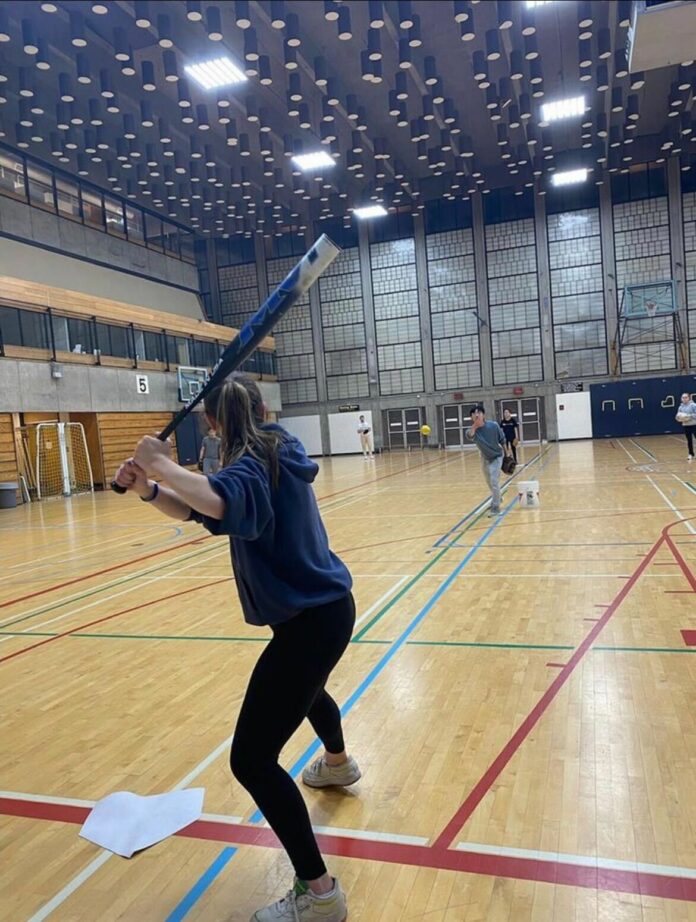
photo of an SFU softball member squaring up for a pitch.
PHOTO: Chloe Legge

By: Saije Rusimovici, Staff Writer

Third-year student Hannah Casseres began the co-ed SFU softball club to rekindle her childhood love for the sport and build a space that inspires “teamwork and collaborative effort.”

Playing both baseball and softball growing up, Casseres was on the hunt for a new softball club after her old team “dissolved” prior to her freshman year at SFU. The only problem was SFU had a varsity softball team, and not a club program. Determined to have the chance to play again, Casseres had one question on her mind: “How do you start a club?” 

Deterred by the beginning of COVID-19, Casseres was able to set her plan in motion a year later, when classes returned to in-person learning. “It was a lot of work,” she explained. “I didn’t realize how much goes into starting a club.” 

Before Casseres could get the club approved, she needed to attract enough members, which was initially a big roadblock. “I needed fifteen signatures — we had no one.” With the help of close-friends turned vice presidents Sunwook Kim, Netanel Orzech, and Chloe Legge, Cassedres received over 90 sign ups at clubs day. “I couldn’t have done it alone,” she said. 

Casseres spent some time talking about the difference between baseball and softball and the misconception some people have about softball being easier than baseball, which she “doesn’t think is necessarily true.” In contrast to baseball, softball is played on a smaller field, the ball is bigger, and pitchers throw underhand. Similar to baseball, nine players on each team take the field in softball. Teams rotate between batting and being in the outfield once they’ve reached three strikes. The aim of the game is to get the most runs — players brought around to home base. 

Practices are currently held indoors on Wednesdays from 5:30 p.m.–7:30 p.m. in the East Gym. A typical practice consists of throwing and hitting drills, and a friendly, yet competitive, scrimmage with teammates. While the softball club is running indoor practices as the varsity team gets priority on the field, Casseres is hoping they’ll be able to get a few games going outdoors, especially as the weather gets warmer.

A little softball experience is preferred to join the team as there’s no coach. While playing experience is not technically necessary, players should know the basic rules of the game and how to throw and hit. Casseres encourages any student intimidated by attending practice by themselves that most of the club’s members first joined the team alone, and had a “great time making friends.”

“I feel like the softball community is super accepting,” said Casseres. 

There’s no formal registration to join the team. Just send the club an email, attend practice, and try to bring your own glove. Once a registration portal is actuated, team members pay a $35 registration fee which goes towards equipment, such as helmets for outdoor practices. In the meantime, if you don’t have a glove, the team usually has enough to lend out during practice. 

“We were really lucky,” said Casseres. “Last year people just brought buckets of balls and tons of bats to help out.” However, the team is always looking for extra equipment as gloves can start at $50. “Any equipment you do have and are willing to bring would be great,” said Casseres. 

To sign up, email [email protected] or find them on Instagram @sfusoftballclub

New Music: Only A Visitor’s ruminative singles build anticipation for upcoming art album, Decay

0
Group photo of Only a Visitor members surrounded by plants with flowers that are just about to bloom.
PHOTO: Yohei Shimomae

By: Petra Chase, Arts & Culture Editor

Only A Visitor is a Vancouver-based quintet with an idiosyncratic style that dips its toes in art pop, jazz, acapella, and avant-garde. They’re gearing up for the February 24 release of their first album under Mint Records, Decay. The album is full of peaceful melodies and harmonies that resonate as lasting meditative hums, drowning out negative thoughts throughout the day.

While akin to the conceptual songwriting of Mitski and ruminative outlook of Weyes Blood, Only A Visitor’s vocal composition casts them in a league of their own. After graduating from UBC with a bachelor’s degree in music, classically trained composer and pianist, Robyn Jacob, founded Only A Visitor in 2015. According to Stir, it started as “a project in which the voices were treated as one of the main instruments.”

This idea is mastered in Decay. From the simple humming that backs their acapella track, “Understanding Nothing,” to the call-and-response of their jazzy single, “What Does Waiting Mean,” vocal techniques are used not only to produce soothing rhythms, but to represent the nature of introspection. 

In addition to Jacob’s keyboard and vocals, the group consists of vocalists Emma Postl and Celina Kurz, drummer Kevin Romain, and bassist Jeff Gammon. Their collective talents come together cohesively. For instance, the jazzy instrumentals paired with theatrical songwriting in “All You’ve Held Since” produce a meandering, whimsical tone.

The album as a whole is a rhythmic meditation. Their single “I Am At Ease,” alternates between piano and vocals, gently building off each other to expand on singular optimistic thoughts like “everyday is a new day,” and “the future is a miracle.”

Fraud of Finery,” my personal favourite song, ponders “being close but yet so far, reaching over barriers of communication, and showing love and connection through the digital versus the tactile.” It was released with a music video October 2022, featuring interpretive dance by Justine Chambers. Chambers’ expressions perfectly match the melancholic mood of the song as she moves throughout her house and a forest. The lyrics, “It’s the season of darkness and midnight sleeps on the couch,” capture the song’s essence perfectly.

After listening to Decay, it’s no wonder CBC music named Only A Visitor “one of 10 Vancouver acts to watch.”

Stream Decay starting February 24 on Spotify and follow them on Instagram: @only.a.visitor.

Canada! We need to talk about our garbage

0
ILLUSTRATION: Raissa Sourabh / The Peak

By: Victor Tran, SFU Student

In 2019, Canadians produced more garbage per capita than any other country. What’s worse is that we’re sending that waste to developing countries. Between 2017–22, Canadians shipped more than 2,300 metric tons of garbage overseas. It’s high time Canada stopped dumping its trash on others and solved this problem domestically. 

Exporting waste to developing countries is appealing for many reasons, ranging from being cheaper, to helping meet recycling goals, to freeing up space in domestic landfills. Despite there being an international agreement that’s meant to prevent the exporting of plastic trash to developing countries, the non-profit Basel Action Network reported that multiple countries, including Canada, violated the treaty in 2021. The result of these violations is Canadian trash being found strewn across the Global South. 

Illegal trash dumping in developing countries with inadequate waste management infrastructure can harm people and the environment for a long time. The charity Tearfund estimated in 2019 that “between 400,000 and one million people die each year in developing countries because of diseases related to mismanaged waste.” Plastic that is not recycled is sometimes burnt in those countries, releasing toxic chemicals that contaminate communities and the food chain. Countries that receive exported garbage are at risk of that waste leaking out to the sea, resulting in contaminated water sources and impaired ecosystems. The influx of plastic waste in the Philippines, a major plastic importer, has sickened residents of Manila and clogged the island nation’s coastlines. We as a nation are creating horrible conditions for developing countries and their citizens. 

So, how do we solve the problem?

The easiest answer is to build more landfills in Canada. We produce more waste than we can store, so why not just build more storage? Because that doesn’t tackle the root cause of the problem.

Canadians produce a great deal more waste than peer nations. In 2019, Canada approximately produced 36.1 metric tons of waste. US, the world’s poster child for consumerism, produced 25.9 metric tons. We should be ashamed. 

We need to take that shame and direct it upwards toward producers. 

In Canada, only 9% of 3 million tonnes of annual plastic waste are recycled. This number is a far cry from Germany, which, in 2020, had a 67% recycling rate. Canada lacks what Germany has been focusing on for the last two decades; namely, strong government policies that motivate consumers and businesses to reduce and recycle.

The German government motivates recycling with two strategies: a deposit refund scheme and mandatory waste sorting policies. The deposit refund scheme charges consumers between $0.12 and $0.37 for purchased glass bottles — which is refunded if the bottles are returned to the retail stores. The program results in an outstanding 98.4% return rate, which not only accelerates the recycling process but also helps customers develop a more sustainable mindset. 

The mandatory waste sorting strategy consists of three major policies. The first is the 1991 Packaging Ordinance, which forces manufacturers to recycle and recover sales packaging. The next is The Green Dot System, a nearly EU-wide program that forces manufacturers to pay waste management companies a fee based on the number of packages on the market and the weight of the packaging. Lastly, there’s the Closed Substance Cycle and Waste Management Act, which hold businesses accountable for avoidance, reuse, recycling, and environmentally compatible disposal of waste that arises from manufacturing. Together, these programs incentivize businesses to rethink their production system and adopt recyclable materials in manufacturing.

Canada has a garbage problem. The solution can’t be to just build more landfills; we need to force producers to think about the ways they package their products and the degree to which they’re liable for disposal. 

An exploration of shinbyu and reincarnation in Myanmar

0
This is an aerial photograph of a temple in Myanmar. The roof is solid gold.
PHOTO: Yves Alarie / Unsplash

By: Olivia Sherman, SFU student

For Buddhist people in Myanmar, earning merit creates a better chance of a good life after rebirth. The pursuit of merit can be understood as “the Buddhist way to develop a wise sense of self” that is often based on selfless activities such as giving, virtue, and meditation. Earning merit can happen in many different ways, but the ideal way is to give things such as food or clothing to monks. The tradition that Dr. Keziah Wallis’ lecture focuses on is called a shinbyu, the practice of turning a boy into a monk. The symbolic action of “giving” the boy to the monks results in high merit for all. 

Wallis, an anthropologist and associate professor at the University of the Fraser Valley, discussed shinbyu ceremonies at a public lecture hosted by the SFU department of sociology and anthropology. She has spent many years studying the Bamar people in Myanmar, where reincarnation “is a total fact of life.”

Wallis has attended 17 of these rituals. The official ordination occurs when boys are around 20 years old. There is a primary ritual for younger boys, often aged between 1012. The shinbyu is, Wallis stated, “the most important ritual in Buddhist Southeast Asia,” and almost all Buddhist Bamars share this notion. 

The shinbyu is a vital ritual in a young boy’s life. It is meant to mimic the ordination of Buddha, who was once a prince who left his regal life to become a monk, where he reached Enlightenment. The boys undergoing the shinbyu are dressed in the finest clothes and makeup, given the best food, and carried in parades: the festivities can last weeks. Wallis explained the literal translation of the word shinbyu is “to make a lord,” as the boys are symbolically turned into princes. 

Though the ceremonies technically aren’t mandatory, most feel an obligation to partake, and those who don’t partake feel an immense loss. Some people will temporarily adopt poor or orphaned boys to sponsor their ordinations; this offers them an equal opportunity to take part in this ritual. Most of the boys stay for only a few weeks, while some stay for years studying Buddhist readings. A mere 1% stay with the monks for life. 

Women are considered “the dominant powerhouse” when it comes to decisions and economics because of their skills. Similarly, the women orchestrate the shinbyu from behind the scenes. While women are not able to earn merit by becoming a monk, they can earn merit by organizing these rituals. 

Shinbyu is also a ritual that highlights motherhood. “A man is not really a man until he has become part of the monkhood, and a woman is not truly a Buddhist until she has given a child to the sangha,” the community of monks, Wallis explained. While most merit-making events have women placed in the back, the shinbyu places them at the forefront. “Although it’s a symbolic sacrifice [ . . . ] that kind of idea of giving up a child is a big thing.” Women earn more merit than men do when they give their child to the sangha. 

The concept of community is a vital factor in a shinbyu as well, something that women largely orchestrate. “The village is constituted by karma, karma is made through merit-making, women are the ones who do merit-making. So if women weren’t doing merit-making, you would have no village.” A shinbyu is a ritual that provides the most merit for the entire community. People gain merit by being happy for others gaining merit, thus creating a “merit-go-round.”

“When you share merit with people, you create a bond of karma with them. You create yeseq.” Yeseq is the concept of sharing merit, therefore creating karma, with those closest to you. The more yeseq one shares with another, the more likely it is they’ll be reborn with each other in the next life.

“Yeseq means we’re not apart,” Wallis elaborated. “We have such strong yeseq that we will be brought back together again.” 

Knowing a shinbyu is the best way to make merit, “it makes sense, then, that the highest, strongest, deepest bonds of yeseq occur during the shinbyu,” Wallis noted. “Karma and community and connectedness — these are all what women do. Men don’t engage in that, women do it on behalf of the men.”