Home Blog Page 199

Uneducated Opinion

0
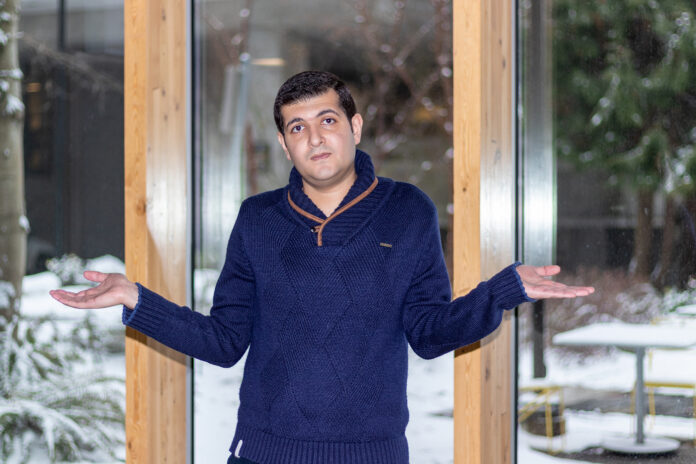
A photo of a student shrugging.
PHOTO: Afsaneh Keivanshekouh / The Peak

By: Hannah Kazemi, Staff Writer, SMRT

  1. What is the difference between Plato and Socrates’ definitions of utopia?

As two of the most famous philosophers, Plato and Socrates actually focus on the material world. Plato’s utopia is one in which all plates aren’t actually plates. Plato means “plate,” but he’s known to favour bowl-shaped plates because they’re extremely versatile and more fun to eat out of. Socrates’ utopia is one where all socks match all the time and washing machines never eat them. If you ask me, this is actually a dystopia because matching socks are boring. What if I want my socks to be funky and mismatched?? What then, Socrates?!

2. Explain what a homunculus is in three sentences or less.

A homunculus is a really big cloud that starts to rain right as you walk out the door in shorts for the first time in May. Homun = massive or huge and Culus = cloud because, like, cumulus or whatever? This cloud absolutely dominates the sky and laughs in BDE when other clouds try to compete.

3. In what scenario could a heuristic be considered admissible but not consistent in an A* search?

One where my dog makes the laws: 1+1 equals window, and movie theatres stop charging $8 for popcorn.

4. What are contemporary problems in Roman architecture?

Most people don’t actually know that most historical Roman architecture was made out of stickers and straws. The Romans would stick stickers on groupings of straws to form posts, then stick more stickers on more straws to make walls and roofs. This was how they held the whole thing together. The Colosseum is all straws. That’s why there are so many fountains in Rome; they’re all made of straws so the water just flows through them super easily. 

They would use scratch ‘n’ sniff stickers in the bathroom so that you could scratch one to cover up the smell, and they would put a dog sticker on top of the window sticker so that it looked like there was a guard dog living there. Though creative and beautiful, the biggest flaw of this sticker-straw method is that the stickers lose their stickiness really fast due to the intense summer heat, leading to collapsed houses. Those, of course, had to be rebuilt with more straws and stickers.

5. In court, what does it mean to establish actus reus and mens rea?

Actus reus refers to when you’re a kid in a play at school and the teacher gives you the role of “sun.” Mens rea is when you sneeze every time you’re in the presence of a man because you’re allergic to the audacity they store deep in their cores. You can only establish actus reus and mens rea at the same time if you’re watching your cousin’s kindergarten spring production, and if there are cringy dads in the audience.


Glow Motive rises from the waters with a debut single

0
Anjelica Solomon and Oceaan Pendharkar in white blouses look up with opaque, shimmering water and a pink lily pad in the background.
PHOTO: Divya Nanray

By: Alex Masse, Peak Associate

Vancouver-based duo Glow Motive is, like the ocean they draw inspiration from, in a constant ebb and flow. The pair consists of two brown, queer musicians: Oceaan Pendharkar and Anjalica Solomon. Neither are new faces in the local arts scene — Pendharkar has experience as a solo musical artist and Solomon has spent years in Vancouver’s poetry scene. What brought them together was a series of serendipities and shared experiences. They met at a conference through a mutual friend, and from there, sprang into working together.

“It was just so exciting to meet someone that shared similar experiences to me,” Solomon said. “It kind of provides an easy container for us to love each other and support each others’ dreams.”

The pandemic was also a major factor. They wrote their first songs together over email threads. “I was just so bored in the house,” Solomon laughed. “And I think, also, boredom creates space to dream [ . . . ] A lot of people’s experiences with it during the pandemic resulted in songs, plays, and films.” 

And when the time came to go from emails to live entertainment, Glow Motive adapted accordingly. “There have been a series of transitions for sure,” Pendharkar said. “Like, learning to collaborate with each other in different ways. I feel like we’ve already had so many stages, and we’re only releasing our first song now.” 

According to Solomon, the summer of 2022 was when things started to gain momentum. They had the opportunity to perform in front of audiences, including at the Music Talks festival in Maple Ridge.

Because of the band’s collaborative nature, both Solomon and Pendharkar regularly check in with each other and keep conscious of their limits.  “I feel like the transition is ongoing, both within the world and in our band,” Pendharkar said. “As a polyamorous person, one thing I bring to my relationships is the idea it’s a constantly evolving thing, rather than a series of steps you go through.”

But one thing’s constant: the creative chemistry. “The first time we wrote a song together, in person, Oceaan brought their guitar, and I showed up with a pen and paper, and we wrote a song in one hour,” Solomon recalls. “I’ve consistently felt that us, as creative collaborators, [we’re] really aligned. I think it has something to do with our values, and stuff like that being aligned, too.” 

And that alignment is witnessed best in “Show Me You’re Here,” the band’s debut single, which was pre-released on February 3 on their Bandcamp. The dreamy pop track carries themes of grief, ancestors, and self-discovery. The ethereal harmonies and backing vocals are laid over a downtempo, percussive beat, resulting in a distinct, aquatic sound.

As a debut, the track made sense — it was the first song written for the band, when the two were in similar states of mind, each grieving the death of a grandparent.

“We had lost and were losing,” Pendharkar said. “The feelings in this song were something that we could connect on, because it was an experience we were both feeling, and we’re trying to share understanding about it.” 

“The pandemic happening shortly on the heels of my grandfather’s death, I was in this deep grief,” Solomon said. “It felt like the world was closing into this kind of cocoon. When we started collaborating, I think I was slowly coming out of that, or still in that.”

Solomon also cited the duo’s various Scorpio placements for the emotional depth to their work. And true to their water sign influence, the aquatic theming persists throughout the track; lyrically and sonically, it brings to mind images of the ocean and other bodies of water. “The initial image of the song was, for me, returning to the ocean,” Solomon said. “Letting the ocean hold my grief, and not having to hold it myself.” 

“That’s where it started,” Pendharkar agreed. “When I think of water and grief, I think of cleansing, and the water’s also the depth [ . . . ] The ocean is something you can go to, to hold your feelings.” 

“Show Me You’re Here” will have a prerelease on Bandcamp come February 3, followed by a wide release on February 10, and a music video on February 24. Follow Glow Motive on Instagram at @glow.motive.

Metro Vancouver calls for student representatives in a youth and education advisory panel

0
This is a photo of a group of young people collaborating in an office. They have laptops in front of them but they are looking at a TV at the front of the room.
PHOTO: Jason Goodman / Unsplash

By: Aditi Dwivedi, News Writer

Metro Vancouver opened applications for a Youth and Education Advisory Panel on January 10. The aim of the panel is to involve youth and educators in the planning and infrastructure projects taken by Metro Vancouver to build an inclusive future for people living in the region. 

It is, according to George Harvie, chair of Metro Vancouver’s Board of Directors, “committed to engaging audiences who may be impacted by or have an interest in our projects, policies, and plans.” In an interview with The Peak, Amanda McCuiag, director of communications at Metro Vancouver discussed the needs that led to the development of a Youth and Education Advisory Panel and what they hope to achieve.

McCuiag noted the plans and projects of Metro Vancouver, such as the liquid waste management plan and reducing sewer overflows, are about “the livability of the region.” What led to the idea of setting up a Youth Education and Advisory Panel was the “long-term and forward-looking” work needed to create a sustainable, clean, and functional environment. She added how “different teams in the organisation wanted to hear from young people” and how there was a sense of curiosity about what the younger generations felt about the different issues being tackled by Metro Vancouver. 

The panel will have five representatives each from the high school group ages 13–18, the post-secondary group ages 18–25, and people working in K–12 education. The panel will function based on the information they receive on topics related to the development of Metro Vancouver’s plans. They will be encouraged to “pose questions, engage in discussion, and provide comments” on regional issues. Topics will range from managing wastewater, reducing solid waste, water conservation, taking action on climate change, plans for regional parks, and the delivery of K–12 programming, according to the press release.

McCuiag believes “the sense of feeling heard is a really important part of engagement,” and the reason why the youth feels ignored or unheard is because “change takes a long time and so it can feel like there is no momentum.” Which is why, she stated, Metro Vancouver is committed to telling youth their opinions are being taken into consideration. 

According to McCuiag, Metro Vancouver is encouraging people from marginalized communities to participate. She acknowledged there are “equity seeking individuals who would like to participate but can’t because of other barriers,” like technological barriers or difficulty gaining access to resources. She noted they will work on how to “remove those barriers on a case by case basis.”

The Youth and Education Advisory Panel is accepting applications for representatives. The deadline for the application is February 3. Find out more about the application form and process on the Metro Vancouver website.

WGOG: SFU doesn’t provide a list of vacant/occupied rooms on campus

0
empty chairs in a classroom
PHOTO: Duo Nguyen / Unsplash

By: Ben McNallye, SFU Student

Picture this: you need a quiet space for a quick Zoom meeting on campus. You fly through the AQ, WMC, or wherever, looking for an empty classroom. You find one! Go, you. But moments after you log into the Zoom meeting, a line starts to form outside the door. Students waiting to use the room for their 12:30 p.m. class are looking in, wondering who the strange person gesticulating wildly into their computer is. 

Well, nine times out of 10, they’re a fellow student in need. And what they’re in need of is a goddamn, up-to-date, semesterly list of available campus rooms at any given time. But SFU, in all its finite wisdom, doesn’t offer anything like that. 

Sure, you can book a room in the Library at the Burnaby Campus, but that’s not what we’re talking about here. We’re talking about a critical offering for students needing to spend 1520 minutes of their day on a Zoom call for an interview or a pitch meeting, or to just have a moment to themselves without the fear of some first-year tepidly peeking their head in and asking, “is this the tutorial for Archeology 203?” No, it’s not. Come back in 10, you little shit. 

And lest we chalk this up to some entitled student throwing a fit over an impossible-to-provide service, it’s important (and shameful) to note that UBC with a student population and campus size that dwarfs SFU provides such a service! And if those thunderbird-humping, gondola-lacking, vanilla-AF egoists can figure it out, then surely we can too

Let’s not let SFU off the hook. Count up your classes, and show your work to the student population. At long last, one of the Lower Mainland’s most engaged universities needs to match the technology of a bathroom door handle and show folks whether rooms are vacant or occupied. 

Why you should try fencing

0
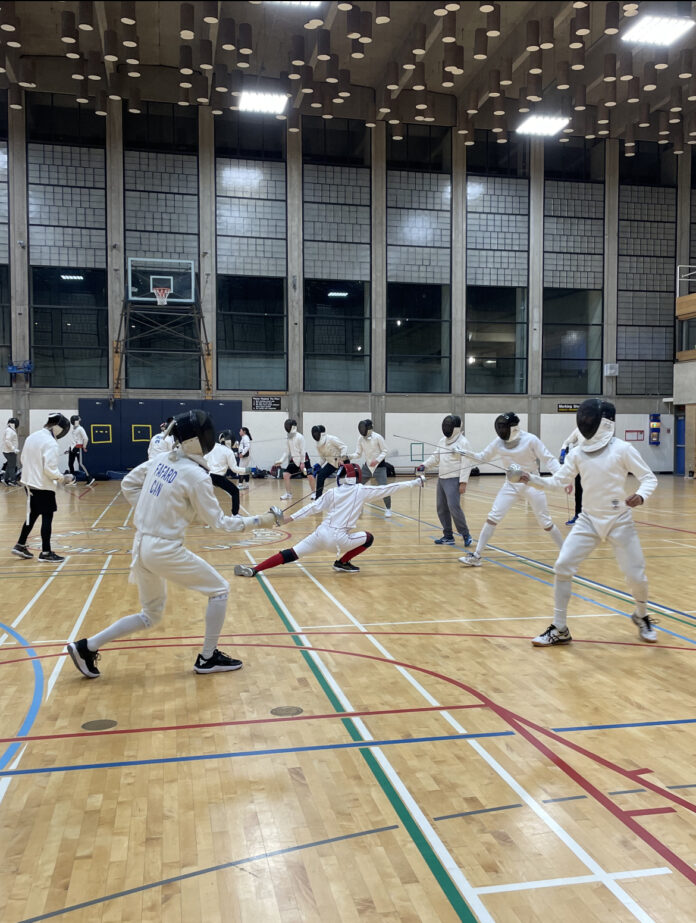
a photo of an SFU fencing practice.
PHOTO: Matthew Cheng / The Peak

By: Matthew Cheng, SFU student

Fencing is an ultimate test of character. It’s about rising to the occasion and never losing sight of the little details: a hesitation in your opponent’s footwork, their tendency to use a certain technique, and their likeliness to strike. Your biggest obstacle is your own mind just as much as it is your opponent’s. In a sport with such little room for error, athletes always have to be on high alert, waiting to defend an attack or launch at their opponent.

The Peak sat down with the athletes and head coach of the SFU fencing team to understand the skills needed to place yourself in front of a blade.

Cole Peterson joined the SFU fencing team with an AAA hockey background. Although familiar with the pressure and training of competing, fencing is Peterson’s first individual combat sport. Unlike hockey, there’s no team to assist you on the field and no teammate’s strength to depend on in fencing.

He described fencing as “something to look forward to, for the most part, and something to improve on constantly.” While victories may feel a little sweeter as an individual, there’s more accountability placed on the athlete when results aren’t going their way. Fencers have to toy the line of striving for perfection without being too self-critical. Peterson referred to the natural hardships and triumphs of fencing as a “rhythm” — steady, everpresent, and something each person has to get used to. “I’m back in a rhythm now,” says Peterson. 

Natasha Sing joined the SFU fencing team after 14 years of competitive dance. She reflected on how different the spotlight is on the piste (fencing track) compared to the stage. “The pressure is so much more involved,” said Sing. “It gives you a lot more confidence in yourself.” 

Another thing pressure can do? Make athletes get comfortable with the uncomfortable, which often translates to personal growth. “Its made me grow up a little bit,” said Sing. “It takes dedication, so I see myself being dedicated in a lot of other things in my life.” 

Marie-Rose Bruskiewicz, head coach of the SFU fencing team and world-class fencer, came from a soccer environment, and didn’t start fencing until her first year of university. But her initial curiosity in the sport developed into an unbreakable dedication.

“There’s no one there who’s going to pick up the slack for you,” said Coach Bruskiewicz. “You’re your own offense, your own defence, and everything in-between.” Coach Bruskiewicz has built a team which not only provides athletes tools to excel in competition, but to flourish in life as well. “I’ve learned a lot of lessons in fencing that I’ve applied to my life that have made me not just a better athlete, but a better person.” 

Art Moves and sparks community on your commute

0
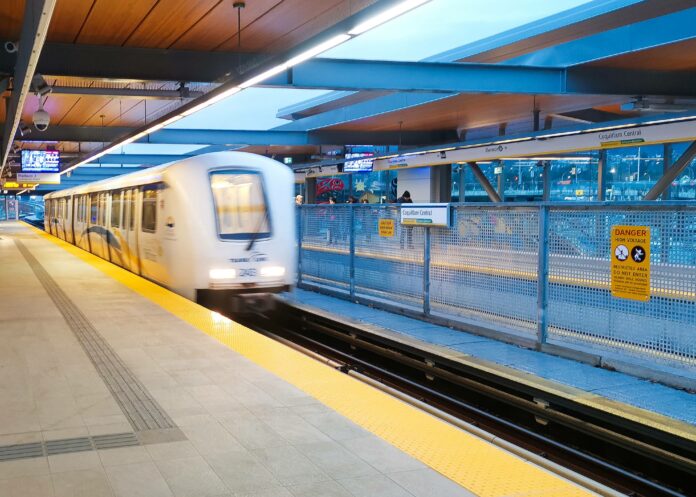
A skytrain in motion.
PHOTO: Afsaneh Keivanshekouh / The Peak

By: Petra Chase, Arts & Culture Editor

As a Vancouver resident without a driver’s license, hopping on and off buses and trains is a normal, everyday occurrence. Even though on transit I’m surrounded by people with similar routines — students on their way to lecture, service workers who barely made it out of bed in time for their morning shift — there is a looming sense of disconnect. Despite being in close proximity to fellow commuters (sometimes literally rubbing against them during the 5:00 p.m. rush), feeling a sense of alienation in public spaces has always felt like a part of life in the city.

On January 20, I witnessed something different. Fiddler Gabriel Dubreuil and guitarist Andy Hillhouse performed a traditional fiddle concert for the train cart, playing a spectrum of swing, jazz, and folk. From VCC Clarke to Lafarge Lake Douglas, I felt connected to a sea of strangers. Faces lit up as people entered at every station seeming pleasantly surprised at first, and eventually settling into expressions of joy. Each song ended with a gratitude-filled applause. All around me, phones were out of sight, as there was no need for a distraction from the current time and place. We were all brought together by the shared sensorial experience of beautiful music and surrounding Burnaby city lights. It was a reminder that art still has the power to bring people together and remind us of our shared humanity. 

This performance was part of TransLink’s Art Moves residency program, wherein each month, a local artist performs for TransLink riders. Produced by Laura Barron, via her non-profit, Instruments of Change, Art Moves seeks to give recognition to BC’s diverse artistic talent from musicians to live painters, and magicians to dancers. The program also “invite[s] riders to surprise and delight in these artful happenings.” In February, you can catch SkyTrain and SeaBus performances by soul singer-songwriter, Krystle Dos Santos, with special guests, Scott Verbeek and Gavin Youngash. Santos recently won R&B artist of the year at the Western Canadian Music Awards. 

Find out about performance times on TransLink’s website.

Diving into the importance of drug decriminalization

0
ILLUSTRATION: Jo Zhou / The Peak

By: C Icart, Staff Writer

As of January 31, if you are 18 or older in BC, you “will now be able to possess up to a cumulative 2.5 grams of opioids, cocaine, methamphetamine, and MDMA within the province.” Instead of criminal charges and drug seizures, British Columbians found with this amount “will be offered information about health and social supports, including local treatment and recovery services, if requested.” This move was announced in May 2022 and the exemption from laws criminalizing drug possession will last until January 31, 2026.

This 3-year initiative is in response to the worsening overdose crisis. In April 2016, the province’s public health officer “declared a public health emergency under the Public Health Act; a first in BC and Canada.” In fact, “illicit drug toxicity is the leading cause of unnatural death in British Columbia and is second only to cancers in terms of years of life lost.” The overdose crisis is a public health emergency and should be treated as such. In BC, the toxic drug crisiskilled more than 10,000 people between January 2016 and October 2022.” The decriminalization of drugs is a critical step against the drug crisis because it will help reduce stigma and people in need will have access to life-saving services. 

BC associates this decriminalization experiment with other harm-reduction initiatives like “safe consumption sites, safer supply, and naloxone.” Harm-reduction is a number of evidence-informed strategies and services that reduce “harms related to substance use.” This perspective acknowledges that complete abstinence is not necessarily a realistic goal for all drug users. Vancouver has been using harm-reduction strategies for decades it opened the first legal Supervised Injection Site, InSite, in North America back in 2003.

The history of drug prohibition in Canada dates back centuries and has been used against marginalized and racialized populations. Specifically, prohibition is tied to colonization — ideas about drugs stem from western Christian religions and were pushed onto Indigenous nations. Prohibition came from “the idea that drugs are inherently bad and an immoral, corrupting force.” 

The Canadian Drug Policy Coalition reported, “In the 1700 to 1800s, psychoactive substances were legal in Canada and many were taken for medical purposes.” 

The “war on drugs,” a strategy that criminalizes drug users, has not been a successful way to prevent people from using. Instead, it contributes to the stigma that pushes people to use while alone and hidden, putting them at an increased risk of death

However, advocates highlight that decriminalization does not change the toxicity of the supply. The drug supply in BC is increasingly toxic with high levels of fentanyl, a synthetic opioid.

Kevin Yake, the vice-president of Vancouver Area Network of Drug Users (VANDU) also adds that the increase in possession to 2.5 grams is not enough. The current threshold ignores the dynamics of drug use in BC, users who develop resistance to fentanyl require higher and higher doses well over 2.5 grams, this oversight is setting them up for failure. When the BC government applied for the Health Canada exemption, it had asked for 4.5 grams to follow the recommendations of VANDU and other advocacy groups. It was settled to 2.5 grams based on feedback from law enforcement. This also brings up concerns about how this new measure is going to be implemented and who is still at the most risk of being criminalized. This is especially true for “those who live in rural and remote communities where people often buy larger quantities of substances when they can access the illicit market.” 

Fentanyl is not the only problem with the drug supply. Paxton Bach, an addiction medicine physician, highlights that uncertainty in drug composition plays a huge role in overdoses and overdose-related deaths. When purchasing and using illicit substances, generally, people are never sure of exactly what and how much they are using. Getting your drugs tested is a good way to deal with that reality. Get Your Drugs Tested is a free testing site on East Hastings that was founded in 2019 by Dana Larsen. It is the only place in Canada where you can get your drugs analyzed seven days a week in-person or by mail. Jerry Martin plans on opening a brick-and-mortar store in the Downtown Eastside selling previously illicit-to-use drugs like MDMA and cocaine. While this might sound controversial, his intention is to provide drugs that have been tested, thus providing a safe supply and potentially reducing overdoses.

However, decriminalization is different from legalization, and selling controlled substances is still illegal. Despite knowing that his store will likely get shut down, Martin still wants to go ahead with his plan and support efforts for a safer supply. It’s also worth noting that none of the above initiatives mention youth. But young people also use and consume substances. In 2022, 28 people under the age of 19 died in BC from toxic drugs. This may be an uncomfortable reality but young people also need harm-reduction spaces. 

Strategies to address substance-related harm in our communities needs to include youth voices. In fact, it’s “a participatory right under the United Nations Convention on the Rights of the Child.” A group of researchers and activists developed a list of 10 calls to action to support the needs of young people who use drugs. Even in places like Vancouver, which is considered to be one of the world leaders in harm-reduction policies, there’s a critical gap between harm-reduction policies and young people who use drugs.

We could potentially start seeing decriminalization experiments like this across the country as “the federal government is currently reviewing an application by the City of Toronto.” 

Internationally, many decriminalization advocates point to the example of Portugal. The country decriminalized possession of less than a 10-day supply of all drugs in 2001. Instead, people caught receive mandatory medical treatment. As a result, “drug-related deaths have remained below the EU average since 2001.” In the first decade following decriminalization, “new HIV infections, drug deaths, and the prison population all fell sharply.” 

Decriminalization may sound like an intimidating step but it is an evidence-informed solution. Many who experience discomfort surrounding this idea will have to sit with the fact that our ideas surrounding substance use are tied to the era that we live in and the culture we have grown up in. There were times when being able to freely purchase alcohol or marijuana as an adult in Canada was also unthinkable. Educating ourselves about substance use and harm-reduction saves lives.

The art of urban leadership with Jonathan Coté

0
This is a photo of the New Westminster port and skyline.
PHOTO: David Stanley / Flickr

By: Saije Rusimovici, Staff Writer

On January 16, urbanist and former mayor of New Westminster Jonathan Coté led a reflective lecture Transforming Urban Leadership, where he outlined some of the key areas of effective urban leadership in addition to challenges in public policy. Presented by SFU’s Morris J. Wosk Centre for Dialogue, Coté provided an insightful look at his experience with 17 years in local government. 

Coté’s final term as mayor of New Westminster ended last November. Since 2014, Coté has served as the chair for regional transportation and the chair of regional planning. As an SFU alum of urban studies, Coté has recently been “appointed an Adjunct Professor in the Urban Studies program.” 

Coté described the feeling of a spotlight shining down on him during his time as mayor. He described a common illusion where the mayor has the ultimate authority when it comes to city building. “There are so many different groups, stakeholders, and people that are involved in good city building that often don’t have the big spotlight that you might shine onto a position like the mayor of a city,” Coté said. “From my perspective, I think the biggest unsung heroes in city-building and in our cities, are actually the people who work for our cities.” Coté went on to say city building is an ongoing, never-ending project that is constantly changing.

Coté spoke on pivotal experiences with urban development and public policy throughout his time as mayor, some of which were initial successes and others that were not. “I think there are lessons to be learned from successes [ . . . ] but also stories where things didn’t quite work out,” Coté said.

In navigating the transformation of downtown New Westminster while maintaining the city’s historical routes, Coté highlighted the triumphs and challenges in an ever-evolving city. “On the one hand we wanted to have a really great conversation about revitalizing downtown New Westminster [ . . . ] but on the other hand, I had a deep concern about the other side of revitalization, which is gentrification,” Coté said. Gentrification happens when the city is reconstructed to encourage wealthier people to move in, displacing people in working class areas. It has been known to primarily impact lower income groups and racialized communities. 

According to Coté, it was important to consider the negative impacts of gentrification on community displacement. “Over my seventeen years, we did a lot in downtown New Westminster [ . . . ] they were kind of flipping back and forth between these two goals of revitalization versus trying to mitigate gentrification,” he added. Coté said this resulted in meaningful developments such as Westminster Pier Park, rather than trying to make “Canada’s newest, trendiest neighbourhood. 

“City-building is important and it is central to all of the biggest issues that we are facing all around the world,” said Coté. He described city-building not as a linear process where success is the result of well-thought out plans, but “messy.” He noted the process of city building is inherently unpredictable as a result. “The reality is, cities are all about people, and people are complicated, complex, and diverse.”

SFU researchers concerned for extinction of sharks and rays

0
This is a photo of multiple sharks swimming in the ocean.
PHOTO: Colton Jones / Unsplash

By: Natalie Cooke, News Writer 

Human activity has threatened extinction for sharks and rays, according to a study published by a team of SFU researchers. The study found that 59% of sharks and rays associated with coral reefs, may be facing extinction. 

Earth.com reported, “This is due to the fact that coral reefs — which harbor over a quarter of all marine animals and plants — are seriously menaced by a variety of human-related threats, including overfishing, pollution, and climate change.”

The study found fishing has the biggest effect on the shark and ray populations. Sharks cannot reproduce as fast as humans are killing them: this makes them an extremely vulnerable species for extinction. 

Sharks and rays are hunted by humans to use in a variety of products. They are commonly used for human consumption, creation of clothing and accessories, and traded internationally for their fins, skins, and meat. They are also used for aquarium display, food for animals, and in medicines.

The SFU researchers emphasized the importance of reducing the amount of shark fishing. To help the shark population recovery, the researchers suggested fishing undertaken by individual fishing households, and industrial fisheries need to be controlled and the management systems need to improve. 

The researchers also explained climate change is a threat to coral reefs and their inhabitants, but it is not the most impactful threat when compared to issues such as overfishing. 

However, the percentage of CO2 in the atmosphere has increased due to human activity and is impacting the underwater ecosystems. The National Oceanic and Atmospheric Administration explained, “Because of human-driven increased levels of carbon dioxide in the atmosphere, there is more CO2 dissolving into the ocean. The ocean’s average pH is now around 8.1 [ . . . ] as the ocean continues to absorb more CO2, the pH decreases and the ocean becomes more acidic.” When pH levels get too high, organisms cannot build and maintain their skeletons, shells, and other bodily structures. 

Ironically, sharks can help make oceans more resilient to climate change. Some shark species can prevent overgrazing from other marine life which allows seagrass to be stronger and denser. This is important as seagrass catches CO2 from the air, preventing ocean water from becoming overly acidic.  There are many ways in which sharks and rays can benefit the ecosystem, which is why their extinction would also threaten our changing climate. 

To learn more about the study, visit the research article published on Nature Communications’ website

Dear Peakie

0
A photo of someone looking prim in an office chair with a thick book in their hands.
PHOTO: Pexels

By: Hannah Kazemi, Staff Writer and Expert Advice Giver

Dear Peakie,

I want to like, go beyond myself this year . . . like, really ascend . . . and you know what they say, the will of the mind guides the will of your path or something. I don’t know who said that, but I do know you can give me some advice on how to be beyond.

Sincerely,

High Up in the Stars

Dear High Up in the Stars,

I think Paris Hilton said that once, and Paris Hilton slays. Sounds like you’re looking for a spiritual experience. I recommend taking some fun gummies and attending a “Starry Nights” event at the Trottier Observatory — lay back and watch the stars dance right in front of your eyes. Try to count the dots in the sky and imagine what it would be like to be floating up there with them. I guarantee you’ll find what you’re looking for.

Good vibes only,

Peakie

Dear Peakie,

Where on earth is my cute, edgy boyfriend with a mysterious past that I must exact all my emotional highs and lows on? It is cuffing season and I am BITTER. I was told this was a school of engagement, no less. Where are people going to seek out their significant others? When will I be a significant other?

Sincerely,

#1 Most Single University Student (NOT Engaged)

Dear #1 Most Single University Student (NOT Engaged),

Uh oh! You must not have gotten the memo: SFU is Canada’s most engaged university. You might have to drop out to preserve your integrity if you don’t find someone ASAP. I suggest sitting next to the cute, edgy guy in your seminar class and introducing yourself by telling him all about your dream wedding. You’re sure to land a bf that way! 

Also, try hanging out around the avocado — it seems to be where lots of your peers get busy, so why not try? Be a hot girl! Actually, maybe don’t try that . . . rumours say you can hear faint cries for “momma and dadda” coming from inside the avocado. I think it might be a good thing you’re NOT engaged. Do NOT tell SFU I said that.

Live, laugh, love,

Peakie

Dear Peakie,

I can feel the hole in my wallet stare into me (metaphorically, of course, I haven’t seen a fifty dollar bill in years). It feels like guilt and bad decisions, but I just need that extra push of comfort every morning from my Renaissance run! HELP.

Sincerely,

My Money Jiggle Jiggles too much

Dear My Money Jiggle Jiggles too much,

Unfortunately (for my wallet), I, too, have fallen victim to Renaissance. The people are too nice and the food is too delicious! Luckily, I think I have the perfect solution to help you feel better every time you tappy-tap your card. Take cash out and use that to fuel your coffee addiction! Instead of hearing the sound of Apple Pay telling you you’re one step closer to bankruptcy every time you need a caffeine boost, pay with cash — it’ll be like you’re not spending any money at all. Because cash isn’t real money . . . right?

Manifesting rich vibes forever,

Peakie