Home Blog Page 186

Courtyard residence unveiled at SFU Burnaby campus

0
This is a picture of the outside of a residency building at the SFU Burnaby campus.
PHOTO: Afsaneh Keivanshekouh / The Peak

By: Isabella Urbani, Staff Writer

Editor’s Note: A correction was made to this article on June 12, 2023 to note that room prices are $3,920, regardless of room type.

On May 19, SFU announced the opening of its newest residency on Burnaby campus. Courtyard, created primarily for first-year and some second-year students, is named after its courtyard hub which will feature “swings, ping pong tables, and open-air gathering spaces.” It will also be home to the SFU residence and housing main building. The building’s garden — the Madge Hogarth Sensory Garden — will pay tribute to the namesake of SFU’s first ever residency building, the Madge Hogarth House, where the courtyard residency is located upon.  

Although the new building will be equipped with utilities like a laundry room and wifi, it will not include individual cooking facilities in rooms, meaning students will need to be on the campus meal plan. 

In addition to the residency buildings, the courtyard residence will also have 17 short-term stay suites. “SFU has guest accommodations for short-term stays to guests travelling alone, in groups, or as part of our SFU community,” said Zoe Woods, director of residence and housing, in an interview with The Peak

These suites, known as The Simon, were previously located at another residency building: the Shadbolt House. With their relocation to the courtyard residence, the 14 short-term stay suites at the Shadbolt House will now become homes which can be moved into starting this fall. This will increase the new student residency next semester from 369 to 383 students

“Increasing student housing reduces pressure on the local housing market,” said Woods, adding that creating spaces for students to live on campus amid the ongoing housing crisis in Vancouver “helps to alleviate worry for students in finding a place to live so they can focus on their studies.” 

With the completion of the building, SFU is officially on stage three of their five-stage Residence and Housing plan established in 2015. Also a part of the second stage was the expanded dining commons in August of 2022, with 500 seats and 10 new culinary stations. 

By 2035, SFU plans to provide housing for 10% of the student population. The Burnaby campus currently has more than 2,450 beds out of their projected 3,250. Prior to the courtyard residence, SFU built residency halls in June 2021 and one and two-bedroom apartments for graduate students and students with a common-law partner or child in September 2022. Housing for third and fourth-year students, including four-bedroom and studio apartments, will be introduced in the third stage and has not yet been given a launch date.

In total, $113-million was spent on financing the courtyard residence — $73-million provided by the provincial government. SFU revealed in their press release about the courtyard residence’s grand opening that the space is “designed to reflect Indigenous culture in the region. 

“Engagement and consultation were conducted during the design process to ensure culturally relevant design materials and layouts were included in the project,” explained Woods. The residency is “intended to support Indigenous learners by providing a community gathering space within the building and an outdoor space that connects to nature.” 

According to Woods, Gabriel George, a traditional speaker and singer from the Tsleil-Waututh Nation, was also present to open with a ceremony for the courtyard residency’s opening on May 19. 

In Fall 2023, the starting cost for a semester in the courtyard residency will be $3,920.

More information can be found at the SFU residence and housing website.
Have a splash with another Dear Peakie

0
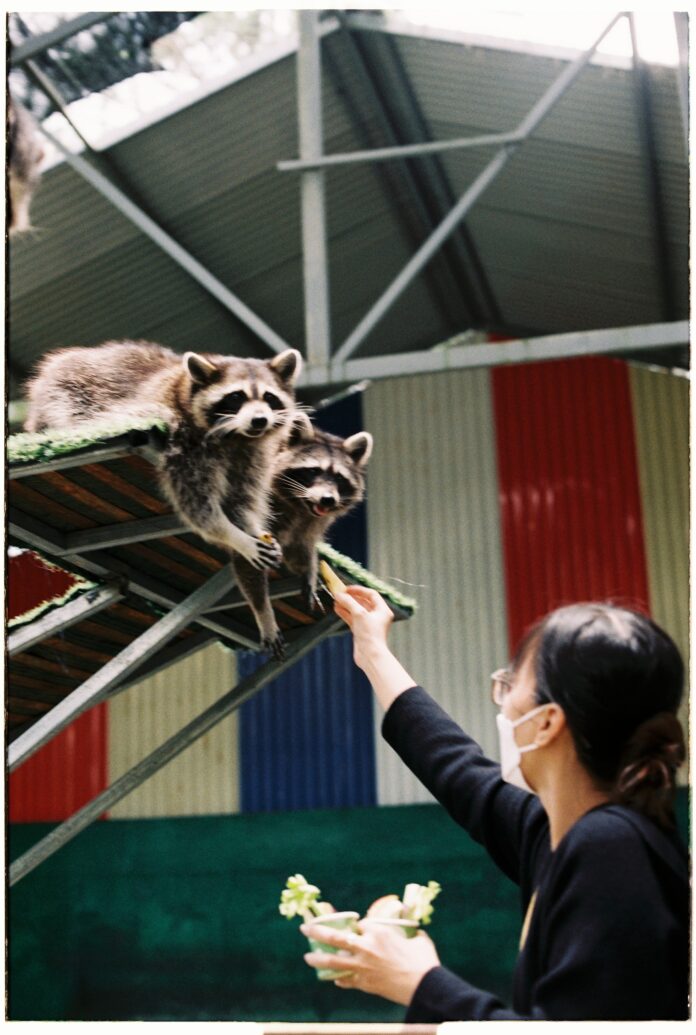
Woman handing food to two racoons
PHOTO: Vinh Lâm / Pexels

By: Maya Beninteso, Peak Associate and C Icart, Humour Editor

Dear Peakie, 

I used to be terrified of raccoons. So, I subscribed to Raccoon Whisperers YouTube channel to overcome my fear. It worked tremendously! But now, I’ve followed in James’ (Raccoon Whisperer) footsteps and fed the raccoons in my neighbourhood. My boyfriend is upset because 50 raccoons came to our house yesterday for dinner. How do I explain to him that the raccoons are part of my cottagecore fantasy?

Sincerely, 
Raccoon Whisperer #2

Dear Raccoon Whisperer #2,

Firstly, amazing use of systematic desensitization to overcome your fear of our beloved trash pandas #HealingQueen. Secondly, what is a boyfriend, if not someone who’s supposed to support your dreams? You might’ve desensitized yourself to raccoons, but don’t you dare desensitize yourself to your boyfriend’s atrocious behaviour. You can have your raccoons and eat with them too, and don’t let anyone tell you otherwise. Let him know that he can become Raccoon Whisperer #3, or all his precious belongings can end up in a tree. <3

Take the trash out,
Peakie

Dear Peakie, 

I’ve been using a fake name at my local coffee shop because Big Brother is always watching. However, I recently learned I have mutual friends with my barista. Long story short, today, my barista asked me why I used a fake name for coffee. So naturally, I told them I was a part of the princess protection program. How do I edit myself into videos of King Charles’ coronation to provide evidence?

Royally,
Wannabe Princess 

Your Highness,

There is only one viable solution. Move. Pack up your bags and move somewhere else because you’ve clearly ruined your chances — and reputation — in your area. You might as well get a shirt with “I’m a liar” on it because NO ONE would voluntarily provide a mutual friend with such “sensitive information.” On another note, Big Brother is always watching, and I’m pretty sure you’re not falling under any radar, considering that you’re writing on a public forum. I don’t mean to reign on your parade (that you’re cordially not invited to, you fraud).

I am always watching,
Peakie

Dear Peakie, 

I’m a fashion icon. As you know, that comes with a lot of haters. Recently, a classmate complained about my outfit to our philosophy professor. I know it’s because he’s jealous, even though he claims it’s because my “giant whale costume is distracting as it sprays water and makes whale sounds.” How do I stand up for my right to express myself through my outfits? 

Sincerely, 
THE fashionista 

THE fashionista,

While I am known for my thirst for vengeance, I will be singing a different tune today. Here is my advice: kill your classmate . . . with kindness. It sounds like he’s not having a whale of a good time, so show him one. Make him have a splash and remind him there are more pressing issues in the sea (like, I don’t know, climate change or the policing of women’s bodies or WHEN TAYLOR SWIFT IS GOING TO ANNOUNCE INTERNATIONAL TOUR DATES). Alternatively, you could apply your learning from philosophy class and have a spirited debate (but we both know that’s not going to happen because who on earth willingly does that). 

Just keep swimming,
Peakie

SFU Residence and Housing presents: The Magic Treehouse

0
Treehouse for rent on top of a mountain with a “perfect applicants only” sign in front of it.
ILLUSTRATION: Christina Cao / The Peak

By: Izzy Cheung, Staff writer

Attention all SFU students! 

We are speeding up construction of our newest housing structure, The Magic Treehouse. As a result, we have begun accepting resident applications for this revolutionary housing concept. It combines edgy and contemporary designs for a unique housing experience. 

The Magic Treehouse seeks to provide the comfort of the forest while maintaining the downtown glamour of city skyscrapers. Our new building is constructed from raw, tree-sourced wood and stainless steel. The result is an ambitious attempt at a colossal treehouse residence space. Time travel devices are not included in this residence’s amenities, but it still provides magic, we promise. 

This residence will surely become your new favourite building on Burnaby Mountain. We provide various services that you’re unlikely to find anywhere else. Located at the top of The Magic Treehouse is our vine-swinging service, which allows residents to swing — via vine — all the way down from Burnaby Mountain. With this innovative amenity, there’s no more need for a gondola!

Situated in the heart of Burnaby’s portion of the Trans Canada Trail, The Magic Treehouse grants residents unlimited access to the beauty of SFU Burnaby’s nature. Residents will never feel lonely as each room has glassless windows, allowing wild animals to come in and out of the rooms at any given moment. You’ll see various animals, including squirrels, bears, and maybe even a certain Scottish Terrier with a fabulous mustache. Think of this as an innovative way to enjoy the company of animals that aren’t stuffed with cotton in your own personal space. 

Rooms in The Magic Treehouse are well-stocked for all residents to enjoy. Each non-private single room has a high-quality Hoverbrella, Avocado On A Stick, and SunShaders. For a small price, your dormitory can also include a mattress. We also provide a faulty microwave, bottle opener, and a dustpan with a large hole in it. Electricity, broom, desk, bookshelves, and storage drawers are not included. You’ll also all be sharing one bathroom! 

Applying is as easy as one, two, three! We have two different term plans for you to choose from. You can now apply for housing in the Fall 2024 semester — applications are due by June 6, 2023. We’ll be opening applications for the Spring 2025 semester from July 17–18 of the same year. 

The ideal housing candidate for The Magic Treehouse is a driven, determined individual with lots of experience living in residence. You’ll be sharing a floor (and occasionally a room) with many other students and animals, which can be intimidating for a first-time renter! Please keep this in mind when applying, as you’ll only have ten minutes to accept your housing offer if this is extended to you. The initial application fee is $2,000 and does not count toward the final payment. 

We have a few small requirements for all successful applicants. You must: 

  1. Be a student (SFU, CapU, Langara, KPU, TWU, UVIC, or any elementary, middle, or secondary schools — UBC students are not permitted). 
  2. Be over 5’4” and under 5’11”. 
  3. Be born on a Monday, Thursday, or Sunday — those born on Tuesdays are prohibited. UBC students born on a Tuesday attempting to apply will be pulled in for further questioning. 
  4. Have a Netflix subscription. 
  5. Have finished grade six with a minimum GPA of 3.75. 

What are you waiting for? Apply for residence at The Magic Treehouse today! 

Rooted brings Indigenous cuisine to SFU dining hall

0
A large white bowl with bison bourguignon, a stew with chunks of meat, carrot, and vegetable garnish. On the side, on a plate, is a loaf of bread and carrots.
PHOTO: Gudrun Wai-Gunnarsson / The Peak

By: Saije Rusimovici, Staff Writer

Rooted is a new program bringing traditional Indigenous ingredients and flavours to the SFU Dining Commons. Curated in collaboration with Steph Baryluk, a Teetl’it Gwich’in chef from Teetl’it Zheh in the Northwest Territories, the menu features over 15 unique dishes with fresh BC produce and game meats. Ingredients are chosen to reflect Indigenous traditions from a light and refreshing sweetgrass-tossed spinach salad to hearty plates like elk pot pie and braised rabbit with fresh sage.

Inspired by her grandmothers, Baryluk told SFU, ​“Both my parents are residential school survivors, so today, as I have the freedom to practice my culture and traditions, I will be loud and proud.”

“The Teetl’it Gwich’in people still continue to live off the land respectfully harvesting game meats and plants for medicine,” Baryluk said. “Hunting, fishing and trapping remain important both culturally and economically, with caribou, moose, whitefish, being staples of our diet.” 

Colonization has contributed to the loss of traditional knowledge of Indigenous ingredients and recipes. Indigenous food traditions are often criticized as a result of colonial narratives. Rooted is a small step toward unravelling these narratives. 

I had the opportunity to taste three uniquely crafted dishes. Many of the ingredients, while being nutritious, also have medicinal properties. I was eager to experience these new flavours paired with familiar and unfamiliar ingredients.

Venison sausage penne pasta

Coming from an Italian background, I was curious and excited to see this combination of flavours in a tomato-based pasta dish come together. The venison sausage, which usually refers to deer or elk meat, was cooked perfectly. This offers a rich flavour to the dish without overpowering the other ingredients. Traditionally, venison is often preserved by being cut into thin slices to be dried or smoked into beef jerky. 

“Hunting is an important part of Indigenous culture, and so is respect,” Baryluk commented. “When a deer, elk, or any animal is hunted, we are sure to use everything, nose to tail.” The bones of the animal are often crafted into tools and the hide can be salvaged for sewing and drum making. The dandelion leaf garnish not only offers a hint of sweetness to the dish, but is a rich source of Vitamin A, B, C, & D.

Bison bourguignon

A flavourful stew composed of large chunks of bison, carrot, and local BC mushrooms, this was my favourite dish. The meat was cooked perfectly, tasting similar to beef but offering notes of sweetness to break up a rich umami flavour. Making stew is “a great way to use up your ingredients and feed a big family,” said Baryluk. “As Indigenous people we like to use what we have, what’s around us. 

Growing up, stew was something my mom made frequently but I never tasted the combination of bison and mushrooms before. This dish is so comforting; I wish they would serve it in the dining hall more often. It would be a perfect addition to the menu, especially in the colder winter months. 

Bannock donut holes

I was excited to try bannock for the first time, especially paired with the sweet wild blueberry sauce served alongside the donut holes. Bannock can be baked, fried, or cooked on the stove top, and can traditionally be made from nut meal or corn. Blueberries are often used in both sweet and savoury recipes. Not only do blueberries make yummy additions to recipes, but they’re often used to preserve meat or for medicinal remedies. I had always considered bannock something to eat alongside a savoury dish, so I was looking forward to trying it with the sweet and slightly tart blueberries. They were so delicious, I found myself wanting to get up and fill my plate with more (and maybe sneak one or two in my pockets for later)! 

Two Rooted dishes are served every second Friday in the SFU Dining Hall. To learn more about each item on the Rooted menu and to see what is being served visit the Rooted website. 

SFU dining commons serving up more than just breakfast, lunch, and dinner

0
This is a photo of the SFU Dining Hall. People are buying food and walking around the space.
PHOTO: Kriti Monga / The Peak

By: Eden Chipperfield, News Writer

In September 2022, a new dining experience became available to the SFU community. The Dining Commons area is not just a place to enjoy a meal but a way to foster connections with new friends, study, and indulge in new culinary experiences. Since the Dining Commons opened, students have had the opportunity to taste different cooking styles, learn to make their own dishes, and connect further with their peers. 

The Peak spoke to chief commercial service officer Mark McLaughlin to discuss how the Dining Commons has been received from the community since its opening. “This new dining commons is very much about offering a really high variety of international flavours [for] meeting students’ dietary requirements, but it’s also very much about creating a social space for students, a place where students can just, you know, hang out, chill, study [ . . . ] Students on the meal plan can come and go as they please,”  McLaughlin said. 

The Dining Commons is open 24/7 during the regular academic term. However, for summer hours, visitors can frequent the Dining Commons from 7:00 a.m.–10:00 p.m. McLaughlin elaborated how the 24/7 hours of operation accommodate students on all types of schedules that are “not on the administration schedule,” including athletes up early for practice or hungry students after a late night exam. 

McLaughlin proceeded to detail the food options available for individuals at the Dining Commons, including gluten-free, vegetarian, vegan, and halal options. Diners can inform the cashiers of their nutritional restrictions, and they will be pointed in the right direction. Among the variety of food for dietary restrictions, any student can explore international food options such as chicken shawarma pita. McLaughlin noted this may provide comfort to international students.

The Peak also spoke to students regarding their own dining hall experiences. “It’s nice being able to just take my laptop and attempt to study,” one student responded who has been a frequenter of the space throughout their time at SFU. They also noted their enjoyment of the Indonesian curry thats served as part of the international flavours station. 

One of the newest additions to the Dining Commons is the Indigenous culinary experience, Rooted. It offers students the chance to try Indigenous cuisine: “It’s really important, to sort of daylight Indigenous cuisine and methods. We have a lot to learn from Indigenous people, from their culture.” McLaughlin stated, “We were delighted that we could bring it to light that we offer these Indigenous meals.” Indigenous food available at Rooted includes a barbecue blueberry salmon bowl, maple glazed trout salad, elk pot pie, and bannock doughnut holes prepared by Chef Steph Baryluk, who is Teetl’it Gwich’in and from Teetl’it Zheh. 

Another significant feature of the Dining Commons that students should be aware of is the My Pantry station, where students can cook their own meals. They are overseen by staff members who encourage people to try new techniques or ingredients. “We’ve got about, I think, five burners there, five stations where students can cook what they’re making,” McLaughlin noted. 

The Dining Commons has achieved Gold Status as a LEED building, meaning 40% of the ingredients are locally grown or processed in British Columbia. “We’re also one of the few facilities at SFU that’s air-conditioned,”  McLaughlin remarked.  

To learn more about the Dining Commons and the foods available, visit their website at www.sfu.ca/food/dining-commons.html

Protesting against nuclear energy in India

0
This is a photo of Dr. Ajmal Khan A. T. This headshot depicts Dr. Khan staring into the camera, smiling.
PHOTO: Gudrun Wai-Gunnarsson / The Peak

By: Olivia Sherman, News Writer

Content warning: mentions of police brutality.

According to India’s minister of state, Jitendra Singh, “nuclear power plants are likely to generate about 9% of the country’s electricity by 2047.” This year will also mark 100 years of independence from Britain’s colonial occupation of India. Nuclear power will help India achieve an emission rate of “Net-Zero by 2070.” 

However, Dr. Ajmal Khan A.T., author, environmental scholar, and postdoctoral fellow of Harvard University, explained that things aren’t as idyllic as they seem. In his most recent lecture, hosted by SFU and the David Lam Centre, Khan presented a dialogue on India’s climate crisis and anti-nuclear activists from across the nation.

Power plants are costly to build, both in terms of economics and in the amount of land they require. “In most of these locations, normally uranium is being mined,” Khan said, which is damaging to the environment and the people living in its vicinity. Despite promises of better jobs and ways of living, many residents of India haven’t seen improvement. Figures from India’s department of atomic energy calculate that nuclear power plants generate only about 2% of India’s total electricity

Khan quoted S. P. Udayakumar, an anti-nuclear activist: “If India was getting half or a third of its energy from nuclear plants, then maybe there would be an argument for it [ . . . ] But after all this, after years of crushing the peoples’ protest at Idinthakarai, is it really worth it?” 

Khan focused his conversation on two nuclear power plants in India: the Kudankulam Nuclear Power Plant (KKNPP) in Tamil Nadu, in the south of India, and the Jaitapur Nuclear Power Plant (JNPP), Maharashtra, on the west coast. Both these power plants are ripe with controversy, he explained, and resistance from the people living in the surrounding areas have created a lasting legacy. “The movements in India are substantially different from the movements in Europe, North America, and any place outside South Asia. They have a different history,” Khan said. 

In 1988, then prime minister Rajiv Gandhi and Soviet head of state Mikhail Gorbachev signed an inter-government agreement to build two nuclear reactors. Construction of the KKNPP then began in 2002. From its beginnings, the KKNPP was deemed controversial: the reactors were set up without the publication of the Environmental Impacts Assessment Report or the Safety Analysis Report. Over one-million people live within 25 kilometres of the power plant, exceeding the recommendations from the Atomic Energy Regulatory Board. Its location is also in violation of the Coastal Regulation Zone, as it’s built just 500 metres from high tide. This location has been proven to be a concern for local fishers. 

There were also concerns about its safety, as the agreement between Gorbachev and Gandhi was made only two years after the infamous Chernobyl disaster in 1986. After the 2011 Fukushima disaster in Japan, these concerns turned to dissent. Protests broke out in India, and police fired back with violence and tear gas. At least two were killed in these protests in 2012, while several thousand were arrested for sedition, or “waging war against the state.” 

While the KKNPP was created with the help of Russia, the JNPP was in collaboration with a French nuclear company called Areva. The location along India’s west coast proved to be lush and fertile, with unique wildlife. Clearance was given for six nuclear reactors to be built on top of this land, destroying crops and grazing land, and contaminating fishing waters. Public hearings were one-sided, concerns were dismissed, and the clearance to construct the plant were proven to be fabricated. Protests spanning from 2010 to 2018 were once again met with violence. These reactors proved not only detrimental to the environment, but also to “life, lands, livelihoods.” 

Khan explained how the series of protests shaped protestors into a community of grassroots activists. “It can even be said that, over the course of the movement [ . . . ] farmers and fishers [ . . . ] became a group to challenge the powerful Indian establishment.” 

These anti-nuclear protests are covered in a series of essays edited by Khan. The book, People Against Nuclear Energy: Anti-nuclear Movements in India,  can be accessed online through the SFU Library.

Five series to watch based on your favourite cult classics

0
Four library staff with pronounced facial expressions in a library office.
PHOTO: Courtesy of CTV

By: Payal R., SFU Student

If you liked Abbott Elementary (2021), you may like Shelved (2023)
Where to watch: CTV 
Number of seasons: 1
Genre: Comedy

CTV’s Shelved is a single-camera workplace sitcom that follows a group of librarians in Parkdale, a working class neighbourhood in Toronto. The library is managed by Wendy Yarmouth (Lyndie Greenwood), an upbeat and overly sweet head librarian who searches for creative solutions to keep her underfunded branch afloat. Similar to Abbott Elementary’s Janine Teagues (Quinta Brunson), Wendy finds herself stuck in situations she’s dug herself into, albeit with good intentions. Whether it’s organizing a Women’s Day bookshelf or a collective community mural, Wendy often exhausts herself from overthinking. She relies on quirky co-workers to keep her grounded, from a quick-witted and aspiring writer, to a loud-mouthed assistant manager, a heartbroken new transfer, and an easygoing business consultant with very little business to manage. Shelved manages to highlight structural, socio-political issues using humour so viewers can see the importance of supporting public libraries. It’s also uplifting to watch with the ease of knowing everything will work out in the end, with heartwarming characters who become like family.

If you liked Arrested Development (2003), you may like Succession (2018)
Where to watch: HBO (Crave)
Number of seasons: 4
Genre: Drama

HBO’s Succession is a satirical drama that follows the employees of Waystar RoyCo, a multimedia company founded by Logan Roy (Brian Cox). This family-led business shares a similar dynamic to Arrested Development as it begs the question of who will run the family company when their aging father’s health declines. Like George Bluth Sr., Logan Roy has sunk the company into a great amount of debt which causes his power-hungry son to take charge. The Roy siblings include an eccentric older brother, a conniving workaholic, an immature playboy, and a smart and savvy sister trying to prove her worth, all joined by their needy cousin Greg. Similar to the Bluth siblings, the Roy family struggles to find common ground between each other which results in poor negotiation of company contracts. If you know nothing about the stock market, it’s okay: Succession is just 27% more serious than Arrested Development

If you liked Columbo (1971), you may like Poker Face (2023)
Where to watch: NBC Peacock, Citytv+ via Prime Video
Number of seasons: 1
Genre: Crime drama

If anyone over the age of 55 is reading this and has watched Columbo, NBC’s Poker Face is a crime mystery that reimagines the classic WhoDunIt — while we know who’s done it from the start. The series is led by Charlie Cale (Natasha Lyonne), a sarcastic but tough casino server who possesses the ability to tell when people are lying. When Charlie is unknowingly entangled with her employer’s shady business, she is forced to flee and seek odd jobs to support herself. Similar to Columbo, this case-of-the-week series starts off with the crime and follows up with Charlie’s investigation, illustrating how she pieces evidence together to find the culprit. The series is created by Knives Out director, Rian Johnson, and includes a stellar guest cast in the first season, like Orange is the New Black’s Dascha Polanco.

If you liked Insecure (2016), you may like Sort Of (2021)
Where to watch: CBC Gem
Number of seasons: 2
Genre: Dramedy

CBC Gem’s Sort Of follows Sabi Mehboob (Bilal Baig), a non-binary Pakistani-Canadian millennial who balances life as a bartender and babysitter in Toronto. In the first season, Sabi tries to navigate their relationship with the children they babysit after their mom falls into a coma. This propels Sabi to reconcile their own relationship with their mother. Similar to Issa Dee from Insecure, Sabi experiences the highs and lows life has to offer all while trying to combat cultural and gendered expectations placed upon them in a heartwarming and hilarious way. Writer and actor Baig told The Star, “I think what I love about this form of art the most is that it kind of proves that people are complicated and love often is too.”

If you liked The Society (2019), you may like Yellowjackets (2021)
Where to watch: Showtime, Crave
Number of seasons: 2
Genre: Drama

Inspired by William Golding’s novel, Lord of the Flies, Showtime’s Yellowjackets follows a high school girls’ soccer team who become stranded in the woods after a plane crash in which they must learn how to survive without any parental supervision. The show’s narrative shifts from the time of their plane crash, sometime during the ‘90s, to the present, 25 years later. As they attempt to reconcile and cope with their complicated cannibalistic past, a journalist starts snooping into their lives. The adult cast features a sharp-witted housewife, a senator suffering from insomnia, a sarcastic burnout, and a sickeningly sweet nurse with attachment issues. If you liked seeing the way anarchy plays out amongst a diverse cast of characters and theorizing what actually happened in the wilderness in The Society, Yellowjackets is your show.

The golden rulebook for being a golden roommate

0
A group of people sitting around a living room
PHOTO: Microsoft 365 / Unsplash

By: Izzy Cheung, Staff writer

At some point during all our lives, we end up having to share a living space with someone else. Whether it be with family, friends, or school-assigned individuals, we’re bound to share a living space with someone other than ourselves. A person’s roommate can make or break their experience living in a certain place, so as potential roommates, we want to make sure we’re well-equipped to make both our living experiences go as smoothly as possible. After all, being one’s roommate means you have a relationship with them — you’re a physical presence in one another’s lives. So, without further ado, here are some golden tips on how to be a golden roommate. 

Compromise is key 

With all relationships — professional, familial, or really anyone with whom you’re sharing a living space — compromise is a major determinant of success. It’s not often that everyone involved in a situation can get what they want, hence the need for some flexibility. Your roommate may not like the same things that you do, and vice-versa, so figuring out common ground is important. If you and your roommate would both prefer to grocery shop over doing the dishes, then you can establish a schedule that allows you two to switch chores every week, which brings me to my next point.    

Establish set guidelines 

People live their lives differently from others. Your roommate might be an early bird, while you prefer to sleep past the morning hours (same). Figuring out some rules, guidelines, or even a physical schedule is important for determining who does what. This can vary from a chart detailing who does which chores for which week, to a verbal agreement on what time friends are allowed over. Having a whiteboard or sheet of paper with these details is super helpful — especially if it’s colour-coded. Keeping it posted on a common space such as on the fridge, on a bulletin board near the front door, or in a shared office space makes it easier for both of you to go back and check if needed. 

Be considerate 

This rule plays off of the previous one. When setting guidelines, or even just sharing a space with another person, you want to keep their interests and habits in mind to give them the most comfortable experience possible. Consider things like respecting your roommate’s sleep schedule, being mindful of their diets and food choices, and avoiding touching their stuff. If you finish a product that you often share, replace it with a new one (such as cleaning supplies or detergent). Even something as small as picking up a pint of your roommate’s favourite ice cream for them to have after a long day will do wonders. My mom always tells me to treat others how you’d want to be treated — so keep this in mind when sharing a living space with others. 

Get to know each other 

You don’t have to be friends to be roommates, but it’s definitely a good idea to get to know them as you live together. When sharing a living space with someone it’s inevitable that you’ll get to know them. For some people, sharing a living space in a dormitory-type setting is a new (and occasionally scary) experience, so being friendly and making an effort to learn about them will make everyone’s experience that much more positive. Getting to know your roommate will allow you to have an idea of what kind of person they are, making it easier for you to be mindful of their preferences and interests. If you know that your roommate prefers clean spaces, it’ll be easier for you to remember to put things back where they belong. You’re living with this person for a decent amount of time every day, so getting to know them is important — if not mandatory. 

Clean up after yourself 

I can’t stress the importance of this one enough. Having lived with a teenage boy, I know what it’s like cleaning up after others (spoiler: it’s not fun). Make sure you clean your dishes, pack up any leftover food, and dispose of your empty wrappers and bags. A little chaos is okay, but just make sure it doesn’t look like a tornado ran through your living space, especially if your roommate prefers cleanliness. Large piles of crumbs are a no-no (we don’t want any bugs or animals eating those up). Shared living spaces reflect on everyone — even if you have your own room, it doesn’t hurt to keep it clean. 

Communication is (also) key 

Constant communication — for example, about meal plans for the night, or who is having people over and when — is exceedingly important. Make sure your roommate is aware of what’s going on at all times regarding your living space. Letting them know that you have a big exam the next day and need to study will remind them to be cognizant of noise levels in the living space, and will likely encourage them to do the same if they have one coming up as well. It rarely hurts to have too much communication between you, but a lack of it will definitely have some negative impacts. Whether you’re borrowing something or bringing someone over, make sure your roommate knows; after all, it’s their space too! 

Commuting outside of Metro Vancouver sucks

0
A sign of Waterfront Station
PHOTO: Lauren Kan / Unsplash

By: Kelly Chia, Editor-in-Chief

Having lived in Maple Ridge for three years, I know firsthand how inconsistent buses outside the Metro Vancouver area are. To this day, transiting to where I lived is still an awful affair of waiting for only one out of the three buses headed to Maple Ridge, because the 701 Maple Ridge East was the only bus that went to my street. This meant I’d sometimes wait an upwards of an hour for that specific bus to come so I could go home. 

Although the R3 now goes to Haney Place at a much faster rate compared to the 40 minutes it used to take via the 701, this route doesn’t change the commute time of people living past Haney Place. For some commuters, those bus stops are still too far from them. In my case, it’d take at least an hour to get to Coquitlam from Maple Ridge — not accounting for how late the bus could be before I could take the SkyTrain. Maple Ridge is not the only city to have poor commuting options, and it’s frustrating that TransLink hasn’t provided more routes. Reliable public transit across the Metro Vancouver region is vital for commuters.

Imagine heading to a job interview or doctor’s appointment, dreading that buses might come late, or, as I’ve been unfortunate enough to experience multiple times, not at all. As a bus driver in Abbotsford reported, bus inconsistency is an issue if it means that the next bus comes over 45 minutes later than when you planned to leave: “When you run for a bus in Mission or Abbotsford, and see its red taillights pulling away, it’s not like Vancouver, where you’ll know the next bus will be there in the next five to ten minutes.” Speaking with bus drivers on my way home, they told me that sometimes, there weren’t enough buses on the route because there just weren’t enough drivers.

On Reddit, a user commented that though a bus route comes to 88th avenue in Surrey, it only runs from 2:45 p.m. to 7:20 p.m., which is an abysmally small time frame. Their comment is in response to fellow commuters dissatisfied with the public transit service covering Surrey. Concerningly, BC Transit manages public transportation services outside of the Metro Vancouver area. Many commuters currently face significant transportation fees because transit drivers are on strike, and they’re unable to take the bus. Transit drivers should not be blamed for striking poor working conditions, nor can they be blamed for not having enough support from TransLink and BC Transit. After all, drivers are being paid 32% less than other drivers in the Metro Vancouver area.

It’s not for lack of commuters taking these routes, either. In a report on Metro Vancouver’s 10 most problematic bus routes written in 2019, commuters complain that routes like the 410 don’t have enough buses running, with one commuter reporting to wait two hours in one instance. This is despite the 410 having “the 12th most boardings last year — nearly six million.” That’s far too many people who can’t rely on public transit to leave their cities. We should be able to expect public transit to be reliable, especially because so many people need to use it for work, for school, and much more, without worrying we’ll be an hour late to our destinations because of the bus’ unreliability. The BC government should be cooperating with transit companies to provide more service to these areas. 

Compared to when I lived in Maple Ridge, Port Coquitlam has multiple bus routes headed to Coquitlam Central Station — a major transportation station connected to the SkyTrain. This should be standard. Public transportation is the only commuting option that some have, and transit companies should make more of an effort to prioritize the thousands of riders that use the bus every day. This includes making sure their drivers have serviceable wages and support, so that these important routes have the service they deserve.

Soak up spice n’ umami with this cold noodle salad

0
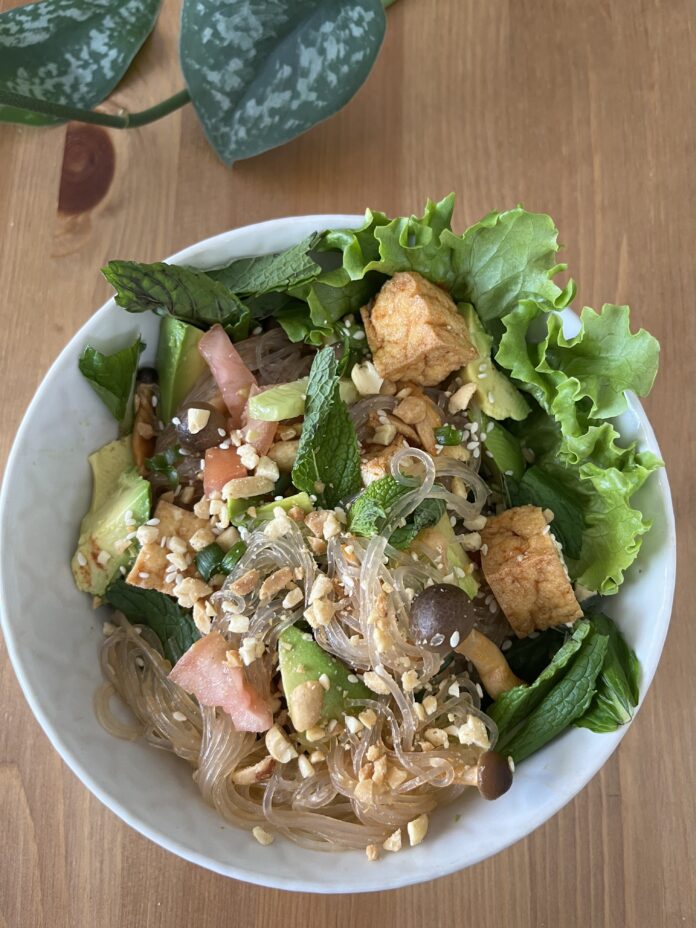
A photo of a bowl of noodle salad on a wooden table. The bowl has lettuce, tofu, mushrooms, and more vegetables.
PHOTO: Petra Chase / The Peak

By: Petra Chase, Arts & Culture Editor

This cold noodle salad exists in the middle of a venn diagram of everything you might look for in the perfect recipe. There’s NO COOKING involved (except for boiling the noodles), it’s easy to prep in bulk (add freshly-cut vegetables to serve), and it follows an easy formula that you can customize to your liking or whatever produce you have available! When I first made this, I was craving the cold noodles and sesame flavours of the Korean dish, japchae, but didn’t want to eat out, so I improvised with the ingredients I had on-hand. I’ve tweaked it a tinge over time, and now it’s one of my go-to’s!

The sponge-like ingredients, like tofu and mushrooms, steep in the tangy, umami flavour to make each bite mouth-watering. The texture of sticky sesame-seed coated rice noodles paired with hydrating cucumber and a kick of mint brings a refreshing touch perfect for hot summer days. This is such an easy way to get a variety of veggies in your system. Plus, it’s got plant-based protein and iron sources!

Ingredients (Makes 2–3 servings)

Base

Sauce

  • Sriracha (3–5 tbsps, depending on desired spice level)
  • Soy sauce (3 tbsp)
  • Sesame oil (1–2 tbsp)
  • Rice vinegar or lemon juice (1 tbsp)

Toppings

  • Sesame seeds
  • Mint leaves
  • Spring onion (also known as scallion)

Additional suggested components

  • Avocado
  • Tomato
  • Lettuce
  • Other vegetables as desired

Recipe

  1. Combine and mix ingredients in a large bowl. Add a few tablespoons of water, enough to coat the base ingredients.
  2. Cut your tofu puffs into quarters and separate mushrooms into individual pieces by cutting them from the base. Then, add to the sauce bowl. Make sure everything is coated in the sauce and let them soak while you continue the recipe.
  3. Boil the vermicelli noodles according to the package instructions. You may want to stir occasionally to avoid them sticking to the bottom of the pan. Once soft, strain and immediately run cold water over them to avoid clumping or sticking. Add them to the rest of the base ingredients with sauce once they’re no longer hot.
  4. Crush peanuts into small pieces using a mortar and pestle, or you can crush them under a can. Julienne the cucumber by cutting it into thin, long slices (almost like cucumber noodles — of course, this just makes for a cohesive texture but you can cut your cucumber any way you like). Add to and mix the peanuts and cucumber to the base ingredients, making sure to coat everything.
  5. Optional — add additional suggested components according to your preference. You may find you need to add more sauce to coat more ingredients. If you’re prepping this to eat for a  later time, you should add freshly-cut vegetables closer to the serving time.
  6. Serve with chopped mint leaves and spring onion, and sprinkle (or drench if you’re like me) with sesame seeds.