Home Blog Page 186

TSSU members form picket line in labour action

0

Six people forming a picket line with two people in the front holding an orange bucket as a drum. The location is at AQ Shrum Science building.
PHOTO: Amirul Anirban / The Peak

By: Olivia Sherman, News Writer

As of June 12, the Teaching Support Staff Union (TSSU) has gone on strike, with an overwhelming 94% vote to take this action. Leading up to the strike, teaching assistants (TAs) began their labour action by refusing overtime pay for assignments taking over 17 hours a week, or the assignment of tasks taking over eight hours a day to complete. TAs also enacted classroom strikes, in which students are informed and updated on the strike priorities. The labour action culminated in picket lines formed outside various SFU buildings on June 16.

In an interview with The Peak, two members of the TSSU, Kayla Hilstob, the TSSU chair and member of the contract committee and Liam Kennedy-Slaney, a TA and steward in the department of Geography, explained the reasons behind the strike and the responses from SFU.

Hilstob, a PhD candidate in the School of Communication, elaborated on the priorities the TSSU is working for. “One key thing for benefits is that we want to increase mental health coverage for up to $2,500 a year, because, as you know, we are in a mental health crisis, and it’s incredibly expensive and hard to access mental healthcare. The employer has always said, ‘we support mental health and well-being of students and our workers,’ and we can say that’s really not true, because they don’t want to give us anything into the mental health coverage.” 

Hilstob also pointed to the increasing class sizes as a cause of mental health distress for TAs. “We want to improve compensation to address overwork caused by new modes of teaching and increasing class sizes.We’re doing more online classes. We’re looking at growing class sizes. And there’s no cap on the amount of students that can be in a class.”

Kennedy-Slaney, a PhD student who works as a TA for geography classes, explained that despite his love of teaching and engaging with students, he had been struggling with finding time for his own research under the weight of grading and tutorial planning. “It takes a lot of time and energy to be a dedicated and helpful teaching assistant,” he explained. “It’s also the thing that I’m always thinking about [ . . . ] my mind becomes filled with tutorial planning and grading, and these things. 

“And then, you know, of course, at the end of the semester, about 40 papers come in that are all really well-written, and deserve a lot of attention, but need to be turned around within 5 or 6 days [ . . . ]  what we’re really looking for is fair compensation for that kind of work, because, as I said, myself and most other graduate students make very little progress on our own.” 

“It’s our right to have a picket line. You know, we take it very seriously, and we’re going to keep fighting.”

Kayla Hilstob, TSSU Chair.

There are many concerns related to healthcare coverage, Hilstob said. “They want to eliminate enrollment for international student health fee coverage, and they want to replace it with this individual reimbursement process which makes coverage harder and less robust. [ . . . ] So basically they want to add all these little cuts and hurdles to health coverage that should be easy to access.

“The university has retaliated against our strike by threatening to cut off our extended health and dental benefits, and cut off the international student health fee that we’ve earned through bargaining in the past and through strikes [ . . . ] we see this threatening international student health free coverage as particularly egregious, as it’s an attack on international students rights.” 

Hilstob elaborated. “This is all an attack on our disabled members, folks who need extended health care. Why is SFU attacking our most vulnerable members?

“SFU has not cut off our extended health benefits yet, but they have said they will,” Hilstob said. SFU has communicated to  TSS that unless they pay a “$40,000 bill a month,” their extended health and dental benefits will be terminated. “Which is completely egregious, right? Because it’s our earned right. It’s in our collective agreement.”

The Peak reached out to SFU for a statement and was directed to visit its website on strike updates. According to its statement, the school highlights it has not cut health benefits for TSSU members, and that the responsibility of paying for health benefits goes to the union when strike action is taken. 

According to another statement from SFU on June 16, the school has “received reports from members of the university community concerned about certain behaviours at picket lines” from union members. For those affected by “harassment or intimidation,” SFU encourages reaching out to resources and mental health services. Hilstob completely denies these allegations, and said that this is “complete hypocrisy.”

“We’re fighting for better healthcare and mental health care for our members, and they’re threatening to get away. “It’s our right to have a picket line. You know, we take it very seriously, and we’re going to keep fighting, [ . . . ] It’s our right to make noise. It’s our right to ask people not to cross a picket line, and they’re [ . . . ] trying to smear our actions that are completely our right, and there will be some disruptions on campus. That’s what the picket line is, and it’s up to you to accommodate students.”

Kennedy-Slaney explained that many faculty members have shown support for the protestors. “[They] expressed their moral support of the strikes, and they have put their bodies on the line and joined us on the picket lines on Thursday” and “proudly waved the Simon Fraser University Faculty Association flag.” 

Kennedy-Slaney encourages students and non-TSSU members to not cross the picket line and support the TSSU in its labour action. “I think one of the snappy, nice ways to think about those buildings when a picket line is surrounding is that they are lava. So you know, picketed buildings are lava. Don’t go in, don’t set foot on it. Avoid it.”

This is a rapidly changing situation, and The Peak will update its information as bargaining continues.

Editor’s Note: This article has been corrected to reflect that Liam Kennedy-Slatey is not on the contract committee. It has also removed the School of Communications involvement in the strike as they did not consent to appear in this article.

Finding my way back to art

0
A painting in shades of blue. Resembles waves of an ocean

By: Saije Rusimovici

Art has always been a huge part of my life, even though I never considered myself an artsy person. I always thought that a “good” artist had to have exceptional drawing or painting skills. This mentality has stuck with me since elementary school, when I received mediocre grades on all my projects. I enjoyed using my imagination in art class, but would always be disappointed at the low grades my teachers gave me, despite my creative efforts. In those formative years, when a subjective thing like art is judged based on a teacher’s rubric, it feels like an objective judgement of your artistic capabilities. For this reason, I shied away from activities like painting, even though I enjoyed them, for fear of not being good enough.

It wasn’t until my adult years that I realized appreciating art was not limited to being good at traditional mediums, nor could it be assessed by a generic academic scale. As a kid, I had fallen in love with songwriting — appreciating and dissecting the lyrics of my favourite songs. I even started to write songs on my own, finding peace in the storytelling process through music. Looking back on my childhood, I realize that there is no “right” way to make or appreciate art, nor does everything you make have to be perfect.

Despite this, it still took a while for me to be comfortable creating. As I mentioned, I was never particularly good at painting or drawing, and despite my efforts to learn how to write music to accompany my lyrics, I wasn’t very good at playing the guitar either. Frustrated, I figured I couldn’t call myself an artist because I didn’t have the talent or patience to learn what all my artistic friends were able to do. Even in everyday life, my best friend’s bullet journal was set up nicer than mine. So, instead of focusing on being perfect, I decided to go back to the beginning, to my true desire: to create.

Taking up scrapbooking was something I always wanted to do, but never thought I would be good at. By “good,” I mean making sure my photos were meticulously chosen, lined up properly, and the pages were decorated with perfect connection to the theme reflected in the pictures. The thought of bringing out my ruler to measure cardstock made me want to pull my hair out. I decided to push all these thoughts aside (including those that tried to compare what I created with someone else’s project) and do whatever I wanted with the blank pages of my brand new scrapbook.

I used scraps of craft paper, left from other attempted endeavours in art, and created my very first page. I decided to document each month as a page or two in my scrapbook, dressing my canvas with photos, stickers, and tangible mementos (things like restaurant business cards) from the month. I didn’t buy any of the fancy pens my friends purchased from Michael’s. Instead, I raided my mom’s sticker collection that she’s had since I was a little kid. I used cutouts from old magazines and newspapers lying around my house. Trying to find things to decorate the pages was a lot more fun than I originally expected, and I relished in the feeling of finding random materials that ended up working well with the photos I chose.

I barely measured, planned, or focused on perfecting anything on any of the pages — instead I let my intuition guide me, decorating the pages with anything I had in front of me and choosing images that evoked feelings . . . Through scrapbooking, I fell in love with creating again.

About three months into scrapbooking, I decided to invest in a few more quality materials that would help me create what I envisioned: things like a glue gun and lettering stamps. I finally felt as though I found a hobby that resonated with me and allowed me to hone my artistic personality, even if it meant I had to use all the ink from the family printer every now and then. This all started with taking that first step away from the concept of perfection — the idea that in order for something to be good or worth your time, it has to be flawless.

There is no right way to make or appreciate art. Had I focused on what other people thought, or kept comparing my work to others as if I were competing for an invisible prize, I would have strayed away from the reason I wanted to make art. I started my scrapbook to reflect on my life, relationships, and adventures, giving my memories and experiences a permanent life on a page.

I’m still learning and navigating through my artistic journey outside the confines of academic judgement and perfectionism. I’ve taken on new projects and learned a lot from creators on social media. I don’t compare myself to them. Instead, I see them as a source of inspiration and encouragement, and delight in their wisdom and experience to expand my artistic horizons. Today, my perspective of art and what I consider as being an artist has changed. I’m no longer fueled by striving for perfection — by seeking validation from my friends, or even worse, my teachers. Scrapbooking has become a way for me to transfer the abstract aspects of my life into tangible works of art. Even though I’m still learning to embrace imperfection and stray away from self imposed judgement, I’ve learnt that art, in all forms, is about letting our creativity run, reflecting on our experiences, and making us feel something.

Children’s shows allowed my inner child to roam free

0
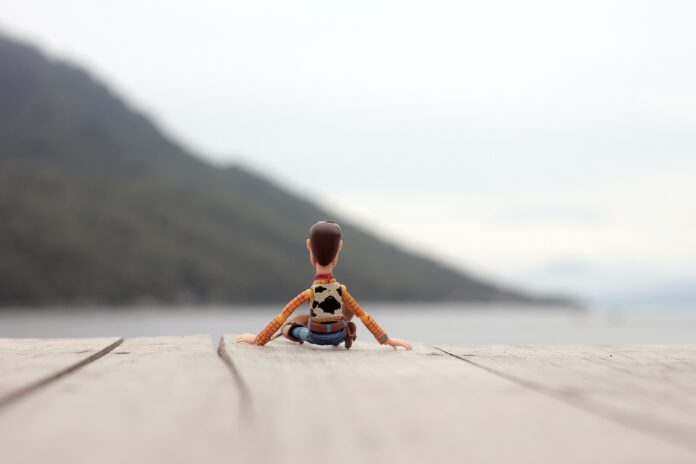
A toy figurine of the charachter Woody from the Pixar movie Toy Story sitting, in the horizon a mountain and the sky can be seen

By: Isabella Urbani

Growing up with two teenage brothers, I basically skipped over watching children’s shows. Sure, I can sort of remember watching Yo Gabba Gabba!, Lazy Town, and Hi-5, but what I remember most is watching what my brothers liked at the time: Family Guy, The Simpsons, and King of the Hill

When my youngest brother was born, I was 10-years-old and thereby inherited babysitting duties — which basically meant I got to spend my weekends planted in front of the television watching children’s shows. As a result, I got acquainted with a lot of television shows I wouldn’t have otherwise watched: Mike the Knight, Team Umizoomi, and my favourite of them all, Bubble Guppies. I even went to see the Bubble Guppies live. What a dream. 

While my brother was only interested in the music and boisterous characters, I was fully immersed in the storylines, problem-solving, and companionship. But by the time my brother was growing out of these shows, I was just starting to get into them.

So, recently, I got to work tracking down all the shows I would have watched on the Treehouse network in the early 2000s. If I felt endorphins watching these shows again, I reached nirvana when I discovered the shows I had completely erased from my brain: Rolie Polie Olie, Harry and His Bucket Full of Dinosaurs, 4 Square, and Roll Play

My fun watching these shows came and passed in a week, but one show in particular held its grasp on me: The Berenstain Bears.

I didn’t watch The Berenstain Bears growing up very often. It wasn’t a fixture on the children’s network we had growing up. But every now and then, when it was on, I watched it. Watching bears acting like humans was entertaining enough as a child, but unlike most blasts from the past, the show was just as good, maybe even better, watching it the second time around at 19.

Ignoring the fact that they’re bears, the show’s plot was practical. In every episode, either Mama Bear, Papa Bear, Sister Bear, or Brother Bear wound up in some sort of trouble. Any children’s show I had watched up to that point only focused on the trouble the children got themselves in, with limited screen time for the parents.

The problems the characters faced were grounded in reality.  Friendship troubles, budgeting, healthy eating, and overwhelming workloads were all discussed at one point or another. Much like the problems, the solutions were as accurate as a children’s show can be. Conflict wasn’t always solved with a simple fix or a snap of a finger. Instead, they faced the implications of their decisions and learned their lessons the hard way.

The family also had their ups and downs. Brother and Sister Bear were extremely competitive with one another and always butted heads. Mama and Papa Bear often fought about expenses and buying their children the gifts they asked for. They were two financially conscious and thrifty bears. Mama and Papa Bear were authoritative.

Not to be confused with authoritarian parenting, authoritative parenting is the style of parenting equivalent to being a liberal in Canada: it’s the middle ground. Parents that are authoritative set clear boundaries and expectations, but work hand in hand with their children to solve problems by talking it out.

I was envious of the Berenstain family dynamic. I love my parents, but they operated on the “tough love,” “I’m your parent, so what I say goes” type of program. You can see why I fixated so dearly on the Bears who were the complete opposite of that.

Family turmoil was resolved by the end of the episode. Brother and Sister, although completely out of hand on numerous occasions, had the opportunity to learn from their mistakes.

In the “Blame Game,” Brother and Sister go on a tirade accidentally destroying objects around the house and blaming one another. Instead of boiling over, both Mama and Papa teach their children to own up for their wrongdoings, stop blaming one another, and lend a hand without asking for anything in return. “Instead of shouting and pointing fingers,” Momma said, “we should get to work and solve the problem.”

The Berenstain Bears didn’t teach me what a perfect family dynamic is, but what a functional dynamic looks like. Understanding that brought to light the dysfunctionalities in my own family, and it also proved to me that it’s possible for parenting to be reciprocal. This was comforting for me as a child, and even more so now, as I look forward to building my own family.

I have something to aspire to for my children. I want my children to grow up in a similar environment that the Berenstain kids grew up in — one that is forgiving, that doesn’t resort to fear tactics to prove a point, and isn’t fixed. I want to grow with my children. I want to admit to my shortcomings, and change for the better, rather than being defensive about the way my children say I make them  feel — even if that hurts my feelings. I want my children to feel comfortable coming to me and admitting what they did wrong, understanding  there will be consequences, but I’m not going to hold this incident over their heads.

My parents didn’t become softer until I was an adult. The version of them my younger brothers experienced was not who I had growing up. Through their mistakes with me, they learned how to be better for my brothers. And without The Berenstain Bears, I might not have known that a “healthy” dynamic between parents and children isn’t supposed to be spiteful.

Ultimately, it’s not the family squallers that are problematic, it’s how these disagreements are resolved. Problems shouldn’t be pushed under the rug to fester hate into resentment. They need to be nipped in the bud, which means admitting you’re wrong and moving on. I didn’t learn that growing up; I learned that from a children’s show.

Pink convocation, unnecessary vent sesh, and opposite day?

0
Portrait of a woman posing in a large Barbie box. She is surrounded by pink items, including a rotary phone and ice skates.
PHOTO: Юлиана Маринина / Pexels

By: Hana Hoffman, Peak Associate and C Icart, Humour Editor

Dear Peakie, 

I wore pink to my convocation as an homage to Barbie, Elle Woods, and Mean Girls (yes, it was on a Wednesday), and no one understood! How can I recover after discovering that I am surrounded by uncultured folks? This Barbie is really weighed down by all of this. How did they not notice how fetch” my hot pink heels were? “What? Like it’s hard?

Sincerely, 
Vision in Pink 

Dear Vision in Pink,

I want to start by saying I truly admire your respect towards pink legends. Pinkalicious and P!nk are my idols! Honestly, I think everyone at the convocation was intimidated by your swag, so they kept quiet. Plus, you just GRADUATED! In other words, you said goodbye to every person in the institution, so why feel embarrassed in front of a bunch of people you’ll never see again?

#2Cool4School,
Peakie

Dear Peakie, 

I actually don’t need advice. I just wanted to give you some: mind. your own. business. Why do you feel like you can tell us all what to do? You won’t even reveal your real name. Is it because deep down, you know that “you know nothing, Jon Snow?” Your relevancy in this paper has peaked, Peakie.

Sincerely, 
Maybe We Should Give YOU Guidance

Dear Maybe We Should Give YOU Guidance,

Unfortunately, I know who you are, and I don’t think sending hate in disguise is very professional: #hater. You weren’t offered the position as Peakie because we currently are not hiring (duh). I understand your frustration, but we do have other available jobs at SFU. Please let me know if you’re interested, and I’ll forward your resume to other hiring employers so they can LOL as well.

Consider applying for local newspaper delivery,
Peakie

Dear Peakie, 

I might have to break my lease because I can no longer live with my roommate. Last night, we were doing a puzzle together, and I found out they don’t do the border first. What next? Are they going to start eating their pizza crust-to-tip instead of tip-to-crust? I can’t live with someone like that. Is there anything in the Residential Tenancy Act that covers this?

Head-scratchingly, 
Absolutely Puzzled

Dear Absolutely Puzzled,

I’m sorry you have to go through this nightmare! I don’t know how your roommate survives school; I bet they write in their notebook from the bottom right to the top left of each page, starting from the middle of the book. From what I know about the Residential Tenancy Act, section 124.2 states that you may be considered for a post-emotional damage fund if your roommate regularly performs opposite actions, such as starting a puzzle from the middle and eating pizza from the crust first. I advise you to reach out and move out ASAP before your roommate starts pouring milk into your bowl before the cereal!

With urgency,
Peakie

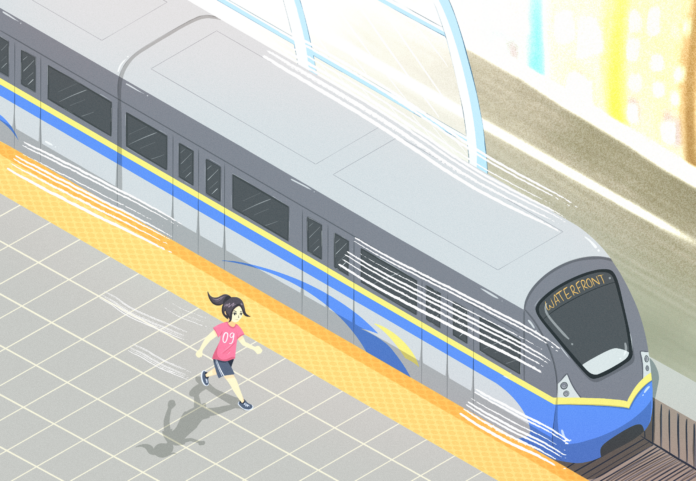
Local guy sprints to catch the SkyTrain, knowing damn well the next one arrives in two minutes

0
Runner racing the SkyTrain
ILLUSTRATION: Alyssa Umbal / The Peak

By: Hailey Miller, SFU Student

We’ve all seen him — that one guy who causes a scene at the SkyTrain station. The guy who appears out of nowhere and leaps up the escalator two steps at a time. Like a lightning bolt, he sprints through hoards of people in a failed attempt to catch the moving vessel as its doors are already on their way to being slammed shut. 

Let’s talk specifics here. This always happens at Commercial-Broadway — always. I’ve seen it, you’ve seen it, and there’s no doubt the security cameras have captured it live. At this point, the SkyTrain personnel are a little too accustomed to this regular occurrence. They shrug it off and continue about their day as if they didn’t just see a flurry of chaotic speed whirl by in a frenzy of time-crunched panic. 

If we’re being honest, chances are you’ve probably pulled a lightning bolt SkyTrain manoeuvre once or twice yourself — come on, don’t be shy. It’s bound to happen at some point, isn’t it? Let me set the scene for you: it’s rush hour — wait, every hour is rush hour around here — and you’re in more than a bit of a hurry. You’re trying to be subtle about it, but subtlety has no place in any transit station around this town. Maybe you should’ve left your house two minutes earlier. Let me guess, you thought you gave yourself enough time to catch the bus, right? Maybe you did, maybe you didn’t. Maybe the bus was late, or the connection took too long. Have to transfer at another stop? Forget it. Switch modes of transportation on the way? Good luck! Maybe your alarm clock didn’t go off, or you forgot your cup of coffee — the magical bean elixir of energy. Dare I mention the horrors of potentially forgetting your Compass Card? We all know the story. Regardless of the matter, you will never be as careless as the regular Mr. SkyTrain Lightning Bolt Manoeuvrer. 

We all know this guy. Clearly, he likes to attract attention to himself. Whizzing by faster than a thunderbolt, he sizzles on the SkyTrain platform. You’re watching the chaos unfold as Mr. SkyTrain Amateur screeches past the yellow caution line, attempting to pry the doors open with all his might. Wait, who am I kidding? He’s no amateur. He’s a well-seasoned transit user, specializing in the daily disruption of us sophisticated SkyTrain connoisseurs — contrasting his chaotic disarray with everyone else’s orderly fashion.

By now, the door frame’s seals barely allow the guy’s hands to scrape past, out of danger. Even then, he doesn’t make it through the moving doorway in time. His frazzled looks complement the dismay plastered on his face. How dare he miss one train and have to wait a whole 120 seconds for the next? What a waste of time! With dissatisfaction, poor ol’ SkyTrain Hurrier Guy is accompanied by the electric woosh on the tracks that follows shortly after the train’s swift departure from the station. So, the man waits impatiently. Time ticks by like a broken hourglass. He paces back and forth, scuffling his feet and mumbling under his breath until he hears the hissing sound of the tracks coming to life. All is lost, yet all is found, just for Mr. SkyTrain Manoeuvrer to catch the next train in-bound.

Opinions in Dialogue: The intersections of education

0
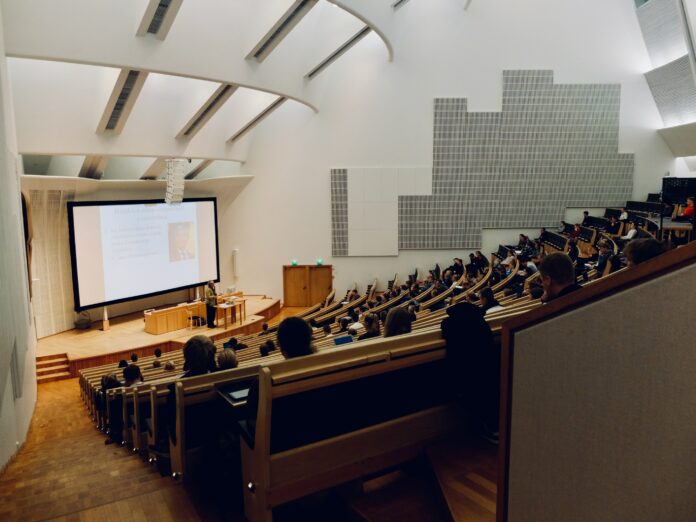
A lecture hall
PHOTO: Dom Fou / Unsplash

By: Cameron Palmer, SFU Student and Charlie Ruiz, SFU Student 

Meritocracy is the age-old myth that everyone has a fair chance at success in life, and those who try the hardest will achieve their dreams. In reality, our society is built in favour of those who happen to be born with privileges. Not everyone has the same opportunities to get the most out of their university education, but sometimes it feels like professors don’t recognize that.

Cameron: As a renter in Vancouver financially supporting myself and my education independently, life always feels like it’s moving too quickly to keep up with. I’ve tried juggling three courses on top of working full time, maintaining a social life, staying active, eating healthy, and taking care of my mental health — it was far beyond my capacity. I’m in my fourth year, slowly making progress towards my bachelor’s degree one or two courses at a time. While this pace keeps me at bay, it’s hard not to compare myself to peers who seem to coast through assignments, thoroughly understanding the material on top of a full course load. I can’t help but feel jealous seeing younger people graduate before me.

But, I have to remind myself that it’s often not a fair comparison — many students don’t have to constantly worry about making money to support themselves, and can devote more time and energy to studying and managing deadlines. Socioeconomic privilege not only “shapes the path to college” but also plays a major role in students’ experiences and success once they’re there. Being able to devote more time to my courses is a luxury I wish I could have. Instead, I’m constantly rushing to complete assignments after long shifts, never catching a break to enjoy what I’m learning about. I wish professors would understand some students might not be struggling due to carelessness or lack of intellect, but simply because they had to prioritize working an extra shift over finishing an essay because food and shelter are basic necessities.

Charlie: I relate to the “not being able to enjoy what you’re learning” thing. The courses I take have so many interesting concepts and ideas, but I’m never able to learn all of them due to time and energy constraints. Being disabled, I work at a much slower pace than my peers, and so I sometimes have to prioritize certain assignments and readings, while skipping others. SFU has not been entirely understanding of that. Professors release assignment and course details too close to deadlines and often will not give you earlier access or extensions out of “fairness.” Sometimes courses expect you to dedicate your entire life to school, but for so many people that’s not feasible. There are many factors that make up student life besides school: work and finances, family and social relationships, and health. Without stability in all these aspects — it becomes increasingly difficult to focus on doing the best you can in school. University success isn’t only made up of hard work, but often many other factors align to shape the experience. 

Because of this, it’s very frustrating when professors are inflexible about things like attendance. Some students need to make sure they’re able to pay rent, get food in their bodies, and even have to stay home to take care of themselves. School isn’t everything and professors shouldn’t expect it to be.

I’m grateful to have control over my own finances without having to worry about rent by living with family, but it’s another stressor to have conflictive parents, and “moving out” isn’t a simple solution. In addition to cost, I worry about living alone because my physical limitations make it so that I would have a hard time taking care of myself, all by myself. 

Cameron: I empathize with wanting independence from difficult family members. Living separately has granted me a sense of freedom; being able to set boundaries with family is so much easier when you don’t live under the same roof. I’ve also heard of families using money as a way of controlling their children. 

Even though I appreciate my independence, I still spend considerable time helping my family with things like accessing resources and applying for government assistance. While resources are available in BC for lower-income people, they aren’t always accessible and usually the waitlists are long, which can cause considerable stress in times of crisis. Supporting my family is also going to come before class assignments, in ways those with higher income may not have to worry about.

I can’t blame anyone for depending on their parents, especially with Vancouver’s high cost of living. For me, living on my own was never a choice and I had to put myself through university for a chance to get a good paying job one day to bring stability to my family.

Charlie: Helping family feels like a form of labour that never gets spoken about! Translating and connecting them to resources is something that can be so time consuming, and, depending on your relationship with your family, difficult to set boundaries on. Students who have shelter, financial stability, and a good home life are definitely free of some of the stressors other students face, and I wish professors would recognize that not all circumstances are equal. 

Cameron: Building on this, many professors direct students to external resources for support without actually acknowledging the extra time and effort it takes to use these resources. Most communication classes grade based on writing, grammar, speaking, and comprehension of course content. This gives fluent English speakers a considerable advantage. Non-fluent speakers are casually told to get help from the Student Learning Commons outside of class. As a fluent speaker, I still struggle to comprehend academic readings and put them into words — I can’t imagine how difficult and time-consuming that must be with a language barrier. While it’s great resources are available outside of class for students with barriers, including learning disabilities and mental health issues, professors need to factor in those barriers when it comes to grading.

Charlie: In addition to professors being understanding about various circumstances, universities should be more flexible with their support. Scholarships and bursaries require full-time status and a minimum GPA. This is very exclusive to those who cannot meet the criteria. While SFU allows students with disabilities to apply for these with less of a credit count, the student must be registered with CAL — which is a lengthy and laborious process. Further, SFU notes bursaries “should not be treated as your primary source of funding” and “you may not be awarded a bursary every term.” For students in need of funding, this can be very difficult. It is also unclear how SFU defines “financial need,” and simply applying is another lengthy process.  

Cameron: Anthony Jack, author of The Privileged Poor put it perfectly: universities “bend over backwards to admit disadvantaged students, but then, once the students are there, they maintain policies that not only remind those students of their disadvantage, but even serve to highlight it.”

The Bright-er Side: A transit ride

0
Skytrain at King George station
PHOTO: Lauren Han / Unsplash

By: Alex Ileto, SFU Student

Every day I have to take transit is a day I dread. Something always tends to irk me, whether that be an angry bus driver who runs over the curb every once in a while, or a baby who is having an absolutely miserable day. However, I started to enjoy my transit journey when I paid more attention to what was going on around me. 

I’ve noticed people admiring the sunset when the time hits. I’ve noticed a little girl — no older than five — entertaining an elderly woman by enthusiastically talking about her first camping trip with their dad. I’ve noticed people coming together collectively to yell, “BACK DOOR” when the exit just won’t open. Little interactions like these remind me that although transit rides can be dreadful, there are always wholesome moments to cherish. 

Every time you board a bus, SkyTrain, or SeaBus, you’re entering a community of people who transit, all with their own stories, personalities, and destinations. So forgo watching that new TV episode on your phone. Embrace your next transit ride and pick up on the positives.

Events and services at SFU Burnaby’s PolyCan Health Centre

0
The exterior of the PolyCan clinic at SFU Burnaby is photographed here.
PHOTO: Afsaneh Keivanshekouh / The Peak

By: Izzy Cheung, staff writer

PolyCan Health Centre is a multi-disciplinary health clinic located in SFU Burnaby’s UniverCity. On June 17, they hosted puppy therapy and a community BBQ that was open for anyone to attend. This event took place in partnership with various charities such as the Heart Tattoo Society

PolyCan opened in 2020 on Burnaby Mountain. The clinic’s services are all covered by SFU student insurance. 

To learn more about the clinic and their upcoming events, The Peak sat down with Lylan Phan, PolyCan’s director of aesthetics, and Viktoria Abanos, PolyCan’s assistant marketing and project manager. 

PolyCan offers services such as physiotherapy, acupuncture, registered massage therapy, medical aesthetics, mental health services, and shockwave therapy. Booking an appointment for any of their services can be completed either in-person or online

“It’s on campus, close by, students just need to walk in or they can book online,” Phan said. “For people who are not great at booking appointments for themselves [ . . . ] online booking [is] super easy and non-judgmental.” 

PolyCan also offers wellness services for Indigenous communities such as annual assessments, pain management, acupuncture, and personal training. Their online booking site allows Indigenous people to book appointments immediately.  

“We have a very rapid booking system for Indigenous peoples,” Abanos said. “They can pretty much immediately make an appointment to come see whatever type of specialist they’d like [ . . . ] all of their services are covered by insurance so they don’t have to pay a dime.”     

Abanos and Phan were both very excited when discussing how the idea for the community BBQ event came to fruition. 

“Dogs are cute and everyone loves dogs — myself and Lylan included, of course,” Abanos said. “We were trying to find a community event that would be kind of fun for everyone involved. 

“[We] definitely want to give back to the student community we serve, so dogs are a great way to have an inclusive event,” Phan added. 

The event also included “a variety of raffles” as well as a food drive. Proceeds from the event will go to the Heart Tattoo Society, who “[focuses] on feeding the vulnerable and homeless in the Vancouver area.”  

In line with their ideas of giving back to the student community, PolyCan is also offering free facials to anyone who comes in before July 1. 

“It’s very convenient and it’s super important for students to take care of their health, especially during stressful times,” Abanos said. “A lot of students often don’t have the time to be going and getting appointments elsewhere so this is absolutely a great opportunity for students to take care of themselves, and also look great while doing it.”  

Visit PolyCan Health Centre at 9055 University High St 102, #205, or book an appointment on their website

My mind and I are not friends

0

By: Isabella Urbani, Staff Writer

Dear friends,

It’s been one of those weeks. Writing feels harder than it should be. I’m either sleeping too little or too much. The load of laundry I said I was going to fold when I “felt” better has been rotting away in the corner of my room, and because that detail is out of place, I have an excuse to let the rest of my room go up in flames. I’m a person of extremes.

When I was in middle school, I had a horrible compulsion with placing my backpack in a particular way against the wall leading to the garage. But what made the backup perfectly placed was arbitrary — it changed every time. I would be glued to the spot, sometimes for 20 minutes, until it felt right.

I refused to dress up in high school because I convinced myself that’s what people who get good grades do. They simply can’t look the part, and be the part. Even now, part of me doesn’t see anything wrong with that.

I didn’t start taking medication until I was 18. That summer, I began to dissociate and experience depersonalization. I told my doctor it felt like I was living in The Sims, and I was a character being controlled by someone else.

I had no concept of time. I would think something happened two weeks ago when it actually happened that same day. I would move something, not realizing I did so, and then freak out when I found it in a different place mere seconds later. I didn’t think life was real. I didn’t believe my brother was my brother.

Before that, I used to be known for being dependable, doing it all, and doing it well. Now, it feels like my body is allergic to routine.

I don’t like the feeling that comes with accomplishing tasks because my brain forbids me from taking in the moment, and instead, focuses on the next big task.

I can’t watch the news anymore because it scares me, and I don’t like that I live on a big ball in the middle of space. I constantly remind myself: “Humans have been living on Earth for centuries taking up time, space, and creating waste.” Even though the notion that life will probably continue long after I’m gone calms me down enough to quell my panic, I soon remember that AI is taking over the planet, there are wars across the globe, and the amount of information on the Internet makes me deeply uncomfortable.

If I begin a task, I can’t stop until it’s finished. But didn’t I just interrupt myself and start an entirely new conversation? Yes. That’s what my mind is like — a wasteland of half-acknowledged thoughts. And being the heart-on-my-sleeve type, you can see it in my face when my thoughts are running a mile per second. I can’t remember the last time I had a conversation with someone where I didn’t have to stop and ask them what I was saying, or had to apologize because I started staring off into my surroundings.

I’m obsessed with appearing to be the picture of intelligence. I ramble, and as Michael Scott says, hope I find the sentence along the way. One summer, my entire Notes app and tabs were full of words I wanted to include in my vocabulary. Every time I had a typing error, I thought I had somehow forgotten how to spell.

I make the most mundane tasks, like putting cans in the garbage, a challenge for me to excel at. Sometimes the energy I force myself to put into these tasks makes me avoid them altogether. But once I actually do them, the only thing I can think of is why I didn’t do them sooner — just like I did when I put off writing this piece.

I once told my parents I can’t describe what I do because I don’t agree with my actions either. I told my doctor it’s like my brain and mind are disconnected. My brain doesn’t act on my behalf. I don’t know who that is. It tells me what to do, and sometimes I do it, like getting off the bus at a random stop.

Maybe if I didn’t overthink, I wouldn’t fear things I never did before. I would be able to turn on the shower for more than a few minutes because no, my brain is wrong, I’m not going to cause the world to run out of water.

 Why do you need to know this information? 

When my depression started getting really bad, nothing gave me more comfort than knowing that other people are suffering as well, despite how twisted that sounds. It still surprises me when people tell me that they take medication as well. Because, well, I thought that was just a me thing. I wished I could see the world as other people did. I wish I could be so unaffected by things I couldn’t control as my brother does, and those a whole group of people who know how that feels. To feel seen. Because that exact thing is what gets me through the day. Baby steps.

I’ve thought about scrapping this article many times. I used to restart projects, no matter how far into them I was, if there was a crease or a smudge that irked me.

When people ask me how I’m doing, I genuinely don’t know. I don’t know myself very well, because I feel like a visitor in my own body. I miss being young. I have an infatuation with pictures of myself growing up because I can’t remember what it felt like. I grew up fast.

I keep birthday cards my parents wrote for me as a little girl on my table. I have a tattoo on my bicep that reads, “If I’m not for me, she’ll be,” to acknowledge that no matter how much I feel like nothing, I’m still that little girl.

I have a rock on my side table that reads “one day or day one” to motivate myself to stop putting off tasks and just start the journey. I’m petrified of my age. I never liked my birthdays. I feel like time is running out for me while subsequently thinking I have too much time left.

I love music and car rides. I hate airplanes, although I’m not afraid of heights. I never used to cry as a kid because I was the only girl in a family of five brothers, but now, I cry far too often for my liking. I don’t like silence. I listen to music while I read, write, and even go to sleep. I’m terrified of having children, especially a little girl. I don’t like driving because I’m too focused on what other drivers are doing. I can’t cross the street even if it’s clear until I look both ways enough times. And it feels damn good to write that all out.

I notice the trees. I’m grateful for waking up to a new start. I rejoice that the things that brought me stress a year ago, I no longer fixate about. I do everything in my conscious power to bring myself happiness because that’s when I feel the best, and I’m sick and tired of feeling sick and tired. If depression is going to make my life feel like hell, then I’m dragging it all the way with me. I may lose the battle, but I will refuse to lose the fight.

FNMISA hosts first inter-tribal powwow at SFU

0
Photograph of two of the dancers in formal regalia at the powwow event on April 8, 2022.
PHOTO: Courtesy of FNMISA

By: Isabella Urbani, Staff Writer

On April 22, SFU’s First Nations, Métis, & Inuit Students Association (FNMISA) hosted their first inter-tribal powwow in SFU Burnaby’s West Gym, which resides on the unceded Traditional Coast Salish Lands of the Tsleil-Waututh (səl̓ilw̓ətaʔɬ), Kwikwetlem (kʷikʷəƛ̓əm), Squamish (Sḵwx̱wú7mesh Úxwumixw) and Musqueam (xʷməθkʷəy̓əm) Nations.

As an association, FNMISA represents all Indigenous students. Sisters Kali and Raven King Stierle, who are Cree and Métis from Treaty 4 territory in south Saskatchewan, make up two of the 11 executive board members who organized the event. 

Kali has been FNMISA’s treasurer for three years and is the current longest-reigning board member. She told The Peak “creating a space for Indigenous students on campus,” in the form of a powwow, has been a priority of FNMISA for as long as she’s been a member. Raven has been FNMISA’s special events coordinator since Fall 2022. 

Raven explained that powwows originate from the plains, where her family is from. These differ from potlatches, which are a “West Coast tradition.” Kali added that potlatches are integral to local economies, and are conducted in longhouses or other spaces as “forms of governance” to redistribute wealth, as each person both gives and receives a gift. While powwows are also conducted on the West Coast, Raven explained they’re unique from powwows in the plains. 

“[We had to] respect and acknowledge that we’re not on our own territory — we’re on Coast Salish territory, and acknowledging that it’s their land we are hosting this event on,” said Raven.

Powwows can be either competitive or traditional. A traditional powwow, which was the type FNMISA held, does not judge dancers for “the way they carry their regalia, their dance style, and the way that they perform,” which is typical for a competitive powwow, said Raven. However, it’s not uncommon for dancers to be awarded first, second, and third place in traditional powwows.

While the powwow was stuck in the ideation phase for three years, it took FMISA members just four months to coordinate and organize the event, from December 2022–April 2023. The powwow was held between 10:00 a.m.–10:00 p.m. and was attended by 1,000 guests. They provided dinner for nearly 700 people and had 40 vendor tables displaying Indigenous artwork.

Kali said the process of coordinating the powwow reminded her of an Indigenous saying called “walking in two worlds,” whereby “Indigenous people walk through [colonial] spaces, carrying [their] traditional knowledge, teachings, and Indigenous identity. 

“It was very much a lot of organizing in terms of logistics: booking the space, getting the food, permits and licenses. And then it was also organizing in terms of consulting with our elders [and] community,” said Kali.

The powwow was also inter-tribal. Inter-tribal, as Kali explained, “is a gathering of all nations. So that’s Cree, Ojibwe, Saulteaux, Squamish, and then also European.” As a gathering of all nations, the powwow was open to all ages and ethnicities, including the SFU and Burnaby communities. 

“There are so many different aspects of Indigeneity that we wanted to share with everyone, because we are proud of our culture, and we want people to see that and get to know who we are as Indigenous students. So, really, our main focus was a celebration for everyone,” said Kali. 

Kali described the powwow as “an amazing day of vibrancy, celebration, dancing, drumming, singing, vendors, and food.” And while the celebration was for both Indigenous and non-Indigenous observers, the powwow, called “Honouring Indigenous Students,” made sure to feature Indigenous artisans, SFU alumni, and current students as head lady and man dancers, which Raven acknowledged as a “very honorary position.”

With the first annual powwow complete, the board is already brainstorming what can be done to make the event even better next April. 

“It’s going to be a tradition for FNMISA, and it’s going to be a big tradition for Burnaby campus,” said Raven, reiterating that “everybody’s invited.”