Home Blog Page 162

TSSU initiates full work stoppage

0
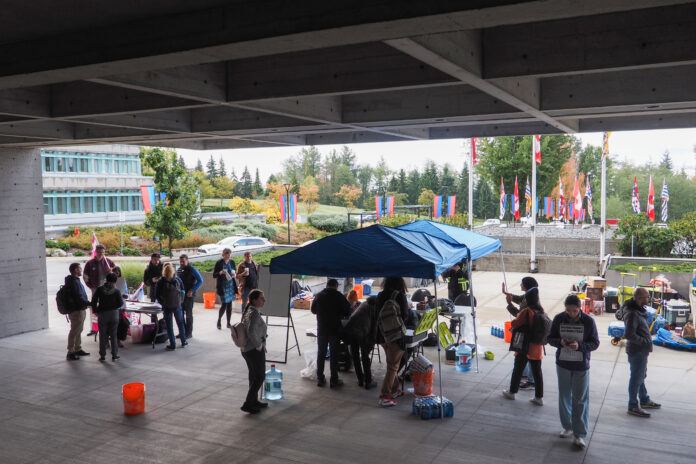
TSSU picket line at SFU Burnaby campus.
PHOTO: Olivia Sherman / The Peak

By: Olivia Sherman, News Writer

On September 28, the Teaching Support Staff Union (TSSU) engaged in a full work stoppage and began demonstrating in picket lines across all three SFU campuses. The stoppage of all work for teaching assistants (TAs) is an escalation of the current strike, which started in June. The Peak interviewed media spokesperson and bargaining committee member, Dalton Kamish, to learn more about the strike and ongoing actions. 

The TSSU has been campaigning for an adjustment in pay to keep up with the rising cost of living, end wage theft, and ensure a better future for instructors with a pension plan, Kamish said. They noted the SFU administration has been unprepared and inflexible with their terms. “The employer and their spokesperson just won’t bargain meaningfully,” they said, and it’s “not the employer’s intention” to do so. Kamish noted the SFU administration didn’t attend the arranged bargaining meeting on the evening of the work stoppage.

TAs are paid for how many courses and hours they teach. This compensation model doesn’t account for how many students are in each of the TA’s classes, therefore a TA is paid the same for a class of 10 students as a class of 100 students. This is also not reflective of office hours, assignment and test grading, or the number of emails and online communications sent, which the COVID-19 pandemic has exacerbated. Kamish said this is an example of wage theft, which is when an employer fails to accurately compensate a worker for their job. 

The university said the reason this compensation model cannot be changed is because of the mandate of the Public Sector Employers’ Council (PSEC). PSEC is meant to oversee BC’s labour relations and compensation planning. Kamish said PSEC sets a limit on the general wage increase a workforce can acquire, which isn’t what TSSU is asking for, but rather compensation for the work already completed. “It’s not a cost to the university to pay for the work that’s already being done. It’s not a general wage increase.”  

Kamish said “employers like SFU hide behind this mandate” and “use PSEC to shirk their own responsibilities to actually administer and manage the university. They act like they can’t decide to take some of this enormous surplus and spend it on the people who do the work.”

On the day of the work stoppage, all graduate and undergraduate students at SFU received an email on behalf of the administration from Yabome Gilpin-Jackson, the vice-president of people, equity, and inclusion. They also received an email from Dilson Rassier, provost and vice-president, academic. The notices made reference to the 41 bargaining meetings between November 2022 and September 2023. “In that time, the university tabled approximately 50 proposals while TSSU leadership tabled more than 500 proposals,” SFU said. “To date, there are still more than 200 TSSU proposals outstanding.” 

Kamish said TSSU is aware of the mass emails to students. “The irony of it is that, it reflects how much work we’ve put into our proposals, in contrast to how little they’ve put into theirs,” Kamish said. “I know for a fact that they’re counting changing typos as a proposal, because there’s no way that their math works.” TSSU members have expressed frustration with SFU spending much of their bargaining time in meetings discussing spelling errors, grammatical errors, and minute details. Kamish also noted many of the items TSSU proposed are recurring issues that have been brought up since 2012, “but every round they act like they’ve never seen them before. 

“Every single proposal we’ve made to improve our collective agreements, they’ve said, ‘that will reduce your wage increases.’ It’s only in the last three bargaining sessions they admitted ‘okay, maybe some things don’t need to count against your wage increases.’”

The mass email on September 28 also stated SFU’s bargaining team will continue to “look for solutions to present to TSSU to resolve collective bargaining” in order to strike a deal with the union, but said this will be accomplished “when the TSSU is prepared to return to the bargaining table.” 

Kamish said TSSU is “waiting to go back to bargaining [ . . . ] We’re out on picket lines, we’re on strike.” They added, “We don’t see a lot of sense in confirming a bargaining date when they’re going to waste our time, and we know that.” At the time of publication, TSSU had announced they would return to the bargaining tables on October 6, but no results from the meeting had been released. 

The work stoppage means TAs will stop teaching all tutorials and labs, and grading tests and assignments. Communication with TAs, such as through emails and Canvas messaging, will also cease during the strike. “While bargaining should follow logic and reason, it follows power, and our greatest power is our labour. The way that we show that is by withdrawing that labour,” Kamish said. “The normal, everyday function of this university relies on exploiting TSSU members’ work.” 

Kamish and the TSSU have hope of winning the strike. “We have a long and proud tradition of winning strikes.” 

This is an ongoing story The Peak will continue to cover. For more information on ongoing job action, visit https://www.tssu.ca/. The Peak reached out to SFU administration for a comment, but they declined to speak. 
Angela Sterritt discusses systemic violence against Indigenous women

0
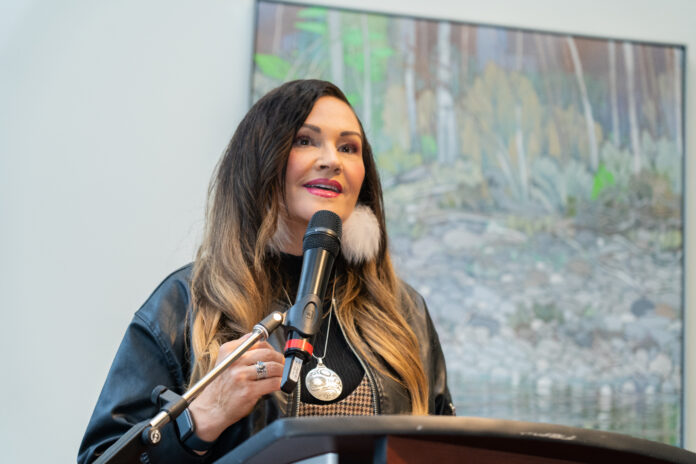
This is a photo of Angela Sterritt giving her lecture. She is standing at a podium, speaking to a large audience. The photo is close on her face. Behind her there is a painting of nature, forest, and animals.
PHOTO: Joelle Lee

By: Karissa Ketter, News Editor

Editor’s Note: This article was updated on October 13, to correct the title of the Haíłzaqv (Heiltsuk) Washing Ceremony. Also, to correct that Angela Sterritt investigated the cases of Ramona Wilson and Tina Fontaine in her book.

Content warning: mentions of missing and murdered Indigenous women and police brutality.

On September 25, Gitxsan author and investigative journalist, Angela Sterritt, spoke at SFU for the annual Andrew Mack Memorial Lecture series. Sterritt spoke on the systemic violence Indigenous communities and women face today, as highlighted in her newest book, Unbroken

“The reason why my book is called Unbroken is because when I grew up, I always heard Elders say, they took everything away from us, but we are unbroken,” explained Sterritt. “A lot of people think that colonization ripped everything away from us, which it temporarily did: our languages, our cultures, our children, our communities, our connections to our lands.” Sterritt said all the things colonization attempted to take away from Indigenous communities, they are powerfully reclaiming today. “I am proof that our cultures, our laws, and our land are still alive today.” 

Sterritt is a “bestselling author from the Wilp Wiik’aax of the Gitanmaax community within the Gitxsan Nation on her dad’s side and from Bell Island Newfoundland on her maternal side.” Her lecture, “How Indigenous women’s knowledge and power can transform our understanding of human security,” was hosted by SFU international studies. 

SFU international studies director, Dr. Megan MacKenzie, began the presentation by noting “the best way to solve global problems is to initiate solutions that draw from multiple fields of study.” MacKenzie said, “In this moment in the world’s history, the school’s ethos is perhaps more important than ever.”

Dr. Andrew Mack has been an adjunct professor for SFU international studies since 2007. According to MacKenzie, “Professor Mack’s work also helped legitimize and bring more attention to the concept of human security.” According to Mack, the concept of human security today goes beyond the original military terms of war and extends to considering “what it means to live without freedom from fear and want.”

In Sterritt’s lecture, she said, “I want to talk about what human security means for women, girls and two-spirit people in Canada.” To do this, Sterritt outlined three case studies of systemic violence that she investigated in her book. Two of these cases were those of missing and murdered Indigenous women, Ramona Wilson and Tina Fontaine. Both young Indigenous women inspired Sterritt to write her book, “and have also really illuminated the tragedy and the crisis of missing and murdered Indigenous women and girls in this country.”

Indigenous women in Canada make up only 4% of the female population. Despite this, they disproportionately make up “25% of all female homicides in Canada. Indigenous women are 12 times as likely to be murdered or go missing as any other woman in Canada and 16 times as likely to be murdered as white women,” said Sterritt.

The lack of government action to protect Indigenous women sends a strong message to Indigenous communities, according to Sterritt: “That we don’t matter.” Canada’s colonial policies “ushered in the idea that we were not human,” said Sterritt. 

Many Indigenous women have gone missing along a 700 km stretch of highway between Prince George and Prince Rupert in BC, including Ramona Wilson. This portion of Highway 16 has been named Highway of Tears, after the women who have gone missing there. Sterritt explained there are several Indigenous communities along that highway, some as far as 70 km away from the highway. “The reserves are far away, and the colonials set this up on purpose. It’s a system of apartheid that they created to make way for white settlers to come to thrive off the land.” 

Their communities being far from the main highway and urban centres made it increasingly difficult for Indigenous peoples to engage with the local economies. Additionally, the provincial government refused to set up a public transportation system along this highway until 2019. “Women have been forced to hitchhike on these lands.” 

One of the goals of Canadian colonialism was to dismantle Indigenous cultures and Indigenous sovereignty. Colonizers enforced that Indigenous communities “temporarily had the inability to enact [their] own laws [ . . . ] The colonials that came over understood deeply and intricately women here have power,” said Sterritt. She noted that Indigenous women were the “backbone of their communities.” Indigenous women were targetted in colonial society, to disenfranchise their humanity and power. 

“In order for Indigenous women and girls to have safety, we need Canadians to see Indigenous people as full dimensional beings,” said Sterritt.

Another priority for Sterritt is for Canadians to recognize Indigenous governance systems and sovereignty. The third case study she included was that of Maxwell Johnson, “a grandfather who was handcuffed while trying to open a bank account with his 12 year old granddaughter,” in Vancouver. 

After Sterritt covered the story in a CBC article, she found people “were shocked that anti-Indigenous systemic racism still happens. They were shocked that people of colour trying to open a bank account might be arrested.” In response, the BMO employee and Vancouver police officers were called on to attend a Washing Ceremony, which is part of the Haíłzaqv (Heiltsuk) justice system when wrongdoing has occurred. 

The two arresting officers from the Vancouver police department refused to attend. Sterritt noted that if the officers had attended, it would have been “such an amazing opportunity for these two officers to come and to bear witness to a different form of justice, a different court system. One that doesn’t handcuff people and put them in jail and forget about them. One that upholds people in all the things that they’ve done.”

When taking part in a Washing Ceremony, Sterritt said the person is symbolically saying, “I’m responsible, I’m accountable, and I’m honouring your system of governance and your system of law.”

Angela Sterritt concluded the lecture by sharing what white settlers on this land can do for Indigenous people. “I want to implore you to uphold Indigenous laws and governing structures, implore you to speak the truth. But I also want to implore you to dismantle the systems that our white ancestors have created.”

Angela Sterritt’s book, Unbroken, is available for purchase at Massey Books and on their website at www.storestock.massybooks.com/.

A chat with our favourite advice columnist

0
A woman standing beside a window. The blinds are slightly raised.
PHOTO: Min An / Pexels

By: Saije Rusimovici, Staff Writer and C Icart, Humour Editor

Dear Peakie, 

The other day, my friend asked me to close the blinds, revealing a very embarrassing truth about myself: I don’t know how blinds work. And can you blame me? Multiple cords are involved, and that stick thing that you twist, apparently??? Blinds are a medieval contraption I have yet to demystify. How do I hide my secret? 

Sincerely, 
Confused by Blinds

Dear Confused by Blinds,

This might signify that the time has come to pick up a tired but true skill necessary to spare you some embarrassment. You might be thinking, “Oh, Peakie, you’re so smart. Of course, you know how to close the blinds! It comes naturally to you!” And alas, reader, you are not wrong.

Nevertheless, my trials and tribulations are not important here. The next time you are home alone, you have to practice! Yank at the strings, pull at the blinds to manually open them if you must! See how they work by breaking down the mechanics one piece at a time. 

And if all else fails, it might be time to invest in some curtains. 

Warmly, 
Peakie 

Dear Peakie, 

My sister used MY fork. I spent years walking through the IKEAs, Bed Bath and Beyonds, and Costcos of the world, looking for my ideal fork. It needed to be pointy enough, provide excellent mouthfeel, and double as a comb. Needless to say, it is one of my most treasured possessions. So, why did I come home to my sister sloppily stabbing her gnocchi with it?! She’s saying I’m overreacting, but you’re on my side, right?

Sincerely,
Get the Fork Away From My Utensils

Dear Get the Fork Away From My Utensils,

Ah, this letter impacts me on a personal level. Okay, pull yourself together, Peakie. I hate to go on about my own experiences when giving advice, but this hits too close to home. Oh, what the heck. I’ll tell you my story.

When I was a child, my younger brother would use my favourite cereal spoon in EVERYTHING. A spoon meant for CEREAL does not belong in a bowl of Kraft Dinner (did I mention I loathe Kraft Dinner?). The point is, you’ve got to protect what belongs to you. When I finally moved out, I purchased a special set of monogrammed utensils. I keep them in a locked safe where my roommates will never find them. As much as it pains me to eat with regular cutlery, it needs to be done so no one will discover my secret set. 

Thinking of you,
Peakie

Dear Peakie, 

I don’t need your advice; I need your help. Yesterday, I got ghosted by not one but TWO buses. I watched patiently as the minutes to the scheduled arrival of my bus went by on Apple Maps. With one minute left, I carefully took my U-Pass out of my wallet so it would be ready for that tapping action. But the bus never came, and I had to resort to old-school transportation technology: my legs. Will you meet me at my secret lab where we can work on top-secret teleportation technology, so I’m never stranded again?

Sincerely, 
Teleporters Against TransLink 

Dear Teleporters Against TransLink,

Unfortunately, I cannot meet you. It would be a violation of both my privacy and yours. I’m sure you can understand. But let’s think about this logically. Of course, you can’t Uber around this city economically, and with rising gas prices, it’s no surprise that taking transit is your best option. Hmm. Yes, well, I never thought I would say this, but I am a little stumped. Fortunately, having my own driver, I don’t need to worry about these things . . . 

I hear those electric scooters are quite fashionable these days. It’s not quite a teleportation device, but you’ll be zooming down the mountain in no time! And, if you see the bus, you can scoot on right over to it! Gosh, I’m brilliant!

Don’t forget your helmet!

Best wishes,
Peakie

The final edition of summer SFU athletics updates

0
Photo of the volleyball team gathered in a huddle congratulating each other on the court.
PHOTO: Steve Frost /bSFU Athletics

By: Isabella Urbani, Sports Editor

Volleyball 

News 

  • Former professional volleyball player, Sarah Chase, joined the volleyball team as an assistant coach. 
  • The volleyball team was picked to finish fourth in their division this season in the pre-season coaches’ poll. SFU finished fifth in the standings last season. 
  • Juniors, Brooke Dexter and Jocelyn Sherman, were named to the Great Northwest Athletic Conference Volleyball Preseason All-Conference Team.

Awards 

  • Dexter finished tied for eighth for the Nadine Caron Top 10 Scholar-Athletes. She had a 3.97 CGPA as a biological sciences major. Dexter earned her second Faculty Athletic Representative Scholar-Athlete Award for having a CGPA of over 3.85, and was one of 18 athletes to be recognized with an Academic Achievement Award.
  • Junior, Kohl Peters, won her third Faculty Athletic Representative Scholar-Athlete Award for having a 3.86 CGPA as a criminology major. Peters is also an Academic Achievement Award winner.
  • Junior, Hanna Kolof, was named an Academic Achievement Award Winner for having a CGPA over 3.5 as a kinesiology major. 

Wrestling 

Men’s recruitments 

  • Ethan and Owen Kennedy: twins from Alberta, who will compete in the 125-pound weight category.
  • Isaiah King: wrestler from Las Vegas, Nevada, making the trek up to Burnaby to compete in the 125-pound weight category. 
  • Shahbaaz Singh: reigning 71 kg, U-19 Greco-Roman champion from Alberta, who will compete in the 157-pound weight category for SFU. 

News

  • The wrestling team started the season as part of the Rocky Mountain Athletic Conference

Awards 

  • Sophomore, Owen Gudmundson, finished tied for third for the Nadine Caron Top 10 Scholar-Athletes. Gudmundson had a 4.18 CGPA as a molecular biology and biochemistry major. As a result, Gudmundson earned his second Faculty Athletic Representative Scholar-Athlete Award, and was a recipient of the Academic Achievement Award
  • Junior, Elijah Lazar, was also named an Academic Achievement Award winner.
  • Sophomore, Paige Maher, won the 72 kg weight category silver medal at the 2023 Junior Pan American Championships. Maher represented Canada at the U-20 World Championships in Jordan in August.
  • Sophomore, Sam Pereira, won the 92 kg freestyle weight category silver medal at the 2023 Junior Pan American Championships. Pereira represented Canada at the U-20 World Championships in Jordan in August.
  • Sophomore, Ivy Threatful, placed fourth in the 53 kg weight category at the 2023 Junior Pan American Championships. 

To be long but not for too long

0
A person sitting alone on a large expanse of a sandy beach. Behind them is a shadow of two people standing together on a bridge.
PHOTO: Alev Takil / Unsplash

By: Sude Guvendik, Staff Writer

A contemplative poem that delves into the complexities of human belonging, exploring the various paths we take in our search for connection and the ultimate realization that true belonging transcends the physical realm.

In the tapestry of life, we seek our place, 
A quest for belonging in this boundless space; 
in the hearts of strangers and familiar grace, 
We navigate the puzzle, this human chase.

Some find solace in the streets they’ve known, 
Where roots run deep, and history’s sown, 
In close-knit towns or a family’s zone, 
A sense of belonging, like a heart’s true home.

Yet, others wander, like stars in the night, 
Through foreign lands, in search of light, 
In the differences and the foreign sight, 
They discover belonging, a pure delight.

But is it possession, or a fleeting thrill, 
To claim that we own, and our hearts fulfill? 
When we tether ourselves to another’s will,
Are we truly belonging, or just standing still?

The soul, a traveller, in endless quest, 
For the one connection, that feels the best, 
Yet, even when found, in love’s warm nest, 
The void may linger, an uninvited guest.

Belonging evolves, so don’t be longing for that, 
Make peace with your mind as you tip your hat, 
To the truth that we’re here, but not for long, 
Temporary beings, in a world so strong.

Why bother fitting into moulds so tight, 
When the body belongs to one mould’s light, 
The essence of belonging transcends the physical, 
It’s a connection to the divine, deeply mystical. 

In each other’s souls, we find the reflection, 
Of the sacred, the eternal, the divine perfection.

So cherish the bonds that life bestows,
In the highs and lows, and wherever it goes,
For in the tapestry of love that grows, 
True belonging is where the soul truly knows.

What’s In & What’s Out: Current fashion favourites

0
Torso of a person wearing dark gray shirt and black cargo pants with a chunky silver chain necklace and a black sling bag. They are standing outside of a blocky concrete building.
PHOTO: May Chee / The Peak

By: Tian Davidson

I’m an avid fan of fashion, and get my inspiration from TikTok and Pinterest — places where trends change rapidly and you can discover new ideas. With so many trends coming “in” and “out,” I have strong opinions about what trends my closet is going to consist of this fall. Remember, fashion is all about finding what works for you; you are the fashion icon no matter what you choose to wear. Who knows, you might just bring an old trend back to life!

IN: Black rectangular sunglasses
These chic sunglasses are showing up all over my feed right now, and for good reason: anyone can find them at the thrift store, and they elevate nearly any outfit, too. Baggy jeans, an oversized hoodie, and these statement sunglasses? You’ve got yourself a cool fit using the staples already in your closet. You can feel like a celebrity in disguise when you wear them with a face mask. 2000’s hiding-from-the-paparazzi look anyone? Even though summer is ending, you can enjoy the last sunny days rocking these bold frames.

OUT: Bucket hats
Many people have been loving bucket hats. However, I find it so hard to wear them with my big headphones. Especially attached to cute headset accessories, like little cat ears and tie-on crocheted sprouts, these bucket hats just block the view, and the music. As someone who refuses to use small earphones, bucket hats are inconvenient.

OUT: Tote bags
Before you grab your pitchforks and hunt me down for saying tote bags are a dying trend, it’s for good reason: tote bags are not a trend at all, but a staple of anyone’s closet. Calling tote bags a trend is equivalent to calling backpacks a trend: they’ve both always been around and are here to stay. Tote bags in particular are easy to accessorize with custom prints, so it’s no surprise they’ve become a closet staple. They’re also very affordable compared to other bags, and an easy way to support a local artists’ work.

OUT: Fjallraven KÅNKEN bags
Speaking of backpacks, Fjallraven KÅNKEN bags were popularized in the time of scrunchies, puka shell necklaces, and hydroflasks. While backpacks are useful for many students for their versatility, comfort, and organization, this one’s preppy style doesn’t match my current streetwear aesthetic. Besides, they aren’t very affordable. I still love the cute design though!

IN: Over-the-shoulder drawstring bags
I love that these bags are becoming more popular for their casual design and versatility. They pair well with my y2k fashion looks. You can easily pair this bag with any fit, and it’s great for any scenario, from sports, to school, to work because of how much space this bag can provide while still looking fashionable.

IN: Baggy pants. 
I cannot stress enough how versatile these pants are, whether you want to pair them with a hoodie or with a fitted shirt. In the first few weeks of the fall semester, I’ve seen so many people rocking oversized pants on campus. From cargo pants to fresh jeans, baggy pants are a great way to play with proportions. Whenever I wear baggy pants and a smaller sized shirt, not only do I look a bit taller, but I’m also so comfortable (not sweatpant-level comfort, but still great). The baggy cargo pants and hoodie combo is an easy fit if you’re looking for a budget-friendly outfit that’s perfect for the autumn season.

While it’s great to experiment with your wardrobe, please remember not to go out and impulsively buy clothing online. Try to look for environmentally-conscious sources for your new closet best friends, such as secondhand stores and online resellers. You could even borrow some from your friends or family if they fit!

Innovative Indigenous artists

0
A collage of three album covers: Potlatch in the Box, The End of it All, and Altering the timeline.
PHOTOS: Courtesy of Edzi’u, Courtesy of Iskwē Music Inc, Courtesy of Coax records

By: Saije Rusimovici, Staff Writer and Petra Chase, Arts & Culture Editor

Indigenous Peoples have been making music on this land since time immemorial. Music of diverse styles have long been a central part of social, cultural, and ceremonial life for the many Indigenous cultures living in so-called Canada. Today’s Indigenous musicians carry on these traditions and innovate by incorporating non-Indigenous influences. Here are three Indigenous artists to start listening to.

Edzi’u 
Content warning: forced assimilation of Indigenous people.

Tahltan and Tlingit experimental musician, Edzi’u, transports listeners by enmeshing ambient sounds, words of wisdom, and her own angelic voice. Their debut album, Potlatch in the Box, reflects the “wrongs of the past,” particularly the Canadian government’s potlatch ban. As part of the Indian Act, Indigenous peoples were banned from practicing this celebratory tradition for nearly 100 years. Through spoken word and dialogue samples, tracks recount the horrifying tragedies of that period. “Can you Introduce Yourself in the Language” explores the “destruction” of Indigenous languages.” Edzi’u also stresses the album’s “positive power,” seen in the themes of resilience in “Warrior Song” and “2Spirit,” in which their Auntie Dwayne talks about the role of two-spirit people in potlatches. The work is soul-stirring; Edziu’s humming with the piano is like a gentle lullaby in “You Don’t Wanna Know Me.” “What Does Nation Mean?” is a collage of a conversation with a child talking about their nation, against a gentle windy ambience. Potlatch in the Box opens with a customary welcome from Raven Clan, sprinkled with laughter and sounds of nature. Edzi’u put thought into every detail: be sure to look out for the imaginative Easter eggs from the album’s cover art within the tracks! 

Iskwē

CBC has named Iskwē (ᐃᐢᑫᐧᐤ in Cree) “one of the most powerful performers in the country,” and for good reason. The Cree-Dene-Irish singer, EDM producer, and activist has been releasing music consistently since 2017, dipping her toes in everything from electronic pop to bluesy folk. In 2019, her energized ballad,  “Little Star,” won a JUNO award, and she’s gone on to perform globally. Listening to her 2023 single, I Get High ft. Nina Hagen,” I was immediately drawn in by the smooth rhythm and rasp of her voice. It’s a song I could listen to on repeat with the windows down on a long drive. Her 2022 collaborative album with Tom Wilson offers emotive bluesy duets like the jazz-tinged “Blue Moon Drive” and “Stir the Ashes.” Her 2017 debut album, The Fight Within, remains a powerful collection about Indigenous struggles in Canada. Iskwē wants listeners to feel “empowered to be a part of change.” She continues to pour her heart into her work; her most recent single,End Of It All,” details the ending of her marriage: “We tried, and we tried, and we tried, but the end of it all came anyway.” See her perform live at The Pearl on November 10! Find more tour dates on her website.

PIQSIQ

I first heard the Inuit duo, Kayley Inuksuk Mackay and Tiffany Kuliktana Ayalik, live at Surrey Fusion Festival this summer. It was one of those situations where I literally had to stop what I was doing, turn around, and search for where the music was coming from; it was the unique throat singing of Mackay and Ayalik. Throat singing is the “world’s oldest form of music,” a “guttural style of singing or chanting” usually performed by two women facing each other. The closeness of the sisters is reflected in their intimate duets. They grew up in Yellowknife, Northwest Territories, their roots in Nunavut’s Kitikmeot and Kivalliq Regions. Much of the inspiration for their music draws from the “environmental extremes” of their home, where they were exposed to very short summers and long, dark winters. Their 2019 album, Altering the Timeline, is a good place to start listening. 

A love letter to the night

0
PHOTO: Thula Na / Unsplash

By: Hailey Miller, Staff Writer

I am a night owl through and through. I can’t help that I’m in my absolute prime following the hours past midnight. The depths of darkness cascade through the night, blanketing the stars before twilight emerges and morphs into the break of dawn. I am as nocturnal as an actual owl. The eerie sounds of night are the soundtrack to my life. They call my name, enticing me with each constellation that dazzles upon the sky. I do my best work between late night and the hours that precede dawn. I guess you could consider this my own version of the witching hours. I thrive during these hours, concocting potions of passion and emitting spells of creativity — there is no greater time to write a song, do an assignment, or aimlessly comb through my thoughts. 

I’m a sucker for the city lights and the night life — from live music to catching up with friends, the hums of the pubs abuzz with chatter and clinking glasses, the radiance of the marquee lights, and the neon signs in all their fluorescent beauty. The resonance of rhythms and lyrics of live music serenade me in the distance — from sold-out stadium shows to crowded bar gigs. The streets that whisper our names and the outings that tempt our souls. The late night tastings of fine dining with the clinking of expensive silverware. The contrary: a quick grab-and-go bite to eat from a real hole-in-the-wall serving up grub long past midnight. The hollers of “last call” and the screeching of stools being stacked on top of tables upon close. The late night movies that end as the lights are shut off and the last kernel of popcorn pops. The late night study sessions in coffee shops, kept awake by caffeine and the camaraderie of fellow students’ studies. The night shift workers and the party animals alike, alongside the ambience of a night out.

There is something about these late-night experiences you just can’t find during any other time of day. There is a particular peculiarity that comes along with being a night owl — a knack for the moonlit hours, a sense of longing for the dark once the day breaks. I can’t turn off the nocturnal side of my brain; being a night owl is ingrained in me. I feel it in my blood, as it trickles through my veins. It pulsates, it radiates, as the clock ticks and the time passes by. If nocturnal energy was celebrated, I’d be thriving in every which way. Yet somehow, I am energized by the night. The passions penetrate and the creativity flows. I do my assignments late at night because we all know diamonds are made under pressure. I chat with friends who ask why I’m still up, and I respond with the same inquisitive curiosity and a questionable answer. Why is it that we excel during these hours?

I know this schedule is not ideal — believe me, I don’t need a reminder or a judgemental remark. Being a night owl is not the picture of sleep health — I know it, and I get it. I contradict all my other healthy habits by staying up long past dark, so, don’t take this late-night advice. Don’t follow in the footsteps of us nocturnals in our streetlight shadows. We are the evening adventurers who would rather be anywhere but in bed fast asleep — the ones who can’t sleep regardless of how many hours we get, or how early we go to bed. It doesn’t matter if I get four hours of sleep or 12, I’ll still be living my night owl dream. Kudos to all the productive early birds out there, but I’ll choose basking in the glory of my nighttime extravaganza of staying up late any night of the week. So, here I am, exposing my bad habits and calling myself out so you don’t have to. At this point, it’s not just a bad habit, but rather, a lifestyle. One that, clearly, I’ve unintentionally abided by regardless of the circumstances.

I’ve tried to be a morning person, really, I have, but I am just not cut out to be an early bird. I don’t even begin to function until the late morning hours. I know, I know, “just go to bed earlier,” you’ll say. If morning started around noon, then that would be a different story, but midnight is my afternoon. I’ll live vicariously through the productive early birds who get the worm and finish half their day’s worth of chores and tasks before I’m even up and out of bed. I’ll save the late-night laundry for my midnight escapades and check items off my to-do list while the crickets cheep. I’ll revel in the liveliness of the city streets and the at-home nightly creativities alike. When morning comes, I’ll sleep past the rooster’s crow and the hustle and bustle of the early morning rush hour in the sunlit glow. If I’m feeling adventurous, I’ll get up to watch the sunrise — but I’d rather catch the sunset instead. I’ll cozy up in bed until the day’s demands call my name and the song of my alarm clock strikes a single chord before I hit the snooze button. Until then, I’ll take a double shot of espresso, and I’ll see you at noon. 

Diaspora Citizenship: Palestinian Journeys

0
This is a photo of the conference centre at SFU Harbour Centre.
PHOTO: Aria Amirmoini / The Peak

By: Sude Guvendik, Staff Writer

Content warning: mentions of displacement. 

Saeed Teebi is a Canadian writer who was a finalist for the Atwood Gibson Prize for Fiction and shortlisted for the 2021 CBC Short Story Prize. Teebi recently engaged students and faculty at SFU for a conversation about the themes of citizenship-as-belonging and identity within diaspora communities. The event, titled “Diaspora Citizenship: Palestinian Journeys,” was co-sponsored by SFU international studies and featured an exploration of Teebi’s celebrated collection of stories, Her First Palestinian.

Teebi’s work has garnered attention for its exploration of Palestinian identity and the experiences of Palestinian diaspora communities in Canada. During the event, Teebi discussed his motivation for writing Her First Palestinian, highlighting the need to feature Palestinian characters and narratives in the Canadian literary landscape.

The concept of belonging is “very precarious” for Teebi. He described it as a “highly localized feeling to belong in small places and in small settings.” He emphasized the profound importance of language as a guardian of history, underlining how language, with its intrinsic ties to memory, preserves spaces and narratives that may exist both in tangible and intangible forms. 

Teebi explained that “we will return” is a mantra often passed down through generations as a symbolic thread connecting diasporic Palestinians to their ancestral land. This idea of return is not just a political aspiration; it’s a fundamental part of their personhood, selfhood, and dignity. It represents the unwavering belonging to their homeland, a connection that has been sustained through decades of displacement and struggle. 

The Palestinian occupation is regarded as prolonged and unlawful Israeli control over Palestinian territories, including the West Bank, Gaza Strip, and East Jerusalem, leading to the subjugation and disenfranchisement of the Palestinian people. Supporters of the Palestinian cause contend that ending this occupation is crucial for realizing the Palestinian right to self-determination.

The commitment to the idea of return is not solely about the practicality of physically returning to Palestine, given the complex geopolitical realities. Many elderly Palestinians in the diaspora may never see their homeland again. However, Teebi underscored the importance of recognizing that holding the belief has immense cultural and psychological significance. Believing in the possibility of returning to Palestine offers hope, even though many elderly Palestinians in the diaspora may never physically go back due to complex political reasons.

Teebi shed light on the character of Nadia, a central figure in the narrative of his debut work. Nadia, a white Canadian lawyer in a romantic relationship with a Palestinian, plays a pivotal role in the story by exemplifying a remarkable willingness to embrace a different perspective. 

Nadia’s emotional voyage is closely intertwined with her discovery of historical records inscribed in Hebrew, which bear witness to Palestine’s existence prior to the establishment of the state of Israel. This revelation acts as a poignant turning point for her character as she challenges her preconceptions. This moment prompts a comprehensive reevaluation of her own understanding of the region’s complex history.

“I always knew I wanted to write something that had to do with my Palestinian identity and featured Palestinian characters,” Teebi explained in a CBC article. “On the Canadian literary landscape, there’s not a lot of that. It was important for me to feature those kinds of characters.”

Teebi’s desire to bring Palestinian voices to the forefront is a reflection of the broader conversation about representation in literature. While his stories are rooted in the Palestinian experience, they are “pretty universally applicable to other peoples in diaspora or other immigrants,” Teebi said. “But to engage those kinds of characters was important to me.”

The event provided attendees with a unique opportunity to delve into Teebi’s literary journey and the impact of his work on discussions surrounding citizenship, belonging, and diaspora experiences. Through his stories, Teebi invites readers to explore Palestinian experiences in Canada and the broader diaspora. 

Her First Palestinian is available at Massey Books. Visit their website at www.storestock.massybooks.com. The full version of this article can be found at www.the-peak.ca.  

Global climate strike gains thousands of supporters across Vancouver

0
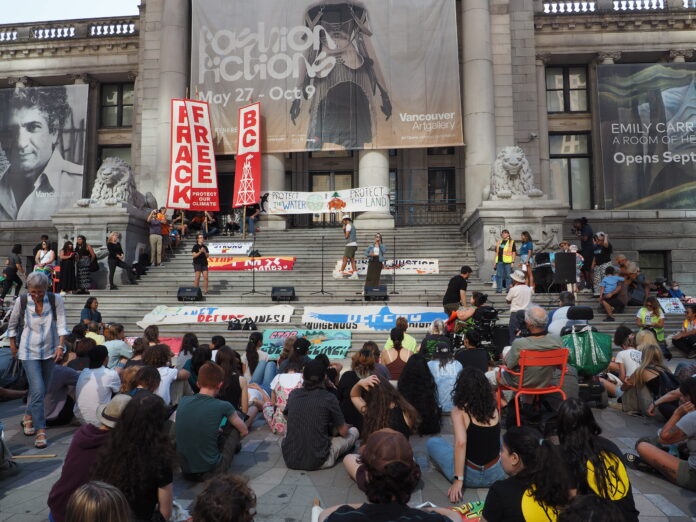
This is a photo of the strike, being held outside the Vancouver Art Gallery. Numerous people are gathered outside the gallery, holding signs that show support for the climate protest. The largest signs, placed behind the speakers, read “Frack Free BC.”
PHOTO: Olivia Sherman / The Peak

By: Olivia Sherman, News Writer

Content warning: mentions of forced assimilation 

On Friday, September 15, thousands marched across Vancouver as part of a global initiative, Global Fight to End Fossil Fuels, to protest against climate change. The march started at Vancouver City Hall and ended at the Vancouver Art Gallery, where song, dance, and speeches took place. Vancouver’s climate strike joined dozens of countries and hundreds of cities around the world in protesting fossil fuels, pollution, and climate inaction. 

Co-hosting Vancouver’s strike was the organization Sue Big Oil, an initiative to hold politicians and lobbyists accountable for consequences derived from fracking and oil. The David Suzuki Foundation, Fridays for Future, For Our Kids, and other organizations were part of the fight. 

Marissa Nahanee, a Sḵwx̱wú7mesh (Squamish) and Nisga’a Indigenous ambassador, opened the rally at the art gallery with a traditional Sḵwx̱wú7mesh welcome, and led the crowd in a celebratory song. Between speeches, musical artists performed in solidarity with protestors. Performances included hip-hop, folk, and a drag show from Vancouver drag queen Batty Banks

Severn Cullis-Suzuki, co-founder and executive director of the David Suzuki Foundation, showed solidarity with the protesters. At age 12, Cullis-Suzuki spoke out against climate change at the 1992 UN Earth Summit, and her advocacy has spanned her whole life. “We’re here today, along with our [family] around this earth, to call an end to fossil fuel supremacy,” she said at the September 15 rally. “Humanity is now in uncharted territory.”

To extract liquefied natural gas, deeply-embedded rocks must be injected with high-pressure “fracking fluid” to gain the oils within. There are 25,000 fracking wells across BC, which require freshwater from local lakes and rivers to make fracking fluid. A spokesperson for the BC Oil and Gas Commission told The Narwhal that natural gas companies used over 4.2 billion litres of water in 2020. A 2021 study from the University of Toronto found that these chemicals, when released into the environment, can “cause or exacerbate health problems including birth defects, cancers, and asthma.”

Fracking companies often receive drilling credits, which cover part of the drilling and completion costs for wells, and can reduce royalties. According to Wilderness Committee, “14 of 15 of the top fracking companies in the province receive more in drilling credits than they pay in taxes and royalties.” 

“We want politicians to show some political courage or get out of the way,” said Janelle Lapointe, an Afro-Indigenous climate activist and interim director of public engagement and mobilization at the David Suzuki Foundation. She continued, “The BC NDP and the federal Liberal government are telling us they believe the crisis, they understand the severity of the crisis, yet they’re meeting with oil and gas lobbyists every single day.” 

Lobbying is the act of influencing the decisions of a government toward the interests of an individual or private group, such as oil and fracking. Though this persuasion is considered legal, environmental activists have had concerns about external influences over politicians for decades.

“Even though a lot of us are here today out of fear, out of sorrow, frustration, and uncertainty, I hope we leave with a lot of love in our hearts, and lead with love,” Lapointe noted. 

Lifelong Indigenous environmental activist, Cedar George Parker, elaborated on the need for love and hope in the face of fear. “This really is a story of hope to move on and continue on.” He added, “It all comes down to hope.” 

He described how growing up on a reservation and being taught to protect and respect the world around him allowed him to grow up surrounded by love. “We really need to Indigenize the policies that Canada put in place to assimilate and put us down,” Parker stated. “We need to humanize our education system, we need to humanize the way we think, we need to humanize the way we look at the land, look at the water, and a way we can be prosperous.

“Be brave as you can be with every footstep moving forward. Be brave as you can be when we’re standing up to [the] industry [ . . . ] standing in the face of fear, because our youth are worth it.”