Home Blog Page 1176

Clan softball drops four more in Florida

0

The SFU softball team was looking to rebound from a disappointing opening to the 2014 season in Montana, where they lost five straight against non-conference teams. But in four games in Florida last week, the Clan came up empty-handed, dropping all four as their record fell to 0–9 in exhibition play.

The Clan’s best chance at a victory came in their first game of the weekend, a 6–5 loss to the Eckerd College Tritons, the first of a doubleheader against the Florida-based school.

“We had our chances in the first game,” said head coach Mike Renney. “We really showed some spark and showed a lot of fight. I think that loss took the wind out of our sails a bit in the second game.”

In that second game, the Clan allowed double digit runs for the third time this season in an 11–4 drubbing.

“Ultimately we need to have more kids perform,” added Renney. “We’re suffering through some youthful mistakes and unfortunately they’re happening in bunches.

“The youngsters are getting opportunities to play and it will ultimately pay off in time but it may take some trying times to get to that level of experience we need to get to.”

Thatt level is still a long way off. In the final doubleheader of their Sunshine State journey, the Clan’s offence vanished in 8–0 and 5–1 losses to the University of Tampa.

It’s tough to lay blame on just the offence, though: in nine games this season, while scoring just over three runs per game, SFU has also given up almost nine against per game. It’s hardly a formula for success, but there’s little time to mope; the Clan need to turn things around before conference play begins on March 7.

“We’ll return home now,” said Renney after the final game. “[We’ll] lick some wounds and look forward to the opportunity to get outside and get a few more opportunities at some preseason exhibition games.”

Peer Prepper #3

0

Into the wild

0

musicwilderness

Music from the New Wilderness, performed at The Cultch from February 11 to 15, was presented by Western Front New Music, winner of the Rio Tinto Alcan Performing Arts Award in 2014 — a $60,000 prize. New Wilderness was the first project to come to fruition as a result of that money.

Curated by DB Boyko, six artists set out to get intimate with the landscape of wildly diverse British Columbia, creating compositions that marry history, field recordings, and information about each location with the artists’ own subjective experiences. The process hearkens back to  19th century romantics who sought immersion in nature as a reflex and refuge against the growing thrum of urbanity.

The balcony section of The Cultch was closed to accommodate the array of specialty sound equipment which made for an absolutely incredible and immersive experience.

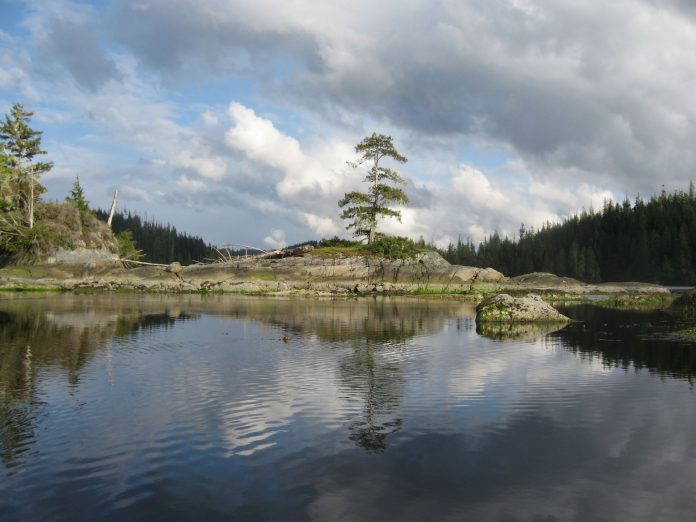
I spoke with Jenni Schine and Adam Basanta, two of the six artists involved with the project. Their component offers a vision of the Broughton Archipelago — the largest marine park in BC with, according to the BC Provincial Parks website, “a wonderful collection of dozens of undeveloped islands and inlets.”

Schine first volunteered at Broughton after hearing about the Salmon Coast Field Station from Scott Rogers (station manager at the time) who introduced her to Billy Proctor, an incredible story-teller whose perspective on how to be was infectious. He approached new-comers with the utmost welcome, always ready to demonstrate how to live with permanence in this unique off-the-grid location.

“There are fewer people living in wilderness [meaning] there are fewer people who are witnessing what is happening to our natural world.”

Jenni Schine, artist

Schine quickly discovered a deep fascination for the place and assumed the role of ethnographer, beginning a process of recording her surroundings and the people therein.

Schine and Adam Basanta had met in a class on acoustic communication. The two wanted to work together from the start and one day Basanta got a green light call from Schine; he made his first trip to the Broughton Archipelago with high quality sound equipment on his back. In the composition, we hear Schine say, “You can’t run away, you can’t busy yourself, you kind of have to just go there,” a feeling Basanta identified with on his first trip.

musicwilderness2

Schine was thrilled with the technology; it meant unprecedented volume for the subtle sounds of their environment, and the eventual delivery of those sounds to an urban audience who might, as she described, “listen to [them] deeply and make connections to the places they call home and experience as sacred.”

Basanta recently finished a MFA at Concordia University in the individualized program for students with specific research goals for a multi-disciplinary project. A composer at heart, the program facilitated his fascination with connecting visual and aural elements.

Music from the New Wilderness was lacking in visuals save the glow of the lidless piano on stage, some sheet music on a stand, and some very soft lighting effects. Going in, I wondered if I would crave something to look at, but in fact I wished the room had been darker so as to focus on my sense of sound.

Basanta composed the piece in three vignettes, creating a narrative. “One will be mine, one will be yours, one will be Billy’s,” we hear him say in a measured tone as the calculated and elegant chaos of the composition envelops his words.

In the first part, we hear the Broughton Archipelago as experienced by Basanta, the first-timer who wouldn’t call himself an outdoorsy type. In the second, Schine who comes and goes, moves through the brush, the sound of crisp branches crackling beneath her feet. In a voice for long distances, we hear her calling for Billy.

The third and last movement hones in on Billy, a somewhat mythical man who we hear speak in a filtered, old radio tone: “Well, you just gotta find a way to stay here — everyone who comes here loves it.”

 Music from the New Wilderness is experimental, elegant, disparately but deeply historical, and attuned to a sense of foreboding that seems to be waiting just around the bend.

“It’s about place-finding, trying to find home and where you belong,” Schine said.

“What became clear to me when I was there is that there are fewer people living in wilderness and what that means is that there are fewer people who are witnessing what is happening to our natural world. What happens to our resources? Are the salmon coming back year after year? Are the trees being logged and if so, what areas are being affected? So my big question is: what happens when there are no more people living in the wilderness?”

Woohoo, Boohoo

0

Web - Boohoo - Rawksteadi

Woohoo: neknominations

We all love to take to the internet once in a while (or all the time) to witness the latest goofball vines or funny fails. With a new viral trend, you might get to see someone you know!

A “neknomination” is when someone films themselves drinking in a unique or strange way, and challenges friends to out-do them within 24 hours, with the video then posted on social media.

It’s never been easier to watch a buddy from high school drink a pitcher of beer in his underwear and do snow angels in freezing temperatures. Those who can’t drink alcohol can resort to a hot sauce, siracha, and orange crush amalgamation and still get laughs and props for their efforts. One South African man has even used his neknomination as a chance to do random acts of kindness for the poor.

Boohoo: alcoholism

I got nominated! However, I never completed my challenge. My “nerknnommnashhn” came from a friend who did his on the same night we were pre-drinking together. Guess what: he was too drunk to remember.

Since the game emerged in 2008, challenges have been linked to several fatalities and have embarrassed countless participants. Is it worth posting your buffoonery on the Internet for everyone (including possible employers) to see in exchange for a temporary drunken state and a few laughs? No. Social media and alcohol go together like mustard and coffee.

Needless to say, neknominations have not caught on due to their positive impact on our culture. In an age of shrinking privacy and increasing connectivity, the embarrassment they result in will provide lessons learned the hard way for too many people.

Some of you may say boohoo to me, having not completed my nomination. Well, I guess I’ll have to live with it.

Child Stars Who Have Aged Poorly

0

You won’t believe how badly these former kid-celebrities have aged! They’ve really aged poorly!

Haley Joel Osment

Osmend

Oh boy, has this guy ever aged poorly! Sure he was super cute when he was a kid but look at him now! He’s just as cute! It’s like he hasn’t aged a day! Seriously, he’s 25 but still looks 10 years old! Talk about aging POORLY!

Lindsay Lohan

Lindsay-Lohan

Wow, what’s going on with Lindsay? She looks even younger than when she was a famous child star! I swear to god she looked like a teenager when she was in Mean Girls! What is she, aging in reverse? That is most certainly a POOR way to age!

Macaulay Culkin

lizard

Culkin was always a funny looking kid but I wouldn’t have guessed in a million years he’d grow up to look like this! Most people at least age into an older human but he seems to have developed into some sort of lizard-type creature! I can only describe his aging process in one way: POOR!


Salt and Paper: Blackberry turnovers with an almond glaze

0

Processed with VSCOcam with f2 preset

There are a few simple pleasures in life I will never take for granted: rays of morning sunshine, a hot mug of coffee, berry-stained fingers in the summer, and a perfectly flaky pastry.

Amidst the hustle and bustle of our busy lives — in between writing papers, rushing to work, catching the last bus home — there are moments that are meant to be savoured such as the string section of your working soundtrack, the crumpled leaves beneath your running feet, and the old woman sleeping peacefully on the bus, the city lights reflected on her face.

When it comes down to it, these little pauses are the chapter breaks in our day — they give us a reason to stop for a minute and slow down. It’s so important to take note of these sensual pleasures in life on a daily basis. They’re what make us human.

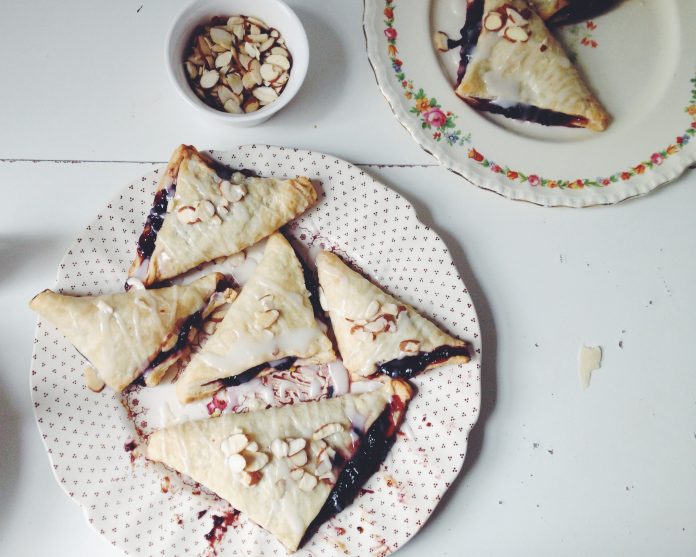
These turnovers are warm, flaky, and berry-filled, and are a perfect reminder that it’s fine — even healthy — to stop what you’re doing for a moment for a bit of an indulgence. I made the pastry dough myself, but if you’re dough-phobic you can also buy frozen sheets in the grocery store as they will do just fine.

For the pastry:

• 2 cups unbleached all-purpose flour

• 1 tsp sugar

• Pinch of salt

• 12 tablespoons (or 3/4 cup) cold unsalted butter

• 1/2 cup ice water

Processed with VSCOcam with f2 preset

In a medium bowl, mix flour, sugar and salt. Cut in butter either with a pastry blender or your fingers. Add water and mix until the dough can be formed into a ball. Refrigerate for 30 minutes.

For the turnovers:

• Blackberry (or blueberry or strawberry or any other kind of berry) jam

• 1/2 cup of confectioner’s sugar

• A couple drops of almond extract

• 1 teaspoon of almond milk, more as needed

• A handful of slivered almonds

Processed with VSCOcam with f2 preset

Pre-heat oven to 425 degrees F. Roll out dough on a floured surface — you want it pretty thin as it does tend to puff up in the oven. Cut dough into squares and add a dollop of jam in each corner. Fold over the other corner, creating little triangle pockets of goodness. Bake for approximately 10 minutes, or until the pastry is golden brown.

In the meantime, mix the confectioner’s sugar, almond extract and almond milk in a small bowl until you get a good consistency for drizzling. Once those little babies come out of the oven, let them cool a tad, then top with almonds and the almond drizzle. Don’t be afraid to get sticky jam fingers.

Processed with VSCOcam with f2 preset

Lover’s quarrel: Cindy Sherman meets Dzunuk’wa

0

satelitegallery1

Both reading break and Valentine’s Day are considered the right time to make those previously unthought-of chance encounters. Maybe it’s the winter doldrums that push us to step into the unexpected — an opportune excuse to shake things up. Perhaps it is just time to try something new.

That being said, there is an exhibition at the Satellite Gallery which started on Feb. 14 with a similar concept in mind: Cindy Sherman meets Dzunuk’wa is a collective exhibit culled from the private collection of Satellite Gallery founder Michael O’Brian, and his wife Inna Vlassev O’Brian.

As the title of the show implies, more than 40 works were selected without regard to possible historical, cultural or thematic assemblages, in order to place the individual pieces in close proximity to their proposed aesthetic soulmates — without rejecting the odd lovers’ quarrel, either.

Cindy Sherman’s painted nails and made-up face are another clue that she isn’t quite meant to be the girl-next-door.

The juxtaposition of the two title pieces are a case in point. On the one hand, Cindy Sherman looks out from her “Untitled” c-print self-portrait from 2002/4 wearing a leopard print shirt that covers a distinctive, soon-to-be motherly figure. Her painted nails and made-up face are another clue that she isn’t quite meant to be the girl-next-door.

The piece is characteristic of the artist’s exploration of female gender roles as well as her particular style: halfway between garish and graceful.

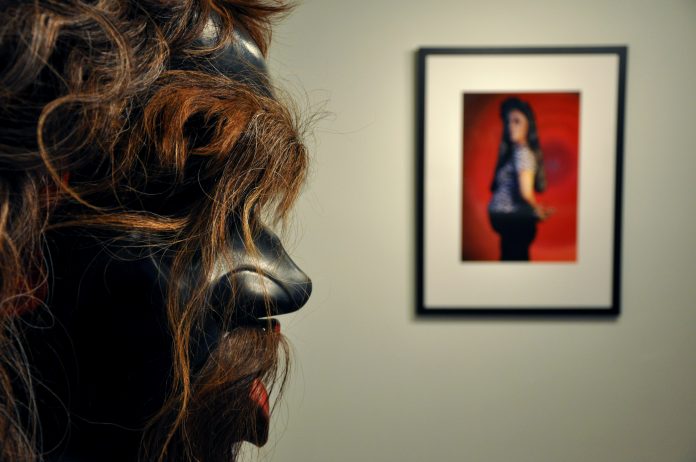
On the adjacent wall is hung her ill-fated twin, “Dzunuk’wa, the Wild Woman of the Woods,” a large red-cedar mask sculpted by Kwakwaka’wakw artist Beau Dick in 2012. Here, the horse hair mane and puckered red lips remind us of the giant’s hunger for human children and her self-conscious attempt at seduction. Not such a far cry from what Sherman is alluding to, but with quite a different sense for the otherworldly.

BRIANJUNGEN

Chosen by a curatorial quartet that includes Cate Rimmer (Charles H. Scott Gallery), Keith Wallace (Morris and Helen Belkin Gallery, UBC), Karen Duffek (Museum of Anthropology, UBC) and Helga Pakasaar (Presentation House Gallery), the intent was to mimic the process of building a private collection through fortuitous relationships.

While most artistic comparisons are meant to be in close proximity within the various zones of the gallery, some concordances span the entire showroom area, as a long-distance couple would time and space. These were my favourite pieces in the show.

The first is a square assemblage by Brian Jungen found on the wall near the gallery entrance. Titled “Blanket No.9”, the artist combines two professional sport jerseys to create an abstract weave motif of geometric design.

At the opposite end of the gallery can be found another textile work that draws you in with its finesse: the Jacquard tapestry “Self-Portrait” by Chuck Close. The artist’s impressive gaze is matched only by the viewer’s pleasure at unraveling the multiplicity of threads that meander from one piece to the next.

SFU appoints new VP, research

0

SFU will welcome Joy Johnson as its new VP, research this fall. Current VP, research, Mario Pinto will finish his second five-year term this August, whereafter Johnson will step into the role.

Currently, Johnson is the scientific director for the Institute of Gender and Health at the Canadian Institutes of Health and Research; she is also a professor in the School of Nursing at UBC. Her tenure as SFU’s fifth VP, research begins Sept. 1, 2014.

In a media release, President Andrew Petter said, “We are incredibly fortunate to have Dr. Johnson joining SFU as our next vice-president, research.” In that same release, Pinto added that he was “delighted” to have Johnson succeed him and that her extensive and varied experience “bodes well for the future of research at SFU.”

Johnson will be moving away from working primarily in the field of health to what she called a, “broader mandate.” She said, “Taking on the position of vice-president, research I’m going to be concerned about developing research capacity in all areas of research.”

She expressed her excitement about the change and explained the allure of a position at SFU. One factor she mentioned was the vision of SFU as an engaged university, and she looks forward to the opportunity to engage with the community across three campuses.

For Johnson, the prospect of a younger university also appeals to her: “[With] younger, comprehensive universities like Simon Fraser, there’s a lot of creativity that can take place, a spirit of adventure.”

Though excited to begin her new position, Johnson acknowledges that it will come with its own challenges. She stated, “I think it’s always a bit of a mistake to come in with too many plans when you’re taking up a role like this.” She made it clear that her first priority is to become thoroughly familiar with the university and what its research capacities are.

She continued, “I really want to get to know the researchers at Simon Fraser, get to know what the challenges are for researchers, and then start to look at ways we can strengthen research capacity at SFU. Before I can move forward on any of that, I really need to stop and learn about the institution in more detail.”

The next obstacle she alluded to is one that she said affects researchers all over Canada. “Many researchers are concerned that there’s not enough funding for research,” she said. “It’s going to be a challenge to try and find ways to help the excellent researchers at SFU make sure that they have the resources that they need to keep their research going, and to help grow the research at SFU.”

In anticipation of next fall when she will officially take up her position, Johnson says she will be setting up various meetings over the next month with the current VP, research, as well as President Petter, in order to prepare herself for this exciting new challenge.

Updating the Status

0

o-WARRANT-CELL-PHONE-facebook

Why do we need all these gender options, anyway?

Because not everyone thinks of themselves as a man or a woman, and that’s okay. Most people tend to place themselves into one of these two categories, but there’s all sorts of folks who don’t feel like they fit into either box — or that they fit into both — and their gender identity is no less valid than anyone else’s. In supplying 56 custom gender options (in lieu of a previous three), Facebook has recognized that gender identity is much more complex than the usual binary.

Gender is a set of culturally learned practices, and a tool through which people build and reflect their identities.

We tend to be taught from a young age that gender is inextricable from biological sex, but that just isn’t the case. Though your doctor more than likely labelled you as either male or female as soon as you were born, it’s ultimately up to you to choose which gender suits you best — and it very well might be neither of those choices.

Sex and gender are totally separate terms. Sex refers to your chromosomes, your genitals and everything else to do with biology (to be clear, we’re not talking the verb sex, which is something totally different). Gender, however, is a set of culturally learned practices, and a tool through which people build and reflect their identities. Whatever behaviours you think of as “masculine” or “feminine” are that way because of the culture we live in, and the beliefs it supports and indoctrinates.

In allowing people to choose the gender that best reflects them, Facebook has taken an important step in recognizing the scope of gender identities and respecting the right of every individual to choose whichever term best reflects who they are.

I’ve never heard of some of these terms. What do they mean?

I’m glad you asked. For starters, most of you reading this are probably cisgender — that means your gender matches up with your biological sex. For example, if you’ve got male genetalia and chromosomes and you identify as a man, that makes you cisgender, or cis.

Trans folks identify with a separate gender than their biological sex dictates — using an asterisk after the term trans implies that you’re including each and every gender option (and sex option) that a trans person might be. Some trans people will include their preferred gender identity after the word trans, such as “trans man”; others will settle for “trans” or “transgender.”

Agender people don’t identify with any gender, and feel they’re better off not having a gender at all. Gender fluid, genderqueer and gender nonconforming people all fit somewhere in the middle of the gender spectrum, and some don’t tie themselves down to a single definition, preferring to define their identity on a day-to-day basis.

Most of you reading this are probably cisgender — that means your gender matches up with your biological sex.

Bigender people — you guessed it — identify with both male and female genders, and pangender folks identify as all genders at once. Two-spirit is a term used in over 130 First Nations tribes; it describes those who don’t fit on either side of the gender binary, but have aspects of both male and female genders.

I’m a cisgender woman. Should I choose the “woman” option, or the “cis woman” option? What’s the difference?

Either! Facebook’s custom options are extensive, and to be fair, there’s a little bit of overlap. There is, however a difference between these two terms: a cis woman is a very specific description of a unique gender identity, whereas the term “woman” is a lot more interpretable, and can be used to describe a whole subset of genders. If in doubt, choose the term you feel best describes who you are, and what gender you best identify with — however you would describe yourself to your friends, family, and partner.

What do pronouns have to do with all of this?

Along with their new gender options, Facebook has fine-tuned its user settings by including a drop-down menu with pronoun choices: him, her, and the agendered them. The pronouns you use to identify someone are an important part of how you relate to that person, and it’s your job to make sure that you’re using the correct pronouns with whomever you meet. Facebook’s inclusion of pronoun customization is a useful tool for people too nervous to ask someone for their preferred gender pronouns — or PGPs — in person. It’s also a nice way for people to dictate which PGPs they prefer without having to constantly correct the people around them.

Why is there still an “other” option? Doesn’t this cover all the bases?

Not quite. Like all facets of your identity (style, tastes, personality, and so on), gender is a process of constant reinvention — and like all inventions, some of them have yet to be discovered. Despite the admittedly exhaustive nature of Facebook’s custom options, kudos to them for leaving the door open for new possibilities, and for giving those who don’t feel like putting their gender into a single category — or feel like it isn’t anyone else’s damn business — a choice to match.

Tippy Top Ten: SFU Road Construction

0

Here are the Tippy Top Ten worst things about the road construction at SFU…

10. It’s really messing up previously super convenient trip to school on top of a mountain

9.Your Sherpa wants a raise

8. New roads will be useless in five years when we all have flying cars

7. Will add 5-30 minutes of bus stop small talk about how bus is 5-30 minutes late

6. Future smooth roads will make us more susceptible to attacks from invading Mongolian army

5. It’ll force you to drive through UniverCity and remind you there’s a place called “UniverCity”

4. Soon won’t be able to blame bumpy road for arousal on the 145 anymore

3. With legitimate excuse for being late, “murdered parents” story will go to waste

2. Will inspire too many students to transfer into Construction faculty

1. Even after they’re finished, the roads will still lead you to SFU