Home Blog Page 1154

Burnaby prepares for quidditch world championships

0

WEB-quidditch-Mark Burnham

To most, quidditch is a game confined to fiction, played solely in J.K. Rowling’s popular Harry Potter series; however, in Burnaby, BC, quidditch is very real and currently thriving.

Not only has SFU managed to field a competitive team in the past year, but the quidditch world championships — the Global Games — are coming to Burnaby this July. Both the SFU and UBC quidditch teams, who played a hard-fought game on Friday, March 28, have players trying out for Team Canada.

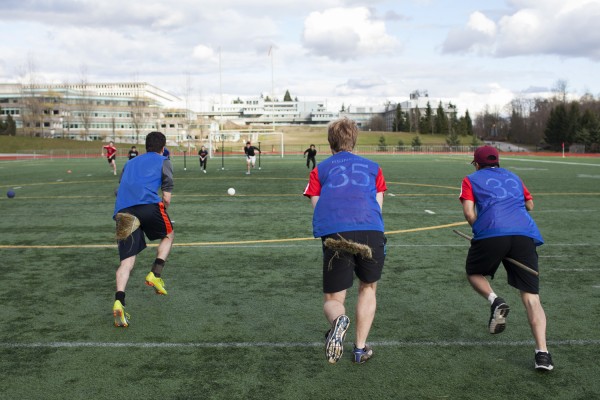
Real quidditch — or “muggle quidditch” as it is sometimes called — actually plays like a typical team sport, in the vein of soccer or rugby. There are three chasers on the field for each team who try to score with the quaffle. The two beaters, on the other hand, use balls called bludgers, thrown at the chasers to try to stop them. The keeper tries to prevent the quaffle from going in the hoops, but can also act as a fourth chaser. Each score of the quaffle is worth 10 points.

Quidditch distinguishes itself from other games, however, with the snitch and the seekers. In lieu of the mystical creature in the books, there is a snitch runner, a player unaffiliated with either team who tries to evade both teams’ seekers; the seekers, meanwhile, are trying to steal the snitch attached to the runner’s belt. Whichever seeker captures the snitch earns their team 30 points, and ends the game (this does not guarantee the win, however, depending on the spread).

Muggle quidditch obviously differs from the movie version in several ways. In Harry Potter, brooms enable players to fly, while in muggle quidditch the broom is merely a handicap similar to dribbling in basketball; the player must hold it the entire time. Also, the bludgers in real life are just balls, rather than weapons. To simulate recovery time once hit, the chaser must retreat to their own goal post before going after the quaffle again.

Although most people are confused when they see that SFU has a quidditch team, it is this reaction that draws people to the sport, says SFU quidditch team founder and president Christine Konrad. “It was too funny watching people walk by, and people whose faces were like, ‘What?’,” she explained. “Those were the ones who you’re like, ‘Yeah, yeah, come on over, I’ll tell you all about it.’”

Konrad, who is also a chaser for her team, feels that quidditch provides a unique sense of community because players “all have something a little unusual in common [. . .] You’re all doing quidditch, you’re all doing something different.”

On Friday, March 28, SFU faced UBC, one of the originators of quidditch in the region, with an inspiring force behind their team. Although SFU scored the first 10 points, they lost all three games by scores of 90-30, 50-20, and 60-30. Despite the end results, SFU played better with each game, and only lost the last two because of a snitch catch.

Alexa Rowe, president of UBC’s team and a seeker, applauded SFU’s efforts: “SFU has really improved, I was really impressed with their gameplay as well. They kept it within snitch range for a couple of those games, so it was really exciting probably to watch and to play.”

Now, besides a possible road trip, only the Global Games remain. “The fact that the Global Games are here will [. . .] increase awareness of quidditch in our region,“ stated Rowe, “Quidditch in the States is huge and quidditch in Canada, especially up here in the northwest region, isn’t as well known.”

Konrad agreed, pointing out that she first became interested after watching a game between UBC and UVic. “That’s what made me want to start a team, was watching it in action.” She continued, “ If people from other schools in the area, [such as] Langara, Cap[ilano], if they’re watching games, and they’re like ‘I want this,’ then we [will] have more local teams springing up.”

The Global Games will take place at Burnaby Lake Sports Complex West on July 19.

SFU vs. UBC

0

Web-SFUvsUBC

You’ve all heard the jokes about UBC and SFU. I know you have — they’re written all over every bathroom stall in the school. Here’s my personal favourite: “What do SFU and UBC undergrads have in common? They both applied to UBC.”

There are hundreds more just like it. Some portray UBC kids as snooty and self-centered; others take SFU’s history as a liberal arts stronghold as evidence of our status as dirty, unkempt hippies. Since my first day at SFU, I learned to furrow my brow and shake my head disapprovingly at any mention of UBC. It’s like an initiation ritual.

“I think having a rivalry with SFU is part of our identity as a campus community. Every institution needs their rivals, right?” – Thea Rodgers, UBC Student

The competitive spirit between the two schools goes far beyond the undergraduate community. Our sports teams — particularly the Clan and UBC’s Thunderbirds — have a rivalry whose roots are deeper than most. Look no further than the Shrum Bowl, a yearly showdown pitting the two against each other for a trophy, not to mention bragging rights. It’s been held on and off for 33 years, with SFU leading UBC 17–15–1.

Business majors will also be familiar with the rivalry between Beedie School of Business and UBC’s Sauder School. Barbs are often traded over which school is “better,” and a quick search on Google will turn up endless forum disputes on the subject. (I read these things so you don’t have to. Seriously, who posts in those threads?)

The Peak has even gotten in on the fun, sparking a friendly competition with UBC’s student paper, The Ubyssey. Our two papers may or may not have participated in a dance competition at a journalism conference earlier this year.

“I think there is an anti-SFU sentiment that persists, maybe even for students who have never even been to SFU before,” says Thea Rodgers, a UBC undergrad. “I think having a rivalry with SFU is part of our identity as a campus community. Every institution needs their rivals, right?”

But what’s behind this rivalry? Is it really based on a belief that either school is inferior, or is it just a product of our proximity and our comparable status among Canada’s top schools?

Most likely, a little bit of both. I’ve had my fair share of arguments with fellow SFU students who genuinely believe every single UBC stereotype there is — that they’re all rich pricks, that the teachers are snooty and inaccessible, that the campus is full of sexist dudebros who throw biweekly keggers and spout rape culture slogans. (Okay, that did happen that one time.)

It’s baffling to me that people can fall hook, line, and sinker for these kinds of generalizations. Really? Everybody at UBC is like that? I don’t buy it.

I’m not trying to say that a little scholarly competition is a bad thing. Hey, if it gets us working harder and helps us muster up a little school spirit, what’s the harm? But there’s something a little disconcerting about dismissing an entire university’s worth of students, teachers, and faculty because of a “traditional” rivalry.

Out of all the people who actively dislike UBC or SFU, what good reason do you have? Have you actually taken classes there, or met more than a handful of people who go there?

Yeah, I didn’t think so.

Truth is, most of the hostility between our two schools is left over from people who’ve long since graduated, passed down from generation to generation until we’re not even sure why we hate each other anymore. But we keep butting heads, pretty much just for the sake of butting heads. No small part of it is jealousy, I’m sure: no one likes to think that they chose the wrong university, or that their school is worse than the one just 30 kilometres away.

Now, I’m not going to lie. It’s hard to deny that glimmer of happiness, and subsequent pang of guilt, I feel whenever SFU beats UBC at something. Maybe it’s irrational — like when a friend gets passed over for a promotion, or when you beat your significant other at a video game.

But as much as no one on either side of this feud would like to admit it, both schools ultimately have their ups and downs. There are good reasons to go to both, and barring some gigantic change in the next decade or so, there always will be.

University is ultimately what you make it, and you’re bound to get a wide range of opinions from people who go to both schools. When I applied for SFU, I was told there would be no community, and yet I’ve met some of the best friends I’ve ever had at The Peak, one of the closest knit communities I know of at any university.

UBC may claim to have more prestige — they do tend to place higher than us in most university rankings — but it’s not about that, at least not entirely. It’s about what you do to make your university experience the best it can possibly be, no matter where you’re studying.

So, in light of all this, I’m extending the olive branch: why can’t we all just get along, guys? Can’t we unite over some common enemy — say, Quebec, or Ontario? As far as I’m concerned, a house divided cannot stand. UBC and SFU should team up. What’s standing in our way? A dusty old history of half-hearted insults and a football rivalry? Together, we can make the West a force to be reckoned with.

SFU won’t accept Bitcoin anytime soon

0

WEB-Bitcoin-Antana

SFU recently announced that it won’t be accepting Bitcoin as payment for student services in the near future — however, the university is open to the possibility.

Mark McLaughlin, executive director of SFU ancillary services, said that the university must monitor Bitcoin’s stability and longevity before seriously considering accepting it on campus. Nevertheless, McLaughlin said he wants to encourage student engagement and respond to demands from SFU’s prominent Bitcoin club.

SFU’s Bitcoin club was the first of its kind established at a Canadian university, and continues to play an active role in making Vancouver a hub for Bitcoin enthusiasts. Esther Tung, the club’s VP communications, said that users are attracted to both the social and economic benefits of cryptocurrencies.

Tung explained that, as a digital currency, Bitcoin is decentralized and protected from government devaluation. Bitcoin provides instantaneous transactions and acts as a universal currency; this is good news for people in developing countries who have limited access to physical currency or bank accounts, but who probably have Internet access, Tung explained. Using Bitcoin allows these small merchants to participate in otherwise unreachable global markets.

“Bitcoin has a lot of potential for social change,” said Tung. Although McLaughlin agreed, he maintained that SFU will wait until the value of Bitcoin stabilizes before looking into it further.

“We have to make sure what we do is built to last,” McLaughlin said. While both McLaughlin and Tung think cryptocurrencies are here to stay, there is some speculation about whether or not Bitcoin will maintain its position as the forerunner in cryptocurrency.

McLaughlin told The Peak that SFU is looking into hyper-local currencies such as Seedstock, which could be used as a campus-wide currency with a portion of the proceeds donated to SFU-affiliated charities.

Although Tung admitted that the price of Bitcoin is volatile right now, services like Bitpay offer merchants the option to cash out at the time of the transaction regardless of currency fluctuation after the fact.

Therefore, Tung said, “There is virtually no risk for the university, other than, I mean, if Bitcoin goes to zero,” a possibility she considers to be extremely unlikely.

Regardless of the risk, McLaughlin sees this as a potential opportunity for SFU to live up to its reputation as an innovative, engaging university. “Would we love to be the first university in North America to accept Bitcoin?” McLaughlin mused. “Yeah, I think that would be a really neat thing.”

If the value of Bitcoin stabilizes over the summer, McLaughlin envisions SFU accepting it as a pilot project at the bookstore or dining services as early as fall 2014. However,  he does not see the university accepting Bitcoin for tuition payments any time soon.

Tung remained skeptical of the university’s claims, saying, “No matter how much [SFU] says that it’s progressive and it wants to engage the world, they’re still conservative at heart.” She doesn’t think Bitcoin will enter the mainstream until it is accepted by more retailers or institutions; then, for example, SFU could pay its employees in Bitcoin without them having to cashing out to buy food or other on-campus services.

While McLaughlin can’t promise any immediate changes to SFU policy, he applauded the leadership role that Tung and other students have taken in the international Bitcoin community and said that he and his colleagues are definitely paying attention.

With so much uncertainty around Bitcoin’s future and yet so many opportunities for social change, McLaughlin said, “It’s interesting to see where this all takes us — check back in six months.”

Addicted: Nymphomaniac Vol.1 and 2

0

seligman

It’s a room reminiscent of Freud’s set-up: a woman is reclined, a light from behind setting a glow on her, the makeshift patient.

Joe (played by Charlotte Gainsbourg and whose younger self is played by Stacy Martin) wound up in this strange bedroom convalescing under Seligman’s (Stellan Skarsgård) wing after he found her in a wet brick and mortar alley. We might have called it chance if it weren’t for the over-saturation of coincidence in the film. At certain hallmark moments the too-precious serendipity is exhausting, and we don’t offer von Trier the leeway we might for a less seasoned screenwriter.

Joe sets out on a life-long, four-hour recollection of her nymphomaniac condition. Seligman is too eager, moving in careful intervals, scratching his chin; his fascination with this detailed montage of her sexcapades is in medias res, as though he had the bed made and the tea boiling before he found her.

Seligman’s openness is like that of a priest on the other side of the confessional: getting high on this unprecedented access but responding as though asexual. Speaking of priests, the film inevitably challenges us with the choice of whether or not to moralize. Joe is puzzled at Seligman’s very clinical (pedantic, rather) responses to her monologues, and for the viewer it feels measured as we realize that each chapter reveals something more difficult to bear.

She is not a woman with desire and control, rather she is a person succumbing to an appointed vocation — eating for survival and not for pleasure.

Young Joe in Vol. 1 is played by an utterly bored-looking Martin, a young first time model-cum-actress. It’s hard to feel anything for what she gets up to, whether playfully teenage or pregnant and under-stimulated, as present-day Joe narrates the exploits. She is not a woman with desire and control, rather she is a person succumbing to an appointed vocation — eating for survival and not for pleasure.

Joe speaks about the condition methodically, outlining the monotonous routine she managed to find herself in with a full-time job and 10 different fucks per day. Is there even a way to schedule ten partners in a day without a fairly dedicated administrative sense? She loses sensation, and then her husband (Shia Labeouf), and then eventually total hope for her future.

Joe and Seligman realize the sun is coming up and notice a tiny splash of sunlight on the outside of the building directly across from his window. Seligman mentions that he’s never been able to identify what series of reflecting surfaces makes it possible, and there’s a soft feeling of rarity and buoyancy in the mysterious source of light.

Von Trier, it first seems, has attempted to suggest Joe’s nymphomania as a counter-cultural condition — an exercise in chest-puffery where women are capable of living on the man’s side of the double standard, a place where tallying sexual partners at least exists for the other 50 per cent of the world.

But the attempt inevitably folds over on itself. The languorous, digressive nature of the film comes to a sharp head in a series of very slight interactions between these two new friends. The room’s tone changes, some sudden action and then — we exhale, but the relief is only momentary, impulsive. Von Trier brings us to the edge of this sexual capacity from a woman’s perspective and, with the finale, snaps the whole thing back, leaving us with a bleak shadow of what he perhaps lays out as his forecast for female sexuality.

The Straight Medicinal Dope

0

If you’ve been following the news, or have a Google Alert for the words “medical marijuana,” you’ve probably been hearing a lot about medical marijuana recently. Apparently, the rules surrounding it are changing or something; it might be illegal, I don’t know. The point is you need to get informed about it and learn the cold hard facts about medicinal dope. So here it is, everything you NEED TO KNOW about medicinal marijuana.

Conditions Treated with Medical Marijuana

Contrary to what you may have heard, medical marijuana isn’t just for people suffering from “not being high” and is in fact prescribed to reduce pain for a number of real ailments.

piechart

Dispensaries

Dispensaries are the name for medical marijuana stores. They sell a range of differently-named forms of marijuana, all with their own unique benefits much like you will find when purchasing antibiotics. They also sell terrible-tasting cookies and brownies. No one knows why, it’s just tradition!

Side Effects

Unfortunately, medical marijuana-use isn’t all fun and games like Xanax or Methadone. There are 3 known side-effects to frequent medical marijuana use.

1. Memory Loss

2. Poor Counting Skills

Slang Terms

Medical marijuana goes by a lot of different names out on the street, here’s a few you should learn.

1. Medical Weed

2. Medical Pot

3. Medical Reefer

4. Medical Chronic

5. Medical Dope

6. Medical BC Bud

7. Medical Ganja

8. Medical Puff

9. Medical Mary Jane

10. Medical Cannabis

Types of Medical Marijuana Plants

Sativa

Recognizable as a tall and slender leaf, sativa medical marijuana has more THC (Total Highness Concentration) and gives patients the energy and inspiration to finally finish that 3-D puzzle they’ve been putting off.

Indica

Indica is shorter and fatter in appearance than a sativa plant. It also has more CBD (Chill Baked Degree) which makes patients mellow enough to enjoy the movie “Here Comes the Boom” but also makes them so sleepy that they miss the last half-hour.

Maple

Although it is the most commonly found form of medical marijuana in Canada, Maple Leaves have been proven to be almost entirely ineffective as a medicinal product despite countless reports from 12 year olds who “totally got stoned” off of them.

Grad Gab

0

Results from the GSS Elections

The results are in for the Graduate Student Society elections, which were held from March 25 to 27. The positions up for grabs were Academic and Internal Relations Officer (AIRC), Coordinating and External Relations Officer (CERO), and Member and Community Relations Officer (MCRO).

Of the three positions, only that of MCRO was contested. The MCRO is responsible for “overseeing the public communications of the Society.” The final count was 88 votes for candidate Melissa MacAskill to Brieanne Olibris’ 85 votes. There were also 41 abstentions.

Although there were originally two candidates for AIRO, Mengliu Zhao withdrew her candidacy. Therefore, the GSS will proceed with the acclamation process for both the AIRO and CERO positions at the upcoming GSS Council meeting on April 16.

Volunteer Appreciation Gala

The GSS hosted their third annual Volunteer Appreciation Gala at the Vancouver Aquarium on April 4. The event honoured volunteers from this past year who have made contributions to the GSS.

In addition to enjoying live music and a free photo booth, some volunteers received fun prizes such as “Best Caucus Minutes” and “Best Councillor,” among others. This year even afforded those in attendance the opportunity to dine with the belugas.

Said current GSS Member and Community Relations Officer, Eleonora Joensuu, “We hope this event shows our members how important and appreciated their dedication is to their student society and just generally, a big thank you!”

Tippy Top Ten: Spring Sendoff

0

Here are the Tippy Top Ten Biggest Surprises from the SFSS Spring Sendoff …


10. One of the performers had a pronounceable name

9. The beat was only dropped once and it was an accident

8. 3LAU did an entirely acoustic EDM set

7. Tupac hologram refused to perform after not receiving payment

6. MOIEZ’s brother Peter filled in for him without anyone realizing it

5. A few attendants retained their sense of hearing

4. The exact same song was played over six times

3. FKYA turned out to be a juggling act

2. Concert was briefly hijacked by the Putty Patrol

1. The mother died and Ted started dating Robin

West Coast separatist movement grows

8

cascadiaflag
PRINCE GEORGE — There is a separatist movement building slowly in the Pacific Northwest; its speed reflects the pace of the people outside of its metropolitan centers.

It is not your typical movement based on the right and left spectrum, nor is it necessarily about protecting a certain culture. More so, it is about creating one, building off the foundation of what already goes on in the westernmost bioregion.

It is about decentralizing two governments that seem to disregard what the population wants on the West Coast. The movement calls for a new sovereign state: Cascadia.

The map is not perfect yet. For some it stretches from northern California to the Alaskan Panhandle. For Cathasaigh Ó Corcráin, co-editor of underground journal Autonomy Cascadia: A Journal of Bioregional Decolonization, Cascadia’s borders would reflect the fact that it is based largely on ecological designs rather than current political boundaries.

Corcráin, following Dr. David McCloskey’s influence, says that watersheds should dictate Cascadia’s region. For example, he uses the Alsek River in Alaska and Yukon as the northernmost border, and the Klamath River as the southernmost. He also points to the importance of sharing the Salish Sea.

Flowing from that, Corcráin also sees the focus of bioregionalism as challenging the current way we associate ourselves with the land. Bioregionalism, as defined by Brandon Letsinger, founder of the Cascadian Independence Project and manager of Cascadia Now’s web presence, is “a way to reframe and rethink a lot of the boundaries and borders on this region to better represent economic, political, social and environmental realities.”

Corcráin, who traveled around theoretical Cascadia when filming Occupied Cascadia, says that he also noticed many similarities to communities around the region that shared similar relationships with natural resources and surroundings. For example, a logging community in rural Washington likely shares many cultural characteristics with a logging community in rural northern British Columbia.

Furthermore, Corcráin points to that fact that Cascadia is a very wild place, and the wilderness is rugged and “in your face, hard to ignore.” Letsinger said that Cascadia is the birthplace of the idea of bioregionalism. What’s more, Cascadia has many of its ecological systems still intact relative to the rest of North America. He says Cascadians are further united by love of a shared place.

In 2011, the “Republic of Cascadia” made it onto a Time Magazine list of the Top 10 Aspiring Nations, which may be just the beginning, despite the author’s throw-in that Cascadia has “little chance of ever becoming a reality.”

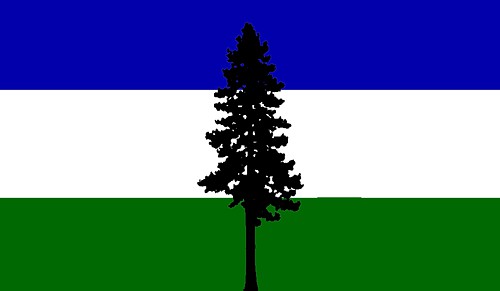
Many British Columbians have probably seen Cascadia’s flag, amicably nicknamed the “Doug Flag,” as it has made its way onto the packaging of one of Victoria’s most popular brews, Blue Buck. The Doug Flag depicts a Douglas Fir over a typical horizontal tri-colour flag.

The three colours — blue, white, and green — represent the bioregion of Cascadia. The blue is for the ocean, lakes, rivers and other bodies of water; the white for the snow-capped mountain ranges and glaciers; and the green for our lush forests.

Letsinger sees growing support for Cascadia. He points to lack of other alternatives and general unhappiness when it comes to the Canadian and American federal governments. He sees this as largely due to the fact that Cascadia focuses on positives and a new, untainted prospect.

According to Letsinger, Cascadia Now is in direct communication with around 15,000 people and acknowledges the many social media groups with thousands of followers which support Cascadia. Corcráin agrees, saying that he has seen the buzz around Cascadia grow since he first became involved. Only time will give clear definition to Cascadia.

Fun in the sun #2

0

Questionable Information: Mt. Rushmore

0

The majority of the United States’ federal debt is the result of a top-secret project to add Lincoln’s top hat to Mt. Rushmore.