Home Blog Page 1098

Female Body Inspector forced to go undercover at family dinner, put on a sweater

0
Despite his title, Justin Wilderman is almost unrecognizable with a jacket on.

Despite routinely displaying his role as a trained and trusted FBI: Female Body Inspector, a 13-year old operative is reportedly working undercover at tonight’s dinner — you know, because grandma’s coming.

Justin Wilderman, who’s been an FBI for almost three weeks now and has proudly let the world know it by wearing his standard issue T-shirt everywhere, from the grocery store to the movie theatre and even the classroom, is now being called to work in secret for the first time.

According to reports, his mother, Mrs. Wilderman, feels that tonight’s birthday dinner for her uncle Richard is “too important” for her son to be out in the open in his uniform.

“I don’t really get it, but usually I don’t mind too much,” Mrs. Wilderman explained, speaking about her son’s career choice. “All the relatives will be here tonight though and I’m just not sure if they’ll approve [of Justin’s career choice].”

She continued to say that it would be best if Justin went undercover and put on that blue sweater that his grandmother had bought him to cover up his FBI shirt.

However, Justin has made it clear that even if his uniform isn’t visible, he will continue to uphold the responsibilities that come with wearing it.

“This isn’t just a T-shirt to me, I don’t treat it as some sort of novelty or hilarious joke,” Justin told The Peak. “I took a solemn oath when my brother Terry gave it to me to make sure no female bodies went uninspected and I haven’t let him down yet.”

Despite whatever preconceived notions people might have about wearing an FBI: Female Body Inspector shirt, Justin says it is in no way a pile of laughs — it is actually a serious responsibility.   

A lot of people think [this job] means that I just stare at attractive women on the street and look at their boobs or whatever,” Justin explained while putting on the blue sweater-disguise. “No, I have to inspect ALL female bodies, not just hotties.

“The elderly grocery store clerk, the overweight janitor at the movie theatre [. . .] any female animals,” Justin listed endlessly. “Do you know how many of the squirrels you see around are ladies? Turns out it’s a lot of them!”

Justin further explained that he doesn’t just inspect uniquely female parts either but that he has to take note of every aspect of their body, from their armpits to how many moles they have.

“The entire process can take anywhere from 10 minutes to a half-hour per female. If I leave the house, I normally end up working at least a 10-hour day. That’s why I like to have the shirt, so people know what I’m up to.”

All of these reasons will make working undercover very difficult for Justin.

“There are a lot of women in my family and now I’m going to have to do my inspections without them knowing I’m a professional,” he said, shaking his head. “I hope grandma doesn’t think I’m just leering at her, I have to do my job!”

Although Justin says that he is fully committed to being an FBI and wouldn’t give up his duties for the world, he admits he sometimes wishes he had gone in a different direction in life and become an arbiter of “Who farted?” like his brother originally offered him.

“That would’ve been a lot easier, it’s always uncle Richard,” he said, cringing at the thought of having to inspect his Aunt Cheryl’s psoriasis patch later tonight. “I guess I just didn’t think this career through enough.”

At press time, Grandma Wilderman had arrived at the door and was delighted to see that Justin was wearing the sweater she had bought him. No word yet on how Justin reacted to what she was wearing, but indications that she wore a dress suggest he wasn’t altogether thrilled.


Research confirms Adam Sandler movies too lowbrow for Great Apes

0
The three sins of Adam Sandler: plot, character development, and Rob Schneider.

What was once mere speculation and popular opinion has now been confirmed: a study released last week by the Entirely Real Institute of Humour and Evolution has produced shocking information regarding Adam Sandler films and the reactions they elicit from viewers.

After taking a cross section of great apes —  from chimpanzees to gorillas and orangutans — and exposing them to the entirety of Mr. Sandler’s filmography, researchers discovered that although the apes’ enthusiasm began the trial at a relative high, it suffered a substantial drop-off as they were exposed to more recent films.

“We witnessed abnormally high levels of enjoyment during Sandler films from the ‘90s,” said Marie Thomas, a research assistant for the Entirely Real Institute. “It wasn’t until around the early 2000s that things for the apes really started to go downhill.”

It’s reported that Mr. Deeds — a film that the researchers agree is an “overall feel-good film” and “a lot of fun, if you just lower your expectations” — marked the first instance of an ape admitting it wasn’t Sandler’s best work. Shortly after that, the apes began to show signs of confusion, followed by anger. The third and final emotion for most of the apes was depression.

During the screening of Jack and Jill, an orangutan named Sammy pointed at the screen, looked to her handler, and signed, “Why?” During the 2014 film Blended, a gorilla named Chico signed, “A bit lowbrow, isn’t it?” with an ironically hilarious gesture, which included him slapping his own forehead before dragging the hand down his face. A bonobo named Henry watched Grown Ups and fell asleep, waking up during Grown Ups 2 and signing, “I dreamed we were not doing this. It was a good dream. How many sight gags did I miss?”

“We set out to see how far back our ideas of humour go,” explained Thomas. “We know what Roger Ebert thinks of Adam Sandler movies, but what about chimps? Turns out they have fairly similar opinions. We’re fascinated by the fact that they will laugh for 15 minutes when they throw feces at each other, but That’s My Boy got nothing.”

This isn’t the first time that the Entirely Real Institute of Humour and Evolution has been in the headlines this year. Back in February, People for the Ethical Treatment of Animals (PETA) blasted the organization and this particular study for its “unethical treatment of great apes,” saying that it could not condone any operation that subjected a sentient life to Click, no matter how promising the film’s premise may sound.

“These are some sick people doing some sick things,” said PETA member Robert Rosenberg in a video that went out in March. “I speak for myself and the rest of the organization when I say we’ll be doing everything in our power to stop what’s being done to these poor, unfortunate animals.”

Though Mr. Sandler was too busy producing and starring in Grown Ups 5 to respond to The Peak’s phone calls, it can be speculated that he’s still richer than any one of us will ever be and will probably continue making awful movies starring all of his friends, regardless of what PETA or the rest of the world has to say about it.

A look at the NHL rule changes

1
Under the new rules, a player can’t delay a faceoff after an icing call.

On September 11, the NHL announced new rules that will go into effect this season, which are designed to allow for more goal-scoring opportunities — read on for a breakdown and analysis of the changes:

Trapezoids

The trapezoid will now be expanded by two feet on each side. This will allow goalies more room to come out and handle the puck, leading to more turnovers and most likely goals. The goalie coming out to play the puck more frequently will help to protect defenseman from those nasty hits into the boards that have been more prevalent the last few years. I still wish they would get rid of the whole trapezoid though, as it would make for some more interesting dump-ins.

Spin-o-ramas

The NHL has eliminated the spin-o-rama in shootouts altogether. I’m not a fan of this one, as it limits the moves players can use in a shootout. Isn’t the shootout supposed to be a skills competition? Why say to a player “you can’t use that move” if he has the skills to pull it off? It takes away an exciting, skill-oriented aspect from what is a  mostly pointless portion of the game. Instead, maybe the NHL could start using international shootout rules, where players can shoot multiple times. Now that would be interesting.

Tripping on Breakaway 

Players are no longer allowed to trip a player on a breakaway, even if they get the puck first. Previously, a player could dive in front of an opposing player on a breakaway, effectively tripping him, as long as the player on the breakaway touched the puck first. I don’t think this is a very good idea, simply because it takes a great deal of skill and awareness to knock the puck off a player on a breakaway instead of simply tripping him up. However, I’m not that upset about this rule, because who doesn’t want to see more breakaways?

Diving

The NHL can now give out fines for players who dive and embellish, but it’s not a big enough fine, in my opinion. Two thousand dollars is a drop in the bucket for a guy making $4 million a year, and that fine only happens on the second offence; the first garners a nice little warning. And why is the coach getting fined? He starts getting fined after a player’s fourth offence, but he’s not the one diving, and he’s probably not telling the guy on the bench to snap his head back.

Faceoffs 

After an icing call, a team can now be penalized for trying to delay a faceoff — a much needed rule change. GMs and coaches must have gotten sick of players essentially cheating on icings and going unpunished, and doing so in plain sight no less. Plus, it’s good for the fan; I was tired of watching games where the faceoffs took twice as long because a guy intentionally waived himself out. Now with the threat of a penalty, at least a player has to think twice before cheating.

Shooting to win

0
SFU was knocked out in first round of last year’s playoffs.

Last season, SFU men’s hockey were expected to be championship contenders. Instead, their season ended abruptly with an unexpected loss to Trinity Western in the first round of the playoffs.

Despite having dynamite offensive talents in Jono Ceci and Nick Sandor, the Clan could only muster five goals over three games against TWU. Their offensive struggles in the playoffs indicated that the team needed more offensive production from the bottom half of the roster, a need head coach Mark Coletta sought to fill this offseason.

The focus of recruitment was on depth and goaltending, filling the vacancy left by Graeme Gordon. In all, ten new faces will appear on the roster this season.

Langley native Adam Callegari possesses the gaudiest offensive numbers of all the new recruits coming to Burnaby this season. Callegari posted 70 points in 38 games while playing for the Aldergrove Kodiaks of the PIJHL. He is highly skilled and figures to fit right in with the free flowing offensive game the Clan runs.

Experience is the most significant value that Matthew Berry-Lamontagna and Matthew Luongo, the first two commits of the offseason, bring to SFU. Berry-Lamontagna played his last four seasons in the WHL and BCHL where he faced off against the top junior competition in the province. Luongo comes from BCIHL rivals Selkirk College and has played on the past two championship winning squads — the Surrey native knows what it takes to win championships.

The goaltending vacancy was addressed by adding netminders Jordan Liem and Dominic Stadnyk. The two will expect to battle it out over camp and preseason for the starting spot in goal. Both are relatively young at 21 years old, so goaltending will be a position for the SFU faithful to keep an eye on all season.

Although the new players will factor into the team’s success this season, the second year players are even more important. Yan Kalashnikov, Josh McKissock and Aaron Enns had solid rookie seasons in the BCIHL, but more offensive production will be needed from this trio if the Clan wants to reach their ultimate goal.

Enns was third on the team in scoring, putting up 31 points in 21 games and showing flashes of dominance in last years campaign. SFU will rely on Enns to take the next step and be a more consistent threat in order for the Clan to avoid being a one-line team.

The same goes for McKissock and Kalashnikov. Each player has great offensive talent, but neither was able to put the puck in the back of the net as much as this team needed them to.

SFU has enough talent to win the championship, but many things need to go right for the Clan to reach this goal. Some questions remain: Can Liem and Stadnyk fill the giant hole left by the departure of Graeme Gordon?  Will Callegari carry over his incredible scoring performances into the BCIHL? Are Kalashnikov, McKissock and Enns ready to take the next step?

If the answers are no, the Clan may face another early exit from the playoffs. But if they come together and plays to their true potential, this team can win the 2014/15 BCIHL championship.

SFU men’s hockey play their first home game at Bill Copeland Sports Centre on Friday, October 10 at 7:00 p.m. against the Selkirk College Saints.

Clan split Alaskan series

0
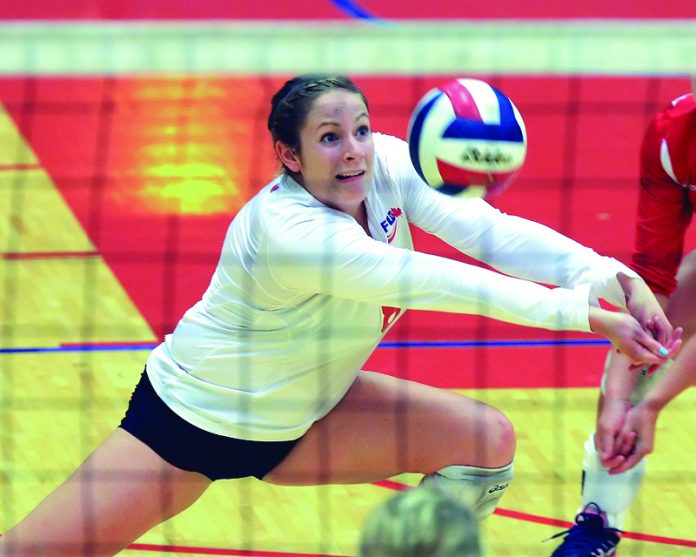
Outside hitter Kelsey Robinson making a desperate move to save the rally.

On Tuesday, the Clan won their GNAC opener against the University of Alaska Fairbanks by way of a sweep. The next night, though, the tables turned, as SFU was swept by another Alaskan team, the University of Alaska Anchorage Seawolves.

Although a sweep usually indicates a sizable loss, for the first two sets the Clan were neck and neck with the Seawolves, able to keep up but often unable to keep a lead.

SFU setter Brooklynn Gould-Bradbury, who led the team with 18 assists and provided eight digs, opened up the game with the first serve, although the Seawolves would score the first point. The Clan, though, would jump out to a sizable lead, reaching a peak of seven points at 10-3.

The Seawolves, however, got right back into the game, eventually tying things up at 16-16, helped in part by SFU giving up five straight points. UAA would then seize the lead, which they would not surrender for the rest of the set, winning it 29-27.

The second set would tell a similar story. This time, though, it was the Seawolves who got off to the early lead, taking the score to 9-5. In a role reversal, the Clan rallied back with a six point streak to take the lead at 11-9, which they would hold for most of the set.

When the Clan were leading 21-19, UAA started their push back, scoring three points to once again take the lead. SFU could only muster one more point before losing the set 25-22.

Although the first two sets were rather close battles, the third marked a serious collapse for the Clan.

The Seawolves rushed out of the gate after the intermission to a score of 13-2, aided by a remarkable eight straight points. Unlike the prior two sets, SFU was unable to fight back before losing handily 25-10.

Libero Alison McKay, who had 13 digs, was happy with her team’s performance in sets one and two: “I’m really proud of the way we played in the first two sets; I thought we fought really hard, we covered the ball, [we had] good hustle, we really kept up with them.”

She stated that the third set collapse provided a learning opportunity, acknowledging that frustration after the first two sets may have played a part in the Clan’s meltdown. “It’s always a bit frustrating, but now we have something to work on and push through.

“I think we can learn from it, to play consistent the whole way through,” she added.

Clan lose two in a row

0
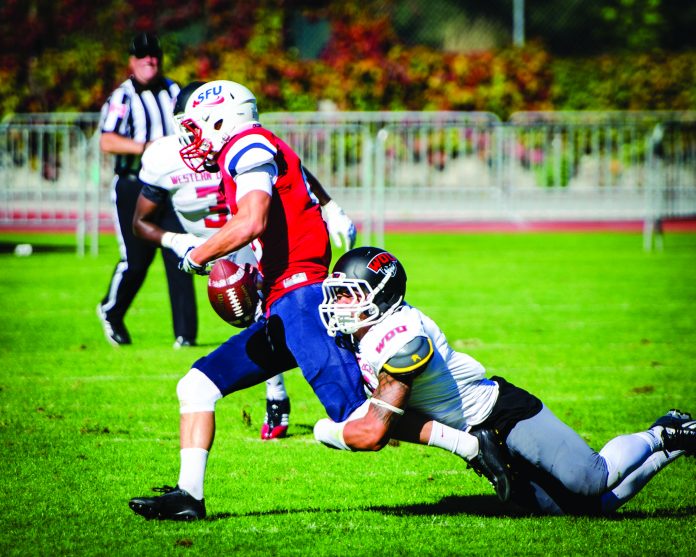
SFU were often unable to convert.

SFU has now dropped the first two games of the season, losing to the Western Oregon Wolves on September 13 by a score of 38-14. This marked their first game against a GNAC opponent, although it did not count in GNAC standings.

The first quarter was marked by little offence, with neither team putting points on the board, perhaps aided by the astronomical number of penalties against SFU. Although the flags did not contribute to the Wolves’ point total, they did serve to slow down the game and removeany Clan momentum.

In the first quarter, SFU went four of six on third down conversions, which is a good total, but it also speaks to the Clan’s inability to achieve first downs, and ultimately convert.

A bright spot for SFU’s offence appeared during a 5:45-long drive in which the Clan made it to the Wolves’ six-yard line, in part thanks to a 20-yard pass from quarterback Ryan Stanford to newly minted starter Sam Swerhone.

This forward progress was immediately interrupted by an interception in the end zone by Western Oregon with 1:34 left in the quarter. This would be one of SFU’s many missed opportunities and a sign of things to come.

Within two minutes of the second quarter, Wolves running back Joe Harris, who plagued the Clan all afternoon, ran the ball in for a touchdown, opening up the scoring.

SFU returned the favour quickly, however, when Chris Tolbert rushed five yards, tying up the scoreboard. However, Tolbert’s game has been inconsistent to say the least, with one fumble this game and two in the previous match.

SFU was forced to re-kick the ball twice after kicker Tiernan Docherty kicked out of bounds. Things would turn from bad to worse, as the Clan allowed a 62-yard pass to Wolves receiver Tyrell Williams for a second touchdown, returning the lead to the Wolves.

Turnovers would become the main story for the Clan; they ended up with four in the final tally, resulting in each of Western Oregon’s next scoring opportunities. The Wolves would score both a touchdown and a field goal off of turnovers, taking the score to 24-7.

SFU kept themselves in the game with a touchdown with only 12.4 seconds left in the half with a nine-yard reception by third-string running back Cole Tudor.

When the second half begun, however, any good will that the Clan built quickly evaporated when the Wolves scored another touchdown 1:42 in, and another just under half-way through the quarter, bringing the game to its final score of 38-14.

The Clan were unable to put any more points on the board and Western Oregon seemed content killing the clock.

Before the end of the game, head coach Jacques Chapdelaine took Stanford out, concerned that the team around him had given up on the game, particularly in the third quarter collapse.

“Our team just did not seem to have the energy to fight through adversity,” commented Chapdelaine. “That’s concerning to me, I don’t like to see that.”

With most of SFU’s problems being self-inflicted — mainly turnovers and penalties — he added, “We just seem to look for ways to hurt ourselves.”

However, not all was negative. Before being pulled, Stanford threw for 387 yards, while in the absence of wide receiver Lemar Durant, who was out with illness, much of the team stepped up. Bobby Pospischil’s 145 receiving yards were a game highlight, while Jamal Kett, Kyle Kawamoto and Swerhone each had over 50 yards. Linebacker Jordan Herdman led the team in tackles for the second week in a row with nine.

There were a lot of good things out there,” concluded the coach. “The elements are all there, we’ve just got to keep pushing on in the same direction.”

Battle for the Border

0

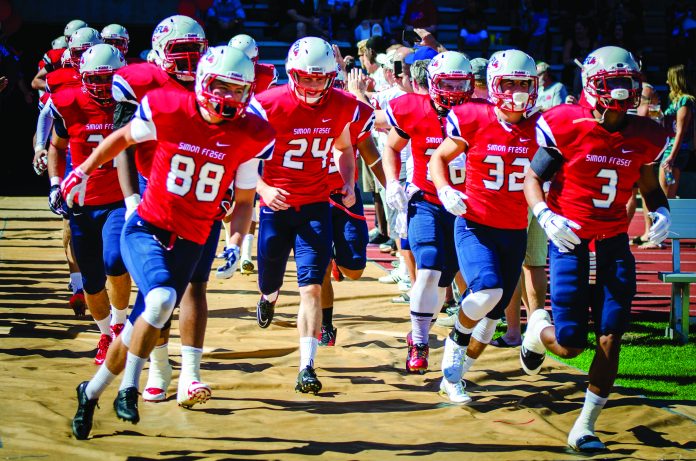
For $20, students can catch a ride to Bothell, WA to watch the Clan face the Central Washington Wildcats this Saturday, September 27.

The buses will leave from both the Burnaby and the Surrey campuses at 2:30 p.m. in order to get to the 6:00 p.m. game located in Bothell, just north of Seattle. The Facebook event posted by the SFSS estimates the drive to take two hours and 17 minutes.

The ‘Battle for the Border’ will see SFU face their closest GNAC rival — and their only opponent in Washington, in fact. SFSS at-large representative Jeremy Pearce explains the two teams are developing a rivalry, especially in the absence of the Shrum Bowl, and that they already compete for recruitment. “A lot of the time we’ll have the same recruits that we’re trying to get [as CWU],” he explained.

Pearce hopes that taking students to the game in Washington, which is a first, will help foster this rivalry.

Pearce, an SFU football veteran, also hopes to expose SFU students to NCAA football culture in a place where the whole community, not just the university, rallies around the team.

“It’s providing this unique opportunity. It’s an amazing atmosphere down there [in Bothell]. I’ve played on the football team for four years myself; it’s amazing down there,” he said.

“They have anywhere from 5,000 to 7,000 people at the game. I want students to experience that atmosphere and then eventually I’d love that atmosphere to carry over up here [at SFU].”

Students can buy tickets at the SFSS general office. The $20 will cover transportation and the cost of the ticket. Students will be returned to their respective campuses at around midnight.

Note: Students will be required to bring their passports or necessary visas in order to cross the border.

SFU loses home field advantage

1
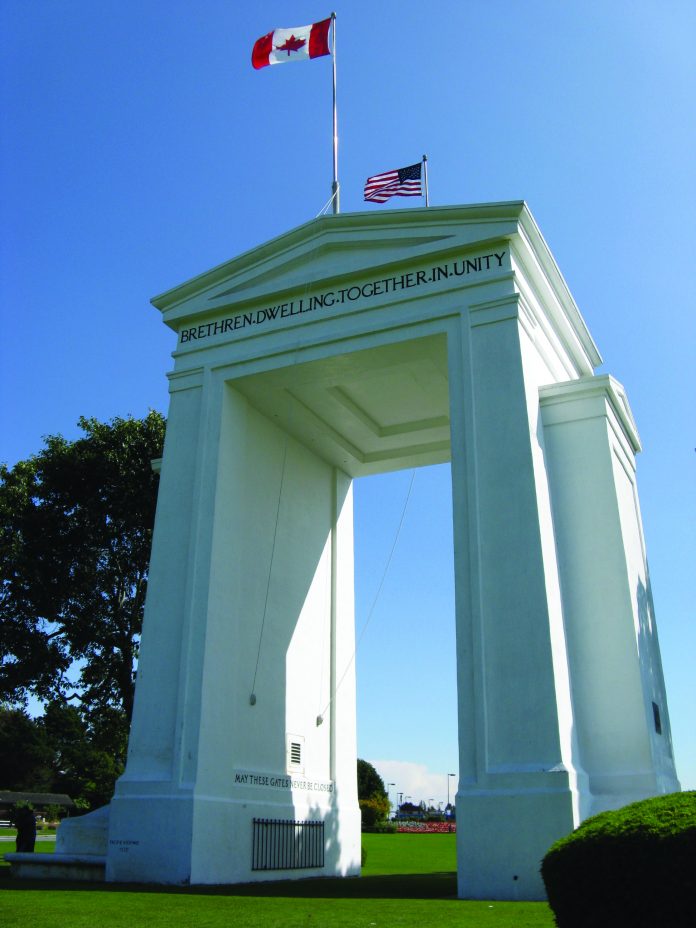
Playing at the Peach Arch could remove the need for passports.

If you’re a Clan fan like me, you may recall that after a hard-fought first season as a full member of the NCAA, SFU’s men’s soccer team ended the season ranked number one in the West Region. Which means — according to NCAA regulations SFU was granted home field advantage.

However, many of the American schools complained that some of their players and personnel don’t have passports to travel to Canada for the play-offs. Unfortunately, the American schools won, stripping SFU of their much deserved home field advantage.

As a die-hard Clan fan, this was something extremely upsetting to me. So, I began to look for solutions. That’s when I came across this special place within driving distance from SFU — Peace Arch International Park.

For those of you who don’t know, Peace Arch International Park is a park situated at the US-Canada border, half in BC and half in Washington. And what makes this park special is that visitors from either side can walk into the park both in BC and Washington without passports, provided they don’t wander further.

After some rough measurements, I’ve identified an area at the park with potential, roughly as large as Terry Fox Field without the track. SFU and the NCAA could simply set a temporary pitch using large pieces of artificial turf, plait the grid, and install temporary bleachers both on the Washington side and on the BC side and problem solved.

This solution, though not as optimal as allowing the Clan to deservingly host the play-off matches on Terry Fox Field or in Swangard Stadium, will render the “we don’t have passports” argument completely useless since passports would not be required.

More importantly, many Clan fans could actually attend the play-off games as the park is within driving distance of SFU.

Even though I still strongly believe that SFU should not suffer the consequences of the NCAA being unprepared, I hope that the universities will stop complaining and start preparing their passports in case the Clan,  once again, win the right to host the play-offs.

I hope the decision makers in Indianapolis will finally treat SFU like the full-fledged member of the NCAA it is, and stop stripping our rights like we don’t belong. We are part of the NCAA and should be treated as such.

At least for now, I may have found us a solution.

Meet the Clan: Callum Whittaker

0
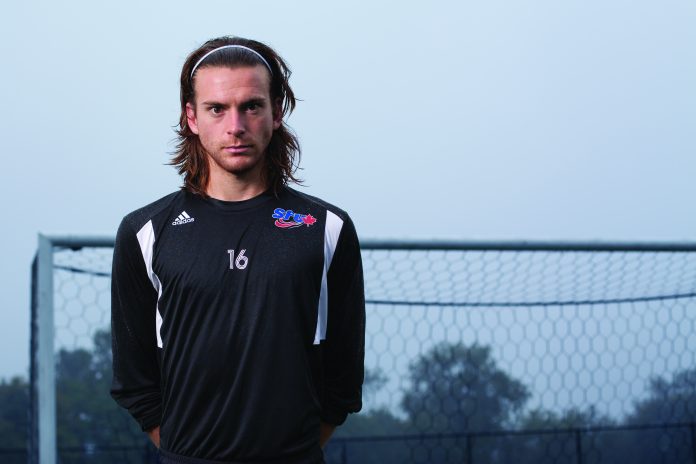
New division I transfer, Callum Whittaker hopes to help the men’s soccer team to a national championship.

Screen Shot 2014-11-26 at 5.10.27 PMTo compete at the highest levels of the world’s most popular sport, a young athlete must overcome many obstacles and sacrifice certain comforts in life. Academics also provides struggles of its own, and demands a great deal of focus and consistency in order to succeed.

What these two worlds have in common is the demand for mental strength and perseverance; for Callum Whittaker, these things come naturally.

A native of London, England, Whittaker brings an unmatched wealth of playing experience to the SFU men’s soccer team. The defender saw action with the youth teams of Chelsea, Ipswich Town, and Southend United in England before being named the captain of Northern Ireland’s U-18 and U-19 international squads. Not bad for a player who tried out the sport just for fun at age six.

Whittaker recalls, “My dad always played football as a kid, he was a part of Arsenal’s group as a youngster. But he never pushed it upon me and wanted me to find out what I wanted to do in life. It was random how I ended up doing it; one of my friends had a flyer for a local team and didn’t want to go alone. He left after the first session and I stayed on and pretty much went from there.”

Just three years later, Whittaker would be picked up by Leyton Orient FC and would sign his first contract lasting until age 16. Chelsea eventually paid the buy-out clause in the player’s contract at age 12.

“Chelsea is based out of Surrey, which was two hours away so it became quite strenuous on family to get me there three to four times a week. From there, at age 14, I went to Ipswich Town until I was 16. After, I began a sort of apprenticeship to live at Southend United’s hotel and trained with the first team as a 16-year old.”

Three years later, Whittaker’s playing career came to an end with Southend, but he was given the opportunity to take his game to North America and The University of San Diego, an NCAA division I school.

“I wanted initially to go to other clubs, but my mom said it would be best to get an education for free through scholarships. Moving away from home is tough, but leaving at 16 to go live in a hotel was a stepping stone that helped ease me into it. Probably the hardest thing was acclimatizing to the California heat when I’m used to rainy England.”

Now in his senior year, the communications major has landed in beautiful (rainy) BC as a new transfer to don the kit of SFU’s Clan. Alongside another Southend youth product, Robert Hyams, the Englishman immediately broke into the highly competitive starting 11, and made his defensive presence felt from preseason onward.

“I’m a big communicator, I like to because that keeps me focused. If I go quiet I can lose concentration, so if I talk it means I’m thinking about everything more and more,” said the defender. “I think I’m fairly tenacious in the tackle, I like to get stuck in, I don’t mind pulling up my sleeves and getting dirty when [I] need to. Besides that, I am comfortable on the ball and can pass it around to get things ticking.”

It is fitting that the outspoken defender has chosen communications as his field of study, but his hard work and grit show that actions can speak louder than words on the pitch. The English style of play is reflected in his aggressiveness and determination — traits that Whittaker admired in Manchester United’s legendary midfielder, Roy Keane.

“He was my idol, I loved his tenacious ability, his attitude was spot on everyday and I try to model myself after that. He is aggressive because it’s the winning attitude inside of him; it’s always football first.”

Screen Shot 2014-11-26 at 5.11.15 PMWhittaker started his play in the same position as the Red Devil at centre midfield, and displayed his versatility in the centre back and fullback positions.

Even when thinking of a career outside of professional soccer, Whittaker’s love for the game shines through — he suggests an interest in a career in media relations, saying, “I wouldn’t mind going into the media side of football, I could talk about the sport for the rest of my life.”

For now, though, his goal for this season is an historic one: to help SFU become the first Canadian NCAA champions. “As an athlete that would be a defining moment of a career. There’s always a bit of hatred at us, so it’s a burning fuel to go out and do it.”

Dance House brings Wayne McGregor back to Vancouver

0

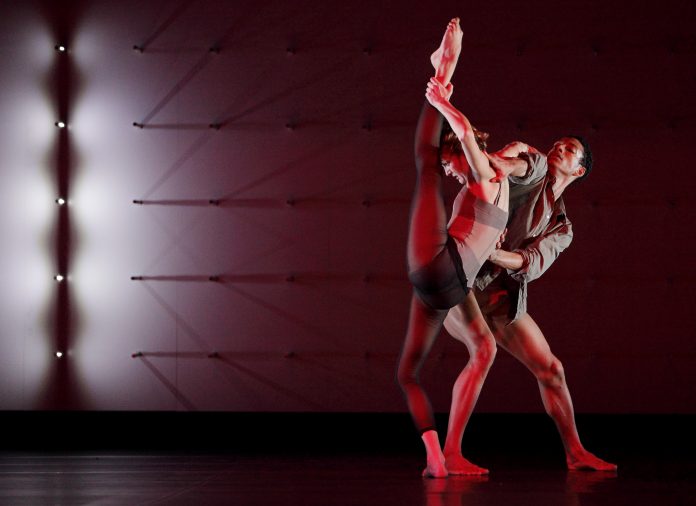
With a computerized pin board of 3,200 LED lights serving as the backdrop to Wayne McGregor’s latest work, Far, this acclaimed UK choreographer is playing with ideas of cognition and enlightenment. McGregor was last in Vancouver with Entity in 2012, and Dance House producer Jim Smith said that Far has a different tone.

“Far is a darker piece musically. The sound is a darker journey of trying to get to enlightenment, and there’s an ambient feeling.” McGregor deals with large ideas allowing the audience to make big abstractions based on the concrete questions that he’s asking about the brain and creativity.

“It’s very much about ideas,” said Smith. “McGregor spent a fair bit of time thinking about neuroscience and creativity and the brain.” He is also very interested in technology, explaining the light board which can be seen as representing the synapses of the brain.

Smith can see where the notion of enlightenment comes from in this work, and he said that it points to the growth and dissemination of information. “It’s about adding information to a larger body of work, the expansion of information. It’s the opposite of a dark age where there is a loss of information from society.

“In Entity there were large contraptions on the stage,” explained Smith, saying that “the set very much defines a lot of [McGregor’s] work.” In Far, the light board “fills the space and commands a lot of attention.” Although this might seem like it could overwhelm the stage, Smith said that they strike the right balance between the set and the movement itself. The large set pieces are also counterbalanced by the minimalist costuming which reveals the body so that the movement can be the focus. “The costumes are very pedestrian — they show the body in a natural way,” explained Smith.

McGregor has a distinctive style that is marked by fast paced, athletic movement. Smith explained that unlike much of the more conceptual work being created these days, McGregor dancers are athletes and the work is very physically demanding. “It’s very inventive movement; he’s establishing a signature,” said Smith. McGregor has choreographed for films such as Harry Potter and the Goblet of Fire and worked on a music video for Radiohead. He is able to strike a rare balance, excelling in both the world of contemporary dance and popular culture.

Dance House brings contemporary choreographers from around the world to present their work in Vancouver, and Smith explained that McGregor is part of the avant-garde in contemporary dance. “There’s a certain fascination of a generation and movement of choreographers that includes Crystal Pite and Hofesh Shector. They’re of a similar age and stage in their careers, and they’re on the cutting edge of contemporary dance in the world right now.” By bringing McGregor back to town, Smith said that Dance House aims to shed light on the current state of contemporary dance.

“Speaking of Dance,” a public lecture on this work, will be held at SFU Woodward’s on September 23. Far by Wayne McGregor’s Random Dance will be presented by Dance House September 26 and 27 at the Vancouver Playhouse. For more information visit, dancehouse.ca.