Home Blog Page 927

SFU consults community on 2016–2017 budget

1
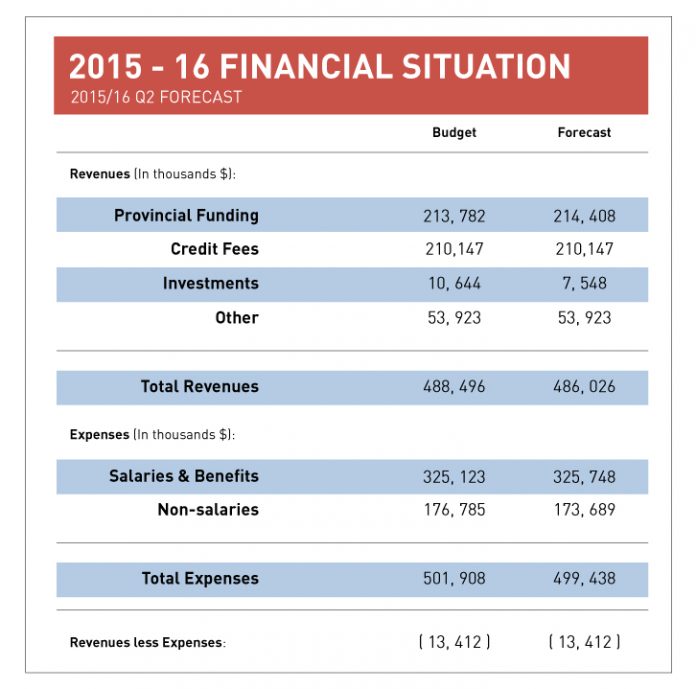
The financial outlook for 2015–2016 shows a revised investment projection with marginal changes elsewhere. - Graphic by Gabriel Yeung

SFU recently held a community consultation on the university’s 2016–2017 budget on October 29.

The session outlined SFU’s financial outlook and made budget recommendations for 16–17 with the help of Associate VP Finance Alison Blair.

This community consultation was the last of four events, after which the university will continue to put the budget together until it is ready to be confirmed in its final form by the Board of Governors on March 24, 2016.

Blair noted that “market uncertainty” in 2015 and 2016 “has caused us to revise some investment income projections.” Income from investments was revised down to $7.5 million from the initial projection of $10 million in 2015–2016.

Last year’s tuition fee increase of 2 per cent for all students led to a $4 million increase in revenue and the additional 8 per cent increase for international undergraduates only led to a $6.5 million increase in tuition revenue for 2015–2016. 

Among the recommendations for the next fiscal year’s budget made were an “across the board tuition fee increase of 2 per cent,” and a 25 per cent higher fee for international fees for the Masters of Business Administration (MBA) program, MSc in Finance, and the Management of Technology MBA, over the domestic fees.

While the audience in the Diamond Family Auditorium was sparse, those in attendance raised questions about various aspects of the budget recommendations, especially the raise in international student fees for the MBA program.

Said one student in a question to the presenters, “If this is a consultation, which I’m not sure if anything we say here today will change anything, I would like to speak against [differential fees].” She continued, “It is an exploitation to charge one group [more] for the same product depending on where they’re from.”

VP Academic and Provost Jon Driver characterized the rationale for differential fees as “pretty straightforward arithmetic.” He explained that the university currently dilutes the grant it receives from the provincial government by taking in more students than the province pays for.

He noted that the university considers the cost of accommodating more graduate students as “the price of being involved in research.”

Said Driver, “In the case of the MBA program, I think we would see this as a less research intensive program. It’s basically a program that confers a very significant financial advantage on the people who go through the program.”

One question from the audience brought up the issue of divestment from fossil fuels and whether or not the issue was on the table for next year. Blair responded, “No, not at this time.” She did, however, mention that the board recently created a Responsible Investment Committee and is “looking into” investing more into sustainable industries.

The Ubyssey reported on Oct. 26 that UBC is currently lobbying the provincial government for removal of the cap for domestic tuition fee increases of 2 per cent.

Driver explained SFU’s position on the cap, referring to a document produced by the Research Universities Council of BC (of which UBC and SFU are both members), which states the group “[does] not want to appear either in favour of taking the cap off or in favour of the cap being universally applied because [members] do have certain programs where there is a genuine need to increase tuition.”

The Simon Fraser Student Society (SFSS) was also on hand to detail the society’s role in the university’s finances. VP External Relations Kathleen Yang spoke to recent lobbying by the SFSS:

“We asked for four key things,” she explained: funding for open textbooks, increase to capital funding, and the ability to self-finance capital projects were among the concerns the SFSS brought to the provincial government.

“Those are our key asks,” said Yang, “Whether or not they take those key asks is another story.”
Sitting down has never been so friendly

0
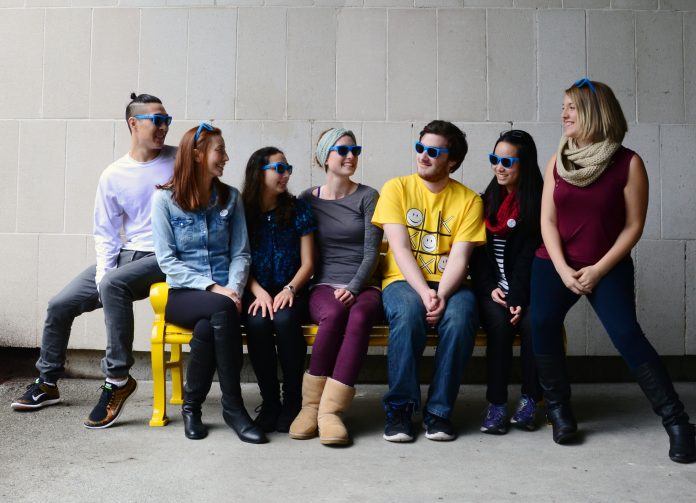
The bench is meant to serve as a safe space for people to talk about mental health issues. - Photo by Lisa Dimyadi

Have a seat and make a friend! SFU’s Hi-F.I.V.E. Movement for Mental Health has unveiled a new Friendship Bench on Burnaby Campus.

Operating with the support of SFU Health and Counselling and the Simon Fraser Student Society, Hi-F.I.V.E. is a student-led group that started at SFU to advocate for mental health awareness.

The group hopes that the gift of the bench will become a symbol of the importance of mental health for all visitors to campus and will encourage people to feel comfortable to talk openly about mental health issues.

“Resources do exist and help is nearby if you need it,” said Hi-F.I.V.E. coordinator Tanya Miller, emphasizing that no one should have to “suffer in silence.”

Located in a courtyard on the south side of the AQ, across from the SFU Gallery, the bright yellow bench invites passersby to sit a spell, connect with others, and foster a safe space for individuals that are in distress.

The bench is the only installment in Western Canada and just one of five that the project has begun to roll-out. Hi-F.I.V.E. hopes to have the courtyard renamed to reflect the significance of the space. 

Photo by Talha Qadir

The Friendship Bench initiative was founded by a group of three men who have all grappled with or experienced a loved one deal with mental health issues and suicide. Suicide survivor and co-founder Sam Fiorella got involved with the project after his son, who was a student at Carleton University, took his own life in 2014.

“The bench itself was chosen to represent the coming together of students and students helping each other out, talking to each other,” explained Fiorella. “We wanted something that was more than a one-day campaign, that was a permanent thing.”

The project raises funds to install benches on secondary and post-secondary campuses across the country, as well as donate $1000 to a local campus group to provide mental health awareness education, marketing assistance, and financial support to services for those in crisis.

Each bench is accompanied by a plaque and a URL leading people to all the mental health resources that their school makes available to students. People are encouraged to use the hashtag #yellowisforhello as a public forum for open and honest communication about mental health.

The Friendship Bench’s partnership with Hi-F.I.V.E. will extend outside of SFU. “If campuses don’t already have a mental health initiative, they’ll suggest Hi-F.I.V.E.

It is applicable to anywhere, really,” said Miller, adding that the University of Tokyo, among others, is currently in the process of adopting a Hi-F.I.V.E. group of its own.

The initiative’s webpage encourages people to connect with others: “Getting the help you need or making the difference in the life of someone struggling starts with a simple ‘hello.’”

Laugh Track: Paul Anthony

0
Illustration by Gabriel Yeung

If variety is indeed the spice of life, then Paul Anthony’s Talent Time is a bowl of Carolina Reaper peppers soaking in Tabasco sauce. A live variety/comedy show currently in its eighth season, Talent Time combines musical acts, live comedy, and unique/bizarre performances into one of Vancouver’s most deliriously enjoyable monthly events. (Each installment also gets filmed, edited down, and later aired as a half-hour cable access show.) At the centre of it all is Paul Anthony, creator, talent booker, host, and titular glue that keeps everything together.

Read on to learn more about how Talent Time has changed since its debut eight years ago, what an act needs to make it a good fit for the show, and how committed Anthony is to keeping Talent Time going.

Where did the idea for Talent Time come from?

There are so many different answers to that, one being that I’ve done a variety show my whole life. When I was a kid, we would put on little shows at Thanksgiving for our family, and I used my cousins and aunts and uncles. So I’ve always been interested in variety performers and I always get really bored with any scene. A lot of comedian friends will just do comedy shows and hang out with other comedians, and a lot of musician friends just go see their friends’ bands play, and that’s about it. But I’d be going on the SkyTrain out to a mall in Surrey to see a talent show, and I’d watch two hours of garbage and then you’d see something that’s so fantastic and magical and I’d want the whole world to see it. And I could never get friends to make that journey, so I thought I’d bring the acts into the city and put on a variety show.

How has the show changed over its eight seasons?

It’s grown at such an interesting, organic rate, which means really slowly in this case. I was trying to figure out what the show was this whole time. I wanted the format to be somewhat of a variety too. I was using different co-hosts all of the time, I was really playing with what you could get away with, what the audience was drawn to. The first couple of years, it was more punk-rock and raw, with some positive moments and then a lot of really dark shit, and as it kept going it slowly became about championing the human spirit. I didn’t mean to do that on purpose; it’s just what the audience responded to the most, and what I liked more. Over the years it’s become a real community show. I’ve stayed in contact with a lot of people who’ve been on the show, some have become friends.

Historically, are there any types of acts that have been fan favourites for the audience?

If it has all of the elements, of being something that people don’t generally see or haven’t even thought of it existing, and then you add genuine talent with a really interesting personality, then that’s a homerun. But that’s hard to find. We have lots kids and seniors on the show, people who aren’t hyper-conscious of being cool or what they look like. They’re just going from the heart.

What are some of the challenges that come with being the host to such a range of eclectic acts?

It’s challenging to stay present the entire time, when I’m producing the show. I can’t help but think about, “Okay are they setting the next thing up? Has that sound effect been loaded yet?” If you’re not present as a host, it’s kind of painful to watch, and I’ve done that way too many times. One thing that takes the pressure off is having my co-host Ryan Biel, which is one of the reasons why I brought him on. He’s just so funny and likable and present, that if I’m off in my head for a moment doing something, the show doesn’t fall apart.

What were you drawn to first: comedy or acting?

I always liked the sound of humour. I would go to bed curled up to my ghettoblaster speaker and listen to old comedy shows, whatever was on the radio. Even as a kid I remember not really getting it; I just loved the idea of laughter. I remember watching my dad make his friends and family laugh and it just seemed so magical. I started acting as a sort-of skipping school strategy. I wanted to stay home from school, but I had just seen Ferris Bueller’s Day Off and I thought that if I walked out into the world like me, the principal would find me. So I’d put on my dad’s clothes and started walking differently and putting on accents, so then I could go out and rent a movie and get a personal pan pizza from Pizzahut, come home and enjoy the day.

Then I started just doing all sorts of experiments, like dressing up like a homeless kid when I was 11 and just riding the bus and going through garbage cans and seeing how people reacted. The psychology of it all was what interested me, just figuring out why people do certain things. Even now I still find it fascinating.

What can people look forward to at the upcoming Games Night edition of Talent Time?

You’re going to see the great acts that you’ve come to expect from the show, including a 12-year-old pop singer who wrote and recorded her own pop song; we have the Runaway Four, who do videogame medleys, so they’ll be playing to actual gameplay from retro video games; comedian Sophie Buddle; a couple of surprises. And then the second half will be the Family Feud part. We’ve actually built a set for it. It’s going to be very analogue and hand-made, but made by really talented people; a lot of them professionals in movie and theatre, so it’s got a cool mixture. The games are real questions too. I did research to find surveys of 100 people, so I wasn’t just making it up.

What do the next eight years hold for Talent Time?

There’s something really hilarious to me about doing this show my whole life. I think I’m in it for the long-haul, because it seems really funny to be 80-years-old and still hosting this show. Like, a cable-access variety show that you’ve hosted for your whole life? That’s just funny to me. And that just shows the stupid lengths I’ll go to for something that makes me laugh, because I’m willing to just mess with the trajectory of my whole life so that when I’m on my death bed, to just be chuckling to myself that I did a cable-access show for zero money my whole life. I have a daughter who’ll be two in December and she was first on the show in her ultrasound video, so maybe one day I can pass the family business off.

Experience the magic of Paul Anthony’s Talent Time for yourself: the Games Night edition is on November 5, with a new Talent Time happening on the first Thursday of every month at the Rio Theatre.

Woohoo, Boohoo

0

Woohoo: Hotmail

I’m a classics kind of gal. I adore all things old. Shakespeare takes over my bookshelf, Elvis takes over my iTunes library, and Degrassi takes over my DVD collection. All things old are gold.

And this is how I feel about my archaic Hotmail account — every early 1990s child’s dream. Fancy emails accounts like [email protected] and [email protected] made us very excited to lurk inside our inboxes full of atrocities.

Anything and everything from “If you don’t send this to seven people within the next five minutes, your dad will die tomorrow,” and “These naked Asian women are ready for you” ads seem to have found your email address, whether or not you actually signed up for them.

The phishing scams that Hotmail has to offer are plentiful, but quite frankly, we’re old enough now to know better than to believe the Nigerian Prince who’s willing to give us $6 million USD if only we help him get into the country for two grand.

Boohoo: Out-dated, hot males

Hot males have a way of capturing our attention, old or not. From George Clooney to Zac Efron, there’s always a choice for someone. Hot males exist in our SFU halls: from Julian Somers in Health Sciences, to Robert Prey from the Communication faculty, each department has got something sexy to offer.

Hot males make me happy. I’m thankful to stand close to them, to talk to them, to creep down the hall after them, to watch from the windows of their homes as they cook dinner. . . hypothetically, I mean.

But all of this changes as soon as I see a hot male using Hotmail. Like, come on, dude. It’s the 21st century. Get with the program. And by program, I mean Gmail, duh. Unless, of course, you’re Clooney, in which case you may use Hotmail.

However, I draw the line at Internet Explorer. Just, no.

Textbooks are okay, PDFs are not

0
Image by Olivia Tsai

Since the beginning of my university career, the most exciting part of a new semester has been buying new books at the bookstore. I know that this isn’t the most affordable or efficient way to get my course material, but I do enjoy new books; the ability to crack the spine and inhale that new book scent. I’m even okay with having to purchase custom-bound course packs. And while I may sound as if I’m advertising for the SFU Bookstore, I actually defend all print books for class in general.

Sadly, the PDF has become the bane of my university experience; I haven’t had a class in recent memory that hasn’t included multiple PDF readings, if not entirely comprising the course reading list. While this may seem like an excellent idea to save money, for me it simply isn’t worth it. One reason being that I don’t appreciate having to fight with Canvas to download my readings. While it’s nice to have access to an online learning hub, Canvas doesn’t constitute the most user-friendly experience, and depending on how well my professor understands the system, I may spend an excess 30 minutes trying to find one reading.

Also, what platform should I read it on? My highly distracting electronic device that’s one quick swipe away from a black hole of procrastination? Do I buy a printer, ink, paper, and an industrial stapler to print my own copy? Or do I waste time buying a printing card and having to return to library to keep printing unbound pages? None of these options seem like a great idea, yet this is the predicament I face. We have to be prepared to waste our valuable time and money to print off reams of paper that we will probably never give a second glance to, and that we can’t even sell to the next wave of students taking that particular class.

Professors often justify this PDF conundrum as being more cost-effective for students, or because they don’t like the way that that the supplementary readings are printed by document services. My time is money and I would rather have a neatly organized, pre-printed and bound set of readings than have to print, organize, and try to not lose what is sometimes 40-plus loose-leaf pages of readings per week.

Finally, PDFs allow professors to sneak extra readings into the course curriculum. When registering for class, I always look at the course outline so I can prepare myself for what I will have to read, and so I can roughly estimate how much time the class will take.

The books listed seem manageable for my selected course load; inevitably, though, when the syllabus arrives, there are three to five supplementary PDF-based readings every week to accompany the books that are also assigned. While it is my own fault for forgetting that there are always PDF-based readings, I naively hope that what the outline lists as assigned books are truly the only readings for the class.

I know that the PDF isn’t going anywhere because of the importance placed on technology in academia, but I really do miss the printed book, the fact that it is nicely bound, and unplugged. And when all else fails, it decorates your shelf to make you look more educated than you feel. 

Political selfies relay excitement, not self-indulgence

1
Illustration by Momo Lin

As I type this, Internet-Zach finds himself swimming in two types of digital expression: political spiels spurred by the critical October 19 election, and the omnipresent stream of selfies. As different as they appear on the surface, they have much in common.

Social media makes self-expression simple;  we can make ourselves an open book to the rest of the world. Inevitably, our aims in placing ourselves on display in such a way are called into question.

People commonly accuse avid Instagrammers of using selfies to brag; to show off themselves and their lives like trophies, putting the rest of us to shame. As being politically-minded and civically-engaged grows steadily trendier, many who showcase their political views through social media are painted with a similar brush.

Jen Gerson, the writer who first made this point, summarize her argument best in The National Post on October 13 by saying, “It’s not even about being part of a political party as much as it is about demonstrating that you’re part of a political party. The sort of person who belongs to such things.” That is, people post photos taken with ‘X’ political leader not out of real concern for politics, but to ensure others know how fashionably educated they are.

While there are undeniably such people out there, portraying everyone pushing the #StopHarper hashtag as cut from the same cloth seems rash. That the point is made through a comparison to the selfie is an awfully condescending double-whammy. There really shouldn’t be anything wrong with sharing aspects of your life on a platform that’s specifically designed for doing so, nor should it result in being labelled a ‘fake.’

Gerson describes the selfie as a symbol of how self-obsessed we’ve become in the modern age, but it’s more than a vain indulgence; it’s a mark of healthy confidence and self-love. Why should we make fun of it any more than we do other forms of photography? If we ourselves, humans, full of emotion and intrigue, don’t qualify as art, then what can?

She proceeds to link selfies and politics, and bases her doubts of people’s passion towards the political issues on the kind of posts people make. As an example, she notes that selfies taken with Justin Trudeau “rarely, if ever” include actual discussion of his platform in the caption.

But really, this is a little petty. It very much comes off like asking someone: “You like this band? Prove it. Name five of their songs.”

Gerson is a prime example of a significant subset of people — those who eschew forms of social media and look down on those who embrace it. ‘Of course selfie-sinners couldn’t actually have intelligent thoughts,’ is what it amounts to, and this is both close-minded and elitist.

I do apologize for the fact that, in the event that I meet the leader of my preferred party and take a photo with them, it will probably not be accompanied by an APA-style essay even after it hits the Internet. I’d like to think I’m allowed to support a party without being obligated to speak on their behalf at every opportunity.

Perhaps I was more concerned with being in the moment and sharing my excitement than going into details. Perhaps I figured that anybody who cares either already knows about my party’s platform, or has the ability to check for themselves within seconds. Perhaps I’m respecting that not everyone appreciates being flooded with political info on their news feeds.

And maybe, just maybe, I’m secure enough in my political beliefs that I don’t feel like I have something to prove.

This week in comics

0

AgoraphobiaThe Adventures of Agoraphobia Man: World Defender (Jacey Gibb)

BW- Jeremys ExcusesJeremy’s Excuses (Reuben Newton)

BW-CrapsideThe Crapside (Ryan Stella & Darien Lechner)

Screen Shot 2015-10-30 at 9.53.19 PM Creator’s Pet (Destiny Hsu)

Screen Shot 2015-10-30 at 9.53.30 PMPeers (Leslie Lu)

Satellite Signals

0

WEB-woodwardWoodward’s

The Djavad Mowafaghian World Art Centre will play host to a panel discussion titled, “Social Inequality in the City” on Monday, Nov. 2.

Starting at 7 p.m., the event will explore the growing inequality gap between the wealthy and the poor and how it relates to “decreasing health outcomes, poorer education levels, higher rates of mental illness, higher levels of incarceration and less social mobility.”


segal_building-01Segal Building

What is the ecological role of forest fires in BC and how do they affect human health issues? Experts will address these questions in the free lecture, “BC’s Balancing Act: Forest Fires, Ecology, Smoke and Health.”

The talk will be held at 7 p.m. on Nov. 5 in the Segal Building downtown.


Surreysurrey
As a part of SFU’s 2015 Community Summit, SFU Surrey presents “Leading and Learning,” an evening of conversation around using innovation to improve sustainability in cities like Surrey. The event will feature presentations from community leaders on Nov. 5 from 7 to 8:30 p.m.

Midterms

0

It’s that time again, midterm season. Few can name a time more depressing.

Created by Paige Smith & Eric Smith
Special thanks to Jacey Gibb & Joel Lionborn

TSSU ceases job action

0

SFU’s Teaching Support Staff Union (TSSU) will be ceasing job action and allowing its members to release grades effective immediately after voting to enter into binding arbitration with SFU administration.

The union voted by majority on Oct. 28 and with the recommendation of the TSSU Contract Committee to accept Final Offer Selection through binding arbitration.

As a result of this vote, job action ceases immediately and the two parties will return to the bargaining table over a period of 21 days.

If, after the bargaining period, there are outstanding items, arbitrator Vince Ready will have the final say on matters and his decisions will be binding.

One TSSU concern that was ironed out in a Memorandum of Agreement, pertained to the arbitrator’s authority to make a binding decision. “Initially, what we had received from SFU’s administration was something that did allow the employer to undo the binding arbitration,” said TSSU Chief Steward Reagan Belan.

That option has since been removed from the Final Offer Selection process. Belan explained that this removal was key to allowing the Contract Committee to feel comfortable recommending that members vote to accept the proposal.

“In an ideal situation, we won’t have anything to refer to Final Offer Selection — we’ll just deal with it all in bargaining and the arbitrator will not enter into it,” expressed Belan. She added that she is “optimistic” that will be the case.

SFU stated in an online labour update that it is “strongly committed to this process and anticipates a respectful and productive conclusion to bargaining.”

In the meantime, TAs and sessional instructors are allowed to release their students’ grades as soon as possible.

SFU warned students that this process might take a while: “The University is prioritizing the return of grades to students as soon as possible, but this may take a few weeks.”

All withheld grades are currently locked in archives and members will need to physically go and retrieve them. Belan concluded, “We would just ask those students to be patient, because it will take a little bit of time.”