Home Blog Page 925

Cinephilia: Wim Wenders retrospective features Paris, Texas

0

With the upcoming release of Everything Will Be Fine, Wim Wenders’ latest film starring Rachel McAdams and James Franco, The Cinematheque is presenting a retrospective of this important filmmaker’s nearly 50-year career, showcasing 14 of his features and a collection of his experimental short films.

Along with contemporaries Rainer Werner Fassbinder and Werner Herzog, Wenders was at the forefront of the New German Cinema — arguably the most influential filmic movement of the ’70s. Fassbinder’s The Marriage Of Maria Braun, for example, tackled the effects of America’s cultural influence in West Germany.

Wenders has previously focused on the effects of American influence on his home country in The Goalkeeper’s Fear of the Penalty, and the alienation outsiders feel within the US in Alice and the Cities; here, though, he shifts his gaze towards the isolation that Americans may experience within their own country in Paris, Texas. Wenders’ masterpiece of cinematic storytelling and character-driven empathy is a mythical introspection into American identity from the perspective of an indigenous outsider who clings onto the past.

Dressed in a suit, tie, and ball cap while covered head to toe with dust, an everyman stands amidst the expanse of a Texas desert. For a brief moment he stops to take his final sip of water before continuing his trek towards the infinite horizon. When the man is picked up by his brother, he can’t speak. An empty vessel, a nameless cypher with no memories, a Biblical figure wandering the desert looking for the Promised Land. We instantly speculate: “Who is this man, and where is he going?”

Paris, Texas is about this man becoming someone and going somewhere. The man’s name, Travis, contains many connotations — an allusion to the defender of the Alamo and also the protagonist of Taxi Driver. Inspired by John Ford’s The Searchers, there is a mythical feel of Western movies that permeates most frames of Paris, Texas. The film is about Travis’ attempt to grab onto old myths in a milieu of evolving Americana.

Travis’ brother Walt is well-adjusted in this new city landscape where cowboy boots have been replaced with dress shoes and the vast expanse of the desert has become crowded by skyscrapers. Attempting to cling to the old ways, there is a telling moment where Travis asks to trade his shoes for a pair of older cowboy boots that Walt never wears.

What is as striking as it was 30 years ago is Wenders’ ability to meticulously express emotions, themes, and symbols through compositions and editing — the way he frames the space and organizes it through cuts (a famous scene where Travis talks to his ex-wife divided by a pane of glass is unforgettable). Written by the talented actor and Pulitzer Prize-winning playwright Sam Shepard, Paris, Texas won the Palme d’Or at the Cannes Film Festival in 1984 and remains one of the greatest films ever made. 

The title, a juxtaposition that borders on oxymoron, is not just a clever indication of Wenders’ European perspective on American identity, and thus a progression of his work in the New German Cinema — it also plays an important role in the film’s thematic development. Travis tells us that the small, nowhere town of Paris, Texas is where his parents conceived him. Tellingly, we never see the begotten, old, western town. It remains an archaic ideal that Travis holds onto — like an old Germany untainted by American imperialism.
New CBC podcast tells student stories

0

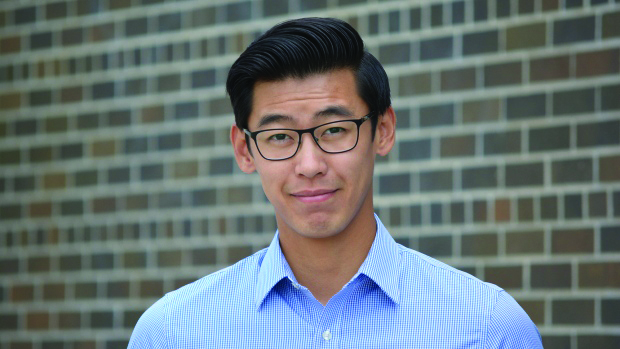
CBC has decided to delve further into the world of podcasting, and has chosen post-secondary students to be the captivating subjects into their latest foray.

Campus, an online-exclusive from the CBC, has launched onto airwaves during this fall semester and is starting to make waves for its intimate and immersive stories of extraordinary students.

Albert Leung, host and creator of Campus, said that the network wanted to get in on the podcasting craze and the coming-of-age atmosphere of university was an appealing place to start.

“University is really that ultimate crash course in life,” said Leung. “At an early age, there’s so much that young adults have to deal with. The threat of failure, the pressure to succeed, and I always say this to people, that university is this trial by fire.

“We felt campuses were a breeding ground for memories to be made, moments to be had, but ultimately great, great stories to be told.”

The series is currently three episodes deep, with each episode ranging between 15 and 20 minutes. To start things off, Leung and his crew have featured a young woman who went blind weeks before attending university, a student who became homeless while completing his masters degree, and a student who came out as trans during their time at school.

Before Leung was the voice of Campus, he covered the Olympics, the Ottawa shooting, and other national news events in Canada for the past eight years. The switch from doing all that to diving into these immensely personal stories requires a bit more of a delicate touch.

The payoff for this diligence, though, is the ability to shed new light on the same, often political stories that CBC is more used to reporting on.

“Sometimes, you lose the humanity [doing hard news]. I think breaking news tends to be obsessed with getting the facts out there, and sometimes not how people feel about everything,” Leung said.

“For people who consume news normally, for them to be able to hear just how much of a struggle it is, for example, for a transgender student to go about their daily life or to be more specific to make the decision to take hormone replacement therapy and change their everyday voice, I think hearing those types of stories gives a lot of context to major issues that students and Canadians in general are facing.”

Campus is currently slated for 15 episodes, but as with any pioneer project, there isn’t really any true sense to predict what the show — or CBC’s relationship with podcasting — could become.

Leung went on to say that while response to the show has been limited so afar, it has been garnering a steady positive reception.

If you believe that you know of, or personally have, a story that goes above and beyond that of a typical student, you could be part of this podcast by submitting your tale to [email protected].

Michelle Nelson urbanizes homesteading in her new cookbook

0

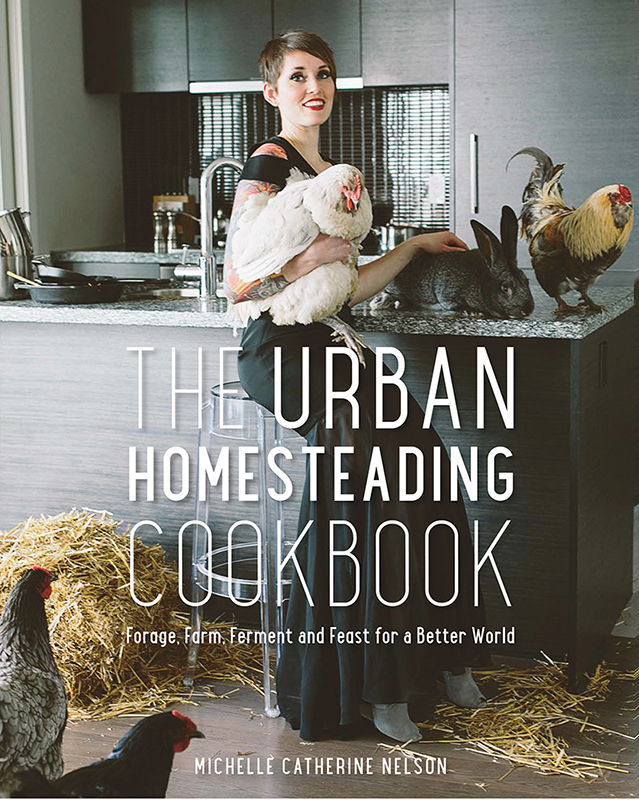
Michelle Nelson, author of The Urban Homesteading Cookbook, graduated from SFU with a PhD in conservation biology. While at SFU, she also wrote articles for this very section of The Peak.

Her new book provides guidelines to create a better, more sustainable lifestyle that promotes saving BC’s environment, one ecosystem at a time. The recipes focus on using abundant ingredients (both native and non-native to BC), including invasive species. Her idea: to literally eat away the problem.

Invasive species, which have been introduced to Canada from other countries, outcompete native species and cause entire ecosystems to collapse. According to Nelson, “purple loosestrife, Japanese knotweed, and American bullfrog [are] three that are really easy to identify, really easy to find, and super invasive.” Humans are doing nature a favour by collecting as many of these species as possible.

Besides caring for our ecosystems, there are also moral and health-related reasons for becoming an urban homesteader, as the book explains. Commercially-produced fruits and vegetables often contain harmful chemicals, including pesticides and herbicides, which are dangerous for human consumption. It’s far safer for someone to grow and eat their own food than to buy it from the grocery store.

From a moral standpoint, many farms have become industrialized and grossly mistreat animals. They raise livestock with the primary purpose of making profit. Their goal is simply to get food onto people’s dinner plates; animals become products, rather than living beings with rights. People can instead raise their own animals, such as quail and rabbits, and ensure that they are provided a decent quality of life.

Beginning in a downtown Vancouver apartment, Nelson explored the best way to adapt homesteading to an urban way of life. She experimented with keeping quail in a rabbit hutch, growing vegetables, and foraging for invasive plants and animals. From all of this she was able to craft original and delicious recipes using sustainable ingredients. Such ingredients taste fresher and have far more complex flavours than any store-bought products.

From brewing beer to preserving jam, her recipes cover a wide range. Even someone who has little or no experience with farming or foraging can find ways to become a more sustainable consumer. It’s as simple as using a single pot to grow, for instance, Portobello mushrooms indoors.

Another great entry point is foraging. As Nelson says, “You could start with collecting things for tea, like rosehips or clover or mint; those are really easy to find.”

For bakers, chocoholics, or anyone with a sweet tooth, there’s a recipe for Dark and Stormy Chocolate Cupcakes with Cricket Flour. Tempura lovers should try the Sesame Panko-Crusted Frog Legs appetizer.

Beyond featuring just recipes, Nelson’s writing provides detailed instructions on how to identify different species and in which habitats they can be found. All four sections on foraging, keeping animals, growing, and preserving are further complimented by beautiful photographs.

Nelson describes her urban homesteading lifestyle as “rewarding” and believes individuals can help to improve BC’s ecosystems. She hopes to “inspire people to try something that’s in the book and make that connection between conservation and food production.” Whether you have a sprawling backyard or live in a confined apartment, it is possible to make a difference.

Nelson intends to continue writing her way to a better world, and future books she is considering would focus on foraging for greens, including herbs and flowers, or eating invasive species.

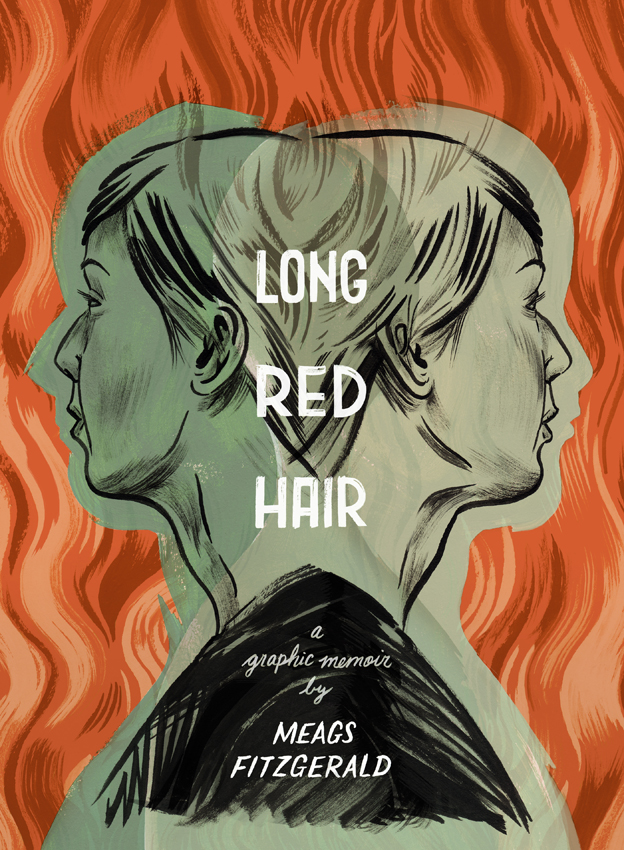
Comic Connoisseur: Long Red Hair is an insightful graphic memoir

0

Meags Fitzgerald sits cross legged in front of her archaic television set beguiled by the classic motion picture Who Framed Roger Rabbit? Coming across a particularly provocative scene in the film, Fitzgerald began to rewind and play her cassette tape to fanatical tedium. Captivated by the screen presence of the timelessly titillating Jessica Rabbit, it was then and there she realized that she was not like the other little girls on her block. It was then and there she discovered her attraction to women.

Long Red Hair is a graphic memoir in which author Meags Fitzgerald recounts her early childhood and progression to becoming a confident and fully-realized adult. She places particular attention and focus on defining moments in her life, highlighting comical discussions with her mother and endearing moments of frustration and sadness. Coming to terms with a sexuality she cannot aptly define, we follow Fitzgerald as she goes through sleepovers, her first kiss, and the discovery that menstruation is not pleasant.

The story is also chalked with tons of nostalgic references and throwbacks to the 1990s for those of the millennial distinction. Where some references might negatively date a story, Fitzgerald succeeds in crafting a memoir which really places the reader in the shoes of its protagonist and her world growing up.

In a lot of ways, Long Red Hair is like an alternative version of Richard Linklater’s film Boyhood (with a more forgiving runtime). However, that never takes away from the experience of reading this graphic memoir, because it ultimately provides a story which is much more intriguing and captivating.

This is in part due to the author’s unique upbringing. Fitzgerald’s life is devoid of a cookie cutter template, which makes for a highly engaging read. Getting to see the world from the perspective of a pansexual character is not only invigoratingly refreshing to experience, it’s also quite enlightening.

The memoir is a fantastic snapshot of the life of a character struggling to find their way in the world. It’s also a great reminder of a time when different sexualities were not widely spoken of with the accessibility and understanding they are today.

Fitzgerald’s artwork is warm and inviting to readers. The art style is reminiscent of the penciled sketches that might fill one’s personal journals. Every page is enriched with in-depth rendering that provides layer upon layer of rich exposition of the characters and environment.

The colour red also plays a significant part in the story. The subtle symbolism of crimson which laces the story grabs the eye. While a literary element such as this can sometimes be a nauseating expense, Fitzgerald’s use of the colour red is a well-developed cherry on top for the story that leads to a stellar payoff.

In the end, Long Red Hair is nothing less than a gratifying memoir filled with many memorable and heartfelt moments. And it will leave you misty-eyed as you see Fitzgerald find herself in the final pages.

Food Fight: Cafe Deux Soleils is the ultimate veggie hipster eatery

0

The ambiance of Café Deux Soleils explodes out the doors onto their large, scenically painted entrance wall. It is easy to see that their goal is to make a healthy and trendy home-away-from-home aimed to be a hub for casual meetings, such as coffee catch-ups, study dates during the day, and relaxing nights out.

The presentation of the menu has to be my favorite part of this cafe. On a huge blackboard on the wall, colorful chalk professionally scripts the surface with vegetarian and vegan-friendly comfort food. Other things that I felt fit perfectly with the rustic and homely ambiance were the semi-open kitchen, the worn-down furniture, high warehouse style ceiling, and a children’s play area.

Almost every night, you’re in for a performance, whether it be local live music, a comedy show, open mic night, or a poetry slam. Whether you are interested in playing at Café Deux Soleils or showcasing your art, they are open to contact. These events and booking forms show that the cafe is as committed to building a sense of community and togetherness as it was when it opened 20 years ago.

I kicked around all day at this cafe to read a book and also meet a friend for a late lunch. The first thing I ordered was a soy mocha. It was average — I tasted more of the rich chocolatey flavor which overpowered the coffee taste. I had a feeling that their drip coffee would have been a better option.

For lunch, I ordered a basic veggie burger with half hash browns and half salad. The veggie burger was true to nature healthy, tasting more of chickpeas and veggies than some kind of suspicious fake meat. That being said, I found the veggie patty to be quite bland, needing a bit of a kick from either some hot sauce or jalapenos. Their hash browns were well-seasoned chunks, but what really impressed me was their salad — it was straight-up delicious.

The greens were fresh and not at all bitter, and the dressing had a zing without being wince-inducing. This is coming from someone who is very picky about their salads. I know what you’re thinking: how can a vegan be picky about salad? My friend wasn’t very hungry, so she opted for some miso soup, but instantly regretted it. She claimed that it didn’t taste very traditional at all and had a weird gingery aftertaste.

We both opted for fruit smoothies for dessert, and I swear I’ve never tasted a better smoothie in my entire life. This surprised me, because I live off of smoothies — how could a basic strawberry banana almond milk smoothie top every smoothie I’ve ever made or bought? I’m still mystified by it. If anything, I’ve vowed to go back and try more of their salads and order about a litre of that damn fine smoothie.

The service was nothing special, but nothing to complain about, either. It was almost fitting to have friendly but curt service, also quite understandable as a lineup formed every hour or so. I especially loved that everything was served on regular plates and everything was compostable — very sustainable.

Visit this charming cafe, and don’t forget to bring a book. Their breakfast, lunch, and dinner menus are extensive and creative; enjoyable for any Vancouverite.

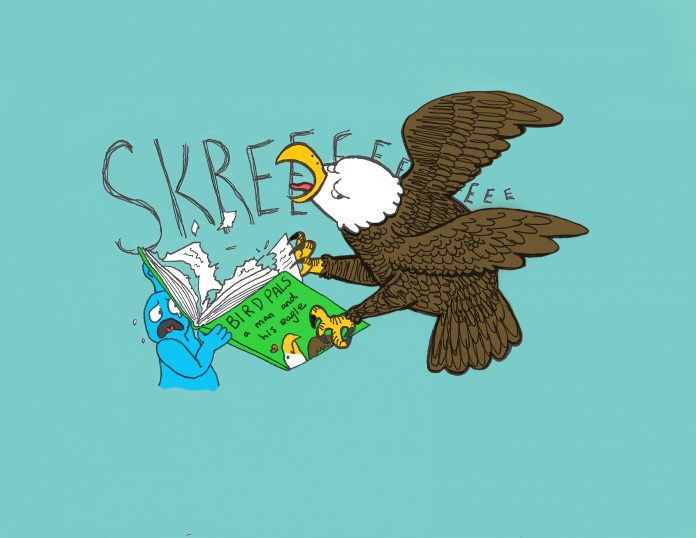
HUMOUR: Please consider donating to the North American Foundation For Improved Bald Eagle Literacy

0
Illustration by Ariel Mitchell

Please be advised that parts of what you’re about to read might be difficult for some individuals. The following contains many hard-hitting truths that not everyone will be comfortable hearing, but keep in mind that unfortunate realities are rarely easy to hear.

If a bald eagle cries out in the middle of the forest, and none of us are around to hear it, did the eagle ever make a sound? Just because you can’t see someone’s pain doesn’t mean their pain isn’t real. That’s why we implore you, dear readers, to reach out and give to the North American Foundation For Improved Bald Eagle Literacy.

Did you know that 100 per cent of all bald eagles surveyed last year were found to have “little or no literacy skills”? Not 50 per cent, not even 99 per cent; a full 100 per cent of bald eagles have never known the joy of curling up to a good book, or the pain that comes with watching a promising Stephen King plot descend into an incoherent mess by the ending. A bald eagle has never read a book, then heard some director was adapting it into a movie, and then as he walked out of the theatre at the end of the movie mumble, “It was okay, but the book was better.”

With your help, we can improve eagle literacy rates and give them the chance to experience these precious moments we so often take for granted.

Your money today can bring change for an eagle’s tomorrow. Donations received will go towards properly training language mentors, speciality reading glasses for bald eagles with poor eyesight, and building facilities that can foster a healthy learning environment tailored to eagle standards. The more donations we receive, the more of each of these services we will be able to provide to eagles in need.

But if the satisfaction and joy that comes with doing a good deed isn’t enough to convince you — even though it should be — we also have a list of wonderful incentives to encourage readers like you. For any donation under $10, we’ll send you a card thanking you for your generosity. For $25, we’ll personalize that card and include a photo of a bald eagle whose life you’ve helped make a difference in, as well as a short biography about that eagle. For $50, we’ll send you a T-shirt with our logo on it. At the next tier of a $100 donation, we’ll send you a 500-word book report written by a formerly illiterate bald eagle. For a $1,000 donation, we’ll send you a tiny vial of actual eagle tears; for $2,000, you’ll receive the same vial but the liquid will be from tears of joy.

You already know you’re an above-average, decent human being. Well, now’s the time to earn swag that proves it to the rest of the population.

A troubling report conducted by the United Nations in 2015 showed that Canada is tied for last place in the world when it comes to countries donating money for improving eagle literacy. I mean, they’re all tied for last place — no country currently donates any form of currency to this noble cause — but just because none of the other countries are doing it doesn’t mean Canada should be barbaric in our practices, too.

So I ask you to listen again to those same eagle cries mentioned before. Their cries are a cry for help. Please donate today and help create a better world for readers and nonreaders alike.

HUMOUR: SFU friendship in critical condition after student forgot to turn anon off

0

Two longtime best friends attending SFU appear to be on the outs, thanks what one of them called “the most intense forms of cyberbullying” she’s ever seen: an accidental message received from the other student that was meant to be submitted to SFU Confessions.

Melissa Baker, a third-year Business student, was sent a vague passive-aggressive paragraph about an incident that occurred between her and ex-BFF Amy Eaton last week, in which Eaton alluded to behaviour that Baker displayed that “really grinds [her] gears.”

Eaton, a Communications major, has been claiming the whole thing was a giant misunderstanding, as she meant to submit the post to SFU Confessions but wasn’t paying attention and accidentally messaged the friend she made in grade two.

“It was an honest mistake,” said Eaton. “Mel knows that I would never be the kind of person to just tell someone if they’re bothering me. It’s so rude, and honestly, you don’t know what triggers you might set off.

“I understand that I can’t take the risk that she might get upset if I tell her she’s being rude. She knows I’d never actually bring my problems straight to her face. We’re clearly not in high school anymore.”

Eaton said she usually healthily vents her frustration out of SFU Confessions like most students, where they can use the veil of anonymity to say almost anything they want to about people, with the implication that if they happen to read it, they can pretend it is about someone else and go about their daily business.

She went on to talk about the benefits of stepping up for a friend who has read a post about them. “When you see someone grieving, it can be a great opportunity to remind your friend how valuable you are to them by consoling them and denying said post could ever be true,” Eaton said.

“All the while, you are secretly hoping they magically grow as a human being without ever being shown a real reason to, but would never show it in real life. “

However, Baker is not having any of it, and claims that if Eaton was a “true friend,” she would have thought twice about confronting her directly through a Facebook message.

“I honestly just think that it’s so disrespectful for another person to be upfront when they have an issue. You can’t just be expect someone to be okay with having their flaws pointed out in such a personal, intimate manner,” said Baker.

“I know that she meant to post it anonymously and that I would have never had to deal with it, but now that I know that people would be posting about me personally instead of the other faceless randos SFU has to suffer through every day, I don’t know how our friendship will go back to normal.”

Baker was originally thought to have been looking into a more serious cyberbullying charge, but has since backed down as she stated in a follow-up comment that she wanted to appear only “low-key upset” and is now “just trying to get over it and move on.”

There was an attempt to reach SFU Confessions for a statement during publication, but the only way to contact them was by submitting a confession. At press time, it is believed the media request was stuck in a queue, as the most recent confession was one relating to Thanksgiving: “Turkey for Thanksgiving AGAIN? Real original, mom.”

Pity those behind the #BoycottStarWars trend

0
Photo courtesy of Lucasfilm

Here we go again. The same tired tale is being repeated. A fresh batch of Internet trolls have infected our Twitter timelines in an attempt to bring hate and negativity to one of the greatest fandoms in cinema history. Last week, #BoycottStarWarsVII was trending on Twitter.

This hashtag was created to launch a tirade of ridiculous claims that the movie was “anti-white” and promoted “white genocide.” Apparently, the apocalypse has arrived because one of the lead roles in the new Star Wars movie, of a storm trooper, is being played by a black actor, John Boyega. While it’s tempting for me to be spiteful and return the negativity, I had a peculiar realization. Proponents of the boycott are simply subjects to be pitied. 

#BoycottStarWarsVII ended with an interesting twist and proved that a quote by Martin Luther King rings true: “Darkness cannot drive out darkness; only light can do that. Hate cannot drive out hate; only love can do that.” The Star Wars fandom is one based on love and dedication. The boycott movement failed before it begun.

This ridiculous hashtag was trending because an overwhelming number of people criticized it. Genuine Star Wars fans were never going to let a group of bigots taint their beloved franchise. As indicated by the ticket sale records the movie has already shattered, love obviously wins.

Apart from the usual trolls, the most prominent category of people behind the boycott were the racists. As people grow and the lens through which they view the world expands, it is expected that their understanding of how life works will increase. Reading some comments under the hashtag, I realized that there are humans whose scope of the world will forever remain tiny and distorted. They will never experience Earth’s beauty at full capacity because they don’t allow themselves access to all the possibilities.

I feel great sympathy for them, because they do not realize how misguided they are when they make claims of “white genocide.” Claiming prejudice and racism requires a basic understanding of what those terms mean. The English dictionary and Google are resources that should not be taken for granted.

Here are some solid facts that relay the irony in this trend’s claims: George Lucas, the creator of Star Wars, is married to a black woman. Darth Vader, arguably the most iconic character in the franchise, was voiced by James Earl Jones, a black man. Billy Dee Williams and Samuel L. Jackson are black men that played characters in previous Star Wars films. If anyone is to boycott this film, they should boycott the whole franchise — and anyone willing to do this for these reasons are not real fans, and they lack basic logic.

There are so many changes going on in the world around us. In fact, the only constant thing on this earth is change. It is only a matter of time before movies and television shows accurately reflect the diverse races and complicated people that exist in the world. People of colour are no longer satisfied with being ignored, underestimated, and stereotyped. We are as ambitious as ever to become whatever we dream, no matter the struggle ahead of us.

People with natural feelings of inferiority need to put people down to feel important. Individuals like this feel fear when they are no longer able to put certain people down. If diversity in movies inspire that type of fear in someone, I encourage it, because their nightmares will soon be realized. More young people of colour are accepting no less than what they deserve and work hard for. Those desperately spouting prejudice in an attempt to stifle positive change are fighting a losing battle.

If droids, Wookies and Ewoks can exist in the Star Wars universe, people of colour absolutely can, and should. So get over it.

SFU Hockey win 7–6 in a barn burner

0
Jono Ceci had four points on the night.

SFU played host to the University of Victoria last Saturday in an absolute thriller of a game. It had it all: goals, great saves, and even a big hit. Both teams combined for an incredible 12 goals by the end as SFU eventually won it in a shootout 7–6.

“I think the guys showed a lot of character,” said Head Coach Mark Coletta after the game. “We challenged them going into the third and they proved us wrong.”

The Clan got off to a good start, with new recruit Jared Babych scoring to put SFU up 1–0. However, just a few second later, UVic leading scorer Carsen Willians answered right back to tie it all up. Captain Jono Ceci would restore the lead, but Vikes forward Cameron Rowat scored with 36 seconds left in the period to level the score at two heading into the intermission.

It was another poor second period for SFU, much like the team’s last home opener in many respects. UVic was able to put four shots past Lyndon Stanwood, two of which came a minute apart. Stanwood made 27 saves on the night in place of last game’s starter, Jordan Liem. Tyler Basham and Babych scored for the Clan, and the team headed into the third down two goals, their prospect of winning the game slim.

“Well, I don’t know if I can say it [while being recorded],” said Coletta when asked about what was said between the second and third period. “I think the message was, let’s bear down, show some heart, eliminate the mistakes, and the freebies. Because if you look at the goals we gave up tonight, at least four were handed to them.

“The other thing was just [to] move our feet,” he continued. “We’re a fast team, and in the third period, I think we showed that.”

The Clan came out into the third and took care of business. Smerek and St. Pierre scored to tie the game up, and Stanwood made some great saves to hold off the Vikes’ attack. In the shootout, Ceci and Basham scored to give SFU their second win of the season.

The goal capped off a big night for captain Jono Ceci. With one goal and three assists for a total of four points, he led the team in scoring on the night and is poised to become the leading scorer in BCIHL history. “He’s a class act,” said Coletta. “He’s going to get that record soon enough, and we hope we can get him a BCIHL championship to go with it.”

The team’s next home game is against Eastern Washington University. Puck drop is at 7 p.m.

Volleyball team snaps four game losing streak with Thursday win

0
Before Thursday’s game, SFU hadn’t won at home since October 8.

The SFU women’s volleyball split their two weekday home games — on Tuesday evening they saw their fourth straight loss, while Thursday provided a welcome win.

Tuesday’s game — a scheduling rarity — was a four set defeat to the top Great Northwest Athletic Conference (GNAC) squad, the Western Washington University Vikings (WWU). Though the Clan fought well in the first set and came on top 31–29, the Vikings showed why they’re the top team in the Pacific Northwest. They stormed back to win the next three sets 25–20, 25–11, and 25–21.

The last time that these two teams played, SFU played an excellent first set before losing 1–3. The same was to follow this time, too. The first set was quite even until the end, when the Vikings gained three points in a row to get a 24–22 lead and two match points. However, SFU defended well and tied it back at 24 all. The Clan were able to keep up the momentum and came out on top 31–29.

Western Washington took the second set 25–20, and handily took the third quarter 25–11. It became clear why WWU is ranked as high as they are, as it seemed like every SFU spike was either blocked at the net or went straight to a Viking player.

SFU came out swinging in the fourth. Madison Power and Devon May began spiking like they did in the first set, and blocking by Tessa May stonewalled the WWU front court. All this, combined with more spectacular digs from Alison McKay, gave SFU a commanding 15–8 lead.

However, it was not to be, as the Vikings clawed back to tie it up at 18 all. A series of long rallies ensued, and it was Western Washington who came out on top in those, building a 24–19 lead. SFU was able to save two match points, but the third time was the charm as WWU took the fourth 25–21 and won the match.

“I thought we fought hard, you saw a lot of good long rallies. We did a lot of good things, but they just did a few more good things,” said Head Coach Gina Schmidt.

Thursday night, however, it was the Clan’s turn. SFU swept the Montana State University-Billings Yellowjackets (MSUB), winning all three sets handily, and snapping a four game losing streak. The victory also marked the first home win since October 8.

Despite SFU notching the first point of the game, the first set started on an even keel, with the teams tied for much of the set, with the Yellowjackets even leading for periods of time. However, after the Billings-based team got an 11–10 lead, SFU put up a seven point run, establishing a dominant lead that neither team had been able to reach previously.

Two three-point runs and a two-point run later, SFU won the first set 25–14. After SFU’s initial seven-point run, the Yellowjackets could only muster three further points.

SFU would go on to win the second and third sets 25–17 and 25–19, respectively. First year middle blocker Tessa May led the team in kills with 13, followed closely by redshirt sophomore middle blocker Madison Power, who had 12 kills.

With the split games, SFU now sits at 10–12 overall and 6–8 in the conference, which places them sixth in the GNAC.