Home Blog Page 919

SFU loses 94-82 to Central Washington in exhibition play

0
Max Barkeley had a team high 22 points on the night

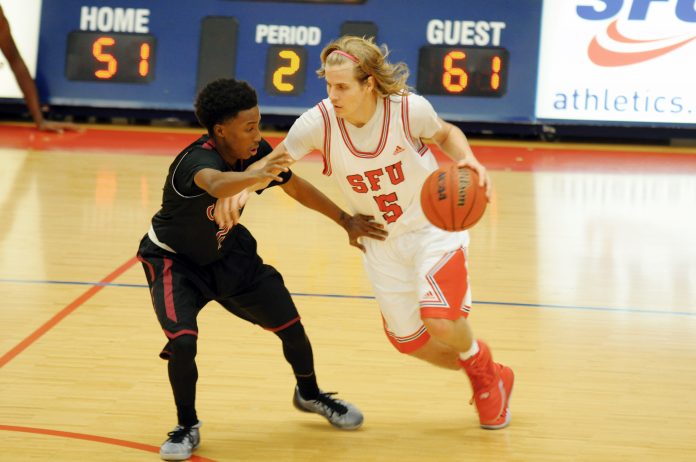
Saturday afternoon was the first home game of the season for the men’s basketball team. While it was only a preseason game, it was a good chance to see the new recruits in action as well as new head coach Virgil Hill in his first game. While the Clan weren’t able to pull the win out, they played well for stretches of the match. And though they never led at any point, they were able to come very close to pulling off a big preseason win.

“I thought there were stretches that we showed that we belong in the league,” said Hill. There’s certainly other stretches where we showed our inexperience. We still have to trust in each other and in the system and be able to play solid and organized.

“Five minutes to go I thought we were in good shape. And that’s you would call crunch time [. . .] now you need to be solid at both ends. Good shots, good execution offensively and defensively. And we just broke down more offensively than defensively,” he continued.

The Clan, facing off against Central Washington Wildcats, came out flat. The visitors jumped out to a quick 9–2 lead, which eventually extended to a 21–12 lead. It looked like this was going to be a blowout loss, much like the game against rivals UBC in late October. But the Clan were able to tie the game up at 25, thanks to a long-range three by senior Michael Harper. From there, the Wildcats quickly regained their lead, going on a 22–13 run to end the first half of play 47–38.

At the start of the second half, it looked like Central Washington was going to pull away. They looked good both on the offensive and defensive side of the ball. But the trio of Oshea Gairey, Max Barkelely, and Michael Harper were determined to keep the Clan in it. The three combined for a total of 58 points on the night, and had a number of big buckets throughout game. With 5:07 to play, SFU came close to an upset, inching within four points of the lead. But the Wildcats were able to make some big shots of their own, and the final score was 94–82 for Central Washington.

Oshea Gairey was a standout for the Clan. There were several points during the game where he seemed to dominate the court, but he also had stretches where he all but disappeared, something coach Hill says needs to be addressed.

“When he [Gairey] fires up and he gets to that next level, he’s actually quite good. But he saves himself. He paces himself. That’s what he has to understand, is that he has to play at that kind of feverish, intense, warrior, fire-in-your-eye mentality all the time. But he doesn’t do that. It’s like he’s waiting for something.

“[What we need to improve on] is just defence,” said Gairey postgame. “Stopping the transition. They got some easy buckets in transition, and just finish the easy shots we should have made.”
The Clan’s next game will be Tuesday against Douglas College. Play starts at 7 p.m.


Clan volleyball lose to nationally-ranked Seawolves

0
Alison McKay led the team with 34 digs on the night

SFU’s three-game winning streak came to an end on Friday night as they lost a close match to the 11th ranked Sea Wolves of University of Alaska–Anchorage (UAA). The Sea Wolves climbed into first place in the GNAC after their 3–1 win on Burnaby Mountain.

The opening set of Friday night’s match was a back-and-forth battle that SFU led early on with a score of 14–9. Clan setters Danielle Curtis and Tamara Nipp provided their teammates with early opportunities to put up points on the board. However, offensive errors from the Clan allowed the Sea Wolves to rally back and capture the first set 25–21.

SFU was unable to bounce back from the first set as they found themselves in an early deficit during the second set. The Clan defense played well, but the offense was often unable to put the ball away during extended rallies. The second set ended 25–12.

When asked about her team’s defensive performance, coach Gina Schmidt stated, “All season our [defense] has been what we’ve hung our hat on. We dig a lot of balls and that’s thanks to Ali [McKay] and our other defenders. We do build momentum with those digs, so now we need work on following that up with a little bit more offense.”

The Clan stayed neck-and-neck with the Seawolves’ throughout the third set, as the two teams exchanged powerful swings. On UAA’s game point, the Clan rallied from a two-point deficit to take the lead and win the third set 26–24.

“I thought we were playing reasonably well in those first two sets,” said Schmidt. “It was just one or two rotations where we were getting trapped and that was the difference in the sets, so if we could just eliminate small runs then we could be in a back and forth game [. . .] which we managed to do in that third set.”

SFU hoped to push the match to a fifth set, but the Seawolves had other plans as they closed out the fourth set with a final score of 25–18. Sisters Devon and Tessa May finished the game leading the Clan with 11 and 10 kills respectively, followed by Emma Jennings with eight.  Defensive specialist Alison McKay led the Clan with 34 digs, and setter Tamara Nipp finished the game with 26 assists.

The SFU women’s volleyball team will look bounce back tonight as they face off against the Nanooks of University of Alaska–Fairbanks in the West Gym at 7pm on Burnaby campus.

We The City celebrated how the arts shape our city

0
Candy Chang spoke about transforming cities through art.

On November 4, an undeniable energy bubbled in the heart of downtown Vancouver at We The City: An Evening at the Centre, an event dedicated to exploring the paramount role that arts and culture play in the makeup of our cities.

Hosted by SFU Public Square in partnership with Vancity, the evening was imperative in the schools’ 2015 Community Summit, which hosted a variety of programs designed to encourage the consideration and celebration of the cities we live in.

Hosting the function were SFU President Andrew Petter and Vancity President and CEO Tamara Vrooman, who set the stage by introducing the importance of individuals, both in institutions such as theirs and beyond, to be engaged in the community.

“What makes a city glorious and great,” Petter posited in his original, beat- inspired poem, “are its universities, especially when they come down from their ivory towers.”

It wasn’t just people coming down the mountain to engage, but creative agents and people from all corners of the city, and elsewhere, who value arts and culture in society. “What makes a city glorious and great are its gatherings and dialogue,” he said.

Mo Dhaliwal, who moderated the gathering, stressed the unique capacity of our city to foster such an event. He noted, “Vancouver has the space, literally and figuratively, to hold an intention. This city moves.” Furthermore, the night boasted an impressively dynamic panel, featuring Candy Chang, Teju Cole, and Buffy St. Marie.

“What makes a city glorious and great are its artists,” Petter said. He was proven right by the evening’s guests, including author Teju Cole, who is also an art historian and photographer. He’s fascinated by the repetition, memory, and layering in making up the fabric of our cities. He imagines “we can draw a constellation knowing that cities retain memory. . . they are unable to forget.” His fondness for getting lost in cities fuels his connection with them. The playful exploration into the world’s city streets is experimental for Cole, who sees the city as “an invention, probably our greatest technology.”

Candy Chang explores the ways in which we can transform our cities into spaces of cultural trust and understanding through art and design. Her work is rooted in the creation of non-intrusive spaces for us to “grieve, gather, and worship together.” A self-proclaimed introvert who draws creativity from a place of anxiety, she is curious about “how our cities foster mental health in communal ways.”

Best known for her interactive public installations such as Before I Die, a collaboration that encourages us to avoid “postponing our greatest needs,” she warned: “It’s really easy to get caught up in your day-to-day and forget what matters to you.” Most importantly, she points to the power of art and community to overcome these challenges.

Buffy Sainte-Marie is an audacious singer-songwriter, visual artist, philanthropist and social activist. She encouraged the audience to “treasure our own uniqueness,” and stressed the healing that comes with creating things, something that is so often lost as we mature into adulthood. “Encourage the child within you, it’s a matter of mental health. Everyone is creative, please nurture that.” Expressing how pleased she was with the gathering, she confirmed that, “the idea that Vancouver is encouraging artists is a very good one. Take heart, and lead with your life.”

Art has the power to connect individuals to themselves, to each other, and to the places they live. It inspires agency, which is fundamental in creating the world we so deeply crave. As Petter said, “What makes a city glorious and great are we — for cities are made, not found.”

Spectre succumbs to Skyfall’s spotlight

0

The 24th film of the James Bond saga, Spectre, was unfortunately unable to live up to the hype surrounding it. You could tell that director Sam Mendes had the pieces to build a worthy spy thriller, but was unfortunately unable to bring it all together.

I should clarify one point: on its own, Spectre was not a bad film. However, when watching a James Bond movie starring Daniel Craig, it’s natural to compare it to other Bond movies starring Craig; in this light, Spectre does not distinguish itself. Though it is much more interesting and better executed than Quantum of Solace (let’s be honest, it would be difficult to do worse), it is definitely behind both Skyfall and Casino Royale.

There are certain elements of the film that are without a doubt worthy of a thumbs up. The action throughout was great. This film seemed to have more action scenes compared to the previous three Bond films, and they were executed more effectively than ever. Whether it was a grandiose scene with massive explosions, or simple hand-to-hand combat, each scene was shot well and kept the audience incredibly entertained. As well, Daniel Craig’s portrayal of 007 was spot on. He has clearly matured over the last three films and was able to find a balance between the stereotypical stylishness and suave demeanour of Bond, and the grittier human element that Craig brings to the role.

The villain in Spectre, played by Christoph Waltz, was quite a letdown. The return of Ernst Blofeld as Bond’s main nemesis was a great addition to the movie, as it added a nostalgia factor; however, Mendes was unable to use Waltz to his prime. Both the quantity and the quality of dialogue that Waltz had was less than expected, and most of the verbal jousting between Blofeld and Bond was predictable and uninteresting.

It was a real shame, since both Inglourious Bastards and Django Unchained have shown us that giving Waltz a good script and ample screen time is basically guaranteed to make your movie better.   

The Bond girls in this movie also didn’t connect as well with Daniel Craig as ones had in the past. The main love interest for James Bond is Madeleine Swann (Lea Seydoux). Throughout the film, the romance between them seems forced, with no real flow  between the stages of their relationship. This is in stark contrast to James Bond’s courtship with Vesper Lynd (Eva Green) in Casino Royale. It was clear that they had real chemistry, and their connection seemed far more natural.

Finally, we’re left with Spectre’s official song, “Writing’s on the Wall” by Sam Smith. The song is an accurate representation of the movie as a whole. On its own, it is a great song. But a Bond song? Not quite. Parts of the song definitely have that classic Bond feel, but on the whole it doesn’t feel like it matches the franchise, and when compared to recent Bond songs such as Adele’s “Skyfall” or Chris Cornell’s “You Know My Name,” the song — like Spectre — just doesn’t cut it.   

TEDxVancouver presents exhibition on identity

0

This year saw the arrival of something new as part of TEDxVancouver: ID: The Exhibition. Through an exhibition of visual art, it showcase local artists who explored this year’s theme of identity.

Featuring three artist’s series, 14 individual artists, and three installations, this was a loaded exhibit presented within Postmark Brewing in Vancouver’s Railtown District, situated between SFU Woodwards and SFU’s Visual Arts Studios. A pop-up exhibit lasting only two days — the weekend before the main event — ID: The Exhibition is another step forward in the continued growth of TEDxVancouver. Though, while this ambitious exhibition had great potential, it could have done more to explore identity from a critical and less corporatized perspective.

The exhibit drew heavily from talented Emily Carr and Capilano University grads, with several self-taught artists also featured. The three artists’ series, featuring work by Amelia Alcock-White, Drew Young, and Ilya Viryachev, made up over half the artworks. Their focus was on figurative painting carrying over into the rest of the exhibit, which was almost exclusively dominated by paintings with only a few sculptures and installations in between. This focus is largely a result of the background of the artists selected, which tended towards illustration, design, and digital media.

The creation of an exhibit around identity as part of TEDxVancouver has great potential. With an extensive pool of talented artists in Vancouver, and the personal, critical, and reflective potential of the visual arts, the exhibit supported the purpose of TEDxVancouver by looking at the issues of identity through a more distinct lens.

ID: The Exhibition, however, isn’t given this space to breathe. The theme itself is problematic. ID: capitalized for impact? Id, the psychic apparatus driving our most basic instincts, comes to mind, but neither the works in the exhibit or the main event support this interpretation.

TEDxVancouver 2015 is centred around identity, repackaged for branding as ID. But ID doesn’t bring to mind personal identity —  it evokes the facelessness of bureaucratic and corporate identification. ID is not the grassroots, introspective identification of self, but the imposition of identification from on high. This confused theme was a surprising and ultimately misguided choice for the exhibitors.

An exhibit on ideas of identity has the potential to critically engage with its definition, boundaries, and expectations. ID: The Exhibition is first and foremost a commercial showcase, with most of the works priced for sale. The space was co-opted in the style of a commercial gallery with artworks crammed into its confines. The descriptions of work failed to spark discourse or invite questions.

The work was largely upstaged in part by the presence of a corporate liquor sponsor, and the loud music was reminiscent of a corporate launch party or a club.

Canadian artists must often work the role of producer, financier, exhibitor, and promoter in a delicate and exhausting balancing act. ID: The Exhibition brings this to the fore. It provides a space for supporting local artists while undercutting their ability to engage critically. Though the potential existed for an exhibit to create a distinct space of discourse around TEDxVancouver’s theme of identity, we were left instead with a window dressing.

Air India (redacted) addresses 30th anniversary of Air India bombing

0

Air India (redacted) is a 90-minute multidisciplinary performance commemorating the 30th anniversary of the Air India 182 bombing, the deadliest terrorist attack in Canadian history.

Creating a work of this scale and scope is no easy task. Interdisciplinary approaches to art such as this must reconcile different mediums and combine them together in a way that’s both cohesive and sensitive to the source material. Ambitiously, the creative team brings poetry, music, theatre, opera, and projections together into a performance that tries to capture the “fluidly shifting perspective of [Renée] Saklikar’s poetry, from directly emotional, to formal, to legal nomenclature or forensic reports,” according to the project’s media artist, John Galvin.

Air India 182 was downed by a bomb placed in its cargo hold, breaking apart mid-air and falling into the Atlantic off the South West Coast of County Cork in Ireland. The attack resulted in 329 casualties, 268 of whom were Canadian citizens. The tragedy extended through an investigation and prosecution lasting over 20 years that led to a single conviction. It was followed by a public inquiry that wrapped up in 2010, detailing the “cascading series of errors” by the government, RCMP, and CSIS that allowed the attack to happen.

Saklikar’s collection of poetry Children of Air India: unauthorized exhibits and interjections forms the basis of the project, and the creative team included Saklikar, SFU School of Contemporary Arts Professor Owen Underhill, as well as three Irish artists: Galvin, director Tom Creed, and composer Jürgen Simpson. It was performed by Vancouver’s Turning Point Ensemble and soprano Zorana Sadiq, countertenor Daniel Cabena, and baritone Alexander Dobson.

Air India (redacted) draws attention to judicial practices, and the contrast between information and lack thereof. This absence is an element that is carried throughout the performance. This silence draws attention to the difficult questions faced in the wake of the tragedy. Simpson described these moments as “filled with incredible meaning, as often the most difficult part to deal with are the names.”

The project is the culmination of eight years of development between Simpson and Underhill, restarted with the release of Saklikar’s Children of Air India in 2013.

Following the structure of Saklikar’s poetry, Air India (redacted) is split into a series of distinct chapters that trace the story of the Air India incident in an abstract, disjointed way. Simpson characterized the performance as alternating from “pointed passages that unfold slowly, to incredible, almost violent passages.” This is very much a journey of discovery, through separate but related moments that have to be pieced together and restructured into a larger narrative.

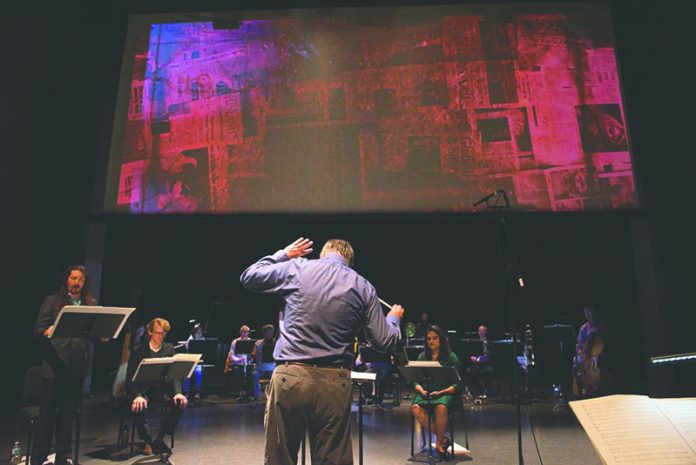
The stage is commanded by a long table occupied by the singers, who sit, rise, and navigate around the space as they sing Saklikar’s poetry with a sense of operatic scale. Galvin’s projections occupy a vast screen hanging over the stage where abstract imagery, collage, and video footage provide a parallel that reflects on the tone and atmosphere, aiming for an evocative rather than explicit feeling.

Each constituent part of the performance is excellent. The score reflects the poetry, and deftly navigates the narrative arc of each portion, supporting and sometimes anticipating developments elsewhere. Galvin’s projections set a tone for the performers with its use of colour and imagery. The incredible talent of the ensemble and the musicians was readily apparent, and all three singers carried certain chapters on the weight of their voices and their ability to project emotion to further the poetry. This use of opera captured a sense of drama that added to the tragedy.

Unfortunately, the operatic nature of the show occasionally obscured the meaning of the text and prevented some chapters from gaining momentum. Certain ones became clouded when one medium overpowered another. The waiting was worth it, though, for when the many forms were balanced, resulting in moments of extreme poignancy and emotion.

Reflecting on a national tragedy while bridging distinct art forms is a difficult task. Though Air India (redacted) occasionally struggled, it succeeded in Simpson’s goal of making a certain “meditative space to keep the memories and questions of Air India alive.” They set out to do something ambitious and extremely difficult, and though not every moment was a success, they did it in a sensitive and informed way. That’s a large part of what it means to be an artist: to take risks and open up spaces for dialogue and reflection. In a country often at odds with our own histories and tragedies, that is exactly what we need.

12 Hilarious SFU Student Confessions

0

Chitter is booming with anonymous SFU confessions; here is a highlight of the best.

Can we just toss Daylight Savings already?

0

I grew up in a region of the province that never changed its time in the fall and spring. We still felt its effects: every fall our TV shows would air an hour earlier than before, and when we traveled to Alberta to watch movies, we had to do the math to establish arrival time. I grew up thinking about what a nuisance this was. Then I moved to Vancouver, and now I’m one of those people whom I used to look upon with amusement.

A couple weeks ago, we again moved our clocks back an hour. Why in the name of Father Time are we still doing this? Someone please tell me. Daylight Savings Time (DST) is an archaic remnant of World War One. Germany used it to conserve wartime fuel. It spread to other nations during the War, which many dropped it until WWII then picked it up again. BC adopted it through a 1952 Plebiscite; yes, the same sort of plebiscite that Metro-Vancouverites just stressed over for the Transit funding.

This means there is no binding law stating we all have to follow DST in BC. According to section 26 of the Interpretations Act of 1996, the Lieutenant Governor in Council in BC has the power to regulate the times and days for Daylight Savings Time.

There is no binding law stating we all have to follow DST in BC.

As an example of how easy it is to drop DST, this past spring the town council of Fort Nelson voted to stay with the rest of The Peace River Region in not observing the time change.

Every year ICBC shows that there are more crashes and accidents during the switch, mainly in the spring when we lose an hour of sleep. BC Hydro can tell you that any power we might save with DST is negligible due to our latitude in North America. We don’t turn our lights on in the morning, instead we turn them on earlier in the evening. There is no power saving, just a shift in time use.

Could external trade be a reason to keep DST? This past year the states of Washington and Oregon put forth bills to abolish DST; BC said it would not follow. Alberta is already an hour ahead, so in the Fall they would be the same time as us. Our port trade with International partners won’t make a difference because they are multiple hours difference from us and some don’t use DST themselves. No, trade is not an excuse.

The time changes every year are ridiculous and redundant. It’s as if to say that by cutting a foot off the top of a blanket and sewing it to the bottom you make a longer blanket. Though in reality nothing has changed except where the blanket lays.

There is no longer a valid reason to maintain Daylight Savings and there are far better ways we can influence energy consumption and saving. Best of all, to ditch DST, we do not need to change any laws — all we need to do is change with the times.


145 bus falls into a sinkhole

0
There were no injuries among passengers in the bus that fell into the sinkhole. - Photo courtesy of Burnaby NOW

Passengers on the 145 bus this around 7:30 a.m. this morning were in a for a bumpier ride than expected when a 6 foot deep sinkhole opened up underneath the back wheels of the bus.

TransLink advised The Peak that “all the passengers and bus operator were safely evacuated” and “no injuries were reported.”   

There was a delay in removing the bus from the scene since there was uncertainty over whether the ground was stable enough to support a tow truck. However, the bus is to be towed and fixed at TransLink’s maintenance facility.

Global News reported that the sinkhole is 10 feet long and six feet deep. In addition, this sinkhole had previously been filled 3 months ago.

City of Burnaby Engineer, Dipak Dattani told the Burnaby Now that the hole was unrelated to work on the Stoney Creek rehabilitation project”. He added, “It is an unusual event. We don’t have such occurrences on a regular basis in Burnaby.” He could not say what caused the sinkhole.

The 145 and 136 bus lines are being diverted currently with the 145 heading up the mountain on Gaglardi from Production SkyTrain station rather than proceeding up Production Way and Broadway like usual. These diversions are expected to last “at least until” 6 p.m. tonight, according to TransLink.

SFU dominates Eastern Washington in 6–2 Win

0
SFU got revenge against Eastern Washington after a 5–1 loss at home

Although the season is still in its early phase, the SFU men’s hockey team has already played the Eastern Washington Eagles three times. All three games have been drastically different, as this one was a lopsided win for the home team. Three first period goals gave SFU a big early lead, and they cruised from there to a 6–2 victory.

“I thought the effort level was really good,” said Head Coach Mark Coletta after the game. “The execution was good, and we found the net.”

“Everyone was going hard tonight,” remarked forward Brandon Tidy afterwards. Tidy came away from the match with a goal and an assist in the game. “We got a full team effort from everyone. [They all] did their part and we got a big win.”

Eastern Washington came out with a lot of energy, considering they had played the night before. Early on in the game, the shots were 8–1 for the visitors and SFU had barely any time in the opposing zone. But from then on, the period was all SFU. Adam Rossi opened the scoring with his first ever BCIHL goal, the beneficiary of a beautiful feed from Graham Smerek. Matthew Berry-Lamontagna added a second just under three minutes later, and Tidy scored to make it an early 3–0 lead.

The second period was all SFU. At the 6:19 mark, Tyler Basham went bar down to make it 4–0. Eastern Washington was able to make it a three-goal game briefly, with Paxton Bell crashing the crease on the power play to make it 4–1. However, just a few seconds later, Smerek was sent in all alone on a breakaway and restored SFU’s four-goal lead. The teams traded goals in the third to make it a final score of 6–2.

The key for SFU on the night was stopping forward Beau Walker. The Eastern Washington star had scored five goals in the previous two games between them, and on the night he was held to only a single assist.

“[We were] physical with him,” said Coletta afterwards. “Making sure that he knows that you’re there. You have to get him early and get him off his game a little bit. He’s always going to be very competitive, and Tommy [Assistant Coach Tom Spencer] did a good job making sure the right matchup was on the ice, and Jimmy [Assistant Coach Jim Camazzola] did a good job making sure the right defenseman was on the ice.”

Despite the scoreline, the game saw several injuries for SFU, with Jaret Babych and Darnel St. Pierre going down during the match.

“Babych got a knock to the head,” coach Coletta noted after the match. “I don’t think it’s a concussion, but definitely a good knock. So we want to take every precaution that we can with our players. St. Pierre took a puck to the inside of the knee; he should be fine.”