Home Blog Page 913

Mixed season for SFU men’s soccer ends on a high note

0
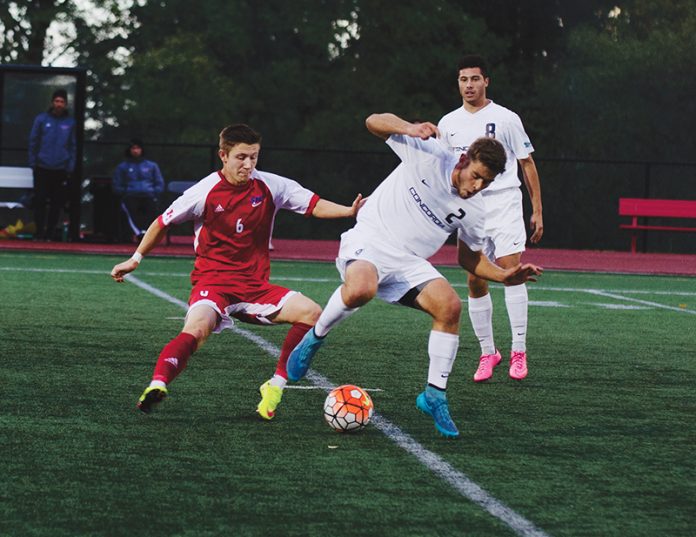
Adam Jones (#6) was named GNAC Freshman of the Year.

Though SFU men’s soccer team was able to finish off on top with a win on seniors night, they unfortunately did not do enough to qualify for the GNAC championships. After a season of mixed results, SFU will be hoping to build in the offseason and make it back to the big dance in 2016.

Leading that rebuild will be SFU Head Coach Clint Schneider. This was his first season as head coach of the program, but he’s already been involved with the team for many years under former Head Coach Alan Koch, who left to join the Whitecaps organization.

“The transition was pretty seamless, since I’ve been involved with the team for as long as I have.” said Schneider. “They know me, I know them, so it was just establishing the type of culture that I wanted, which was not too far removed from what the guys are used to, and then implementing it. That was the biggest change: implementing my culture and me being the big guy in charge, making sure the buck stops with me.”

The Clan was without star striker Jovan Blagojevic this year, who was drafted by the Vancouver Whitecaps and then sent to their reserve team. He led the team with 18 goals last season, and his absence was definitely felt this year, as the team scored only 29 goals this season compared to 41 last time around.

Defensively, however, SFU flourished under coach Schneider’s system. The Clan let in  nine fewer goals than in 2014, and they turned Terry Fox Field into a fortress, conceding zero goals at home all year long. Coach Schneider attributed this to a concentrated team effort.

“The guys were going to do everything it took to not allow a goal. We have a very good goalkeeper, but it starts with the guys up top and it works itself back. . . When you have a group of players who are brought into doing that and working hard for each other, well then, the proof is in the pudding,” Schneider quipped.

Leaving the team this year are Shane Satar, Callum Whittaker, and Alex Rowley, three key cogs for the Clan. Coach Clint was incredibly pleased with their contributions for the team — not only on the pitch, but off of it as well.

“Off the field, all three of those guys are fantastic team guys. They care about the culture we created [and] they care about the young guys that are going to be the legacy when their gone. So they really spent time and built into those guys who established what it means to play for SFU, what it means to play for Canada in a lot of ways, so that part will be badly missed.”

Reflecting on the year as a whole, coach Schneider said he would give the season a C+ rating. “The only reason I would rate it that low,” he said, “is because we didn’t make the postseason [. . .] I would still say it’s a pass, for sure, and there was a lot of positivity with this group that we can carry on towards next year. We have the real ability for it to be special.”

SFU volleyball sends off seniors on a high note

0
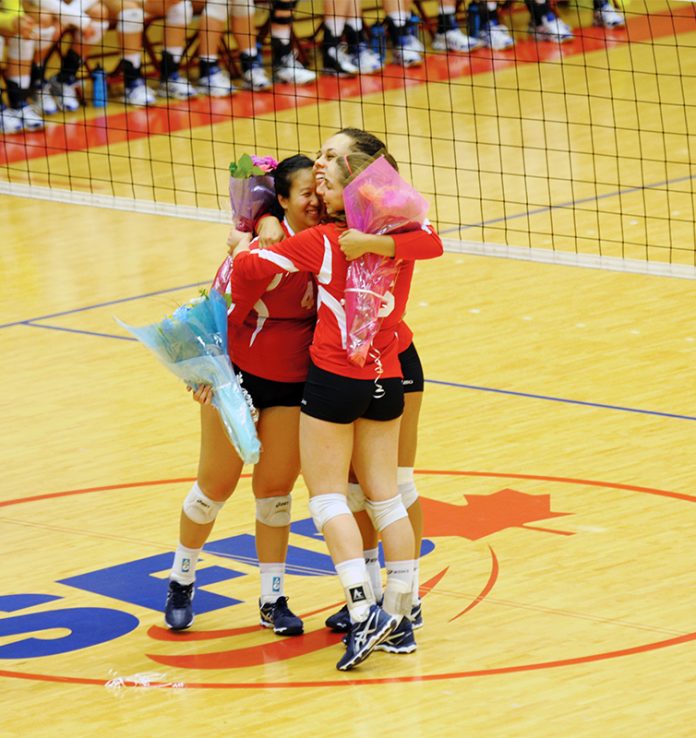
Helen Yan, Jessica Young, and Danielle Curtis all played their last home game.

SFU’s Volleyball squad had its senior night on November 14, and they made it a memorable one for the grads with a 3–0 victory over the visiting University of Alaska–Fairbanks Nanooks. It was the last home match of the season, and the victory brings them up to 13–13 on the season.

The Clan had just come off a 3–1 loss courtesy of the nationally-ranked University of Alaska–Anchorage Seawolves, and they were keen not to let the northern schools pull a double over them. The Clan got the first point of the match and never looked back, constantly pressuring the Nanooks with a barrage of powerful spikes and deft dinks.

The West Gym crowd got to witness history early in the first set, as Alaska–Fairbanks outside hitter Sam Harthun set a GNAC record with her 1462nd kill. She was by far the Nanooks’ strongest player, constantly giving the Clan headaches with powerful serves and well-placed spikes. However, the ladies of SFU were able to weather the Alaskan storm early on, and went on to control the rest of the match.

“It always starts with our passing and serving,” said SFU coach Gina Schmidt after the match. “We handled the ball well on the first contact and we put them into trouble with some good serving on our part. It helped our defense and transition game and we had contributions from all of our attackers, and when everyone is scoring, it makes life easy.”

One of those high scorers was SFU Senior Jessica Young, who led the team with 13 kills and three aces. The other two seniors, Helen Yan and Danielle Curtis, also did an excellent job in their last home games, helping to keep the Nanooks at bay throughout the three sets.

SFU took the first set by a score of 25–18, and continued to put the pedal to the metal in the next set. Emma Jennings had a number of strong kills early in the match, and she continued this form in the middle frame as well. The Nanooks were left completely flummoxed by her power and precision, and had no answer for it the entire match. Devon May was also a nightmare for the visitors, smashing the ball at will. She finished off the match with 12 kills and two blocks, and helped the Clan take the second set 25–15.

The third set began in the same way the second ended, with SFU overpowering Alaska–Fairbanks. Whenever Alaska did manage to get themselves a chance at a point, SFU’s defense would show its strength and pull off an improbably dig or a brave block. The Clan’s pressure was too much for the Nanooks, and the third set ended 25–14.

After the match, when senior Jessica Young was asked about her favourite moment playing for the Clan, she said “That is the hardest question you could have possibly asked me because I’ve had so many great moments here [. . .] It’s been a great run, and I’m so appreciative of the fact that I even got to be here and that I got to meet all these people and play with them and learn from them.”

After the performance today, it seems like SFU volleyball will be filled with great moments for years to come.

Men’s hockey collapses in third period

0
SFU was not able to hold on to the 2-0 lead for the win.

The men’s hockey team was in tough against the Trinity Western Spartans. Last year’s top team in the BCIHL was no pushover, but the Clan got off to a quick 2–0 lead in the first period and things seemed to be under control. However, two late goals in the first tied the game up at two, and the winner was scored halfway through the third by the Spartans’ Jamey Kreller.

“Well, I think it was a little bit of complacency on our end,” said Head Coach Mark Coletta on the game’s disappointing finish. “When you go up 2–0, and you play very well the week before, I think it was more of a mental thing. We didn’t prepare mentally, and we weren’t cognizant that Trinity is a good hockey team.”

A notable but unsurprising absence from the lineup was forward Jaret Babych. Coming into the game, Babych had scored five points in six games with the Clan, four of which were goals. He had to leave the previous game against Eastern Washington after taking a hit high.

“It looks like a mild concussion. We will take all the precautions that we can so he can be ready in the future.”

To get out of the team’s current slump, it’s going to take a concerted team effort, according to coach Coletta. “In the past it’s always been, you look to a couple of the older guys or the veterans. But I think we have a team where we have a mix of seniors and a mix of first-year guys.

“This year is more of an internal group, and they guys themselves have to really pull together and find, again I keep coming back to this word, consistency. I think that’s the main thing.”

SFU’s Brendan Lamont was named the game’s second star. He scored the opening goal of the game, and had an assist on SFU’s second goal. Matthew-Berry Lamontagna finished with 12 minutes in penalties on the night. The SFU powerplay finished zero for four on the night.

SFU football lose to Azusa Pacific on final game of the season

0
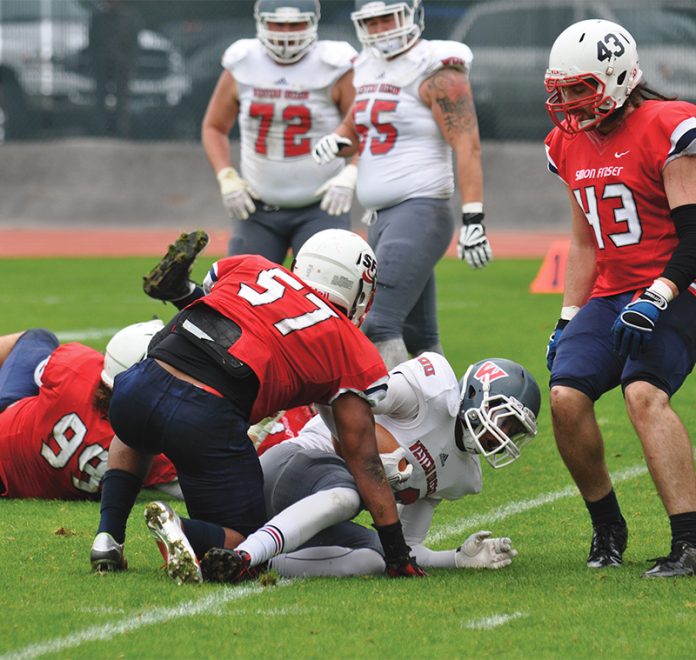
Jordan Herdman (#57) finished with a total of 15 tackles.

The SFU football team lost their season finale 38–17 to California’s Azusa Pacific University last week, capping off a winless season. Despite several close games in which they had second half leads, the rebuilding Clan football team finished with a 0–9 record in Head Coach Kelly Bates’ first season at the helm. The Clan was hopeful to finish the season with a win after a close 10–6 loss to Azusa Pacific in the first game of the season.

The Clan started out strong, opening the scoring on a 37 yard touchdown pass from quarterback Ryan Stanford to wide receiver Christian Berger. SFU started out forcing three consecutive punts on defence before a costly mistake on offence created an avalanche of momentum for the Azusa Pacific Cougars. The Cougars were able to strip sack Ryan Stanfield in the endzone for a touchdown that evened the game at 7–7.

Pass protection was a problem all game for the Clan, who yielded five quarterback sacks to the Cougar defence. Azusa Pacific added 10 more points in the last half of the second quarter to take a 17–7 lead into the locker room at halftime. The third quarter was all Cougars, as they reached the endzone three times offset by a lone Tiernan Docherty field goal. The fourth quarter saw the Clan finish strong with a blocked punt followed by Justin Buren’s nine-yard touchdown run on a jet sweep.

The offence was led by SFU running back Ante Milanovic-Litre who rushed for 157 yards on 26 carries. This was his second consecutive 100-yard rushing game which built on his 142-yard, two-touchdown performance from the week before. Quarterback Ryan Stanford passed for 133 yards and was backed up by Tyler Nickel who passed for 27 yards. Defensively, linebacker Jordan Herdman had another stellar game with 15 total tackles.

Coach Bates remarked how Jordan Herdman and his twin brother Justin “are a unique group of kids from Winnipeg, Manitoba whose father played in the CFL. Here they are setting GNAC records last year, [conference] player of the year last year for Jordan and manning our defence and making it what it is. They aren’t loud kids but lead by example.

“They are also both academic all-stars” he added. “Jordan has been in the top 10 for all SFU athletes. They are both on their way to become radiologists. This tells you what type of kids those guys are. You can see this across the board on this team.”

Jordan Herdman was rewarded for his efforts by being named GNAC defensive player of the year for the second straight year.

Bates is clearly a man with a conviction and passion for football, who genuinely cares about his players and is committed to building a lasting tradition of excellence for SFU football. Despite the team’s disappointing showing this season, the program seems to be in good hands under his watch.

Men’s basketball succeeds in Royal rumble

0
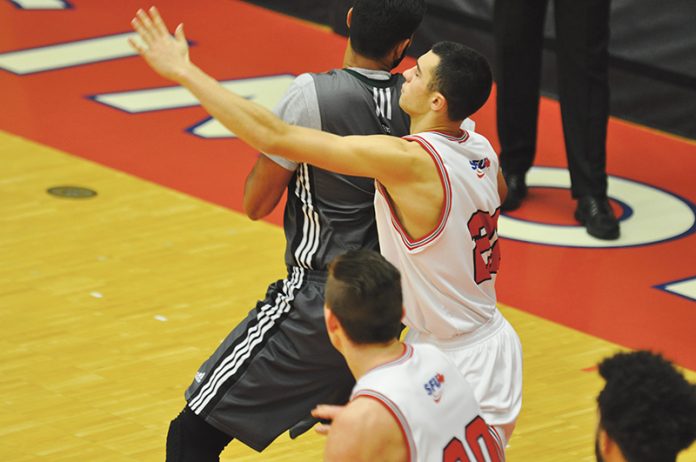
Hidde Vos (#22) finished with 14 points in 32 minutes of action.

The SFU Clan men’s basketball team got its first win of the season Tuesday night against the Douglas College Royals with a score of 78–58. Though a 20-point gap between the two squads might make some think that SFU dominated this game, nothing could be further from the truth, as the Royals made the Clan work for every point, and a wide margin of victory was not secured until late in the game.

“It was a battle in the first half, and then we came back [and] showed some resilience,” said Clan guard Hidde Vos after the game. “It’s good to get the first [win] of the season.”

It was a tale of two halves, as the Clan started the match playing down to their opponent’s level. Douglas College took an early lead, and were able to frustrate Simon Fraser all throughout the first half. SFU’s Michael Harper had some excellent runs at the Douglas defense, cutting through them like a hot knife through butter. However, SFU’s defense was unable to shut down the Royals offense, as it seemed like they were able to sink three-pointers at will. Along with that, the Royals were winning most of the rebounds in SFU’s zone, and getting easy points off layups as a result.

The Clan started playing a bit better in the middle of the frame, and went on a 10–0 run to take a 25–19 lead with nine minutes left, due to some timely points and steals from guard/forward Denver Sparks-Guest. However, SFU was unable to pull away, and the plucky Douglas side fought back with some timely three-pointers, retaking the lead with two seconds left on the clock.

The halftime score was 37–35 for the visitors, and SFU’s Head Coach Virgil Hill was visibly displeased going into the halftime break.

Hill must have given quite an impressive speech during the intermission, as the Clan came out in the second guns blazing. Douglas College fought tooth and nail to keep their lead, but they were no match for the firepower that SFU brought. Specifically, it was the incredible play of guard Hidde Vos that propelled them. Beginning early in the second half, Hidde had timely steals, smooth three pointers that hit nothing but net, and some sick no-look passes that would have compelled even Steve Nash to tip his hat.

But it was not only Vos that shone for the Clan in the final frame. Oshea Gairey helped draw multiple fouls, and on the defensive end Gibran Sewani and Max Barkeley shut down multiple Douglas attacks with rejections that made the crowd go wild. It seemed like a totally different SFU side was on the court, and the scoreboard was showing it. After being down 44–40 early in the second half, the Clan went on a 25–0 run to take a 65–44 lead.

The final stages depended on SFU not letting Douglas claw its way back as they did in the first half, and this time, the Clan was successful. SFU ran the Royals ragged in the second half, and it was clear the visitors from New Westminster had no gas left in the tank at the end of the game. SFU held on for a 78–58 blowout, and they’ll certainly be hoping for more wins like these in the future.

Abby Lloyd’s long road to wrestling

0
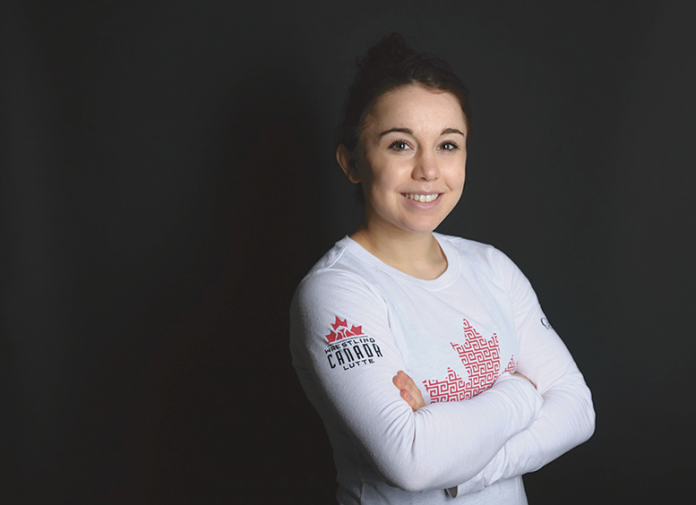
Abby was originally focused in judo, but switched to wrestling once she came to SFU.

Wrestling is a sport unlike any other, and one that it requires intense commitment from competitors. It requires years of training and focus to compete at a high level. This makes the case of sophomore Abby Lloyd all the more interesting. A native of Powell River, BC, Lloyd’s background is in judo, and she only began wrestling when she came to SFU.

“I started judo when I was about six years old,” Lloyd said. “I competed internationally for quite a while, and leading up to graduation I had to consider post-secondary, which there wasn’t a lot of options in regards to judo. [. . .] So I turned to wrestling, where Mike Jones [Head Wrestling Coach] recruited me, and I saw an opportunity in that.”

There are some similarities between judo and wrestling, but for the most part, Lloyd had to learn the sport from scratch. “There’s a lot of overlap in regards to takedowns and throws. But there were a lot of habits that I had to break in regards to being put on my back. Because judo fighters can be on their backs and defending at the same time. [In] wrestling, you can’t.

“What I really like about wrestling is that you can grab the leg,” she said. “Whereas in judo in 2010 they started incorporating rules where you couldn’t grab the legs. [. . .] In wrestling there’s more freedom for me to use my technique and [less worry] about being disqualified for something that’s against the rules.”

Lloyd has had some help from numerous people in SFU wrestling to make her a more well-rounded wrestler. “My coaches and my teammates” were the first people she mentioned. “[My teammates are] not ones that because they are [competing] in the same weight class, they’re going to keep all these secrets from you. They’re ones that actually want to see you get better and they want you to improve. If they see you doing something wrong, they’re going to correct you on it.

“In regard to coaches, Mike Jones is one of those guys that’s not going to tell you that you’re doing it perfectly, because he doesn’t want to boost your ego that much. He’s going to tell you that you did it better, and then he’s going to tell you how you can improve on it.”

One thing unique to the sport of wrestling is the weight class system. To compete in a certain weight class, Abby has to be at the weight or under it. For this season, she is fluctuating between the 109 lbs and 116 lbs weight class, which means lots of bulking and then cutting down.

“It’s not really healthy, but a lot of it will be water weight,” she said. “I know some of the guys they can probably lose 20 pounds of water weight. So what I do is, probably two to three weeks before prior to [the] competition, if you’re making a big cut, you want to focus on just cleaning up your diet. Making sure you don’t have any added sugar, no unneeded carbs, [and] try not to eat late at night.

“Leading up the week before you, start reducing water intake. Basically we just throw on the [compression] suit and get sweating. You want to cut water weight as much as you can before the competition.”

Abby explains the difference between the two weight classes. “The 109 [weight class] will definitely be focused more on speed, and the 116 more on strength. I myself am very compact, so a lot of the girls are going to be taller than me. [. . .] The strength and the height are the big differences.”

Between gaining and losing weight, Abby still has to study for her classes, a balance she found difficult to maintain in her freshman year.

“It was really, really hard,” she said. “I had no idea what I was doing. I came from a really small town, and in high school, I had such a close connection with my teachers [and] they were very lenient with me, [because] they knew my travel schedule.

“At SFU they understand the situation of varsity athletes, but you have to understand the responsibility is on you to get your assignments done and have things ahead of time if you’re going to be away. Whereas [in high school], I just relied on my teachers to get me out of things. But my first semester was a nightmare. My grades weren’t the best, but as I started to learn the ropes, I recognized that there has to be a balance academics and sports.”

The season is still in the beginning stages, but Abby has some concrete goals heading further into the season.

“My personal goal is to just really focus on my leg shots right now. Because I’m starting to develop an understanding of what my setups need to be in order to make those leg shots, as opposed to just tying up and going for the throw in judo. My goal is just to keep up with that, keep improving, and then hopefully it’s going to lead to some good results.”

Free the nipple on social media

1

[dropcap]I[/dropcap]f you have a Facebook or Instagram account, it’s more than likely you’ve come across the #FreeTheNipple movement. Lesser known is the #DoIHaveBoobsNow campaign, which challenges how trans bodies fit into the world of social media censorship.

Facebook currently only allows images of chests they presume to be male to be displayed. Breasts, specifically nipples, on the bodies of women are strictly not allowed. Courtney Demone, a woman from Victoria, is challenging this. Documenting her transition from male to female, specifically her breast augmentation, she’s determining at what point of transition she’s too feminine to be revealing her body for Facebook’s standards.

The controversy surrounding breasts is particularly interesting when considered from a biological perspective. There’s very little difference between male chests and female chests, except that the latter has specialized lobules, allowing them to breastfeed. This is widely unknown, however; many presume that there are major biological differences between the two. This may seem like an innocent case of misinformation, but it can have deadly consequences. Male, for instance, can get breast cancer are often diagnosed too late simply because they neglected to check themselves.

So what exactly are we censoring? Are we censoring breastfeeding, since the only real difference between the two is the aforementioned lobules? According to a statement Facebook made a while back, they “will always allow photos of women actively engaged in breastfeeding.”

Is it the size of breasts? Surely this isn’t the case either, since men with large chests can post shirtless pictures of themselves with no consequences, yet women with small breasts get their photos removed for nudity.

The only conclusion left is that Facebook has a problem with women’s breasts and women’s breasts alone. This is especially saddening because, in 2014, Facebook replaced their previous gender-binary system where users had to choose either male or female for their profiles with a drop-down list of options. Especially huge for users was the new choice to write their own.

Unfortunately, their censoring policies remain contradictory to this progression. Demone herself described the issue as “nonsense,” saying, “Facebook allows us to input what gender we are, yet they go ahead and assign us a binary gender anyway based on our chests.” By denying some bodies the right to be displayed, Facebook both subscribes to the gender and sex binaries, and contributes to a society that disproportionately polices women’s bodies.

The implications of this are huge. Policing women’s bodies contributes to a culture run amok with slut-shaming and victim-blaming. It’s a tired old trend that has to go.

I’m in full support of lifting the ban on all nipples and breasts. The benefits are endless. Parents worried about their children being exposed to “pornographic” content should consider celebrating the effects that visibility of a variety of breast-types could have. Instead of only seeing breasts that fit the porn aesthetic — which, let’s face it, are just as accessible on the Internet as Facebook itself — they’d be exposed to a more realistic spectrum of body types, likely decreasing the insecurity experienced by children about their own developing bodies.

And they wouldn’t have the pesky problem of having to decide what counts as feminine enough and what doesn’t.

So instead of drawing arbitrary lines in the sand saying which breasts are too risque, Facebook should simply lift the ban on (what they presume to be) women’s bodies, simultaneously rejecting gender binaries and refusing to contribute to a society that shames people for having feminine anatomy.

Save your holiday cheer for the last month of the year

0

[dropcap]W[/dropcap]alking to my neighbourhood Starbucks, I’m surrounded by elaborate light shows on either side of the street. The community seems to be engaged in a fashion showdown.

“Jeff, you got Christmas lights on your garage? Well, I’ve got mine on my roof. Plus they’re LED.”

“Mitch, please, you’re just trying to overcompensate for your lack of glow-in-the-dark lawn reindeer.”

“Sorry, Jeff, I can’t seem to see your reindeer behind my six-foot-tall candy canes.”

I finally enter the Starbucks, and I’m immediately greeted with the smells of pretentious coffee and the sounds of Bing Crosby singing “White Christmas.” I go up to the counter and order my Venti Caramelito Gingerbreadito Latteito, which — of course — is served in a festive cup. As I sit my keister down on an overly-plump sofa, I can’t help but feel that this is what makes December fantastic: DIY light shows, classic holiday songs, and overly sweetened hot beverages.

There’s just one problem: It’s the first week of November.

Yes, it seems that these days the eleventh month of the year has morphed slyly into the twelfth, with the festive season beginning the second you change out of your risque Halloween outfit. Many people might say, “But is that not a fantastic turn of events? Instead of having one month to listen to cheesy holiday tunes, we now have two!” I am afraid that nothing could be further from the truth.

Before you start branding me a cynical Scrooge, I ask that you turn down “Chestnuts Roasting on an Open Fire” and hear me out for a second. I have absolutely nothing against the festive season during December. Indeed, I challenge anyone that has the gall to call me a Grinch to a Christmas song karaoke-off. However, my problem lies in the fact that there is only so much holiday goodness that one can absorb before bloating to the size of a mall Santa.

The holiday also brings with it some fantastic pieces of music, but they usually go stale after about 30 days.

Let’s go back to those lights present in my neighbourhood. I truly do tip my hat to those who endured cold Canadian weather to put them up. But after a month, it starts to get annoying to see that smug look on plastic Rudolph’s face everyday I go to school. Or those carols blasted in every single coffee shop in the northern hemisphere.

The holiday also brings with it some fantastic pieces of music, but only up until their expiry date, and they usually go stale after about 30 days. This means that once December rolls around, I’m already tired of the songs I should be enjoying.

If that’s not enough to convince you, let’s bring out an academic argument. Finals start around the second week of December (sorry for reminding you). Had we as a society decided to begin our holiday festivities on the first of December, then all the cheery music would indeed be cheery, as we would only have heard it for a little while by that point.

On the other hand, after listening to carols during the entire month of November, “Deck the Halls” playing during finals season just reminds me of the grueling month that I just had. The same goes with those Starbucks holiday cups. There’s only so many red cups I can look at before going bananas, and going bananas during finals season is a recipe for disaster.

Therefore, SFU students, I implore you to put away those Christmas lights. Hide that holiday jazz CD you bought at the flea market. And for goodness’ sake, dump that festive cup of sugary coffee. Though it may make your November a bit glum, your December is bound to be extra sweet in comparison.

SFU isn’t ready for a Men’s Centre

7

[dropcap]W[/dropcap]hen talking about the Women’s Centre on campus, it’s not uncommon to immediately hear the sarcastic question of “well, where’s the Men’s Centre?”

The idea of a Men’s Centre on University campuses is one embroiled in years of debate. It is common for universities to offer to make resources available for the entire student body, but typically there is nothing specifically for men.

SFU has one of the longest-running Women’s Centres in North America. Being a presence since soon after the university began, and a physical space for over 30 years, they cater to a wide variety of the SFU population. The resources provided extend to students of all genders — something of which many SFU students are unaware.

The idea of a Men’s Centre has been floating around campus for years, and has brought about heated debate over the last few in particular. A group of SFU students did briefly come together in 2012 to try to start a Centre for men on campus. However, nothing was really produced from their ideas, because they seemed to only have a few powerful people behind the project, rather than a community to speak to its necessity. For something to one day come of this, students will need to come together with the existing structures that are available, and work in tandem to fill the lack of men’s programming available at SFU.

One of the major problems with the idea of a Men’s Centre both at SFU and other universities is that, more often than not, those who propose a space specifically for men are doing so as a reaction to the presence of a Women’s Centre on campus, rather than because they recognize the lack of men-centered resources at their university. It’s as if the presence of a Women’s Centre somehow negates men’s experiences, when in fact, they simply work to support self-identified women who systemically experience violence and marginalization at a much higher rate.

The Women’s Centre’s resources extend to students of all genders.

This is not to say that it is not possible to establish successful spaces for men to access resources and discuss their issues. The University of Victoria is a great example of an institution that provides successful programming for men. Their men’s circle, according to their website, creates a safe space for men to “challenge gender-based violence and dominant constructions of masculinity” through discussion of their everyday issues with other men, alongside broader issues of violence, sexual assault, and consent. This all takes place through an activism-based, anti-racist, anti-colonial framework.

But here’s the thing: resources already are available for men at SFU. The Women’s Centre resource area is open to all genders, with a “masculinity” section in their library, many resources for men like the safer sex supplies, referrals to local organizations, and peer and crisis support available to men as well. SFPIRG also has many resources available to anyone at SFU, and has run critical masculinity workshops in the past. These are only some of the resources available to men on campus, and even more can be made available if men are willing to join together to challenge their ideas of masculinity and organize for change.

In the end, a Men’s Centre is something that would definitely add to the university experience. However, for it to be successful, non-sexist, non-racist, and unprejudiced, more students need to be interested than just the few who pushed for the centre in 2012. This kind of space cannot thrive if men’s goal is to exist solely in opposition to existing feminist frameworks; rather, they need to critically look at the structures of masculinity that they’ve been taught and accept.

It’s so hard to write an opinion-editorial for The Peak

0

[dropcap]M[/dropcap]y peers have always thought of me as an opinionated person, since I always have something to say on just about anything. But now, as I sit at my computer picking my brain for something to write about, I remain at a loss for words.

It’s writer’s block, I say to myself. So, I decide the best cure for this is to binge Entourage for, well, three and a half hours. When I finish the series, I return to my blank word document. I thought I could argue about Entourage, or the song I’m listening to, and watch the words appear magically on the screen.

My problem is that I can’t give reasons for why something is particularly awesome or why it’s just horrible. Half the time anything I say is just because I feel that way. There’s no real logic behind it; and realistically, nobody wants to read, “Entourage is a great show. Yup. That’s all.”

I don’t understand why I can’t get anything down on paper. When did backing up what we say become so difficult? Perhaps it wasn’t until I started writing for The Peak at the beginning of this semester that I realized this.

It’s also noteworthy to understand that these opinion pieces are supposed to range from 450 to 550 words. That’s a lot of words for one opinion, don’t you think? Do people even have 500 words to say? Do people even read 500 words for something that isn’t for class? Or even if it is for class?

On the other hand, let’s say you’re passionate about something specific. When Adam, the lovely Opinions Editor, approves it for writing, you’re overjoyed! Best day ever, am I right? But then the follow-up e-mail pops up 12 minutes later: “Oh, and please keep it to a 500 word maximum.”

Do people even read 500 words for something that isn’t for class? Or even if it is for class?

Here come the waterworks.

By this point, you’re already a solid 763 words into an introduction on how Brussels sprouts have changed your life, and now you’re crying as you try to cut it down. The problem is that everything you’ve written seems important. Your tears fill up the bowl of Brussels sprouts you’ve been munching on. You like it, so you write a little bit more. When you get to your 2,674 word count, you submit it, explaining to Adam you just didn’t know how to hone it. YOLO, you think.

Whether or not Adam decides to actually print that content, you feel fulfilled. You feel accomplished, you feel completed, you feel good.

Where to now? You’ve already written about what you care about the most, and now you’re stuck scrambling for ideas by yourself since all of Adam’s weekly story pitches have been taken. You remain uninspired, but you love to write, so now you’re stuck.

And when you start writing about how difficult it is to write an op-ed, that’s officially when your creative juices have hit rock bottom, unless adding those Brussels sprouts to your daily green smoothie regiment really did spark some new creativity in you.

Either way, I recommend you watch some Entourage. It’s a great show. Yup. That’s all.