Home Blog Page 9

Summer 2026 course electives

0
A screenshot of someone’s MySchedule on GoSFU. The course codes in the piece are listed on the chart.

By: Heidi Kwok, Staff Writer

Looking for an easy-breezy course for this upcoming summer semester? Tired of traditional midterms and research papers? Or maybe you’re just looking for a way to kill time after failing to secure a co-op in this abysmal job market. Either way, we’ve got just the right electives for you. Check out the following classes that are impossible to fail.

RAC 101: How to Train Your Raccoon (3)

An introduction to theories, research, and hands-on practical approaches behind taming and domesticating North American suburbs’ most elusive creature: the raccoon. Students will learn diplomatic negotiation tactics, including mastering the art of the cheese and sausage tax. This course will also focus on wildlife hypnosis methods, neighbourhood-specific raccoon calls, and dumpster-diving techniques. To foster intercultural understanding, there will be a mandatory two-day field trip in which students will spend a night in a recycling depot to better understand a raccoon’s natural habitat. Further emphasis will be placed on establishing fairytale-like friendships as depicted in animated Disney princess movies. Prerequisite: Proof of rabies vaccination (the student’s, not the trash panda’s) and a bottomless supply of bandages to deal with any consequences.

HIST 232: Problems in Modern Cheese History (3)

Gouda, brie, paneer, Parmigiano Reggiano. What do all these iconic cheeses have in common? Their exact origins remain hidden and fiercely contested among the world’s premier cheestorians. This course will examine major historical debates concerning the lineage of global cheese family trees, beginning from 8,000 BCE to the present. Students will investigate dairy milking, curdling, and preservation techniques ranging from ancient Egypt to modern, labour-intensive mozzarella farming necessary in cultivating dollar slice New York pizzas. Experts will be brought in to educate students on the delicate practice of cheese tasting. There will be a final examination requiring students to identify 100 cheeses while blindfolded.

BUS 463: Entrepreneurship Opportunities Amidst the Climate Crisis (4)

This advanced seminar will expose future business leaders to lucrative monetization opportunities in a warming world ravaged by extreme weather, inequality, and conflict. Following the frameworks of billionaires like Jeff Bezos and Bill Gates, students will learn to leverage strategic profitability models from increasing flooding, heatwaves, wildfires, famine, and more. Topics include marketing branded pollution-free air in neat glass bottles, subscription-based private firefighting services, and luxury nuclear bunker real estate advertising. A capstone project will focus on wooing politicians through lobbying and bribery initiatives to maximize shareholder value. Corequisite: BUS 363: Navigating Environmental and Labour Regulations (and Loopholes) with a P grade. 

GEOG 319: The Geography of Tap Dancing (3)

Examine the spatial fix of tap dance across the US and beyond. Lectures will explore how percussive footwork travels through space, mapping the click-clacking sounds of tappers from hardwood studio floors to concrete subway platforms. Students will be treated to a special screening of the award-winning film Happy Feet to analyze the geocultural dissemination of the step dance phenomenon among Antarctic penguin populations. A group-based project will require students to perform the entire discography of Wicked through a capella tap dancing.

SFU debuts new Black Student Centre

0
Bright hues of orange, blue, green, and yellow colour the chairs, ceiling, and cabinets of the Black Student Centre. Cushion-y seats are on the right, a green kitchen is in the back, and students sit in long desks near a row of photos on the left.
PHOTO: Elliott Marquis / The Peak

By: Lucaiah Smith-Miodownik, News Writer

Content warning: brief mention of police brutality.

Last month marked the opening of SFU’s Black Student Centre, a project more than four years in the making. Advocates such as Dr. June Francis first set out to create the space in 2021 after the university signed onto the Scarborough Charter on anti-Black racism and Black inclusion. The charter was born out of a series of forums hosted in 2020 by the University of Toronto, featuring representatives from schools across the country. The product of these dialogues was four principles acting as guiding structures in the pursuit of anti-racist institutions: Black flourishing, inclusive excellence, mutuality, and accountability. Included in the charter is a recognition of the importance of “constructing affirming, accessible spaces” for Black students, faculty, and staff.

Dr. Jennifer Kandjii, SFU’s director of equity, diversity, and inclusion for Student Services, was an integral piece of transforming the centre from vision to reality. The Peak spoke with her for more information on this process and the space itself.

Kandjii explained that, before the centre’s creation, Black students on campus spent significant time “asking the university for a dedicated space that provides culturally appropriate resources.” The murder of George Floyd by a police officer in 2020 sparked protests internationally, and the Black Lives Matter movement amplified conversations surrounding anti-Black racism. In the following year, the forums sparked the creation of the Scarborough Charter. 

While Kandjii’s responsibility was to determine the location of the centre on campus, Michelle Fenton, a Vancouver-based Black architect, took the lead on the designs. Kandjii said these details were “informed by prior consultation with Black students, faculty [members], and staff at the university.” Black students were involved in “choices around colours, choices around patterns, even the current photos we have on the wall of the Black Student Centre.”

The result? A space “culturally grounded in African and diasporic design” with “rhythmic patterns, geometric shapes, and natural materials.” This includes “terrazzo and mosaic-inspired details, terracotta tile, and green woodgrain millwork.”

The centre is community-minded with space for gathering, as well as private areas for counselling, advising, and meetings. Kandjii described a wellness area suitable for any number of programs, whether that be yoga, group counselling, dance, or hair styling. SFU’s Black student health and wellness report informed this space. It outlined Black community members’ needs within the university context in the pursuit of well-being and equity

To ensure the centre receives proper support, SFU hired Daniel Sheriff as an associate director in February 2025. Sheriff will work closely with Kandjii to oversee and run the everyday operations of the centre. The centre is also in the process of hiring a student life coordinator to provide additional support.

Kandjii described a recent open house event for the space, where she witnessed past, current, and future students’ sense of profound fulfillment brought on by the centre. Local high schoolers were able to “see themselves being at an institution that cares about their well-being and cares about the cultural needs they have,” while current students expressed “the joy, the tears, the sense of relief and excitement. 

“You could feel it in the room, you could feel it in the air, and students kept giving us so much feedback of appreciation and deep gratitude.”

— Jennifer Kandjii, director of Equity, Diversity, and Inclusion for Student Services

Kandjii reiterated that without these same students, in addition to faculty and staff, the space would not have been possible — “it was their insights, their voice, their spirit that led us to achieve this huge milestone.”

SFU alleges TikTok added unauthorized AI additions to their advertisement

0
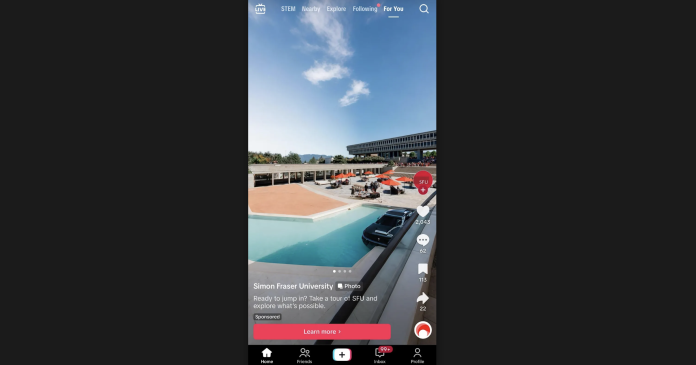
A black car sits in the middle of a light blue pool in the middle of convocation mall, while also merging into the concrete ground.
PHOTO: Courtesy of Aidan Ramage / Reddit

By: Mason Mattu, Section Editor

Does SFU have a pool in convocation mall? Or a parking lot that allows cars to park inside the pool? Those are the kinds of images that Aidan Ramage, a student at the SFU Beedie School of Business, saw via an official SFU advertisement on TikTok. 

Ramage told The Peak, “I felt a bit betrayed; we have a beautiful campus and have hundreds of artists enrolled full-time at SFU. Choosing to circumvent available resources in favour of artificial intelligence (AI) is disgusting to see from such a big institution.” 

“The university did not approve the ad, which used generative AI to fill in areas above and below a video frame,” SFU told The Peak. “Once SFU was aware of the ad, it was immediately pulled. Our team is working to ensure that it will not happen again.” 

TikTok offers various advertising tools. Smart+ campaigns involve AI-driven analytics, and with an add-on called Symphony, businesses can generate parts of the advertisement using AI. However, TikTok’s advertising guide describes Spark Ads as a campaign option with manual control. 

The university denied enabling any of TikTok’s AI creative tools in their ad suite on their end, opting to use a “Spark” manual campaign without any “automated creative optimization features” enabled. There is no mention of these AI tools on TikTok’s page on Spark Ads. 

According to the platform’s advertisement policies, any ad content that is “inaccurate, misleading, or false” is banned from the platform. The SFU advertisement is misleading because there is no pool within convocation mall.

A representative from ByteDance, TikTok’s parent company, refused to speak on the record with The Peak, instead asking to be put in contact with SFU to work on fixing any technological problems. The Peak followed up with SFU, who stated that “the university is no longer using the previous ad format, which caused TikTok’s AI features to alter our original assets without our knowledge. Due to the platform’s popularity with potential student audiences, we continue to run ads on TikTok but have switched to a new ad format that prevents AI optimization.”

“There was no indicator from TikTok that the ad included AI-generated content,” Beedie student Aidan Ramage said. “This is another thing that confused me, as normally, videos and ads on TikTok indicate when content has any traces of AI-generation.”

This is not the first time that users of TikTok’s advertising suite have complained about unauthorized AI additions to their advertisements.

Video game company Finji recently criticized TikTok for adding unauthorized “racist and sexualized” AI changes to a character in an advertisement.

They were also unable to make changes to these variations. Like SFU, the company claimed they had AI “all the way turned off” in the ad suite. According to reporting by IGN, a customer service representative from TikTok confirmed that Finji’s AI tools were indeed turned off. 

One user on the r/TikTokAds subreddit also complained about unauthorized additions to their manual ad campaign. “I have NOT activated smart creative on my campaign, yet it seems to be on. When I watch my own ad, AI-generated changes have been made like changing the music and adding animations or AI stock images.” 

This is the second time the university has found itself in a controversy regarding AI-generated promotional material. Recently, the SFU Bookstore was accused of using AI-generated art. 

Fasting can unlock a healthier and more sustainable lifestyle

0
a Black hijabi woman breaking her fast with a date. There is a plate of dates beside her.
ILLUSTRATION: Abigail Streifel / The Peak

By: Heidi Kwok, Staff Writer

Ramadan is the ninth month of the Islamic calendar, during which fasting is observed by Muslims as a form of spiritual worship. In the Islamic case, fasting is the abstention from both food and water from dawn to sunset. As one of the five pillars of Islam, Muslims fast during Ramadan to develop restraint from shahawāt (desires) and shubuhāt (doubts) in order to become closer to Allah (The God) through the attainment of taqwā (being mindful of God). Through deprivation, the resulting hunger and thirst serve to foster greater empathy for the less privileged. Outside of Islam, the ritual of fasting — albeit with variability in the type and duration of fasting — is likewise commonly practised in other religions, including Judaism, Buddhism, Catholicism, and Hinduism. For instance, some Catholics refrain from meat on Fridays during Lent. While in Hinduism, some practitioners may only consume a single vegetarian meal a day during celebrations and honorary occasions. The benefits of fasting extend beyond the spiritual, and into enhancing the physical and mental health of its practitioners, the achievement of a more sustainable lifestyle, and improving the health of the planet. 

Unlike diets that restrict what you can eat, intermittent fasting describes a schedule of eating and not eating at predetermined times.

What this might mean is that a person may choose to only eat at certain hours of the day and refrain from eating for the remainder — a break from the three-meals-a-day eating pattern that many people are accustomed to in the modern world. A lack of readily available nutrients during fasting transforms the cells of the body into survival mode, triggering the detoxification of old cells in a process known as autophagy. Autophagy is a little like Marie Kondo’s organizing method. Damaged cells that don’t “spark joy” are discarded as junk and salvageable parts are repaired into functioning cells. What could follow are health benefits such as decreased risk of cardiovascular disease and improved liver and gut function and evidence of greater mental well-being for those with mood disorders. I can personally attest to the efficacy of intermittent fasting as someone who has observed their dad transform from a person with high cholesterol and poor liver function to a noticeably healthier and more cheerful person through informal periods of fasting due to the influence of Buddhist teachings. 

Interestingly, a 2022 study examining the impact of various types of religious fasting on planetary health found that fasting can contribute positively to the environment through reduced consumption. Many religions abstain from consuming alcohol during fasting periods. Some alcoholic beverages that have been fermented, such as beer and wine, are considered ultra-processed foods due to undergoing intensive industrial and manufacturing processes — to the detriment of the environment through waste generation and pollution. Other industrialized food production, like livestock rearing and meat production, are also responsible for significant greenhouse gas (GHG) emissions, land use changes, and habitat loss, not to mention a major source of carcinogens for humans. Because the consumption of red meat is often not permitted during fasting, the planet may very well be better off with this drop in demand. Shifting to a plant-based diet or cutting out meat altogether can result in a significant reduction in GHG emissions.

Needless to say, you don’t have to be religious to capitalize on the health and environmental benefits of fasting. If you do decide to give intermittent fasting a try — with the consultation of your health provider — you can always draw inspiration from the myriad of religious fasting rituals. While temporary withholding from food and water (as is done during Ramadan by Muslims) may not be viable for some people, other faiths various dietary-restrictive fasting during days of significance. Whether or not you choose to perform one kind of fasting or another, there is something to be learnt and maybe utilized from the ritual of fasting.

Fascism across borders: the Canadian companies collaborating with ICE

0
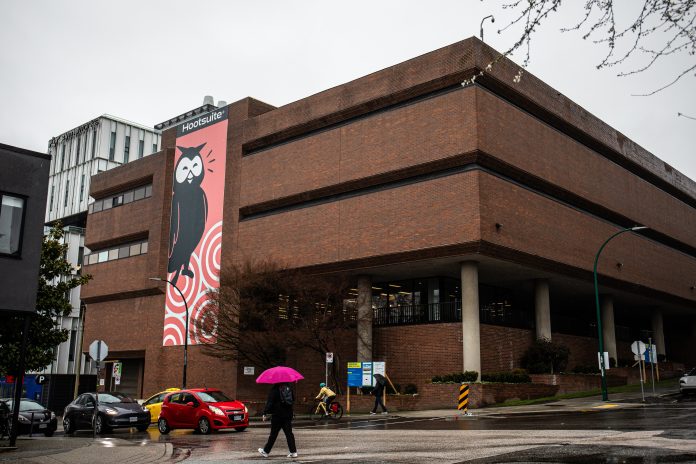
A photo of Hootsuite headquarters.
PHOTO: Gudrun Wai-Gunnarsson / The Peak

By: Olivia Sherman, Peak Associate

Content warning: mentions of gun violence.

The United States’ Immigration and Customs Enforcement (ICE) has enacted detentions and mass deportations against undocumented immigrants for over two decades — this has surged in frequency since President Donald Trump’s second term began. 2025 was the deadliest year for people in ICE custody since 2004. This January saw ICE commit two gun killings. More than three people were also shot in 2025 by ICE. 32 people died in detention centres in 2025, and at least six more so far this year. Their families say this was due to health complications from neglected healthcare and abuse. Human rights advocates and immigration lawyers have also reported inadequate healthcare and sanitary conditions. In January, protests in Minneapolis, where two killings were filmed and uploaded online, spread across the US, and garnered worldwide media attention and solidarity. 

Anti-ICE sentiments have also grown in Canada, as has the spotlight on Canadian companies aiding, benefitting from, and collaborating with ICE and its increasing number of detention centres across the US. One of these is Hootsuite, a Vancouver-based marketing company. On January 30, demonstrators arrived at Hootsuite headquarters to protest against the company’s involvement with ICE. Despite freezing temperatures and heavy rain, around 500 protestors arrived at Hootsuite’s Mount Pleasant headquarters, blocking 5th Avenue and carrying signs down Main Street to raise awareness. 

Hootsuite describes themselves as a “platform to manage, monitor, and measure” social media presences and they have a contract with the Department of Homeland Security (DHS), which oversees ICE and its activities. It’s worth up to $2.8 million and has transactions as recent as September 2025 for Hootsuite’s services. Hootsuite CEO Irina Novoselsky stated in late January that Hootsuite provides “insights that drive better decisions and accountability, without endorsing specific actions or policies.” 

In an internal call to Hootsuite employees, obtained by The Globe and Mail, Novoselsky said the company “did nothing wrong” and that “ICE is a customer within the public affairs group.” In the same call, Novoselsky also claimed reports on their collaboration with ICE are “fake news.” 

The January 30 protest was organized by Democracy Rising, a grassroots Vancouver-based anti-fascist organization. Fascism is a right-wing populist movement, often relying on the scapegoating of marginalized groups to carry out authoritarian acts. Historically, these acts consist of censoring the media, expanding territory through annexation, dehumanizing chosen scapegoats through fearmongering, and mass imprisonment and eradication of perceived enemies to the regime. 

The Peak spoke with Democracy Rising co-founder Kalifi Ferretti-Gallon, who says the community-led organization is “firmly rooted in our backyard.

“We have a community that we want to protect and we want to engage [ . . . ] If you have offices in Vancouver, you’re part of this community.” Although the scope of Canadian companies collaborating with ICE is nationwide, Ferretti-Gallon notes that there are local avenues for action and change. Many of the companies working with ICE have offices in Vancouver, such as Quebec-based security firm GardaWorld. They provide security guards to an ICE facility dubbed “Alligator Alcatraz” for its human rights violations and the hundreds of undocumented disappearances of its detainees. 

Independent Canadian journalist Rachel Gilmore has documented several more companies working with DHS and ICE, including IT firm CGI and media company Thomson Reuters. Both have offices in Vancouver. Canadian real estate agency Avison Young is currently selling two of their US-based warehouses to ICE for processing facilities, as the Globe and Mail reported

Democracy Rising wrote an open letter to Hootsuite, condemning their continued involvement with ICE and stating their concern “that ICE has become the enforcement arm of a fascist regime” with inhumane conditions in facilities, including accounts of documented sexual abuse and deaths in custody. The letter calls for an end to all ICE contracts and a commitment to not aid in further “authoritarian enforcement.” This would align with Hootsuite’s own commitments to “equality and anti-racism, community and environmental well being, and disaster response,” the letter points out. 

“Anything less will remain a stain on Canadian history,” the open letter states. “Canadian businesses have no place working with them.”

As of the interview in late February, Ferretti-Gallon states that Democracy Rising has not seen a response to their letter, and has “not really seen any kind of action on them, on their social media or in any kind of official public capacity.” 

BC Green Party leader Emily Lowan attended the January 30 rally, calling for action against corporations benefiting from ICE. Lowan has also been a critic of the Jim Pattison Group and the company’s recent agreement to sell a warehouse they own in Virginia to be used as an ICE processing facility. The Jim Pattison Group is the second-largest privately held company in Canada, with ownership spanning from broadcasting, agriculture, car dealerships, outdoor signage and advertisements, and multiple grocery chains, including Save-On Foods and Nesters Markets. 

While the company stated it wasn’t aware of the intended purpose of the facility after its initial agreement to ICE, they still received public backlash. On January 30, the Jim Pattison Group made a single-sentence announcement that the transaction “will not be proceeding.” A few hours after the Hootsuite protest, protestors reconvened outside the Jim Pattison Group offices in a celebratory demonstration. Also hosted by Democracy Rising, the protest outside Hootsuite was followed by another one on February 21.

Ferretti-Gallon formed Democracy Rising last year with her partner in solidarity with “nationally coordinated protests that were happening in the US.” The No Kings rallies in the US were a response to Trump’s second term and his authoritarian administration. “We’re trying not just to use this organization as a vehicle for protest, but also to build community, because we are realizing that’s the best way to fight fascism,” Ferretti-Gallon said. 

The violence seen conducted by ICE is a symptom of a rising growth of right-wing authoritarianism across the globe, and isn’t unique to the US. Canada’s recent Bill C-12, or the Strengthening Canada’s Immigration Systems and Borders Act, is one example. The bill, recently passed by the House of Commons, is not yet law but could allow the Minister of Citizenship and Immigration to change, cancel, or suspend immigration documents, increase Canadian Border Services Agency (CBSA) authority over who is allowed in, and suspend applications if it is in the “public interest” to do so. Several migrant advocacy groups have spoken out against this bill, including the Migrant Workers Alliance for Change, who are in a coalition with Democracy Rising and staged their own protest outside Toronto’s Hootsuite offices on February 26, which also called to reject the bill.

Ferretti-Gallon explained this rise in border security is directly linked to recent threats of annexation by Trump.

Fascism really begets fascist behaviour.

— Kalifi Ferretti-Gallon, Democracy Rising Co-founder

Saying Canada is increasing their “strongman behaviour” at the border in response to these threats. We are calling on these offices and these kinds of entities, including public institutions like US embassies and the CBSA, to stop directly supporting ICE, stop profiting from ICE, stop facilitating and hosting ICE.

Monday Music: Songs to stand up to the man

0
A photo of a fist held upwards against a pitch black background
PHOTO: Luis Quintero / Pexels

By: Mason Mattu, Section Editor 

From Mark Carney’s austerity measures, to a skyrocketing cost of living, and the potential for an East-West pipeline to go through stolen Indigenous land, we’ve got a lot to be angry about in this country. The number one perpetrator? The Man. The Man could be capital, the rich, those who profit off endless wars, colonial governments, or fascists like Donald Trump. 

Traditionally, protest songs have been upbeat. But these aren’t average protest songs. I present you with some songs that can fuel your rage against The Man

I Pity the Country by Willie Dunn 

This track by the late Indigenous singer Willie Dunn addresses the struggle of being an Indigenous person in Canada. “Police they arrest me / Materialists detest me / Pollution it chokes me / Movies de-joke me.” This song is so sad — it’s as if the speaker has given up all hope of change as the guitar strums. That the impacts of colonialism are inevitable, cyclical, and permanent.

However, this changes towards the end when he tells us that “revolution is brewing,” bringing in a sense of hope and agency to the act of protest. Listen to this song and let’s get to work. 

Jack’s Dream” by James Gordon 

Jack Layton inspired Canadians with his vision for Canada and was responsible for the New Democratic Party securing the status of official opposition after the 2011 federal election for the first time in Canadian history. He passed away that same year. 

Politics aside, this song lays out Layton’s vision for a more humanistic Canada. One in which no person goes starving, and where we mobilize to create economic change. His masterful delivery combined with phrases that Layton used himself reminds us that his dream is not dead and it is our responsibility to keep it alive. 

Gordon reminds us of Layton’s last line in his posthumous letter to Canadians — “Love is better than anger / Hope is better than fear.”

There’s a Tumour in the White Houseby Dan Mangan 

Vancouver-based singer-songwriter Dan Mangan wrote this during Trump’s first administration, yet the message still rings true today.There’s a tumour in the White House / There’s a blowhard at the gate / Choke-holders in the squad car / Bootlickers on parade,” he sings with a lingering sense of pain in his voice.

Mangan encourages Americans to take action by talking to one another, including talking to their Trump-supporting family to change their minds. What I think we can learn from this song is that deep within everyone lingers a sense of morality. As he says, “maybe it’s not too late,” if we reinvest in speaking out and up as a form of protest. 

Stephen Harper Hates Me by Cathy Cook 

Cathy Cook, an Indigenous woman, recorded this song on the brink of the 2015 federal election. She fused blues and Indigenous drumming while asking former prime minister Stephen Harper why he hates her. The “her” in question represents different marginalized Canadians — including a fired climate change researcher, a veteran on the brink of suicide due to chronic underfunding for Veterans Affairs Canada, and a seasonal worker. 

This song was part of the Stop Harper movement that saw Trudeau — who we thought was a once in a lifetime leader (we were wrong) — elected. Replace Harper with Carney, and you’ve got a good summary of what’s going on in Canada right now.

Get moving with Indangamirwa Vancouver

0
A photo of dancers from Indangamirwa performing
PHOTO: Courtesy of Angelique Muhorakeye

By: Heidi Kwok, Staff Writer

Indangamirwa Vancouver is a dance group “dedicated to the preservation, education, and appreciation of traditional Rwandan music, dance, and culture.” For the troupe, cultural dance is more than a form of entertainment but also “a means to educate, communicate, and preserve ancestral background all while fostering togetherness.” The Peak interviewed Angelique Muhorakeye, chairperson of Indangamirwa and SFU alum, to learn more about the origins and inspirations behind their performances.

This interview has been edited for clarity and concision.

When was Indangamirwa Vancouver established? What motivated you to form the dance group? How has it evolved since then?

Prior to coming to Canada, I belonged to another group, also called Indangamirwa, based in Nairobi, Kenya. As refugees in Kenya, there are a lot of vulnerabilities that can lead someone astray. So dancing was used as a way to heal people and to keep young people busy and connected. 

Now I’m here. This is another test for me, so I thought of looking for Rwandans who live here and seeing if we can start a dance group. In 2015, my sister and I, along with two other dancers, established the group. We were then invited to perform at a wedding, which motivated us, and out of passion we just continued. 

Year by year, we would have different people coming from Rwanda joining. We started becoming really strong in 2018. We now have 16 members. Last year, we had our 10th anniversary, which was a huge success. The entire community showed up and everyone wanted more! 

Could you tell me more about the types of dances that Indangamirwa has performed in the past?

We do both Intore and Amaraba. Intore is specifically for men, because the word means “warrior.” Traditionally, they were meant to guard the king and the kingdom. With Amaraba, mostly women do it. It’s a dance that could represent anything, but our dancers usually imitate cows with big horns. That’s why you see a lot of hands being raised. 

There are also other different types of dances depending on where you’re from and which part of Rwanda. Most of the time we are celebrating something. Either the birth of a child, a wedding, love, it’s always something being celebrated — something beautiful. That’s why our dance involves smiling throughout.

You are a dancer, a language interpreter, and an advocate for refugees and immigrants in Canada. How have these different experiences shaped or influenced your artistic practice?

They’re intertwined. Like I mentioned, we come from a refugee background. There are a lot of negative influences that come with it because there’s poverty involved. So having an artistic background helps with being creative and taking that art into the community so that people will have something to do instead of being idle. 

When we go perform, we involve people. We have children’s groups where I sometimes go to teach how to dance, to connect with their African background and heritage. We also have women who are going through healing, and some of them are immigrants. 

The language part helps me because the people we deal with here were immigrants and from the same background of the languages I speak.

It’s a communal type of work because it’s collective and it’s through association. That’s why, back home, a lot of people know how to dance — not because they’re dancers — but because that’s the way you spend your time, connecting to your ancestral dance. 

What does it mean to you to perform and showcase Rwandan music, dance, and culture here in Canada?

There’s pride in who I am. It gives me confidence to stay, to love who I am, and to connect back to where I’m from, which influences where I’m going.

I’m a cultural ambassador. If I have something beautiful, why not share it?

— Angelique Muhorakeye, chairperson of Indangamirwa Vancouver

Every time I dance, I’m healing. I’m working out. There’s just a lot of benefits. Why not give it to the other person?

Our performances always end with interactions that encourage people to dance with us. You get to have a different kind of outlook on things when you participate. 

Is there anything else you’d like to add?

I would just tell people to get up and dance! It doesn’t matter what you’re dancing — just get off that couch and dance. Don’t worry about people looking at you — just enjoy yourself. And if people see that you’re happy, they will join you, because joy is contagious.

Follow the dance group on Instagram @indangamirwa_vancouver for more information and news on upcoming performances.

The shit files: The SFU Shitter begins his carnage

0
Lana Del Rey sits comfortably on top of a chair.
IMAGE: Courtesy of Lana del Rey / Youtube

By: The SFU Shitter

My friends, the time is now for poop liberation. My good friend, the SFU Pisser, started this movement. Now, it’s time for us to end it. Our goal? Better quality washrooms. Bidets in every single one of them. How will we achieve it? Join our struggle! 

Our struggle is a principled one. We are not reckless shitters — we are targeted ones. We will take our poop to the front lawns of SFU’s executives. That includes you, president Joy Johnson. We will not rest until we can peacefully shit on campus. 

For my first letter to The Peak’s readership, I thought I would write about my forthcoming activities in the best way I know how — verse. I have parodied Lana Del Rey’s latest song, “White Feather Hawk Tail Deer Hunter,” because the title represents how long we have waited for improved toilet sanctuaries on campus. 

It’s my white feather 0-ply AQ 6000-level toilet paper,

Likes to keep me cool in the hot breeze summer.

Toilet’s always broken like a John Deere mower,

I wish there was a bidet, it’s such a bummer.

One day when I shat . . .
A solution, 

Popped into my head — retribution. 

In the dark (snap), snap, crackle pop, tch, 

I’ll shit on the lawns of those who make the big decisions.

Everyone knows I had some trouble
Going poo-poo on campus.

And I wanted to know if I could use your phone,

To film myself going poo-poo on the VP-finance’s front lawn cause I’m . . .

Positively poo-poo, everything that I do,

Don’t know how exactly liberating it could be? 

Whoopsie-daisy, yoo-hoo, letting all my poo-poo,

Out on the lawns of those busy executive bees. 

Take your hand off the record button, hun, 

If I yell, “Yoo-hoo, constipation’s almost done.”

Whoopsie-daisy, yoo-hoo, 

I imagine you do,

Know exactly how quintessential having an SFU Shitter can be.

It’s my white feather hawk tail damaged toilet,

I’m going to shit on Joy Johnson’s lawn, it’s my own verdict.

Now I have an APB from the police, come and get me. Oh perfect. 

I’ve just been shitting, waiting for some press coverage.

I usually have a musty throne for the summer, 

Yeah, I’ll shit on your lawn, it’ll recover sooner than your next budget blunder.  

Put that fancy bidet on my ass — no worries in September, 

I love my ass, I’ll fight for my toilet throne ’til I feel Bidet’s pleasure! 

Everyone knows I had some trouble,

Finding places to shit on campus.

And I wanted to know if I had your support,

To bring our shit to the chancellor’s front lawn — it’ll help me shit in peace on campus.

Whoopsie-daisy, just shat on the VP-facilities’ front lawn,  

Whoopsie-daisy, just shat on Joy Johnson’s mansion’s stairs.

Whoopsie-daisy, just shat in an executive’s brand new car,

Whoopsie-daisy, just shat all over the Board of Governors’ rug.  

Whoopsie-daisy, I feel very OK,

Whoopsie-daisy, now that I have the chance to shit OK.

Whoopsie-daisy, share this song with a friend,

Whoopsie-daisy, poop liberation must never end.

I’m the white feather hawk tail SFU Shitter,

I’m not a cat but I’ll make you feel like you’re all my litter.

Get ready, the world is my toilet baby,

I wish you could all see the mess I’m about to create-y (THIS RHYMES!).

Whoopsie-daisy, maybe I’ll shit on a dean’s lawn,

Whoopsie-daisy, my underwear’s just a social construct.

Whoopsie-daisy, you better watch your back.

Whoopsie-daisy, the SFU Shitter is here,

Whoopsie-daisy, you all should fear

Pilates is for babies . . . is what I said before I tried it

0
A man wearing a baseball cap trying to do pilates. The girls behind him are giggling because of how much pain he’s in.
ILLUSTRATION: Victoria Lo / The Peak

By: Noeka Nimmervoll, Staff Diva

The Navy SEALs taught me that nothing is forever except discipline. Now that I’m retired, I pump five tonnes of steel in my garage every day for 15 minutes straight like the beast I am, to remind myself that this ass might retire, but it won’t quit. Last Tuesday night, mid-routine, my neighbour Janine showed up to my garage to complain about all the carnal screaming I was doing at 11:00 p.m. She told me that all my screaming was getting in the way of her “sleep” and that she was going to call the police. She said she was teaching a Pilates class at 7:00 a.m. the next morning and she needed her rest. I told her if Pilates was a real exercise, I might take her seriously. Janine got right in my face and told me I couldn’t handle her class. 

Oh, it’s so on, Janine. I signed up for her 7:00 a.m. class and sneered in her face. “You don’t know who you’re messing with. You can’t handle the beast.” Her eyes flashed like Satan operating a flamethrower. “I’m gonna serve you your own ass on a platter,” she whispered. 

OK, it’s 7:00 a.m. and Janine walks in and claps her hands, her eyes scanning every person in the class. “Hey everyone, how are we doing today? Alright, everyone ready for an hour of your body on fire? We’re blasting those thighs and abs today. Keep your eyes on me, ’cause we’re moving fast.” She looks at me and gives me a stink eye. “No breaks today. OK, on your mats!” 

She puts on some Carly Rae Jepsen and starts demonstrating the first activity. “Three, two, one, let’s go!” Sweat is rolling down my face by the time I’m on my third leg lift. My entire body is shaking even though I’m just lifting my legs, and I can’t see Janine anymore because of my eyeball sweat. She starts yelling for us to get on our feet for squats and pulses. “DON’T STOP, ONLY 30 MORE SECONDS!” yells Janine. DAMN, Janine. All I see is red and I think I’m fading in and out of consciousness. 

As we’re pulsing, I start thinking about how I should not have drunk that case of PBRs last night,cause I think my body is trying to sweat all of the beer out. My mat is so slippery. “NOW ONE LEG PULSE!” screams Janine. I look over at her. She’s got this rabid look in her eye — and she’s staring right at me. Terrifying. I get on one leg and bend my knee and — BOOM, down I go. All the ladies gasp in unison. I am staring at the ceiling, gasping for air, and then I get on my side and hurl onto the ground. This is rock bottom, I think to myself. Suddenly Janine appears right in front of my face. “HEY, GET UP!” yells Janine. “NO EXCUSES! GET UP OR GET OUT! YOU CAN’T HANDLE THE BEAST! YOU ARE WEAK! YOU ARE WEAK!!!!” 

Since Janine is usually home around 3:00 p.m., I’ve adopted a new schedule. I wake up at noon, do my workout, then go to the bar from 3:00 p.m. to 10:00 p.m. I haven’t seen her in months. I will never get rid of the image of her red, sweaty face screaming at me while I lay in a puddle of my own barf and sweat. She is tougher, meaner, and stronger than any of my former Navy SEAL bosses, and they were VERY intense about their paperwork. 

What does it mean when doctors ask “are you sexually active?”

0
a woman during a doctor’s visit at the hospital. She sits on top of a hospital bed, and the doctor is standing to her right, asking her questions.
PHOTO: RDNE Stock project / Pexels

By: Noeka Nimmervoll, Staff Writer

Content warning: References of sexual activities. 

The wrinkling of paper underneath you as you sit atop the patient’s table. A cold stethoscope against your skin. The question, “are you sexually active?” These are all part of a regular doctor’s appointment, but one can be exclusionary if it’s being asked by someone who has a narrow and heteronormative understanding of sex.

In the wide spectrum of human intimacy and relationships, what counts as sexually active?

It seems the definition is different for everyone, and this reality is not reflected in a doctor’s checklist. For health-care to be truly inclusive, doctors should be more specific about what they mean when they ask, “are you sexually active?”

Doctors ask about sexual activity ultimately with the patient’s best interests in mind, but they do not make it clear how you should answer — what kind of sexual activity is being asked about? It’s important to have conversations about using condoms to prevent STIs in penetrative anal sex between men, or using dental dams when having oral sex. It is easy to withhold valuable information if you assume that your doctor is asking about penetrative vaginal-penile sex, when that doesn’t apply to you! Perhaps you are straight, but you masturbate, or you prefer fingering with your partner(s). Being honest about how you are sexually active opens up conversations about contraceptives, screening for STIs, and vaccines for HPV, among other things. Additionally, if you are showing symptoms of a yet-to-be-diagnosed condition, information about your sexual health may be the piece of information needed to understand what’s going on. However, when treated like a binary “yes or no” question, instead of a conversation, your individual identity and sexual experiences are undermined, and have the potential to prevent you from receiving quality health-care. Among the many different reasons for doctors to understand a patient’s sexual health, some are only applicable to certain types of sex. For example, the doctor might be inquiring about your sexual activity to assess which contraceptive to recommend to you — which is only applicable to certain kinds of penetrative sex. The vagueness of asking “are you sexually active?” may limit honesty between patients and healthcare professionals, and disproportionately affect marginalized communities.

Sexual health education is part of the BC school curriculum, but it is often based in heteronormative assumptions, impacting doctor-patient relationships. Everybody has their own experience with sex education, but mine memorably involved a timed game of put-the-condom-on-the-banana, and did not discuss 2SLGBTQIA+ experiences and sexual health. Personally, I got my queer sex ed from Glee and my friends, but it shouldn’t be on the individual to fill in the blanks about what a system should already be teaching. This heteronormativity that guides our sexual education is reflected in the doctor’s office by making 2SLGBTQIA+ individuals feel less visible. People who need to “come out” to their doctor must overcome more barriers, including social stigma, vulnerability, and fear around patient-doctor confidentiality, to access the same medical care as their cisgender, heterosexual peers. 

I recognize that this question becomes more personal and invasive the more specific we get. But this question itself is aged and heteronormative, and it heavily excludes 2SLGBTQIA+ communities and countless people who partake in outercourse. I know it may seem like a small thing, but words matter, and they reflect the broader culture of exclusion and heteronormativity. By properly explaining the definition of sexually active, people have better opportunities to discuss and improve their sexual health.