Home Blog Page 882

SFU hockey: a tale of two games

0
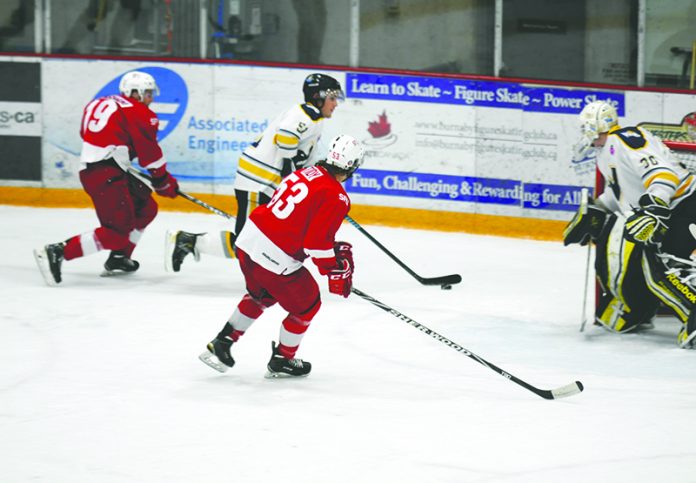
Brandon Tidy (#53) scored in his fourth consecutive game.

On Saturday, SFU was able to squeak out a 2–0 victory over local rivals Trinity Western. It was a game that was vastly different from the previous night, where SFU won 10–5, scoring five goals in the third period alone. The Clan came out and played a very tight, defensive game that was still highly entertaining.

“I thought it was one of those games where you have to guts out a victory,” said Head Coach Mark Coletta afterwards. “It’s even both ways, both teams are playing with injured players, and you go from one night where there’s 15 goals to a night where there’s only two. It’s a character win, and we’ll take those.”

The first period was marked by penalties. A total of eight were taken by both teams, five by Simon Fraser. In the second, Brandon Tidy broke the deadlock, scoring in his fourth straight game off a fortunate bounce. Jono Ceci sealed it in the third period with an empty net goal, his second point of the night and the team-leading 25th point. The majority of the game was quite defensive, with both teams determined to tighten up after the goal fest of the previous game.

The big story of the game, however, was Clan goaltender Jordan Liem. He made 33 saves that night gaining the win and a shutout. He made a number of terrific saves, including an amazing cross-crease save early in the third period to preserve the one goal lead.

“Try to keep calm,” said Liem on what went through his mind late in the game. “Usually when the play’s in your end you’re not usually thinking too much. But when it goes down the other way, you’re definitely trying not to say the word ‘shutout’ in your head, or trying not to think of the end of the game with a shutout. You’re just trying to keep your team in it with a 1–0 lead.”

Another big story afterwards was the unsportsmanlike conduct penalties that SFU took during the game. The Clan took three of them during the game, two of them after ordinary cross checking and slashing calls. This meant regular two-minute penalties turned into massive four-minute kills for the SFU penalty kill.

“I don’t think he likes us very much, to be honest,” said Liem afterwards. “I think we rubbed him the wrong way right off the bat, with [Matthew] Luongo being a little lippy. We know him from before and he’s just that kind of ref where if you get on his bad side, you’re on his bad side for the rest of the game.”

With top pairing defensemen Jesse Williamson still out, Dustin Cave stepped into his spot alongside Darnel St. Pierre. “The Caveman” filled in nicely, providing a number of bone-crunching hits throughout the game, and seemed to have instant chemistry with St. Pierre.

“They’re finally coming into their own,” said Coletta on the pairing. “They’re first-year guys, and it takes time for these guys to get used to this style of hockey. Everybody always thinks that the BCIHL is a collegiate league that isn’t that great, and we don’t get much respect. Which is fine. When they come from Junior A or Junior B and they’re the big guys in the pond, they come play for us, they realise how good this league really is.

“Cave and St. Pierre are very physical guys, and that’s what we need them to do, and they did that tonight.”

Political science should replace WQB requirements

0

[dropcap]S[/dropcap]FU’s WQB requirements should be replaced with practical knowledge courses that will help us students become more responsible adults in our communities. In particular, Introduction to Political Science (POL 101) would be the best alternative course to our current WQB options, as to be an informed Canadian citizen is just about as ‘practical’ as it gets.

You thought you lacked an intimate relationship in time for Valentine’s Day? Don’t worry about it. The government is a very intimate part of our lives, whether or not we want to admit it. It has an impactful and powerful say over every little thing: the air we breathe, our money, our homes, our food, our information, and even our personal agency.

That’s right, ladies. If you choose the wrong government, next thing you know it may have something legally unpleasant to say about whether or not you even have entitlement over your own body.

You can be religious, atheist, man, or woman from any manner of background, yet you will still fall under the one umbrella that is Canada. If you are a Canadian citizen over the age of 19, I believe that you have the responsibility to be educated and active in politics. But this isn’t as daunting as it sounds. It could simply mean you do your research, form an opinion, support your party, and vote. It could also mean that throughout that party’s term, you keep them accountable to their platform and continue to fight for the changes you want to see.

SFU’s POL 101 is currently a Breadth-Social Science course, so there is a higher chance that more students will take it as compared to other 100-level courses, yet it’s still not enough to make a democratic difference. Why? Because POL 101 is not mandatory for everybody.

I was so shocked during this past election, where the political stakes were so high and personal, yet many students I spoke to did not “care much about politics” or “know enough to cast a vote.”

I wanted to tear my hair out. It’s your job to know. It’s your job to represent as many minorities in your community as you can. People that don’t have the same rights that you do are placed in a very vulnerable position, don’t you understand this?

POL 101 is a theory-based course that not only teaches you the basic definitions and theories surrounding politics, but encourages you to form your own opinion on the issues you see around you, and to think about what kind of changes you’d like to see made by our highest authority.

This should be a mandatory course at SFU. It’s something much more applicable and useful for a post-grad adult, rather than our other current WQB requirements, which include learning about pointless topics such as dinosaurs and the stars in the sky (in my case, as a liberal arts student).

As fascinating as that is, my priorities lie in knowing exactly who is representing the Canadian people, and exactly what I can do to be heard if I don’t approve of their actions or lack thereof.

Make POL 101 a requirement.

Satellite Signals

0

WEB-woodwardWoodward’s 

From February 11 to 21, the SFU Woodward’s Cultural Program will be presenting daily showings of Robert Lepage’s one-man show 887 at 7:30 p.m. in the Fei and Milton Wong Experimental Theatre at The Goldcorp Centre for the Arts.

887 premiered in Toronto earlier this year and explores the mechanisms behind memory, consciousness, and childhood.

vancouverHarbour Centre

On Wednesday, February 17, there will be a poetry recitation at Harbour Centre. “Lunch Poems at SFU” will take place at noon at the Teck Gallery, and is a free event open to the public. Poetry readings at Harbour Centre are held on the third Wednesday of each month.

Poetry will be recited by UBC Humanities teacher and poet Ted Byrne, as well as Kayla Czaga, who was nominated for the Governor General’s Award for Poetry in 2014 for her debut collection of poems, For Your Safety Please Hold On.

Michael Harper’s fourth quarter

0
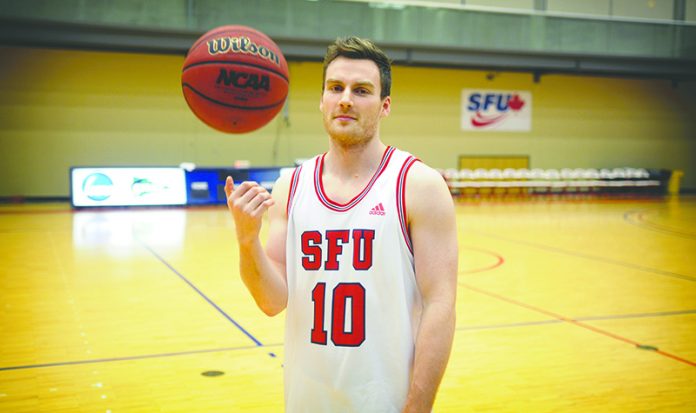
Harper leads SFU in scoring, averaging 14.1 points per game.

It’s been a tough season for the men’s basketball team, to say the least. The team suffered through a 18-game losing streak, and has only won a single game in conference play this season. One of the constants throughout this trying season has been senior Michael Harper. The native of Melbourne, Australia has averaged the most minutes on the team, and leads SFU in scoring for the season.

“I’d be lying if I said it didn’t take a hit, but guys still like playing basketball,” said Harper on the team’s struggles this season. “[The players] still enjoy the competitiveness, and that helps take away from the aspect of losing. Just the fact that you enjoy basketball still. And you know, there’s always hope for the next game. You’re always looking forward to the next game, because we’re not down and out, we’re never down and out.

“Your spirits are always trying to stay high, [and] this is when you really get tested to see [where you are] with the program. When you get to this level, winning is what keeps jobs and keeps scholarships. [. . .] So if you’re in a losing environment, [when] things get heated, we stay together. I think everyone has each other’s back.”

Harper started playing basketball at the age of eight, when a friend of his started playing. While still in Australia, he had his eyes set on coming over to North America to play basketball.

“Basketball in Australia is more kind of European, because high school basketball isn’t as big,” he explained. “There’s still high school basketball, but it’s not as serious. And then once you get to university [in Australia], no one plays, everyone who’s on the university team shows up drunk to the game. That’s kind of why I wanted to come to the [United] States or North America, because the basketball for my age, that’s where it’s at.”

Harper elaborated further. “You can play professional in Australia, there are club teams that pay you, but it’s not about development once you go professional. [In North America] there are college coaches that are with you every day. It’s just more hands-on at the collegiate level. You grow up watching college basketball, like high Division I schools, and you see them on TV and they’re just out of high school.”

“One of the tests that I’ve had as a senior is being more vocal.”

Harper got his wish when he went to play for the University of Hawaii in his first two years of university.

“It was good,” he said. “It showed me different people’s coaching styles. Just different athleticism, playing with guys growing up in America, [. . .] I had to adapt my game a little bit. [It was] more challenging, [and] I think I learned a lot at the Division I level that translates well to the Division II level.”

After not getting much playing time at the University of Hawaii, Harper transferred here to Simon Fraser, to finish his collegiate career playing regular minutes.

“[I] just wanted to play in my college career,” he said. “I didn’t want to sit on the bench for all four years. [. . .] James Blake, the head coach before our current coach, contacted me because he knew someone at the University of Hawaii in the offices. They obviously knew that I was looking to transfer, so Blake got into contact with me and it all went from there, really.”

With James Blake gone and his successor Virgil Hill at the helm, the Clan have drastically changed their style. Not only are the two coaches’ game philosophes different, their coaching style is different as well.

“They’re pretty different,” said Harper. “Last year we had a more loosely-flowing offence, which is a fact [that goes with] the players that we had last year versus the players that we’ve had [this] year. Coach Hill has more of a hands-on system, more plays that are run. We have a younger team this year as well, so he’s really trying to build a program [. . .] As the lone senior, he puts a lot of pressure on me to show [the others] how it’s done. And just really lead the way, and show how college basketball should be played. We have good juniors as well, in Hidder [Vos] and Max [Barkeley].”

Harper has also had to adjust this season, becoming a leader on the team — a stark contrast to his supporting role earlier in his career at Hawaii.

“I’ve always been a guy that leads by example,” said Harper. “One of the tests that I’ve had as a senior is being more vocal. I’ve never been the most vocal guy growing up, so it’s always just been my actions. So that’s how I’ve kind of how I try and do it, is leading by actions. And it helps that we have guys from last year as well, a few guys from last year that help me and Coach Hill build the program as well.

“It’s not just me as a senior, it’s everyone pulling their part, wanting to win, wanting to get better. Instilling that confidence that it’s just a process.”

Once his NCAA eligibility is over after the season, Harper plans to go back to Australia to finish his degree while playing for a club team.

Five reasons why we should lower Canada’s voting age

1

Did you wake up on your 18th birthday and think to yourself, “wow, now that I’m 18, I am much more politically conscious, and totally ready to make well-informed decisions about my government?”

I’ll go ahead and guess that you didn’t. Unfortunately, there is no ‘magic’ age when we suddenly become experts in Canadian politics. Youth are not any less able to think critically about their options to make informed decisions than anyone else, thus we need to consider lowering the voting age to get Canadian youth thinking more about politics.

Denying youth the chance to participate in the democratic process is unjust. Put simply, age should not render an entire demographic powerless and without representation, and here’s my list of reasons why:


1) To say that teens shouldn’t have the right to vote because they’re too weak, immature, or simply aren’t smart enough to make an informed decision is the exact same argument that kept women, indigenous peoples, and minorities from being able to vote for so long. Applying that same discriminatory philosophy to young people only weakens our democracy.

2) If we encourage youth to participate in the democratic process from an early age, chances are they will become lifelong voters. Voting is a habit. There are people who vote in every election until the day they die, and others who have never even seen the inside of the voting booth. By bringing Canadian youth into the political fold sooner, we could ultimately increase voter turnout down the road.

3) By age 16, we all are all looking for ways to assert our independence and assume greater responsibility; voting rights would give some recognition and a voice to a demographic craving just that. By giving them a legitimate way to empower themselves, we are helping them become accustomed to what adult life will be like.

4) Youth can provide sufficient reasoning when it’s asked of them. If we act like they can’t, we are only doing them a disservice. Not to mention applying the ‘ability to reason’ to youth is a criteria we don’t even ask of adults when it comes to the voting booth. We don’t ask adults to prove their reasoning competencies before they cast their ballot, and to even suggest so sounds ridiculous. Youth deserve that same courtesy.

5) Young adults and teens have the biggest stake in the game, period. I hear all the time from a variety of adults in my life that young people are the worst voters because they “have no stake in the game.” Simply put, some people are of the opinion that since young people don’t have any wealth or clout, they don’t know how to vote. This is 10 different shades of bullshit. Youth have the biggest stake in the game because they will inherit the deficit, they will be responsible for cleaning up the world we polluted, they are the ones suffering through a barebone public education system, they’re worried about being able to afford tuition and living costs and they’re often affected by systematic injustice and poverty. To say that they have “no stake in the game,” or that they are oblivious to the issues is simply insulting and untrue.


Youth undoubtedly need protection from coercion (which is often the argument against lowering the voting age), but they also deserve representation, respect, equal opportunity, and the right to share their voice and agenda.

It’s time we seriously look at lowering the voting age, and let youth take on the larger, more significant role in society they are capable of playing.

The pain of being a Canucks fan

0

[dropcap]B[/dropcap]eing a Vancouver Canucks fan comes with it a special type of pain. It’s very different from a Toronto Maple Leafs type of pain, one centred around a time always being terrible and never coming close. No, being a Canucks fan means dealing with the pain that comes with getting as close as humanly possible to winning, and then falling at the last hurdle. The Canucks are the only team in NHL history to get to two game sevens in the Stanley Cup finals without winning the Stanley Cup.

My first clear memory of the Canucks was the 2002 playoffs. I remember listening to the radio of the first game in Detroit, in the car during a school field trip to the local library. After the first two games, I was sure they were going to win the Cup. Of course, I was naïve. The Red Wings were absolutely stacked that year, and the Canucks had no chance. But try telling that to my eight-year-old self.

This set us up for the first Canucks disappointment. In game three of the series, the Canucks were tied one-one with just a couple of minutes left in the second period. Detroit player Nick Lidstrom, just trying to kill some time, shoots the puck from centre at the goaltender Dan Cloutier. The puck somehow manages to go in, and Detroit takes the lead at 2–1. They win the game, and promptly win the next three games to win the series at 4–2. After game six, I remember balling my eyes out. I was so sure the Canucks were going to win.

The words that have become familiar to every Canucks fan: “There’s always next year.”

If that was crushing, next year might have been even tougher. 2003 was the height of the ‘West Coast Express’ era, and this time, I was sure they were going to win it all. After winning the first round series against St. Louis, the Canucks were up against the Minnesota Wild, a team only in the league for a few years. After taking a 3–1 lead in the series, the team was only one win away from advancing to the Western Conference finals. The Canucks then proceeded to lose the next three games, including blowing a 2–0 lead in game seven at home. I was inconsolable afterwards, and I remember my dad trying to calm me down after with the words that have become familiar to every Canucks fan: “There’s always next year.”

After two years of crushing losses, you’d think I would be very cautious and not get my hopes up. Wrong. The 2004 playoffs pitted the Canucks against bitter rivals the Calgary Flames. This time the Canucks, without star-power forward Todd Bertuzzi after his suspension for his now infamous hit on Steve Moore, were in for a fight. The Canucks won the first game, and the teams traded wins from that point on. After Brendan Morrison scored in triple overtime in game six, the stage was set for an epic game seven.

It didn’t disappoint. With literally less than six seconds left in the game, Matt Cooke tied it up with the empty net to send it to overtime. I was on a high. The Canucks had all the momentum, and surely they would score and go on in the playoffs. Well, just a minute and a half into the overtime period, Martin Gelinas scored over an outstretched Alex Auld, and the dreams were crushed yet again. I also cried for a good hour or two. I’m not even going to get into 2011, because it still hurts a bit and it’s so fresh in my, and everyone’s mind.

These formative years were crucial in my development as a Canucks fan. I now distrust every move they make on and off the ice, and am pretty much an eternal pessimist when it comes to any team success. Hopefully they can win a Cup soon, so I can stop crying every time they’re eliminated.

SFU plans to introduce required Indigenous studies course

0

SFU students will likely have an Indigenous Studies course become part of their requirement to graduate in the future.

The discussion surrounding the development of a new Indigenous Studies course is currently in its early stages. SFU’s Office of Aboriginal Affairs plans to collaborate with the SFSS, the First Nations Student Association, and the Aboriginal Steering Committee, the vehicle of communication for SFU’s Aboriginal community, to make this educational component a reality.

“Our senior administration is very supportive of Aboriginal issues at SFU,” says William Lindsay, Director of the Office of Aboriginal Affairs. “However, they want to make sure that [this is implemented] in the right way — it can’t be a top-down process, it should be student-led.”

The Office of Aboriginal Affairs is currently looking at providing three potential options for students: an Indigenous course being phased in for undergraduate students, an opportunity for each faculty to develop their own courses with Indigenous content, or the creation of an Aboriginal Awareness workshop for graduate students. They are hoping to implement all three of these options for the incoming class for Fall 2018.

The course would focus on educating students on facets of Aboriginal life and history, building off of the curriculums currently offered by the Department of First Nations Studies.

Dr. Eldon Yellowhorn, an Associate Professor and Chair within the Department of First Nations Studies, offered the existing introductory course, First Nations Studies 101, as an example. “In [First Nations Studies 101], students gain basic knowledge on issues of importance to native people in the contemporary world and the historical trajectory which they come from,” he says. “Anything that is on offer in the future will, of course, play off on what we already have.”

The SFSS will also form a working group that is yet to be created by the Office of Aboriginal Affairs and the Aboriginal Steering Committee. “We as the SFSS will be there to facilitate student advocacy and consultation work with students in how this program will be implemented,” explains Kathleen Yang, VP of External Relations.

At the February 12 SFSS Board of Directors meeting the board voted unanimously for a motion to endorse the course requirement.

Aside from providing students with knowledge and insight about First Nations history, this course is also being viewed as an opportunity for reconciliation. Lindsay noted that the development of this course is in line with the goal of education and awareness within the Truth and Reconciliation Commission’s recommendations.

“I really feel that students are ready for this. Canada is now more knowledgeable about Aboriginal issues than ever before. We [First Nations peoples] are in a position of influence in this country like never before.” he says.

Yang echoed this sentiment: “[This course is] not just about Indigenous people and settlers, it is about all of us coming together and learning about history. It really is about all of us.”

Embark hosts summit on vision for a sustainable SFU

0
Over 45 students attended to take part in a conversation on sustainability. - Photo by Kevin Rey

SFU students wasted no time in building their vision of a sustainable university at Embark’s Student Sustainability Summit, an SFU2021 partner event.

The event brought together 45 students from a wide array of disciplines, taking part in ranging discussions about different facets of sustainability. Their ideas and conversations will be used to build a Student Sustainability Vision which will help shape the university’s new sustainability strategic plan that will carry on until 2021.

“We got an overwhelming response,” Embark’s Executive Director Josh Cairns said, speaking to the enthusiasm of the participants. This summit was a continuation of the discussion that Embark started in November of last year. They surveyed over 400 students in the hallways of all three campuses, asking, “What does a sustainable SFU look like?”

One of the challenges of the event was addressing a topic as complex as sustainability. Cairns explained that “everyone defaults to the idea that sustainability is turning the lights off when you leave the room,” but the topic is far more multifaceted. SFU’s Sustainability Strategic Plan has six facets: energy and emissions, consumption and waste, mobility and travel, learning and discovery, society and equity, as well as risk and resilience.

Embark, formerly Sustainable SFU, has been promoting sustainability since 2003. The organization offers  programs and events all year long. Students with their own project in mind can apply to use one of the $12,500 worth of grants Embark offers every year. Some of the projects include aerial imaging of agricultural land, and funding a competition for sustainable business practices.

One of Embark’s recent initiatives was a petition to encourage SFU vendors to switch from styrofoam to more sustainable materials. As of April 19, 2015, any SFU vendor renewing their lease will have a new set of food packaging guidelines, instructing them to use recyclable or compostable packaging only.

This kind of pressure on businesses to reduce their waste production is catching on in Vancouver as well. The city is currently considering a ban on single use coffee cups and plastic bags to reduce garbage.

For those skeptical that SFU students have any say in university policy, Cairns said, “if you give students the opportunity to be involved [. . .] you’d be surprised how much input they have.” He also added that because SFU was readily approaching Embark for student involvement, he is “confident that the ideas students brought forwards [will be seriously considered by the] university.” Embark is planning on submitting their vision statement to the senior sustainability council at the end of March.

Although the Summit is over, there are still ways for students to get involved with SFU2021. “One way is to convene a community conversation with friends and submit your thoughts and ideas as a group,” Cairns said, explaining that the SFU website has a guidebook titled SFU 2021 to help organize this kind of event.

Kevin O’Leary, save your fire for Dragon’s Den

0

[dropcap]I[/dropcap]n all honesty, I don’t enjoy Canadian politics. Though, I find it bearable enough to be fascinating. Perhaps this is why I’m currently trudging through a minor in political science — I’m fascinated by how much I dislike it but how unavoidable it is in my life, by how complex and shifting it is. I’m particularly interested in how different our politics are from America’s.

For some time now, I’ve toted Canadian politics as being the “politics that America should have.” The fact that we’re still a country with a young history and a small population supports the notions that our politics are far more progressive, practical, and less of an excuse for entertainment than that of the big boy downstairs. Canadian politicians are seen as politicians. Sure, Trudeau may be the closest thing we’ve had to a celebrity politician, but ultimately he’s recognized primarily for the political role he’s in. This is the way politics needs to be in order for it to work.

But when I booted up the Macbook Pro a few weeks ago, and scrolled through heart-sinking headlines that told me Canadian television celebrity Kevin O’Leary is considering throwing his investor’s hat in for Conservative party leader, that’s when it became clear that our politics have begun to take a turn for the worst.

To be clear, I hate American politics — if you could even call them that. The United States runs rife on an overanalyzed entertainment gongshow it proudly labels “democracy.” Sure, some politicians may be true to their aims, but as much of the American public seems hungry for Fox to manhandle them with useless information, I think it’s safe to say that “democracy” is a bit of a crapshoot term shaken frantically down a frayed pant-leg on our southern hillbilly. Mix distorted media with a clueless fascist like Donald Trump, and I don’t even know where to start on what a sad disaster US politics is.

He’s a carefully sculpted character created to swipe up good ratings for reality television.

I dislike Canadian politics in a different way — mainly because it’s far more real. And real politics comes with a different (though necessary) baggage than the entertainment kind. Enter O’Leary, stage right. The investor and TV personality is known for his abrasive and often outrageous behaviour on popular programs such as Dragon’s Den and Shark Tank. And as a TV persona, he’s fake. He’s a carefully sculpted character created to swipe up good ratings for reality TV. He’s known for tirelessly playing devil’s advocate against so many perspectives that would seem like practical no-brainers. And sadly, he’s known for his exorbitant wealth.

Similarly, Donald Trump is a television celeb with the same caricatures. And from what we’ve seen, these aspects are swiftly gaining mindless American support by firmly declaring that Mexican immigrants be forced out with an expensive wall, and that all Muslims be banned entirely. In other words, he’s taking his made-for-TV persona and moronically persuading what should be a sacred aspect of life.

O’Leary has unfortunately begun to dabble his toes in a similar fashion by bribing Albertan oil patches with one million dollars from his own wallet if the province’s current NDP Premier Rachel Notley steps down from her position. Sure! It’s great for ratings, but does it have a place in true politics? Take a wild guess.

The sad truth is that the public can be mindless and TV celebs are influential, their pockets run deep, and apart from needlessly bloating our political climate, they probably have no clear idea the everyday challenges to middle and lower class citizens. So please, O’Leary, apart from actually learning a bit of French, don’t terrify us as your flashy shark fins tauntingly break the surface of the real world.

Stick to the bottom of your tank.

SFU’s Chitter revolution

0

What is Chitter?

The Convocation Mall raccoons should watch out, because there’s a new woodland creature winning the hearts of SFU students: the bright blue squirrel of Chitter.

A few months ago, someone told me about the new app. At first, I didn’t quite get it. It was described to me as a lawless, never-ending thread that had content ranging from bizarre confessions, to UBC jokes, to anonymous nudes. And you will find all of those things on Chitter. But this app shouldn’t be written off as another campus fad.

I sat down with 25 regular Chitter users some who got involved when it launched this past September, and some who just recently began posting to talk about what this app has to offer SFU students. And one thing became increasingly clear: Chitter has allowed for a whole new kind of community to emerge that has otherwise been absent at SFU.


Any SFU student can Chitter

Chitter is a message board. You can post anonymously, but when you comment on posts, your Facebook name and profile picture appears.

There are separate pages for certain topics, such as anime or photos of your pets, but the main page changes in topic constantly. It’s not uncommon for long threads to appear on the posts, as frequent users chat back and forth.

You also have the option to give ‘upvotes’ and ‘downvotes’ to posts you like or not. If a post reaches negative five, it is automatically removed from Chitter. You can also ‘like’ other Chitter users, and chat with other users once they’ve liked you back.


A community of Chittering

Who is Chitter? As it turns out, this isn’t an easy question to answer. The app has attracted so many different kinds of students — science, arts, business, first-year, graduate, male, female — there is no real portrait of the average Chitter user. This made made the Chitter community one of the most diverse groups on campus.

When I asked the group what they wished I would convey about the community in this article, overwhelmingly, they wanted me to encourage other students to post and let the existing users get to know each SFU student.

They all wanted to stress the inclusivity of the app, expressing how it is a place where everyone can feel welcomed and no one is judged.

While there is no real ‘face’ of Chitter, there are users who post so frequently they have become recognizable around campus: these are the ‘Chitter famous.’

“There is no hierarchy [within the Chitter community], but people will recognize you [around campus],” said one girl. Some of the users enjoy being recognized, while others said it makes them feel uncomfortable. Like it or not, some of the more frequent commenters are becoming well-known campus celebrities.

Just last month, while I was still becoming acquainted with the Chitter app and community that belongs to it, one of my friends pulled me aside at The Highland Pub to point out a guy who he recognized from Chitter. I didn’t really know what to make of that man’s Chitter fame, but it does mean that this is more than a collection of random thoughts and raunchy jokes — it’s a place where SFU students gather and socialize — contrasting SFU’s reputation for being cold and lonely, particularly on the Burnaby campus.


When I asked the group what they wished I would convey about the community in this article, overwhelmingly, they wanted me to convey that Chitter is an inclusive place where everyone is welcome.

Anonymous positivity

Overwhelmingly, the Chitter users I spoke with highlighted that the app was a place where you can go to find people with whom you click. While I was conducting this group interview, two of the girls in the room realized they knew each other from some posts on the message board, and instantly went in for a hug. They were thrilled to be meeting in person and spoke as if they had known each other for months. The online community developing on Chitter is one that is without rival at SFU.

They told me the app provides a safe place, where bullying and derogatory comments were down-voted and removed quickly.

If you browse Chitter, you will always find supportive comments, be it for academic or other issues that often plague students. There is, for instance, a group of people who started a “body positivity” movement on the app, where users post photos of parts of their body they’re insecure about, while others validate the poster and reassure them of their beauty.

When this app first launched at the University of Alberta, it had no real direction, and there was a lot of opportunity for the project to fail. But as it has spread to different campuses across Canada, it has taken on different roles.


Changing life at SFU

Everyone I spoke to about their Chitter experiences was sure that this app had changed their SFU experience for the better.

There is now a large group of regular Chitter users — about 200 of them meet up regularly. The in-person meetups started last semester and have now become a daily occurrence.

Past gatherings range from sushi dinners, to house parties, to afternoons in the rotunda playing card games. Every day there are multiple Chitter events happening on and around every SFU campus. In their minds, this app changed the way they looked at SFU. Suddenly, making the trip up the mountain was about more than going to lecture and going home — it was going to a place where you meet up with friends, get help with classes, and make memories.

Almost everyone I chatted with said that they met some of their closest friends through Chitter. Some even met their significant others.


A breed of its own

Chitter does have some similarities with other campus development projects. It’s anonymous posting feature is a lot like the SFU Confessions page on Facebook, for instance. But there are several features that distinguish it.

As one girl put it, there is “no filter” on what gets posted. There is no admin to regulate content.

Others focused on how addictive Chitter is. Everyone in the group interview claimed they checked the app multiple times a day. “I’ve checked twice since I’ve been here,” said one guy.

Chitter also sorts students in a unique way. They aren’t separated by interests or area of study; they are part of a large group. While clubs are great for meeting students with the same interests, they are without a doubt more divisive as they sort students into small groups rather than creating one large one.


Chitter on, SFU

At the end of the day, Chitter is still new at SFU. It’s instant success bodes well for its future on campus, but it’s still too early to predict whether the app will stick or fizzle out. But, after speaking with a handful of Chitter’s most frequent posters, and having downloaded and spent time on the app myself, I’m certain that the app will become a lasting aspect of SFU’s community. As it destigmatizes online relationships and pulls in a wide range of students, the app will cement itself in our minds as a tool for finding friends on campus.

Ultimately, though, it will be up to SFU student to sustain this project.


Chitter lingo

OP = Original poster

CAD = Chitter After Dark (this is exactly what you think it is)

Chit head = Someone who posts on Chitter frequently

Dev = A reference to one of the app developers