Home Blog Page 877

SFU lose to Central Washington on Senior’s Night

0
Michael Harper was honoured pre game with a framed jersey.

Saturday afternoon marked SFU’s final home game, and consequently, the final annual Senior’s Night — the last game in the West Gym for seniors who have used up all four years of NCAA eligibility.

Perhaps it was fitting then, in a lacklustre 84–64 loss against the Central Washington Wildcats, that the game belonged to the youth of the team, a sort of passing of the torch.

Andrew Williamson, who is credited as a redshirt-sophomore on the official roster, but was redshirted last year and appears to actually be in his freshman season, led the team in minutes played with 37. He also lead the team in points with 15, tying his career high. Redshirt-freshman Bowen Bakken had a career-high eight points and made two three-pointers, a first for him. Despite playing through a reported injury, redshirt-sophomore JJ Pankratz put up 13 points, good for second-best on the team.

And if we’re talking youth movement, that’s not even mentioning freshman Oshea Gairey, who, in his first eligible year, is already a dominant force in the Great Northwest Conference (GNAC), though on Saturday it was his first time in six games not hitting double digits in points, and his lowest field goal count (two) since January 14.

With only one senior, and even only one junior on the team with Max Barkeley’s departure, that’s the way it has to be.

“Now we can trust those guys. Before we didn’t know who to put in, but now we know we can go with these guys. We’re getting to the point where I’m comfortable putting any one of those guys in the game,” said Head Coach Virgil Hill. “That’s a good sign in terms of the future, in terms of our depth.

“If we can get better internally and augment that with external talent, it’s going to be fine — it takes time, it isn’t going to get built in one season.”

But the man of the night, the passer of the torch was SFU’s sole senior Michael Harper, having transferred to SFU before last season, playing two seasons with the Div I University of Hawaii. With the departures of key seniors Sango Niang and Justin Cole after last season, he’s seen his role increase — going from averaging 20.7 minutes a game (which would have been the third-lowest minutes on the team in tonight’s game) to averaging 33.1 minutes per game and regularly playing more than 35.

“He was Mr. Do Everything,” said Hill. “I mean, he’s the guy we could rely on to do everything — he had to defend the best guys, he had to hit shots, he had to post up, he had to be a leader, so there’s not one thing we didn’t ask of Michael, and that’s a hard thing. [. . .] He’s always in a situation where he’s generally matched up against someone who is probably more athletic than he is, but he’s a smart player and he’s strong.

“He’s going to be a tough guy to replace and that’s a huge hole for us to fill next year.”

Before the game, Harper, and his father Mark who came in from Australia, were honoured with a framed jersey, in lieu of the traditional flowers, because Hill remarked Harper’s father didn’t “look like a flower guy.”

Harper admitted he was nervous going into the game, his last in the West Gym, saying, “I’d be lying if I said it didn’t dwell on my mind before the game.

“I’ve definitely built a home here — it’s going to be strange leaving. It’s a tough time playing my last home game here.”

Harper played 35 minutes, one of only two players to play more than 30 on Saturday, and had 11 points, good for third in team scoring.

The game started out good for the Clan, opening the scoring and holding a consistent lead for much of the first half, with Harper putting the team up 30–27 with a layup with 3:40 to go in the first. It had appeared that SFU would have a chance for the first home conference win of the season.

However, Central Washington put up nine consecutive points to end the half, while SFU didn’t muster one — not even one free throw — leading them to go down 36–30 at the end of the half.

“That’s what good teams, and that’s what mature teams do, they’re relentless, they don’t give up, and they don’t throw away possessions. And when the game gets tighter, they can elevate their game,” said Hill. “As a young team, you have to have a strong will, and that’s a strong willed team — they just keep going and going, they don’t relent, where sometimes we just kind of pass it and, ‘Oh well, it’s a turnover.’ You have to value the ball at all times.”

The second half did not provide any relief. SFU remained competitive for much of the half, but could not make up any points for a sustained period of time. A six point lead slowly grew to a 20 point lead for Central Washington.

“I’ve definitely built a home here — it’s going to be strange leaving.”

SFU notably only had one more turnover than Central Washington, with 18, but, notably, 15 of those came in the second half.

“It was a tough game, it was a winnable game. Our offence was a bit stagnant, but that’s been the story all season in the second half,” said Harper.

“We had some chances, didn’t knock down a couple of shots, but the effort was there.”

Perhaps the most notable absence of the game was Cedric Chen: without his taunts, Central Washington had an easy time on the free throw line — making 26 out of 29 attempts and only missing for the first time when the score was 71–56 with 4:56 left in the game. Student athletes in attendance tried to fill Cedric’s shoes, but it was no match. Interestingly, the Wildcats only missed once the crowd had gone pretty much silent — perhaps stunned by the abnormal quiet treatment.

For Harper, these games, which without playoff chances might otherwise be lacking in meaning, he sees a team that is growing, getting better.

“[We] just need to keep doing the things we need to do to get better, we’re out of the playoffs, but it doesn’t mean we don’t want to win, don’t want to go out on a high note. [We’ve got to] bring the effort,” he said.

“We’ve gotten tougher. I feel like plays are getting more confident, which is the main thing, confidence, especially in a young team like this, just to get things going, finish off the season with some confidence leading into next season.”

COLUMN | SOCIAL STIRRUPS: Did social media win Trudeau the election?

0

Social Stirrups — Analyzing our online social world is a web-exclusive column, in which Kendra Nelson delves into the hidden meanings of our online social media world.  Read more of this column here. And check back soon for more bi-weekly content!


[dropcap]T[/dropcap]he
New York Times recently deemed Canada “hip,” with Justin Trudeau’s rise to prime ministerial power. Trudeau is the down-to-Earth Canadian that we can all identify with. We’ve seen him as the snowboarding instructor, the amateur boxer, the family man. He essentially seduced America to reconsider their opinions toward Canadians. Could these dashing good looks be a coincidence?

Or is it possible that Justin Trudeau was specifically chosen to be the face that would ultimately garner our trust, our hearts, and our vote? Let’s think more deeply about how social media plays a factor in manipulating public opinion to sway votes, ideas, and ultimately the politics of our country.  

The year is 1960. Nixon and Kennedy square off in a competition to gain the political upper hand to win the Presidential election. Kennedy has an unfair advantage, however. Not only is he easy on the eyes, he is healthy next to a feverish, sweaty, Nixon. The audience that merely listened to the broadcast on radio generally thought Nixon would be deemed winner; however, with television viewers, Kennedy was champion.

Kennedy and Nixon face-off for the U.S. presidency in 1960.

Screen Shot 2016-02-22 at 4.00.45 PM

Jason Mittell explains that Kennedy, the first “made for TV” president, was born from the phenomenon called “emotional television.” TV had the power to resonate with people in a passionate and moving way, and was better able to connect to the people.

The moral of the story is that the combination of charisma, photo ops, and the emotive power of images on television, is said to play a significant — and sometimes precarious — role in politics.

If television has the ability to evoke strong emotional ties to certain politicians through campaign ads and photo ops, then what is to be said about the power of social media? What does this say about the way politicians interact with their voters in contemporary times?

“Such ads work to reinforce upbeat emotional associations for voters and hope to evoke positive visual imagery whenever a voter thinks about a candidate.”- Jason Mitchell

Rupert Murdoch’s New York Post ran an article by Reed Tucker entitled “Hunky Prime Minister Justin Trudeau is the JFK Jr. of Canada.” Would it be too gregarious to state that social media won Justin Trudeau his campaign as television won JFK his presidency in the past?

It is clear that Trudeau was able to utilize social media to his advantage in the horse race coverage during the campaign. Just like JFK did with TV, Trudeau was able to harness his JFK-like good looks and Canadian values, and put them on display for the Internet, which is what resonates with the modern public sphere the most.

Screen Shot 2016-02-22 at 4.00.31 PM

Julian Ausserhofer and Axel Maireder conducted a study in Austria that sought to discover the effects of Twitter on national politics. They found that the majority of political debate on the social media platform came mainly from politicians, journalists, and experts in various fields. Although open participation from citizens was available, the findings suggest that the most influential tweets come from a central elite.

While this may seem like common sense, it is important to note that social media is often regarded as a space for citizens to have their opinions heard. However, the evidence suggests that social media sites may be housed under the same roof as every newspaper, TV channel, and other media presence that holds power over how a story is released. This means that citizens are still visiting CBC on the web as they did on television, rather than to seek alternative news sources.

“Those [politicians] who did participate in [social media] conversation, fared better off in image than politicians who did not. Trudeau took full advantage of this connection.”

On that note, the next finding was that politicians harnessed the power of Twitter mainly for the purposes of campaigning, promoting their image, and sharing information with the public. They do not use it to converse with the public; rather, they use it as a one-way dialogue, to promote their image further. However, those who did participate in conversation, fared better off in image than politicians who did not. Trudeau took full advantage of this connection.  

Perhaps the trend started with Obama taking particular interest in social media. From this graph, it’s clear that the effort was put in to uphold a strong presence on the Internet and bond with citizens in a new way. After two consecutive terms, Obama is still regarded highly from American citizens. Social media no doubt plays a role in that.

Screen Shot 2016-02-22 at 4.00.57 PM

Looking at the current American campaign, Bernie Sanders is rising in popularity. But how did he do this while enduring what his campaign calls a “Bernie blackout” (a lack of coverage compared to other delegates)? The answer: Bernie Sanders’s social media presence is astounding, and at a level never before seen in history. From Obama, to Trudeau, to Sanders, the use of social media amongst politicians in spreading their mandate, public image, and values is rising, along with their popularity among the citizenry.

Although social media has been an extensive tool that has completely reshaped our world, the driving force behind politics has not changed, but merely shifted to accommodate the new technology.

So coming back to the question of whether or not social media won Trudeau the election: perhaps not single handedly, but essentially yes. It did him a world of favours. With the ability to connect with the community on issues, provide trustworthy Canadian appeal, and establish his charming image on modern social media platforms, Trudeau definitely stood out amongst all the rest.

SFU Hockey defeats Trinity Western 3–2

0
Brendan Lamont scored in both regulation and the shootout.

Love may have been in the air, but it certainly wasn’t on the ice when SFU played host to Trinity Western last Saturday. The Valentine’s Day game was the third one straight against the local rivals, and a total of 74 penalty minutes were recorded between the two teams. The vast majority of these were for scrums after the whistle.

Oh, and there were goals as well. After Trinity Western took a 1–0 lead on a two-on-one break with Brandon Tidy on the powerplay, Brendan Lamont scored for SFU to take the lead, before Russell of Trinity Western scored in the third to tie it up. The game needed a shootout to decide things, where Lamont scored the only goal, giving SFU both the 3–2 win and the two points in the standings.

“I think Tom Spencer said it well. Anytime you play three games in a row against the same team, regular season wise, it’s going to get chippy,” said Head Coach Mark Coletta afterwards. “[When] it’s a regular season game, three in a row, you’re going to get that.”

The Clan are going through a bit of an injury crisis at the moment. Jordan Liem, Jesse Mysiorek, Jesse Williamson, and Jared Babych were all out of tonight’s contest. Despite that, SFU has gotten solid contributions from players such as Dustin Cave, who have come in and done a great job filling in for players. It raises the question of whether the injured players will get their spot back after they are back to full fitness.

“I like the [idea] that you don’t lose your spot because of an injury,” explained Coach Coletta. “If they’re healthy enough, and they’re fit enough, they’re going to jump right back into where we think they serve the team the best.”

Goaltender Lyndon Stanwood, who was named first star after a 42-save performance, was the surprise starter on the night. He was the game day choice after Jordan Liem was not able to play due to an illness.

“Yeah, I felt good,” said Stanwood. “I think I’ve struggled a bit throughout the beginning of the year, haven’t been getting the bounces I want, but I played a lot better today, saw the puck, kept them out of the net, and got the win.”

After the win, Stanwood and teammates celebrated very emphatically, more than the usual business-like approach that has become a part of the team.

Said Stanwood, “they were giving it back to our team so I thought I’d just overexpress my emotions on how happy I was. I didn’t even think about it, I just did it. It was pretty fun.”

SFU sits in first place in the league, two points up on Selkirk College. The rest of the season will be about keeping hold of that first place to ensure home ice advantage, as the Clan has already clinched a playoff spot.

“One hundred percent, home ice advantage is huge,” explained Coletta. “When you can play two out of three at our own rink, especially how we play at home with our team speed, it’s a benefit for us and it’s our goal. We’re only thinking that way right now, to get first place.”

SFU’s six soccer recruits ready to rumble

0
Kristian Yli-Hietanen scored eight goals in 14 appearances for Capilano last year.

SFU men’s soccer coach Clint Schneider was busy in the offseason looking for new players to help bolster an already strong Clan-squad. Five promising high schoolers and an established college forward signed for SFU, and Coach Schneider sat down with The Peak to hear his views on the new talent making its way up the mountain.

Raheed Rahim (MF)

Previous school: Cariboo Hill Secondary

“Raheed is extremely quick, technically very gifted, creative, does a lot of good things, has lots of good habits. A lot of people will look at Raheed and write him off based on his size [5’7”]. I don’t believe in that, it’s about their ability. Raheed plays with a chip on his shoulder, he’s not afraid of physical play, and he’ll succeed in our environment because he’s a winner.”

Lucas McIlveen (DF)

Previous school: Dr. Charles Best Secondary

“He never looks out of place physically. Good enough pace, very good one-on-one defender, reads the game really well, has good ‘football IQ,’ as we would say, and his technical ability as a centre back is really good, his passing, his technique, etc. Again, a winner, plays for a very good club in the VMSL, wins lots of games there, and it’s no coincidence that he starts a lot of those games.”

Kristian Yli-Hietanen (FW)

Previous school: Capilano University

“I truly believe that he has the ability to step in right away. Now that’s gonna be up to him, but when we brought him up from Pacwest we brought him in because we thought he was going to play. He’s athletic, he simplifies the game as a number nine, he’s excellent in the air, and he can finish. We’re looking for a guy who can finish chances, and he can finish chances.”

Erik Morden (DF/MF)

Previous school: Dr. Charles Best Secondary

“Super athletic and very, very fast. Plays rugby sevens, so physically he is not afraid of contact whatsoever. [. . .] Excellent player, gives us versatility, can play on either side, has a right foot and a left foot. He usually plays left back or left wing for his team, sometimes he plays as a forward too. I would be really surprised if he doesn’t give us minutes this coming year, but it’s up to him.”

Aidan Bain (GK)

Previous School: Terry Fox Secondary

“Aidan has all the tools, big, strong, athletic, extremely driven, very good academically, big hands, which you need for a goalkeeper, reads the game really, technically he’s there. He is as ready to play right away as any other goalkeeper we’ve brought in. [. . .] Will it be tough? Absolutely. It’ll be up to him, just like for any other player we have on the team. But he definitely has the ability to do it.”

Stefan Cuk (DF/MF)

Previous School: Burnaby Central

“He’s versatile, he can play multiple positions. [. . .] Very, very good technically, really good understanding of the game, good athlete, still growing into his body. Tremendous upside, high character, and lives in Burnaby so he’s a guy that’s just down the hill for us. He really has the ability to start for us, but it’s up to him.”

Despite the bumps, EXO put on an excellent show

1
EXO’s first performance in Vancouver was filled with high energy from start to finish.

EXO is a Korean/Chinese boy band who began stealing teenaged girls’ hearts four years ago, in 2012. The group consists of nine members: Xiumin, Suho, Baekhyun, Chanyeol, D.O, Kai, Sehun, Chen, and Lay, each with their individual charm and strength, which has contributed to the group’s astounding success worldwide.

Since their debut, they’ve only grown in popularity, with tours across Asia and North America, making history as the first K-pop group to be featured in the Canadian Hot 100 as well as the first group from their entertainment company — SM Entertainment — to hold a concert on Canadian soil. The fact that they came to Vancouver for their EXO From EXOPLANET #2 — The EXO’luXion tour was a big surprise for a lot of K-pop fans, since Vancouver has often been snubbed by SM entertainment as a tour destination until now. Me and my fellow K-pop fanatics rejoiced and eagerly bought tickets, which were fairly pricey but also well worth it.

My experience before the concert was a nightmare. It had nothing to do with the boys themselves (let’s be real, they’re pretty perfect), but the organizers were completely incompetent. They didn’t sell tickets until a little over a month before the show, the arena layout was only revealed after tickets had gone on sale, photography was banned (though this didn’t stop anyone), and there was a lot of general confusion about what to expect.

The concert was delayed by almost an hour, security was tight and forced patrons to leave their belongings unattended at the door, and the stadium layout didn’t suit EXO’s usual set, leaving concert-goers watching from odd, sideways angles. All these things left a sour taste in my mouth, but luckily, once EXO came up on stage and screamed “VANCOUVER!” those negative emotions turned into pure excitement and pandemonium from the crowd, leaving me squealing like I’ve never squealed before.

EXO opened with “Overdose,” “History,” and “MAMA,” all classics from their earlier EPs, which definitely hit everyone in the stadium with a wave of nostalgia. Spirits were high, and my normally calm demeanor turned into a screaming machine for a good 10 minutes. However, the setlist after that was a bit odd.

It was a mixed bag of songs from their Christmas EP, their Japanese album, and their biggest hits, with a tear-jerking bittersweet video, a group striptease, and an EDM DJ set from Chanyeol, all in a matter of three hours. Albeit out-of-season, “Miracles in December,” featuring D.O., Chen, and Baekhyun, was enchanting. Chen is, in my opinion, the best singer of the group, however midway through the concert his voice became noticeably more nasally, and D.O., who is also a phenomenal vocalist, missed some high notes, likely due to illness.

Regardless, they all have velvety, incredible voices, and it was surreal to hear them live. Other notable tracks from that night were “Playboy,” “Call Me Baby,” “Love Me Right,” and “Unfair” — the last of which has been on repeat on my phone ever since the concert ended.

K-pop groups must be able to sing and dance simultaneously, and I will always applaud them for being able to achieve both without collapsing — not to mention the jetlag and K-pop’s notorious reputation for overworking their idols — but I’m going to be honest, EXO isn’t famous for their dancing ability. They do have a few phenomenal dancers like Sehun and Kai, but the rest of the group felt somewhat uncoordinated. To be fair, this may have been because the UBC Thunderbird Arena could not accommodate EXO’s usual extended stage, thus creating significant changes in choreography.

EXO really kept the energy going strong; Xiumin with his lighthearted dance breaks, Chanyeol with his charismatic hair-tousling, and adorable attempts at speaking English from Suho, the crowd went wild. Though some people in the mosh-pit got a little too wild, perhaps from scrambling over each other in excitement, or getting too close to the stage pyrotechnics, a few minor injuries affected the mood, but the boys managed to pull through and encouraged safety with their “One step back!” chant.

One thing I admire most about them is how much they care for their fans, and this concert was a prime example of that. They consistently showed concern for their fans’ safety with speeches that would melt anyone’s heart.

EXO’s first stage in Vancouver will hopefully not be their last, and despite the many mishaps surrounding the event, EXO managed to pull off an amazing, memorable show which will go down in K-pop history.

FOOD FIGHT: The Wallflower wilts under pressure

0
The wonderful ambiance gets lost in the restaurant’s short comings.

By reviewing restaurants in Metro-Vancouver, Food Fight is dedicated to highlighting the differences between vegan and omnivorous cuisines. Columnists  Yelin and Bartosz show that you can have the best of both worlds.


The Wallflower is a cozy nook on Main Street that has been open since January 2009, boasting comfort food and nostalgia for carnivores and vegans alike. They offer a delectable breakfast until 4 p.m. every day, as well as an extensive lunch and dinner that is accessible through late hours.

I would say the menu was 40 percent vegan friendly and 60 percent carnivore-oriented, a pretty up-and-coming change developed thanks to customer feedback. Although most of the food offered at The Wallflower is quite simple and recognizable, they have put their own spin on traditional dishes and introduced new creative choices as well.

Two of these more innovative dishes include a “vegan Thai tofu wrap” that consists of tofu, lettuce, sprouts, cilantro, carrots, peppers, vermicelli, and coconut curry sauce; and the Zomato famous “lightning fries” made from fries, chilli, jalapenos, tomato, olives, vegan cheesy sauce, and salsa.

As they were still serving breakfast food when my friends and I got there, I was able to order bumbleberry waffles at 2 p.m. in the afternoon. That’s right, friends — if a chewy waffle with warm mixed berries in syrup and the whipped cream on top in the middle of the afternoon sounds good to you, this is your spot. My two friends both ordered burgers (porto burger and canuck burger) and were more than satisfied with these, but they found the dryness and blandness of the fries they chose for their sides disappointing.

I regret to say that our first dining experience at The Wallflower was not very pleasant in terms of customer service. We walked in during Saturday brunch hours where every table was taken up and we had to wait a few minutes for a table to be cleaned and set for us. During this wait, we got kicked out of the store and into the rain because there ‘wasn’t enough room’ for us to stand indoors for 10 minutes. This is understandable in a way, because there isn’t enough walking room in the place to start off with, but it was still an unpleasant feeling to be kicked outside as a customer.

Our waiter was curt and did not come by enough to fill up our empty water glasses or ask if the food was alright. I also ordered a tea which I didn’t receive; I stayed quiet about it until they brought over the bill, showing they had charged me for the tea I never got.

The Wallflower has an innovative yet traditional menu, mediocre customer service, and an ambiance that is comfy and homey, but doesn’t meet the statement on their website: “A place where you can relax in the corner with a good book, catch up with friends, or meet new people in the neighbourhood.”

Maybe I simply came at the wrong time, but the ambiance was overshadowed by the busy-ness and I would not have stayed to read a book nor meet new people.

Alisha Roberts’ home career ends in style

0
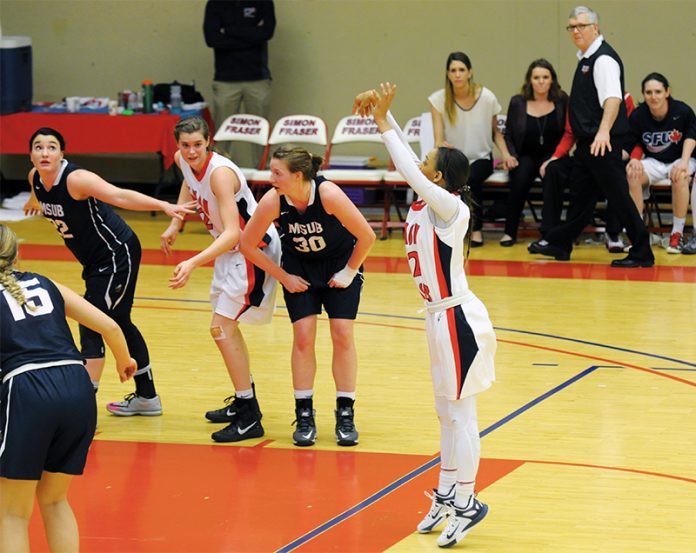
Alisha Roberts takes the winning shot to defeat Montana State.

In their final home game of the season, the SFU Clan women’s basketball team survived a poor fourth quarter to defeat the MSU-Billings Yellowjackets 63–61. The Clan improved to 13–10 overall, and remain fourth place in the GNAC standings.

The Clan was led by Australia native Ellen Kett, who had 19 points and six assists. Her running and distribution speed kept the Yellowjackets on their heels all game, and she had many dazzling spin moves that sent the crowd into a frenzy.

However, this game was all about Alisha Roberts. This was the senior’s final home match, and she definitely rose to the occasion. Her strong clutch three’s and strong overall play in the first half of the game helped the Clan take a 34–26 lead going into the halftime break. Screen Shot 2016-02-19 at 9.31.41 PM

The second half started off with SFU going on a 8–0 run, and with their 16 point lead it appeared that this match was going to turn into a blowout. However, MSU-Billings showed why they were the third ranked GNAC squad: they slowly but steadily clawed themselves back into the game.

The fourth quarter was a disaster for the Clan, as they got thoroughly outplayed on both offense and defense. With 3:54 left in the game, the Yellowjackets took a 59–58 lead, and officially erased the 16-point deficit.

SFU rallied, though, and tied it up at 61 apiece with 2:12 left. Then, an ending worthy of a Hollywood movie took place. Alisha Roberts had the rock for the last play of the game, and with 0.5 seconds on the clock she was fouled on her way to the rim. The fate of the match was in the hands of the senior, as she had a chance to win the game from the free throw line.

“I was definitely nervous, my hands were shaking,” said Roberts after the game, “but you know, that’s the shot I take every single day in practice, my dad always tells me free throws win games, so when I stepped up to the line I knew that I was going to make those shots, I just had confidence in myself.”

She sunk both, and her final two shots at the West Gym lifted the Clan to a 63–61 victory.

When asked what she was going to miss the most about her team and SFU after the season ends, Roberts answered, “the community. We’re not only teammates, but we are friends off the court. We spend so much time together, it’s going to be tough not having that next year. And the SFU community, the people who come out for our games every week, turning out in the stands, it’s so fantastic to have that, and the kids who come and watch our games, it’s just awesome.”

Don’t be afraid of falling in love

0

Fear is often associated with our trepidation for the unknown. 

When we think about being afraid, roller coasters and horror movies often come to mind. But they are, in fact, not what society has deemed to be the scariest risk we take. Our greatest fear is much more common than that: love.

It’s a word that runs the media. TV, movies, and music are obsessed with love, eventually finding ‘The One,’ and the happily ever afters. Similarly, the heartbreak and pain of love is put on a pedestal. Rarely are we given a story or song that has nothing to do with being in love. This, in and of itself, is an issue. The more we glorify love and sensationalize what it means to be in love, the more we run a risk of detaching ourselves from the very idea.

Truth be told, the fear of falling in love is very real for many of us. For some, it’s the idea of having to commit to forever, while others are worried that they aren’t loving someone the right way. There are so many rules about how to be in love, and one doesn’t have to look far to find them. Articles titled along the lines of, “How to Ask a Girl/Guy Out,” “How Long Should You Wait Before Texting Back,” and “When to Say ‘I Love You’” are abundant online. If I had a nickel for every time some magazine tried to tell me how to be in a relationship, my tuition would be paid for.

These sorts of articles reinforce the notion that love has regulations and specific etiquette, when the reality is anything but.

When we want something badly, we really don’t want to screw it up. We begin stressing over the little things and, against better judgement, will turn to internet articles for advice. Falling in love is scary, and these well-intentioned articles are only trying to make it easier. Despite good intentions, though, they become deterrents for love-seekers, scaring us away from love by over-complicating the situation.

I was having a conversation with my best friend, who is single, and she admitted, “I don’t know how to invest in love. I can’t put myself out there without knowing what I’ll get in return.” Her thought brought to mind the risk associated with investing in the stock market — we simply don’t know whether our investments will be worth it or not. She didn’t want to risk falling for someone without knowing whether they’d be worth it in the long run. 

While I understand where she was coming from, I also know that love always comes with a degree of risk and uncertainty, and even if it goes sour, it is always a valuable experience. Losing out on love doesn’t mean you have lost everything; rather, it builds on who you are as a person, and you always gain something from it.

By and large, love is made out to be complicated, and multi-layered. But we’re doing ourselves a disservice by perpetuating that idea. Love is actually very easy if you let it be. And falling in love is not big deal: it’s only natural that we grow attached to others around us.

When it comes to expressing this very idea, too, we have a weird fixation on the timing with which we should say, “I love you.” Many have tried to sell the idea that there is a perfect time to be in love, and, thereby, to make those feelings known, but again this, is a false representation. Truth be told, there is no right time to drop the “L-bomb.” We need to stop letting over-sensationalized ideas like this ruin our relationships before they even start.

When I first met my current boyfriend, I was immediately drawn in by his shy smile and the warm manner in which he spoke to me.

Our first date was only after two short weeks of knowing each other and he asked me to be his girlfriend that same night. I was scared, but not necessarily scared of falling in love. I was scared that I was doing it all ‘wrong.’ Most people would say that we were moving too fast. That, because we had started dating so quickly, we wouldn’t last, and we couldn’t truly be ‘in love.’ It was just an infatuation. Yet I remember that, even if the relationship had moved so quickly, it felt right to me.

Despite not following typical ‘rules’ and ‘conventions’ of dating, we have been together for a year and a half now. After that date, everything fell into place — we fell into a rhythm of getting to know each other, trusting each other. I know that he’s got my back and I’ve got his. That’s my story. There is no cookie cutter key to loving anyone. Love is, afterall, a complex experience and can be felt in a million different ways. We all just need to let ourselves feel it.

So push that fear aside and let yourself fall head over heels for someone — however it may happen. You never know where you might land.

Matter branches out from happy tropical pop

0
St. Lucia draws their musical inspiration from global sources.

At first listen, St. Lucia seems like a band trying to recapture the synth-pop stylings of the ’80s. But after about 10 seconds, this proves to be anything but accurate. This is how Jean-Philip Grobler — the creative force behind the band — wants it to be.

While Grobler admits the group has 1980s synthpop influence, this genre is not his main inspiration from the period. “[It] was a decade where there was this feeling of there being no rules on the kinds of music you could make,” he told The Peak. “And it doesn’t feel like authors were necessarily restraining themselves or holding back. I like to make music that I feel is not limiting myself.”

Grobler’s ethos is made clear throughout the band’s latest release, Matter. “There are a lot of real instruments, obviously there’s a lot of synthesizers, and a lot of layering; and that approach comes from the ’80s.” But that is not the only inspiration that goes into creating their sound. Grobler, having grown up in Apartheid South Africa, has a different musical background to draw upon when creating music.

“When I was growing up, we didn’t have a lot of variety in the music that was making it into South Africa; we basically were getting the poppiest of pop from all over the world, because anything kind of subversive would kind of be banned by the Apartheid government,” Grobler said. He grew up without a negative view of pop, he says: “I just loved pop music, I loved alternative music, and I loved a lot of different things.

“I also went to this boys’ choir school and going there, we did a lot of African music. I think that influenced me in a lot of ways, definitely rhythmically in a lot of ways, harmonically in a lot of different ways.

“That’s why the music that I make embodies a lot of those different things: embodies pop music but also embodies experimental nonlinear song formats.”

Matter fully embraces these two genres that Grobler describes. The album has the synth-heavy sound that is often associated with ’80s pop music, but this sound is filled out with African influences, creating something that is unique to pop music today.

While this mix of influences is where his sonic inspiration comes from, Grobler doesn’t go into writing a song or album with a specific influence in mind. “As I am writing, different stuff is inspiring me,” he says.

This ability to allow the writing process to unfold lets the St. Lucia sound grow. “For the first record, we were pigeonholed into like this electro-pop, tropical [sound]. People just called us this tropical pop band.” While he didn’t necessarily want to get away from that label, Grobler felt “that’s not all that we are. There’s more to us than just being a happy tropical pop thing.”

For Grobler, the song that captures this departure from this sound is “Rescue Me.” The song didn’t have that tropical, happy feeling, Grobler says: “it feels a little more epic.” The song is true to the St. Lucia sound, but has a feel that is different from their first album When the Night. It is a bigger sound that embraces the major chords and strong rhythms of African music that, as Grobler notes, serve as inspiration for their sound. 

Matter still captures the essence of St. Lucia, but shows an evolved sound. Overall, the album is strong; it captures the highly danceable and singable pop sound, but grounds it with a singer-songwriter background.

The sonic profile that is associated with St. Lucia didn’t come about until Grobler moved to Brooklyn. It was living in Williamsburg and being exposed to the hipster culture that allowed him to focus on creating this sound.

“When I first started St. Lucia, it was at a time around 2009–10 when people hadn’t come back around to pop music yet. Anything that was critically acclaimed was at least a little bit abrasive and alienating.

Trying to make pop music, Grobler says, “just felt like I was hitting a creative brick wall. I think that, almost as a reaction to that approach, I started going back to the music that I grew up with [. . .] the hipster movement in Brooklyn influenced me to go against that; instead of trying to be cool, I would just allow  influences [. . .] to come out.” 

This creative growth that Grobler underwent — and is still undergoing — has allowed St. Lucia to evolve from the “happy tropical pop thing” of When the Night to the bigger, sparser Matter.


St. Lucia will be preforming in Vancouver on March 1st at Venue Nightclub. 

Fresh Off the Boat uses character quirks for the better

0
Fresh Off the Boat explores race within the context of a sterotypical family.

Fresh Off the Boat is a rarity for a television show. It focuses on a Chinese family, and was picked up and renewed by a major network: ABC. It is also based off of Chef Eddie Huang’s memoir of the same title.

The show is centred on a Chinese family who move from the Chinatown area of Washington D.C. to suburban Orlando, Florida. The Huang family consists of father Louis, mother Jessica, son Eddie, his two little brothers Evan and Emery, and their wheelchair-bound grandmother. Since this is the only show of its kind on cable television, I wondered what kind of light it portrayed Chinese families in, and how heavily it played on stereotypes.

Overall, the show portrays a pretty stereotypical family. Louis moves his family to a different city to follow his idea of the American dream. Jessica puts great emphasis on academics and always wants her children to be the best of the best. Eddie is the slacker child who tries to be cool and sometimes succeeds at it, while his younger brothers are child prodigies who can make a lightbulb work using nothing more than a can of soda and a glass contraption. The honorary old Chinese relative is the grandmother, who sits in front of the television all day, and leads a secret off-camera life that escapes the family’s attention.

What prevents Fresh Off the Boat from being another forgettable cookie-cutter race sitcom are the refreshing quirks of each character. Ask yourselves: when was the last time a TV show starred an eleven year-old Chinese boy who loves hip-hop? The answer is never.

Contrary to stereotypes, the mom Jessica cares about things other than grades. She is probably a three on the tiger-mom scale. She is completely okay with Eddie experimenting in the love department and tries but fails to give him emotional and relationship advice.

I love that the writers didn’t introduce a token Chinese best friend for Jessica; that would have been boring and predictable. Her BFF is her exact opposite: a blonde woman named Honey who likes to jog and married an older man who has a teenage daughter who despises her step-mom.

Evan is the youngest child in the Huang family, and although he is only eight, he manages to charm the neighbourhood ladies and conducts neighbourhood meetings. Meanwhile, Emery is a ladykiller and a genius. It’s hilarious to see a ten-year-old boy getting 150 percent on a quiz and having a girl on each arm.

My personal favourite character, however, is Louis. He positively portrayed and is so perfectly westernised that it’s magical. He opens a steakhouse called “Cattleman’s Ranch,” hires all white people, and speaks fluent English. He usually plays the “good cop” and is the chill parent who lets his kids go to sleepovers and play ball, instead of forcing them to do homework 24/7. He encourages them to do their own thing. His laid-back attitude perfectly checks his wife’s paranoia, overprotectiveness, and her constant need to micromanage.

If I have yet to convince you to check out Fresh Off the Boat and follow the lives of a family of loveable misfits, then I haven’t done this show justice. I strongly urge you to watch this fantastic show, streaming on Shomi and airing on ABC.