Creator’s Pet (Destiny Hsu)

Mystic Man (Reuben Newton)

Peers (Leslie Lu)


Creator’s Pet (Destiny Hsu)
Mystic Man (Reuben Newton)
Peers (Leslie Lu)

After years of genetically modifying calzones in a mildew-covered basement, a hideous monster is born: the Pizza Pocket.
Pizza Pockets are essentially highly noxious cheese farts wrapped up like fat little gremlins in a swaddle of greasy dough. Whenever I eat them, I feel like a baby bird cawing away, eager for its mother to vomit into its mouth (and I wouldn’t be surprised if I was literally eating pre-chewed earthworms — the ingredients of Pizza Pockets are basically a military secret).
Pizza Pockets don’t even pretend to be delicious, either, since they know that you’ve already hit rock bottom eating them. After those little poop-sacks are chucked into the microwave, they immediately explode into a crime scene of cheese and self-loathing, and then arrogantly expect you to shove their mangled existence into your mouth. I won’t stand for your abuse anymore, Pizza Pockets.
Pizza in your pockets! A cool snack and great quirk — who wouldn’t want to be known as the babe with the pizza in their pockets? It’ll be a quirk you’re actually proud of, as opposed to that other quirk you have of being a nervous farter (you’ll never forget that one time at summer camp where you went in to kiss Victor for the first time and ripped one so loud that he ended up crying with fear).
Pocket pizza will make you the hippest cat on the block, like John Travolta in Grease and, incidentally, just as greasy as John Travolta in Grease. Just carry a few slices of ‘za at all times, and you’ll always be ready for action.
“Is that pizza in your pocket or are you happy to see me?” It’s both, of course! You’re always happy when you’ve got pizza in your pockets.
Woodwards 
The Djavad Mowafaghian World Art Centre will host “Two-Spirit and Indigenous Transgender Stories and Photos of Safety, Belonging and Well-being” on Wednesday, March 9 at 7:00 p.m.
The free lecture will feature research from leading Indigenous Two-Spirit, transgender, and gender non-conforming figures and will shed light on issues facing these communities in Metro Vancouver especially in health and well being.
Surrey 
There will be an information session for SFU’s Human Resources Management Certificate on March 17 from 6:30 to 7:30 p.m., in room 5100 at the SFU Surrey campus. This information session is a great way to find out if human resources management is for you, whether you’re a student interested in the field, a professional looking for a promotion, or just curious about the program.
The session is held at no cost, and registration is available on the SFU website.
Harbour Centre 
On March 15 from 5:30 to 7:00 p.m. at Harbour Centre, SFU’s School of Public Policy will be hosting a presentation by Anne Giardini, SFU Chancellor and a former lawyer and business executive, to speak about problems and perceptions surrounding women and power.
The talk will discuss methods by which private organizations and governments can change these perceptions and enable equality.

[dropcap]I[/dropcap]n the world of text messaging, we complain about the amount of times meaning gets lost in translation — the amount of times our “K” texts are perceived as anger, or when and when not to punctuate our sentences. Our circumstances of miscommunication are blamed on the short forms we send across text. Yet, unfortunately, this is not a technological problem.
We make assumptions all the time and we don’t need a cell phone to do it. We are inherently sensitive, destined to take things too personally, and rarely inclined to go beyond our own perspectives. How many times do we read into somebody’s tone of voice? How many times do we twist the words they say into meaning something that maybe they don’t? How many times do we actually take the time to make sure we’re reading into things the right way?
Miscommunication is one of our greatest flaws. We assume things and we don’t have the courage to figure them out. And the worst part is that these assumptions destroy us. They destroy our friendships and our perspectives on people; they destroy our willingness to fight for relationships to stay alive. In a sense, they fuel our isolation. We’ve criticized the way English classes force us to read between the lines and we’ve forgotten that we’re naturals at it — that we use these tactics every single day and we’ve formed our world around the assumptions we’ve created on every kind of interaction.
One sentence has a thousand meanings and with a slight change in pitch suddenly the meanings become personal.
We live in a world where one sentence has a thousand meanings, and a slight change in pitch can suddenly make something intensely personal — targeted at us with harshness behind their syllables. A world where we fail to ask questions because our assumptions guide us to answers might not even exist; thus we perpetuate the bubble of toxicity we’ve created, of always assuming and never understanding or asking. Of never mending the bruises that have developed from these assumptions.
Why are we prone to stop trying, to let broken relationships get the best of us? Because we assume the next will be like the last. We get stuck in a pattern and assume it will perpetuate itself, so we give up before there’s even been a chance to try. We avoid relationships, avoid their repairs, avoid conflict, we let our assumptions dictate every aspect of ours lives, and we will inevitably and irreparably hurt ourselves in the process.
These days, any miscommunication is somehow linked to a text message we sent that we shouldn’t have punctuated. As if miscommunication stems from Facebook messenger and other sources of online conversation — as though this technology can create the problems we so frequently bring up. Has technology worsened our communication? Or were we never that good in the first place? As a communications student, I’m wired to believe the overabundance and heavy reliance on technology is the cause of a lot of our problems. But it’s not.
We are.

To SFU,
I’m concerned about my class with Dr. Olle. A geography course based entirely on digging is odd. Is this standard? Also, where is Dr. Tran?
Also, and I’m not complaining about this, but I’m wondering if we’ll be able to leave the campus soon. The rations aren’t enough, and several students are worried about illness. . .
Best,
Alice Rook
Hi Alice,
This isn’t the best place to talk about specific course or professor location problems. But I do want to calm your nerves — every class has taken on a mandatory digging segment, its intensity is being left up to the discretion of each professor. I assume that Michelle was just especially interested in digging, her being a geography professor and all.
Don’t worry about calling professors by their first names, by the way. We are all comrades under SFU, as was voted upon by the SFU Voting Committee last week. Just look to the flags: “Comrades engaged under SFU, we have got our digging to do!” They’ve always been there.
Concerning your concerns concerning the rations, I assure you that more will come, come delivery day! Just last week, delivery day was a Tuesday; perhaps this Tuesday we will be just as lucky. Provided we aren’t cheated again by those UBC rascals. Those cheats! This week, perhaps, the shipment will stop by an SFU campus first.
We’ll all be able to leave soon, comrade! Our families are waiting for us, and they love us dearly. I miss my family as well, though I recognize the magnitude of our work. Who knows what glorious riches lie in the innermost depths of Burnaby mountain?
We do, Alice! And you will too, in due time, if you stay the course, and don’t question your course, of course! Look to Comrade Michelle, who goes above and beyond her digging pedagogy duty.
Look to the stars, SFU, and keep your shovel in the mountain!
Best,
Victor Von Doom
Director of Comrade Relations,
President of Voting Committee
The fourth annual memorial for Jim Green, former Vancouver City Councillor and community activist, celebrated his life with a staged reading of his book, Against the Tide: The Story of the Canadian Seamen’s Union.
While studying at UBC in the early 1970s, living in the Downtown Eastside, and working as a casual longshoreman, Green became acquainted with former members of the Canadian Seamen’s Union (CSU), and was approached by a committee with the request that he record the history of their union.
The staged reading was commissioned by SFU’s Vancity Office of Community Engagement and shone light on a lesser-known chapter of Canadian labour history, featuring the CSU. The memorial was held in partnership with the Institute for the Humanities at SFU, SFU’s Department of History, and the BC Labour Heritage Centre.
Vancouver City Councillor Geoff Meggs, who was the original editor of Green’s Against the Tide, explained in the foreword to the event guide: “Most Canadians have forgotten, if they ever knew, that our country once boasted one of the largest merchant navies in the world, a key to victory in the Second World War crewed by men and women organized into the Canadian Seamen’s Union.”
Charles Demers, a local writer, and SFU history alumni, adapted Against the Tide for this special performance.
The production was directed by Amiel Gladstone, and featured Andrew Wheeler as Jim Green, Carmen Aguirre as Labour, and Kevin MacDonald as Capital. Local musician and SFU MFA graduate Corbin Murdoch performed live on the set, singing lyrics that originated as poetry in the CSU’s newsletter, Searchlight.
Am Johal, Director of SFU’s Vancity Office of Community Engagement, explained that “the story of the Canadian Seamen’s Union is not just an historical tale. The relationship between labour and capital is also a very contemporary story.
“Taking this book that is rarely read these days and giving some life to the first-person narratives that are in the book was a great way to bring to life these memories in a way that they wouldn’t be forgotten,” he said.
Director of Research at the BC Labour Heritage Centre, Robin Folvik, explained, “it is important to acknowledge all of the information contained in this book that would likely otherwise have been lost without Green’s research and writing. His extensive interviews across the country and access to former CSU members’ memorabilia and clippings captured things that otherwise would have been impossible for us to access today.”
Their reading highlighted some of the key moments in the history of the CSU, including the 1949 strike, which ended in victory for the union.
The lines were divided between the three actors: Wheeler read the words of Jim Green, Aguirre read testimonies from members of the CSU, and MacDonald read the lines of the government and corporations who opposed the CSU and its ties to the Communist Party.
“Jim did these interviews in the ’70s and the ’80s — many of the people he interviewed have passed on. The interviews are held at the national archives, but it’s a very obscure story and hard to find. Jim spent a lot of time traveling the country trying to capture these stories so they wouldn’t be forgotten,” said Johal.
“We thought that at this annual memorial event, it would be an interesting time to land this text down in the present in a way that still resonates with us today.”
The reading was filmed and is currently being made into a documentary.
Folvik reflected, “although working people have always been cultural producers, using a wide range of creative practices to reflect their experiences, they are rarely the ones to receive funding or support to bring their projects to a broader audience.
“SFU’s Vancity Office of Community Engagement’s backing of this production, particularly one that is so focused on the struggles and solidarities of working people in Canada, fills an important gap.”
U of A study finds shift in Canadian attitudes to marriage
[EDMONTON] – University of Alberta sociologist Lisa Strohschein, in her study of Canadian perceptions of marriage, found that matrimony is no longer of central importance to Canadians. Her findings suggest that people are getting married later in life, are having children without worrying about marriage, and are far more focused on their careers and concerned with their financial stability than in the past century.
This study said that marriage is still important to Canadians and viewed as an end goal, but the findings suggest that our attitudes surrounding its necessity have loosened significantly.
With files from CBC News
Laurentian University’s chili lunch supports literacy program
[ONTARIO] – Laurentian University’s Equity and Social Justice Committee has raised funds for Frontier College’s literacy program by successfully organizing a chili lunch.
The literacy program aims to support Aboriginal groups across Canadian provinces. It has allowed Aboriginal children to be more immersed in reading books, a result confirmed by the parents of these children. Six thousand children have already participated in this program, which continues to grow and expand.
With files from The Lambda
McGill researchers develop model biological supercomputer
[MONTREAL] – McGill University professor Dan Nicolau and his team of researchers have developed a book-sized model for a biological supercomputer that uses proteins propelled by Adenosine triphosphate (ATP), a key chemical in the process of metabolism.
Due to the biologically-based processing providing less heating issues, these supercomputers are said to be more energy efficient than their current counterparts. The researchers are uncertain as to when full-scale versions will be available.
With files from McGill Newsroom
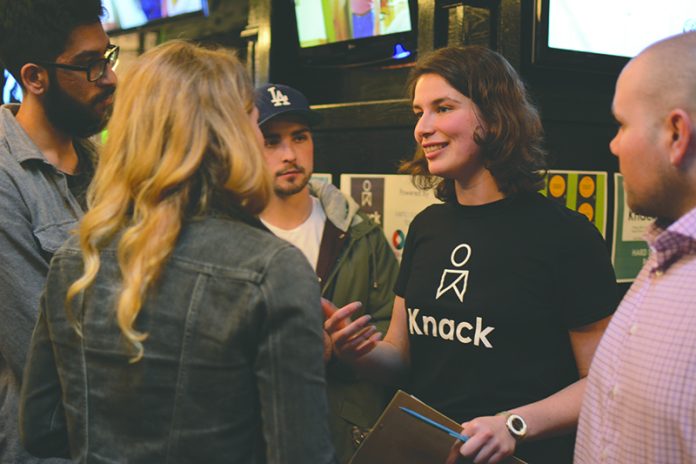
If you have ever hunted for a job, you know how hard it is to find one all too well. That struggle is 10 times greater for low-income individuals living in the poorest neighbourhoods in East Vancouver, many of whom are physically unable to work in full-time positions and are often dismissed by employers.
SFU MBA Candidate Anna Migicovsky is hoping to make that job search a little easier. She is the project coordinator of an employment platform called Knack, which aims to connect businesses with those who are looking for employment in Vancouver’s Downtown Eastside. Migicovsky developed the program along with two others as part of her internship at LEDLAB, a social innovation lab that is a branch of RADIUS SFU and EcoTrust Canada.
Knack was created as a community program in partnership with the Potluck Cafe Society, which has been providing good food and employment opportunities for the community for over 15 years. Migicovsky and her team also work with other nonprofit organizations within the Downtown Eastside, such as Union Gospel Mission, an organization that also provides career advising as part of the services it offers.
According to Migicovsky, around 7,000 people in the Downtown Eastside are currently collecting social assistance, and these individuals are not necessarily working. “The Downtown Eastside is currently very volunteer-focused, but these volunteers are actually doing a lot for the organizations [of which they are part],” explained Migicovsky. “We want to create more income-generating opportunities for these individuals. We’re trying to use the knowledge and wisdom that Potluck has in order to increase the number of employment opportunities.”
Knack focuses on educating employers about inclusive employment, and that people are coming from unstable backgrounds and might be unable to work 40-hour weeks. The program also offers several workshops to develop soft transferrable skills such as time management, teamwork, and conflict resolution, to name a few. Upon completing these workshops, participants earn digital badges that act as certifications of the skills they have developed. They are similar to badges that one would earn by being part of a Scouts Canada troop, and veer away from qualifications one might include on a traditional resumé.
Essentially, Knack wants to create a mutually beneficial relationship between employee and employer. “There is an untapped labour market right now that is about providing low-skill jobs at affordable rates. This program is not just about educating individuals, but also about understanding what the employer wants,” said Migicovsky. “It’ll increase quality of life for the individual and also create casual part-time work positions for the employer.”
But most importantly, what Migicovsky wants individuals to take away from the Knack program is a better quality of life. “Employment isn’t only for people who are healthy and stable,” Migicovsky said. “It is also a pillar of health.”

[dropcap]T[/dropcap]he argument on behalf of female genital mutilation (FGM) has been happening for thousands of years, as the procedure has been practiced for centuries globally. According to the United Nations, over 30 countries have practiced FGM.
FGM is generally practiced as infibulation, where young girls’ or infants’ labia lips are cut off, as well as their clitoris. The vaginal opening could also be sewn nearly completely shut, with just enough room for menstrual bleeding to emerge. These procedures can cause irrevocable complications for childbirth and sex, as well as psychological trauma.
Although FGM is criminalized in Canada and depicted negatively throughout mainstream media, gynecologist Dr. Allan Jacobs argues that minor vulvar procedures should be legalized as a “compromise.” He states that to disallow “small vulvar nick[s]” would be discriminatory towards different cultures that uphold this practice, and that allowing them could “forestalls subsequent vulvar infibulation done under dangerous conditions.”
His intention is to replace major infibulation procedures with smaller, less invasive procedures; ones he claims are completely harmless to the child at the time, and as she grows into womanhood. In an interview with CBC radio, Jacobs compares ear piercings, circumcision, and breast enhancement surgeries to female genital mutilation procedures.
Though, when creating analogies like these, it is crucial to look to the reasons for a procedure. Female genital mutilation procedures are based in patriarchal traditions, can be meant to inhibit sexual pleasure for women, can cause dangerous repercussions, and are simply harmful operations that young children cannot consent to.
If Allen Jacobs intends less invasive procedures to be a compromise, it is a compromise that will most likely fail. According to Ruth Macklin of the Albert Einstein College of Medicine, cultures that are inclined to perform extreme mutilation of female genitals would not be likely to acceptless invasive alterations just because they’re available. In fact, the practice of genital mutilation was often done in many cultures to determine whether a women was essentially ‘marriage material.’
If less invasive vulvar ‘nicks,’ as Jacobs proposed, were carried out as harmlessly as he describes, then there would be no evidence on the woman by the time of marriage; and therefore could be seen as obsolete.
The fact of the matter is, not every cultural practice deserves respect. Historically, the United States used female genital mutilation to cure hysteria in the 19th and 20th centuries, until people began to question the ethics of the practice.
To preach cultural acceptance surrounding a violent and non-consensual procedure in nonsensical. It is undeniable; some cultural practices are harmful. Culture is a dynamic force that can shift and change, and to accept a practice as harmful as FGM is regrettable at best.
Maryum Saifee has written for The Guardian about her experiences with ‘less invasive’ FGM, and hopes to be an inspiration for other women to come forward with their experiences. Saifee, when speaking on air to CBC, states that her experience with type one female alteration procedures was a “blocked out the memory because it was so traumatic.”
Instead of making loose inferences about whether or not “less invasive” FGM procedures are psychologically and physically traumatic, Jacobs should turn to survivors of the procedure he is recommending in order to learn the real effects it can have. As Saifee adamantly insists, “any form of structured gender-based violence [. . . is] just wrong,” and in no way should we condone or accept it.

Maintaining my grades has always been a struggle as a student at SFU. It’s not that I lack commitment to my English major and History minor, it’s that something hovers over me that provides me with great anxiety. It’s not mental illness, work, or family issues, but rather something much greater. You see, what I really fear is the coming of Galactus.
Yes, that’s right: the great world destroyer of the cosmos, who eats up planets like Cookie Monster does a box of Chips Ahoy! Just knowing Galactus is out there and could pounce upon the Earth at any moment absolutely terrifies me. I mean, the Fantastic Four can only stop him so many times — eventually he’s going to succeed at one point and just eat us up. Galactus consumed my thoughts to the point that anytime I saw anyone wearing a purple helmet, I started screaming.
I realized I needed help for my issues, but no psychiatrist was qualified in helping me resolve my issues with intergalactic world-eaters. There was only one known professional in the galaxy who might understand me. So I set out to contact an ex-employee of Galactus, Norrin Radd aka The Silver Surfer.
Mr. Radd told me that “fearing Galactus, much like the cosmos themselves, is meaningless.” After a long discussion in which he described to me a lot of random shit I didn’t understand about the nature of the universe and some dude named Uatu who watches shit, I left feeling dissatisfied. Ultimately it seemed I was doomed to never feel any comfort whatsoever, and that I would have to resign myself to a lifetime of worrying about the destruction of the Earth.
That was until I saw an offer in the paper for a job serving as a translator for an intergalactic entity hoping to communicate with various planets. I figured it had been a while since my last job in telemarketing and that I enjoyed talking with people enough that I might as well apply. When I arrived at the office, I was teleported into space where, face-to-face, I finally met Galactus himself.
I screamed for a solid three minutes until Galactus yelled at me to be silent. He explained he wanted me as a herald for him to devour other worlds across the galaxy. In return for my service, he would not destroy Earth, but he also demanded I make a great sacrifice.
Yes, dear reader: he demanded that I drop out of SFU.
I told him that I couldn’t after spending so much money on my BA and investing so much time in school. At first, he scoffed at the notion until I told him what my fees were, which according to him were “cruel even in the eyes of a world eater.” His promise to pay for my tuition in return for part-time work helping him decimate civilizations across the galaxy was an offer I couldn’t refuse.
And that, dear reader, is how I learned to stop worrying and love Galactus. Sure, I’m now an accessory to the genocide of multiple alien races, but this bachelor’s degree wasn’t going to pay for itself. Now I must bid you farewell, as Galactus told me to quit this Peak crap because it was making me late for world consumption work.


