Home Blog Page 86

Give help instead of offering it

0
Illustration of three people handing out takeout boxes at a table that reads free food.
ILLUSTRATION: Cliff Ebora / The Peak

By: Tam Nguyen, Staff Writer

Living in a capitalistic society where your value is based solely on how independent or productive you are makes reaching out for help harder than ever. Instead of burning ourselves to the ground and then struggling to reach out for help, we as a society should proactively look out for each other. 

The principles of capitalism focus on individualism with the belief that we are “self-interested” and “inherently competitive.” This is a harmful mindset, as it conditions us to feel embarrassed and inadequate whenever we struggle. However, we can be more attentive. The next time you are hanging out with your loved ones, offer to help — even small gestures such as driving them home, getting food, or helping with chores go a long way. One study found that when you help out a friend, your stress level reduces. When we improve other people’s lives, our own lives improve too. 

Looking out for others should not be limited to the people you know, either. As we interact with strangers in daily life, it’s also important to keep a positive and pay-it-forward attitude. Our circle of support should involve our peers as much as professionals. The only way we can transform toward this collective mindset is by building communitiese through acts of kindness. 

I have been a first-hand witness in spaces where people focus on fostering relationships and care. Many activists also practice security culture, with their motto being “we keep us safe.” People from all backgrounds look out for each other, and while no one should feel ashamed to admit that we are struggling, help is always appreciated.

Poilievre is anything but “for the people”

0
Canadian Parliament building in Ottawa
PHOTO: Paul VanDerWerf / Flickr

By: Yildiz Subuk, Staff Writer

Pierre Poilievre is a version of Trump for individuals who are not quite comfortable with revealing their bigoted beliefs. He’s built his campaign on rigorous attacks on current Prime Minister Justin Trudeau. The Conservative leader presents himself as being “for the people,” but his support for problematic movements leads me to question how authentic his campaign to liberate Canadians truly is. While Trudeau has had his share of criticism, Poilievre has made his entire campaign about attacking the Liberals without any clear plans for addressing issues in Canada.

Poilievre announced he will run for prime minister in 2022 — after endorsing the Freedom Convoy,an anti-vaccination and far-right political movement (and the same space where many far-right people flew nazi flags and indulged in racist sentiment). As a candidate who understands the power of media, he frequently produces ads and other content of himself engaging with voters. He presents himself as an everyday Canadian, often showing up to social events in a T-shirt, positioning himself as a humble, hardworking Canadian. 

However, Poilievre is anything but that. He is a populist leader — someone who appeals to working class individuals by placing the blame for their disadvantages on a real or imagined elitist group — in this case, the Liberal Party. While inequality does exist for the working class, populists often scapegoat marginalized groups and offer solutions that, ironically, further reinforce inequality. This type of leader’s “charismatic” personality can have a wide appeal among the majority of low-information voters (people who are not as informed about political discourse). Populist leaders can belong to any political ideology, but are often right-wing. 

Poilievre has managed to grab the attention of many by tapping into a real anxiety: the housing crisis. But while this anxiety is valid, his solution boils down to not voting for Trudeau. In his video Housing Hell, he blames the current prime minister for causing the housing crisis, while failing to address any nuances about the issue. The video intends to instill anger by infuriating the viewer with stats about how housing has gotten worse, but only provides a vague explanation of why the issue exists in the first place. Housing insecurity disproportionately impacts low income and marginalized folks. Voting for a leader who doesn’t value social programs will not solve these issues. 

While the Conservative candidate may be an expert at stirring the pot, he lacks sincerity. He’s gone on record saying that he stands with Israel, while legitimizing the genocide against Palestinians — he tweeted “Israel has a right to defend itself.” In 2008, he made statements about how compensation for residential school survivors doesn’t provide any “value.” While he later apologized for those comments, he also gave a speech at the Frontier Centre for Public Policy, a research group that has downplayed the effects residential schools had on Indigenous children. Comments like these should make you wonder whether Poilievre truly understands the “average” working class folks he tries to appeal to. 

Currently, the Conservative Party have nearly a 20% lead over the party under them. While Poilievre has won a lot of support since the start of his campaign, and while his approach may seem enticing to some, it is important to note that his actions do not reflect the reality he preaches. He’s claimed that he will make Canada “the freest nation on earth,” but when diving deeper into his comments about marginalized groups, it is important to question who exactly he will make the country “free” for.

Vancouver’s Clean Air Festival returns for its second year

0
This is a photo of many people sitting down outside at last year’s Clean Air Festival
PHOTO: Courtesy of Do No Harm BC

By: Sofia Chassomeris, News Writer

On September 15, the second annual Clean Air Festival was hosted at Slocan Park. The Clean Air Festival is an “immuno-inclusive,” hybrid event put together by a team of community members and organizations. Some organizations include Clean Air 604, a group that provides arts and cultural events in Vancouver with masks and air purifiers, and DoNoHarmBC, a group that advocates for “effective and equitable public health policies.” 

Other organizers included Safe Schools Coalition BC, an organization that works to protect the rights and safety of marginalized students, as well as Protect Our Province BC, an organization that advocates for evidence-based public health policies. The first Clean Air Festival took place in 2023 and was inspired by the idea that protecting each other by wearing masks “should be considered a celebration.” 

The Peak interviewed Dr. Karina Zeidler, co-founder of Protect Our Province BC. Zeidler described the event as a place where people can “get together and celebrate solidarity, mutual aid, and community care.” Considering the lasting effects of the COVID-19 pandemic, she emphasized the importance of making “sure that the safety precautions for the event would be really robust” for people to enjoy the festival without unnecessary risks. 

“It can be pretty isolating out there these days for people who are still wanting to stay safe from COVID-19 as well as other airborne pathogens or other air pollutants,” said Zeidler. “For some people, there’s very limited events and activities that they can participate in if they are particularly high-risk.” N95 and KN95 masks were provided to event-goers and required for participation at the festival. Zeidler also noted that a lot of effort was put into making sure that the festival was physically accessible and a safe environment for queer and gender-diverse people. 

The event hosted activities for all ages, including kids’ games, live shows, and a workshop for making air purifiers that were later donated to schools and vulnerable community members. Zeidler explained that the live shows’ purpose was to deliver entertainment in a safe manner and uplift multiple marginalized artists. Zeidler described Rae Spoon, the main performer at the event, as a “trailblazer” in the music industry for their career as a Canadian trans musician over the past 20 years. 

Other artists featured at the festival included Dani Your Darling, Kayli Jamieson, Travis Bernhardt, and Geoff Berner. Zeidler added, “They’ve been doing a lot of work in terms of wanting to create safe, live music performances” by holding outdoor concerts and wearing masks. 

Zeidler hopes to see the Clean Air Festival continue to be an event where people can come together in a safe and accessible way. “We’re hoping every year that we’ll be able to push it a little bit further,” she said, referring to the festival’s growth in size and sponsorship since its first run.

SFU lab makes breakthrough in reversing Parkinson’s disease

0
This is a photo of different tables and gas tanks in the Verheyen lab
PHOTO: Prerita Garg / The Peak

By: Caitlin Kingsmill, News Writer

In July, researchers at SFU’s Verheyen Lab and the Baylor College of Medicine in Texas identified a gene that may reverse symptoms of Parkinson’s disease. The Verheyen lab was exploring the role of a gene known as “Cdk8” in fruit flies and its human counterpart gene “CDK19” when they discovered a connection to Parkinson’s. The neurodegenerative disease is currently incurable and affects one in 500 Canadians. 

Researchers found that by decreasing the amount of the Cdk8 gene present in the fruit flies, the flies developed movement impairments associated with Parkinson’s. However, their impairments were reduced when researchers “put more of the fly Cdk8 or human CDK19 gene into cells.”

“This function involves helping cells get rid of defective mitochondria which is a function that is impaired in Parkinsonism,” Esther Verheyen, professor of molecular biology and biochemistry at SFU, told Global News.

According to the Parkinson’s Foundation, Parkinsonism is “a set of movement symptoms associated with Parkinson’s disease and other disorders.” Individuals with Parkinsonism may have stiffness, difficulty walking and balancing, and tremors. Symptoms can include “mood and thinking changes, speech problems, and sleep disturbances.” 

In an interview with The Peak, Verheyen discussed the research and the team behind it as corresponding author of the paper. She said Jenny Zhe Liao, an SFU PhD student and co-lead author of the study “really took the lab in a new direction with this work” and that “this was a really big accomplishment for her.” 

The paper’s other co-lead author is Hyunglok Chung, a PhD student, and Hugo J Bellen, a professor of molecular and human genetics, is the other corresponding author. Verheyen explained SFU’s collaboration with these two researchers from the Baylor College of Medicine, saying, “We realized there was some overlap in research interests with a lab in Texas, and so we reached out to them and started collaborating with them on the project.” 

The Verheyen lab has been working on this research for several years, though they did not originally set out to find a potential Parkinson’s treatment. “We stumbled into it the way genetics research often is — you find something that you weren’t expecting,” shared Verheyen. When the research began, the goal was to better understand the functions of the Cdk8 gene. The team pivoted once they made the connection to Parkinson’s disease, which Verheyen described as a “lightbulb moment.” 

This is the first research to establish a connection between the Cdk8 gene and Parkinson’s. With the paper now published in Nature Communications, Verheyen said she is “hoping that the larger scientific community that works on this could [ . . . ] collectively move it forward. 

“Our work with Cdk8 changed how the mitochondria act and made them change in a way that helped with Parkinson’s features,” explained Verheyen. These findings “could help with other diseases that also impact how mitochondria work.”

There is always a lag between conducting research in a model organism like a fruit fly and advancing that research into human cells. However, a treatment for Parkinson’s may lie in existing drugs through a process called drug repurposing

“Here at SFU, we have this great screening center where you can do drug screenings. We could look for drugs that might somehow help a cell make more Cdk8,” said Verheyen. “Sometimes there are drugs that were developed for one purpose but then found to have another effect.”

SFU Olympians: Red Leafs who performed on the world stage

0
Six athletes in athletic wear (two in red bodysuits that read “USA,” two in red and white bodysuits that have a Canadian flag, one in an all-red one that says “Canada,” and one in a taekwondo uniform).
ILLUSTRATION: Cliff Ebora / The Peak

By: Kaja Antic, Sports Writer

Though the 2024 Paris Olympics have now come to an end, we should still take pride in the performances current and former SFU athletes showed during the two weeks of competitions. Six athletes competing in the games have ties to the Red Leafs, competing both for Team Canada and Team USA.

Justina Di Stasio – Wrestling
Team Canada – women’s 76 kg

Illustration of Justina Di Stasio
ILLUSTRATION: Cliff Ebora / The Peak

Di Stasio wrestled for SFU from 20102014, and went on to earn silver and gold medals at the 2015 Toronto and 2019 Lima Pan American Games, respectively. Now an assistant coach for the women’s wrestling team, Di Stasio earned her spot on Team Canada as a first-time Olympian for the 2024 games. Di Stasio placed 12th in the 76 kg women’s classification, falling to Türkiye’s Yasemin Adar Yigit in the Round of 16

Ana Godinez Gonzalez – Wrestling 
Team Canada – women’s 62 kg

Illustration of Ana Godinez Gonzalez
ILLUSTRATION: Cliff Ebora / The Peak

Godinez Gonzalez began wrestling at age 16, looking to improve her performance in rugby. Competing for the Red Leafs until 2021, Godinez Gonzalez has twice been the 62 kg women’s wrestling gold medalist at the 2022 and 2023 Pan American Championships, earning a silver in the 2024 Commonwealth Games. Godinez Gonzalez defeated France’s Ameline Douarre in the Round of 16, then lost in the next round to eventual gold medalist, Japan’s Sakura Motoki. Earning a spot in the repechage round, Godinez Gonzalez defeated Romania’s Kriszta Tunde Incze, then lost in a bronze medal match to Norway’s Grace Jacob Bullen, placing fifth overall in the 62 kg category.

Josipa Kafadar – Taekwondo
Team Canada – women’s 49 kg

Illustration of Josina Kafadar
ILLUSTRATION: Cliff Ebora / The Peak

Kafadar is currently working towards an undergraduate degree in biological physics, as well as becoming a first-time Olympian. Kafadar was an alternate during the 2020 Tokyo Olympics and earned her black belt in Taekwondo at the age of 12. During the 2024 Paris Olympics, Kafadar lost in a Round of 16 match to eventual bronze medalist, Lena Stojkovic of Croatia.

Marie-Éloïse Leclair – Athletics
Team Canada – Women’s 4x100m Relay

Illustration of Marie-Éloïse Leclair
ILLUSTRATION: Cliff Ebora / The Peak

Fresh off of being named the Great Northwest Athletic Conference’s (GNAC) Female Athlete of the Year in June, Leclair headed to Paris to take part in her first Olympic Games. The star sprinter was part of the relay team that set a new Canadian national record for the women’s 4x100m relay during the qualifying race in Paris, reaching the finish line with a time of 42.50 seconds. Team Canada ended up placing sixth in the 4x100m final. Leclair has been highly successful with the Red Leafs in both indoor and outdoor track and field events, while also majoring in health sciences with a minor in Indigenous studies. 

Helen Maroulis – Wrestling
Team USA – women’s 57 kg

Illustration of Helen Maroulis
ILLUSTRATION: Cliff Ebora / The Peak

Maroulis went undefeated during her collegiate career with SFU and dethroned the three-time Olympic champion Saori Yoshida of Japan to win gold at the 2016 Rio Olympics. Hailing from Maryland in northeastern US, Maroulis earned the bronze medal at the 2020 Tokyo Olympics and mirrored that result at the 2024 Paris games. Maroulis defeated Anshu Anshu of India and Alina Hrushyna Akobiia of Ukraine. She lost to eventual gold medalist Tsugumi Sakurai of Japan, then defeated Canadian Hannah Fay Taylor to win the bronze medal. 

Dom Parrish – Wrestling
Team USA – women’s 53 kg

Illustration of Dominique Parrish
ILLUSTRATION: Cliff Ebora / The Peak

Parrish wrestled for SFU from 2015 until 2019, and was a training partner for Team USA during the 2020 Tokyo games. Originally from California, Parrish won gold at the 2022 World Championships in the women’s 53 kg wrestling. Parrish was defeated in Paris in the Round of 16 by eventual gold medalist Akari Fujinami from Japan. Selected for the repechage round, Parrish was defeated by Khulan Batkhuyag from Mongolia — who she had defeated in the World Championship finals in 2022. Overall, the first-time Olympian placed 11th in the 53 kg classification.

Need to Know, Need to Go: Fun and free September events

0
an illustrated calender that says "Need to Know, Need to Go"
ILLUSTRATION: Courtesy of The Peak

By: Amrit Kamaal, Peak Associate

Editor’s note: the Kairos Blanket Exercise event has since sold out. 

The summer may have come to an end, but that doesn’t mean the fun should! With the fall semester Peak-ing around the corner, now is the perfect opportunity to unwind and relax before you start that autumn grind. Here are some of our picks to unleash that summer high for the perfect back-to-class transition. 

Filipino Fest 
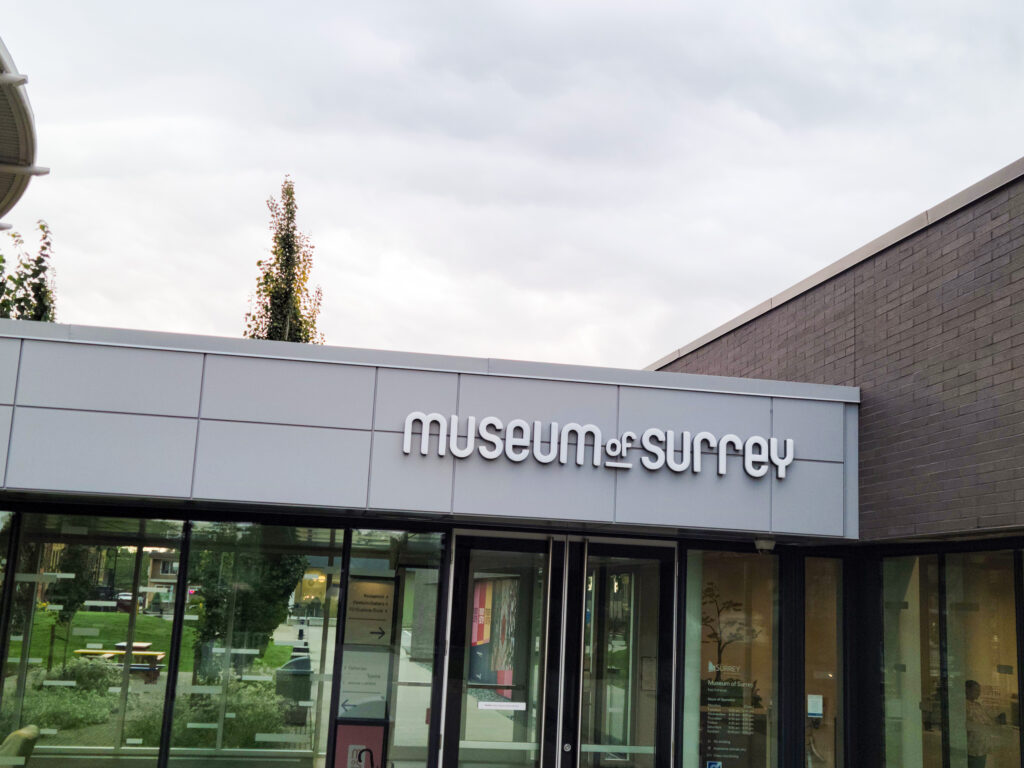
Museum of Surrey, 17710 56a Ave, Surrey
September 21, 2024, 11:00 a.m.4:00 p.m.

entrance of museum of Surrey
PHOTO: Amirul Anirban / The Peak

This lively festival is the perfect place to learn about and appreciate Filipino cultures and communities in Canada. Activities include story sessions in Tagalog and English, market vendors, textile displays, a Filipino dance involving bamboo poles known as Tinikling, and more! The festival will also feature live musical performances from local Filipino artists such as Glisha and Gabriel Regehr, traditional dances by Himig Kabataan and PhilCAS, and some sets by the DJ collective, The Kuyas. This event will also have a quiet, comfortable, sensory-friendly space available. 

Kairos Blanket Exercise 
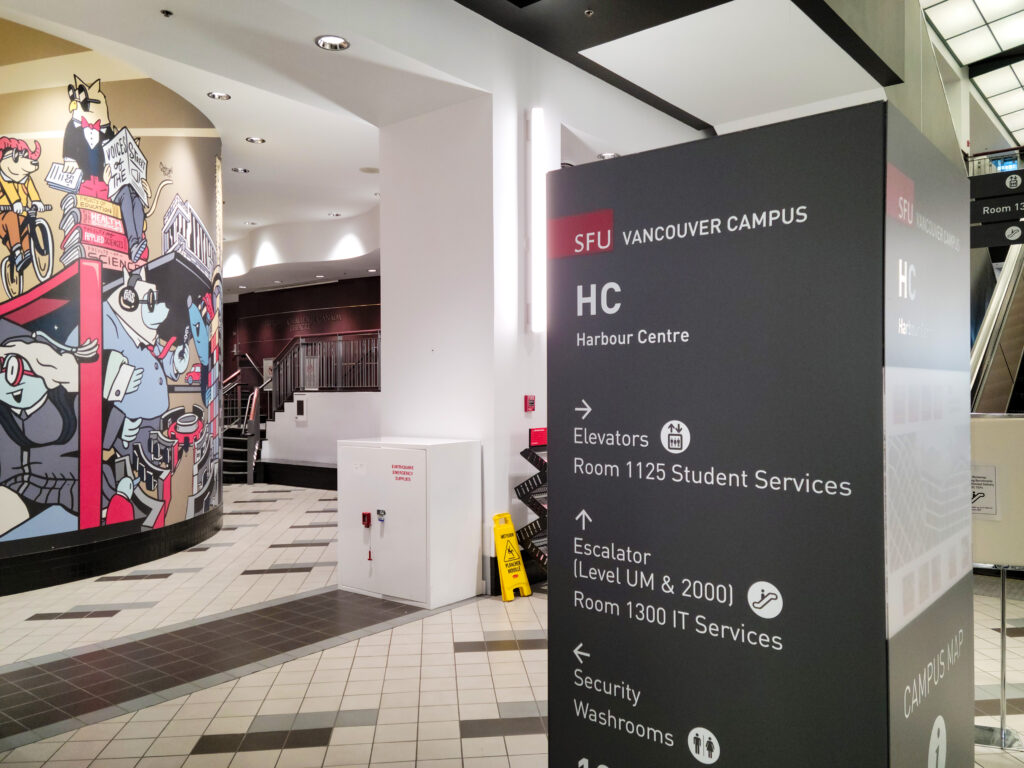
Joseph & Rosalie Segal Centre Room, SFU Vancouver Campus
September 21, 2024, 3:30 p.m.5:30 p.m.

inside of SFU harbour centre
PHOTO: Amirul Anirban / The Peak

Hosted by Hubert Barton, Catalina Parra, and the Vancouver Latin American Cultural Centre, this insightful, intercultural event explores Indigenous experiences. Event-goers are welcome to bring a friend and traverse the blankets that are meant to “represent the land.” This is the perfect opportunity to take a step forward in reconciliation by walking through history.  

Adult Colouring Club
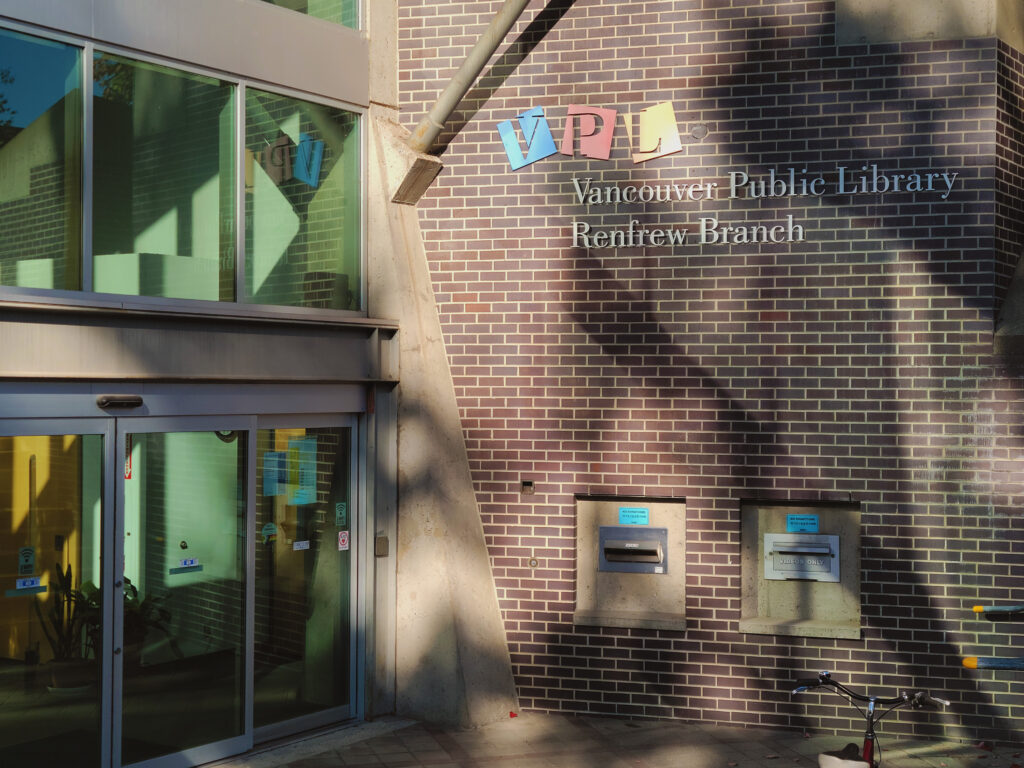
Vancouver Public Library, Renfrew Branch, 2969 East 22nd Ave. Vancouver
September 20 and 27, 2024, 10:00 a.m.–11:00 a.m.

A brown brick building with book deposits and a motion-sensored glass door. The letters V, P, and L are written on the wall in blue, red, and yellow boxes respectively.
PHOTO: Amirul Anirban / The Peak

We’re all in need of a self-care day every once in a while. With school starting, this is the perfect place to release school stress. Taking place every Friday of the month, this event is catered towards folks looking to unleash artistic energy, connect with others, and relax their minds. Along with offering free drop-ins, the Renfrew Branch also provides free colouring sheets and pencil crayons. Bring your family, friends, or study buddies, because this will become an essential escape from those first few weeks of the fall semester. 

Protest for Palestine held at SFU’s Employee Appreciation BBQ

0
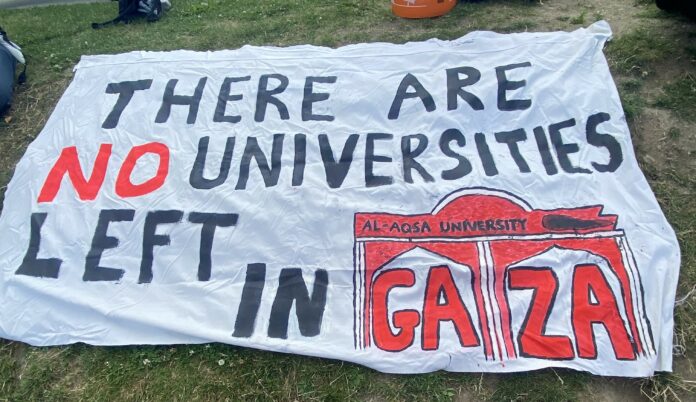
a handwritten banner saying "THERE ARE NO UNIVERSITIES LEFT IN GAZA"
PHOTO: Tam Nguyen / The Peak

By: Tam Nguyen, Staff Writer and Hannah Fraser, News Editor

Content warning: mentions of genocide.

On August 14, SFU held its annual Employee Appreciation BBQ at the AQ Pond to celebrate faculty and staff. Around the start of the BBQ, an independent group of SFU students and staff marched in front of attendees to protest SFU’s continued investment in military arms companies that supply weapons to the Israeli military amid the Palestinian genocide.

A divestment petition from the SFU Faculty for Palestine details SFU’s investment in BAE Systems, Booz Allen Hamilton, and CAE Inc., noting that “the weapons and services of these corporations have collectively facilitated the killing, maiming, or displacement of millions of individuals.” As of March 31, SFU has invested $7.2 million in these companies.

The protest group included individuals from the Simon Fraser Public Interest Research Group (SFPIRG) and The Teaching Support Staff Union (TSSU), who carried banners with messages such as “stop funding genocide” and “divest now / no more delay / 312 days.” After marching from Convocation Mall to the AQ pond, a protester gave a speech and claimed SFU is “not a democratic institution” as the school “continues to ignore [their] demands.” 

“The Board has asked the Finance, Investments, and Property Committee to review the policy and provide recommendations.” — SFU Statement

Students and faculty of SFU have been vocal about the school’s involvement in the genocide, resulting in two Boycott, Divestment, Sanction (BDS) motions passed by the SFU Faculty Association in June. Both these motions indicated that SFU would have to formally commit to boycotting, divesting, and sanctioning the aforementioned companies. SFU agreed to discuss divesting on May 30 but have not made further statements since then. SFU stated that “the Board has asked the Finance, Investments, and Property Committee to review the policy and provide recommendations.” They added that this review will “take place over the coming months and allow for a consultative and transparent process.”    

The protestors stated they were at the BBQ event to demand that SFU condemn the scholasticide in Gaza, divest from the companies supplying military arms to Israel, and keep racialized groups on campus safe. Scholasticide involves the “systemic obliteration of education through the arrest, detention or killing of teachers, students and staff, and the destruction of educational infrastructure.”

This is a photo of a couple of protestors holding up signs in the middle of the AQ pond
PHOTO: Tam Nguyen / The Peak

The Peak interviewed a protestor who shared a concern regarding protestors’ safety at SFU, noting that “SFU has a history of deploying very harsh security tactics and security personnel on students.” The Peak also corresponded with another student protestor who stated that “SFU holding an event to ‘appreciate’ employees is laughable, considering the suppression of Palestinian solidarity and the administration’s reprehensible behaviour displayed in trying to crush the TSSU.” During the TSSU strike in 2023, SFU was found hiring Lions Gate Risk Management Group (LGRM), a private surveillance company, to “build evidence” and file for an injunction against the picket line.

SFU stated that they hired LGRM to help “monitor picket line activity” and note down cases of “behaviour escalation at the picket line that could constitute bullying or harassment or physical safety or assault.” SFU ended its contract with LGRM in March, saying they “will reassess how [they] hire for security contracts in the future.” 

“I’m honestly not surprised by the entire response. I’m disappointed, but I’m not surprised.” — a protestor at the event

At summer convocation, SFU Students For Justice in Palestine (SFU SJP) claimed there was an “unprecedented amount of security during ceremonies.” SFU responded by saying they “introduced a bag check and bag concierge service,” but noted “there was no significant increase in security presence compared to previous years.” 

“I’m honestly not surprised by the entire response. I’m disappointed, but I’m not surprised,” said the protestor. “SFU has made it clear again and again that they don’t really listen to students, or faculty, or staff.” Students and staff have been protesting SFU’s investment in arms manufacturers since November last year, but SFU SJP has been advocating for Palestine on campus since as early as 2022. SFU stated that “the community will be invited to participate in this important conversation within the coming weeks.” 

The protestor shared they chose to protest during the BBQ because they wanted to catch the attention of many people at the event, including senior administrators. The other protestor shared that the BBQ event was “an example of the superficial kindness the administration tries to use as a replacement for actual change.”

SFSS music festival returns after five years

0
a photo of a previous fall kickoff
PHOTO: Courtesy of SFSS

By: Caitlin Kingsmill, News Writer

The Simon Fraser Student Society (SFSS) Fall Kickoff Music Festival is returning to the SFU Burnaby campus for the first time since 2019. The festival will be held on September 20 from 4:00 to 10:00 p.m. at East Parking Lot, with tickets costing between $50–65. The event will feature a musical lineup of artists and DJs, food trucks, and more. 

The Peak interviewed Chitransh Motwani, SFSS vice president of events and student affairs. “We wanted to give students an opportunity to celebrate together, fostering a stronger sense of community and belonging, which has been a priority for us,” he said.

When planning for the event, Motwani said he was inspired by larger music festivals like FVDED In The Park in Surrey and Badlands Music Festival in Calgary, and wanted to offer SFU students a similar experience at a “significantly cheaper price.” The lineup features Troyboi, Wuki, Felix Cartal, Asad Khan, and Seb C.

Motwani said this year’s festival will be the first at SFU to incorporate a variety of third-party vendors that supply food, drinks, and brand activations. He explained that his goal was to cater to a wide audience, ensuring that attendees would remain entertained for all six hours of the festival even if they didn’t know all the musical artists. The festival is being organized in collaboration with Blueprint, a Vancouver-based events company, and The Forum SFU, a student events organization.

“It is definitely a really huge event in terms of manpower.” — Chitransh Motwani, vice president of events and student affairs, SFSS

Over 40 student volunteers assisted with the festival’s marketing and on-campus student outreach efforts. “It is definitely a really huge event in terms of manpower,” said Motwani. He added that an event this size typically takes around six months to organize, but it was already in the planning stages prior to the beginning of his term at SFSS in May of 2024. “But, there was definitely a bit of hurrying in terms of getting things finalized and trying to put everything into place with so many stakeholders.” 

Motwani said some challenges of planning the event included rebuilding a network of contacts that were lost throughout the five-year hiatus. These included contacts within SFU and external contacts for sponsorships and vendors. 

According to Motwani, the SFSS could not host the festival until now as they faced COVID-19 restrictions and “lost an enormous amount of money back in 2019as the last music festival resulted in a deficit. 

“While SFU has been experiencing budget deficits, the SFSS operates independently, and SFU’s finances don’t directly impact our budget,” he said. “We’ve had funds specifically allocated to support large-scale events like this for the student body, and we’ve worked carefully to ensure that we could bring this event back without compromising other student services.” SFU estimated an annual deficit of $20.9 million for the 2023/24 fiscal year and $49.9 million for the 2024/25 fiscal year.

“It has definitely been a challenging ride,” said Motwani. “But, happy to really say that SFU has supported us as much as they can and multiple departments have been helping organize this and bringing back the party to the campus.”

How a beloved Palestinian restaurant planted its roots in Vancouver

0
A painting filled with green, tan, and gold brushstrokes that make buildings with domed roofs. On the outside, two hands hold paintbrushes and paint along the picture.
ILLUSTRATION: Angelina Tran / The Peak, PHOTO: Tam Nguyen/ The Peak

By: Tam Nguyen, Staff Writer

On a sunny Tuesday afternoon, I strolled around the vibrant neighbourhood of Hastings-Sunrise while on my way to meet Tamam and Sobhi Al-Zobaidi, co-owners of Tamam: Fine Palestinian Cuisine. Squeezed among tax offices and banks was the restaurant and its big, yet simple yellow sign. The spacious interior was decorated with acrylic artworks painted by Mrs. Al-Zobaidi and Palestinian flags on the wall. 

Mrs. Al-Zobaidi welcomed me with a hot anise teapot. On the stove behind us, a cook prepared a boiling pot for rice, cabbage, and a quintessential Palestinian dish: mujaddarah. It was such a pleasure to sit down with both of them and talk about who they are and how their restaurant gives back to the Palestinian community here in Vancouver. 

Formerly a visual artist, Mrs. Al-Zobaidi, whom the restaurant is named after, worked in a kids theater back in Palestine. Regarding her magnificent acrylic artworks on the wall, specifically the triptych artwork consisting of  “Noontime in Jerusalem” (2019), Friday in Jerusalem” (2021), and “Full Moon Over Jerusalem” (2023), the self-taught painter noted that her artistry “started developing a taste” after lots of practice.

With training experience in culinary arts at Vancouver Community College, Mrs. Al-Zobaidi cooks with fresh ingredients in reasonable amounts to avoid wasting resources. “People eat food fresh everyday,” she said, also noting that it’s a way of feeling “like you’re eating at home, too.” 

To Mrs. Al-Zobaidi, food brings a great sense of community, as it is a “celebration of gathering people together.” The restaurant has a diverse menu, including dishes like chicken kebab and grape leaves, though they specialize in mujaddarah and freekeh. “These are very Palestinian dishes,” Mr. Al-Zobaidi shared. 

The conversation turned to Mr. Al-Zobaidi. He completed his master’s degree in film at NYU back in the ‘90s and has been writing and publishing articles about Palestinian culture in both Arabic and English since then. His experience of working and living in various NYC neighborhoods, from Brooklyn to Greenwich Village, made him feel as though “the whole city was like an art gallery.” 

“There’s no discussion, no hesitancy, no suspicion. They like the food, then they open up to you. They open up to the story of your food, and your food starts to tell the story. This is how food connects.” — Sobhi Al-Zobaidi, co-owner of Tamam Fine Palestinian Cuisine

Mr. and Mrs. Al-Zobaidi’s story of founding the restaurant started when they arrived here in Vancouver and “noticed how absent” Palestinian culture was in the Lower Mainland. “No art, no food, no fashion, no literature, nothing,” Mr. Al-Zobaidi shared. This is what drove them to open Tamam. Ever since the restaurant opened, they learned that “food is really powerful, a vehicle that carries and transmits culture.” 

For Mr. Al-Zobaidi, food is more powerful than even film and art. Not because of the complex nature, but because “people eat, and they love the food.” 

“There’s no discussion, no hesitancy, no suspicion,” he said of people trying new cuisines. “They like the food, then they open up to you. They open up to the story of your food, and your food starts to tell the story. This is how food connects.” 

Looking around the place, I could see Mrs. Al-Zobaidi decorating the restaurant with cozy lights and wooden furniture to create an atmosphere where it feels like the restaurant is “delivering the culture” to diners, as she puts it. She noted how this medley of cultural goodness is combined “so you can see what is Palestine, what is Palestinian food, what is the cuisine, and what it is coming from.” 

In light of the genocide still ongoing in Palestinian occupied territories, Tamam aims to raise $100,000 in aid to send to the Palestinian community. They have been hosting multiple lunch fundraisers on Sundays, from 1:00 p.m. to 5:00 p.m., where they serve mujaddarah by donation. Up to the present, they have reached $95,000 and are planning to host another fundraising event at the end of September this year. 

When the UBC encampment was still up and running, Tamam restaurant joined the Meal Train team where they cooked for the whole encampment every Wednesday. The UBC encampment sent their deepest appreciation to Tamam for the nourishment they provided with care and love. 

“It wasn’t just giving food for us,” Mr. Al-Zobaidi shared. “It was a mutual support, because we felt not only were we supporting the students, but we felt supported by the students.” 

In this way, Tamam’s “food becomes like a love letter” one that delivers the true message of community. 

Back-to-school isn’t an excuse for mass consumerism

0
Notebooks with pens and scissors on top
PHOTO: Jin Song / The Peak

By: Hailey Miller, Staff Writer

With back-to-school shopping in full swing, many students have participated in the annual shopping spree of stocking up on snazzy supplies, the latest technology, and clothing galore. These days, it’s become a market of wants over needs. Students often partake in back-to-school shopping because it’s widely advertised, but do you really need the latest trends, or are you just buying into mass consumerism? Offsetting your back-to-school carbon footprint will put less strain on the environment and help you save money in the process.

Remember those school supply lists we would get back in elementary school full of everything from a 100-pack of pencils, multiple packs of lined and graph paper, and a dictionary and thesaurus as the cherry on top? These lists were setting us up for consumerism before we even understood what that meant. Who really uses 100 pencils in a single school year? Did you even crack open that dictionary once? According to a report conducted by the Retail Council of Canada, 86% of Canadians participated in back-to-school shopping in 2022 — “with majority of those shoppers spending more than $50.” This level of materialism not only exacerbates environmental waste, but it’s also a waste of your money. 

The trend of back-to-school shopping normalizes unnecessary spending to give us a false sense of productivity. Like any type of consumerism, back-to-school shopping increases waste that ends up in landfills because people automatically throw things away — even if they’re still in good condition — to make room for new supplies. In the US, about 77% of school supplies are wasted each year, and you can imagine how much waste Canadians produce given the 86% that buy into back-to-school. 

Amid the popularity of back-to-school shopping, many students are wanting more ethical and sustainable ways to partake in back-to-school trends. With many people becoming more conscious of their carbon footprints, there’s a growing interest in sustainable shopping. Just because you’re offered a plethora of student discounts on everything from streaming subscriptions to discounted clothes and technology, doesn’t mean you have to use them. Unless you could absolutely use a deal on something you were already planning on buying, you’re still wasting money and fueling consumerism. 

When it comes to school supplies, reuse what you have unless it absolutely needs to be replaced. This goes for technology, pens, notebooks, bags, and so on. For supplies you can’t reuse such as dried out pens and markers, Staples has recycling programs at participating locations. When shopping for new supplies, consider buying pens with refillable ink, recycled paper, or buy gently used products from places like Facebook Marketplace and online student groups. Marketplace is also great for finding gently used (and often like-new) technology such as iPads and laptops if your tech is about to bite the dust. Student groups are great for finding used textbooks that not only save the environment but also your wallet!

To alleviate mass consumerism and engage in more environmentally-friendly means of back-to-school preparedness, we must stop mass consumerism at its root. Remember that reduce, reuse, recycle applies to school supplies as well, and will not only help the environment, but keep you financially frugal, too!