Home Blog Page 848

Vancouver’s housing crisis caused by foreign money and government, report says

0
Average house prices in Vancouver can reach over $1 million (data from Macleans)

Vancouver’s housing affordability crisis is caused by an influx of foreign money and poor political oversight, according to a report out of SFU.

Assistant professor from the School of Public Policy, Josh Gordon, said the BC and federal governments have done little to stop money, primarily from mainland China, that pushes domestic buyers out of the market and raises prices for properties. Gordon addressed the issue of racism, and assured readers that “the problem is that the money is foreign,” not that the money is from China.

Other contributing components were also included in the report. Historically low interest rates in Canada, coupled with Vancouver’s natural and artificial geographical boundaries are two key factors playing into the equation.

Gordon dismissed other common justifications for government inaction as “distractions,” like the supposed lack of social housing, bad zoning, and high “desirability” of living in Vancouver.

“Too often people [simply assert] this or that claim” and don’t back it up, especially “influential people connected to real estate and government,” Gordon said in an email to The Peak. He further stressed his intention to “confront the evidence in a careful way,” engage the interested public, and challenge conventional approaches.

Canada’s Business Immigration Program, specifically the investor stream, is a primary cause of the housing crisis, according to Gordon. This “cash for citizenship” program has allowed wealthy individuals (net worth $1.6 million or higher) to come to Canada.

Gordon cited a 2014 report by Citizenship and Immigration Canada, and one by UBC professor David Ley. He summarized the reports, saying that the program was an “unmitigated failure,” and the migration to Vancouver was “substantial, and consisted almost entirely of investors from Greater China.”

Roughly 48 percent of these immigrants’ business operations were “real estate and rental,” and only 10 percent of them had any self-employment income. Gordon also reported that the average annual income tax paid was only $1,400, compared to $7,500 for Canadians.

Between 1980 and 2012, an estimated 200,000 investor stream migrants came to Vancouver, representing 8 to 9 percent of the regional population. The program ended in 2014, but thanks to a “loophole,” an estimated 1,800 investor migrants have come to BC through Quebec since then.

Gordon pointed to a study by urban planner Andy Yan. Yan looked at 172 homes sold in West Vancouver from 2014 to 2015. His research showed that 66 percent of buyers had non-anglicized Chinese names, suggesting “recent arrival.” For homes over $5 million, it rose to 88 percent.

There is a significant “‘de-coupling’ of the Vancouver real estate market from local incomes” Gordon reported, thanks to the purchasing power distorting the market. Prices are inflated “across the board” as upscale buyers move to less high-end neighbourhoods and the effects continue, claimed Gordon.

Incomes in Vancouver have not significantly increased, nor are they at a level that would suggest a correlation with the skyrocketing housing prices, which the CBC reports has increased 30 percent in the last year.

In 2015, over USD $1 trillion left China for foreign markets. Gordon included a survey showing 14 percent of elite Chinese investors said Vancouver was their preferred location for real estate investment. Gordon concluded that “a massive amount of money from China entered the Vancouver real estate market in the past year or so.”

Gordon explained that there are severe consequences for Vancouverites. Intergenerational inequality perpetuates and millennial buyers are unable to enter the housing market in Vancouver, even into apartments and condos.BC has a highly leveraged real estate economy with “unstable debt foundations.” Construction and real estate services account for over 25 percent of BC’s economy, compared to roughly 20 percent for both Ontario and Alberta.

Increased housing prices cause individuals to assume more debt than they can afford. If interest rates rise more, this problem might worsen. Gordon explained that mortgage holders could owe more than their home is worth, putting them “underwater.”

Gordon said that communities suffer too. First-time buyers are pushed into the suburbs, farther away from their families, friends, and workplaces. Young professionals leave Vancouver, and there is an exodus of young talent because of the unaffordability of starting a life there.

Gordon presented two potential solutions to the problem: a progressive property tax scheme, and better tracking of foreign investment and laundering. The tax scheme would target foreign owners of high-end ($1 million and over) homes and would reduce demand in Vancouver. The Canada Revenue Agency and the Canada Mortgage and Housing Corporation also need to keep better records to allow for real tracking of foreign money pouring into Vancouver.

Gordon’s report is not peer-reviewed, and was “aimed squarely at the public debate.” He wishes to see “sensible policy action” from the government through public pressure.

Trottier Observatory able to see planet outside our solar system

27
An artist's representation of what Tau Bootis B could look like.

The Trottier Observatory has successfully detected a planet from beyond our solar system.

Tau Boötis B, also known as the Millennium Planet, is an exoplanet that was first discovered in 1996. Last summer, the Observatory’s team started trying to independently locate the planet and measure its properties.

With the aid of newly acquired technology, they utilized photometry (a method of detecting planets and stars reliant on light) and spectrometry (reliant on the speed of the planet) to locate the planet while measuring factors such as its diameter and mass. These allowed the astronomers to further calculate properties such as density and composition.

Despite the fact that Tau Boötis B is already relatively well-documented, the Observatory’s ability to perceive it themselves is an unprecedented step.

“I knew we wouldn’t be able to see [the planet] until the spring, and so I spent the winter learning how to use the [new] spectrograph,” stated professor Howard Trottier, discussing the journey leading up to the detection. “When the exoplanet was finally in our skies, I was ready to go.”

Once Trottier mastered the use of the spectrograph, he began teaching others with interest how to operate it through formal workshops. This group included SFU faculty and students alike.

In the wake of observing Tau Boötis B, Trottier hopes to include the techniques and equipment used in a future observational astronomy course, designed to accommodate students both within the sciences and outside of them. Although the professor has not yet submitted a proposal, he “knows the course [and its] structure.” Ideally, he hopes to be able to offer the class by Spring or Fall of 2017.

“One of the major functions of the Observatory is for students to use it to do things that they want to do,” he said. He went on to discuss the ramifications of the hypothetical class for non-science students specifically.

“The message to people is that science is not something over there that only somebody else can do. Anybody can do it,” he said. “[Astronomy is] accessible in that way.”

Trottier hopes to teach students how to operate the needed equipment, how to “find [their] way around the sky” using coordinates, and theory involving the instruments and working with data. This will culminate in an independent project proposed by students.

Aside from identifying exoplanets, Trottier noted that spectrometers can be used to study phenomena such as star movements and accretion disks, and to measure factors such as the distance between galaxies.

Trottier suggested the possibility that students would, in the future, be able to propose ways to take advantage of the Observatory’s equipment.

NEW MUSIC FRIDAY

1

By: Sarah Finley, Max James Hill, and Jessica Whitesel

Follow The Peak on Spotify to stay up to date on New Music Friday.

“THat Part” – ScHoolboy Q feat. Kanye West

Jessica Whitesel: I love how this is a more laid-back song — but that doesn’t mean that it’s a super chill song, either. It’s just really good. ScHoolboy Q and Kanye are comfortable with themselves as rappers and it really shows on this track. It might not be very innovative but it is still a banger.

Sarah Finley: I’m salty that I’m listening to a ScHoolboy Q / Kanye collab before Childish Gambino / Kanye, but whatever. Kanye takes over ScHoolboy Q’s intro with lyrics that failed to impress. Relaxed percussion and lazy vocals make the rapping sound repetitive, while echoing lyrics made the track boring and dull.

Max James Hill: Who says new Kanye isn’t fun? This one’s a banger — ScHoolboy Q has such a nice, natural flow, and the paranoid beat fits perfectly with the braggadocio. It’s definitely nothing new for either artist, but there’s enough confidence and quotable lines to make this a winner.

“Afraid of Heights” – Billy Talent

JW: I used to like Billy Talent — granted I was like 12, but still they used to be sort of OK. This is just kind of really sad. I wanted them to get in touch with their earlier sound. They didn’t do that, and it can just go under the genre of “I am an angsty 13-year-old trying to rebel, but also not so hard that I buy CDs with a parental advisory sticker on them.”

SF: Punk group Billy Talent released this angsty, guitar- and drum-heavy, rock-ish track. It’s indiscernible from every other almost-emo song I’ve ever heard. Hard pass.

MJH: As a former diehard Billy Talent fan (like, we’re talking 2005 here), this was a big disappointment. I already know that they’re bad, but at least they seemed like they were having un-serious fun on their earlier releases. Now it just feels like they’re trying to be super angsty and inspirational and My Chemical Romance lite. It’s not a good look.

“For What It’s Worth” – Kygo feat. Angus & Julia Stone

JW: This is pretty decent background music, but it is forgettable. I like Kygo and I like Angus & Julia Stone but sticking them together just really doesn’t work for me. Each artist was trying to sound too much like the other and it led to a pretty forgettable electronic-inspired track.

SF: Soft feminine vocals back up a deeper, masculine voice in the intro, segueing into head voice vocals. Beautiful piano chords combined with gentle cabasas provide the instrumentals. I give this peaceful and calming track a 10/10.

MJH: So boring. Literally not even worth writing about. I’m convinced no more than 10 minutes of effort went into writing, recording, and releasing this milquetoast piece of muzak.

“Dominos” – Peter Bjorn and John

JW: This is a fun song. Not as fun as some of their other stuff, but I can still picture people dancing to this and that is always a fun time. It’s not going to reach the level of “Young Folks,” but at least it sounds different than some of the music that is currently out there.

SF: Peter Bjorn and John take you on an adventure via an eclectic array of percussion, including a steady bass, heavy use of shakers, and the occasional muted snare. Having a chorus for the lyrics doesn’t hurt either.

MJH: Well, it’s not “Young Folks,” but I for one really enjoy the sense of levity and clear ‘80s influence here. Is it just me, or does the piano in the background sound a bit like the menu screen tune from the Super Smash Bros. series? Weird. Anyway, this isn’t worth more than a listen or two, but it’s cute and completely inoffensive.

“This One’s For You” – David Guetta feat. Zara Larsson

JW: So I now know why this song makes me want to forget how to hear. It is supposed to be an uplifting soccer tournament song — UEFA EURO 2016 to be exact — and it is just a no. Also the weird, vaguely Bollywood sounding parts and the crowd cheering. There is too much fake happiness and it makes me sad.

SF: Romantic lyrics typical of summer radio hits that are played way too many times for anyone’s good, combined with Zara Larsson’s heavily autotuned voice leave me wildly unimpressed. Get back to me when there are lyrics more original than “our hearts beat together, we stand strong together, we’re in this forever.”

MJH: Sounds like Rihanna with a head cold. I definitely have begrudging respect for how much Guetta is able to squeeze emotional gravitas out of big musical crescendos (see “Titanium” for the best example of this), but this one is pretty shallow and forgettable. Also because my heart is a block of ice I hate when the chorus of kids comes in. A note to all musicians: please stop trying to pull my heartstrings with singing kids.

“Final Song” – MØ

JW: I would dance to this song in a club with my best friend and only pay attention to the, “Don’t let this be our final song” part. But I can also see asshole club DJs playing this as their final song after last call because why the fuck not. All that aside it will probably be one of the songs of the summer because it is actually a pretty good song.

SF: MØ, one of my fave artists, is back with another beautifully done electro-indie-pop track. Her unique voice is gentle and high, singing desperate lyrics to beachy-dance-vibe instrumentals. Bless.

MJH: Now this I like: sure it’s formulaic and pretty derivative, but MØ clearly has pipes and her performance feels very genuine. The sound reminds me a bit of Carly Rae Jepsen and Charli XCX, which makes sense since MØ worked with the same producer as those two (Noonie Bao). It also helps that I love both of those artists, so this is a winner in my book.

“Warning Call” – CHVRCHES

JW: This song has really clean production. Almost too clean. It is a good song, but the amazing vocals paired with the really high production values make it sound like CHVRCHES got sent through a dishwasher on a sanitizer cycle. Also the end does this weird autotuned echo thing which is kind of weird.

SF: CHVRCHES is easily another one of my all-time favourite groups. Lauren Mayberry’s childlike voice is just as ethereal as always in this track, which keeps its very signature electro-pop sound. Someone buy me a concert ticket, pls.

MJH: I loved CHVRCHES’ first album, but it feels like they haven’t really evolved much since then. “Warning Call” is likeable — the production is immaculate, Lauren’s vocals are typically strong, and it’s immediately catchy without feeling manipulative. But I know that this band is capable of a lot more, and this feels like they’re just on autopilot. Meh.

“Burden” – Foy Vance

JW: I’m getting almost a gospel vibe from this. Also the sense that Vance was like, I really like “The Weight” but like I don’t want to be someone to cover it for the millionth time, so I will write this. If you want to listen to a song that is the Coors Light version of “The Weight” this is your song. But really just listen to the original.

SF: There’s a fine line between slow country songs and jazzy, folk-grass, blues songs. This track tiptoes on the line, dabbling on either side. Foy Vance’s deep voice sings optimistically caring lyrics to a slow, deep bass. I likely wouldn’t listen to this again, but it’s not like I hated the experience either.

MJH: It’s like the unholy matrimony of James Taylor and Brad Paisley. Except Irish.

“Superstitious” – MKTO

JW: Wut? Like I don’t know how I am supposed to feel about this song. It wants to be one thing then it’s another thing. It is just a hot mess and you really should just skip it if you know what is best for your ears.

SF: MKTO reminds me of the summer of 2014. I had just gotten my driver’s licence, and their track, “Classic,” was playing non-stop on the radio. Extremely similar to the rest of their tracks, MKTO definitely didn’t try anything new with “Superstitious.” This bodes well for fans, and irritating for non-believers. For me, Tony Oller sounds like he’s trying to be Adam Levine and Malcolm Kelly’s rapping could use a bit of work.

MJH: Radio Disney Music Awards nominees MKTO rip off Justin Timberlake in the sonic equivalent of a Klondike bar covered in maple syrup. Both are overly sugary and just leave a nasty artificial taste in your mouth. No thanks.


“A Little Rain (A Song For Pete)” – Arkells

JW: I want to really like the Arkells just because they are Canadian, but there is just something about them that reminds me of high school. I like the story behind the song and it could make for a really good “drinking with your bestie” song, but I’m not fully sold on it.

SF: Catchy guitar strumming, optimistic vocals sung passionately, and snare-heavy percussion create a top-notch summer driving track.

MJH: My high school sweetheart loved the Arkells, so I pretended to like them while secretly straining to tolerate their boring, nostalgic faux indie rock. This, thankfully, is an improvement on their early work: it feels like they’re doing their own thing, even if it is mostly a Springsteen ripoff with less bite than a teething Chihuahua. It’s listenable.

“Move Together” – Somewhere Else feat. Majid Jordan

JW: I just don’t really have that much to say about it. Just that maybe Somewhere Else should be a place and not a just band name, and that Majid Jordan should move there with them. Maybe probably.

SF: This track couldn’t decide if it wanted to be EDM-y, or classic sad pop. The bass drops are too timid and lead to vocals that sound like they were intimidated right before singing. Words to describe this track: bland, vanilla, stale, dry.

MJH: I imagine listening to this song while shopping in a Wal-Mart and thinking, “Oh fuck. This one again?”

“Alone” – Marshmello

JW: This is super ravey feeling, but like in a mainstream pop way. It can’t function properly in either world, so therefore should just not be a part of this world. Also I can see 12-year-olds snorting Pixy Stix to this song thinking that were sooooooo cool.

SF: Are you an angsty tween in love? This track is perfect for you! Lyrics like “Nothing feels like home. I’m so alone. Try to find my way back home to you,” are autotuned to the point where I’m fairly certain Alvin and the Chipmunks were the inspiration.

MJH: Like Crazy Frog after popping molly. This song makes me want to eat an entire bag of M&Ms and egg my fifth grade teacher’s house.


COLUMN | LIST BITCH: 10 stupid things that I don’t have time for

1

List Bitch is a new web-exclusive column featuring feisty, unapologetic listicles on life. Check back each week for new content!

1) Decaf coffee

There is a special place in hell for whoever created decaf coffee. Seriously. What a colossal waste of my precious, over-caffeinated time.


2) Neighbours who have, loud, obnoxious sex at all hours of the day or night

Power to you girl, but we both know he’s not that good. Do us all a favour and turn on the stereo or hit the boyfriend mute button.


3) People who hate on feminism

C’mon now, as long as you are a literate human being you know that the definition of feminism is equality. If you’re not down for that, then there is certainly a deeper problem. Do us all a favour and educate yourself before you bash a very beneficial and necessary movement. Look at it this way, we all came out of a vagina. Thus, we all have a reason to respect women.


4) Sleep

What is this foreign, strange-looking term? Seriously though, sleeping may be wonderful, but it is the least of my priorities.


5) Laundry

Why wash when you can Febreeze? Pro tip: buy enough socks and underwear to carry you through weeks and weeks, before your T-shirts get so wrinkly something has to be done, and you’re on to your last ratty, hole-filled sock.


6) Antibiotics that don’t work with alcohol

So you find yourself with strep, or some sort of nasal infection, or even run-of-the-mill anti-acne antibiotics that are ineffective with alcohol. This seems like a cruel joke from the drug manufacturers. I don’t doubt that they’re cackling with glee over our beerless existence as we speak.


7) Peeing

Seriously though, I know I’m not the only one who has found themselves on several occasions, being some sort of busy, only to be called away by goddamn human bodily needs. Seriously, what is more mundane and pointless than peeing. I refuse to believe I’m the only one who feels this way.


8) Boys who bitch about girls being ‘teases’

I’m not going to pretend I understand your insatiable need to be an absolute asshole, but no woman owes you anything. This should be common sense, but evidently the idiot population continues to grow, and us girls continue to fear friendly “hellos” as being too forward. Thanks for that, idiots.


9) Racist comments you try and play off as ‘jokes’

I’m unsure how you managed to miss the memo, but jokes are required to be funny. Tina Fey is funny. Kevin Hart is funny. You on the other hand, are an undercover bigot in dire need of a reality check.


10) People who comment on the amount of makeup on my face.

I’ve gotten it all; from “why do you wear so much makeup?” to “don’t you think it would be better if you wore a bit more (insert cosmetic) here?” Short answer: FUCK NO. If I didn’t explicitly ask your opinion on whatever I chose to put on my face that day, then pipe down.

Bonus points for men who go out of their way to comment on how much “prettier” I’d be if I wore less. Number 1: I don’t spend my time and money on Urban Decay and the perfect winged liner (shit I can guarantee you don’t even understand) to impress your lame, tactless ass. And number 2: I don’t recall asking you what your opinion on my “prettiness” was anyway — seriously, shut up.

Captain America: Civil War is about more than just superheroes

1
The conflict between Captain America and Iron Man, engulfs other members of the Avengers.

Captain America: Civil War is captivating. Moviegoers will be taken aback by the monumental showdown between Captain America and Iron Man. With its political tones rivaling those of its predecessors, this newest instalment to the Captain America film franchise will resonate with audiences. The film’s development was strong, with its political themes of conflicting ideology and civil unrest.

Reprising their roles as Iron Man and Captain America, Robert Downey Jr. and Chris Evans deliver charismatic performances as the famous Avengers superheroes. The civil war mentioned in this film’s title was finally realized through a colossal battle between two opposing groups of superheroes led by Captain America and Iron Man. While this battle amongst heroes was an extension of their political beliefs and motivations, it was one of the most iconic scenes that will be remembered from this film.

When Steve Rogers (Captain America) decides to help his long-time friend Bucky Barnes (Winter Soldier) to evade arrest, a dispute begins between Rogers and Tony Stark (Iron Man). As public tensions rise concerning the world’s demand for superheroes’ accountability, Rogers and Stark continue to develop opposing political beliefs that will spark a civil war between them.

Audiences had the pleasure of seeing for the first time the ferocity of Black Panther and the twisted mindset of Helmut Zemo. We also had the honour of seeing Spider-Man (Tom Holland) in action, providing us with a glimpse of what to expect from this famous webslinger and wall-crawler in the next Spider-Man revival in 2017.

Over the course of the film, there seemed to be two core plot points that spearheaded the story. On one hand, you had Captain America’s attempts to aid Bucky, while Bucky himself acted like the Jason Bourne of the film, avoiding capture and staying hidden. On the other hand, you have this conflict between not only Rogers and Stark, but also among other heroes who have fought alongside them in the past.

As the film’s story became more tension-filled, comic relief — between Bucky and Falcon (Anthony Mackie) as well as the naïve personalities of Spider-Man and Ant-Man — allowed us to not get too distraught by the emotional turmoil.

When the dramatic confrontation between Captain America and Iron Man finally reached its climax, saying I was blown away would be a great understatement. From the stylish visuals of Iron Man being overpowered by the relentless strength of both Bucky and Rogers to Iron Man and Rogers duking it out in a no-holds-barred fight, the film immersed the audience in these great heroes’ raw power and intensity.

While it is a superhero film, Captain America: Civil War is unique from all the rest. It emphasizes how modern politics continually influence our beliefs, and how far we’re willing to go to stand by them. Stark and Rogers’ emotional turmoil left the audience awestruck at the sight of these former allies now as enemies.

Two SFU players are off to the Canadian Football League

0
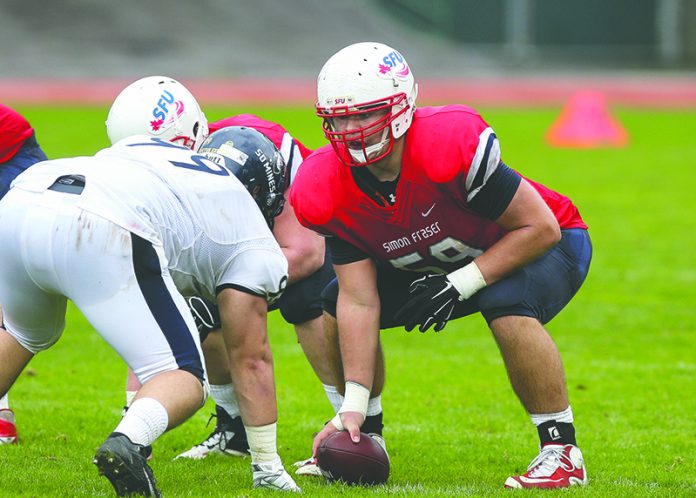
Michael Couture (right) was one of the two SFU alums selected in the CFL draft.

Even though the SFU football team went winless last season, two new CFL draftees are proving that the team is still capable of turning heads.

On the annual CFL Draft held on May 10, former Clan football players Michael Couture and Quinn Horton were picked by the Winnipeg Blue Bombers and the Calgary Stampeders respectively. Two SFU players were drafted in 2016, an increase from 2015 when only Lemar Durant was chosen.

Couture was drafted 10th overall by the Blue Bombers. The Burnaby, BC native was a two-time Great Northwest Athletic Conference First Team All-Star, as a centre in 2014 and as a tackle in 2015. He was drafted considerably higher than expected, as he was ranked 16th in the CFL’s Scouting Bureau Final Rankings.

Couture’s former coach, Kelly Bates, has spoken very highly of him. “Mike is a great person and his hard work has paid off,” Bates told  SFU Athletics. “He has been drafted by an organization in Winnipeg that will give him a tremendous opportunity to play and grow into the game at the next level.”

He will join former teammate Matthias Goossen, who was drafted second overall by the Bombers back in 2014. His versatility on the line was what ultimately made him a high pick, as he has played every position on the offensive line throughout his four years at SFU.

Horton became this year’s Canadian “Mr. Irrelevant,” the nickname for the last player picked in the NFL draft. He was selected in the eighth round with the 68th overall pick. He was a GNAC All-Conference First Team in 2015 and finished the season with 37 tackles, 8.5 of those for a loss.

Highland Pub closes for summer due to deficit

0

Thirsty summer students hankering for a beer may need to find a new watering hole: the SFSS recently announced that the Highland Pub would be closed for the summer. The move comes as Food and Beverage Services (FBS), a branch of the SFSS, tries to grapple with its trend of yearly deficits.

SFSS CEO Martin Wyant and newly elected SFSS President Deepak Sharma sat down with The Peak to discuss the closure. Wyant noted that the pub has accounted for a lion’s share of the approximately $3 million loss weathered by the society over the past eight years. The past several years have seen deficits upwards of $100,000. Current estimates for 2016 point to around a $360,000 loss. “When we say it loses money, what that really means is student dollars that are going to cover the deficit,” said Wyant.

According to Food and Beverages Services General Manager John Flipse, the pub “usually ends the summer with about $100,000 loss” due to fewer students being on the Burnaby campus during the summer semester. “The board has no more appetite for such a loss,” he said.

“I don’t want to give up on it but we have to stop the bleeding.”

The SFSS board began considering measures to address the deficit, including considering whether the FBS might run as a “for profit” business or as a service that would need continual subsidies.

Wyant looked into the history of the student society’s food and beverage operation when he began at the SFSS and was unable to find any record of it ever making money. Similarly, when reaching out to student societies that run pubs at campuses across the country he found that “almost all” had lost money. “We’re not alone. That’s kind of cold comfort,” said Wyant.

He pointed to the challenges associated with providing student-run food options on campus. Just last semester, a Big Smoke Burger (which is licensed) and a BC Liquor Store opened in the Cornerstone building on campus. When the Higher Grounds coffee shop originally opened, competitors like Starbucks and Tim Hortons did not operate on campus.

In addition to competition, Wyant noted that although food prices have been rising, particularly in BC, FBS hasn’t raised its own prices in a while. “We’re sensitive that students have limited capacity to pay,” he explained.

Furthermore, unlike most restaurants, FBS workers are unionized, resulting in higher labour costs. Wyant didn’t see a problem with this, arguing that workers should make a living wage; however, he notes that it is one of many challenges the pub faces. “I don’t want to give up on it but we have to stop the bleeding,” said Wyant.

WEB pub info 2

Wyant and Flipse both noted the need to change the pub’s business model when the pub reopens, likely in the first week of classes in September.

Wyant in particular pointed to the success of events such as SFSS pub nights and those held by other clubs which can prove profitable for the pub. The new pub could focus on events and catering, an area under FBS which Wyant remarked is financially sound.

“I think we’ve got some opportunity there. We have 200–300 clubs here at SFU, that are tied to SFSS. [The pub] is a wonderful space. We would like to reimagine that space.”

Wyant suggested that changes to licensing could be an option on the table, with a space for underage students to lounge in the pub area. Sharma, however, noted that changes to licensing may prove challenging, as the university holds the liquor license and not the student society.

Wyant was optimistic about the pub adopting a new business model while still providing a space for students to socialize. Said Wyant, “I would love to find a way to have that space better used with less money coming out of student wallets. That’s what it comes down to.”

SFU hockey eyes NCAA Division I membership

0

NCAA Division I hockey might come to SFU as early as the 2018–2019 season. Athletics director Theresa Hanson has launched a three- to six-month consultation process that she hopes will lead to a decision from administration by the end of the summer or September 2016.

“DI hockey makes sense on a lot of levels, certainly in our market,” said Hanson in an interview with TSN 1040. “We’re a hockey-crazed country, [but] we have no DI university hockey in our country,” she said, adding that many great student athletes leave Canada to play NCAA Division I in the US.

SFU is the only Canadian university that competes in the NCAA, with 17 teams competing in Division II in the Great Northwest Athletic Conference. SFU is allowed two Division I teams, and is exploring the possibilities of men’s hockey and beach volleyball to make the jump. Division I is the most prestigious division in the NCAA, and features the most competitive schools and athletic programs.

SFU men’s hockey has played against NCAA Division I teams in exhibition and has games with said teams scheduled for next season as well. Two years ago, the team played against NCAA Division I champions, North Dakota, a game they lost 4–3.

“It could be a game changer.”

Men’s hockey currently competes in the BC Intercollegiate Hockey League against UVic, Selkirk College, Trinity Western, and Eastern Washington.

Moving to NCAA Division I would be good for SFU, Burnaby, the province, and the country, said head coach Mark Coletta to CKNW 980.

Former Executive VP Business for the Vancouver Canucks, Jon Festinger, told The Province that SFU Division I hockey would engage audiences on local, regional, and national markets.

It’s “a game changer” said Hanson, due to the uniqueness in the hockey market and the story associated with it. Imagine, the only NCAA school in Canada, offering Division I hockey for Canadian-born athletes to play while receiving the world-class education SFU has to offer, Hanson explained.

In the most recent Frozen Four NCAA national championship 10 BC-born players were on the North Dakota, Quinnipiac, and Denver teams. In addition, Canucks first-round pick Brock Boeser played for North Dakota in the national championship; goalie Thatcher Demko, another Canucks prospect, played for Boston College in the semifinal.

“Sustainability is the biggest thing,” said Coletta. He noted that while the move would be years away, stakeholders must look “50 years down the road.” Coletta also argued that the consultation process will help the school decide whether to move forward.

There are some significant challenges that the consultation must address, the most prominent being the venue. SFU does not have a rink, and therefore external rinks must be looked at, such as the Pacific Coliseum.

Other factors include conference affiliation, travel, equipment, revenue streams, and number of student athletes on scholarships.

SFU’s scholarship fund currently sits at $11.5 million. Hanson aims to increase the funding to $20 million.

Joining Division 1 could mean SFU could compete on an even larger scale, but at this point it’s too early to tell if SFU could sustain an NCAA Division I team.

SFU has contemplated one in the past, but with the consultation process now in place, it shows this time around there is a serious intention of pursuing the distinction.

“It’s a lofty goal, but I think it’s doable,” said Hanson.

SFU students create home brewing system for craft beer

0

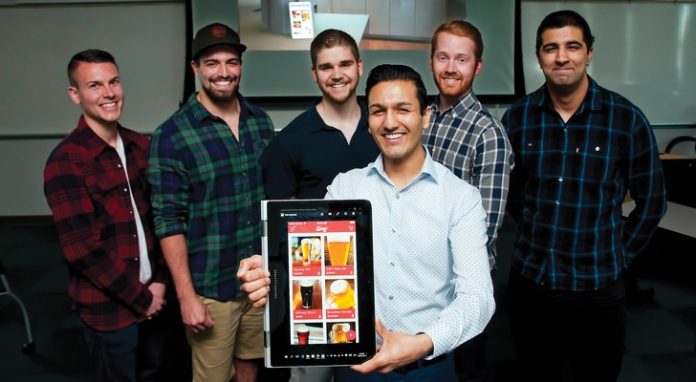
Sharing their passion for beer, six SFU students have teamed up to create Brewstr: a startup that facilitates simple beer brewing at home. Specifically, Brewstr is an automated home brewing system controlled by an application on mobile phones.

Ryan Lymburner,  a fifth-year Mechatronics student at SFU who helped to create Brewstr, described the beer-making process as “tedious,” “boring,” and “quite [a lot] of manual work.” Brewstr was designed to allow users without the usual knowledge or experience to make beer and cider that can be personalized to suit the owner’s taste.

The Technology Entrepreneurship@SFU program at Surrey campus was where it all started. The program’s main goal is to successfully commercialize projects and establish new startups. There Lymburner first met his team: Jeremy Thompson, Derek Muxworthy, and Jordan Sciberras, all of whom are Mechatronics students, and Business students Karan Thakur and Kavi Sekhon.

Lymburner called his team “a great blend of everything,” describing their diverse skill sets and backgrounds.

Brewstr has gained much attention from local media, despite having begun in January of this year. Lymburner added that the team is very “motivated” to know that their projects are gaining popularity  and “going [quickly]” to the next stage.

Regarding Brewstr’s near future, the complete prototype will be finished soon and ready for public tests and funding. In addition, the team will work closely with local breweries to ensure that the quality of the beer is suited to the tastes of consumers.

Lymburner and his team see their inventions as a “complement” to the local beer industry, rather than a competitor to it. They suggested that local breweries could create their own ingredient packs and kits for purchase, allowing them to share their recipe with people more easily. Ultimately, the Brewstr team hopes that their invention might help to create a community of people who, like them, enjoy a cold brew.

CENTRE STAGE: Just Words melds poetry and dance; flamenco, Irish tap, and belly dance share the stage in Encuentros

0
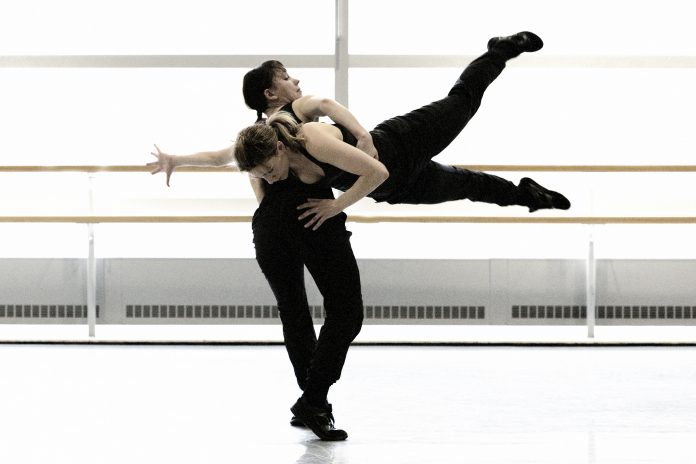
Just Words explores the importance of dance as an art form.

Just Words – Les Productions Figlio

April 27–30, Firehall Arts Centre

Serge Bennathan steps to the front of the Firehall stage, a spotlight on him as he picks up a sheet of paper. He reads off a letter that he wrote to fellow choreographer and dance artist Grant Strate who passed away in 2015. The letter shows his respect for Strate as he says “we need your grace,” as well as his thoughts on the importance of dance as an art form.

In personal, reflective interludes, Bennathan spoke directly to the audience and shared parts of his life: his experience as an immigrant, his desire to write a blog, to choreograph chaos, and he even shared an original poem with us. His words coloured the choreography as Karissa Barry and Hilary Maxwell translated the words into dance. Aside from directing his Vancouver-based dance company, Les Productions Figlio, Bennathan is also a writer and painter, and with this latest work he wanted to express himself through words and speak poetically. The love poem he shared with us, in French and then in English, was full of beautiful imagery and romantic tension.

Barry and Maxwell, dressed in black pants, tank tops, and sneakers, were at times dancing in sync and at times in opposition, pushing against each other and throwing each other aside. The steady pace of the choreography was neither overly physical nor lacking in intensity, and Bennathan was able to augment his words through rigorous movements.    

Bennathan danced with Barry and Maxwell at a couple points during the show, but for the most part he stood at the side of the bare stage while they danced. Sometimes he urged them on with directions such as “vas-y,” and traded places with them to share more of his words. With fervent choreography and thoughtful poetic interludes, this show was much more than just words.

Encuentros – Kasandra Flamenco and Caravan World Rhythms

May 1, Vancouver Playhouse

Kasandra “La China” and her ruffled red dress swirl and dip in unison. Her dance partner is the long train of her dress, following her every move as she skillfully maneuvers it. When she is joined onstage by another flamenco star, Ricardo Lopez, the dress envelops both of them in a gentle hug.

Kasandra is the artistic director of Encuentros, as well as her own company Kasandra Flamenco. Her concept for this one-night show was to bring together Irish tap dance, flamenco, and Egyptian belly dance to highlight their percussive similarities and have dancers face off in passionate encounters.

Kasandra and Lopez shared a couple of particularly passionate scenes; you sensed that they felt the rhythm in their bones and were completely in tune with the onstage musicians. One of their duets featured an innovative costume piece that kept them connected: they each wore a small vest connected by a long piece of fabric. As they danced the fabric wound around them and helped to visualize their patterns and symbolize the relationship being portrayed.

Representing Irish tap was Vancouver-based Joel Hanna, who has performed with Riverdance and has some of the most virtuosic footwork I’ve ever seen while making it look easy. He must have been working hard, though, because at one point between lightning fast footwork sequences he looked at the audience and said with a sigh, “It’s hot!”

Hanna and Lopez shared an intense scene teasing and challenging each other with increasingly difficult steps. Like an impromptu jam session between musicians, their steps shared the same rhythm and mood but displayed the different qualities of their respective genres. Kasandra had her own dance duel with belly dancer Ashley Kirkham, whose undulations and microscopic vibrations were impressive. It was interesting to see the rhythm represented through the hips and torso in belly dance, as opposed to through the feet and hands in flamenco.

Another essential element of flamenco dance is the live music. Guitarist Gareth Owen, singer Vicente Griego, percussionists Davide Sampaolo and Tim Gerwing, and Oud player Serwan Yamolky provided the perfect accompaniment to the movement.

Cries of “Ole” and “Bravo” could be heard throughout the show. It was wonderful to see these four soloists who are experts at their craft sharing a stage and showing us how their grounded, rhythm-infused styles can work so beautifully together.