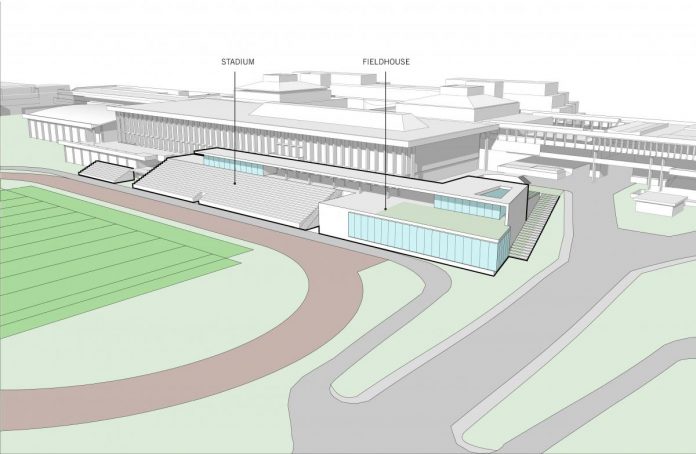
As announced last week by the Simon Fraser Student Society, the Stadium portion of the Build SFU project has been terminated before ground had even been broken on the project.
After estimates predicted that the project would likely cost three times as much as the projected ten million dollar price tag, the SFSS Board of Directors decided to terminate the project at their last board meeting on August 11.
“On July 5, we got the cost estimates from the architects, and it was a $22 million hard cost,” said Arr Farah, VP University Relations for the SFSS. “After you add in the soft cost, it was around $30 million.” The hard cost refers to the cost of construction itself, whereas the soft cost includes such expenses as legal, architectural, and engineering fees.
“Our budget was only 10 million — that’s all students approved,” Farah added. “So it was safe to say we just couldn’t afford this project anymore.”
The development comes while construction of the Student Union Building (SUB) has been underway for months.
“It’s a difficult decision, but when you think about all the other students in the school in its entirety, you really do comfort yourself saying it is the better decision for all the students”
– Larissa Chen, Interim President of the SFSS
It wasn’t an easy call to make for the Board, especially for members like Farah and Interim President Larissa Chen. Both were members of last year’s Board of Directors, who were the ones to approve the Build SFU project in the first place.
“It was a very difficult decision,” said Farah. “I know for Larissa and I, we were on the board last year, we were part of the push to get the vote for both the SUB and the stadium project. I think there’s a lot of emotional attachment to this project.
“It’s just not feasible,” he continued. “The real responsible decision is just to cease the project and that’s what’s in the best interest of student who are paying today and in the future.”
In regards to student payments, the Board guaranteed that there won’t be any increases to the levy due to anything like cancellation fees, which was a fear expressed by students online. As it currently stands, the levy will remain the same, though there is a chance it could be decreased, according to Farah and Chen.
“I think in terms of [a levy decrease], it depends on the conversation we have with SFU and Scotiabank,” said Chen. “We don’t want to give any false promises in advance, but we’re definitely going to be taking into consideration that the Stadium project will not be moving forward and continue to choose what’s best for all students.”
Those conversations will likely happen during the upcoming fall semester, and Farah indicated they are the biggest priority right now for the SFSS.
For the foreseeable future, the Terry Fox Field will remain the same as it is now.
The decision comes weeks before the start of the semester, which will also see a by-election for a new SFSS president and Environment Faculty representative. The choice to discontinue the Stadium project will likely be one of the last that Chen has to oversee as interim president, and one which she said was very challenging.
“It’s a difficult decision, but when you think about all the other students in the school in its entirety, you really do comfort yourself saying it is the better decision for all the students,” she said. “The onus isn’t on anyone, it’s just that it’s not possible.
“The decision was very, very hard because I was on board last year and we definitely did push for both the Stadium and the SUB and we really believed in it. We really wanted to see it pass and be successfully completed.”
When asked about how this might affect the SFSS’ relationship with SFU Athletics, Chen hoped that they would be able to see that the project wasn’t feasible.
“I think that in terms of our relationship with SFU Athletics, there’s really not much we can do to control how they perceive the situation. All we can do is provide them with the facts and the cost estimate as it stands right now which is very much outside of our scope,” she said.
Farah agreed, adding that there is a difference between SFU Athletics and the student athletes whom the SFSS represents.
“Our relation with the athletics department is [the same] it’s always been. [There is that element that] they always want us to work together and collaborate on different things,” he said. “But when it comes specifically to student athletes, I think it’s important to note that the SFSS has been in support of, the Board has been in support of — we really pushed to get this vote.
“We need to do, as Larissa said, what’s in the best interest for all our students.”
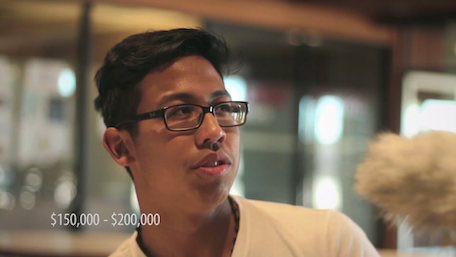
In this week’s issue, The Peak featured the 2016 salaries of SFU’s Administrators. So in this episode of Peak Speak, we ask students how much they think president Andrew Petter makes in a year and what they think about the actual figure.
Nothing says “my masculinity is as fragile as a newborn child” quite as clearly as “no homo.” Seriously, if you have to disclaim your sexuality every time you express a positive thought about the same sex, you have a deep problem. You look insecure at best, and homophobic at worst. Please disintegrate.
“I’m not that kind of girl.”
I hear this most often from fellow females justifying their actions (I’m looking at you, internalized misogyny). “I’m not that type of girl to do this, or say that.”This phrase seems to imply that women can’t be multifaceted creatures, when in reality we all are. Go ahead and be any ‘type’ of girl whenever you want, and remember not to apologize or explain yourself to anyone.
“That *insert meaningless video game here* totally raped me.”
No. It. Didn’t. Don’t you dare trivialize a traumatic event that happens to thousands of women. Not cool.
The “crazy girlfriend” (or boyfriend).
I have yet to meet a nice guy who constantly complains about their ex being “crazy.” More often than not, that girl is “crazy” for having legitimate feelings, thoughts, or opinions and expressing them (God forbid!). Take this stereotype as a gigantic flashing sign that says “I’m a mildly sexist prick.”
“Excuse me while I go kill myself.”
An overdramatic, inconsiderate response to everyday, mundanely unfortunate events. I’m not sure when this expression came into play, but I’m over it. We both know you’re not going to kill yourself over your makeup smearing, or the Starbucks line being a tad longer than usual. Suicide is not funny. It will never be funny. You sound like an asshole.
“That’s retarded” and “That’s so gay!”
I feel silly even including this, because using a minority as an adjective, and a negative one at that, is so blatantly wrong. It may seem harmless at the time, but it contributes to a larger cultural problem. Many of us harbour hate or ignorance subconsciously, and language like this allows those thoughts to breed. Check your rhetoric before you wreck yourself (ha).
[dropcap]W[/dropcap]e all walk separate paths. Sometimes those paths meet up with other people and you travel together; sometimes you travel on your own; sometimes you see people for a short time; and sometimes you lose your way.
Ever since I got back from exchange in Australia, I have been trying to find the path I was on before I left. I can’t find it, at least not yet. I know I will. I am a stubborn person and quite strong-willed when I want to be. Lately though, I have not wanted to be strong. I’ve not wanted to be anything, and that’s not great.
It’s a strange thing to come back to your home after being away for a long time. When you’re gone for months at a time, you change independently from the people who you were around before you left. You miss birthdays, breakups, couplings, and graduations. You make new friends, you see new places, you get back and want to share those experiences with people around you.
You just don’t always have the words to articulate what it meant to swim under a waterfall, or hike to a mountaintop and see the vastness of a country in front of you. To make friendships becomes something more, like being considered family by people who are on the same path as you.
You try, you meet, you smile, and tell the stories. Your friends to whom you’ve returned laugh and smile as they see the joy you express while you do your best to share the experiences with them. Except you’ve changed, and so have your friends. You see, as you have followed your path while away, they followed their path without you.
Since I got back I have been struggling to find my path here again. I have been doing my best to push through the brambles and undergrowth, yet they seem to be thicker this time. I am seeing fragments of it as I pick up my old passions. I’m slowly getting back into gaming and old projects that I had to shelve while I was away, yet picking them up this time feels different — not bad, just different.
I want to make it clear: I’m not depressed and I’m not sad — I’m just confused. I don’t really know what to do and I can’t seem to jumpstart my ambitions again. I have them, they just feel like they are asleep. Maybe it’s time to ring the alarm clock.
My mum used to tell me, when you are lost in life and don’t know where to go, pick a direction and follow it to its end. On the way, you’ll find other paths that may extend the journey. When you get to the end and you need more, it’s satisfying to know that you’ve at least accomplished that much. So now, simply keep going.
That is what I plan on doing: I am going to stop trying to find my old path and start carving a new one. The brambles in the way are only there for a short time and simply going in circles will only get me tangled, until I pick a direction and just go. Before I know it I will be making my own path again. Who knows — maybe I will find something that will extend the journey that I can’t think of, sitting in my apartment waiting for life to happen like it used to.
The latest find is one of the few "well-preserved" archaeological sites in the Comox Valley area.
The K’ómoks First Nations got more than they bargained for while holding a barbecue in the Comox Valley last year.
A midden containing ancient artefacts was discovered at the site, leading SFU archaeology professor Dr. Robert Muir to oversee a six-week field school excavating the area. During the excavation, Muir and his students discovered around 80 stone tablets, some as small as pebbles, estimated to be roughly 2,000 years old.
The field school, led by Muir, involved 21 third- and fourth-year students excavating a 100m by 120m exploration site on the K’ómoks First Nations’ traditional territory, and studying their findings. The excavation was conducted at the Puntledge RV Campground on Vancouver Island.
They have uncovered myriad artefacts: herring rakes; deer, dog, and elk bones; harpoon points; bone fishing needles; and, perhaps most excitingly, the flat stone tablets, each marked by symbols on one side.
According to an interview with Muir by the Comox Valley Record, the markings on the tablets could be seen as symbols for trees, feathers, or fertility. In the interview, he described the site as “very unusual,” referring to the tablets as “a little mystifying.”
The site was first discovered in 2015 when a group of the K’ómoks First Nations were digging a roasting pit for a celebratory barbecue.
During the celebration they uncovered an accumulation of shells, finding later that it was a midden containing numerous animal bones as well as other miscellaneous deposits.
According to Muir’s interview with the Record, “[the discoverers] thought, ‘Uh -oh, there’s a site here,’ and we figured out how large it really is.”
He claimed that in over 30 years as an archaeologist, he’s never studied a site like this.
He described the area as “well-preserved and pristine.” It’s one of only a few spots where these artefacts have been discovered in the Comox Valley.
The artefacts found in the excavation site are being taken to SFU to be photographed and studied. The students are currently helping with the analysis of these artefacts, after which Muir will take extra time to study them before returning them to the K’ómoks band.
The K’ómoks First Nations are an indigenous band from the eastern coast of Vancouver Island. They are currently comprised of around 330 individuals, including people of Puntledge, Ieeksun, Sathloot, Tat’poos, Cha’chae, and Sasitla ancestry.
Having suffered greatly because of European settlers, including the loss of over half their population due to a smallpox outbreak in 1862, the K’omoks people have worked hard to maintain their community. They are comprised of four reserves on the island, and regularly hold events and take part in business ventures and partnerships.
Student groups advocating for Simon Fraser University to divest from fossil fuel companies are reeling after the university posted a draft to its divestment policy.
Called a “significant step backward” in a media release posted on the Embark website, the policy outlines ‘guidelines’ that the Responsible Investment Committee (RIC) will use to consider divesting from that company.
The extent to which SFU is invested in that entity
If the entity derives more than 10 percent of its revenue from activities that cause social injury
Evidence that divestment will produce a favourable outcome
Impact on the university’s “fiduciary duty [. . .] to maximize return on its investments”
This draft policy comes after three years of the Divest SFU campaign pressuring the university to rethink its stance on fossil fuels. A joint venture between SFU350 and Embark, the campaign calls on SFU to “immediately freeze any new investment in fossil fuel companies, and to divest within five years from direct ownership” in order to address climate change. Josh Cairns, executive director of Embark, conceded in the release that until now “the university has made considerable progress regarding its stance on divestment.”
However, Cairns elaborated on the Embark website that this policy draft isn’t quite up to snuff. He argued that “the policy revision, if it is adopted in its current form, creates an unjust test for the university’s investments that ensure divestment will not occur.”
This is in line with the trend of Canadian universities rejecting divestment. Earlier this year, McGill, UBC, and the University of Toronto have all rejected calls to divest from fossil fuels. However, Cairns explained that SFU should look to the “University of Ottawa, which recently committed to decarbonizing its investments in accordance with Canada’s emission reduction commitments.”
Cairns said in a separate media release that “The revision suggests that the university is comfortable investing in an entity that profits from harming people or the environment — as long as the entity’s revenue from harmful activity is below an arbitrary 10 percent threshold, and as long others are also investing in the entity.”
The same media release noted that under the new conditions it might be “all but impossible” for divestment to occur at SFU.
The issue of divestment at SFU touches on a local conflict that has been playing out over the past few years.
Kinder Morgan is seeking to expand the existing Trans Mountain Pipeline that transports tar sands products from Edmonton to Burnaby. This project has elicited controversy due to environmental and safety concerns. The proposed expansion would triple its capacity, but critics argue that the economic benefit to the province is marginal, especially given the environmental risks.
Earlier this month, MP for Burnaby North-Seymour Terry Beech held a consultation meeting to address Canada’s Climate Change Action Plan, and to continue the discussion about the proposed Trans Mountain Pipeline expansion. The event is the first in a series taking place over the summer.
As for what will happen if SFU rejects divestment outright, SFU350 has been collecting students’ signatures, pledging “direct action.” A similar situation unfolded after McGill rejected divestment this March: students staged a sit-in at the vice chancellor’s office for days, while supporters camped outside.
Cairns finished his statement by putting the issue in no uncertain terms. He spoke to the fact that SFU is a signatory of the Paris Pledge for Action, a document that acknowledges the gravity of climate change, and commits to limiting global warming to 2 C above pre-industrial levels. “SFU should ensure its actions align with the just future it has publicly committed to,” he argued.
The RIC is currently accepting emailed comments on its draft policy until August 7, and will review in September.
Mark LaLonde has experience with the Vancouver Police and the Justice Institute of BC.
Following sexual assault allegations and privacy issues in campus washrooms, Mark LaLonde has stepped in as SFU’s new chief safety officer as of June 6.
LaLonde brings a wealth of experience to the position. “My entire career has been focused on public safety, and risk management, and human security,” he said in an interview with The Peak. After working with the Vancouver Police for 12 years, LaLonde took a position at the Justice Institute of BC, and later worked for various non-police agencies. He also spent years working with a national risk mitigation firm.
What attracted LaLonde to the position at SFU was the energy and dedication on campus, as well as the critical role his position played in the larger dynamic of SFU. Additionally, the fact that LaLonde’s friend and former police colleague Terry Waterhouse had been a chief safety officer gave him a glimpse of a working environment that he found appealing.
LaLonde has also previously contracted SFU grad students for research, and been a guest speaker in some of the classes. His mother and one of his sisters are SFU graduates.
For LaLonde, his most rewarding work has also been his most challenging. He did consulting work with the UN in areas such as South East Asia, the Middle East, and East Africa. Some of these projects focused on the protection of women and young girls from threats such as human trafficking, intimate partner violence, and commercial sexual exploitation.
Coming into his role as chief safety officer, LaLonde named his number one goal as “the safety of students, staff, and faculty.” Along with their physical safety, he spoke about addressing the emotional and psychological safety of students through resources such as the Health and Counselling Services, Student Services, the Women’s Centre, and Out on Campus.
When asked about the recent sexual assault issues SFU has been dealing with, LaLonde said SFU is taking a firm approach.
“Our entire process is survivor-centric,” he declared.
He spoke to the policies and protocols in place at SFU to ensure immediate and appropriate attention is given to students who raise concerns. Additionally, LaLonde is working on an ongoing campus initiative to develop new sexual violence policies, such as protocol enhancement, prevention training and awareness, and communication programs to discuss issues such as consent.
In regards to the washroom privacy incidents, LaLonde advised SFU students to “be vigilant at all times, be aware of [your] surroundings, and report incidents in as much detail as possible quickly so that security and the police can respond.” In addition, he spoke about how campus security has stepped up its patrol in key areas.
LaLonde looks forward to working with his team at SFU to oversee the safety and security for the entire community. He strongly believes in the effectiveness of his communication and policy reforms, to deal with the safety issues with which university is currently struggling.
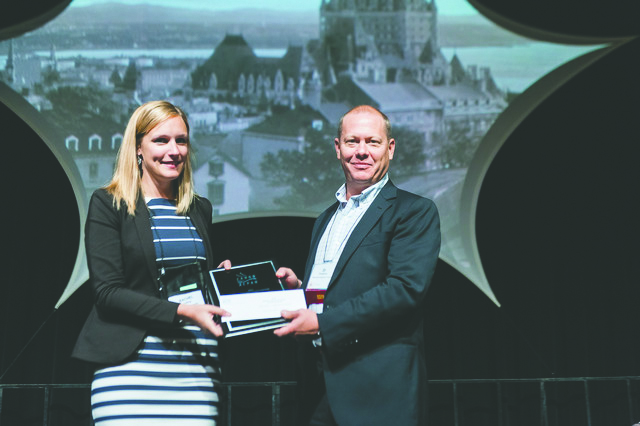
The program manager for SFU’s Zero Waste initiative, Rachel Telling, takes home 1st prize at the 2016 Quality & Productivity Awards from the Canadian Association of University Business Officers.
The program was given the Innovation Award from the National Association of College and University Business Officers, and the Quality & Productivity Award from the Canadian Association of University Business Officers.
Rachel Telling, the program manager for Zero Waste, has attributed the initiative’s key to success as cross-departmental collaboration. “The initiative is aided by SFU’s Zero Waste committee, which is a committee made up of different groups and departments in the university,” said Telling.
The project has been supported by students and staff through a wide range of volunteer programs and movements within the community. Telling emphasized the massive participation of many departments that has helped the project achieve great success.
She noted that “there is a general representation from all key departments like Dining Services, and Sustainability Services. Even student representatives from the SFSS and GSS are involved, [as well as] partners like UniverCity.”
Telling expressed pride in the solidarity that has bound all of these different groups together: “We have been working together from the initiative, [and] we can achieve more than we ever could if there were one or two departments.” The committee is now looking at reducing waste from resources purchased by SFU Food and Beverage Services, such as cooking oil and butter.
Executive director of Embark Josh Cairns noted that the project’s success is impressive given the high expectations that came with its launch: “The 70 percent diversion goal [set by the program] is quite lofty, and at the time that seemed so far away, but it only took a year for SFU to reach that goal.
“I would say that the Zero Waste program is definitely a highlight and a key milestone for SFU in regards to its sustainability commitment.”
Looking towards the future of the program, Cairns remarked, “I think the reality is that like any sustainability initiative, you’re getting decreasing return on your effort. So now, when the project has reached its 70 percent waste diversion threshold, every extra percentage [point] is gonna be much more difficult. It’s gonna be very challenging to ensure that there’s widespread compliance across the university and the students are well-versed in [the program].”
He added that the constant influx of new students to SFU each year is both “a blessing and a curse” for the program, given that each new student needs to be educated in how the Zero Waste Initiative works.
“You have to ensure that the new students entering SFU are educated on the Zero Waste program, and [that there are] changes in behaviour, for SFU to exceed the 70 percent goal,” Cairns said.
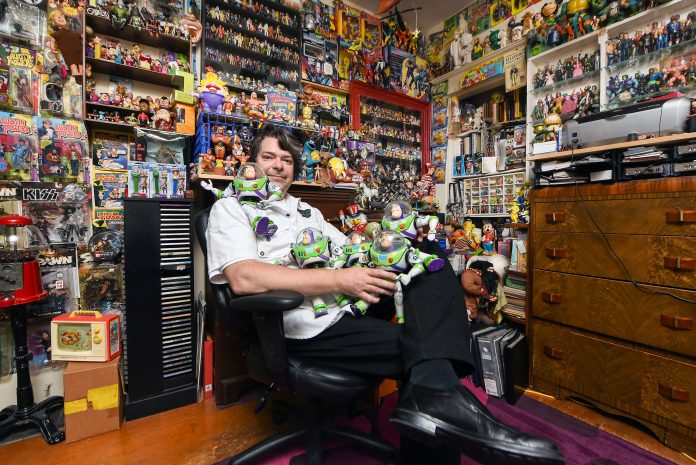
Angus Bungay never lost the compulsion to collect or his love of action figures.
Remember when you used to collect? Maybe it was rocks, keychains, baseball cards, or Puppy Surprise toys. Whatever it was, many people did it as children. Some people never grow out of that compulsion to build a series of objects that may become the envy of others, or to amass a collection that has deep personal meaning. Until January 8, 2017, you can see 20 such collections at the Museum of Vancouver (MOV) in All Together Now: Vancouver Collectors and Their Worlds.
All of the collectors are locals except for two — but they collect things related to Vancouver. Viviane Gosselin, curator of contemporary culture at the MOV, explained that they made a point to focus on the individuals themselves. “The collection and the collector are at the forefront,” she said, explaining that they wanted the experience of the exhibition to feel like meeting the collectors.
They accomplished this by pairing each collection with a large backlit photo of its collector, along with a brief Q&A explaining why and how they collect. Only one of the collectors wanted to remain anonymous, but there is still a photo accompanying his collection of rare pocket watches, his face obscured by one of the watches.
Each collector has a unique story to share, and their collection takes on new meaning after learning about them and their motivation. For example, Marie Allen, an artificial eye collector, is a second generation ocularist, and custom makes glass eyes for her patients. There is also Harold Steves, who collects heirloom vegetable seeds. His grandfather and great-uncle started the first seed company in Western Canada.
All of the collectors are passionate about their objects, and the act of collecting has shaped their life. Often it starts small, without the goal of amassing a large collection, but it begins to grow from there. It seems there is a bit of a snowball effect that happens once you become known as a collector.
Gosselin easily separates collectors from hoarders, explaining that hoarding is pathological and non-discriminatory, whereas a collector will build a series and never want to add more of the exact same thing. A collector is usually more discerning.
I was extremely impressed by the diversity of collections on display at the MOV, as well as the interesting interactive component of each one. These are not static collections that you simply look at as you walk by. You can play the pinball machines, listen to a song on the jukeboxes, try on a corset, learn how to tie a fishing fly, and listen to music from the concerts listed in the poster collection. From taxidermy to prosthetics, and Chinese restaurant menus to action figures, this exhibition has something that will appeal to everyone.
One of the goals of the exhibition is to show the diversity of series and change the way people define a collection. The press release for the exhibition reports that nine out of 10 collectors are men, but Gosselin thinks that may be skewed by how a collection is traditionally defined. Many women may collect things such as shoes, clothes, or gadgets, and many people who actually do collect wouldn’t self-report as a “collector.” This show features seven female collectors.
Looking at these impressive collections, I was reminded of my former collecting days, when I used to find great excitement in adding the next item to my stash. For these collectors, that has never died. Everyone has a connection to the collectors’ experience, said Gosselin. “Even if you outgrew your collecting, people can relate to that rush.”