Home Blog Page 799

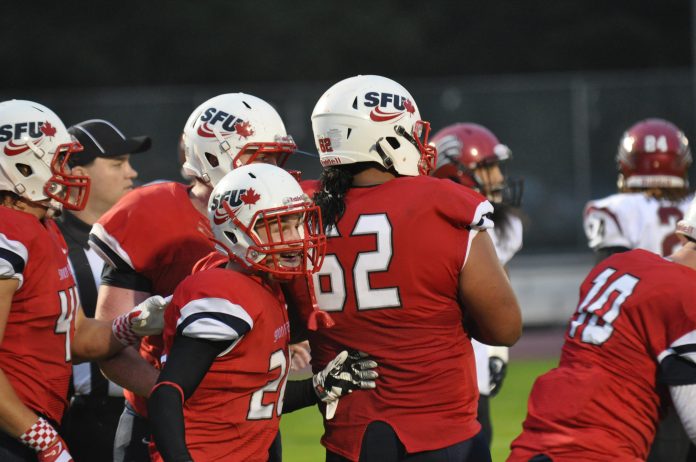
SFU loses 64–14 to Azusa Pacific

0
So far this season, SFU has been outscored 235-48.

SFU won the coin toss. Having chosen to defer, SFU nonetheless started on offence after recovering the Azusa Pacific fumble. Going for it on fourth and six, quarterback Miles Richardson was rewarded when freshman receiver Gavin Cobb caught the 36 yard pass for a touchdown. Just 1:20 in, SFU was up 70.

Saturday night on the road versus the GNAC-leading Azusa Pacific, the Clan’s fortunes seemed to have changed. 0–3 so far, and outscored 17134 in the three games prior, it looked like they might have a chance at their first win since October 2014.

Their first shot on defence was actually relatively successful. Considering that in each of the previous games SFU allowed a touchdown on their opponents first offensive drives, holding Azusa to three points was an accomplishment. But the fact that Azusa even got three points was a sign of what was to come.

“We would have actually got off the field, they were fourth and four. We stopped them, but we had a defensive player line up offside which gave them a first down,” said head coach Kelly Bates. “So even then, we shot ourselves in the foot and given them the ability to go down and get that first field goal.”

Then on SFU’s next drive, during the punt attempt the snap was “handled errantly,” resulting in a turnover on downs, with Azusa gaining good field position. On SFU’s 28 yard line, Azusa needed just one pass attempt to make the touchdown and take the lead, which they would hold for the rest of the game.

Though the first quarter would end with SFU down only 107, Azusa’s lead ballooned in the second and third quarter with scores of 310 and 230, and the game ended 64–14.

“Well, right now we are not playing mistake-free football, and when mistakes compound themselves, it’s very tough to overcome,” said Bates. “Azusa Pacific was very disciplined team that played very hard. When they don’t make mistakes and we make too many it’s very tough to compete.”

The Clan’s only other solace came in the fourth quarter. Richardson made another 36 yard touchdown pass, with this one going to Justin Buren. SFU held Azusa scoreless for the quarter (of course with the caveat that it was unlikely that Azusa was putting out their best effort or players at this point — they played total of three quarterbacks, two of which put up over 170 passing yards each.)

“I’m not really about inspiring them, I’m about showing them the reality of our situation.”

If you look just at his passing yards — 224 — Richardson didn’t have a bad night, but two interceptions, nine sacks, and 80 yards lost tell a different story.

Buren was similarly effective as last week putting up 100 yards receiving. Cobb put up 57 yards receiving, while freshman Tom Franklin put up 45. Running back Jalen Jana led the running game with 41 yards.

Ante Litre, who is first on the depth chart in the running back position, did not play for the second straight week. Litre, who The Province’s Howard Tsumura reported was injured in the season opener versus Idaho State, returned to play against Texas A&M Kingsville but has not played since.

Bates was blunt about the challenges the team has faced at the beginning of the season, and what he has to do as coach.

“I’m not really about inspiring them, I’m about showing them the reality of our situation. The reality is that we played two Division I level teams to start the year off with a roster that is undermanned and undersized still due to the coaching carousel that was up here for a few years and we’re going to be recovering from that for the next two to three years — [. . ] it’s a process that’s going to take a while,” he explained.

“From there, when you come off those two games with the physical toll your body takes — both of them being on the road — and then play the two top teams in your conference, you haven’t set yourself up for success with your schedule.”

So far, SFU has struggled, perhaps even more so than last year. Last season, the team was able to appear competitive for much of their games, and lost on average by 19.2 points per game and lost two games by a single digit margin. This year, they have not lost one game by less than 32 points.

While Azusa (3-0 in GNAC play) and Humboldt State (last week’s opponent) are probably the GNAC’s toughest teams, any comfort gained from the fact that SFU has already faced them is erased when you realize that SFU has to play both of them again (the GNAC only has five teams).

Still, Bates wants to look at the positives.

“[These are] great opportunities for us to measure ourselves and really great opportunities to see what we’re made of in terms of dealing with adversity and you really won’t have that answer until many games down the road, this year or maybe in the next year, whether we faced that adversity properly and were able to grow from it,” he said.

“When you’re still trying to build that belief in yourself that you can do it, you tend to be fragile.”

THIS SATURDAY: SFU hosts the Central Washington Wildcats (1–1 in GNAC play). Last season, the Clan lost to the Wildcats 40–7 and 30–24 (which tied for SFU’s closest game last season). Last Saturday, Central Washington beat Dixie State 40–18 in a non-conference game.

Central Washington has an effective run game leading the GNAC in rushing yards, averaging 182.2 yards per game.

“Central [Washington] is not an overly complicated team in anything they do, however, they’re going to line up and smack you in the mouth as hard as they can. They’re very physical, they’re very aggressive, they finish every play right up to the whistle and they want to impose their will on you,” said Bates. “So for us to have success against this team we’re going to have to be very smart football players, we’re going to have to play very technically sound, and we’re going to have to bring the pitbull in ourselves out in order to compete with the aggressiveness.”

The game will be a homecoming celebration, with the game taking place at Terry Fox Field instead of Swangard Stadium. Kickoff is at 6 p.m.
 

SFU hockey loses big to Trinity Western

0
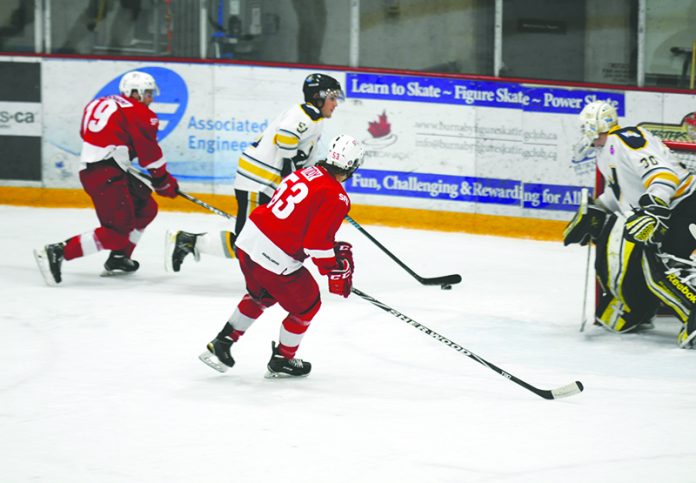
Brandon Tidy (#53) scored SFU's lone goal in the game.

It was only a preseason game. However, a 6–1 defeat — especially to perhaps your biggest rivals, and the team that knocked the Clan unceremoniously out of the playoffs last season — raises some concerns heading into BC Intercollegiate Hockey League play on October 7.

“I think overall the effort was poor,” said head coach Mark Coletta afterwards. “Everything was poor on our front. We’ve got some work to do.”

What made this game so perplexing from an SFU perspective is how it started. The first period was uneventful: shots were just 6–5 at the end of the period, and the only real scoring chance was from new captain Brandon Tidy.

However, it was all Trinity Western in the second. In a vastly different period, there were four breakaways early on, two for either side, and both of SFU’s were for newcomer Daniell Lange. However, a knuckler from Spartans defender Kenny Batke fooled Jordan Liem, opening the floodgates for four more goals. The second and third goals, as well as the fourth and fifth, came within one minute of each other.

“Everything was poor on our front. We’ve got some work to do.”

The third saw SFU get a goal, courtesy of Tidy. He was able to break Trinity Western’s shutout at the 8:15 mark of the period.

“[Mak] Barden and [Jaret] Babych had two good minutes behind the net,” said Tidy on what led to his goal. “[So] when me and [Graham] Smerek went out there, we had five tired Spartans and we took advantage.”

The third also had a couple of big scrums. The first saw a Trinity Western player get into a fight with SFU goalie Lyndon Stanwood. He was helped off the ice afterwards and as of publication time there is no update on his status from Coletta. The second one involved Trinity Western’s goalie Lucas Mills, who skated out of his crease after a stoppage in play to confront an SFU skater. Both came with under two minutes to go. It’s another chapter in an intense rivalry between the two teams.

“We had a good discussion after the game about how to act, how to conduct yourself not only as an athlete but as an individual,” said Coletta after the game. “I think sometimes emotions get the better of guys. We don’t condone any of that garbage. If somebody wants to fight one on one because somebody instigates our goalie that’s great. I think one-on-one fights are a part of hockey. All the other stuff is not condoned by us.

“A loss is a loss, it’s easy to look behind and go forward,” said Tidy on what the team needs to do for future games. “We can’t dwell on a 6–1 exhibition loss, that’s not going to be any good. Just have a hard week of practice and see what we can do.”

SFU’s next home game is October 15 against Selkirk College. Puck drop is at 7 p.m. at Bill Copeland.

At-Large Representative nomination form

0

The Peak Publications Society Board of Directors is seeking to elect three (3) new At-Large Representatives for the 2016-17 academic year. To qualify, candidates must be current SFU students, must not hold any editorial position on any of the Society’s publications, must not be a member of the Peak Collective (collective members are those who have contributed over the past semester), and must not hold any office at any Student Society.

You must also fill out the form below and collect signatures from five (5) members of the members of the Peak Publications Society — there are lots of them in our offices who would be happy to endorse you — and submit it to our Business Manager, Maia Odegaard, by 11:59 on Tuesday, October 11, 2016.

Questions? [email protected]

at_lrg_rep_newform

Women’s soccer suffers second loss of the season against Western Washington

0
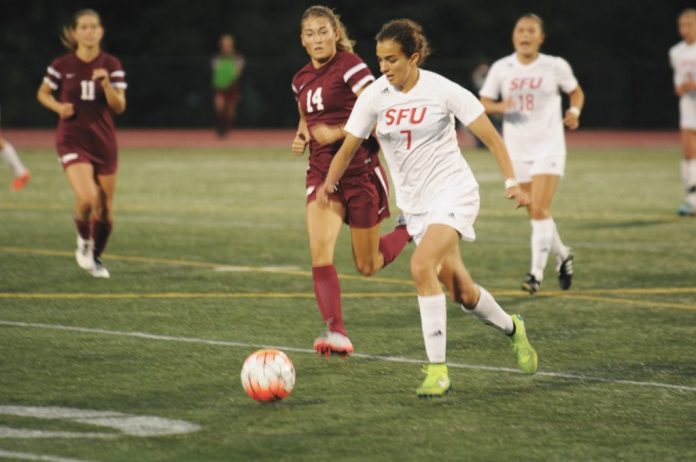
Olivia Aguiar had a chance to tie the game up late, but hit the crossbar.

The women’s soccer team was handed its second defeat of the season by the Great Northwest Athletic Conference (GNAC) champion, the Western Washington University (WWU) Vikings.

After quickly getting into the rhythm of the game, the Clan seemed at ease in terms of possession and handled the first half with authority and technique. A mistake cost the team a potential win, though.

The goal that would win the game was scored by WWU forward Elise Aylward. She chested the ball into the goal 20 minutes following the kickoff, converting an assist from her teammate Gabriela Pelogi.

“We made one mistake and it cost us the win.”

Aside from the Vikings goal, SFU goalkeeper Priya Sandhu gave a quality performance and stood strong between the posts. The Vikings unleashed a total of 11 shots on her, as well as several other attempts in the penalty area. The Clan protected the net well, with midfielder Jenna Baxter diverting a free kick, and the defence blocking two corners.

SFU returned strong during the second half. The team generated several chances, reaching a total of eight attempts against the Vikings and creating multiple opportunities of scoring quality goals, including a spectacular long shot by Olivia Aguiar, which hit the bar.

The Clan lost the Vikings by a final score of 1–0. Despite a strong collective performance, the Clan’s terrific attempts to turn the game in its favour were not enough to take on the GNAC title contender. Still, the Clan fans witnessed what the “Beautiful Game” is about.

“I think we played a very solid game,” said coach Annie Hamel. “We made one mistake and it cost us the win. We had our opportunities, we creates our chances. We had a game plan, we executed well, but sometimes you fall short [. . .] We are ready to move forward.”

After 90 minutes witnessing her team battle to defend the home pitch, Hamel reflected on the loss and the changes in the next few games. “There are always areas of improvement. Now we have to limit those little mistakes that we make throughout the game. This was a great performance, and for us it is just about building on that. The game can be cruel at times.”

Freshman Emma Pringle has been remarkable in her first season with the Clan. The Clan’s new rookie — who scored four goals in five appearances — noted that “collectively we have played very well [. . .] My goals are from my team and my team always helps me. I’m very confident about next game. I feel that we are ready to take on any team. I just keep my head up and strive for the best.’’

Moving forward, the Clan will be taking Terry Fox Field again on September 29 against Seattle Pacific University. The game is scheduled for 4:30 p.m.

Fuck textbooks

3

Why are textbooks so damn expensive?

Textbooks, and their ridiculous price tags, are a complicated mess that takes some explaining. The main reason textbooks are so expensive is they aren’t in a free market: students don’t have options when purchasing textbooks because the book is required for the class. Not any psychology text will do — it has to be the one assigned by the prof. This forced choice allows publishers and bookstores to put crazy high price tags on books because their clientele is guaranteed.

What’s the deal with new editions?

Sometimes authors will make extreme changes to a text. This can be because of new research, but it’s not uncommon for new editions to be released that correct nothing more than typos.

It makes perfect sense that, as new developments in your topic of study unfold, that you want them to be included in your curriculum. You want your education to be current, not lagging behind and becoming outdated.

However, if all that has changed is an added section and some typo fixes, there’s nothing in this world that can convince me that purchasing a new $130-textbook instead of the earlier edition for $50 is the better call.

I’d rather scan the pages from a friend’s book. Better yet, if you could just buy the missing section for $10 or $20, you’d still come out ahead instead of buying the new text.

Why do textbooks have to come bundled with access codes, study guides, etc.?

Because the universe hates us. Or at least, it feels that way.

Honestly, this is what I hate the most about buying textbooks. The textbook comes automatically bundled with a study guide you don’t need and won’t use, and you have to pay for it because that’s the only way to get the textbook.

My favourite bundle is the textbook and the access code. Why? Part of the problem concerns Canvas. If we could make the best possible use of that tool then we could end the bundling that increases our total at the checkout line.

What is the Open Textbook Project?

The Open Textbook Project is an initiative led by BCcampus and supported by the Simon Fraser Student Society (SFSS). It pushes for professors to adopt open educational resources: freely accessible textbooks and other learning materials.

VP university relations Arr Farah said they’re channeling their efforts into “advancing the cause.”

Farah pointed to the five library grants which were given out to faculty to aid in the creation of the open resources as evidence that the SFSS is moving in the right direction. He also noted that in the coming year, a course using an open textbook — Canadian History Pre-Confederation — will become available.

The SFSS’ lofty goal is to have as many textbooks as possible be offered as an open resource, but the world of policy moves slowly. Their goal for this year is to talk to the SFU Faculty Association and collect data on students’ use of textbooks.

Are textbooks even necessary?

It really depends on which faculty you’re in. For courses in the sciences, business, and social sciences, textbooks can be crucial because of the techniques and memorization required by those kinds of courses.

However, with courses in the arts, philosophy, English, and the like, you can probably skate by without buying textbooks. Most works and essays by old white guys are freely available in PDF form on the Internet. For novels and other books, libraries are a great resource.

But it also comes down to what kind a student you are. If you’re really gung-ho and it’s easier to have all your reading material in one place, then textbooks are probably necessary for your success. If you just need to pass — or know you aren’t going to do the homework or readings even when the material is right in front of you — you can probably forego the shopping trip.

So what can we do?

Not a whole lot that will bring about immediate change. Ask your professors if the latest edition is really necessary, or if the access code will be used (I’ve been burned before). Ask your instructors if there are cheaper alternatives to buying the textbooks. Help professors seriously consider moving to open resources.

Remember, you’re not limited to the bookstore. Try other suppliers like Better World Books, Amazon, and second-hand bookstores.

There is no obvious answer to this problem, but we need to come together as students and start demanding better and more affordable options.

Stop telling people how to protest

0

Before I start, I’m going disclose that I am white — like, almost horrifically so. I recognize that as such I’m afforded some rights and freedoms that are denied to other members of society. And even though I am a woman, there’s no way that my experiences can compare to those of anyone who is a person of colour.

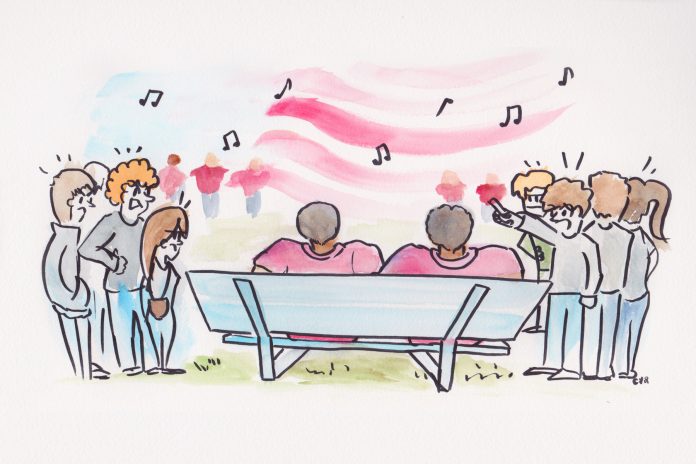
That is why the protest-shaming of Colin Kaepernick and the other NFL players who are sitting or kneeling during the “Star-Spangled Banner” makes my blood boil. These are people who are standing up to attain the rights that are already extended towards white people in America.

There’s a long-standing tradition of African-American athletes protesting during the playing of the national anthem — most notably, Tommie Smith and John Carlos’ fists raised in the Black Power salute at the 1968 Olympics. The sitting and kneeling of Kaepernick and other NFL players is nothing new.

Yet (lots of) white people seem to hate it.

While the comments on websites like BuzzFeed have been relatively respectful for the Internet, that may have more to do with the sites’ readership demographic than overwhelming support for the athletes and Black Lives Matter movement. As of September 22, a quick Facebook search of Kaepernick’s name brings up one headline that stands out: “Colin Kaepernick says if he is killed for protests, it will have ‘proved point.’”

A quick scroll through the comments on this particular post brought up messages of support for his protest, POC educating white people about why this protest matters, and naturally, things like “white people have it bad too you know,” and “he’s doing it wrong.”

While messages of support and the education of uninformed people are great, the other two types of comments blatantly ignore the issue.

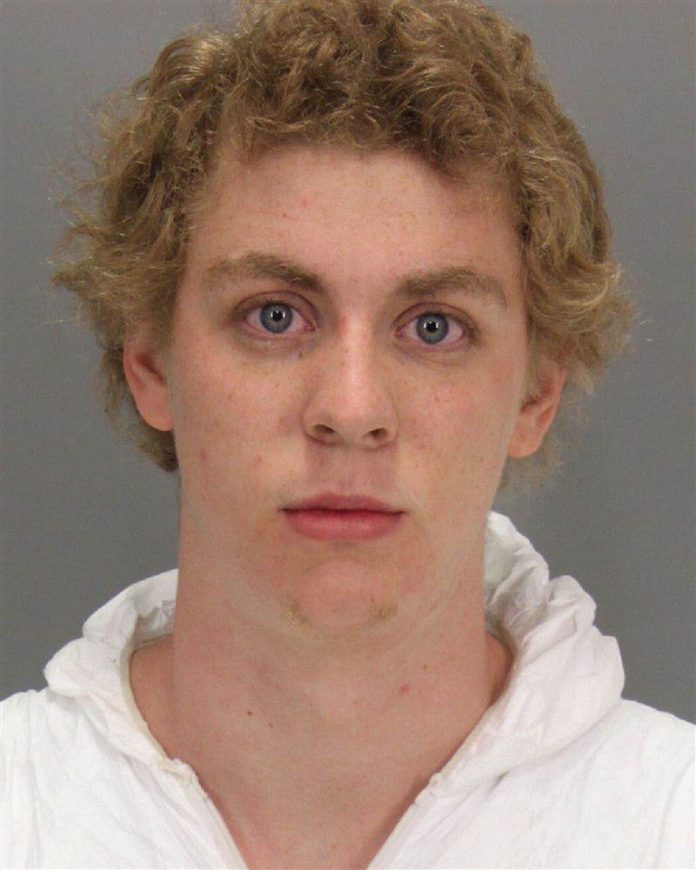
“White people have it bad too you know” is one of the most knee-jerk comments one can come up with. Yes, there are poor white people, and white people who get arrested; but that isn’t equivalent to what POC of the same socio-economic stature face. Just look at the length of time Brock Turner and Corey Batey were sentenced to after committing similar crimes, and tell me again how hard it is to be white.

The final “you’re [protesting] wrong” comment is the one that makes me shake my head and go, “Are you for real right now?” How would you, an unoppressed white person, like them to protest?

They take to the streets and march, you get mad. They take part in a peaceful protest, you get mad. They try to talk about the issues they face in a public forum, you change the channel or you get mad. What does that leave?

Nothing. It’s not really about protesting the “right” way; it’s about not protesting at all. It’s about a love of comfort and a fear of change. The way white people would like protests to happen wouldn’t make a large enough or lasting enough statement in regards to civil rights. Letter-writing campaigns and collecting signatures don’t garner lasting media coverage and can’t accomplish what needs to be done.

I hope that Kaepernick’s protest can make long-standing change and continue the conversation surrounding Black Lives Matter, and that police will stop shooting first and asking questions later. I don’t think that Kaepernick is protesting “the wrong way,” because as a white person, I’m not here to police your protest; I’m here to support your efforts.

We can’t afford to be lenient with sex offenders

4

I can’t believe I have to write this. There shouldn’t even be a discussion happening around Brock. Fucking. Turner.

If you don’t remember, Turner was convicted of three counts of felony sexual assault for raping an unconscious woman behind a dumpster. He was sentenced to six months in Santa Clara County Jail and three years of probation, instead of the prosecutor’s recommendation of six years in prison, or the maximum potential sentence of 14 years in prison.

For a lot of people, six months in county jail was a slap in the face of sexual assault survivors everywhere. It’s incredibly debilitating to see your worth as a person be judged as less than the minimum sentence of two years. It is humiliating to have your trauma, your nightmares available for everyone to read or hear; to have your assailant’s father describe the worst event of your life as “20 minutes of action” not worth sacrificing the promising future of a sex offender.

There was also uproar regarding the media’s handling of the story, with reporters describing Turner as a good kid with a great swimming career ahead of him and using a non-mugshot photo in coverage. Now, because of “good behaviour,” Turner has been released after serving only half of his six-month sentence.

Some say Turner has learned his lesson, and that having to register as a sex offender and live with his parents in Ohio is punishment enough. Some say that since his swimming career is ruined, his future is doomed, and that’s the ultimate price to pay.

To those people, I say: what about the future of Emily Doe, the sexual assault survivor? How will she be able, as she says in the letter she read out at Turner’s sentencing, to sleep without a nightlight, or without having nightmares where someone is touching her as she’s unconscious? How will she get over the fear that haunts her every moment?

Brock Turner may have lost his shot at the life of a famous swimmer, but his actions have changed Emily Doe forever: as she wrote, ‘You cannot give me back the life I had before that night.’. And for that, he only had to pace around a county jail cell for three months.

We have all failed Emily Doe. Turner, for sexually assaulting her; the U.S. justice system, for allowing a judge to waive the minimum sentence of two years; and us, for not changing the way rape culture permeates through campuses and proliferates as an acceptable norm.

Consent is crucial and ongoing. If there isn’t a yes, nothing should be happening.

We need to take all the outrage we feel and reform the justice system into an environment where sexual assault and harassment are not treated with a slap on the wrist. We need to make the world a little safer by enforcing harsher consequences for felons like Brock Turner.

The California bill to instate a mandatory minimum prison sentence for the sexual assault of an unconscious or intoxicated person has so far been unanimously approved by California legislature. It’s a step in the right direction. It shouldn’t have to be this hard to teach people that sexual assault is wrong.

Don’t tell me that I’m “so white”

1

I’m fed up with being told that I’m “whitewashed.” It’s a derogatory term implying that I don’t meet the stereotypical “standards” of my race. Growing up, I felt that I was never “black enough” — but obviously, I was never “white enough,” either.

How can you tell me that I’m not acting like my own race? Did I miss the “How to Be Black 101” course? Constantly receiving such criticism, from within your community and outside of it, leaves the subject of that criticism feeling like an outsider.

I was raised to understand my African culture and embrace my roots, but I was also taught to appreciate other cultures. Doing both doesn’t mean that I’m trying to be someone I’m not. Should I just pretend not to like the things I like?

Throughout my childhood, and even now, I’ve constantly heard phrases like “You’re pretty white for a black girl,” or “Why do you act so white?” I never knew how to respond to such statements and questions, because I wasn’t sure what “acting black” would mean.

Whether I fully understood the situation or not, it was clear to me that I was standing out in a negative way. This racial criticism caused my self-esteem to suffer and complicated the process of figuring out my identity. Maybe I was doing something wrong? I started to wonder if there was actually something wrong with me.

I’ve been told that Africans aren’t educated and don’t speak English. Well, I’m educated, fluent in English, and have good grammar — and that doesn’t mean I’m trying to be white. Many people of colour in this country are educated and speak English; trust me, we’re not trying to be white.

I’ve also been told that poetry and art are activities that only white people are allowed to do. Well, I absolutely love theatre and appreciate poetry, but it doesn’t mean that I’ve tossed my own culture. Let’s note that some of the most well-known poets were people of colour: Maya Angelou, Rita Dove, and Langston Hughes, for example.

I’m especially sick of hearing phrases like “Musicals? No, that’s for white people.” Well, Grease is one of my all-time favourite musicals. (And yes, I realize there were hardly any black people in Grease except near the end, where there are extras dancing in the background — it was based in the ‘50s, so segregation was still prominent.) That certainly doesn’t mean that I’ve forgotten about my roots.

Another stereotype: black people don’t like reading. Well, I’d honestly rather read the book than watch the movie, and that doesn’t mean I’m ashamed of my race.

Eventually, I stopped feeling ashamed of myself and looked at the facts. Even my most basic positive attributes — my speech, my intellect, my love of art — were drawing negative comments.

Black people are allowed to love reading. We can like musicals. We are allowed to listen to Radiohead and Adam Levine. My interests shouldn’t be categorized solely by the colour of my skin, and my racial background shouldn’t restrict me from doing what I love.

I know now that there are no guidelines to being black; I’m in charge of who I want to be. I’ll binge-watch Stranger Things and Gossip Girl, I’ll shamelessly order as many pumpkin spice lattes from Starbucks as I can possibly afford, and I will not live up to your racial stereotypes.

I am not “whitewashed”; I am a hard-working, open-minded, outgoing, proud African woman. I will continue to surpass the expectations that society has set for me. Because the ideas you ascribe to white people are not unique to them.

Why the Canucks’ Stanley Cup run was the highlight of my life

0

For those unfamiliar with me, you could be forgiven for thinking that the title of this Editor’s Voice is a bit over-the-top — but you’d be dead wrong. I’m referring to the two-month period between April 13 and June 15 of 2011, when the Vancouver Canucks almost did the impossible: win the Stanley Cup.

Heading into the season, I had a feeling that the Canucks would have a good team. They’d just come off a second-round loss to the Chicago Blackhawks, but had added players such as Dan Hamhuis, Manny Malhotra, and Keith Ballard.

By January, they had the best record in the NHL, and at that point, it should’ve simply been about coasting into the playoffs. I hoped for an easy first-round matchup against Dallas — a team that the Canucks had outplayed throughout the season. Imagine my dismay when the Chicago Blackhawks became their opponents.

While significantly weaker than the year before, the Blackhawks were still the defending champs. The Canucks easily won the first three games, and I distinctly remember bragging that the Canucks would sweep them and destroy in game four.

Boy, was I wrong. Game four was a 7–2 drubbing, and the Canucks lost the next two games, forcing a game seven.

I’d never been so tense watching a hockey game. If the Canucks lost, it would’ve been the cherry topping of the shit sundae that was the team’s soul-crushing defeats. No Canucks fan would ever live down their team becoming one of few to blow a 3–0 series lead.

Of course, they won thanks to Alex Burrows’ “dragon slayer” goal — in my mind, the greatest goal in Canucks history. From then on, I was obsessed. I started planning my whole life around the playoffs. Homework? Not a chance. Family engagements? Maybe some other time. If I had to go, I always made sure a TV was nearby.

My excitement on June 1 was palpable. I’d finally be able to see the Canucks in the finals. They won two games before getting destroyed in Boston, setting up for a crucial game five. I headed downtown with a few friends to watch it right outside the CBC building.

After the Canucks won, I almost died from the number of high-fives I gave while walking around the downtown core. I was so sure they’d win the cup; after all, they only had to win one of two games. How hard could that be? I headed downtown once again for game six, but the dream of the cup died after a four-goal first period for the Bruins.

Heading downtown to watch the seventh game, I distinctly remember my friend saying, “We’re either going to be there for the biggest party this city has ever seen, or a riot.”

Boy, was he right. After the loss, my friend, who wasn’t a big hockey fan at the time, needed some Subway. So there I was, the most heartbroken and disappointed I’d ever felt, while my friend nonchalantly munched on a veggie delight.

After that, it was chaos. I remember chairs being thrown through a nearby coffee shop. People would randomly start fighting, fuelled by a mixture of frustration and alcohol. At one point, someone was dancing atop a portapotty. We spent the next two hours running with the crowd so we wouldn’t get trampled over, before we took one of the last SkyTrains out of there.

What I miss most about those two months is how it was the topic to discuss during that time. Even people who weren’t into sports were discussing it. And for the record, I still haven’t watched the highlights from game seven.


Whether or not the US pardons Edward Snowden, he shouldn’t return

1

Recent weeks have seen a resurgence of an ongoing controversial discussion over whether President Obama should pardon Edward Snowden before leaving office. Russia granted Snowden asylum in 2013, after he publicly revealed that the National Security Agency (NSA) had been surveilling the American population’s communications and Internet usage without their knowledge in the name of “homeland security.”

Even the FBI director, James Comey, has advised everyone to “take responsibility for their own safety and security” and cover their webcam up with tape. Snowden still resides in Russia, and many believe that he should now be allowed to return home.

The new feature film, Snowden, has reignited interest in this case, and the film is looking to gain further public support for a pardon. Meanwhile, Snowden himself has asked to come home to America, in hopes for a fair trial; however, the only solace promised to him was that he wouldn’t be tortured.

Snowden may deserve a pardon, but whether he receives one or not, he’ll never realistically be able to return to America without putting himself at serious risk.  After revealing what the government is capable of — from watching citizens through their personal webcams to eavesdropping through cell phones — I doubt Snowden would feel safe in his home country anyways.

It’s clear that the government has directly marked Snowden as the enemy, and a pardon wouldn’t stop the NSA from keeping a very close eye on him. Intense surveillance would likely be the least of his problems, considering the intrusive and violent search for Snowden after his whistle-blowing. In this case, we should greet a pardon with scepticism.

While Snowden’s insider knowledge may help him to avoid being spied on, it is nearly impossible to remain completely off the radar. Snowden has approved certain apps in order to help others protect their own privacy, such as Signal to encrypt texts, and KeePassX in order to prevent hackers and companies from discovering the passwords you use for multiple platforms.

In any case, the whistle-blower laws devised by the US government are often ineffective at best for protecting people like Snowden — likely because they pose such major threats. And, ironically enough, the government charged him with espionage.

Despite Obama declaring a transparent government under his authority, for the US to just gracefully admit their mistake of labelling Snowden as a traitor to America seems highly unlikely.

As long as America’s government continues to use “homeland security” as a valid reason to collect private data and obsessively watch over its citizens in true Orwellian fashion, Snowden will remain a dissident in their eyes, and a threat to the current regime. He will not be safe in America.