Home Blog Page 79

A call before noon with Geoffroy

0
A man holds two fingers up as he sits at a piano with a spotlight shining in the back.
PHOTO: Courtesy of @__geoffroy on Instagram

By: Hailey Miller, Staff Writer

Montréal musician Geoffroy brought the Good Boy tour to the Hollywood Theatre on September 21 in support of his latest album of the same name. A deluxe edition of the record was released on September 13, alongside a music video for the new single, “No Calls Before Noon.” The Peak had the pleasure of having a quick chat with Geoffroy about the tour, his musical influences, and the deluxe edition of Good Boy.

“I listen to all kinds of music,” he told The Peak, noting everything “from samba to Afrobeat to country.” As long as there’s “something original” to a song, Geoffroy resonates with it. He credits Graceland by Paul Simon as his “most influential album.”

Geoffroy sees his “No Calls Before Noon” music video as a sort of travel diary. “I was travelling through Vietnam and Thailand with my girlfriend Alex at the beginning of this year. She had a Super 8 film camera and a Sony FX3,” he stated, as the music video included “glimpses” from their trip. “She’s a photographer and I love the way she sees portraits and things that I often don’t notice.” It’s a testament to the charmingly collaborative effort of two different art forms being tied together. 

The deluxe edition of Good Boy has a different cover, three new tracks, and has different musical pacing to it. Geoffroy emphasized that he’s “happy it’s finally all out and [he] can start thinking about what will come next.”

“Touring and playing shows is one of the most important things I feel. People can put a face and a personality to the music. The music hits different when it’s live, it just does,” Geoffroy noted. “I love being out on the road playing shows. It’s a combination of my two favourite things. It also feels good to play these new songs for the first time here in BC and Alberta.” 

Follow @__geoffroy on Instagram to keep up with his musical endeavors. 

Bright-er Side: Photo booths

0
A retro looking photo booth.
PHOTO: Girl with red hat / Unsplash

By: Dani Santos, SFU Student

There’s nothing better than capturing a moment in a photograph. Whether it’s with friends, family, or even just by yourself, photo booths are a cute and fun way to spend a few minutes frozen in time. If there’s one thing that’ll boost my mood at a party, it’s a photo booth.

I’m always the first to point out a photo booth when I’m at an arcade or when I pass by one in the middle of a mall. All my friends know that once that photo is printed out, it immediately goes on my wall — another memory I’ll constantly be reminded of.

Sitting in a photo booth gives you the classic feel of letting a camera take pictures for you — a change of pace from the selfies we’re so used to taking on our smartphones every day. When you’re in a photo booth, you get to be creative in the simplest way.

It’s wholesome how some people choose to plan their poses, but on the flip side, capturing a candid laugh is just as special. I can guarantee you that almost everyone who comes out of a photo booth comes out with a smile on their face.

What Grinds Our Gears: Stink bugs

0
Illustrative brown stink bug with an angry face
ILLUSTRATION: Victoria Lo / The Peak

By: Sarah Sorochuk, SFU Student

Stink bugs — we all know them, we all hate them. That pesky species invades every summer and never really goes away. Soon they will be ruling this town. They may look harmless, but when frightened or killed they REEK. Some wonder why, or how. So I will explain, and show the best ways to get rid of them. But first, why are they here and where they should be? Other than six feet under, that is.

Not here! These bugs have traveled the world, from Asia, to the US in 2001. There they feasted and killed many crops while spreading and finally reached Canada in 2015. Lucky us . . . 

Next! Different ways to escape them; oil diffusers. But particularly smelling like: garlic, lavender, mint, or citrus. These have been proven to repel them. Or, you can choose my favourite option and perform a seance to communicate with the first stink bug and ask them to stay away. But most don’t know how to commune with the dead. 

Thinking about this is bringing back the bad memories . . . Let’s evict those monsters!

Indigenous housing and substance use recovery site launched in Kelowna

0
This is a photo of a park in Kelowna in fall, featuring a body of water by the park
PHOTO: Patrick Imbeau / Flickr

By: Caitlin Kingsmill, News Writer

A housing site for Indigenous parents and children impacted by substance use recently opened in Kelowna. The site, named Tupa’s Lodge, will support eight residents at a time over a two-year period and is the first housing site in the interior of BC to offer these services. The project was launched by BC Women’s Hospital + Health Centre and Ki-Low-Na Friendship Society. The Ki-Low-Na Friendship Society provides community-based services to promote well-being and encourage the preservation of syilx/Okanagan culture and tradition in Kelowna. 

Tupa’s Lodge received $1.8 million in provincial funding and will receive $195,000 annually for operational costs from BC Housing. They also received $400,000 from Canada Mortgage and Housing Corporation. The housing site aims to provide “culturally sensitive and trauma-informed supports so parents can focus on their recovery and wellness while supporting their growing family.”

The Peak interviewed Darci Skiber, executive director of mental health and substance use at the Women’s Hospital + Health Centre. Skiber leads the perinatal substance use program and the families in recovery (FIR) program there. Both programs support pregnant individuals and new parents who are substance users. Through this work, Skiber helped identify the need for a site like Tupa’s Lodge. 

Skiber said that about 75–80% of patients served in FIR are Indigenous. Health inequities faced by Indigenous Peoples reflect systemic disadvantages rooted in colonization and stigma surrounding substance use which exacerbate their negative impacts. “[We] started to recognize that as we are supporting our patients and familles to leave the hospital, we need to also be creating programs that reflect that focus on culturally-grounded care.”

She explained the importance of offering substance use and housing services specifically to the perinatal population, referring to the period directly before and after childbirth. “It’s really about creating services where women feel safe to ask for some help and not have that fear of stigma, or not getting the services that they need, or losing their children.”

She also emphasized the importance of integrating Indigenous cultures and values into the services offered at Tupa’s Lodge. For Skiber, that means trying to break away from the heavily regulated and structured nature of many existing healthcare and housing programs, which she described as being “quite colonial in their structure.” Indigenous populations in Canada are also historically underserved by health care services.

“It’s such a relational approach versus, you know, we can be somewhat transactional sometimes in other healthcare spaces.” 

At Tupa’s Lodge, the integration of Indigenous cultures involves “having Elders, knowledge keepers, or aunties who are floating through the space and there to guide and participate in ceremony and get people reconnected again. 

“That doesn’t exist in a lot of housing spaces,” said Skiber.

Indigenous advocates call for more efficient truth and reconciliation

0
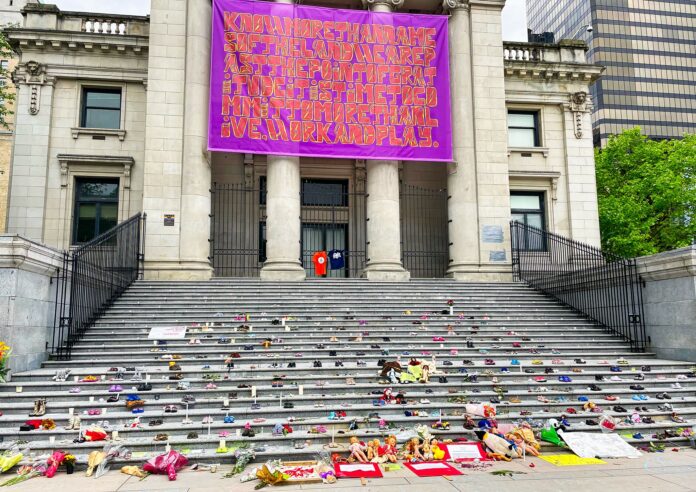
This is a photo of the 2021 Vancouver Art Gallery memorial for Indigenous children whose lives were taken at residential schools
PHOTO: Ted McGrath / Flickr

By: Sofia Chassomeris, News Writer

Content warning: mentions of residential schools, Missing and Murdered Indigenous Women, and colonialism.

With the National Day for Truth and Reconciliation on September 30, advocates are bringing attention to the “minimal to no progress” made regarding the Truth and Reconciliation Commission’s (TRC) 94 Calls to Action (CTAs). The CTAs were created for the Canadian government to acknowledge and educate on the history of the Canadian residential school system and implement policies to improve the lives of Indigenous Peoples in Canada. These policies aim to “ensure, through thorough and honest education, that this never happens again.” 

The TRC was formed in 2008 following Canada’s largest class-action settlement. The settlement was to address the history of residential schools and the continuation of colonial violence against Indigenous Peoples. CBC News reported that “from 2008 to 2014, the TRC heard stories from thousands of residential school survivors.” These personal accounts informed the development of the 94 CTAs, specifically intended for “corporate, community, and classroom anti-racist training.”

The CTAs carry out the Commission’s two main goals: legacy and reconciliation. The legacy CTAs contain policies for educating the public on the history of residential schools and their lasting impact on Indigenous communities. The Reconciliation Education website highlights the “modern-day effects” of this cultural genocide, including overrepresentation in the child welfare system, limited education opportunities, and inequity of justice and health. 

In 2022, the BC Premier’s office released a statement identifying that they represent two-thirds of all children in provincial care despite making up less than 10% of the province’s child population. 

Settler-colonial laws imposed on Indigenous Peoples were structured for assimilation to European culture and meant to “extinguish their communities, cultures, and ways of life.” 1951 amendments to the Indian Act, for instance, allowed provincial jurisdiction over Indigenous child welfare. After amendments to the Act, provincial child welfare agencies began to remove Indigenous children from their homes and rehouse them in non-Indigenous families. The Sixties Scoop drastically increased the amount of Indigenous children in provincial child and family services. 

It wasn’t until 2020 that the Canadian federal government enacted legislation that allowed Indigenous Peoples the right to “exercise jurisdiction over child and family services.” Similarly, the reconciliation CTAs aim to “meaningfully and permanently dismantle the systemic racism that leads to worse health outcomes, premature death, and limited economic opportunities.”

The National Collaborating Centre for Indigenous Health noted that “racist ideologies have fostered a social hierarchy in which Indigenous Peoples are denied resources while dominant groups maintain authority and power.” Safe drinking water is an example of this. While Canada has the “fourth largest resources of renewable fresh water in the world,” 27 reserves received long-term advisories to not consume, use, or boil water in 2022. 30% of Indigenous communities have “high risk” water systems, leaving more Indigenous Peoples susceptible to waterborne diseases.

Beyond 94, which is a CBC interactive site, monitors the progress made on the 94 CTAs. It shows that only 13 CTAs have been completed since the CTAs were created in 2015. 33 CTAs are currently in progress, while the remaining 48 have either not been started or are in proposal stages. “I think the urgency of it all has not adequately dawned on everyone,” said Marie Wilson, one of three TRC commissioners. Wilson shared her concern about the government’s slow rise to action in 2022, but the number of completed CTAs has not increased since.

“So why is it important to understand the history of genocide in Canada?” asks Dr. Pamela Palmater, Mi’kmaw lawyer and chair in Indigenous Governance at Toronto Metropolitan University. “Because it’s not history. Today’s racist government laws, policies, and actions have proven to be just as deadly for Indigenous Peoples as the genocidal acts of the past.” She states this from the final report of the National Inquiry into Missing and Murdered Indigenous Women and Girls.

Things I hope to remember

0
An illustration of a book with photos of different things including a group of people, a house, the sky, and a movie ticket.
ILLUSTRATION: Victoria Xi / The Peak

By: Kaja Antic, Staff Writer

Dear Kaja in 2029,

I hope you remembered to take your meds this morning. If you don’t have to take them anymore, congrats! If not, I hope Zoloft is still treating you well-ish. We just moved out of our childhood home and it’s been . . . an adjustment. I hope you still remember it, or at least remembered to change your address to wherever you live now. Mom’s place was getting too crowded, and being the only sibling who knows how to drive, you moved in with your dad, in the middle-of-nowhere, Langley. I hope you eventually get used to it, right now I’m struggling with how far it is from everything familiar. 

The neighbourhood around “the old house” is changing a lot right now. The SkyTrain construction just started, and the traffic makes driving on Fraser Highway hellish. I hope you remember the little things about the old house. How your brother (accidentally) slamming the front door on his way to school served as your alarm during your first two years of university. How our family dog, Harrison, would paw at your door in the morning to greet you or look sadly through the glass when you wouldn’t let him in and share a bite of your food.

I hope you remember your old bedroom. How it looked before you took that trip to Serbia, the bright-pink walls and the metal pendant lamp that you claimed was a fairy cage. It was hanging down so low, mom and dad would always hit their heads on it, until they got rid of it. Remember when you were five: after returning from overseas, you saw your brother’s furniture now taking up half your room and the pink walls painted beige. After seeing the crib in the room next door, you realized then how soon your baby sister would be joining you. 

The beige stayed for years, only changing once your presence left its four walls. The switch to your begrudging coexistence with your sister when she took his place at age three, and the big sister dream being realized when you finally got a bunk bed at nine. You had the top bunk, of course. Don’t forget how, at 10, you made forts with your sister, searching for every extra blanket in the house and drafting whole floor plans for the fleece-lined structure. You bring your friends over for the first time at 12, and all five of you crowd the top bunk. Looking back on it, it probably wasn’t the safest thing to do, but seventh-grade gossip was more important anyways. Entering teenage years saw our bed move to the lower bunk, as I was suddenly too tall for staying up top by 14. Unfortunately, that was the tallest we’d grow, unless a miracle occurs in the next five years. Remember all the Christmas light strings you strung together to surround the room in a variety of shades and colours — they brought warmth to the cold beige walls. That was one of most tedious thing to take down before your sister painted over the room you lived in for over a decade.

It’s not just your bedroom(s) that were important. I hope you remember going into mom’s and dad’s room after school one day in March 2020, collapsing on the bed and crying while muttering “I like girls.” Mom was confused, she thought we were just a really good ally. You both cried as you laid there, explaining your years-long inner conflict. At least coming out to your sister a few months later wasn’t as dramatic. A light joke being passed off, leading to the “you’re gay?” question, only for her to inform you that she knew from reading your journal. You chased her from your still-shared room to the living room, talked a bit more, then fell asleep on the couch watching YouTube. I can’t exactly remember what we watched, but I hope you remember the relief of finally being out to some of your family. 

The same living room, where you and your brother would take all your stuffed animals and lay them across the top of the couch, a proper audience for a movie night. Shame that tradition died down as you got older. The same room where Christmas mornings were spent, where you met 10-week-old Harrison on his first night home, where you played Just Dance with your siblings on the night that was meant to host your high school grad dance, where you opened your seventh birthday present — a stuffed tiger you creatively named “Tiger.” The same room where you spent one of the last nights living under the same roof as your siblings playing Wii Sports and Mario Party together. You lost every game handedly, but it was a nice way to wrap up your 19- and 15-year-long “living together” streaks. 

Remember the basement suite, especially. It fell into disrepair after Baba passed away. You’d come home from school, knock because you always forgot your key, and have Baba come rescue you. Remember the times you’d end up talking with her for hours, about school, your friends, or her upbringing in rural Yugoslavia, and the places she’d travel to once she immigrated to Canada. And of course, the times she’d make you do a fashion show after shopping. I hope you still remember her voice, lovingly mocking your Serbian, or how proud she was of you for continuing school during a pandemic. 

Now, you have to travel half an hour to visit “your mom’s place,” a sentence I would have never thought of five years ago. I hope you remember what it was like to live under the same roof as her. All the times you’d annoy her while she worked from home, the times you’d get a take out lunch and watch “anything funny” on the TV, and when you’d keep her company by talking about dinosaurs, cars, or hockey while she cooked. It’s hard right now not having her there constantly. I hope that gets easier with time.

I hope you remember the good times of our “moving-out-era.” It’s not perfect by any means, and honestly feels like everything is constantly falling apart, but there are good moments. Remember walking through your childhood home after the movers had left, all the memories from over the years flooding back. Remember picking up Harrison from the kennel a day later, dropping him off at mom’s and seeing him wander around his new home. Remember strategizing the most effective ways to get to campus, now that the directions from your old neighbourhood were all for naught. 

You still have a lot of growing to do, even past these five years. I hope wherever you live now feels like home, or at least as much as it can compared to the old house.

Thank you for doing your best.

Sincerely,

Kaja from 2024

Buy your orange shirt from Indigenous creators

0
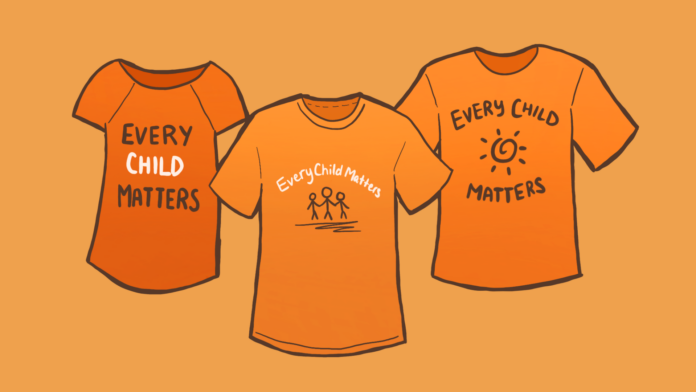
Illustration. Three orange shirts that say every child matters.
ILLUSTRATION: Angelina Tran / The Peak

By: Abigail Streifel, SFU Student

Content warning: mentions of residential schools.

As we head into late September, we’re hearing more and more about the National Day for Truth and Reconciliation. The statutory holiday, which falls on September 30 and coincides with Orange Shirt Day, honours Indigenous children and communities that were harmed by the residential school system.

The story of Orange Shirt Day’s creator, Phyllis Webstad, is now widely known: as a six-year-old Secwépemc girl, she, like many others, was forced into a residential school. There, her orange shirt was taken away — an action that exemplified the attack on identity and agency that over 150,000 Indigenous children faced in residential schools. It is thanks to Webstad’s activism that an orange shirt is associated with justice and remembrance for Indigenous children. However, the shirt — a powerful symbol to recognize the abuses perpetrated by the Canadian government — has been co-opted by companies looking to make a profit.

An orange shirt can be bought practically anywhere. They’re easily found at Walmart, London Drugs, and websites like Amazon and Etsy. But it’s important to consider where the designs for these shirts are coming from. Often, they’re original designs by Indigenous artists like Andy Everson that have been stolen by opportunistic vendors. The lack of recognition contributes to the attempted erasure of Indigenous Peoples that this holiday should be combatting. Indigenous artists deserve credit for their creations, as well as the profits that come from sales.

The reality is that proceeds from orange shirts often aren’t donated to Indigenous causes. This is inappropriate for a symbol that seeks to promote protection for Indigenous Peoples following centuries of systemic abuse and oppression. Without tangible benefits to Indigenous communities, the orange shirt is stripped of its significance. Instead of being a symbol for reconciliation, it’s become no more than another way for sellers to capitalize on oppression.

The best way for us to combat this is to purchase orange shirts from sources that are Indigenous-run or that document their donations to Indigenous causes. Fortunately, there are many places where an orange shirt can be ethically purchased. First, there is Victoria Orange Shirt Day, a campaign started by residential school survivor Eddy Charlie. Their website sells shirts designed by Bear Horne, as well as books to teach children about reconciliation. 

MAKE Vancouver has partnered with Urban Native Youth Association since 2021. Proceeds from their orange shirts are donated to the organization, which benefits Indigenous youth. This year, the shirts are designed by Heiltsuk artist KC Hall. Both adult and youth t-shirts can be found on MAKE Vancouver’s website. Indigenous Marketing Solutions is another Indigenous-owned initiative that supports the Naut’sa mawt Tribal Council’s Elder Council. Their orange shirts are designed by Indigenous artists from various nations: Clayton Gauthier, a Cree and Dakelh artist; Aiden Duncan, a Cree artist; and Stacia Goodman, from the We Wai Kai Nation

Each of these organizations clearly benefit Indigenous communities. There are many other Indigenous businesses like them, and any of them would be a fantastic choice to support. But support for Indigenous people shouldn’t just happen around the end of September. We should all be making an effort to uplift Indigenous communities year-round. This can be done in part by listening to Indigenous voices, educating ourselves, supporting Indigenous businesses and charities, and learning more about reconciliation.

The observance of this day should not be reduced to simply wearing an orange shirt. The intent behind an orange shirt matters far more than the item of clothing itself. It represents reconciliation and solemn acknowledgement of the damage caused by residential schools. Choosing to purchase a shirt from an Indigenous creator carries more significance than buying one arbitrarily from a supermarket.

SFU scientists contribute to new neutrino telescope

0
This is a photo of the IceCube Neutrino Observatory in the South Pole
PHOTO: Courtesy of Christopher Michel / Wikimedia Commons

By: Hailey Miller, Staff Writer

A group of SFU scientists and other researchers across Canada have started building a new neutrino telescope. SFU physics professor Matthias Danninger and University of Alberta professor Carsten Krauss are leading the project, which was made possible through $15 million from the BC Knowledge Development Fund

Neutrino astronomy involves observing subatomic particles called “neutrinos.” A basic atom has three tiny subatomic particles (protons, neutrons, and electrons.) Neutrino particles are transmitted at near lightspeeds, allowing for the emission of the “high-energy neutrinos.” Observations of these particles can aid our understanding of “neutrino mass, topological defects, and supersymmetric dark matter.” A neutrino telescope is a type of telescope that emits “large arrays of optical sensors deployed in a transparent medium, such as water or ice.” Several neutrino telescopes operate around the world, including the leading IceCube Neutrino Observatory in the South Pole. 

Upon finishing the build of the neutrino telescope, it’ll be situated off the coast of Vancouver Island and placed 3000 metres deep into the Pacific Ocean. The telescope will help scientists better understand the movement of tectonic plates and climate change findings. It will also aid in research around marine life and biology, including migration patterns of whales who reside in BC’s waters.

In an interview with SFU, Danninger explained there is still much to learn about neutrino astronomy and that building the telescope will help further understand black holes. SFU’s researchers built part of the neutrino telescope in their lab atop the Burnaby campus, which includes precision calibration detectors. These detectors are “high power light emitters that shine strong lights hundreds of meters into the ocean to calibrate the optical properties of water.” 

Danninger and the SFU neutrino telescope team are working alongside Ocean Networks Canada, which is an ocean observation facility based out of Victoria, BC. The facility’s expertise is ocean infrastructure, so they will help the researchers with the placement of the telescope and overall data collection.

So far, funding for the project only covers “the installation of the first phase of the experiment.” The research team is hoping to receive further funding to cover the costs of the expansion of the telescope and the physical distance it covers. 

The project allows for many new educational opportunities, as numerous volunteers and staff are needed to help with the ongoing phases of the project. Danninger stated that the project will be “a fantastic training ground for undergraduates, for graduate students, and for postdocs.

“This experiment is very exciting for students, because it is new, it’s up and coming, and we are developing new technology,” he said. “We expect to see the unexpected.”

SFU Student Strike for Palestine holds general assembly

0
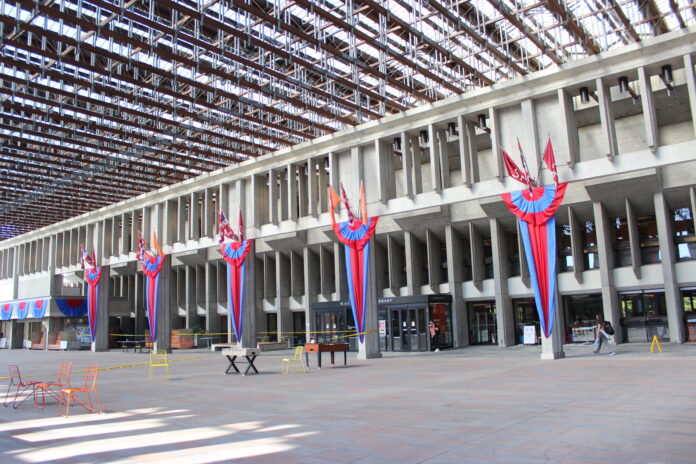
This is a photo of convocation mall facing WAC Bennett Library
PHOTO: Gudrun Wai-Gunnarsson / The Peak

By: Sofia Chassomeris, News Writer

“SHAME!” shouted upward of 50 students gathered at convocation mall on September 13. SFU students gathered at the Burnaby campus for a general assembly to organize protests against SFU’s investment in the ongoing Palestinian genocide. The general assembly was held by the new group, SFU Student Strike for Palestine, which is part of a larger national strike movement.

The Revolutionary Communist Party (RCP) of Canada is campaigning for students to unite in the national Student Strike for Palestine. SFU has shares in BAE systems, Booz Allen Hamilton, and CAE Inc. — three corporations that profit from supplying Israel with military arms and war-related products. SFU Student Strike informed The Peak that “four of 16 elected leadership members are non-SFU student RCP members,” while the rest are SFU students. The Peak was not able to independently verify this.

Speakers at the recent assembly emphasized the need for escalated protest such as a strike or walk-out. They noted that previous attempts to get SFU to divest, including a divestment petition, have been “non-disruptive to the normal functioning of the campus.” In June this year, the Faculty Association passed two Boycott, Divestment, Sanction (BDS) motions that would formally require SFU to boycott, divest, and sanction the previously mentioned companies. In September, SFU president Joy Johnson released a message on behalf of the university, maintaining that the institution will not take a public position on “partisan political matters and current events.”

During the assembly, students elected Anjan Momi to chair meetings on behalf of the group and elected other members to different committees to organize future assemblies and protests. The Student Strike noted, “Students and workers braved the rain and even shouted down a Zionist that tried disrupting us!” 

The group had advertised the assembly around the Burnaby and downtown campuses with posters and leaflets. Hundreds of posters were put up around convocation mall in Burnaby twice but were all taken down each time. They read, “Help build the student strike for Palestine.” The university stated that “there is a long-established policy governing the display of posters on campus, which is designed to prevent damage to university property. Any posters that do not conform to this policy are removed by facilities services.”

In an interview with The Peak, Leonardo Curiel, a member of the SFU Student Strike’s finance and outreach committees, described his experience with campus security when handing out leaflets for the assembly during Club’s Day. “Security started tailing us,” he said, explaining that he had left Club’s Day and was leafleting outside of the event. “They were trying to say, ‘Oh, well actually I don’t think you’re allowed to leaflet here.’” Curiel said they didn’t explain why. He added that when he started recording the interaction was when security started to call for backup. 

“They were threatening to call the cops on me for recording, even though it’s a public place, and it’s my right as a Canadian to do that.” Curiel said that the incident concluded with a campus public safety officer telling the group that they were allowed to continue distributing leaflets. “All that for nothing,” he said. Some Campus Public Safety (CPS) officers were seen watching the assembly from close by. 

SFU offered the following statement: “SFU respects the right to peaceful protest at its campuses. CPS attends the area around all gatherings on campus to ensure the safety of our SFU community, including event attendees, and also responds to calls for service as and when needed.” 

This is a developing story that The Peak will continue to cover.

I can’t keep my succulents alive for the life of me . . . or them

0
Someone sitting next to a dying succulent. They are reading a self-help book that’s called “How to be a good plant parent”
ILLUSTRATION: Cliff Ebora / The Peak

By: Hailey Miller, Staff Writer

The ultimate adulting is caring for a plant — and I don’t mean a fake fern to fill up space and contribute to the ambiance of your grown-up décor. This isn’t amateur hour . . . Plants make you seem like your life’s all put together whether you’re in your own place, or you’re still cramped in your parents’ basement. This new chapter of your life automatically grants permission for the most affluent, garden-growing extraordinaire you know (cough, cough, your mom) to give you your first precious plant child. Congratulations, it’s a succulent! 

Supposedly, succulent babies are easier to take care of, but I beg to differ. One minute it’s absolutely flourishing and you’re sitting in your one-plant garden oasis thinking, “hot damn, I’m a plant parent goddess, and I know my plant shit!” And by shit, you mean soil. While you ride your high horse into the garden, you suddenly find yourself discussing different types of soil and buying cute pots to plant, replant, and transplant. Wait, isn’t it all the same? Do you really know the different soils after all? Um, no. Before you know it, your firstborn succulent is withering away to pieces as its poor, little leaves crumble to the floor. Sound familiar? Succulent babies are just like raising a child, except they don’t cry out in the middle of the night. Instead, they grow into your worst moody teenage nightmare.

I named my succulent Little Succs, because he sucks at sucking up water to keep him alive. I’ve tried, I really have. I’ve given him light, space to grow, and water — but let’s not talk about the fact that I sometimes neglect him. Shh, I don’t want to be in the plant parent bad books. I’ve already had to have the sex talk with him since he seems to want to reproduce . . . miraculously, on his own. Don’t even get me started on how much he begs me for a haircut when he sheds his little succulent leaves every time I check in on him. Look, it’s as strenuous for me, as it is for him, OK? I know I’m not exactly going to win plant parent of the year, but I still love my Little Succs and will do everything to keep him alive . . . including returning him to my mom to take full-time guardianship.