Home Blog Page 78

Centrism isn’t as neutral as you may think

0
Illustration. A political axis graph in the background and a person centered in the foreground covering their face with a nervous expression
ILLUSTRATION: Yan Ting Leung / The Peak

By: Yildiz Subuk, Staff Writer

Content warning: brief mentions of genocide, residential school graves, and police brutality.

Two years ago, I had a conversation with an Uber driver on the way home from Kendrick Lamar’s concert. “While I like Kendrick, I think his music is too political now to the point where it alienates some of his audience,” he said. While this comment may appear naïve or out of touch, it’s rooted in privilege. The desire to be apolitical or centrist is one that’s grown in recent years. People who have historically been discriminated against or under-represented don’t have the luxury of neutrality, and it’s even more concerning to see centrist ideas bleed into government policies.  

Centrism is a political belief that emphasizes incorporating both leftist and right-wing ideas. In everyday life, centrists tend to criticize so-called extremist ideologies from both ends of the political spectrum, and insist that being “balanced” is the most rational approach to politics. While this “both sides” approach may seem rational, it doesn’t account for the fact that there are major social issues that neutrality can’t fix. Those without the privilege to stay neutral on political issues are often the ones that are harmed the most by political decisions. 

Being a centrist about issues involving oppression and human rights injustices suggests we should value the oppressor as much as the oppressed. Debating a topic like whether Israel has a “right to defend itself” is incredibly problematic, especially when considering the United Nations has issued reports condemning the state for its war crimes. Israel has murdered Palestinians at an exponentially high rate. In news media, centrism often appears as a subtle downplaying of events through language choices. For example, many news publications have vaguely framed the genocide in occupied Palestinian territories as a “conflict” or “war.” Similar rhetoric appears in news articles that refer to residential school graves as “anomalies,” or downplay the extent of police brutality in Canada by comparing numbers to the US. We must stop treating centrism as a harmless difference of opinion. There is no middle ground when it comes to injustice.

Centrism is even more damaging when it appears at a governmental level, as it often does in Canadian politics. This is evident when we look at how Canada and 25 other countries abstained from voting on a decision that would allow Palestinians to be represented in the United Nations. Refraining from commenting or condemning “both sides” is not a neutral act. This vote of abstinence was made by the Canadian government because they didn’t want to choose a side, but it effectively denied Palestinians the right to self-representation. 

Centrism can also take the form of pandering to both sides of the political aisle to garner as much public support as possible. According to a Maclean’s  article, the federal Liberal Party has placed an emphasis on reconciliation with Indigenous communities across Canada over the years. This may come across as the Liberals breaking away from centrism, but the party’s performatism shows how neutral they are about truly acting on reconciliation. Currently, no policy changes have been made that allow Indigenous communities to protect their lands and resources.

Centrism can only be rational in a world without social inequity. Staying neutral has less to do with rationality, and more to do with comfort. When people stay neutral, it can be a form of hidden apathy toward injustices that are often the reality for many marginalized groups. Being a centrist is a privileged stance, and those who are suffering from social injustice need a more urgent approach to ensuring their rights — something that can often be a matter of life or death.

Black Colombian refugee fatally shot by Surrey RCMP

0
This is a photo of the exterior of the Surrey Women's Centre.
PHOTO: Amirul Anirban / The Peak

By: Sofia Chassomeris, News Writer

Content warning: mentions of death, police violence, racism, and domestic abuse.

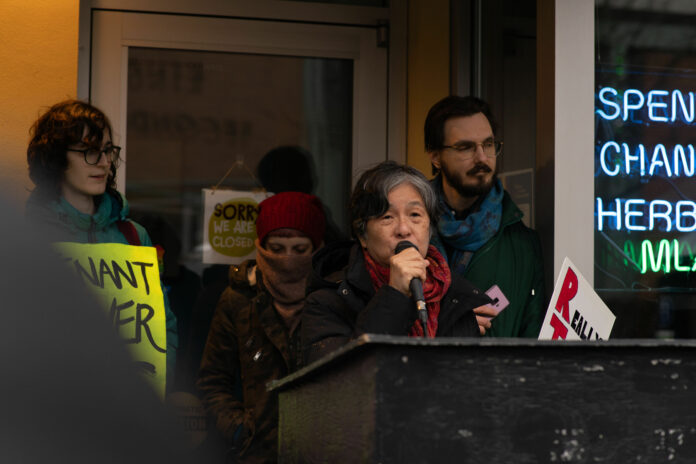
On September 19, Vanessa Rentería Valencia, a Black Colombian refugee and mother, was killed in her Surrey home by BC Royal Canadian Mounted Police (RCMP). One week later, several organizations, including the Battered Women’s Support Services (BWSS), formed a coalition to host a press conference and demand a full investigation for Rentería Valencia. Since 1979, the BWSS has worked to advocate and provide support for women experiencing abuse, with the goal of ending violence against women and girls. 

The Independent Investigations Office of BC (IIO) is investigating the incident in which Rentería Valencia, who was 37, was fatally shot three times on the morning of September 19. Her church circle said police arrived at her home around 4:40 a.m. in response to a call from Rentería Valencia’s husband. Surrey RCMP said officers learned Rentería Valencia had locked herself in a room with her toddler and was “reportedly holding a weapon.” Despite Emergency Health Services’ immediate medical attention, Rentería Valencia “died at the scene.” Her child did not have any injuries.

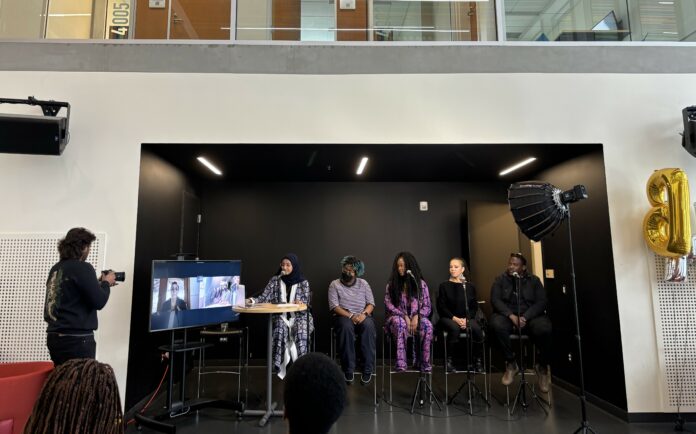
The press conference took place at the City Centre Branch of Surrey Public Library. It was held by a coalition of organizations including the BWSS, Surrey Women’s Centre, BC Community Alliance, BC Civil Liberties Association, BC General Employees’ Union, and the Parents Support Services Society. The Solidarity Committee for Renería Valencia was also present, along with her inner circle attending via Zoom. The coalition is calling for transparency in the ongoing investigation of her death, accountability for the officers involved, and justice for her daughter.

Rosa Elena Arteaga, director of clinical practice and direct service at the BWSS, spoke at the press conference. Peace Arch News reported that organizations “gathered to expose how the system failed Rentería Valencia on multiple fronts before that fatal confrontation.” 

Prior to her death, Rentería Valencia had been accessing outreach programs in her community to learn English and stayed at a shelter with her daughter for two months. CBC News said she had been “hoping to find housing of her own after leaving an abusive relationship.” Unable to do so, Rentería Valencia recently moved back with her husband and brother-in-law.

It is alleged that Rentería Valencia told a friend she wanted to leave home due to safety concerns the week she died. On the night of September 18, Rentería Valencia was with this friend and later went to collect some belongings back home. When she didn’t return to her friend’s house, her friend called the police to check on her. Peace Arch News tried to confirm if police had visited Rentería Valencia before her death, but “both the RCMP and the IIO have refused further comment since the matter is now under investigation.” BWSS notes that “the most dangerous time for a survivor/victim is when she leaves the abusive partner” and “77% of domestic violence-related homicides occur upon separation.”

“She did everything that we asked women to do when they are not safe at home, we tell them to leave,” said Arteaga. 

The Peak reached out to Angela Marie MacDougall, executive director of the BWSS, for an interview, but did not receive a response by the publication deadline. MacDougall also spoke at the conference, highlighting the phrasing of the RCMP’s report. The report stated that Rentería Valencia was barricaded in her room, allegedly holding “a weapon next to a young child.” MacDougall said the RCMP’s statement was “playing into well-worn narratives” used against refugees and women of colour by implying Rentería Valencia was dangerous. 

“We know that women living in abusive situations retreat to bedrooms, spare rooms, bathrooms with their children to establish a physical boundary between themselves and those they believe could do harm to them,” said MacDougall.

BWSS also stated, “This is not an isolated incident, but part of a larger pattern of violence and discrimination faced by Black, Indigenous, racialized, and immigrant communities.” Rentería Valencia’s death has raised many questions within her community. Advocates wonder whether the RCMP spoke or gave commands to Rentería Valencia in English — a language she was not proficient in. They also ask whether she “even [knew] they were police and what they were doing there.”

“We do not know if RCMP attempted any type of de-escalation,” said MacDougall. “Witnesses on the scene told us they did not.” 

While Rentería Valencia’s community awaits further answers from the ongoing IIO investigation, close friends have started a GoFundMe page to fundraise for her daughter and family members abroad.

This is a developing story that The Peak will continue to cover in future issues.

Over 2,000 people killed in Lebanon

0
This is a photo of a Lebanon flag in the distance.
PHOTO: AHMAD BADER / Unsplash

By: Sofia Chassomeris, News Writer

Since September 23, escalating Israeli airstrikes targeting the Lebanese armed group Hezbollah have killed nearly 2,000 people in Lebanon and displaced over one million at the time of writing this article. These attacks, which included the killing of Hezbollah’s former leader Hassan Nasrallah on September 27, indicate the “serious risk” that an all-out war between both countries could be on the horizon.

Hezbollah is a Lebanese armed group with significant political influence in Lebanon. The group was formed in 1982 with Iranian support to combat Israeli invasion and occupation of Southern Lebanon. Hassan Nasrallah, who served the group since 1992, led the party into parliamentary politics. Since then, they have grown in size and political power in Lebanon with backing from Iran.

Within the past two months, violence there has significantly increased; the Center for Strategic & International Studies, a “non-profit policy research organization,” reported that this year, “Israel struck Lebanon more than 300 times in the week of September 15 and more than 700 times in the week of September 22.” Israel’s Prime Minister Benjamin Netanyahu has warned that there will be “destruction like Gaza,” referring to Israel’s ongoing genocide in occupied Palestinian territory. 

Attacks between Israel and Hezbollah are not a recent development. After the Palestinian armed group Hamas attacked Israel on October 7, 2023, and Israel retaliated, Hezbollah “launched a rocket campaign on Israel in support of Gaza.” 

According to the Armed Conflict Location and Event Data, at least 8,313 attacks “were carried out by Israel” between October 2023 and September 2024. Attacks by Israel made up 81% of the attacks exchanged between Israel, Hezbollah, and other armed groups, “which killed at least 752 people in Lebanon.” Conversely, “Hezbollah and other armed groups were responsible for [an additional] 1,901 attacks that killed at least 33 Israelis.” 

Daad and Hussein Tabaja, a Lebanese Canadian couple, were both killed by Israeli strikes in Southern Lebanon. “I don’t need to say that this is not humane. This is not humanity. This is not justice,” said their son Jamal Tabaja in a Global News interview. Global News reported that Jamal, who had been living in Beirut, called his parents the night they died to tell them to evacuate, but the couple were not able to make it out.

On September 29, a demonstration in solidarity with Lebanon and Palestine was held in Vancouver. Another demonstration at the Vancouver Art Gallery on October 5 was held, where one banner read, “HANDS OFF LEBANON.”

The United Nations Interim Force in Lebanon (UNIFIL) peacekeepers, who have their headquarters in Southern Lebanon, said they were struck by explosions twice, injuring two peacekeepers. The explosions occurred close to a UNIFIL observation tower. The UN stated that “any deliberate attack on peacekeepers is a grave violation of international humanitarian law.” The Israeli military claimed the peacekeepers were hurt “inadvertently.”  

“Israel is essentially now undermining [not only] the United Nations and the United Nations peacekeeping force, but the very rules-based international order, and it needs to step back,” Irish foreign minister Micheál Martin told CBC.

Recent Israeli strikes on Beirut, Lebanon’s capital, have killed at least 22 people and injured 117, including healthcare and rescue workers.

Quiz: Which Moo Deng are you?

0
An illustration of Moo Deng, the pygmy hippo, she is calmly lying on some grass.
ILLUSTRATION: Cliff Ebora / The Peak

By: Michelle Young, Copy Editor

  1. Your Blenz order (warm milk) is wrong. You:
  1. Spit it out immediately. 
  2. Despite the barista’s apology and offer to remake your drink, you insist on talking to the manager and lecture them about how you can tell there are one too many syrup pumps in there. You can literally only drink milk, after all. 
  3. Sip it and walk out. 
  1. A rando is throwing small objects at you. You:
  1. Run (or bounce) away.
  2. Attempt to bite them. To your dismay, you can’t reach.
  3. Relocate your nap. You know they will be sued and fined — as they should be! 
  1. You finish doing your business on the toilet, but are shocked to feel a splash of water hitting your butt. You: 
  1. Scream and burst out of the stall in horror. 
  2. Report it immediately and complain about the potential bacterial risks of using a public bidet. 
  3. Allow the bidet to do its job, and curiously examine it afterwards. 
  1. You’re scrolling on Instagram and notice that @simonfraseru has posted about you without your consent. You: 
  1. Instantly drop your phone on the ground. 
  2. Report the account and post a story about the importance of asking for permission before posting pictures of other people (and hippos) online. There needs to be boundaries.
  3. Read the comments before using your toes to keep scrolling on your feed. 

If you answered mostly A’s, you are alarmed Moo Deng. You are always alarmed and who can blame you? The world is full of overstimulating chaos: getting wet and being picked up is scary and unpleasant. Just keep screaming.  

If you answered mostly B’s, you are angry Moo Deng. You want to bite everyone you come into contact with, and whether you do this out of love or not is debatable. You hold petty grudges and run away at minor inconveniences. I would say that you need to learn to express yourself better before you become a menace to society, but I don’t think that’s realistic. Chomp. 

If you answered mostly C’s, you are calm Moo Deng. You are at peace. No one can derail your stay-at-home-for-the-week plans because you won’t let them. You love to lay around and pretend to eat grass. You are always moisturized and ready to show off those gorgeous pink cheeks. Go get ‘em.

Red Leafs track and field star Marie-Éloïse Leclair on her Olympic experiences

0
A girl with brown hair tied back smiles at the camera. She wears a red sweatshirt with “SFU” in the top right corner. Behind her is a set of bleachers.
PHOTO: Gudrun Wai-Gunnarsson / The Peak

By: Kaja Antic, Sports Writer

Some of us take the summer semester off, preferring to work or go on vacation. Others take classes to fill the time, sweating the whole way to campus. If you’re Marie-Éloïse Leclair, you go to the Olympic Summer Games.

The Red Leafs track and field star experienced her first Olympiad as part of Team Canada’s women’s 4x100m relay team, competing at the Stade de France in Paris. 

“It was the first time I went to a competition with other sports because I’ve only been in big track events, not multi sports,” Leclair said in an interview with The Peak. “It was 10 out of 10 for sure.”

Though her main focus was on her scholastic season, Leclair attended a Team Canada camp between indoor and outdoor competitions with SFU. 

“They invited me for a camp at the end of March that was in Florida,” she explained. “Unfortunately, I got a tiny injury when I went there so that kind of set me back.”

Despite the injury, Leclair was “just happy to be invited.” 

Leclair described how training with SFU was not all that different from training with Team Canada, albeit in a setting more focused on the relay portion — which Leclair also competes in with SFU in both the women’s 4x100m and 4x400m relay teams.

“We had a two week training camp in Barcelona [before the Olympics] where we solely focused on the relay, so that was a lot of relay practices.”

Leclair described the relay training as more “specific” with Team Canada rather than with the Red Leafs, but chalked it up to the event being the “main focus” and participants having more experience in the relay specifically. 

“We can really go into the nitty-gritty and these super specific details, but it’s pretty similar. I mean, the main ingredient of really any race is being fast, right?

“At SFU, we’re really lucky because we get so many opportunities,” Leclair noted, discussing how being a Red Leaf prepared her for the Paris games. “The opportunities we get here made a big difference in being familiar in the environment that are international meets.”

During the Great Northwest Athletic Conference Outdoor Track & Field Championships in May, Leclair won the individual 100m and 200m women’s sprint events, along with a second place 4x100m relay finish and a first place 4x400m relay finish with the Red Leafs. A month later, she was preparing for the flurry of athletic competition before the Olympic Games with a Diamond League meet in London, and the aforementioned training camp in Barcelona.

While Leclair was not able to fully participate in the Paris festivities due to her event taking place near the end of the competition, she was able to try one of the hot topics in the dining hall: the mythical, TikTok-viral chocolate muffins.

“They were good. I’m not a big cake person so I was like, ‘I feel like it’s gonna be too much,’ but no, it was super good.” She also got to meet the popular “muffin man,” Norwegian swimmer Henrik Christiansen. “It’s funny because everyone’s like, ‘did you see celebrities?’ And I’m like, ‘the muffin man? Does that count?’”

Education wise, Leclair is working on graduating, taking five courses this semester along with her training regimen. Now heading into her final year with the Red Leafs, she looks forward to building on her record-breaking performances in NCAA competition. 

“I just really want to make the most of it, and like I said, leave my mark,” Leclair described the impact of her final year on the Red Leafs track. “I feel like I already have in a way, but there’s always more to do so if I can go to championships and break my own records, break other records, and place higher than I have in the past.”

Catching up on the 2024–25 Vancouver Canucks

0
Two men in blue jerseys with a green stripe on the sleeve and blue helmets hug as they look to the side. Behind them are the boards and glass of a hockey rink. Cheering fans are visible through the glass.
PHOTO: Courtesy of @canucks on Instagram

By: Izzy Cheung, Sports Editor

The Vancouver Canucks stunned their fans at multiple points last season, from starting their season with an 8–1 win against a division rival in the Edmonton Oilers, to winning the Pacific Division at the end of the year. Now, with a couple of departures and a few key additions, the Canucks’ audiences have been left wondering what kind of performance they can expect from their team this year. Keep reading to see who, and what, the Canucks will bring to the ice this year. 

By the end of the 2023–24 regular season, the Canucks had a goal differential of +56, as per ESPN and NHL.com. This stat is calculated by taking a team’s goals-for count, and subtracting the amount of goals scored against them. A high goal differential typically signifies lots of goals being scored, and lots being kept out of the team’s own net. 

An issue that arose during the Canucks’ playoff run, and towards the end of their regular season, was their offence. The team scored a season-high 56 goals in November 2023, permeated by a 10–1 victory against the San Jose Sharks. However, as February, March, and April came along, their total goals-for dropped to 36, 33, and 24 respectively. Star players such as Elias Pettersson were criticized for their lack of production in the postseason. 

To remedy these offensive woes, Canucks management made four key offensive signings. They brought in former Boston Bruin Jake DeBrusk, who scored five goals in 13 playoff games this past postseason. Also arriving from Boston is BC-born Danton Heinen, a swiss-army knife who can put up 30–40 points and kill penalties. Former adversary Kiefer Sherwood has switched his colours from Nashville Predators yellow-and-white, to Canucks blue-and-green. He’s best known for his aggressive forecheck and backcheck, and his hard-hitting tenacity to separate opponents from the puck. Rounding out Vancouver’s offensive acquisitions is Daniel Sprong, a consistent 40-point, near 20-goal producer. 

Vancouver also saw some shifts in their defensive core, as fan-favourite Nikita Zadorov was picked up by the Boston Bruins in free agency. As well, the team moved on from defenceman Ian Cole, who signed a deal with Utah Hockey Club. Taking these places are another former Bruin in Derek Forbort, and ex-Oiler Vincent Desharnais. Forbort brings a heavy physical presence to Vancouver’s blueline and isn’t afraid to jostle with the opposing team, making the Canucks that much harder to play against. Desharnais brings size to the lineup with his towering 6’7 stature, as well as a right-handed shot — something that’s of utmost value in the NHL. The team also acquired Erik Brännström from the Colorado Avalanche in a trade completed on October 6. 

Currently, five of the Canucks’ top-six defencemen stand above 6 ft, with Forbort, Desharnais, Carson Soucy, and Tyler Myers measuring above 6 ft and 4 inches. From these signings, it’s clear that Vancouver sought to size-up their defensive-core. Bringing in bigger players who are more willing to throw their body around will make them tougher to play against, especially come playoff time. Being able to execute a good hit can turn the puck into the favour of the team committing the hit, resulting in an uptick in possession. It’s also important to keep hits timely, as making a hit at the wrong time can also cause turnovers, leading to goals against. 

For the most part, Vancouver fans will be seeing a lot of familiar faces returning to Rogers Arena. With their new additions, they can also expect to see more offensive firepower and even more defensive checks. 

Afrorack rocks repurposed materials

0
A man tinkers with an electronic device set up with outlets. Around him are various cords, wires, batteries, and other electronic supplies.
PHOTO: Courtesy of Ben Roberts Photography

By: Hailey Miller, Staff Writer

Ugandan sound artist Brian Bamanya — better known by his stage name, Afrorack — brought his modular synth performance to Vancouver New Music on September 27 and the Red Gate Arts Society on September 28 following a seminar presentation with SFU’s music and sound department on September 26. Bamanya performed in Vancouver as part of his Canadian tour, which also included stops in Montréal, Saskatoon, and Edmonton from the end of September through early October.

Afrorack’s résumé includes inventing Africa’s first homemade modular synth, creating electro instruments such as a velocity-sensitive electronic drum kit, and showcasing his expertise in electro-mechanical music. Each of his instruments are made from a variety of recycled materials including old wires, metal, pipes, and wood. The modular synth is a massive DIY synthesizer made from a collection of metal knobs, copper wires, switches, and effect pedals. Effect pedals are electronic pedals that are connected to a pedal board and used by musicians to create different sounds, change frequencies, and add dynamics to a song or performance.

As an interdisciplinary artist with a background in sound art and electronic music, Afrorack has vast experience in building electrical circuits, rigging handmade electronic instruments, and keeping sustainability and renewable energy in mind. Bamanya is a master of his craft in music creation and instrument making, and in his performances, passion flows through his veins.

During the seminar with the SFU music department, Bamanya presented a demonstration of his work with his modular synth. As music and sound majors, we analyzed his work and watched an in-depth performance of DIY sounds and effects. Having taken place in the main music room at Goldcorp Centre for the Arts, Bamanya’s lively presentation was followed by a Q&A session as music majors listened in awe of his creations.

Plugging in to the outlets and revving up his synth rig, Bamanya took us through a full two hours of sound art and music making. With stuttering resonances, intentional feedback, and effects typically only made by a wah-wah pedal — Bamanya curated these sounds via pedals and wires inside of a rubber storage container — the performance was packed with electro and experimental sound. 

Bamanya’s velocity-sensitive electronic drum kit also came about from recycled and reused materials, formulating an instrument that functions off of high velocity pedal inputs as the name states. Although we didn’t get to see his performance with the kit, prior to the seminar, SFU music majors got a taste of his work via compositions and videos of the creative process. 

Afrorack rocked the roof off the music room as the walls vibrated with electronic frequencies and experimental effects. His performance was a combination of rehearsed and improvised as he curated various elements in the spotlight of the Thursday morning seminar. From sounds sweet like flowing waterfalls, to the screech of squeaky wires rigged through pedals working in harmony to enhance the effects, and the rhythms of what could only be the backbeat of a night at the club, Afrorack showed us that making any sound is possible from any ordinary object. As we were left in awe by the sounds modulated from the amplifiers and through our ear canals, it was clear that Afrorack is here to put the rock in electronic roll as the soundwaves pump life back into repurposed materials.

Follow Bamanya @afrorck on Instagram to keep up with his creations.

SFU student updates: Happy birthday!

0
Graphic that reads “Student updates.”
ILLUSTRATION: Courtesy of The Peak

By: Sarah Sorochuk, SFU Student

You’ve spoken, and we’ve listened!

Problematic professors?
Well, we have a solution! Put them on trial! Legal studies are always looking for a case study. So, it’s the best of both worlds: help yourself and others. You get to argue with a professor without consequences, and legal studies students get to participate in a mock trial. Abolishing group projects is a potential topic. Talking to people on a normal day can be hard, but talking and working with people when forced together is the absolute worst. 

Campus seems too dark and gloomy all the time?
Just because we specialize in Haunted Health Sciences, Spooky Statistics, and Creepy Criminology doesn’t mean there isn’t any room for brightness! Add some colour to the Burnaby campus; it could use a glow-up. Too much gray, very monotone. The autumn season is supposed to be filled with vibrant oranges, reds, and yellows. Yet our school looks like a grumpy house on Halloween with no colour, no lights, no nothing. It’s giving seasonal depression. Let’s add some spark! Some pizazz! Graffiti is a bad idea, but flyers could work. Add life to campus by covering the walls with posters! Motivational posters, funny posters, or even nonsense! Make it fun! Maybe even play some tunes around convocation mall or mezzanine. As the ghosts, ghouls, and spirits begin to roam, lighten up campus with some seasonal cheer by playing “Monster Mash.”

Announcements:

Happy belated birthday to all of our September babies!
Did no one remember your birthday? Or did you have to post a birthday story on Instagram to get people to message you? To all of you, with and without people to wish you well on your special day, I wish you a happy birthday! You are sadly closer to the end. I relate to that as a person — sorry institution — who also just aged. And to those who haven’t had a birthday recently . . . Nothing for you!

Pumpkin spice latte season is here
#PSL here and #PSL there: does no one around have any creativity? Pumpkin and fall flavours are good and all, but come up with a better Insta caption already! #PSL was so 2014. Honestly, pumpkin spice lattes are so overkill. Those who like them are basically screaming, “Oh my gourd, I love fall!” We get it, you like cinnamon and pumpkin, but the flavours added to coffee just feels out of place. Don’t get me wrong, fall flavours are great! Just not for coffee. Now! What did the pumpkin say after a cozy fall dinner? Answer at the bottom.

November U-Pass time is now closed
It’s mid-October, and with that you might still need to request your November U-Pass. But bad news friends, you have missed the window. In case you missed the email, U-Pass has changed its policies! As of October 1, you must request them all at once for the next year at an undisclosed date. The expectation is that you keep refreshing the website until you get lucky. So, no November U-Pass for all you email ignorers. You snooze, you lose, and we keep your money.
Oh you made it to the end! Congrats! I’m proud of you! Answer: “Good-pie!”

Don’t play with Peakie

0
Mountains covered in fog.
PHOTO: Inggrid Koe / Unsplash

By: Cam Darting, Peak Associate and C Icart, Humour Editor

Dear Peakie, 

We have officially begun the season where SFU Burnaby gets permanently enveloped in a deep fog. I’ve been told this is just the clouds, but are you sure it’s not SFU spending all our tuition money on hidden fog machines? 

Sincerely, 
Is it a conspiracy if it’s true?

Dear Is it a conspiracy if it’s true?,

That is an amazing question, one I cannot answer. I am bound by the laws of the SFU Coven to refrain from providing any information regarding this conspiracy. I fear for my safety, and my cat, Tuna, is at stake now that I’ve written back to you. However, dear writer, I shall not leave you without thought. Have you ever thought about why SFU is built upon a mountain? Why is it all grey and made from concrete? Why or how there is a body of water in the middle of the AQ? As you ponder, please “Listen” to what I am saying. Our lives may have a “Countdown.”

End of Time,”

Peakie

Dear Peakie, 

Misinformation is rampant on my campus! The same tricks I used to use to get my parents to sign permission slips are now being used on me to sign shady petitions. People are approaching me while I’m distracted, putting a pen in my hand and moving my hand for me. When I tried to call them out, they promised me free trips. How do I fight back against these villains? 

Best, 
Certified “meddling kid” 

Dear Certified “meddling kid,”

The leaves change colour, and people watch flicks. It’s now October, why don’t you have tricks? Ghost and witches have a mission, as do the people with their petitions. It’s spooky season, use that to your advantage! Host a seance, use a Ouija board, I don’t care! But the possibilities are endless. Whatever you do, don’t feel bad. You think they feel bad when they’re making you sign a petition, and next thing you know, you’re on the news because your name is affiliated with a group that’s trying to eat Moo Deng?!?! HELL NAH! JUSTICE FOR MY GIRL!! Anyways, yeah that’s my suggestion; use paranormal activities to smoke their asses!

Make sure you pray after, 

Peakie

Dear Peakie, 

I’m currently sitting in a public space trying to do some school work. HOWEVER, everyone around me won’t stop talking! Don’t they see my laptop? My headphones? My studious face? I’ve tried giving them my most vigorous librarian shhhhhhhh, but everyone just stared back at me and then kept having their little conversations. Please help me. 

Academically, 
Centre of the universe 

Dear Centre of the universe,

The people around you probably don’t know they’re being loud. As you sush them they’re prob like “What’d I do?” This is a tricky case because people don’t know the presence that they’re in. I say, tell them who’s boss. Channel your inner Trina Vega, and let everyone know who they’re messing with. Get up on that table and yell; let them know who’s in charge. Sing, dance, heck maybe even start throwing stuff. You just need to assert your dominance. Once you do that, it’s game over baby. Say goodbye to the talking, and hello to the — hear that? Exactly. Silence.

Ur welcome,

Peakie

Hostility towards immigrants won’t solve the housing crisis

0
A healthcare worker pushing a cart in a hospital
PHOTO: Hush Naidoo Jade Photography / Unsplash

By: Yildiz Subuk, Staff Writer

Content warning: non-graphic mentions of hate crimes against racialized communities.

This year, the Canadian government announced its first-ever limit for temporary residents, which includes temporary foreign workers, international students, and asylum claimants. Amid this decision, immigrants are being increasingly scapegoated as the cause of the housing crisis in Canada, with people suggesting they’re driving up housing prices. And while not all immigrants are people of colour, the disdain that is present around immigration tends to be directed toward people of colour. Canada’s lack of public housing, poor regulatory policies around rent, and housing market privatization are the real culprits. 

The far right, which is known to blame immigration for housing insecurity, are a root cause of the growing anti-immigrant sentiment in Canada. The far right does not consist of one singular ideology, but is a culmination of different beliefs that often push forward extremist white supremacist ideas. The platforming of far-right groups in Canada has allowed a lot of misinformation to thrive, even among those who may not exactly consider themselves extremists. Misguided beliefs regarding immigration have allowed many bigoted individuals to come out and speak freely about their disdain towards immigrants of colour in particular. Harmful misinformation has bled into mainstream discourse. Some examples of dangerous far-right groups include Atalante and Diagolon. But far right talking points aren’t isolated to extremist groups; many Canadian publications like CBC have been parroting anti-immigrant talking points as well.

According to a report by the Canadian Race Relation Foundation, Canadians that are people of colour are three times more likely to be victims of online hate crimes. A report by Statistics Canada shows that 82% of online hate crimes have violent connotations, the most common forms being “uttering threats,” harassment, and “incitement of hatred.” A Statistics Canada report shows that there has been an over 140% increase in hate crimes that target South Asian communities. Many South Asian immigrants have spoken about the online hate they experience.

Contrary to what some may believe, Canada’s housing crisis can be largely linked to the financialization of housing. This is when housing is viewed by private corporations as an investment asset instead of a basic need. It’s led to large corporations owning up to 30% of rental units. Private corporations do not care about affordable housing, as they tend to benefit from rent gouging — a practice where landlords set the rent at an unreasonably high rate. Laws that protect tenants from high rents used to be regulated during the ‘70s, but became less of a priority in the ‘90s. The lack of regulation on private investors has caused a shortage of affordable housing, as many buy properties, renovate, and charge rent that does not align with the incomes of people looking for affordable housing. 

Immigrants should not be subjected to blame for an issue caused by poor public policies and unregulated capitalist practices. It also doesn’t help that Canada’s Liberal and Conservative parties have begun to validate anti-immigrant scapegoating. Migrants coming into Canada to work are often victims of unaffordable housing rather than contributors. They end up living in “overcrowded” or “unsafe” locations, and face many human rights violations, including low wages, long work hours, and physical abuse. They also work in essential sectors like healthcare, construction, and transportation. These are industries facing shortages — industries that benefit greatly from temporary foreign workers. Immigrants benefit Canada’s economy. They help grow the labour force, contribute to social services through their taxes, and boost the country’s public education institutions.

Justin Trudeau’s Liberal government, which was responsible for increasing immigration, has now begun announcing decisions that limit immigration. Recently, they announced the country will be cutting down temporary foreign workers and making more upcoming changes to immigration policy. The government also plans to make visa requirements mandatory for Mexican asylum seekers, a decision which will “affect roughly 40% of all Mexican travellers to Canada.” This announcement feels like a response to the anti-immigration sentiment that has spread across Canada — one that affirms it. These decisions reinforce falsehoods about immigration being “out of control,” as Conservative Party leader Pierre Poilievre has claimed

Both parties have not addressed how the financialization of housing has contributed to housing insecurity, but have instead reinforced beliefs that immigration may have something to do with it. Hostility towards immigration is regressive. There needs to be accountability placed on large corporations that buy up the housing sector, then charge high rent, as well as the government that fails to adequately tackle this issue.