Read The Peak? Want to contribute? We answer some questions you might have.
Lemon-sucking fuck-face:
Bae is a lazy acronym for lazy lovers who blow their load before you can even start thinking about having an orgasm. You left that premature motherfucker in 2016 for better dick, and you should leave the term bae along with him.
Lemon-sucking fuck-face is a much better term of endearment. The term is longer and it takes more commitment to say, showing your significant other exactly how committed you are to them. Nothing says love like a long, complicated insult involving fruits.
An example of how to use it: “My lemon-sucking fuck-face and I went on a very romantic hike and afterwards we sucked each other’s lemons dry.” Sexual innuendo including lemons is optional, but encouraged.
Pubey:
It’s the new age, people. It’s a pubey age.
2017 is the year where we’ll all finally be cool with our body hair. It’s here, people. We can all accept ourselves for having hair on our ass cracks and nipples, and stop shaming our hair follicles. We all, 100 percent, have pulled a very long and very ungodly hair out of a very sensitive area in our lives, and we’re going to stop lying to ourselves about it. It’s time to accept all of our hair. Brush out your moustache and don’t worry, you look beautiful. Let your hair down, girl — your pubic hair.
It’s going to be a revolutionary year. It’s going to be a pubey year.
I’m going to fuck your Pomeranian fluff-hole
The easiest way to tell someone off. Every time a baby-boomer makes a vaguely racist comment and expects you to laugh along, you can now easily silence them with this verbal punch in their problematic ideology.
And now you may be thinking, “fucking Pomeranian fluff-holes is too crude.” But you’re wrong.
If anything, it isn’t crude enough. This culture of ours has basically perverted everything it can get its tentacles on. We take our dicks out for everything — especially apes. So keep up. It’s the year of the fluff-hole.
Clit
2016 was lit. 2017 is gonna be clit.
The clit is the perfect mascot for a great time. No one has a better time than the clit — the clit is the life of the party, and of the female genitalia.
It’s easy to have a clit time. All you have to do is fight the patriarchy while partying. “Me and my boys are going to go out on the town, not give into the pressure society puts on us to be masculine, and we’re going to just have a great time together. It’s going to be clit, mate!”
Tru-douche
Back in 2016, some of us voted for this pretty boy because for some reason we thought that a boy band member could run our country. Now, with this pipeline full of shit spewing in our faces, we need a word for someone who is a big dickbag to Canada — someone who would punch a beaver in the face and defecate on Canadian hero Avril Lavigne.
Cue tru-douche. This insult is perfect to use against any asshole to attack sweet ol’ Canada.
The term originated in the Baltic Nations, but since that isn’t a place, you saw it here first.

Let’s be honest, 2016 was anything but funny. The world is a giant mess and it’s not magically going to get better in the New Year. So let’s look back on when comedians tried to make the best of a really bad situation because maybe that’ll make us all feel better for, like, a millisecond.
Big Fat Quiz of Everything
This is not a stand-up comedy special; this is better. Six guests (usually comedians) compete on this quiz show that is normally aired around Christmas. This year they did three special episodes and, honestly, bless them. While some guests are serious contestants, most have no idea what the fuck is going on. They’re just there to make jokes and it pays off. Stayed tuned for a fun fact about the host, Jimmy Carr, later.
Michael Che – Michael Che Matters
The first time I watched this, I was blown away by how funny Michael Che is. He has great bits for all current events. One of my favourites was about how African Americans’ struggles are constantly forgotten, but we will never forget 9/11 because #AllBuildingsMatter. Another hit is when he starts talking about how Jesus was probably a shitty carpenter. My only complaint was that he joked about wanting Donald Trump as a best friend. Yikes.
Bo Burnham – Make Happy
I may be biased because I saw this special live, but it was awesome. His comedy was insightful and hilarious. My favourite bits were about how terrible stadium country is and a song about Straight White Male problems. While not everyone may be interested in musical, introspective comedy, I would highly recommend this special to anyone.
Ali Wong – Baby Cobra
Not many comedians would film a special at seven months pregnant. Honestly, that might be a good thing, but something about Ali Wong gyrating on the floor made me feel like everything was going to be okay for a while. Her big joke is how she doesn’t want to work anymore and I can 100% get behind that. She will also talk about anything to do with sex. And I mean anything.
Iliza Shlesinger – Confirmed Kills
Iliza’s pretty problematic, but try to power through it. She has some feminist jokes hidden in there. She does a brief bit about the party goblin (fans will already be familiar with this term) and it killed me while simultaneously feeling too real. I also really liked her bit about the ridiculous names we call our grandparents despite how many people they probably killed in the war.
Bonus: Worst Comedy Special of the Year – Jimmy Carr – Funny Business
The only redeeming part of this comedy special was Jimmy’s ridiculous laugh that is both hilarious and makes it impossible for you to take him seriously. His jokes are problematic, and not even funny. Stick to what you know, Carr. We all know your only talent is being the punching bag on Big Fat Quiz of the Year.

By all measures, 2016 was a good year for gamers. Much as I would’ve liked to try them all, I didn’t get around to some of my most anticipated games — still, I was able to try out some of the year’s best and brightest, all of which stick out in my memory for one reason or another. These are my favourite titles of the year.
Overwatch became a new obsession. No other game was quite as much of a cultural phenomenon this year, and for good reason. So far I’ve clocked over 200 hours playing all of the game’s 23 heroes, and I plan on adding at least 100 more to that tally. Overwatch wasn’t just my favourite game of the year — it was my favourite cultural artifact, period.
INSIDE made me reconsider what video games could do. Coming from the creators of 2010’s Limbo, INSIDE is best played with absolutely no foreknowledge of its story or mechanics. It’s an immersive and haunting experience that could only have been told through the medium of video games.
Stardew Valley gave Animal Crossing a run for its money. I never really got into farming simulators when I was a kid — my rationale was, why play video games that let you do things that you could do in the real world anyways? Stardew Valley proves how wrong I was, giving players plenty of customization and addictive tasks along with a surprisingly compelling story.
Pokémon Sun and Moon confirmed that the Pokémon series still has a few tricks up its sleeves. By eschewing some of the series’ most consistent tropes and adding several new features such as regional variants and Poké Rides, Sun and Moon breathed new life into the franchise and once again gave me the chance to raise my ‘mons and compete to be the very best, like no one ever was.
The Witness challenged me to think outside the box. Since I was a kid I’ve always loved jigsaw puzzles, so this game had me right at home. Solving the puzzles that make up the world of The Witness was a meditative experience that challenged the way I think and frustrated me to no end.
Skyrim Special Edition reminded me why I fell in love with the original. While this new edition didn’t fix all of the bugs from the original, its new coat of paint and added ability to install mods on PS4 and Xbox One made the world of Skyrim feel fresh and renewed. The original game remains one of the greatest western RPGs ever made, and it was a delight to return for a victory lap.
Hyper Light Drifter made me feel like a fucking superhero. Like The Legend of Zelda on acid, Hyper Light Drifter offers lightning-fast gameplay, a hallucinatory colour pallette, time travel, and a typically mute main character. The game is style meets substance, and it’s pretty fun to boot.
Fire Emblem: Fates built on a sturdy foundation of tactical RPGs. While originally released in Japan in 2015, Fates landed overseas in February, and proved once again that the Fire Emblem is the best in the business. The game has just enough cheesy plot points and tactical challenges to earn two (or three!) separate play-throughs of its roughly 30-hour campaign.

If 2016 were a movie, it would be a blockbuster disaster movie with a perfectly peculiar soundtrack. Artists ignored the boundaries of genre, creating pieces that showcased their progression and vulnerabilities as artists and people. So I tried to put myself in the shoes of a music director and tried to curate a soundtrack for the year. This is what I came up with:
Best Album Named After a Beverage: Lemonade by Beyoncé
I might be biased because I’m a Beyoncé fan, but I still think it is fair to say Lemonade is one of the best albums of 2016. The music is wildly diverse, while the lyrics are gonna have you ready to break up with somebody even if you’re incredibly single. Combined with the incredible visual component, it’s a stunning portrayal and tribute to black femininity as explored through Beyoncé’s personal perspective and vulnerability. It is an experience from beginning to end.
Best Album Featuring Gospel Choirs and 2 Chainz: Colouring Book by Chance the Rapper
This album is so fun. Chance embraces his church roots in a way that is edgy for hip-hop, but approachable and infectious. He doesn’t shy away from engaging in themes that explore blackness in 2016, yet he does so with optimism and joy at what’s to come. He’s got me ready for my blessings in 2017!
Best Subtle, but Woke Album: A Seat At The Table by Solange
Solange’s first album in four years provides a different look into black femininity and the complexities of the African-American experience. Lyrics that explore the challenges and joys of being a black woman are laid against lush string arrangements to create a piece that is both confident and comforting. Plus I’m pretty sure “Don’t Touch My Hair” is the anthem of many black girls with natural hair (myself included).
Best Album from a Problematic Fave: The Life Of Pablo by Kanye West
Okay, 2016 Kanye has been a mess. However, The Life of Pablo is without a doubt one of the best rap albums of the year. The lyrics reveal an emotionally conflicted Kanye who still maintains his ear for musical excellence, as revealed in his orchestrations and samples. It’s messy and chaotic, yet quintessentially Kanye.
Best It’s About Bloody Time Album: Blonde by Frank Ocean
Since this has been a year where anything could happen: Leo won an Oscar, Drake & JLo started dating — it only made sense for Frank Ocean to drop an album. A nice progression from Channel Orange, Blonde plays like one long piece from beginning to end, staying true to Frank’s chill-vibes production style.
Best Underrated Pop Album: Emotion Side B by Carly Rae Jepsen
Known amongst my circle of friends as Carly ‘Slay’ Jepsen, this Mission-born gal quietly put out a part two to one of the most underrated pop albums of 2015 — Emotion. Each song has its own take on the ’80s vibe yet remains current and fun. Plus it makes mundane things like going to the store seem like a fun time.
Best Album to Inspire the Purchase of a Pink Cowboy Hat: Joanne by Lady Gaga
Mother Monster’s first solo album in three years cements her as a musical chameleon. Blending elements of rock and country with a pop sensibility, Gaga reminds us of her songwriting prowess and powerful vocal capability. Plus that key change in “Perfect Illusion” is singing goals.
Clearly, there are many more incredible albums that were released in 2016. Yet, these few illustrate the uniqueness and breadth of creativity released into the world. Hopefully, 2017 will continue the trend of great music — but with a lot less drama.

Hurt and healing, dependency and recovery; these were the subjects of my favorite films from 2016, a year where cinema was not simply art or entertainment, but a form of sustenance, a means to keep on keeping on. But if these films are of any value, it’s because they’re more about feelings than answers, less about advocacy than about therapy.
Knight of Cups
No American narrative filmmaker working in the last decade has expanded the possibilities of cinema more than Terrence Malick. His films Tree of Life, To the Wonder, and this year’s Knight of Cups have pioneered a whip-whirling montage aesthetic while articulating a vacuity begotten by most mainstream cinema: an isolation from what is true in our materialistic, postmodern hell hole.
Toni Erdmann
A lonely, retired, and divorced man adopts a silly eponymous caricature to sabotage his daughter’s corporate lifestyle, inserting humour and humanity into a one-percenter world completely absolved of those two things. Defying categorization or even mere description, Maren Ade’s Toni Erdmann is familiar in concept, but miraculous in execution; schematic in narrative, but inventive in structure. It’s also just really, really funny.
Certain Women
The latest film by Kelly Reichardt — perhaps the most overlooked American filmmaker working today — is a collection of three stories revolving around women in a small Montana town. Each character carries with them an abstracted history only made visible through gesture. There’s no backstory to any of these characters, no exposition of how they got to this point of estranged melancholy, but without being able to pinpoint exactly why, we feel their plight and we sense their desires and displacement.
Silence
Martin Scorsese’s adaptation of Shusaku Endo’s novel of the same name could very well be one of his finest films. Following a Portuguese priest in 17th century Japan where Christianity and its practices are outlawed, Silence is both Christian art and a deconstruction of it, a film to challenge the faithful and the faithless.
Manchester by the Sea
Lee Chandler faces Job-level tragedies in Manchester by the Sea, a film which isn’t about endings or resolutions, but intersections and interruptions. Instances where petty trivialities get in the way of catharsis: a cell phone buzzing at a funeral, a gurney that won’t fold properly into an ambulance, or a conversation about Star Trek immediately following a visit to the morgue. Kenneth Lonergan’s anti-three-act structure takes Chandler’s grief seriously, denying any simple narrative of recovery, and recognizing that things will never be the same.
Our Little Sister
The simple and optimistic cinema of Hirokazu Koreeda is easy to write off as fantasy, not because it feels dramatically contrived or farfetched, but because the filmmaker whole-heartedly believes in the perseverance of human goodness — even while in less-than-ideal circumstances. About three sisters who adopt their half-sister following their estranged father’s passing, Our Little Sister interrogates inner turmoil with generosity and kindness.
The BFG
Steven Spielberg’s adaptation of the Roald Dahl novel is a fantastical and whimsical immersion into another world. A simple film about family and friendship, here is one of the few Hollywood films of the year to have sincere, classicist values.
Little Men
Little Men traces the doomed friendship of two boys divided by race, class, and their parents’ dispute over rent. Ira Sachs’ film is The 400 Blows relocated to a gentrifying New York City, turning a political issue into sophisticated, balanced drama.
20th Century Women
A montage of memories, Mike Mills’ new film humorously and poignantly recounts an ideological divide in a family during the late ’70s, and a boy’s coming of age at the center of this conflict. Negotiating between his mother’s first-wave feminism and pragmatism and his generation’s radical politics, 20th Century Women is more than a collections of indie-oms, but a perceptive inquiry into how the historical period we’re born into shapes our individual values and identity.
Werewolf
Ashley McKenzie’s emotionally devastating and formally inventive debut feature is the fragmented story of a Cape Breton couple on the methadone recovery program. Werewolf is a part of TIFF’s Canada’s Top Ten Film Festival, which comes to The Cinematheque at the beginning of January.
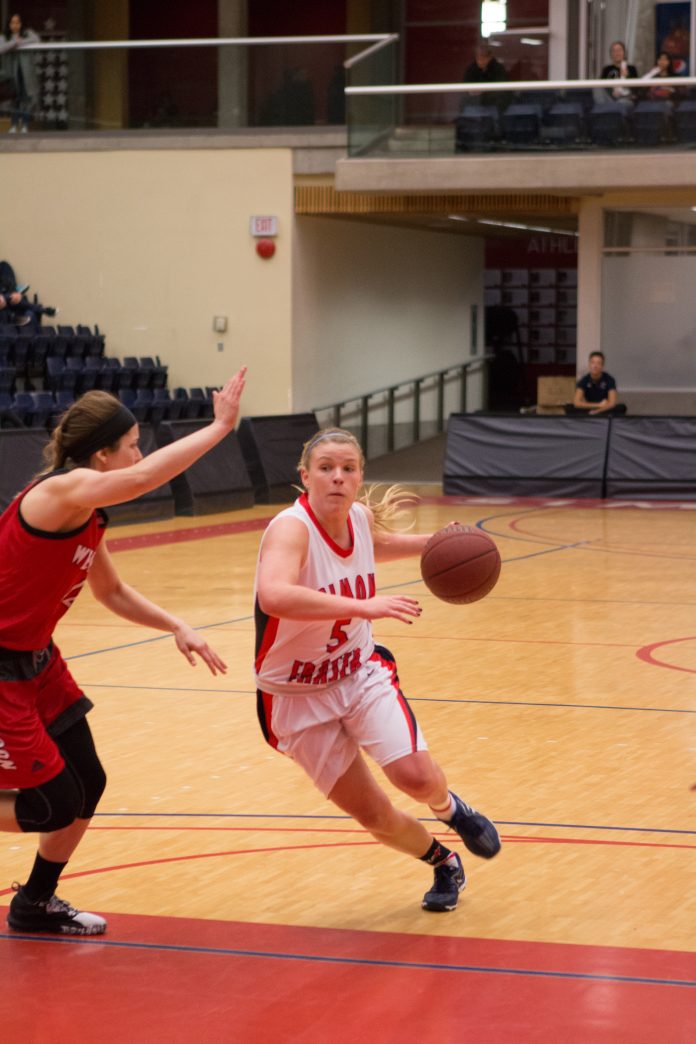
2016 for SFU ended the same way it began – with a win against Concordia University. After defeating the Cavaliers on January 2, 2016, they did the same on New Year’s Eve, with a 80–58 victory.
Coming into the contest, SFU and Concordia were on two vastly different streaks. The visitors had lost four of their last five games played. In contrast, the Clan had won four of their last five.
The early portion of the game perhaps reflected the difference in confidence – SFU jumped out to a 20–4 lead and never really looked back — apart from a slip up near the end of the third quarter, when their lead was reduced to seven. After that, SFU went on a 13–3 run which was enough to eventually seal the win.
Leading the way for SFU was freshman Ozi Nwabuko, who had 18 points to lead the Clan in scoring. It’s her fifth game this season scoring 15 points, and has now become an indisputable part of the team’s starting lineup. A day after playing a mostly defensive role shutting down Western Oregon’s leading scorer Shelby Snook — limiting her to only six points and registering four assists — she’s shown a versatility that can hopefully continue throughout the season.
Senior Ellen Kett went four for six from behind the arc to register 14 points, while Elisa Homer had 12. Tayla Jackson returned to the lineup and had a limited role, playing only six minutes, but providing a block and an assist. Overall, it was a good night for SFU shooters as they went close to 50% from the field.
Despite scoring a season high 80 points, it was defence that was equally as impressive. SFU was able to force 23 Concordia turnovers, and SFU had ten blocks — four from Meg Wilson alone. Sophie Swant had four steals in 26 minutes of action, tying a season high for her, and also had six defensive rebounds.
Next up for SFU are games against Central Washington and Northwest Nazarene, both on the road, on Thursday and Saturday respectively. Central Washington is 0–3 in conference play, but have one of the best scoring defences in the GNAC, sitting third with 58.7 points per game. Northwest Nazarene in contrast are 3–0 in conference play, third in scoring offence with 77.9 points per game, but have the worst scoring defence, giving up 75.9 points per game.
They will likely be drastically different games for SFU, but the good news is that this team appears to be able to win many different ways — high scoring games such as the 78–75 win over Dominicana State on November 22 and tight defensive contests such as the 56–47 victory over Cal Poly Pomona on November 26. Recent history is also on the side of the Clan; SFU was a combined 4–1 against Central Washington and Northwest Nazarene last season, including a 78–67 victory in the playoffs last season over Central Washington.

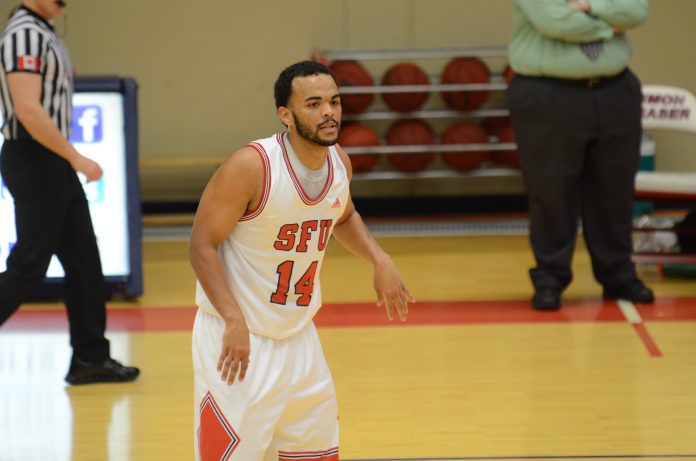
While most teams — the coaches, at least — hate the term “moral victory,” if there ever was one, it happened Friday night in the West Gym.
After suffering a 41 point loss the night before to the Montana State University Billings Yellowjackets, the result didn’t look like it would be much better for the men’s basketball team on the second night of a back-to-back. The Clan, who sit in last in the Great Northwest Athletic Conference (GNAC), were taking on the conference-leading Western Washington Vikings, a nationally ranked team.
The night before the battle with Western Washington, SFU was never in the game, and an effort like that would have likely had a much worse result against Western Washington.
“After last night I didn’t know what to expect,” head coach Steve Hanson told The Province.
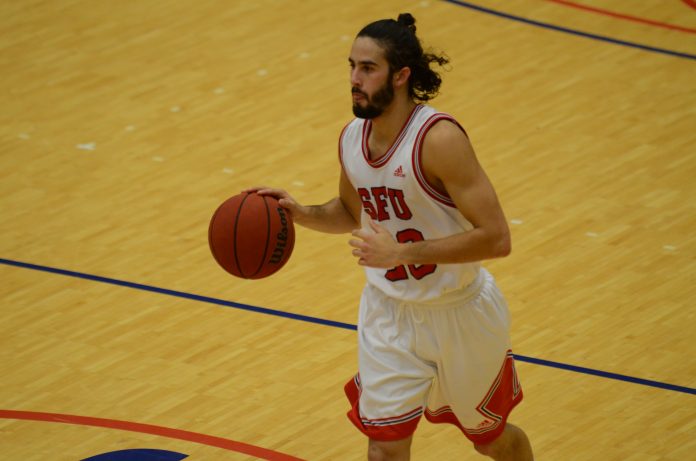
Instead, SFU fell just five points short of handing the 19th-ranked Vikings their first conference loss, with a score of 103–98. While the game marked the second-most amount of points scored against SFU, it also marked their best offensive game this season, even better than exhibition games where SFU was the dominant team.
The game didn’t always look that close. While the game started out with the two teams trading leads for much of the first four minutes, Western Washington took control, building up a 19 point lead with just over three minutes to go in the first half. It was beginning to look a lot like the night before.
However, 11 consecutive points and a three-pointer with four seconds left in the first half by Othniel Spence put SFU within seven at halftime. Spence, though limited to 11 minutes, put up two threes on the night.
Throughout the second half, SFU was able to hold the Vikings off of rebuilding their lead, and slowly eroded that lead before tying the game at 93–93 on a pair of free throws by Kedar Wright at the three-minute mark.
However, the Clan were unable to sustain the momentum and allowed Western Washington to build a slight lead. They fell by five points.
Still, it was an effort the team can be proud of, especially after the night before. It showed that this team can compete, even if they don’t put up the most wins. If they can play like this more consistently, there will be a few more wins.
SFU had some bona fide offence with the team going 34 for 60 (56.7%) from the field, and eight for 13 (61.5%) from the three-point line. They also made the most of free throw opportunities, going 22 for 30 (73.3%).
Kedar Wright put up a career high 28 points to lead the team, in addition to five rebounds. Four players — Wright, JJ Pankratz, Michael Provenzano, and Izaiah Sherman-Newsome — put up double-digit point totals. Sherman-Newsome notched a double-double, recording 12 rebounds and 15 points.
NEXT WEEK: SFU continues a four game homestand with games Thursday and Saturday in the West Gym against University of Alaska Anchorage and University of Alaska Fairbanks.
Both teams are some of the best defensive teams in the GNAC, sitting at the top in scoring defence. Anchorage allows only 62.2 points per game, while Fairbanks is a distant second, allowing only 71.4 points per game (tied with Northwest Nazarene). For reference, SFU allows 87.5 points per game.
Anchorage sits in second place in the GNAC with a 2-1 conference record, and an 8-3 overall record. Fairbanks is one of four teams with one conference win and has a 6-6 overall record.
Tipoff is at 7 p.m. for both games.
While 2016 has been an eventful year globally, SFU has experienced some major controversies and changes this year. Here is a rundown of the top SFU news stories of 2016.
Virgil Hill
On April 1, former SFU basketball head coach Virgil Hill stepped down from his position. This came after a series of allegations from some players of the men’s SFU basketball team, many of whom left the team earlier in the year. SFU has since hired Steve Hanson; in May, the former lead assistant coach was promoted for the spring 2016 season.
The Highland Pub – Debt, debt, and more debt
In May, The Peak reported that the Simon Fraser Student Society (SFSS) Highland Pub holds a $3 million dollar deficit, which lead to the closure of the Highland Pub for the 2016 summer semester. Later in the year, the pub re-opened in September with a slow start. SFSS CEO Martyn Wyant revealed that he would be unveiling a new business plan for the pub to try to reduce some of this deficit. The plan would also combat the competition from the recent openings of restaurants and the BC Liquor Store on campus, including the potential to allow minors into a closed off area of the pub. Later in October, The Peak reported that the pub was $60,000 behind schedule following only a partial opening in September with reduced kitchen staff and shorter opening times.
Deepak elected at SFSS president
In March, Deepak Sharma won over the majority of SFU students and was elected SFSS president over his opponent Darien Lechner. This was only just the beginning of a string of controversy within the SFSS and with their elected president for 2016–17. In June, Sharma resigned as president as he did not receive membership eligibility status due to failing to enroll in courses for the summer 2016 semester. Larissa Chen, former VP student services, stepped in as interim president (as is required of the VP student services) and announced that an official byelection would be held in October 2016.
. . . actually, Larissa elected as SFSS President
Chen had the chance to take on the role of president of the SFSS for the rest of the fall 2016 to spring 2017 term when she was initially offered the interim role. Instead, she resigned from her position as interim president, only to run in the official byelection alongside former president Deepak Sharma and independent candidate, Darien Lechner. However, Chen was voted in as official SFSS president with a 55.8% majority by 6.1% of the student body.
Cancellation of the stadium project
Other notable scandals and controversies from the SFSS include the cancellation of the SFU stadium which caused a huge backlash from SFU athletic teams students. Roughly 70 athletes stormed the SFSS board meeting at the end of August. While the project came in at $20 million dollars over budget, the SFSS was questioned on their transparency over the project. No word, as of yet, to potential options for the future of this project.
Sexual violence policy at SFU by May 2017
The student body is awaiting the draft release sexual violence policy on January 4, 2017. In 2016, it was made clear that SFU was in need of such a policy following the alleged mishandling of three sexual assault allegations at SFU residence. Since then, SFU has held sexual assault policy consultations at each campus with various SFU audiences. The university intends to finalise a policy — like all other post-secondary institutions in British Columbia — as mandated by the provincial government.
Upgrades to SFU infrastructure
Two major announcements were made this year post SFU’s 50th anniversary. In July, The Peak reported a $10 million renovation to the infrastructure running from the Trottier Observatory to the SFU fountain, in order to replace some deteriorating materials which may cause leaks and other issues. In October, SFU also announced a $126 million project to expand the Surrey campus, building a five storey building for the new Energy Systems and Environmental Engineering Program, SFU News reported. This announcement was welcomed by a visit from Prime Minister Justin Trudeau.
Burnaby Mountain tank farm expansion
On November 29, the Federal Government approved the controversial Kinder Morgan Trans Mountain pipeline expansion. Throughout the fall of 2016, The Peak has reported increasing safety concerns over the expansion of the Burnaby Mountain tank farm located just a mile below SFU’s Burnaby campus. While students such as Grayson Barke spoke out about the safety risk the expansion poses, SFU formally announced their stance on the pipeline project with a detailed report, which outlined its risks, just one day before the federal government’s announcement of its approval.