Home Blog Page 754

Stuff we like and don’t like

0
(Elena Hsu / The Peak)

Stuff we like: The Good Place

I know I’m a little late to the party, but this clever sitcom set in the afterlife is as delightful as it is deep. Veronica Mars fans will find plenty to love in Kristen Bell’s lead performance as Eleanor, a terrible person who somehow ends up in a kind of quasi heaven, and Parks and Rec lovers will be happy to know that creator Michael Schur has brought the same warmth and wit to his latest project. It takes a lot of moving parts for such a high-concept show to work, but The Good Place pulls it off. Also, the season finale is killer.

Stuff we don’t like: J. Cole

Is there a rapper out there as cheesy as J. Cole? Okay, maybe Macklemore, but J. gives him a run for his money. His latest release, “High for Hours,” is as on-the-nose and maudlin as political hip-hop gets, and this is coming from the guy who once boasted (ridiculously) that he was better than Slick Rick, Rakim, and LL Cool J — on his first album. Cole’s rapping is boring, and lines where he compares himself to leftover lasagna and boasts “you can’t out-fart me” don’t exactly scream lyrical dexterity. His upcoming split LP with Kendrick Lamar is sure to make for the most one-sided pairing since Simon and Garfunkel.

Stuff we like: Chrissy Teigen’s Twitter feed

Chrissy Teigen is mostly famous at this point for being John Legend’s wife and having incredibly gif-able facial expressions, but she deserves extra credit for her fantastic Twitter feed. When she’s not flirting with her husband in a somehow-charming-and-not-disgusting way, she’s blasting white supremacists and fangirling over Beyoncé. Celebrities using Twitter tend to come up with mixed results (just ask Alec Baldwin), but Teigen has mastered the art, and her interactions with fans and fellow famous people are always a pleasure.

Stuff we don’t like: Coming-of-age movies

Dear The Space Between Us: did the world really need another bildungsroman starring Asa Butterfield? By this point, we’ve seen something like 100 million movies about precocious white boys stumbling into adulthood (see: Almost Famous, Boyhood, The Perks of Being a Wallflower, etc). I don’t know about you, but I am dead tired of hearing about how hard it is to be a suburban middle-class kid. That’s why movies like Moonlight and Blue is the Warmest Color are so refreshing: films need to tell more stories about POC and LGBT kids, and less about dinks like Asa Butterfield. Sorry, Asa.

The April Fools Childrenhood

0

Creating an album is a challenge, even for seasoned veterans of the music scene who have the full support of a record label, and a team of producers behind them. It’s even harder when you’re writing, recording, and mixing whole albums solo. Add in being a university student, as well as involvement in another musical project, and it makes the whole task seem impossible.

Low Colour and its creator David Cowling (The April Fools Childrenhood) are proof that the impossible is possible.

Music wasn’t always what Cowling wanted to do, but following a fateful Christmas at the age of 14, everything changed: “My parents got me a red Fender and I started playing music then, but I didn’t start taking it seriously until about 2010. I did some recordings like a couple of EPs in my room in 2008 and 2009, but 2010 was when I put out a thing that I was really proud of and did a lot of work on.”

Cowling hasn’t looked back since those early days, and his guitar collection has grown since then, but he still has the original Fender that started it all. But it’s not the only thing that has stayed with him since the early days.

The name The April Fools Childrenhood has been around since pretty much the beginning, too. It came out of the desire to play all the songs that he learned over the course of the year. Cowling recounts, “[The concert as a gift was] really ephemeral, and doesn’t inherently give you anything to put under the tree. I started thinking about ways I could have a ‘present’ under the tree that announced the concert that night. So I made a poster advertising a concert in the living room on December 27. And I figured I should make up a name.

“It’s a cross between my birthday and one of my favourite video games. I’m born on April 1st (April Fools Day), and one of my favourite video games is called The Neverhood. Childrenhood is just a play on Neverhood and childhood. I’ve never seen reason to change, and I like how insane of a name it is.”

2014 was also a pretty big year for Cowling, when he released an album titled Youth is Yesterday that was made up of a collection of songs from 2012–2014, and got some album sales and recognition from CBC Searchlight by making into the top 100.

But then Cowling moved, right around the release of Youth is Yesterday. For anyone who creates, the space in which they work is incredibly important, so the shift in space caused some creative difficulties: “I just like, for whatever reason, totally lost the ability to make music. It was just terrible. I don’t know what it was about the old place. It was a wider space and bigger, and I felt more comfortable making noise in my room. But [in the new house] I’m so interconnected to everyone that lives in the house, I think I got nervous about making music.”

Finally, at the end of 2015 Cowling was able to write what he described as “a kind of OK song,” which broke him out of his creative funk. “Out of writing like 20 songs, the four on Low Colour came out of that end of 2015 beginning of 2016 [writing period], when I felt like I wasn’t writing anything that sucked anymore,” recounts Cowling.

Even though there are four songs on the album, Cowling is hard pressed to pick one as his favourite. “More than anything I’ve ever released, this feels more like a collection, and I’m really happy with how it all works together,” he said. “That was something I was thinking about early with this. I don’t really have one [song] that is my favourite, but I’ve ended up going with ‘Miss Resentment’ as my single. But that’s as a result of me thinking that it is more accessible and has more going on in it.”

Cowling also would describe “Miss Resentment” as the least experimental song on Low Colour, since there is an absence of drums on all of the tracks, but it doesn’t really fit in with any genre. According to Cowling, “It’s not pop, but l like writing poppy hooks and melodies — it’s got that influence in there. I could go with folk, but I’m not living in the country in the ’60s. I don’t really have any folk insight, I’m talking about being in love. So I go with ‘experimental will cover it,’ since it’s slow and atmospheric. But genres are bad, I just go into describing how it sounds.”

While there is a focus on love and break-ups on the album, Cowling — self-described as serially monogamous — said that it’s more about general feelings surrounding love and break-ups than any one person. Cowling took his writing inspiration from Sean Vanaman, and decided to inhabit a character and took the emotion to an extreme place, as opposed to a real feeling.

Other than being excited about the four songs that are featured on Low Colour, Cowling is also looking forward to the upcoming dual album release show with Leave bandmate Emma Citrine on February 10 at 2625 Kaslo St, Vancouver. “It’s this giant concrete room, and it’s super reverberant. I’ve wanted to play there ever since I saw the space. I’m also going to show off new stuff since the songs on Low Colour came out of 2015 and 2016. I’ve written new stuff since then.”

However, don’t expect Cowling to head into the studio to make another album just yet, “I’ve been working on this thing for so long that I’m just so pumped to just play shows. I’ve already got four booked for February and March. I want to not be worried about recording at the same time. I have songs that I’ve written that I’m excited for, but I think that I’m just going to workshop those and refine them, and figure out what they are going to be.”

He is also going to place a focus on scoring a feature length film for Vancouver Island-based filmmaker Graeme Higginson, and the remaining composition courses for his BFA in music.

Light rail transit gets the green light in Surrey

0

Surrey is one of the fastest-growing cities in the country, currently housing 20% of the region’s population. With Surrey’s population expected to exceed that of Vancouver over the next 30 years, the city is looking to upgrade the current transit system to keep up with the growing demand.

As part of phase one of the 10-Year Investment Plan, the mayors of Metro Vancouver announced that the plan for light rail transit (LRT) in Surrey will go ahead, with construction of the first phase of the South of Fraser Rapid Transit Project expected to start in 2018. This first phase will connect Surrey Centre (where SFU’s Surrey campus is located), Guildford Town Centre, and Newton Town Centre. A second phase will eventually connect Surrey to Langley, allowing those who live in Langley easier access to the SkyTrain.

Andy Yan, the current director of SFU’s The City Program, described Surrey’s decision of LRT as “an important investment for the city.”

“Particularly since there is an SFU campus there [in Surrey], the LRT will be able to further allow students, faculty, and staff [who] live in the region more access to SFU Surrey on frequencies that they weren’t able to before,” Yan said in an interview with The Peak.

Aside from access, Yan cited positive benefits for the city, including lower cost as compared to other modes of transit, increased economic benefits, and improving the overall livability of Surrey.

Third-year geography student JT Cowan, who lives in Surrey, echoed Yan’s thoughts with regards to the LRT, particularly with regards to the ability for the future LRT to sustain ridership with the increase in population as well as accessibility for all.

“I am definitely in support of the LRT,” said Cowan. “Future development signs all over previously vacated land [. . .] tells me the corridors will be able to sustain ridership and create easy access for riders to their homes and jobs.”

He went on to say that the street level transport will greatly improve accessibility, as everyone will be able to walk on and off regardless of their challenges, as opposed to relying on elevators.

But not everyone is in favour of the LRT.  The most vocal voices opposing the LRT are those behind the SkyTrain for Surrey web page. They argue that the cost to build the LRT and SkyTrain are the same, but in the long run, SkyTrain would cost less to operate. As well, they note that having a transit system that is “fully separated from vehicle traffic is imperative to making sure there are alternatives to being stuck in congestion.”

Matthew Furtado, a fourth-year communication and business student who also lives in Surrey, stands behind the SkyTrain for Surrey campaign, calling the LRT a “small bandaid on Surrey’s clogged, congested traffic arteries.

“I think this [LRT] is setting the bar too low, the problems with LRT are much too significant to call it an ‘expansion’ or ‘improvement.’ [. . .] LRT is no faster than a bus during rush hour,” Furtado said. “Not only would trains be delayed by Surrey’s frequent traffic accidents on its routes, but it would also prove impossible to navigate around them when accidents take place on its immobile tracks.”

For Furtado and many others behind the SkyTrain for Surrey campaign, a petition has been created to call on the Mayor’s Council to consider the alternative of SkyTrain and Bus Rapid Transit so as to avoid making what the campaign describes as the “most expensive mistake in the region’s history,” coming in at a proposed cost of $2.6 billion.

One thing that both sides of the table can agree upon is that Surrey is quickly outgrowing its current transit system and is in dire need of an upgrade in order to keep up with Surrey’s growth. With the start date for construction about a year away, both sides hope to make their arguments known to the public, all with the intention of moving Surrey forward.

Life as a Disney Princess

0

Snow White

Pros:
Rent is super cheap when split with seven other roommates.  

Cons:
How can you possibly enjoy apple pie after going through a poisoned-fruit fiasco?

Belle

Pros:
In your own personal library, you never have to fight some dude playing Candy Crush for a spot to spread your crap and study, and you’re allowed to eat whatever you want without a librarian baring her teeth.  Additionally, there’s no problem if you accidentally touch some gum under a table — it’s yours.  

Cons:
The furniture in your house shouts at you day in and day out.  Could you imagine your fridge yelling at you to “go easy” with the ice cream?  Nobody needs that kind of negativity.


Jasmine

Pros:
Pet tiger.  Come on.      

Cons:
Imagine the hairballs that thing yacks up. (Unless you’re working on a wig-making startup, in which case you’ve got yourself a double-pro.)

Ariel

Pros:
There’s absolutely no need to shower when you live in the world’s OG bathtub — which comes with complimentary salt scrub, all-you-can-eat sushi, and unlimited seaweed wraps.  

Cons:
You have to hunt for two appropriately-sized and matching seashells every time you need a new bra.  Can you imagine how time-consuming mermaid puberty must be?  Victoria’s Secrets may slice your wallet into teeny tiny pieces, but turns out it’s a walk in the park. Also, how can you enjoy sushi when you know your salmon roll’s name?

Merida

Pros:

Nobody will dare to question you about having a “special someone” at family reunions — not even your slightly racist, very ancient, widowed Aunt Margaret.  

Cons:

Medieval Scotland hasn’t discovered Moroccan oil yet.  Good luck with those curls, girl.  

Sleeping Beauty

Pros:

One-hundred years of sleep.  ‘Nuff said.  

Cons:

Every time I blink I have a new paper to write, three extra shifts, a presentation to give, and I’m leading a discussion group in a class I didn’t even know I was enrolled in.  Imagine the workload after a hundred years of sleep.  Alas, ‘tis the double-edged sword of procrastination.  

Cinderella

Pros:
Magically turning any vegetable at hand into your ride is much more convenient than any public transit known to man: you’re not using any fossil fuels and basically composting as a you go.  Everybody wins.  

Cons:
The constant fear that your best friend will get lured by a tantalizing piece of cheese and then mauled to death by a mouse trap.

Mulan

Pros:
Feminist icon who can do whatever a man does, but in a dress (unless you’re in the mood for some kickass armor, because that’s cool too).

Cons :
Donald Trump exists anyways.


World News Beat

0

By: Jonathan Pabico and Bernice Puzon

Greece – Three dead of suspected carbon monoxide poisoning at refugee camp

A refugee camp located on the Greek island of Lesbos was shaken by tragedy after three migrants died inside the camp within the week. Three men were found dead in their tents, with the inhalation of carbon monoxide from the toxic fumes of heaters being investigated as their cause of death. More than 60,000 refugees currently reside in camps around Greece. Concerns of poor living conditions and overcrowding have been voiced by nonprofit organizations working at these camps.

With files from BBC News

US – Members of credit card scam arrested in US

Habib Chaudhry, one of 20 arrests, was taken into custody for participating in a $200 million credit card fraud operation. Thanks to the efforts of the FBI’s cyber division, this scheme was terminated back in 2013, but was discovered to have a surprisingly intricate system. 7,000 false identities were used for the fraud, while 1,800 fake addresses helped make these identities sound more authentic to potential victims. The group that orchestrated this scam used the thousands of cards they acquired for their own spending, leaving behind numerous unpaid debts.

With files from BBC News

Australia – Drug that mimics shark immune system could cure lung disease

Inspired by an antibody found in sharks, Australian researchers have developed a drug called AD-114 that could possibly cure the lung disease idiopathic pulmonary fibrosis (IPF). The drug would create antibodies that would attack fibrosis-causing cells, effectively preventing them from taking over the body. This result reinvigorates the hope to cure IPF.  The drug did so well in tests that scientists have concluded that its applications could potentially extend to other illnesses, such as liver disease. Trials of the drug will hopefully begin by next year.

With files from BBC News

USA – Trump fires US lawyer for opposing immigration ban

Sally Yates lost her position as acting US attorney general when President Trump fired her for refusing to establish legal support towards his immigration ban.  The ban would prevent immigrants coming from countries such as Syria, Sudan, and Somalia from travelling across US borders. Yates’ opposition against the ban was regarded by the White House as an act of betrayal against the justice department.  She previously worked for the Obama administration, but Dana Boente, another US attorney, will now assume Yates’ role as the new acting US attorney general.

With files from BBC News

Czech Republic – Thousands of emails downloaded in cyber attack against foreign state officials

The emails of dozens of senior diplomats have been hacked in a mass cyber attack in the Czech Republic. Lubomír Zaorálek, the Czech Republic’s foreign affairs minister, compared the breach to the one that occurred for the Democratic party during the US presidential election. Thousands of files were downloaded from Zaorálek and his subordinates’ inboxes in what has been dubbed the Czech Republic’s “biggest security scandal in recent years.”  Another foreign ministry official who chose to remain anonymous said that fingers were being pointed at Russia for the attack.

With files from The Guardian

UK – Antimalarial treatment takes unexpected failure for UK patients

Four patients in the UK underwent a drug treatment to combat malaria that unexpectedly failed in protecting them from the disease. The drug’s ability to treat malaria was short-lived, as patients treated for the illness were suddenly called back to address the treatment’s failure. It was determined that the malaria parasite had become immune to the drug’s effects, rendering the drug ineffective. To Dr. Colin Sutherland, it was imperative that UK doctors remained aware of the drug’s potential to fail when treating a patient in the future.

With files from BBC News

USA – Tesla opens the world’s largest battery storage plant

On January 30, major car company Tesla unveiled their new battery storage plant in the California desert. The plant, which is the largest of its kind on earth, houses 16,000 lithium-ion battery cells which have the ability to power a total of 15,000 homes. The plant is part of a project to provide back-up energy in case of shortages in the area, and is critical for the storage of wind and solar energy as an alternative to fossil fuels.

With files from Fortune


Jessie Gibson rewriting the SFU record books

0
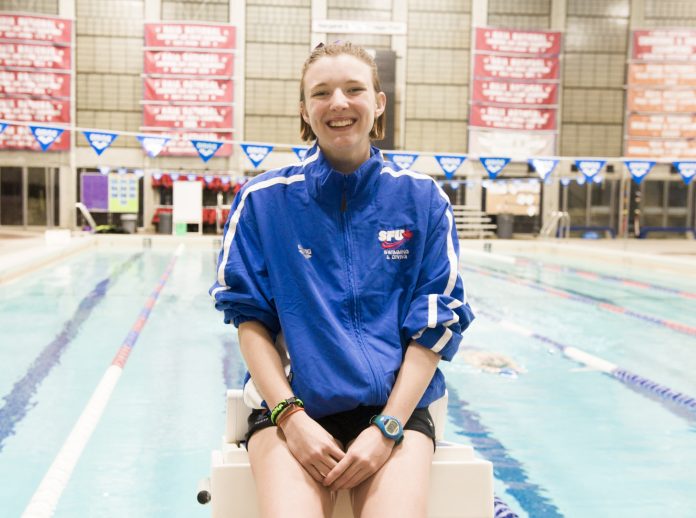
Gibson this season has broken numerous SFU records, including a school record in the 200-yard backstroke.

It’s been a remarkable season so far for Jessie Gibson. Hailing from Abbotsford, Gibson has stepped onto SFU’s swimming team and put in impressive or record-setting performances in nearly every meet this season. Only a freshman, she’s forgone the usual adjustment period and become one of SFU’s key contributors.

“I had been talking to Coach Liam [Donnelly] in my grade 11 year,” said Gibson on her decision to attend SFU. “He contacted me and said ‘I kind of want to talk to you in your grade 12 year, if that’s OK with you.’ I was like ‘yeah sure, SFU, that’s a pretty great school to go to.’

“I came in for recruitment week in November for a recruitment trip, and I fell in love with the team and how everyone got together, and the coaches were great. I signed with them that month.”

Adjusting to the university workload can be a challenge for any student. Add to that that the team practices nine times a week on average — with the majority of them very early in the morning (luckily she says she is “100% a morning person”) — and you get a sense of what Gibson had to go through her first season. A kinesiology major, she’s had to learn how to balance her time very quickly.

“Going from high school to university, no matter how many people tell you, it’s going to be different,” said Gibson. “You’re not really prepared for it until you get here.

“For me, I definitely had a hard time, especially those first couple of months. Balancing my school with the practices, I was super exhausted all the time, but you kind of get into a rhythm of it. I’ve gotten a little bit better, but there are some older people on my team that are giving you tips like take online classes.”

A part not discussed often about attending SFU if you’re a student athlete is the SAT, or Scholastic Aptitude Test. As a member of the NCAA, all prospective players have to get a certain score on this test to be eligible.

“No matter what, you can always do better than what you’re doing right now.”

“You’re trying to answer questions, but they don’t give you enough time to finish them,” she explained. “You’re trying to get the questions done in this rushed time, but you’re like ‘Oh my god I’m going to fail’ [. . .] but after you get your marks you’re like, oh, I guess they mark them pretty fairly based on what you can do.”

Since she started competing for the Clan, Gibson has done nothing but win and break records. On January 28, she broke the SFU dual meet record in the 200 backstroke and the 200 individual medley. The week before, against the same team, she broke SFU dual meet records in the 200-yard freestyle and the 100-yard butterfly. And in the Husky Invitational on December 4, she set a school record in the 200-yard backstroke, along with three other records and was named MVP of the tournament.

That amount would be impressive throughout an entire four year career, but to do it before the end of your first season is truly remarkable.

“It feels good,” she commented on her record-breaking performances. “There’s so many fast people that have come before me to be able to sit up there on the record board, no matter how short it will be, [is great]. There’s always going to be people who come after and beat my records. But to sit on that board even for a little bit is kind of a great feeling.”

She credits Donnelly with helping her stay motivated throughout the season and pushing her to be better.

“[He] really just says what he means, in a good way,” she explained. “He says like ‘I think you can do this better’ and he tells you why. He explains everything he’s doing to you. It’s really straight forward, it’s not beating around the bush.

“Even if it’s something hard he has to tell you, he tells you it, and tells you to incorporate this into it so you can do it better. He’s always looking to the future [. . .] sure, I may have broken a record here or have a best time here, but that’s OK for now, and you can always do better.”

For the rest of her season, both her individual and team goals are clear. For herself, she wants to medal in her best event, the 200-metre distance and compete in the relay.

“We have to get our four girls qualified, but I think we’re basically there,” she explained. “I don’t really get to compete in relays that often. I want to do well [and] I want to work really well for my relay team.”

Her team goal is to win the elusive NCAA National Championship.

“We haven’t got a NCAA title before so I think, by the end of my career here, we really want to get close to it or get it. Liam [Donnelly] always says to us ‘your team goal is always to do better. You can’t stop where you are.’ You have to do better, and he’s enforced that the whole year. No matter what, you can always do better than what you’re doing right now.”

It’s hard to imagine a level at which Jessie Gibson can be better. But, having only just started her career at SFU, the sky’s the limit to how much she can achieve.

FUN FACT: Pulp or No Pulp in Orange Juice?

“I prefer no pulp. I don’t like the texture of the pulp.”

SFU serving up more veggie options on Mondays

0

Having started as a public health awareness campaign in 2003, the Meatless Mondays initiative has transformed into a global movement that addresses health, environmental, and animal welfare issues in regards to meat consumption.

This January, SFU dove headfirst into implementing the Monday Veggie Challenge in communication with the Vancouver Humane Society (VHS) — the organisation that awakened many schools to the movement. The new initiative is in addition to SFU’s previous vegetarian commitments.

The simple argument that cultivating plant crops to feed livestock is inefficient, when we could consume the plant crops in the first place is an underpinning motif for VHS. “Students are thrilled to have a variety of healthy, humane, and eco-friendly food options to help them make delicious and responsible food choices,” said Emily Pickett, VHS’s program coordinator.

Aligning with this view, Ali White, programs manager at Embark (the independent, student-led not-for-profit society based out of SFU) remarked, “While it’s not one of our main programming areas [at SFU], the Challenge coordinates with our work by engaging students in being aware of their carbon footprint, and further supports the health and well-being of both people and the environment.”

Recognizing the momentum that students can create by actively participating in the Monday Veggie Challenge at SFU, White explained, “SFU Dining Services has partnered with us to promote the campaign in the Dining Hall and Mackenzie Cafe, which both provide vegetarian options every day of the week.”

“Not only do students know best how to reach and empower fellow students, but they can provide valuable feedback about menu options and strategies for running a successful campaign within their school community,” stressed Pickett. VHS is pushing boundaries with nine Metro Vancouver schools being on board in the initiative.

This statement resonated with students’ perspective at SFU as well. “We were talking about the Meatless Mondays just a while ago,” said Kendal Singleton, a first-year student currently studying medical physiology. Singleton is currently on the meal plan for SFU.

“I really like it because I’m a vegetarian. Especially on Mondays, the quality and variety of the food is great.”  

Paul Garcha, a first-year computing science major, added, “I’m not a vegetarian, but they served veggie quesadillas last Monday and I think that should appeal to meat-eaters, too.” The two students agreed that SFU’s efforts are commendable, at its initiation.

Embark has students engaging in the front- as well as the back-end of the project through their promotional strategies. “We have a volunteer who is currently working on developing social media graphics for the campaign. In addition, SFU Health and Counselling peers are keen to support the campaign through their tabling outreach, focusing more on the health impacts of meat consumption,” explained White.

VHS and Embark collectively express the positive response Meatless Mondays has cultivated. Piloted in November, Embark plans on bringing more to table. “We hope to encourage other vendors on campus to take part in the Monday Veggie Challenge. This could include offering a discount for vegetarian meals on Mondays, or simply featuring a meatless option on that day.”

SFU food services workers protest for job security

6

It’s a scary time for the food services workers at Simon Fraser University.

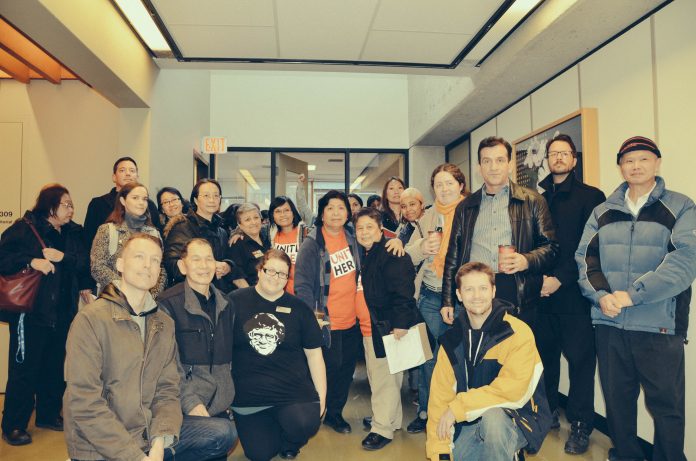
The workers — which include the staff at Mackenzie Cafe, the Dining Hall, and the caterers for SFU events among other roles — held two protests at Simon Fraser University on January 27. In total, there are 160 food service workers employed at SFU.

For many, it feels as though they are in a fight for their jobs.

SFU’s contract with their current food supplier (Chartwells — a division of Compass Group Canada) is coming to an end, and they are tendering bids from any interested companies to secure the next contract for SFU’s food supply. The uncertainty of who will be the next supplier has the food service workers scared for their jobs.

Michael Clarke, a union leader within the SFU community as well as a Compass employee, elaborated on just how much of a necessity the SFU food services are to campus life.    

“We deal with everyone on a daily basis from their morning coffee to your meetings with faculty. We do lunches, we do dinners, we do residence, we even do dinners at [president Andrew Petter]’s own residence for him, so we do a majority of what people tend to not think of on a daily basis.”

Now, they just want to know that they’ll be rewarded for their years of hard work.

“We all want the same thing,” said Bruna Padularosa, who was at the protests. “We want to still have a job. We’re worried if another company comes, they could decide to hire other people; there could be no benefits. We don’t know.”

Padularosa, who currently works at the deli in Mackenzie Cafe, has been with the school for almost three decades. The fear of not having a job is real, and she said that the benefits she collects from the job mean everything to her. She’s very concerned about the prospect of being unemployed soon.

“That is the worst thing that could happen. We all need a job, we’re relying on these jobs,” she said.

The food service workers have teamed up with UNITE HERE Local 40 and have begun circulating a petition for students to sign in support of them, which has garnered over 1,300 signatures so far. Those signatures were brought to president Andrew Petter during the protests.

One of the reasons for the multiple protests was because the food service workers don’t want to abandon their work shifts, and so they went in two waves based on who was available. They first group met with Petter, but the second group was rebuffed. For Clarke, he feels as though the case to guarantee job safety is obvious.

“We have never failed in our task to provide those services, whether it was with Compass group, or the group before that, or the group that will come after that,” he said.

However, according to vice-president of finance and administration for SFU, Martin Pochurko, he doesn’t envision this as being the worst-case scenario it could become.

“I think in times of change, there is fear, but I think if we look back at this two or three months down the road, it’ll have worked out for everybody,” he said.

He explained that SFU is just following procedure for a contract of this nature, and is required to present options to their board as the old contract has come to an end. The current deal with Compass was set to expire five years ago, but both sides took the option of extending to the contract, and it has now fully run all possible courses.

In reading an email sent from Mary Aylesworth, director of Procurement Services at SFU, after the protests, Pochurko explained that SFU views the employees as vital members of the SFU community, and they recognize how integral they are to the success of the school. Furthermore, the university will require that “the awarded Contractor [offer] employment to all existing dining services hourly staff in positions equivalent to their current jobs and at current or better wages and grade rates.”

While it doesn’t mention anything about the benefits that are so important to the food services workers, SFU doesn’t appear to want to damage the relationship it has with those employees.

However, had SFU completely mediated these issues, perhaps the protests wouldn’t have occurred at all.

Living wireless: Things are getting darker than my screen on power-save mode

0

This is the third post in a week-long web series that documents Preethi’s day-to-day experiences while forgoing a relationship with her cellphone. Check back daily for the next article.

Do you wake up in the morning, reach for your phone, and spend an hour in your bed looking through it? Because I sure do. On my third day, I reached for my phone and realized that I couldn’t use it. I wanted to, I really did, I even asked myself if anyone would notice. . . yikes.

Day three has, by far, been the day where I feel the most agitated and deprived of something I need. It hasn’t been a great weekend.

I got out of bed and went for a run because Saturday is the day for self-love. The sun was out, and I wished to take pictures and wondered why it was even necessary that I capture the beauty around me. This urge had to be more than “capturing a moment.” This had to be social media capital.

I tried to have a normal Saturday; I made breakfast for the bae and later made my way to a party. As I expected, the day got tough, then it got tougher. I wanted to show my friends that I had made hollandaise sauce from scratch this morning, and I wanted to share pictures from my get-together. My social media capital was brimming with options, but I couldn’t showcase it. Day three felt like my phone was giving me the boot and I just wanted it back so badly.

My relationship with my phone can be quite important as a means of communication. Communication became harder with people as I had asked everyone to email me if they needed anything.

While cooking, I used my phone to play some music while I switched to airplane mode. Amidst preparation, I noticed that I would unlock and lock my phone, I would even sift through my gallery without purpose — a mindless habit. Even though I excelled at not accessing the internet, I wasn’t very aware of my activity. Not regulating, not being self-aware of my interaction with a phone isn’t very different from any other addiction, if you ask me.

I did not start using a phone until I was in the 10th grade. I only had a personal computer that I shared with my sister since I was a kid; I mostly used to draw patterns in paint and fill them with colours. But, at the age of 15, something overcame me and I asked my dad to buy me a phone.

At the age of 20, when I look back on the past five years, I didn’t care about my phone when I was in class, camp, boarding school, or other such situations. But, when I could access my phone, I had to be on it constantly, more or less. My mother, even today, tells me how she misses the younger me, zealous even though I got on her nerves sometimes. Here comes existential crisis number one. . . did time change me or did my cellphone alongside my social media change me?

Perhaps I miss my younger self, too. This challenge is forcing me to reflect on my daily routine and face what I generally wouldn’t have to, even though I should. I have an addiction to my phone and I need to help myself out of this addiction. Always remember that Kanye said: “Admitting is the first step.”

Living wireless: Day 2 of cellphone-free life

0

This is the second post in a week-long web series that documents Preethi’s day-to-day experiences while forgoing a relationship with her cellphone. Check back daily for a new article.

Every Friday I set my alarm for 7 a.m. — not because I have anywhere to be, but because I want to wake up early, be productive, and do all of the things I procrastinated doing earlier in the week.

At least that’s how I hope my Fridays go. But, mostly I’m only half as productive because I’m easily distracted. Conveniently, my electronic device happens to galvanize my attention span while it continuously buzzes its way into my spare time. However, Friday came and I saw myself get more focused on my work without my phone anywhere near me. I had to step back mid-day and think, “Is this really me?”

I often indulge on Instagram, exploring and exerting energy when I upload a picture. I contemplate what picture would look best to fit my theme or what caption would encapsulate my thoughts. While I associate this practice as an expression of my ardent personality, it can be overwhelming. I find myself editing, re-editing, and even wondering what people might think about my posts.

Feeling insecure about our insecurities leads to an endless loop where we continue to assess ourselves through the eyes of others and through our lives on social media. A very strange byproduct of our phygital (physical and digital) society, indeed.

The phantom vibrations in my pocket are real, but I don’t mis my phone… yet.

Not using my phone liberates me from my social media presence. To be honest, I enjoy expressing myself through our whack platforms. But let me share with you something I noticed: maybe my urge to be present on social media is due to a lack of excitement and fulfillment in my own life.

I realize I’m starting to sound like an Eat Pray Love enthusiast as I tell you how freeing, yet traumatizing this all feels, and believe me I don’t like sounding like a cliché, but maybe all of these ‘self-discovery’ movies were on to something? Maybe Katherine Heigl’s characters have been right all along? (I take the Katherine Heigl comment back, that’s going too far. I apologize.)

I am one who is always listening to music while on the go, and I thought I would miss not being able to add music to my commute. But as it turns out, catching snippets of conversation is an equally enjoyable soundtrack to get you through the day.

If I was lost in my phone, I would have never caught these gem words spoken at West Mall Centre. A couple of Chinese girls said: “Sorry we’re speaking in Mandarin so much,” to a boy they were with.

He replied, “Oh, it’s quite alright. I speak in English all the time.” The response was so woke, it had me shaking. With Trump headlines dominating conversation, it was refreshing, almost heart-melting to hear someone remind us that love trumps hate.

The rest of my day culminated into a very productive affair where I paid attention to my tasks. I’ll admit that I missed Snapchat a little as I use it on the daily, but being aware that I have rules in the challenge, I didn’t access it.

I do find myself wondering, however, if after this challenge is over, and I don’t have to worry about my editor hunting me down on campus because I was unable to complete the series, will I still be this committed to living cell phone-free? I cannot say that I can achieve such an endeavour. I went to bed by midnight and didn’t think much about my phone.

No storm yet, but my weekend is completely free. The greatest test is yet to come.