Home Blog Page 750

How to get more likes on Instagram

0

2.5 billion Instagram likes are doled out every single day by users all around the world. In the time it took you to read that sentence, that little red heart lit up over 25,000 times. How many of those little red hearts burst into your notifications, though? Raise your hand if you’ve ever posted an Instagram photo, and then, an hour later, deleted it out of shame because you didn’t get enough likes.

We all get a little rush of good feelings when someone likes or comments on our photos. I love working on my feed, editing photos and taking candid pictures with my friends, then posting them to Instagram with the perfect caption and waiting for the likes to roll in. Usually, I get about 50–70 likes, while I gape in astonishment at those easily reaching triple digits. I decided to try to figure out what the best types of photos to post are, when you should post them, as well as how captions, colours, and filters fit into the equation.

From my own Instagram feed to yours, I present to you: how to get more likes on Instagram.

TYPE OF PHOTO

Most Likes: Pictures of you taken by someone else

I began by scrolling through the nearly 160 posts on my own account and separating them into categories according to who, or what, is in the photo and who took it. I came up with eight different types of Instagram photos:

  • selfies of myself
  • photos of me taken by someone else
  • photos of me and my SO
  • photos of me and my friends
  • photos of just my friends
  • photos of food
  • photos of things (such as my acrylic nails, flowers, or architecture)
  • photos of animals

I then calculated the average number of likes per type of photo. The type of photo that got the highest amount of likes was pictures of me taken by someone else, usually me standing beside a pretty view on vacation or posing for one of my aspiring photographer friends. Average likes per photo in this category was 49 likes per picture. In that category, the highest-liked picture was of me on the evening of my one-year anniversary with my boyfriend, in my dress and heels with a body-positive caption.

Other high-like earners are pictures of animals, selfies of me, and pictures of me and my SO. The type of photo that earns the lowest amount of likes are photos of just my friends by themselves, averaging at only about 34 likes per picture.

DAY OF THE WEEK AND TIME

Most Likes: Wednesdays, Thursdays, and Fridays, any time

For one week, I posted daily at different times throughout the day and recorded the amount of likes each time and day got after twenty-four hours of being posted. I started on Tuesday and posted a picture of a doughnut from Cartems on an antique plate at 7 p.m., which got 43 likes. On Wednesday at 5 p.m., I posted a picture of me holding two bubble teas served in light bulbs from 17 Degrees Café, which garnered 55 likes. Thursday, I posted a picture of me and my friend hiking at Deer Lake, which got 53 likes. Friday at noon, I posted a selfie of me from Mother’s Day and got the most likes I’ve gotten since making Instagram, a total of 93. I usually post between eight to ten in the evening, since that’s when I get off work, but this post began to make me question if I should be using my lunch hour to boost my like count. On Saturday, bright and early at 9 a.m., I got 49 likes, then on Sunday at 3 p.m., I got 53 likes. On Monday, I decided to find out if noon was actually this magical time to post on Insta, so I posted a picture of chocolate cake and a slice of pizza from Boston Pizza and waited for the likes to roll in. It only got 49 likes, making noon somehow the best AND almost-worst time to post on Instagram.

Was the 93-like selfie just a fluke? A really good selfie? Is Friday just a time when a lot of people are on Instagram? It’s hard to say for sure. In an attempt to leave you with some useful information, though, I will say that Wednesday, Thursday and Friday are the days of the week that brought in the most amount of likes.

EDITED VERSUS NOT EDITED

Most Likes: High-Quality, unedited

I’ll be the first to admit I enjoy editing photos. From the simple use of Snapseed to adjust brightness, contrast, and saturation, to darkening eyelashes and whitening teeth in PE-Fotolr, and clearing textured skin and concealing under-eye bags in Facetune 2 (the free version, of course) all my photos are my mini-masterpieces. Some people, though, feel edited photos and filters make photos look too busy or superficial. I categorized my photos according to edited and not edited and averaged the amount of likes. Edited photos, on average, got 40 likes. Non-edited had a slightly higher average of 42. I then made a third category: good quality, non-edited photos. Most of these were captured on high-quality cameras by talented people. This category had an average of 48 likes per picture.  


CAPTION VERSUS NO CAPTION

Most Likes: Doesn’t Matter

I have an entire folder on my phone of potential *fire emoji* captions, like lyrics, quotes, poems, etc. (R.M. Drake and Rupi Kaur, anyone?), so you could say I take this topic very seriously. For the sake of this report, I consider a photo with “no caption” to be a photo with either literally no caption or a photo captioned by a single emoji or one hashtag. On average, photos with captions got 46 likes and photos without captions got 45 likes, so feel free to just slap a heart emoji on that picture and call it a day.

COLOURFUL VERSUS FADED/FAIR

Most Likes: Whatever you’re feeling like

I was expecting that more colourful photos, with pinks, blues, reds, and yellows, would get more likes than my grey, black, white, and sepia pictures, but I was surprised to find that, once again, it’s pretty much equal. On average, colourful photos got 43 likes, while less-colourful or faded photos got 42. Are artsy, moody, black and white shots making a comeback? Possibly!

So, the next time you sit down with your phone to post on Instagram, try posting a picture someone else took of you, post it near the weekend, make sure it’s good quality . . . Or just post a picture you really like, because YOU liking your account matters, too.


SFU startup helps international students save money on tuition transfers

0

By: Andrew Ng

For international students at SFU, every year can mean huge sums are spent on monetary transfers for tuition from their countries of origin to Canada.

This is what led Mehdi Naseri, a PhD student in SFU’s faculty of applied sciences, to create Rmoney Financial Inc., a startup venture backed by the university’s Coast Capital Savings Venture Connection program based at the Surrey campus.

“Transfers can be painful [for international students],” Naseri explained. A student can transfer a sum of money from their country of origin, and find that up to 7% of the money sent has disappeared into banks’ coffers.

According to Naseri, Rmoney partners with financial institutions in several countries to significantly reduce fees and wait times for money transfers across international borders. It can save students as much as $500 total on these transactions over the course of a year and transfer the money in seconds, not days, Naseri said.

The name for the company founded just a few months ago stems from the word for ‘idea’ in Farsi.

The service is also free for students. “We charge the banks, not the students,” informed Naseri, explaining that the digital platform saves students money by minimizing the costs of the background tasks required by financial institutions to send money overseas.

Naseri noted that while the process of transferring money is complicated, it can be whittled down to banks charging high fees to cover the many processes necessary to transfer money across borders, which include tasks ranging from assurance of compliance with financial regulations to ‘onboarding,’ the process of registering with an institution.

The company partly does this by masking the transaction as a domestic transfer — for example, if a student from India were to transfer money, it would seemingly be a transfer from one Indian financial institution to another.

When asked if the process of building a financial platform was easy, Naseri laughed. “It’s not easy, and it’s not supposed to be easy,” he chuckled.

The biggest obstacle, however, was not founding the company itself, but linking partnerships with other institutions and building a rapport with customers. So far, Naseri said, he has ten students transferring money with Rmoney, but he has ambitious plans to spread usage of the service amongst SFU’s 2,000-plus international students.

Naseri said he hopes to expand the company and offer services accessible to the wider public for international money transfers. His goal — and expectation — is that the venture will become a multimillion-dollar company within the next few years.

Mike de Jong acted in the clear on the foreign-buyers tax

0

By: Mark Westwood

If all goes as planned, finance minister Mike de Jong will be out of office by the end of the month. But for many, including parliamentary sentinel Democracy Watch, now is the perfect time to raise final doubts against de Jong and the BC Liberals.

Many people allege that de Jong implemented the Metro Vancouver foreign-buyers tax knowing full well that his Abbotsford property holdings would increase in value. Duff Conacher of Democracy Watch has stated that de Jong and other MLAs can “profit from their own [tax] decisions,” and that this “loophole should be closed.”

Such allegations are baseless: de Jong did not contravene the Members’ Conflict of Interest Act when he implemented the tax. The current conflict of interest procedures remain adequate for similar cases involving broad economic policies.

De Jong’s introduction of the tax was not a pet project meant to favour Abbotsford residents. In fact, nearly all of the MLAs from both parties voted for the legislation, in response to widespread public support. It was a case of MLAs acting on behalf of the communities in which they live — as they are supposed to do.

At first glance, de Jong’s personal stake in this provincial community may seem unfair. According to CTV, the total value of his residential and property investment mix is about $1 million, and it has gained about $52, 000 since the tax was introduced. Yet the tax was meant to address single Vancouver properties worth much more than any one investment of de Jong’s.

More importantly, many other MLAs residing outside of the target Metro Vancouver area voted for the act. None of these other MLAs are being accused of acting primarily in self-interest. As mentioned previously, each MLA (including NDP MLAs) appeared to have voted according to the best interests of their electorate.

Every MLA pays income tax, so any tax-related legislation an MLA votes for has the potential to change the amount of tax they pay. If those in a position to vote upon issues of economic concern had to recuse themselves merely on that basis, then, at present, there would be no fair way for our government to address such issues at all.

The “loophole” cited by Conacher — that MLAs can “profit from their own decisions”— is merely a sign that MLAs are a part of their communities, and invested in them. If BC residents are subject to the housing market’s pressures, their elected representatives should also be subject to those pressures.

Some may say that such a stance could lead to MLAs legislating inequitably in favour of their own regions. This is fundamental to our provincial democracy: a majority of members get to decide the legislation that benefits their electorate. In the current case, all property values outside of Metro Vancouver experienced a faster rate of growth after the implementation of the tax. This effect was not isolated to the properties of de Jong, or even just other MLAs.

Ultimately, cases such as this should not be viewed as conflicts of interest; rather, they should be viewed as moments of united interests between government and its citizens.

Of course, a strong democratic process must be free of conflicts of interest. When real conflicts arise, more stringent procedures may be necessary. But in cases of broad economic well-being, MLAs should not be forced to be completely disinterested from their electorate’s economic concerns. Such a position is both unwarranted and distracting.

This isn’t the first time Democracy Watch has made arguments against Paul Fraser, BC’s Conflict of Interest Commissioner, that have been ultimately found lacking. In 2016, when Democracy Watch petitioned BC’s Supreme Court to disregard Fraser’s conclusion that “certain Liberal Party of BC fundraising activities” were not “a real or apparent conflict of interest.” The court determined the plausibility of their argument to be “superficial” at best.

BC politics has other real issues at play, such as the need for more affordable housing, and a renewed focus on affordable government services. For the provincial government to work for British Columbians, government members must also be British Columbians.

What the NDP and Green parties could have in store for BC

0

By: Sarvin Samei

On May 29, NDP leader John Horgan and Green Party leader Andrew Weaver shocked the province by announcing a joint partnership and signing an agreement in order to solidify a minority government. That’s a big slap in Christy Clark’s face. With much uncertainty with BC’s political agenda, this new partnership will be interesting, to say the least.

Just to clear the air, this agreement is not a coalition . . . Yes, I’m just as confused as you are. In a recent statement, Horgan said that forming a coalition government was never a part of the plan. There are no set plans for anyone in Weaver’s caucus to join the NDP cabinet.

“We now have, with our 41 members and the three Green members, the majority support in the legislature,” Horgan explained. The Greens will support the NDP’s legislative agenda with financial decisions, and in return, the NDP will take on the Green’s environmental concerns and address them for policy-making.

I’m critical when I hear the government proposing new policies and financial goals, because again I ask the question — how? Ultimately, this NDP-Green alliance is a clever strategy to push for financial and environmental issues, given that the legislature is now 44 to 43 and will impose a challenge for the BC Liberals. So, what do the policy initiatives these parties are pushing for ultimately mean for BC?

Increasing Minimum Wage

BC has the highest cost of living in all of Canada, with one of the lowest minimum wages.The Green Party supports the NDP decision to increase the minimum wage to $15 an hour. This bold, risky move will likely place an additional financial burden on businesses, who will eventually have to increase the salaries of existing employees.

Affordable Housing

BC has struggled with affordable housing for a long time now. BC’s cost of living is ridiculously expensive, especially in the Greater Vancouver region expensive enough that I see myself eventually living in a one-bedroom apartment with six roommates.

The NDP proposed installing 11,400 new sites of affordable housing each year over the course of ten years. The Green Party pledged $750 million for subsidized affordable housing that’s ambitious. The Greens also proposed a 30% foreign buyers tax, which the NDP are against.

Yet I cringe at the discussion of affordable housing, because of the main concern: who is going to pay for this? This part is still unclear. How is the Green Party going to find the money for subsidizing housing? This would most likely result in raising taxes, but which taxes? Property taxes? Incomes taxes? Transit taxes? How are they going to find the funds to support this goal?

It’s hard to predict whether the NDP/Green party will be successful . . . Neither party has announced exactly how they will achieve affordable housing. I’m eager to hear the logistics behind this financial decision.

Health Care

Canadians are fortunate to have universal healthcare, but ironically, BC’s health care system still sucks. With the recent drug crisis, 374 fentanyl-related deaths claimed the lives of British Columbians between January and October 2016.

Both the NDP and the Green Party support creating drug programs to tackle mental health and addiction issues, reducing the costs of prescriptions drugs, and wait for it  eliminating health-care premiums within four years.

Let’s be honest, the chances of eliminating health-care premiums for everyone are very slim, but I do see it being a possibility for lower-income families. It is a relief to see the NDP and Green Party both taking a concerned interest in the fentanyl crisis by proposing more accessible drug programs such as treatment on-demand and coordinated response to overdose.

To overcome the crisis, the NDP and Green party will have to prioritize investing in these drug programs. If the government continues to fail after exerting all its resources, then they may have to look at other solutions such as redoubling efforts to cut off the drug supplies and decriminalizing drugs.

SFSS looks to secure student space on Surrey campus

1

The Simon Fraser Student Society (SFSS) has announced plans to consult students at the SFU Surrey campus about improving study and social spaces. The results of this week’s consultation will be shared with university representatives in the coming weeks, according to SFSS President Hangue Kim.

“The SFU Surrey campus has been growing significantly for years, but the ability to provide social and study spaces for students has not kept pace,” said Kim in a statement last week.

The society has expressed their interest in securing space in the new Sustainable Energy Engineering Building, a five-storey expansion of the SFU Surrey campus scheduled to open in 2018.

“In the last few years, we have had a number of discussions with SFU administration regarding space expansion on the Surrey campus, but we have yet to come to an agreement,” said Kim.

“With the recent announcement of the ‘Sustainable Energy Engineering Building,’ we believe that there is a new and exciting opportunity to develop an agreement that will bring new student-centric space for members.”

The statement noted that the SFSS is seeking dedicated study spaces as well as multipurpose social space to provide a venue for campus events.

“We understand that there will be many SFU academic and administrative requests for space as a result of the new building being constructed,” said Kim. “We believe that student interests should be an important consideration in the decisions for the three-phase academic expansion for SFU Surrey.”

Earlier this year, the SFSS’s annual student survey indicated that students wanted to see more study spaces on campus, according to the statement. The SFSS also noted that the results align with “student sentiment that has been regularly expressed in Surrey.”

SFU announced its plans to expand space on the Surrey campus last year. The Sustainable Energy Engineering Building will host engineering and entrepreneurship programs as well as student spaces.

The first two levels of the building are scheduled to be completed by mid-2018, and construction on the remaining three storeys will continue after the building is open.

The university and federal and provincial government have made a $126-million investment for the new building.

To res or not to res part two

0

It might be a convenient location, but it’s not a place where you want to stay too long. I lived in SFU residence for three years of my undergraduate degree, and the best decision I made was to move off the mountain.

For someone like myself who arrived in Metro Vancouver without knowing anyone, residence did provide friendships that have endured throughout my degree. However, beyond the social aspect, my experience in the single-dorm, shared-everything buildings that make up the bulk of housing options was less than ideal.  

I lived with the other first years in the Towers on the mandatory meal plan before moving into Shell House which boasts shared kitchen facilities. Though finally being able to cook was a big improvement from the Dining Hall food, it didn’t change the discomfort of living in close quarters with many other students in an outdated building.

Like others, I stayed because housing is hard to come by on a student budget and being steps from Burnaby classes is rather convenient. Yet there are some elements that I found problematic, and that finally led to my decision to leave campus living for good last year.


The Dining Hall

As someone with dietary restrictions, I know that my experience with dining hall food represents the worst-case scenario. I had already accepted my housing offer by the time I became aware of the severity of my food allergies.

Most first-year students are restricted by their age to the Towers, which have no cooking facilities beyond a microwave in the common room. I was no exception, and I received verbal assurances from the Dining Hall management at the time that they had accommodated people with my condition before.

Perhaps the food was adequate for those who were not limited by sensitivities or preferences or did not follow religious dietary guidelines. However, the food available to me and many others regularly lacked necessary nutrition groups.

There were stovetops available in the Dining Hall for students and limited ingredients for cooking, but this did not increase my options.

My physical health took a downturn while living in first-year residences. The whole experience ended up being rather expensive as I bought healthier options myself to keep in my room.


Noisy neighbours

There were a couple consistencies that persisted throughout the years, namely noisy neighbours and door-slammers. The problem of noise complaints never wavered for the community advisors in charge either.

In the Towers, the doors were so heavy that the sound would rattle the whole side of the floor unless one made a concerted effort to guide the latch into place. It was the same story for the doors leading outside and to the showers in latter years.

Though it might seem like an easy fix, most of my neighbours never quite got the hang of closing the door quietly. The repeated warnings given by community advisors didn’t seem to have an impact.

The paper-thin walls meant that sound travelled from the kitchen, the hallways, and other rooms whenever someone was having a lively conversation or a rowdy (weekday) night. It makes for an environment that is not a great fit for everyone.


Gross bathrooms

It is perhaps not surprising that bathrooms shared by a whole floor are rather disgusting on a regular basis. Between hair clogging the shower drain, feces in the shower (I’m not kidding), and projectile vomit covering the bathroom floor, I’ve seen it all.

If these spectacular examples of grossness don’t do it for you, certain shower stalls appeared not to have been cleaned by staff for weeks prior to my submissions requesting that the situation be remedied.

This is the nature of living with numerous, and generally unaccountable, individuals. The community advisors attempted to enforce the rules around cleanliness, but they regularly went ignored.


The kitchens

Needless to say, it is not easy to share a kitchen with a floor either. I was lucky enough to be situated close to the kitchen, but, some residents had to travel from other parts of the building to use the facilities.

Limited storage meant that most food items and cooking supplies were often at least partially stored in rooms. That is, if they weren’t forgotten for months on the kitchen counters or under the sink . . .


Fire alarms

It doesn’t matter the time of day or night, there is no escape from the multitude of fire alarms in residence. The alarms are usually caused by unsupervised cooking or 2 a.m. microwave fiascos. Who knew popcorn was so difficult to make?

I found that being jarred from sleep in the early morning hours or rushing straight outside from the shower was a standard routine. However, safety protocols meant that we could not re-enter the building until a fire truck arrived on scene, occasionally taking upwards of half an hour.

While the sensitive alarms are certainly justified, a good night’s sleep before a midterm exam is not guaranteed.


The choice is yours, make it wisely

The setup of most residence buildings are not something that is the right fit for every student. It’s something to keep in mind if you are considering whether to enter  — or stay — in residence.

To res or not to res part one

0

By: Victor Gouchee

Living in residence at university is a tough decision; you move away from your parents, experience freedom for the first time, make new friends, maybe party a little too much, and, eventually, find yourself (maybe). The examples of university dorms we are accustomed to seeing are often those in America, which portray massive parties day after day and bad decisions made by all. I can tell you firsthand, SFU is not like that.

I lived in residence at SFU for my first two years of school and they were some of the best times of my life. The amount of people I met who have helped shape me into the man I am today is ridiculous and I wish I could thank them all. Some have moved on, some have stayed, and some have become closer than I ever imagined. One of the coolest things for me was the diversity of people at SFU in general, but especially on residence. I’ve been floor-mates with people from all over the world: America, Africa, Asia, Europe, you name it. I came from a small town in British Columbia and I now have friends from all over the world, teaching me about their different cultures and religions.

ResLife has also done a tremendous organizational job by putting similar age groups together. The idea of having a freshmen-only building seems fairly straightforward, but the execution brought forth great results. Most of the people I shared a building with in my first year are still my friends. Being around people my own age allowed me to connect easily to people and thus stronger bonds emerged. That being said, residence at SFU isn’t just for freshmen. There are housing options, separate from freshmen, for third- and fourth-years and even masters students. Despite living in another building from someone, there was a common watering hole.

The Dining Hall is a definite highlight for me on so many levels. The quality of the food is much better than your average cafeteria grub. What made it even better was the ease of walking in at any hour, eating what I wanted, and however much I desired. It’s incredible! Not to mention that making friends was inevitable because who really wants to eat alone?

Be careful of how much time you spend in the Dining Hall. Having long conversations during and after dinner can turn into dessert, conversations during and after dessert can turn into another dinner, and then the next thing you know, the “freshman fifteen” hits you. Oh, and you don’t study as much because you’re always eating. Always.        

The staff in the Dining Hall are all very caring and sweet. It kind of makes you feel as if mum is watching you make a bowl of cereal for dinner and slightly judging your choices, but enjoying the fact that you are excited and happy with your newfound freedom.

A qualm I did have about my time living in residence was the amenities ResLife provides you. There was no Wi-Fi provided in the rooms, which was startling to me. I had little understanding of what I needed in order to have my own Wi-Fi, but in the end it was fairly inexpensive and headache-free. Additionally, the mattresses provided are only slightly comfier than a plank of wood. Again, purchasing memory foam or a pillow topper isn’t too expensive, but for the price of Residence, one would expect comfier bedding. At least you’re by yourself, though.

When I watch movies or TV shows about college, everyone always gets a random roommate. That is what I expected when I applied to SFU, but in fact, all dorms are single. This means there’s no need to worry about winding up with a stinky, unorganized roommate who snores. Having a single dorm was quite nice because you get all the privacy you need yet are never too far from your friends. One huge thing to get accustomed to is the shared bathroom. Co-ed, communal bathrooms are interesting to say the least, but they were definitely not an issue in reality. Overall, the buildings were quite nice, and now renovated; they’re not quite what I had anticipated, but they ended up being pretty easy to adjust to and fun to live in.

I interviewed several people to get other perspectives on residence experiences and some had nice things to say, but all had the common theme of “growing out” of residence and wanting their own place.

Tony Van De Venda, a fourth-year business student, was on res for three years and eventually moved off for his fourth year. “I recommend living on residence to everyone,” he said. “For me, I loved it, I felt included, I felt comfortable, and it was a great experience. Eventually, near the end of my third year, I grew out of it and was ready to move off the mountain.”

On the other hand, Juan Mabanta, who has lived on res for three years (and doesn’t plan on leaving anytime soon) brought up the uncertainty caused by moving off res. “Any other university, I would have felt weird as a third- or fourth-year student on res, but SFU is different. You’re in a community of all your friends. If I do move off, where do I move to? A suburb full of people not like me,” he said.

I can agree with both of these points. Res is a tremendous experience. I wish everyone had the luxury of getting to live there for at least a year. Personally, I don’t think university would be the same for me if I hadn’t decided to live on campus. Yet I can also understand the idea of ‘outgrowing’ SFU residence. Afterall, that’s what eventually happened to me. But I wouldn’t trade my time here for the world.

One of the things that makes living on campus so great is ResLife. The way SFU res is structured makes for a very exciting time at school. You have your community advisors, who are in charge of your floor, providing you with an instant friend if you need someone. But there are also games and activities that give you an escape from the trials and tribulations that come with university.

Res Challenge is another activity that I look back on fondly. All of the different floors throughout all the buildings had teams in a tournament. This tournament featured rotating, random sports all semester long, the teams battling it out for the ResLife Cup.

Residence at SFU is much more than just a communal living area; it is a building filled with all your friends, designed to help make your time at university more exciting. When you are a third-year student, you are more of a veteran in the residence world and then you have your second wave of freshmen coming in and of course it’s exciting to see everyone experience freedom for the first time just like you did. It may be a bit annoying to see new freshmen come into res, because by your third year you have often declared your major. Maybe you are looking into co-op, you’re volunteering, or doing whatever you can to pave the way for a career once you graduate. When you’re a freshman, all you care about is that you made it out of high school and are away from your parents for a while. You don’t have a vision of the future yet because you haven’t had the right experiences.

So when it comes time to moving off of the mountain, if the choice ever does come, or if it is your initial decision, I can also tell you that living on your own is not a bad choice either. There is the obvious convenient choice of UniverCity on the other side of campus (very nice apartment buildings yet quite expensive). Living off of Burnaby Mountain in general is also convenient due to the well-thought-out transit system in the Lower Mainland (often much cheaper than residence, but the commute is what some may be scared of). The biggest effect moving off the mountain had on me was how often I saw my friends. No more group study sessions in West Mall late at night or just walking back to our dorm because I had to catch the bus to go home. This was a little tough at first, but in the end, it was much better for my grades (not having long conversations in the Dining Hall meant more time to study, go figure).  

Natasha Tadic, a student who moved into residence in her third year, mentioned that living on res was the only way she made friends. “Friends were a huge part of my residence experience. If I didn’t live beside people, I never would’ve made so many friends,” said Tadic. “Of course you make friends in your classes, but how often do you really see them outside of school? I am a little nervous to move off of the mountain, but also excited to see who I keep in contact with when I’m not always on campus.”

Moving off the mountain does mean you’ll see people less. While that may be a tough pill to swallow, it really will all work out in the long run.

Overall, I want you, the reader, to take away three things from this:

1) Residence is a great experience, especially at SFU. You will make tons of friends from all over the world. Because you are all in similar situations of new experiences and freedom, you will connect very strongly.

2) SFU is not a party school. Do not be threatened by what you see on TV, SFU is nothing like that. There is a strong balance between fun and studies. Even if you don’t know anyone, ResLife makes sure you have all the resources you need.

3) Residence isn’t the only option. UniverCity is the ‘grown-up’ version — you can still live on the mountain in your own little complex with students and others. Or, there are apartments and houses for rent all over the Lower Mainland if you’re willing to commute.

SFU releases report on asbestos incident on campus

1
Photo courtesy of The Peak Archives

Simon Fraser University is launching a re-inventory of asbestos on campus after a report found that work on asbestos ceiling tiles last year was done without proper safety procedures, exposing employees to the toxic substance.

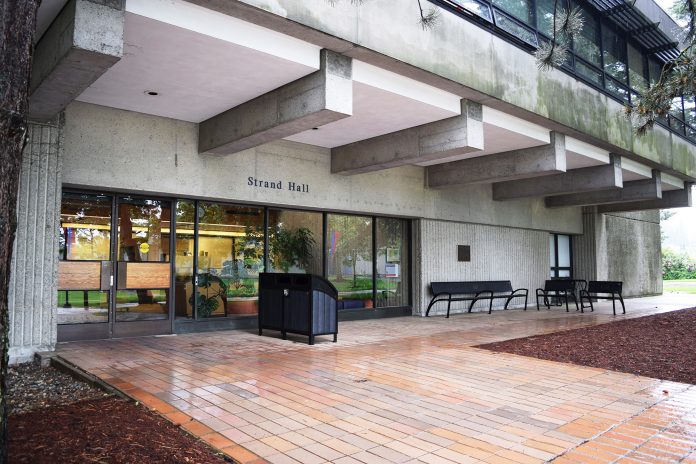
The incident occurred during renovations in Strand Hall on the Burnaby campus in April 2016. However, the report found that the asbestos ceiling tiles in question were not even discovered until 2011 and subsequently failed to be labelled as per provincial regulations.  

As a result, an unknown number of employees and building occupants were exposed to asbestos during other renovations and routine maintenance leading up to last year’s incident.

Asbestos is a toxic fibre used in older construction that can damage the lungs and cause serious health problems or death, according to WorkSafeBC. It does not pose a health risk unless it is disturbed.

The university informed impacted employees of the safety breach when the incident came to light.

“Those affected were notified immediately, as was WorkSafeBC, and it was determined the office area was safe for occupancy,” chief safety officer Mark LaLonde told The Peak. “Any staff who are concerned regarding potential exposure to asbestos can register with the WorkSafeBC Exposure Registry Program.”

The university is required to keep an inventory of asbestos on campus and the label those locations according to WorkSafeBC regulations. Work done in those locations must follow safety procedures to ensure employees are not exposed to the substance.  

The asbestos ceiling tiles in Strand Hall were not labelled and a safety warning was only entered into the maintenance database on the building-level. When the maintenance department took out room-level work orders over the years, they were not flagged as containing asbestos, the report found.

The report “indicated that there were […] potentially 80 instances between 2011 and 2016 where routine maintenance that involved the moving or removal of only a limited number of ceiling tiles were performed without appropriate safe work procedures,” according to the university response.

Several larger renovations of the space were undertaken during this period using proper asbestos abatement procedures, the response noted.

In April 2016, a contractor disturbed the tiles without following safety procedures and work was halted. The tiles were properly removed later that year and the location has been taken off of the asbestos inventory.

Two surveys of asbestos on campus prior to 2011 failed to identify that the ceiling tiles contained asbestos. A major renovation of the finance department in 2009 also did not identify asbestos in the ceiling tiles.  

“It appears that a pre-renovation survey should have been conducted for the 2009 Finance Department renovations but by oversight was not performed,” the university response read. “Such a survey would likely have detected [asbestos] in the ceiling tiles triggering the use of appropriate safe work procedures for that renovation and notice to the university regarding [asbestos] in the ceiling tiles as early as 2009.”

In 2011, an extensive renovation of the advancement department discovered that the tiles contained asbestos.

After the incident in April 2016, the response noted that WorkSafeBC advised the university it was not required to track down past employees to notify them of potential exposure.

Earlier this year, a consulting company analysed samples taken from the ceiling tiles after their discovery.

“These samples were representative of a worst case scenario not likely to be encountered by non-asbestos workers performing routine maintenance work or those workers working in the immediate area when tile ceiling work did occur,” said the response.

The consulting company “concluded that the sampling data did not indicate that workers removing ceiling tiles for maintenance activities […] would be overexposed to asbestos.”

LaLonde told The Peak that the university is taking the recommendations of the report seriously and is taking steps to identify asbestos, inform employees about the presence of asbestos and notification procedures if incidents do occur.

“The re-inventory [of asbestos] is being undertaken to review known locations and to document newly-identified asbestos, and will be completed over the coming months,” LaLonde said. “The process will look at labelling, condition, and identify any maintenance work required in areas containing asbestos.”

A new asbestos inventory database is scheduled to be made available to the university this month.

Read the full report here

SFU grants sustainable certification to campus offices

0
or offices, events, and dining, zero waste stations are just one sustainable practice.

A selection of SFU offices have now been sustainability-certified thanks to a new initiative by the university to push the community towards sustainability goals.

The Sustainability Office came out with the initiative that allows the university community to certify offices, events, and dining if they meet a long list of criteria.

The department of human resources, department of economics, Graduate Student Society, the Vancouver Administration Office, science and environment co-op, Embark, and the Sustainability Office have all recently received the certification.

In addition, the C2U Expo held last month and the Renewable Cities Global Learning Forum were certified as sustainable events.

“At SFU, sustainability is not just about preserving the environment. Instead, sustainability is a method to scale ecological, economic, and social practices to maintain the health and spirit of the SFU community,” said Mandy McDougall, program assistant and coordinator of SFU’s Sustainable Spaces program.

Those offices, events, and dining spaces that are eligible to be certified under the program must be performing at least half of the sustainable practices identified by the Sustainability Office, including steps towards waste reduction and conserving electricity.

The office has also identified socially-sustainable practices, including accessible venues that can accommodate people with impaired hearing at events.

Social sustainability includes promoting diversity whilst economic sustainability may involve investing money in a company that prioritizes long-term sustainable practices, McDougall explained. “Actions such as adhering to ethical procurement policies and researching full product life cycles ensure the social and economic aspects of sustainability are considered.”

McDougall also noted that “notable actions by Sustainable Offices so far include purchasing a reusable coffee filter, pledging to take public transportation to campus more often, and carpooling.” Some events also recycle their name tags and, in the future, we could start seeing events using name tags that can actually be watered and wildflowers will grow from them, she continued.

The program is an extension of the Green Offices and Green Labs program that was launched by the university in 2010. “The program’s success led to the current Sustainable Spaces program, which [includes] dining facilities and events across all three campuses — as well participation from faculty, staff, and students,” said McDougall.

Under the program, there are three levels of sustainability that can be achieved, the highest being awarded when an office, event, or dining service meets 90% of the criteria. Those that have been certified can receive support from the Sustainability Office to apply for sustainability-related funding initiatives.

Most participating offices have confirmed that the Sustainable Spaces program “also contributes to a good team mentality. Everyone in the office gets together and exchanges ideas on how to make their work environment more sustainable,” said McDougall.

SFU students develop app to ease parking in cities

1
Baker Al-Nakib and Thamer Matar joined forces to develop the app.

Finding a parking space is a common challenge for drivers in urban centres such as Vancouver, where the cost of parking is high and sometimes unaffordable for students.

That’s why SFU students, Baker Al-Nakib, Thamer Matar, and alumna Tiana He have created an app called OpenSpot to alleviate the cost of parking and free up more parking spaces. OpenSpot functions much like the room-renting service Airbnb, allowing users to temporarily rent out their parking spaces.

“Before we developed OpenSpot, we noticed that car insurance and parking costs are very expensive in Vancouver,” said Al-Nakib, a third-year SFU software systems student. “Therefore, we invented this app to help offset some of these costs to our community members — from a student’s perspective.”

Parking spot owners list their spot, along with a picture, on the app so that drivers can rent out the space in advance. The owners specify the length that the space is leased for — ranging from a few hours to a few months — and the price is settled between the owner and the renter.

The app recommends parking rates that are only 50–60% of the market value, meaning that a typical parking spot in Vancouver that costs $5 to $6 per hour could be rented for $3 to $4 per hour on OpenSpot.

“Currently, in downtown Vancouver, parking rates fluctuate throughout the day depending on how quickly the spots fill up and if it’s rush hour,” explained Matar, an undergraduate systems engineering student. “Whilst homeowners can demand their parking rate with OpenSpot, this rate will stay consistent throughout the day, regardless of the time, venue, and space availability”

When it comes to apartments or condos, where security is a bit tighter, the app “only works for people who live in the same building,” emphasized Matar.

“In a typical apartment, homeowners are only allowed two parking lots, but there are some families that don’t require both parking spaces,” noted Al-Nakib. “With OpenSpot, families with an extra parking spot can rent out their parking space to another tenant in the building, generating income for themselves and giving an extra parking space to families that need it. It’s a win-win situation.”

If a renter has booked a spot, only to arrive and find that another vehicle is occupying it, the app recommends another location nearby for you to park and maintains the rate you agreed to pay at the booked spot for the alternative location, Al-Nakib explained. If owners have a customer that has stayed past their allotted time, the app team will arrange to have the car towed.

The students expressed that they hope to be able to incorporate an element that allows users to split their parking costs, much like the ride-sharing service Uber. However, they “are still not sure of how technically feasible this feature will be on [their] current system,” said Al-Nakib.