Home Blog Page 74

Independent Jewish Voices Canada to form chapter at SFU

0
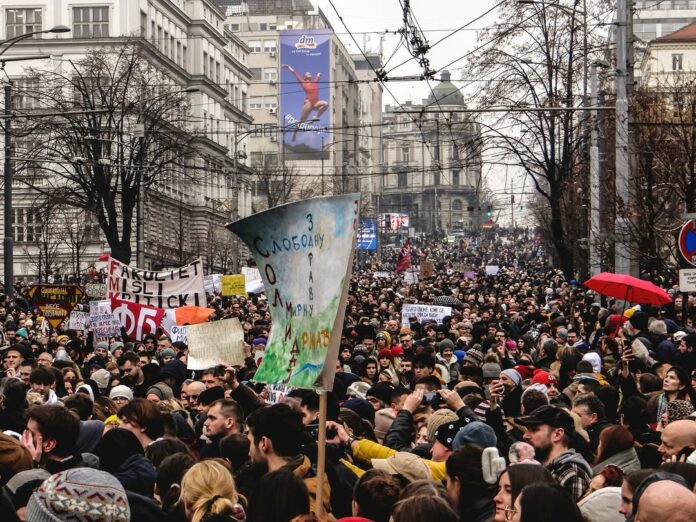
This is a photo of a group of people from Independent Jewish Voices protesting for Palestine.
PHOTO: @ijvlondon / Instagram

By: Lucaiah Smith-Miodownik, News Writer

Content warning: mentions of genocide.

Recently, students started a chapter of Independent Jewish Voices (IJV) Canada at SFU. IJV is a “grassroots organization grounded in Jewish tradition that opposes all forms of racism and advocates for justice and peace for all in Israel-Palestine.” The Peak interviewed Omri Haiven and Dina, SFU students involved in the new initiative on campus, on IJV SFU’s values and plans for the future.

The catalyst for the club can be attributed to the “desire to have an identity that goes beyond Israel and gets back to core Jewish values,” said Haiven. He explained that this includes tikkun olam (world repair) and or tzedakah (charity). Dina added core members felt that “there isn’t really a space for Jewish students [at SFU] who do want to find an identity outside of Israel and outside of Zionism.” According to IJV Canada, “Zionism is generally understood to denote the political ideology that has provided the basis for Israel’s settler-colonial project and unfolding genocide in Palestine.”

“There isn’t really a space for Jewish students [at SFU] who do want to find an identity outside of Israel and outside of Zionism.” Dina, member of Independent Jewish Voices SFU

IJV SFU’s broader goal is to support the pro-Palestine movements at SFU, such as SFU Student Strike for Palestine and SFU Faculty for Palestine. IJV SFU aligns with these campus movements’ goals “to get our university to divest from the companies that are funding the genocide, and also to end all relationships with Israeli academic institutions,” said Dina. SFU “owns shares of BAE Systems, Booz Allen Hamilton, and CAE Inc.” — companies supplying military arms to Israel.   

Dina hopes the club can provide room for “students who are maybe a little bit afraid to speak up right now, especially Jewish students.” IJV SFU stands opposed to the conflation of anti-Zionism and anti-semitism. Haiven explained that “anti-semitism for us is to be targeted as a Jew because you are a Jew” rather than “legitimate criticism” of the state of Israel. He highlighted the wish for “a space for Jews to congregate on campus and speak with a united voice,” explaining how “it takes a community to have that sense of purpose together.

Haiven said that “until the university divests from these arms companies” there will be more conflict between the pro-Palestine movements on campus and administration. “The purpose of the university as an institution for social and environmental justice will be called into question,” he continued.

“In November, a proposed timeline for community consultation will be shared with the SFU Board of Governors. If approved, early consultation with key groups (SFSS, Graduate Student Society, employee groups), will take place in December.” They also said “a full community consultation about SFU’s Responsible Investment Policy is planned for early 2025.”   — SFU statement

In a statement to The Peak, SFU stated that “in November, a proposed timeline for community consultation will be shared with the SFU Board of Governors. If approved, early consultation with key groups (SFSS, Graduate Student Society, employee groups), will take place in December.” They also said “a full community consultation about SFU’s Responsible Investment Policy is planned for early 2025.”  

In terms of next steps, IJV SFU is currently in conversation with Simon Fraser Public Interest Research Group (SFPIRG) and working on becoming an official campus club. SFPIRG is a “student-funded and student-directed resource centre dedicated to social and environmental justice.” The group also hopes to connect with the Multifaith Centre on campus. While IJV SFU is “mostly secular, there’s a really important part of Jewish identity that is non-religious but cultural and we want to be able to talk about those cultural teachings from history and from movements,” explained Haiven.

IJV SFU also hopes to participate in a panel with individuals who were involved in the encampment movement, which saw students across college campuses protest their administrations. Additionally, the group is interested in bringing in Israelis who refused to serve in the Israeli military to hear about their experiences. 

IJV SFU has already welcomed professors, PhD students, graduates, and undergraduates into the space. 

For more information, check out @ijv.sfu on Instagram and view the Linktree in their bio.

Lower Mainland struck by record-breaking atmospheric river

0
This is a photo of the flooding in the Deep Cove area.
PHOTO: @m1km0k / Instagram

By: Hailey Miller, Staff Writer

Content warning: descriptions of death by natural disaster.

On the weekend of October 19–20, a “major atmospheric river” made its way across the Lower Mainland, breaking a number of rainfall records. Some areas “saw a month’s worth of rain in just 48 hours.” From fallen trees and flooded streets to “tens of thousands” of households facing power outages, the atmospheric river caused severe damage throughout the weekend.

An atmospheric river is a “long, narrow band of concentrated water vapour in the sky.” They “are typically 800 kilometres wide and 1,000 kilometres long,” lasting for days at a time. Atmospheric rivers occur when “weather systems travel from the tropics toward the poles through the mid-latitudes,” and in this case, towards BC’s coast. According to the Canadian Climate Institute, the rise in atmospheric flooding in recent years is due to “increasing concentrations of heat-trapping gases in the atmosphere,” which “hold more moisture” and result in “heavier rainfall and more intense storms.” Up to two dozen atmospheric rivers can make landfall each year. Several warnings about the atmospheric flood were put out by Environment Canada and local weather stations. 

This isn’t the first time the Lower Mainland has seen rainfall of this magnitude, as the atmospheric river in November 2021 was just as severe.

North Vancouver and Coquitlam faced some of the heaviest rainfall, with North Vancouver seeing about 350 millimetres of rain, and Coquitlam, over 260 millimetres of rain over three days. West Vancouver also got over 200 millimetres of rain. At least four people lost their lives due to the storm, with two of these individuals’ vehicles being “swept away in fast-moving flood waters on the Sarita River.” A mudslide in Burke Mountain caused a house to slide off a cliff, with the resident losing her life. A Coquitlam man was also found in the Coquitlam River after a five-day search. 

This isn’t the first time the Lower Mainland has seen rainfall of this magnitude, as the atmospheric river in November 2021 was just as severe. Roads were washed out, impacting homes, agriculture, and livestock. Many roads and bridges needed repair due to the severity of the flooding.

Many homes in Deep Cove had to be evacuated this October, with North Shore residents feeling they were reliving the aftermath of the November 2014 floods again. Three other homes also had to be evacuated recently as the atmospheric river “filled creeks in the area with unstable debris,” reported CBC.

As Port Coquitlam residents were left cleaning up their homes, one resident told CityNews, “I’m angry there was nothing done to mitigate it because it was a foreseeable problem.” City of Port Coquitlam mayor Brad West also told CityNews the city has “been diligently upgrading infrastructure over the years and will be conducting a comprehensive review.”

The flooding on Vancouver Island was just as severe, with Tofino seeing 218 millimetres and Kennedy Lake — another region on the Island — receiving over 318 millimetres of rain. 

CRAB Park tent city forced to close

0
This is a photo of CRAB Park. The encampment is not shown in this photo.
PHOTO: MikoFox / Flickr

By: Sofia Chassomeris, News Writer

On October 23, the residents of CRAB Park’s tent city woke up to an eviction notice from the Vancouver Board of Parks and Recreation. The Board stated they aim to close the camp and return the park to “general park use” by November 7. Advocates in support of the tent city and residents of the park criticize the decision. 

In a recent press release, park resident L. said the Park Board is “making homeless people more homeless” through this decision. The Peak spoke with Athena Pranteau and Ryan Exner, residents of CRAB Park, about the eviction notice. “It’s not a legal document,” said Exner. “They have to give us a tenancy agreement to give an eviction.” A tenancy agreement is a contract between landlord and tenant detailing the terms of tenancy. There is no such contract between residents of CRAB Park and the Park Board. 

“It’s a city park but it’s federally owned,” Pranteau added. “Municipally, [the Park Board doesn’t] have the jurisdiction or grounds to be able to evict anyone, especially when it’s on federal land and a federal court judge [allowed] us to be there.” The 2022 court case Pranteau referred to was Bamberger v. Vancouver (Board of Parks and Recreation) — a case in which the judge ruled that “the court should not condone by injunction the displacement of people who are causing no harm and have nowhere else to go.” The ruling has allowed the residents of the encampment to remain in CRAB Park for the past three years. In a statement to The Peak, the City of Vancouver said they “are now focusing on restoring CRAB Park to daytime public use while continuing to support overnight sheltering in accordance with Park Board by-laws.”

Both Pranteau and Exner explained how the eviction notice is only one part of the residents’ “harassment” from the Park Board. “They’re bullying, they are literally robbing us every single morning. Every morning it is an anxiety,” said Pranteau. “It’s extremely against our rights as individuals, as Canadians, as status-Aboriginals, as Indigenous People to this land.”

A case study published by the Canadian Human Rights Commission in 2022 stated that CRAB Park and similar encampments predominantly house Indigenous Peoples due to the systemic results of colonialism. Indigenous Peoples are overrepresented in Canada’s houseless population due to the effects of ongoing displacement of Indigenous communities and lack of government funding for Indigenous housing.

“They’re bullying, they are literally robbing us every single morning. Every morning it is an anxiety.” — Athena Pranteau, resident of CRAB Park

In a statement to CBC, the Park Board claimed that “all seven people on site had been offered shelter previously but declined those offers.” The City of Vancouver told The Peak that the plans to shelter the remaining residents were “developed through weekly collaboration of Coordinated Access and Assessment (CAA) partners from BC Housing, the Homelessness Services Outreach Team, the Ministry of Social Development and Poverty Reduction, and Vancouver Coastal Health.”

Exner shared a few reasons why they declined the plan: “It’s simple. SROs — single-room occupancies — they’re considered housing, but it’s not really housing. I mean, you don’t get any rights, you’re in a room, you don’t get [your own] bathroom.” He described constant surveillance in rooms “infested with bugs,” explaining that “it’s ideal for people to live outside because they don’t have to be so controlled. It kind of feels like we have a little bit more privacy out there.”

Exner said the Park Board’s “view of it is that encampments aren’t proper and that we’re supposed to be housed in the way the system’s set up now. We’re trying to say that the system’s not working, and people are more comfortable living in encampments.”

“They don’t want us there,” Exner agreed. “They don’t care about the human rights, they don’t care about the laws, they just do what they’re going to do to get rid of [the encampment]. We want to stop that.”

Pranteau, Exner, and advocate Fiona York attended the Canadian National Conference on Ending Homelessness in Ottawa from October 29–31 to present “the story of CRAB Park.” Their presentation shared details about CRAB Park, such as how it came to be. The conference hosted organizations, advocates, and community members from across the country sharing their experiences and “actionable information” for attendees.

Pranteau said it was important for them to share “positive outcomes” from within their community “from [their] perspective, and the things [they] do without the Park Rangers.” A month prior on September 30, CRAB Park residents hosted a salmon barbecue “in honour” of the National Day for Truth and Reconciliation, “serving over 75 meals to community members.”

“We wanted to counter some of the other stuff that’s out there,” said York on presenting at the conference.

This is a developing story that The Peak will continue to cover.

I checked my phone to get my MFA code, and now I’m spiralling down the social media rabbit hole

0
Woman standing in a dark room scrolling on a tablet. Behind her, there are multiple computer screens with code on them.
PHOTO: Evgeniy Alyoshin / Unsplash

By: Hailey Miller, Staff Writer

I have a love-hate relationship with multi-factor authentication (MFA). OK, mostly hate. It’s a pain in the ass, but at the same time, it fends off the hackers . . . or so they tell us. Psst, maybe it’s just a scheme. Is anyone actually roaming around to take some random student’s university info anyway? What really gets on my nerves is how often I have to get an MFA code when it times out after what seems like a mere 0.2 seconds. Looking at you, SFU email and Canvas. 

Relying on some ridiculous code that annoyingly flashes like a so-called important warning sign is the worst. It changes in the blink of an eye, and I need it every time I log in to the damn university computing system. As a busy student, I don’t have time for this. Don’t even get me started on the fact that every time I scramble to input my MFA code before the sign-in system closes out, I have to smash those keys like no tomorrow to get the code in before it disappears into the void forever. As if the time limit isn’t stressful enough, just wait until you type the code in wrong and have to start the whole rigmarole over again. Ugh.

The only silver lining is that, somehow, when I begrudgingly mosey on over to my MFA app — which I don’t even care to recall the name of — I suddenly find myself immersed in the abyss of a social media fantasy. As I aimlessly doom scroll across various media platforms, group chats, texts, and even emails (how enthralling!), I forget what I’ve even grabbed my phone for in the first place. It’s not like I mean to get hooked by my socials and notifications. It just happens. I have no control over the fact that this code has automatically transported me from some random MFA app to the depths of a social media rabbit hole. 

I’m tapping into social media, and, oh . . . wait, I have to input an MFA code even though I’m already logged in. What kind of sorcery is this? Before I know it, “How to Use MFA” videos pop up on my search and discovery pages across Facebook and Instagram. How entertaining. Back to the home pages I go, and bam! MFA ads for some undisclosed MFA app . . . not sketchy at all. 

Don’t even talk to me about TikTok. It’s scarred me too much because it reminds me of the ticking of the codes as they count down and disappear before I get the chance to see what they could’ve been . . . all for some useless login. How tragic.

I just came for the damn code, and now sirens are going off in my head as warning signals whoop for me to check every notification at once. All I wanted was to unlock my student accounts so I could frantically search for an assignment that was never posted in the first place, and pretend to read the What’s On emails before deleting them. Is that so much to ask? I swear I’m not distracted; I’ve just been taken to every social media page against my will . . . even MySpace, and I don’t have an account. What a trip. Multi-factor authentication? More like multi-faceted annoyance.

SFUnexplained: Do I see another “out of order” sign?

0
Bathroom stall with an “out of order” sign taped to the door. You can see the toilet leaking under the door and a ghost is floating out of the stall.
ILLUSTRATION: Yan Ting Leung / The Peak

By: Hana Hoffman, Peak Associate

Can someone please tell me I’m not the only one who thinks it’s very odd that an increasing number of things at SFU are going out of order? I don’t know whether we’re getting closer to the end of the world or if we have a Halloween ghost haunting the campus year-round. It’s November now, but I’m still spooked out about everything.

An ongoing disruption of life at SFU is construction. Sometimes, I wonder how many years I have to wait until I can peacefully walk to class without rerouting due to sudden path closures or increasing my headphone volume due to the noise. What bothers me the most is when they use a machine with a drilling sound that reminds me of all those bad memories at the dentist. That alone gives me toothaches and headaches. SFU, many of us would agree that you look perfect just the way you are and don’t need to be renovated all the time!

Next, how often do you walk into a washroom and see at least one stall with an “out of order” sign? For me, it’s every time. How can that many toilets be malfunctioning? Plus, the “Sorry for the inconvenience” poster is never signed off with any name. That’s a little scary, right? We don’t know who is apologizing for breaking the toilets; it could be the ghost or one of our raccoon neighbours. SFU really needs to set some change aside to hire a detective to investigate. Just once during my four years at SFU, I want to experience walking into a washroom with zero stalls being closed. That way, I can examine the full selection of stalls and walk into the cleanest one that looks just right, or maybe even spend some time in each one.

Also, I have some serious trust issues with vending machines. After seeing plenty of fails where the machine doesn’t give back change or the snack gets stuck on the hook, I feel like buying from the vending machine is a gamble. Even if the machine looks like it’s operating, what if there was originally an out of order sign taped to the window that got blown off?

Similarly, water fountains on campus seem to be struggling to maintain their task 24/7. Even if they’re in order, I wouldn’t say they’re reaching the expectations for us thirsty students. Some of the more modern ones have a part to drink from and a part to fill your water bottle, but in reality, it’s either one or the other that’s actually working properly. Often, only a tiny stream of water comes out, so it takes ages to have a reasonable-sized sip. And I hate to mention this, but I feel very uncomfortable when the water is lukewarm instead of cold. OK, last thing about the water fountains, what do you do when the yellow or red button is on? Does that mean “drink at your own risk?” I never see any of the water fountains have the green light on, so I think it’s clear that no water on campus is 100% fresh. 

Lastly, I want to mention that the buses that take us to and from SFU often seem unwell. I understand that everything has good and bad days, energetic and tired days, but the buses’ good days seem to be decreasing. Sometimes, I’m ready to get off, and I press on the bar of the middle bus door, but it doesn’t open, so I have to awkwardly raise my voice to the bus driver so they can hear me and open the door. Quite frequently, the bus is so late that I start to wonder if it’ll ever come or if it broke down on its way. I’m kind of getting worried about all this.

I’m sure many of you can relate to these instances where things at SFU are concerningly falling apart. If this pattern continues, I fear that one of these days, the printing machine will stop working and we won’t be able to distribute The Peak newspapers anymore. So yes, this is a serious mystery and we need to get to the bottom of it immediately!

Creative corner: The incredible art of sumi-e

0
a lion painted in light, watery brushstrokes of varying shades of black and gray.
PHOTO: Hana Hoffman / The Peak

By: Hana Hoffman, Peak Associate

This past month, I got to learn about a type of art that uses just black ink, water, and a single brush size. It’s a traditional Japanese form of art called sumi-e. “Sumi” means “black ink,” and “e” means “painting.” 

Thanks to SFU Study Abroad, I am currently spending my fall semester at Meiji Gakuin University in Japan, where I’ve had the opportunity to get hands-on experience trying out this delicate kind of art. As I was scrolling through the course list at this institution, I found a Japanese culture class which focuses purely on how to paint sumi-e. I figured it would be a good contrast from the usual courses involving lectures, reading, and writing.

Setting up the ink and table goes as so. We start by grinding a small black rock the size of a thumb — which produces ink when we rub it with a bit of water — against a type of rock that acts as a shallow container for our ink. In this particular class, we continue this grinding motion for 510 minutes, but our teacher said she grinds it for 30 minutes to get the ink very dark (if she is going to paint an important piece of artwork). This ink preparation process is a period of relaxation before the painting starts. After that, we use three small bowls; one to mix ink with a bit of water for a medium shade of ink, one for a light shade of ink, and an extra one for removing excess liquid from the brush when needed. We also have a special towel for wiping water and ink off the brush. 

When painting, we often create a gradient on the paintbrush to create shades. This is done by dipping the full bristles of the brush in the light shade of ink, dipping half of it into the medium shade, then dipping the tip into the pure ink. Additionally, we dry the brush, shape it to be pointy, and put dark ink on the tip to paint solid, thin lines. So far, we’ve practised a few brush strokes, learned how to paint bamboo, and tried painting cosmos flowers using real-life photos as reference. Despite not having much of an artistic background prior to taking the course, my sumi-e paintings look nicer than I expected!

Recently, the teacher organised a class field trip to an art museum and took us around the sumi-e section to gain inspiration for our final project. The highlight of this trip was when my friend and I were looking at a stunning painting of a polar bear on a glacier, and when we asked the teacher what painting techniques might’ve been used, she said she could answer any questions about it because it was her own award-winning painting! My classmates and I were amazed by how creative the paintings were. Some of the themes were nature, buildings, animals, and people, all painted with varying strokes of the soft brush. Here, I realised there are no limits in art, and that people can use this delicately simple art form to paint anything on their mind. 

Sports Quiz: Guess the women’s soccer player

0
A white soccer ball lined with orange pentagon patterns sits on a green grass field.
PHOTO: Julien Rocheblave / Unsplash

By: Dani Santos, SFU Student

Test your women’s soccer knowledge with this sports quiz! Try to guess who the player is through these clues.

  1. She is from California.
  2. She is married and has a 4-year-old daughter named Charlie.
  3. She earned her first international cap in 2010 in a match against Mexico.
  4. She went to college at the University of California-Berkeley and graduated with a degree in political economy.
  5. She has written a memoir about her soccer journey as well as some children’s books.
  6. She owns two pitbulls named Kona and Blue.
  7. She is one of the most prominent strikers in women’s soccer with 123 international goals.
  8. Her iconic look involves a ponytail and a pink headband.
  9. In 2023, she founded a charity organization in addition to her clothing brand TOGETHXR (which she created alongside other women athletes).
  10. She recently announced her retirement in September this year, making her final international game on June 4, 2024, against the Korea Republic, and her last club game for the San Diego Wave on September 8, 2024, against the North Carolina Courage.

If you guessed Alex Morgan, you’re right! To commemorate her achievements and contributions on and off the field, it’s nice to look back on these facts that have made Alex Morgan into the person and player she is. Her legacy in women’s soccer must live on!

Horoscopes November 4–10

0
Illustration of a raccoon with flowing locks, stars and astrological signs strewn through her hair.
ILLUSTRATION: Den Kinanti / The Peak

By: Lucaiah Smith-Miodownik, News Writer

Aries 
March 21–April 19 

Stop and smell the flowers, err . . . pet the raccoons. But seriously, just relax. You’re getting too far ahead of yourself these days. You should take a step back and remember what’s truly important: crawling in sewer drains and checking out garbage cans. 

Taurus 
April 20–May 20

You know that Beatles song “Rocky Raccoon?” Consider it a warning. Whatever you do, stay away from anyone named Dan. He’ll only do bad things for your romantic relationships. If you do encounter Dan, do not challenge him to a duel at the local saloon to win back your love. You’re probably not listening to this advice, are you? Oh well . . . at least you’ll have Gideon’s Bible.

Gemini
May 21–June 20

Coffee, energy drinks, cold showers; you’ve tried everything to stay awake. Give up. Stop trying. Become nocturnal. Think about it: does anything that important even happen during the day? Nighttime is where it’s at. Let’s be honest; you were probably already half asleep during your 8:00 a.m. class anyway.

Cancer 
June 21–July 22

You’ve been down on your luck lately, and could probably use some good karma. Maybe try leaving a muffin from Tims on the bench next time you have to head to class (ideally blueberry). If that doesn’t work, you can always drop a pizza off at the entrance to your local sewer.

Leo 
July 23–August 22

Express yourself! Don’t be afraid to step out in that bold, new style you’ve been wanting to try. The world is your runway, so go strut. Black eyeshadow, a fur coat, and a striped tail are all the rage right now. Trust me, everyone cool is doing it. If you really want to elevate your look, add some whiskers.

Virgo 
August 23–September 22

Furry, nimble, likes to scurry around on all fours . . . I just described your crush, didn’t I? Be on the lookout for love this week, as that special someone you’ve been longing for just might finally show interest. Start thinking of romantic date ideas. Maybe the dumpster behind A&W at sunset? Just a suggestion.

Libra 
September 23–October 22

The stars say that you’ll befriend a talking blue jay this week. As a logical next step, you two should probably get jobs as park groundskeepers. Don’t plan on actually doing any work, though. You’re better off messing around and avoiding responsibility as much as possible. Just be on the lookout for any anthropomorphic gumball machines. It’s probably best to steer clear of them this week.

Scorpio 
October 23–November 21

Get ready to pull some all-nighters this week. While everyone else is sleeping, you’ll be working. You know how Lil Wayne said, “Real Gs move in silence like lasagna?” He was talking about raccoons. Take a page out of our book and hit that twilight grind mode. Pretty soon, you’ll have night vision.

Sagittarius 
November 22–December 21

Get ready for an adventure. If you’ve ever had superhero dreams, now is your time. This week might find you travelling through space, chasing villainous thieves in pursuit of a powerful orb. But don’t worry, you won’t be alone. You’ll have a crew behind you, including a treelike alien with a limited vocabulary.

Capricorn 
December 22–January 19

Be vigilant this week. Animal control is on the lookout, and you could be next if you’re not careful. The stars suggest laying low for a while, and keeping your wits about you. Try not to take it too personally, though. Some people just hate to see a trash bandit thriving.

Aquarius 
January 20–February 18 

So what if you have rabies? Don’t let your ailments define you. Focus on the good, whatever that may be. Don’t be afraid to treat yourself to a little pick-me-up this week. How about raiding the garbage of the fanciest restaurant in town? Go ahead. You deserve it.

Pisces 
February 19–March 20

Don’t be afraid to take a risk this week. Happen to stumble upon a bear in hibernation with a stockpile of food? Go ahead, take his stash. I mean, what’s the worst that could happen? Actually . . . don’t answer that. Maybe you shouldn’t listen to this horoscope. Although, the stars say you’ll probably disregard that advice and go for it anyways. Oh well, just befriend a motley crew of forest creatures and I’m sure you’ll be fine. 

The Book Nook: Investigating narratives about oppression in The Message

0
A brown book with a scrapbook-looking design (words written all over, patches of red, black, blue, and white). 'The message' is written in white.
PHOTO: Yildiz Subuk / The Peak

By: Yildiz Subuk, Staff Writer

Content warning: mentions of slavery and genocide. 

“Even plunderers are human beings whose violent ambitions must contend with the guilt that gnaws at them when they meet the eyes of their victims.” — Ta-Nehisi Coates, author and journalist 

Ta-Nehisi Coates writes not to inform, but to address. In The Message, he writes to his “comrades” — the students at Howard University. He guides the book’s topical issues regarding narratives of the oppressed by using first person (“I”) and second person (“you”) points of view to create a relationship with readers. Rather than just reporting, he decenters the idea that issues regarding the oppressed are morally complex. The stark level of humanity that Coates approaches his topics with is haunting and prevents readers from looking away.

Senegal, South Carolina, and Palestine. These three places inform Coates’ efforts to decenter the distorted, oppressor-created narratives of the oppressed. He uses soul-stirring imagery to describe these places in their true form, as opposed to the way it takes shape through oppressor perspectives.  

Oppressors need to create myths in order to uphold illusions that justify their actions. While specific details may be dense, the morality of the situations are not. Coates argues that those who suffer tend to have their stories shaped by the oppressors themselves, which make moral violations feel distorted. 

In Dakar, Senegal, Coates is overcome with the feeling that he is about to confront a truth he has known his entire life. He talks about visiting the Island of Gorée, where 20 million Africans were bought and sold into slavery. While being flooded with grief, he describes how Senegal is filled with people whose beauty feels natural to him. He is reminded of Nubia, with his parents’ stories imprinted in his mind. To him, it’s a stark reminder of how this beauty was ripped apart by the slave trade — how peaceful, uninterrupted families were thrusted onto ships and sent away for the benefit of another. It calls to light the idea of so-called “superior” groups who give themselves the power to dictate who gets to live their lives the way they want to. This excursion reveals the power of storytelling and how these stories can only feel true once they’re confronted head-on. Coates leaves Senegal feeling a sense of kinship with the land and people, as well as a desire to confront his truth.

In his next two travels, the role of the oppressor is made more apparent. Coates leaves feeling a sense of kinship with those who fight against the narratives of the oppressor. The right-wing state of South Carolina finds his book, Between The World and Me, offensive. This book discusses white-privilege and how Black people are constantly under threat by it. Parents complain this may make some of the white children feel guilt. Once a group’s privilege feels threatened, it’s usually because the narratives they are taught are distorted. Facing an uncomfortable truth is more than discomfort — it is a confrontation, one that needs to be addressed, and that’s what Coates does as he ropes readers into the truths he learns.

The final and longest section of the book documents his travel and insights from Palestine and the Israeli-occupied regions. He looks at the Israeli occupation not as a complex moral issue, but one that presents itself that way, when in reality it is undeniably one of genocide and injustice. Coates travels through various parts of the West Bank and reveals how identity plays a crucial part in who gets rights. The idea of civilness is only applied to the settlers, whereas the Palestinian people are limited in their ability to travel through the country. He travels and becomes comrades with an ex-IDF soldier who regrets his service upon seeing the realities of the people his former institution oppresses. He speaks to Palestinian vendors, chauffeurs, and those who are at the centre of the atrocities. Coates gives a platform to those whose voices have been stripped from the traditional media, but writes that the story of Palestine is not his to tell. 

By providing the excerpts of those that fight and continue to find ways to keep their homes, he confronts readers with the truths that are shaped by the language and storytelling around us. For Coates, it is through travel where he is able to derive that truths can only be told by those who are subjected to its oppression. 

The Message can be ordered on Massy Books’ website.  

A Red Leafs mid-semester recap

0
A close-up of a player in a red hockey jersey with the words “SFU” written in white.
PHOTO: Courtesy of @SFUHockey / Instagram

By: Yildiz Subuk, Staff Writer

Editor’s note: this article has been printed with stats from as early as November 1, 2024 at 2:30 p.m.  

Volleyball

The women’s volleyball team has seen a lot of success this season. With a current total of 14 wins and only four losses, the team could put up one of their best seasons yet. Their last outstanding season was in 2016, when they won 21 games and lost only eight. This roster seems to be on track to reaching a similar potential, as they’re currently riding an eight-game win streak. The team has significantly improved from last year, as they are only two games away from beating last year’s record in wins and have less than half the losses. 

The Red Leafs’ volleyball team is part of the Great Northwest Athletic Conference (GNAC). They are currently the top team in the league in conference matches with 10 wins and only one loss. They have been named team of the week, and have swept the competition 3–0 on eight occasions this season. 

Brooke Dexter, who was named the GNAC’s offensive player of the week on October 7, currently leads in kills with 257. This is her 5th career offensive player of the week title in the GNAC. Dexter managed to get an impressive 33 kills in just two matches. 

On October 21, Ezawa Malish claimed her first defensive player of the week title. So far, Malish has made 68 blocks this season, with head coach Gina Schmidt stating, “If a team has a key hitter, we are always hoping that Ezawa is matched up with them.” The defender has played a key role in the team’s success, ranking second in the GNAC for blocks per set (1.19).

The volleyball team is scheduled to play home games on November 14 at 7:00 p.m. and 16 at 5:00 p.m. They will take place at the West Gym on SFU’s Burnaby campus. Tickets are free for SFU students (show ID) and cost $13 for the general public.

Hockey

SFU has two hockey rosters. One is a non-conference team (which means they are not affiliated with any league and can play other teams that are also unaffiliated), and the other is the BCIHL team, which plays against teams in their own division. The BCIHL, founded in 2006, hosts university teams across North America.

SFU’s BCIHL roster has had a promising start to their season, winning three games and losing one in their first four matchups. The non-conference team has had a tougher season, but has played a lot of challenging teams over the course of nine games (winning two back-to-back against Trinity Western and losing seven). 

The non-conference roster has played against veteran teams such as the Lake Superior State Lakers, and are still adjusting to the competition. A current struggle the team looks to address is strengthening their special teams, as they gave up three powerplay goals, as well as one shorthanded, in a frustrating 8–2 loss to UBC. Regardless of the loss, the non-conference team looks to improve their game by playing teams looking for a higher division spot like the NCAA. Head coach Mark Coletta has stated that “NCAA hockey is not only a great game, it’s a pathway to the NHL and it provides hockey players education and a future in the game.”

The BCIHL roster has had some strong performances, as most of their games have been close. Two of their wins have come during overtime, while their only loss is to the Okanagan Lakers. A notable player for this roster is 21-year-old rookie Jayden Fodchuck, who currently leads the team in scoring with three goals in three games as well as an assist. Fodchuck joined the team recently, transferring from a BCHL juniors team called the Cranbrook Bucks

There are three upcoming home games to look forward to during November, all taking place at Bill Copeland Sports Centre in Burnaby. The BCIHL roster takes on UVIC on November 8 at 7:00 p.m., while the non-conference team will skate at home on November 23 and 29, also at 7:00 p.m.