Home Blog Page 665

SFU strives to become a silver fair trade campus

1

SFU is striving to be the first Canadian university to become a silver fair trade campus.

This summer, the Canadian Fair Trade Network released updated standards for its Fair Trade Campus Program which added new requirements for the silver and gold tiers in fair trade membership. Most of the new requirements involved in obtaining a silver fair trade status focus on ethically-sourced product availability.

To meet silver fair trade requirements, SFU will need to ensure all coffee and tea offered by the university or student unions on campus is fair trade-certified, and that there is at least one fair trade-certified sugar option at these locations. In addition, at least three chocolate bar options at each location selling chocolate bars must be fair trade-certified, and at least one fruit or vegetable option must also be fair trade.

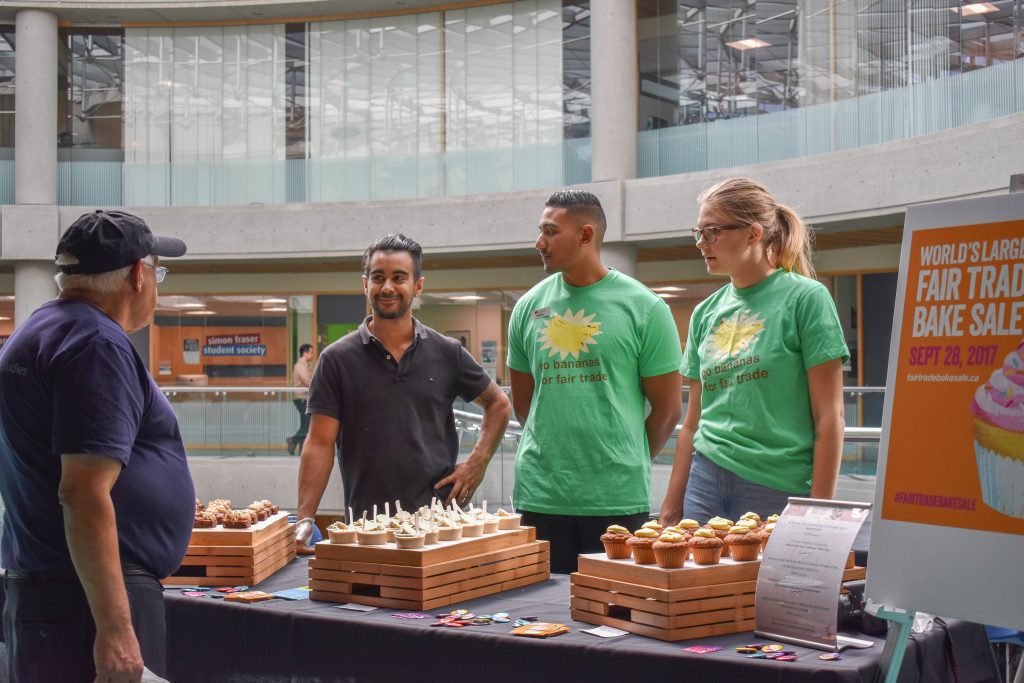
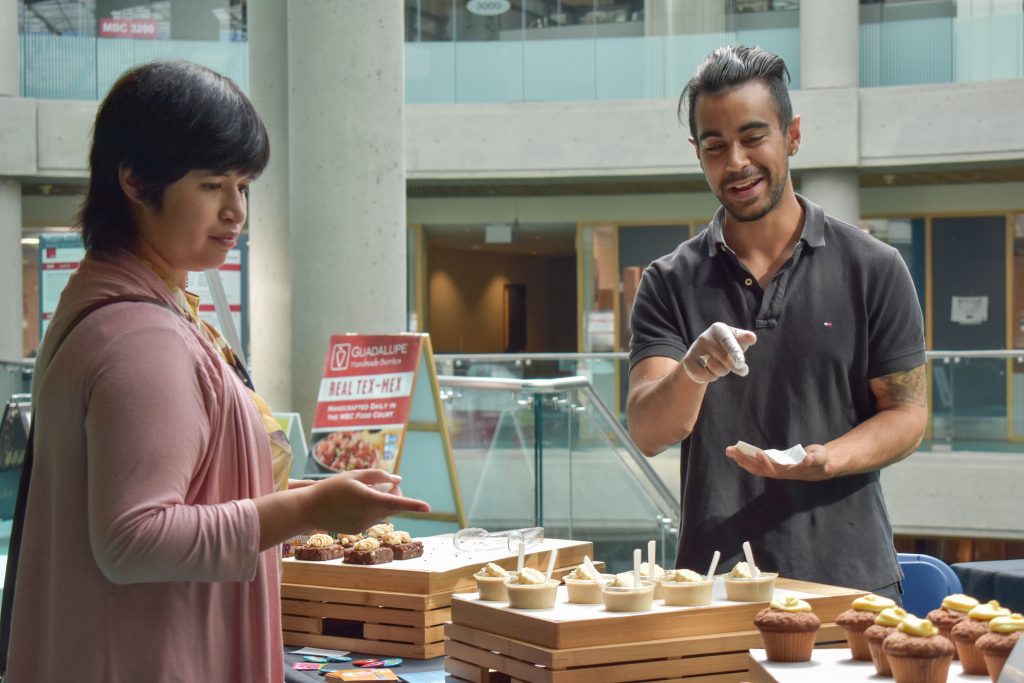
The university hosted the ‘world’s largest’ fair trade bake sale in Maggie Benston Centre last month. The initiative was part of the annual Fair Trade Campus week.

Along with product availability, obtaining the title of a fair trade campus requires a local university steering committee to ensure continued commitment to the program, as well as a push for the visibility of fair trade options and education regarding the fair trade cause.

The university was the second campus in the country to earn a fair trade campus designation in 2012.

“Since our designation in 2012, SFU has strived to go beyond the minimum requirements,” said Torrye McKenzie, a representative from the Canadian Fair Trade Network.

In its efforts to meet the silver fair trade campus requirements, McKenzie reported that SFU has recently brought fair trade fruit onto campus, but still needs to introduce a sugar option, more varieties of chocolate, tea, and non-food commodities that meet the fair trade standards.

Participation in Fair Trade Campus week is a requirement of the silver designation.

One of the requirements of the program mandates at least one franchise on campus serve one or more fair trade products, and SFU was able to meet this requirement in 2014 with the introduction of Starbucks. The campus Starbucks was one of the first locations to offer fair trade options.

McKenzie predicts SFU will be approved for a silver fair trade campus designation by spring of next year. The 2018 National Fair Trade Conference will be taking place in Vancouver in March, and SFU hopes to be able to celebrate its new silver status at the event.

The Canadian Fair Trade Network is a grassroots organization which aims to increase the demand for fair trade in Canada through their work with fair trade groups on both a local and government level. There are currently 26 fair trade campuses across Canada, according to the network’s website.

“[Fair Trade campuses are] a very supportive network, and we feel it gives students the opportunity to work on small tangible goals that in the end bring positive impacts for farmers and producers in the global south,” said McKenzie.

Simon Fraser volleyball close out perfect home stand

0
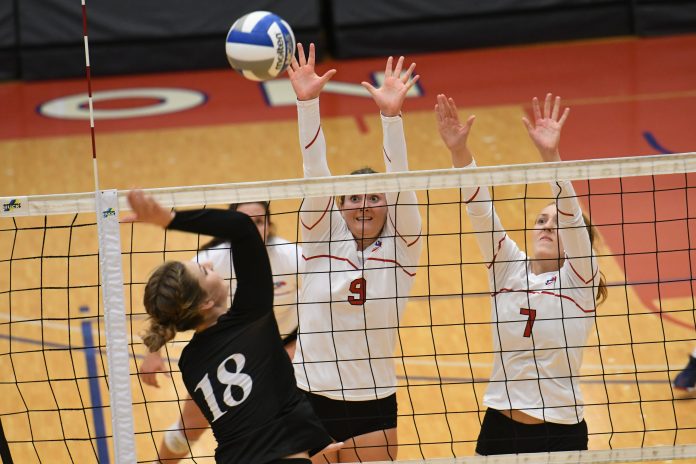
Could this home stand be a turning point in SFU's season? (Photo courtesy of SFU Athletics)

After a rough start to the season in which SFU went 3–8 in 11 away games, they quickly turned things around once they were able to play in their home gym. They capped off a three-game homestand with a 3–1 victory over Concordia University, the exact same score as all three of their other home victories.

Things didn’t get off to a perfect start, however, as the Clan found themselves down 13–6 in the first set. While they managed to close the gap a little bit, Concordia ended up taking the set 25–20. When asked about this slow start by CJSF Radio, head coach Gina Schmidt said, “Most teams come out with a game plan based on what they can see about our tendencies, and maybe they sometimes come out executing a little bit better than we do.”

Despite the unideal start, SFU responded right away in the second set. They got off to a 9–4 start, forcing a Concordia timeout, and eventually won the set 25–14. The Clan then edged out their opponent in a closer third set, winning 25–21.


In what would be the final set of the game, Tessa May got the crowd excited with a massive kill to tie the score at 3–3. The Clan would eventually win the set 25–23 on a Concordia missed serve, wrapping up the victory and putting the finishing touch on a very positive homestand.

Kirsten Pinkney led the Clan with 16 kills, also adding in one block. Christine Howlett had 13 kills, along with five blocks and two aces. Middle blocker Tessa May had 12 kills, and lead the Simon Fraser defence with six blocks. When asked about May’s performance, Schmidt told The Peak, “She had a good weekend . . . the team definitely looks to her to be a leader, both offensively and defensively.”

This three-game homestand may go down as a turning point in the season for the Clan, after they endured a tough 11-game road trip to start the season. When asked how these three wins help the team’s confidence, coach Schmidt responded:

“It certainly helps [our confidence], it’s certainly tough being on the road for 11 straight matches to start the season, especially with a young team. But we knew we had the capability — that we were playing good volleyball. But it was nice to finally get some wins, and in front of our home crowd. We got to play in a number of different situations — playing with the lead, coming from behind, and that will help us as we move forward.”


The Clan hopes to build on their recent success as they travel to Alaska for a two-game road trip. They will first play Alaska Anchorage, who is ranked number 21 in the NCAA II. The game will start on Thursday, October 5 at 8 p.m.

The “Good” Rap?: John Lennon

0

On John Lennon’s 75th birthday, the Imagine: John Lennon 75th Birthday Concert was held by Blackbird  Presents and AMC to honour the late star’s legacy. “#JohnLennon” was trending. To this day, the John Lennon hashtag is filled with fans quoting him and praising him as an icon of  “#love” and “#peace.”

Lennon, who helped lead one of the most influential bands in the history of popular music, is still just as widely revered as an image of kindness and world peace as he’s always been — and this is why we absolutely need to talk about him. Lennon was a “jealous” — more like, abusive — man, and he was very transparent about this.

In 1980, he admitted to Playboy that the lyrics “I used to be cruel to my woman, I beat her and kept her apart from the things that she loved” in “Getting Better” came from personal experience. He confessed, “I was a hitter. I couldn’t express myself and I hit. I fought men and I hit women.”

Examples start with Cynthia Lennon, his first wife. When Cynthia and Lennon first began dating, he saw Cynthia dancing with their mutual friend Stuart. After mulling this over, Lennon got Cynthia alone and smacked her across the face, hard enough to knock her head into the pipes behind her.  

Later, the two had their unplanned son, Julian. Lennon would smack Julian if he believed he was misbehaving, and his definition of “misbehaviour” was broad, severe, and decided mainly by his wild temper. On one occasion, as told in Cynthia’s book John, Lennon yelled at Julian for giggling and screamed, “I can’t stand the way you fucking laugh! Never let me hear your fucking horrible laugh again.” It was, in Cynthia’s words, “monstrously cruel.”

Doesn’t this seem out of character for the man whose identity (read: public persona) is supposedly built around the idea of “giving peace a chance”?

Moving forward in time, if not in character, Lennon caused the end of their marriage by cheating on Cynthia with Yoko Ono. This was hardly the end of Lennon’s abuses, and the neglect of his former family worsened. In John, Julian Lennon stated that he felt “rejected and unimportant in his [father’s] life.”

Lennon moved on, created another life and family for himself, changed everything around him, and ultimately failed to change himself. When Lennon and Ono were together, he insisted that she follow him everywhere — including the bathroom — because, as Yoko stated, “He thought that if he left me alone with the other Beatles even for a minute, I might go off with one of them.”

Lennon was suspicious, possessive, and controlling of Yoko, expecting her to devote herself to him fully. Yet he cheated on her one night at a house party that she was attending with him, as noted in John Lennon: The Life.

Despite this, Ono was committed to him, and became pregnant with their son, Sean. At this time, Lennon allegedly kicked Ono in her pregnant stomach. Their son was not harmed at that time — but some time after his birth, he did something cheeky at dinner, and in turn, John screamed in his ear so loudly that Sean was taken to the hospital for noise-induced ear damage.

His track record of violence doesn’t end with domestic abuse. At the time of Paul McCartney’s 21st birthday, rumours about Lennon’s sexuality were in the air due to his closeness to the band’s gay manager, Brian Epstein. The two had gone to Spain together, and those around Lennon were suspicious of their actions.

Bob Wooler, a friend of the Beatles and a DJ at the club where McCartney was celebrating his birthday, made a small comment to Lennon inquiring about what happened between him and Brian. In return, Lennon nearly beat Wooler to death as he begged him to stop.

Lennon never personally apologized to Wooler for the incident, allegedly justifying his actions because he was called a “queer.” While Wooler was lucky enough to not be killed by Lennon’s anger, the sister of Stuart Sutcliffe, the Beatle before the Beatles were big, claims that her brother was killed by a kick from John Lennon in the head.

A postmortem had shown a dent in Stuart’s skull, and Pauline Sutcliffe says that Lennon had kicked her brother in the head in a jealous rage. She believes the two had a “homosexual affair,” and claims that “John said himself at one point that this happened.” And while these allegations are disputed, it is important to acknowledge their existence — and the fact that these allegations are well in line with actions for which Lennon was known.

While there is still so much more to discuss — his problematically racist lyrics, his mocking of the disabled — this is more than enough negativity for one sitting. I certainly don’t mean to discourage anyone from being a fan of his musical stylings. It is absolutely necessary that we separate people from their creative content if we expect to enjoy anything at all, because we cannot expect artistic talent to come hand in hand with morality.

What we can do, however, is criticize artists for these kinds of monstrous abuses without attempting to rationalize them. Time after time, fans have excused these horrendous behaviours because Lennon was “complex” or because “artistic genius has a price” and accepted and worshipped him for who he was, regardless of the evil he perpetrated throughout his life.

We cannot continue to worship this man as a peace-loving hippie or love-filled prophet, and must move forward with the truth we know. We need to stop celebrating him, quoting him, and hanging images of his face on our walls. Abandon your fake idols, or accept that your praise of a violent and abusive man reflects poorly on YOU.

ARTICLE RESPONSE: SFU’s Clan is not the Klan

0

In a petition that has been buzzing around campus this month, Professor Holly Andersen argues that etymological history and unfortunate coincidence, in combination with recent events, are cause to rethink the SFU sporting moniker, “the Clan.” She argues that it is overly evocative of the KKK, particularly because we play in an American league, and that to continue under this team name would be incredibly disrespectful.

However, with the KKK’s history going back over a century, why is the public outcry over this word so recent? SFU’s football team has been playing under the “Clan/Clansmen” name since the school first opened in 1965. Perhaps we’re simply more attuned to social issues in 2017, but keep in mind that the ‘60s were heralded as the height of the Civil Rights Movement.

SFU has always been a very progressive school, yet in spite of the KKK’s high profile in North America at the time of our opening, it does not seem as if the name was seen as a problem then. In fact, this is the first time that this sort of petition for this reason has been brought forward and garnered attention, and SFU has never had any official, public accusations of white supremacy leveled against it.

The fact that SFU now plays against American teams in the National Collegiate Athletic Association doesn’t change much about the situation either, because that’s not actually new. SFU competed against American teams in the National Association of Intercollegiate Athletics from 1965 until the late ‘90s. Throughout these years, athletes of colour have still played for and against SFU’s team.

I find it hard to believe that our name has such terrible impact, because even Andersen herself states in the petition that “[black student athletes] know that’s not what [we] mean by it.” Certainly, the fact that over 400 people have signed Andersen’s petition shows that there are people who take issue with the name. However, I wonder if changing the name is really the best way to fight the KKK’s influence.

SFU shouldn’t gloss over the negative connotations of the name, but that doesn’t mean we should allow the KKK to dictate and control our language. What it means is that we need to take the opportunity to show that the name “Clan” can be a symbol of pride and respect, by making the distance between ourselves and the KKK clear in our actions.

Though hate groups are on the rise in the US, the Southern Poverty Law Center estimates that there are only 5,000–8,000 members of the KKK in the US at the moment, and the Anti-Defamation League reports that the KKK is actually continuing to decline in membership. This does not, in any way, mean that the KKK should not be treated as a threat. However, with the organization being at a historical and ever-declining low, allowing them authority over our language and our name doesn’t hurt them — it gives their power back.

This isn’t about ‘wishing away’ or ignoring history. The history behind the KKK is tragic and awful. However, I believe that we can remember and learn from history while still moving forward.

Whether we keep the Clan name or not, the KKK will forever live on as a symbol to those who wish to continue their work, just as there will forever be neo-Nazis, hard-line fascists/communists, and other similar groups. What we can do is show solidarity and lack of fear towards an organization that has so much terrible history in North America.

We can host events, presentations, or exhibitions on SFU’s Scottish roots and how they’ve influenced the school’s team names, identity, and mascot choice to show what “Clan” means for us. We can hold fundraisers to raise funds for charities and organizations that works towards ending racial hatred. We can publicly denounce hate crime and those who perpetrate it. If we solidify action plans to fight racism and hate crime into SFU tradition, we can do much more work towards opposing racist ideologies and making the meaning behind the word “Clan” clear.

Undoubtedly, if we continue to use the “Clan” name, we will draw criticism. However, I think that there is still a lot of good to be explored in our team’s name, and through this exploration, I believe we can strengthen our bonds as a school while standing against an organization that has inspired fear in our hearts for too long.

SFU Indigenous students break down barriers at Indigenous Day

0

Indigenous students hosted a gathering on campus last week to break down colonial constructs and make Indigenous peoples visible in the community.

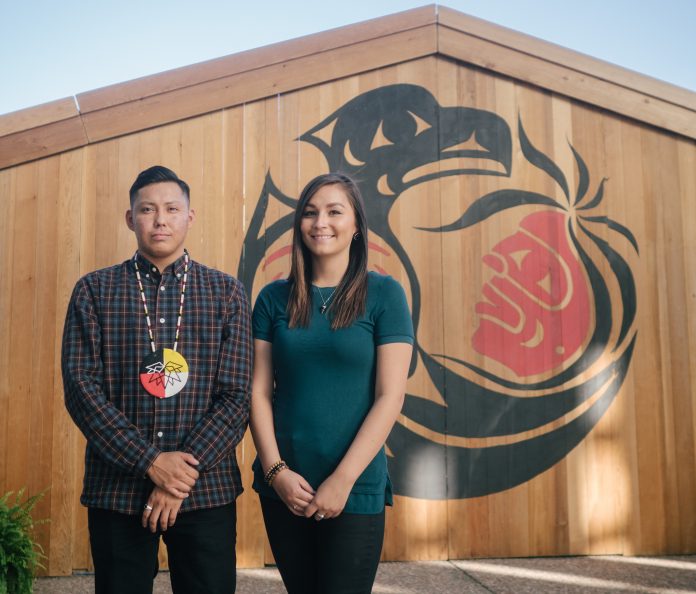
The annual Indigenous Day event in Convocation Mall featured performances by student and visiting artists on the unceded territories of the Tsleil-Waututh, Squamish, Musqueam, and Kwikwetlem nations.

“It gives us room to make space for ourselves,” said Maddi,* an event organizer with the First Nations Student Association. “This just allows us to take up the whole space that we deserve to have and give Indigenous people an outlet.”

This is the fourth time that the event — which is the largest hosted by the association each year — has been held. It also provides a chance for other Indigenous students to connect with their community on campus.

“I feel like that is really essential to Indigenous students in educational settings, for them to succeed here, it is really important to have their community,” said Matthew Provost, who is also an event organizer with the First Nations Student Association. “They may feel empowered, they may feel connected in some way that lacks in other parts of their student lives.”

“It gives us room to make space for ourselves.” – Maddi, First Nations Student Association

This year’s theme ‘burn the borders’ was reflected in the words of Indigenous performers who sought to address colonial structures and present an important message through a diversity of Indigenous stories.

“We are from different nations and have different aspects to what makes us Indigenous. This is to celebrate our differences as Indigenous people and to have it recognized who we are and where we come from,” Maddi explained.

The theme denotes overcoming colonial barriers and bringing the wider community together for the event. A number of student spoken-word artists as well as visiting drummers and dancers performed throughout the day and local Indigenous hip-hop artist Jerilynn Webster, known by her stage name JB the First Lady, moderated the event.

“This year, our headlining acts [are] all Indigenous women who are very, very active in the community here,” Provost added. “You don’t really see that any more — Indigenous women being able to be those voices.”

“We’re trying to break down those barriers as well, especially in Indigenous communities.”

“We have a really big community of Indigenous students here and we want to embrace [that] all Indigenous people are different.” – Matthew Provost, First Nations Student Association

The event is meant as a relationship-building platform for non-Indigenous students and faculty to meet the Indigenous community on campus, noted Provost.

“I feel like there is a huge lacking [in] the knowledge, the accountability, and the realization of where this campus sits, on unceded territory,” Maddi said. “We are here, we are present, we are getting educated, we are part of this community, and that is why it is so important to learn and interact with us.”

The presence of Indigenous students on campus is not recognized often enough, according to Maddi. “We’re not included in a lot of different activities, especially when there is Indigenous content, they won’t come to us,” she continued. “We are often left out.”

The spoken word performances by Indigenous students asserted many of these sentiments.

“All of the emotional labour from the performers . . . it is inspiring,” Maddi commented. “It reminds me why we do these things.”

*Full name was not published at the request of the interviewee.

Our (sometimes troubling) history with the NCAA

0

On September 24, the SFU Clan football team had a historic loss in their homecoming game, losing by 76 points. They’re pushing almost three years since their last win, leading many to languish SFU’s decision to participate in the National Collegiate Athletic Association (NCAA).

The SFU men’s basketball team doesn’t look to be doing any better, having a turbulent couple of years capped off by their ex-coach, Virgil Hill. The women’s team fares much better, but doesn’t get as much hype and attention as they should. Those are just three of the 17 teams that participate in the NCAA from SFU, which include golf, soccer, and women’s volleyball.

It’s been about seven years since SFU joined the NCAA, and SFU has yet to be a winner in any of their Division II sports. They’ve had a few playoff appearances, and even a few playoff controversies, but it’s been awhile since SFU brought home any hardware.

This isn’t to say that SFU has been terrible, as they’ve actually been pretty successful overall. They recently ranked 15 out of 306 in the Learfield Directors’ Cup standings, which measures the overall success of collegiate athletics programs.  

Amidst all this, let’s take a look back at where this all came from, and potentially where the school could be heading as they continue to carry on as “Canada’s team.”


Joining the NCAA

Simon Fraser University had been trying to join the NCAA for nearly fifteen years before they played their first game in the Great Northwest Athletic Conference (GNAC), which is the division SFU plays in.

The first attempt to join was back in 1997, when SFU was still part of the National Association of Intercollegiate Athletics (NAIA), but they were turned down. They would later go on to partly join the Canadian Interuniversity Sports league (CIS, later renamed to U Sports), which was one of the top leagues in Canada.

SFU would have teams play in both the CIS and NAIA up until 2009, after they successfully made a bid to join the NCAA. They gained conditional acceptance for the 2011–12 season, but ended up starting a year earlier thanks to a proposed ban on SFU teams by CIS.  

They would compete as part of a ten-year pilot program for Canadian teams in the NCAA, but with provisional status. This meant they weren’t allowed to advance to national championships. This led to a frustrating time for teams like men’s soccer, who were the number one ranked team back in 2011–12, but weren’t given the chance to prove themselves on the biggest stage possible.

Beginning in the 2012–13 school year, SFU would become a full member and the only international representative in the NCAA. They met all the requirements, which included having at least five men’s and five women’s teams, with at least two team sports per gender.

This would be helpful for recruitment, as athletes were passing over SFU in favour of CIS teams solely for the chance to participate in national championship games.


Why make the switch?

Many have questioned why SFU is even in the NCAA to begin with, which is a valid question for those wondering about the history. The truth is, the administration meant for the school to play in the United States when it was built back in 1965. Gordon Shrum, the first Chancellor of SFU, loved American football so much that he wanted his school to be playing that over the Canadian style.   

They joined the NAIA right away, which is catered to play in the United States, although it does have several teams outside of it. According to Wikipedia, “The SFU Clan holds the NAIA record for most All-Americans and U.S. National Champions (individual),” which is hilarious, but also showed the high competitive level that was the school’s standard.  

This would suit them fine up until 1997, when many of the American schools that SFU would have played against moved into the NCAA. As mentioned previously SFU would try to follow them, applying to the NCAA, but getting rejected. Instead of shutting down the teams who would no longer have anyone to play against, they would split their teams into the NAIA and CIS.

However, this was far from ideal for some teams, like football, basketball, volleyball, and wrestling. The travel and the cost associated with it shot up exponentially, as travelling to Manitoba proved much more difficult than games in Washington and Oregon.

Oddly enough, it would be the University of British Columbia that would open the door for SFU to join the NCAA. They were the main school leading the charge of the Canadian team pilot project, however they would ultimately opt out. Thanks to that, SFU gets the claim of being Canada’s team, which makes for a great sales pitch.  


Controversies of a Canadian team

The switch to the NCAA hasn’t been the easiest road, especially because of the hurdles that being an international team has created.

Most famously, the men’s soccer team — which might arguably be the most successful teams in SFU’s NCAA era — was denied hosting playoff matches twice.

The first time was in 2012, when the team was ranked number one heading into the playoffs, giving them the opportunity to host their first-ever playoff game. However, other schools in the GNAC objected, because players and team staff did not have passports to enter into Canada.

Their arguments were heard by the NCAA, and SFU saw its host status taken away, eventually being forced to set up shop as the “home team” in San Francisco. Despite going out of their way to find a solution to the issue, the NCAA would eventually decide to just take away SFU’s hosting rights entirely, giving them to Grand Canyon University, who finished number two in the region.

This would happen once again in 2016, although renting out a neutral field in Seattle allowed them to keep their hosting rights.


SFU teams that aren’t in the NCAA

When SFU was petitioning to join as a full-fledged member, then-director of athletics Milton Richards said, “We have 17 [teams] and you only need 10 be be a Division II member [so] I really don’t see us adding any more programs,” in an interview with The Globe & Mail.  

However, that may not be the case, as there is a chance that hockey might be on the table to join the NCAA. Currently, SFU lists hockey, field lacrosse, and cheerleading as non-NCAA sports, to go along with their recreation and recreation clubs.

The reason that hockey isn’t a part of the NCAA is that there just isn’t a Division II for hockey. Currently, the school plays in the British Columbia Intercollegiate Hockey League (BCIHL) as an alternative.

In the summer of 2016, new athletics director Theresa Hanson made waves by announcing that SFU would like to join Division I for NCAA hockey, potentially joining as early as next season. Under the current rules for Division II, teams are allowed to have one men’s and one women’s team join the uppermost echelon.

SFU Athletics was also looking into adding a women’s beach volleyball team, bumping them up to 19 NCAA teams. This would give them representation in nearly 80% of Division II’s 25 possible teams (not participating in games such as rifle, equestrian, and bowling).  


What comes next?

As we mentioned, Simon Fraser University ranked 15th in the Learfield Directors’ Cup. This comes after placing 55th the year before, which is still impressive considering there are 306 entrants. Teams like cross-country, women’s basketball, volleyball, and our soccer teams might not be grabbing headlines, but they are doing right by the school.

However, SFU might start to get more recognition as a trailblazer in the international aspect of the NCAA as another team might be joining.

In April of this year, SFU officially joined a pilot program created by the NCAA, allowing other schools to go through the same process. Centro de Enseñanza Técnica y Superior, a school in the Baja California region of Mexico, wants to join the NCAA. They even have the backing of the California Collegiate Athletic Association.

Perhaps if more teams join the NCAA outside of the US, it will lead SFU’s inclusion in the sporting league to be seen less as an experiment and more of a pioneering effort. Unfortunately, this might dramatically reduce the odds of Simon Fraser University remaining “Canada’s team.”

SFU women’s soccer clinch 3–0 victory against Northwest Crusaders

0
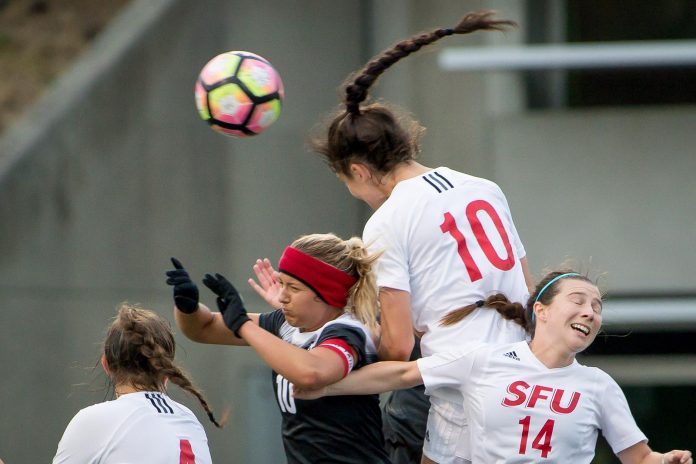
Emma Pringle (no. 10) now has seven goals in her last three games. (Photo courtesy of SFU Athletics)

By a 3–0 score, SFU women’s soccer team won their third game in a row this Saturday night against the Northwest Nazarene Crusaders. Although there were no goals scored until the last minute of the first half, the SFU women were continually pushing for a goal, and fired seven shots at the Northwest goalie Danielle Ortiz in the first half of the game. Near the end of the first half, SFU’s effort began to pay off. With a series of near misses at goal, the game began to heat up. With just over a minute left in the first half, Emma Pringle, assisted by Jenna-lee Baxter, scored the first goal of the game against Northwest.

This was Pringle’s sixth goal in the last three games, and 10th overall this season, but still not her last of the night. With just 10 minutes left at the end of the game, she scored the second goal for SFU resulting in a 2–0 lead over the Crusaders. Assisted by a fantastic 30-yard pass from Katelyn Erhardsen, Pringle had a nearly open field to land her second goal of the game, and secure SFU’s lead for the night.

But the pressure was far from off at this point in the game. With her second assist of the game, Katelyn Erhardsen helped Claire Bareilles clinch the final goal for SFU. A freshman at SFU, this marks Bareilles’ first goal of her SFU career.

“I’m extremely proud of her,” head coach Annie Hamel told reporters at SFU Athletics. “She’s come close in so many games, so she was really excited and we’re all so happy for her.”

With a 3–0 lead in the last minutes of the game, SFU was safely ahead. Despite this, the Northwest girls never gave up, and pushed hard right until the end of the game.

This being SFU’s third win in a row, the team is enjoying their longest winning streak of the season. “I feel very happy,” said Hamel. “It’s good to see two back-to-back really strong performances. Our attack is really getting going, with eight goals in two games, and also two clean sheets.”

The Clan will next be travelling to Montana State University Billings, where they’ll be facing the Yellowjackets on October 5. After that, they’ll be heading to Portland, Oregon facing the Concordia Cavaliers on October 7.

How to survive dead, dry, and dreary lectures

0
Illustration by Alisha Lee

It’s always easy to get through the first two weeks of school because it flies by in the blink of an eye. However, once we’re here on a Monday morning in the fifth week, things aren’t as pretty. Even that grande cup of Starbucks espresso ain’t enough to keep you awake. So, to help you get past one, two, or three torturous hours of tedious lectures, we at The Peak compiled a mini list of fun and adventurous activities that are worth trying out to keep your eyes from drying out!


Go about your business with your hangnails

You’re sitting in your chair — leaning back, half listening to your prof yap — when suddenly, you know something’s wrong with that stinking shoe of yours. You pull out your foot and fuck, a two-inch hangnail is protruding out of your sock! You slap your heel onto the chair in front of you, lean forward, grasp the bastard with your teeth, and riiiiip! Then you wedge the hangnail between your teeth, track down the lone soul that’s going to suffer your wrath, and blow! You’ve scored your three-pointer of the day!



Compose the world’s greatest symphony

Do – re – mi – fa – so – la – ti – do . . . What better way is there to spend your precious time than to use those creative juices of yours? First, lay two or three books on your desk. Then, start slapping a constant 1 – 2 – 3 – 4 pattern with your hands. After that, stomp with your feet at the first and third beat. What’s left is for you to enjoy it! Close your eyes, sway your hips, and fully free yourself from the murderous glares of your classmates and your professor.
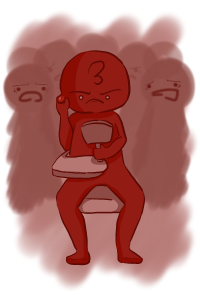



Surf the web

This has got to be the number one most common thing I’ve seen people do. Laptops, tablets, and cellphones all lit up like Christmas. From YouTube to Facebook to Instagram to EVEN, occasionally, Canvas! While you surf, don’t forget to check out the latest vacation hotspots, because the second you’re out of here, that’s where you’re going next.


Freshen up

OMG
! Is that a spot/zit/pimple (or whatever you call it) on . . . me? For all you drama kings and queens out there, this is the perfect way to pass the time! Take out your makeup kits, razors, and detergents — and freshen up! It’s a great way to save time, especially when you’ve got a cute date right after the lecture.


When all else fails to please you, catch up on some beauty sleep. But if you wake up and find yourself in a deep pool of wet slimy saliva . . . congrats to you.

Burnaby campus faces major parking congestion

0
The demand has prompted the university to open an overflow lot in UniverCity.

If you are finding it difficult to find a parking spot at the Simon Fraser University Burnaby campus, you are not alone. The university is experiencing increased congestion in its parking lots this semester and parking passes have sold out at an unprecedented rate.

“I find the parking situation is not only an issue that is disregarded, but [a] large one too,” said undergraduate student Elda Hajdarovac, who drives to the SFU Burnaby campus regularly and knows the struggle to find parking.

This fall parking passes sold out after the first week of classes, according to David Agosti, director of Parking and Sustainable Mobility Services. Last year they only sold out after the first month of classes and prior to that they did not sell out for many years.

“I find the parking situation is not only an issue that is disregarded, but [a] large one too.” – Elda Hajdarovac, SFU student

To address the issue, parking services has announced a partnership with UniverCity to accommodate overflow parking on the Burnaby campus. A hundred new overflow parking spots are located in the southeast corner of campus in the former ‘G lot’ on Tower Road where UniverCity construction has not yet started.

Agosti explained that addressing the parking congestion on the Burnaby campus is no easy feat, but recognized that the issue is a concern for many students.

“One of the challenges is that there are four entities on campus controlling parking,” he said, referring to the lots under parking services in addition to those run by SFU Residence and Housing, UniverCity, and parking along the streets under the City of Burnaby.

“The important thing to understand is that while this is a challenge faced by people driving to campus, in reality this is an overall transportation challenge for anyone coming to the Burnaby campus,” admitted Agosti. “We’re working on both the parking and general transportation situation.”

Students who did manage to get a parking pass may be relieved to know that, since a 2014 blog post posted by parking services, the university hasn’t oversold parking passes in the last three years.

For others who have not been able to obtain a parking pass, it is hard to explain the sudden increase of drivers coming to the SFU Burnaby campus. However, local media has reported that changes in driving habits due to the elimination of bridge tolls this month have caused congestion elsewhere in Vancouver.  

“In reality, this is an overall transportation challenge for anyone coming to the Burnaby campus” – David Agosti, SFU Parking and Sustainable Mobility Services

Since Hajdarovac started her degree at SFU five years ago, she told The Peak that she has never had the chance to purchase a parking pass.

“Oftentimes, especially at the beginning of semesters, there is barely any parking available and I often find myself parking in areas that are completely out of the way,” she mentioned.  

Agosti said that the university is also working on collecting and sending data to TransLink to inform them of which routes have challenges and how they can improve transit services. TransLink recently unveiled a new service expansion, but it did not include direct bus lines to SFU.

Many students also say that transit isn’t a valid option for them.  

“It is not that I am [too] ‘lazy’ to take transit instead [of] driving my car, it’s that it would take me well over two hours for a one-way trip,” explained Hajdarovac. “I also want to add that for people who are driving, opting out of the [U-Pass] is nearly impossible.”

She noted that she would like to see the option for people to put that money towards a parking pass if they need it.

“We are students after all,” she said.

Agosti recommends that students send their feedback, suggestions, and concerns about parking on campus to the parking services office.

Kingsman: The Golden Circle has good action and a good cast, but not much else

0
(Image courtesy of 20th Century Fox)

Kingsman: The Golden Circle is a disappointing sequel by X-Men: First Class director Matthew Vaughn. The film is crowned with fun, stylized action scenes, but it suffers from some severe drawbacks.

     The film’s narrative gets boring after the exhilarating car chase at the beginning. While it’s good to see actors from the first Kingsman, the film is filled with scenes that disrupt the story’s flow. One example is when Merlin (Mark Strong) and Eggsy (Taron Egerton) get drunk as a “Doomsday protocol” after the Kingsman buildings are destroyed. This scene is anti-climatic and only succeeds in already detracting from what could have been a more entertaining spy flick.

“…the film is hindered by its underdeveloped characters and a narrative that becomes stale halfway into the movie.”

     Egerton does continue showing charisma in his reprisal of Kingsman super spy Eggsy.  Colin Firth’s return as Harry Hart is surprising due to his character’s apparent death in the last instalment. However, Firth’s chemistry with Egerton remains unwavering. They evoke heart from their characters’ father-son relationship and, in the film’s final fight, prove that Eggsy and Hart are the ultimate spy duo.  

     Unfortunately, the secondary characters are dry. The American spies called Statesmen, who for some reason use alcoholic drinks as code names, lack substantial roles in the story.  Agents Tequila (Channing Tatum) and Champagne (Jeff Bridges) have such short appearances that their purpose in the film remains a mystery. While it may be that Vaughn intended Tatum and Bridges to be glorified cameos, their lack of significant screen time is a waste of such talented actors. Pedro Pascal’s performance as Whiskey, however, is more engaging. His fight scenes, where he uses a lasso, help elevate the hyperactive craziness that’s present in almost all the film’s action sequences.

     A hilarious surprise appearance is the legendary Elton John. John delivers spunk and light-heartedness in his scenes. His amusing performance overshadows Tatum and Bridges and perhaps the entire movie. John’s unapologetic humour helps make the film a little more worth watching.

     A puzzling casting choice is Julianne Moore as Poppy Adams, the leader of the Golden Circle. Moore does deliver a level of creepiness as Adams, but she doesn’t strike me as a right fit for this character. Her portrayal of a two-dimensional villain with insecurity issues, and armed with a “pleasant on the outside, but psychopathic on the inside” persona, doesn’t provide the right platform to show off her Oscar-worthy acting. With Adams’ predictable motive for world domination, there’s little to expect from Moore beyond just playing a stereotypical, egotistical villain.

     Even though the action is exhilarating, the film is hindered by its underdeveloped characters and a narrative that becomes stale halfway into the movie. There are also aspects of the film that may cause discomfort. A couple of the scenes feature the graphic deaths of a few characters via meat grinder. These scenes are so upsetting and disturbing to watch that even Quentin Tarantino would feel nauseated if he viewed them. Keep those meat grinder scenes in mind and watch with caution. Overall, Vaughn’s Kingsman: The Golden Circle doesn’t have much substance, but it’s still worthwhile to watch.