Home Blog Page 659

The hit new diet of the student

0
Illustrated by Alice Zhang

By Tiffany Chang

We all know how fabulous students are when it comes to eating healthy, right? This is especially true during finals season. We always promise ourselves that we’ll stick to a strict diet of instant, pre-packaged foods, filled with amazing artificial flavours and preservatives, as well as different types of sugary snacks!

This diet has a name. If you haven’t heard of it already, it’s the “Student Diet.” To give you some helpful tips, here are some of the main go-to dishes that are a part of the dominant university student cuisine:

Frozen pizzas: Perhaps the most satisfying part of the student diet, and a great way to provide students with sufficient nourishment from all four food groups! The crust is the grain product. Tomato sauce hopefully has tomato in it — tomato is considered a fruit, right? Ah, and the delicious cheese from the dairy group. . . Cheese just gives us the high-fat goodness we constantly crave. Finally, pepperoni is the deliciously greasy meat! God only knows what’s in that meat. Nothing excites me more than taking the delectable frozen pizza out of the box, ripping off the plastic wrapping, and popping it into the oven for twenty minutes, knowing that I’m making such an easy and healthy choice!  

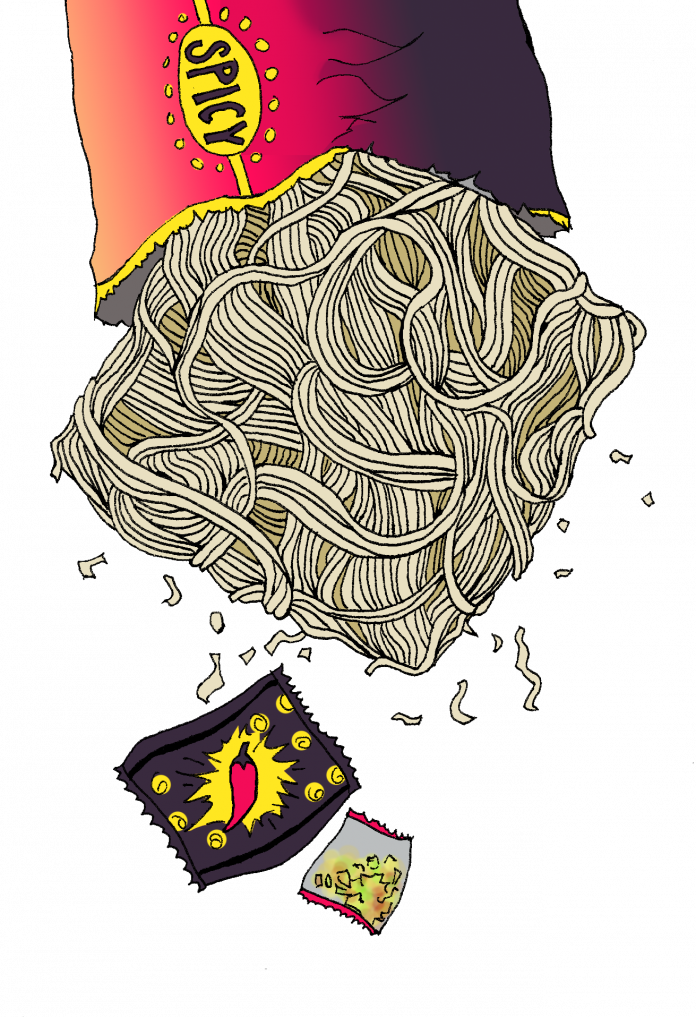
Ramen noodles: Carbs! It is impossible to live without carbs. Eating ramen seven days a week does have its benefits. Carbohydrates do in fact turn into glucose, so it gives students the energy we so desperately need for late-night studying. The more carbohydrates, the better! There’s no question about it; ramen has become a trend, and the ultimate staple for everyone. Keep up the ramen consumption! You can do it!

Fuzzy peaches: Who needs breakfast? All of those doctors and health tips on MSN are completely useless! They say that breakfast is the most important meal of the day. Let’s be totally honest with ourselves: breakfast just makes you sluggish in the morning. Why spend all that time preparing a filling breakfast, or going out to buy it every morning, when fuzzy peaches are a cheap alternative? I mean, of course it’s fine to substitute breakfast with a quick sugar-fix from the sweet confectionary! Try it first thing tomorrow morning. You’ll thank me later.

Any kind of coffee: “Coffee” is every student’s mantra. Who hasn’t seen someone around campus drinking coffee from Starbucks or Tim Hortons? Stop drinking water or juice and just drink coffee! The university student’s body is conditioned to run on coffee once freshman year begins. It’s actually healthier for us to drink coffee than water! Can you believe it? Needless to say, don’t hesitate to go for that extra cup when you feel a little drowsy.

Be consistent with eating these types of foods, and you’ll be a perfectly healthy student!

Stuff we like and don’t like

0
(Elena Hsu / The Peak)

By: Amneet Mann

Stuff we like

Quality bagel service

There is at least one sane bagel supplier on campus — our beloved Renaissance Coffee. Yes, they may put all their chocolate chips in the middle of their cookies, and yes, their pseudo-Iced Capps are made with a questionable amount of sugar, but when I ask for peanut butter on a bagel, I get peanut butter on a bagel.

     You can find disappointment in a lot of places, but not in a Renaissance cinnamon French toast bagel that comes slathered with a thicc layer of peanut butter and cut into halves. That is what I call quality bagel service.


Stuff we don’t like

Do-it-yourself bagels

Twice this week, I needed food under a time crunch, and so I dropped by my local “convenient” campus food suppliers, Starbucks and Tim Hortons, with a simple request: “Can I get a toasted bagel with peanut butter?” Turns out, no, I can’t. What I can get is a toasted plain bagel with a separate packet of peanut butter and a plastic knife. Or, if I’m at Starbucks, I can get a separate packet of jam because they don’t even carry peanut butter.

      Campus bagel providers: I did not pay $1.69 so that I could take a pit stop to assemble my own bagel and contribute extra waste to our devastating landfills.

New student support program for mental health to be launched online

1
The multiplatform service aims to increase accessibility of mental health services for SFU students. (Chris Ho / The Peak)
By: Srijani Datta, Assistant News Editor


A joint effort by SFU and the Simon Fraser Student Society (SFSS) has led to the development of a two-year pilot program extending a new student support service for mental health.

     On August 1, keep.meSAFE Student Support Program (SSP), a 24/7 multi-platform mental health and support service, will be made available to SFU students. The program is the end result of five months of collaboration between representatives from the university and the society.

     The new initiative will be offered online and is to be integrated with the Health and Counselling Services of SFU.

“This is one of the most exciting developments I have seen in my time at SFU.” – Martin Mroz, director of SFU Health and Counselling Services 


Goals of the program

Martin Mroz, director of Health and Counselling Services (HCS) explained that the goal of the pilot is to address three factors. The program is meant to create and provide increased access to health services for students, spread education about mental health and services while working to remove the stigma attached to mental health, and foster a more inclusive and empathetic community where people are able to talk about mental health.  

     According to Mroz, while HCS already did substantial work in the university, it needed more articulation. He talked about involving and training staff members to help spread education and “change the setting.” The hope for the two-year pilot is that it will be a key step in increasing accessibility to mental health services and ensuring the mental wellbeing of students.  


Service accessibility

When asked how he would summarize the overarching goal of the pilot program, Mroz simply stated, “Access.” The new support service will be accessible 24/7 and through multiple platforms such as phone, app, and website. Mroz stressed that existing HCS staff and resources will be very involved with the implementation of keep.meSAFE.

     Under the current system, students are able to secure appointments with counsellors every two weeks. Mroz highlighted the common situations that are not covered in the current scheduling system, such as when students have an immediate need for a mental health service or when they need to speak to someone only once. The new pilot is aimed at filling these gaps by meeting immediate needs of students through ongoing short-term counselling support over the phone, video, or in-person.

     Another gap keep.meSAFE is meant to fill is access to mental health services for students who are not able to physically visit the campus, such as those living or studying abroad.


Privacy concerns

As the pilot is going to be launched on an online platform, the team working on the program has been addressing potential privacy concerns regarding the information that student users would share. According to Mroz, the team has been in contact with SFU Safety and Risk Services (SRS) for expert advice on privacy concerns. While the provider of the service and their databases are stored on Canadian soil, SFU loses some control on the data when a student residing or visiting a foreign country accesses the services.

     Having addressed this concern, Mroz stressed that, over the years, significant work has been done on Telehealth. He mentioned cases in the past where students have asked for videoconferencing services from HCS, a platform that keep.meSAFE can provide SFU with.


Finance matters

SSP will be provided by Guard.me International Insurance and Morneau Shepell. Access to keep.meSAFE will be available to all students of SFU.  The two-year pilot has a fixed cost and is being funded by the university and the SFSS. The SFSS Board of Directors has approved a one-time financial contribution of $75,000 to the program.

     Mroz expressed his excitement for the program, calling it “a positive initiative” and a unique service for a post-secondary institution to be offering.


WHAT GRINDS OUR GEARS: Lack of food variety at the SFU Burnaby campus

0
Courtesy of Parkerpages

Written by Nathaniel Tok

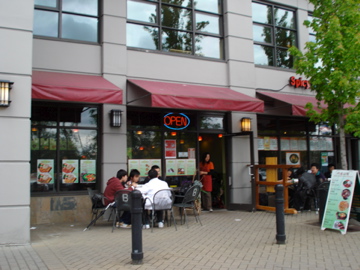
Does anyone else find it annoying that so many of our university’s gastronomy options are monopolized by certain foods? Between SFU Burnaby and the nearby UniverCity, there are at least three sushi places, two pizza places, three burger places, two sandwich places. . . you get the idea.

I know that most of these places have been at SFU for a while but come on, isn’t there something more interesting to sell? Where is my paella? Where are my perogies? The best way for different people and cultures to engage the world is through sharing food, because food makes people happy.

SFU, if you’re listening, that new Student Union Building had better be overflowing with new and exotic foods. I want to eat foods from all around the world, since at this point, that’s the closest my broke ass is going to get to travelling.


One day isn’t enough time to educate Starbucks employees on thousands of years of racism

0
Courtesy of Starbucks

Written by Alex Bloom

In response to an incident of racial profiling in a Starbucks in Philadelphia, in which two innocent black men were arrested without cause, thousands of the chain’s locations will be closed across the United States and Canada for “Racial Bias Education” on May 29 and June 11 respectively. While I appreciate Starbucks’ sentiment, and their intent to prevent further cases of racial profiling in their stores, Starbucks’ track record on dealing with race is not great. I’m not claiming that this new initiative will be just as much of a failure, but Starbucks’ previous “Race Together” campaign does not fill me with trust in the corporate coffee purveyor’s ability to address the issue of racism.

Let’s take a step back in time to 2015, when Starbucks launched “Race Together.” In a presumably well-intentioned attempt to start a larger dialogue about racism, all the corporation did was make their customers feel uncomfortable. The campaign was simple — and that was exactly the problem. Systemic racism is not a problem that can be fixed overnight, and there is a reason that no one has ever asked a coffee chain to tackle it.

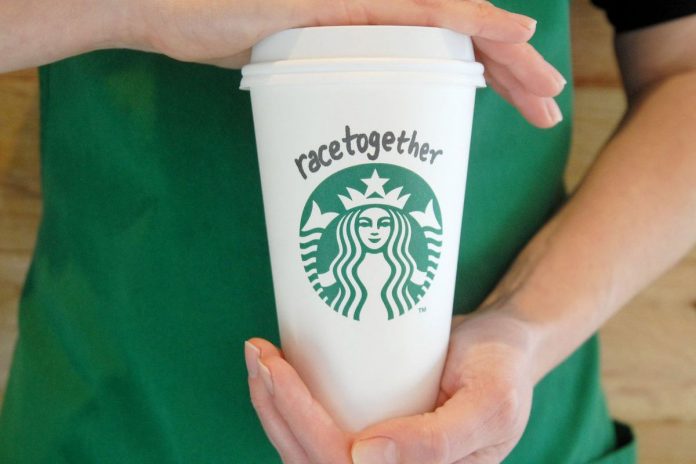
Essentially, Starbucks told its baristas to write the words “race together” on each coffee cup before handing it to the customer, and encouraged them to start conversations about racism during transactions. While it is true that part of the what makes ending racism hard is the fact that no one wants to talk about it, that doesn’t mean talking to your barista about it during the morning coffee rush is the solution. If you are a person of colour who deals with discrimination on a daily basis, you probably don’t need your  teenage white barista explaining what racism is to you.

While it is true that many Starbucks employees are not white college freshmen, and may have been more qualified to speak to the matter, the point remains the same: Starbucks — a business owned by a white billionaire — is not exactly an authority on racism. The “Race Together” campaign was built on several assumptions: that baristas would be comfortable with having conversations about race at work, that the customers would be OK with discussing race in the coffee line, that the baristas would all know enough about discrimination to start a conversation about it, that the customers know less than the baristas on the subject, and that buying a coffee takes enough time for anyone to have a valuable conversation about racism.

It is presumptuous for Starbucks to think that it can nonchalantly step in and solve a problem that humanity has been grappling with for thousands of years, in an afternoon. If it had been put together more thoughtfully, “Race Together” could have been a helpful — or at worst, innocuous — campaign. Instead, the campaign came off as clumsy, alienating, and out of touch.

If you still need convincing on why “Race Together” failed to contribute anything meaningful to the conversation on racism, here are some of the campaign’s “conversation starters” on race, as presented in USA Today: “In my Facebook stream, ___% are of a different race,” “In the past year, I have been to the home of someone of a different race ___ times,” and “I have ___ friends of a different race.” Starbucks essentially asked baristas to pull the “I have a black friend” card to prove to the world how aware they are of racism.

Starbucks’ “racial bias education” seems to be a more tasteful response to a racist incident than their past attempts at being racially conscious. Yet, they also seem to think that one day of training is enough to cut through any racial bias their employees may have built up over a lifetime — a sentiment which does not give me faith that they have learned from their past.

The “Race Together” campaign had all the tact of a white guy who introduces himself to his black son-in-law by insisting that he isn’t racist because he voted for Obama. Perhaps closing their stores for one day of training on the subject is a step in the right direction, but I’d like to see a more comprehensive “racial bias education” worked into their core training before I believe Starbucks is truly invested in combating the issue.

SFU should lessen the number of electives needed or get rid of them entirely

0

Written by Dustin Jorgensen

Education has been commodified and turned into a product like everything else. Post-secondary institutions force students to take more credits than needed for their major in the form of electives. It has gotten to the point that we can argue for eliminating Writing, Quantitative, and Breadth (WQB) electives from SFU. What bigger questions does this raise?

CBC Marketplace recently did a story on fake degrees that uncovered working professionals and politicians who bought fake credentials from online universities. They uncovered a counsellor who held his job for nearly a decade using his fake degree and a computer science lecturer who taught at the University of Toronto and Ryerson using a fake PhD. Pay a few hundred or so and you can have your fake degree too.

If this lecturer and counsellor can hold their jobs without going through the proper education, then what is the point of education in the first place? WQB electives are often taken as GPA boosters and are usually unrelated to the future jobs or careers we’ll have. Students also just take whatever classes they can get into because they want to graduate on time. According to the SFU’s Fall 2017 Undergraduate Student Survey, the most cited reason for us not completing our degrees on time is course availability issues.

It’s hard to not feel like the university is milking more tuition dollars out of our pockets and pushing us into even more student debt. Sure, WQB courses help some students explore and find interests they never knew they had, but it doesn’t take much imagination to picture getting a degree without any of these electives. Would an employer differentiate between a typical four-year degree or a three-year “essentials only” degree? They’re “unneeded” from a job perspective. This is all part of society’s assumptions about degrees and education: we value degrees for the employment to which they’ll lead.

It’s simple. Education has been commodified and transformed into a product like anything else. A degree is primarily valued by comparing the cost and time put in for the wage and the opportunities the degree enables you to have. This is why people are talking up going into trades and downtalking going to university. This is why engineering and computer science majors make snide remarks about Starbucks or flipping burgers to humanities and psychology majors.

But, remember: both an alleged computer science major and a supposed psychology major bought fake degrees and held their jobs.

If SFU dropped the WQB electives, it would save students from what appears to be unnecessary courses and tuition costs, which would make the program seem more ‘worth it.’

BuzzFeed should run an episode comparing different degrees — fake versus real — at “drastically different price points.” No wonder people are buying fake degrees and turning that into a billion dollar worldwide industry: it’s just more worth it to buy a much cheaper fake degree than actually go through the usual process.

Let’s get specific. What could a SFU education without WQB requirements look like? If SFU dropped the WQB requirements for graduation, it would get rid of approximately 8–12 courses. To be fair, keep in mind that some courses, such as PHIL120W, can count as both a Writing and a Breadth elective. Meanwhile, some majors, like the Bachelor of Arts in Health Sciences, have their upper-division writing elective built into the degree (HSCI 319W.) Nonetheless, this would save SFU students two to four full-time semesters of time and tuition. More than $5,000 of tuition fees would be spared.

Another possibility to explore could be if SFU were to eliminate a year of electives, but make a year of co-op or a similar program mandatory. This would keep the length of the degree, but make SFU students more employable, therefore making the degree more attractive to both employers and prospective students. In the Fall 2017 Undergraduate Student Survey, 75% of surveyed SFU students claimed that they felt it was important to be involved in co-op, internships, or practicum experiences, while only 24% of surveyed students had actually taken part.

To some, WQB requirements are quite useful and may spur new interests and career choices. Others would rather only take the courses required for their major and get the hell out. As a whole, we should be focusing on what education is for and can be changed into — to benefit society as a whole — rather than being stuck arguing over whether or not to strip education down to the barebone essentials to benefit individual consumers.

For bigots, the blame game trumps mourning the victims of the Toronto Van Attack

1
Courtesy of AFP/Getty

Written by Amal Abdullah

On Monday, April 23, 25-year-old Richmond Hill resident Alek Minassian crashed his van into a sidewalk full of pedestrians at the intersection of Yonge Street and Finch Avenue in Toronto. Canadians from coast to coast came together to mourn the tragedy that killed 10 and injured 16. Grieving a true catastrophe of innocent lives lost and guiltless people taken unjustly on Canadian soil, we united as one body of Canadians and cheered for #TorontoStrong.

However, not all Canadians grieved the victims. You will always have vacuous bigots who will shamelessly use every opportunity — with no sympathy or empathy for an issue as sensitive as innocent lives lost — to promote their narrow-minded agendas. Within minutes of the incident, social media, Canadian news outlets, and global news outlets exploded with broadcasts. As news spread, the question that I assume crosses everyone’s mind whenever we hear of such an attack began to emerge: was it a radical Islamic terrorist who worked for ISIS?

Certainly, this thought materialized in digital and traditional news mediums in dramatic ways. Canadaland, a crowdfunded platform for “independent Canadian journalism,” reports that during a phone interview on CP24, a well-credited Toronto news channel, that occurred within the hour of the incident, a witness vaguely described the attacker as “a Middle Eastern-ish man”, but admitted that “I’m not sure, that’s what I immediately thought…I can’t confirm or deny whether my observation is correct.”

As a result of this single ambiguous account, Twitter burst with angry accusations and allegations against minorities and racialized peoples — the usual scapegoats. One only has to scroll through the hashtags that were used, which were originally intended to rally support rather than hate, to see the negative responses. An unfortunate consequence of social media is that people’s real-time reactions to real-time events, no matter how nasty or ugly, are immortalized on the internet.

Around the same time, CBC News reporter Natasha Fatah sent a tweet that said “#BREAKING Witness to truck ramming into pedestrians tells local Toronto TV station that the driver looked wide-eyed, angry and Middle Eastern.” At the time of writing, the tweet had gained 1.5K retweets and 2.1K likes. An hour later, she sent another tweet that said, “Another eye witness to the Yonge and Sheppard incident describes van’s driver as white, intentionally hitting people, describing it as a terror attack.” At the time of writing, the tweet had received 190 retweets and 161 likes. 


It is no coincidence that the sheer amount of social media engagement was so much higher for the first tweet than for the second. As per usual, many were reluctant to describe Alek Minassian as a white radicalized terrorist. He was a white man with enough privilege to be described in a Globe and Mail headline as a “socially awkward tech expert,” and a man whose former high school and college classmates claimed him to have had no known religious or political affiliations or strong views on anything.” His declaration on Facebook of being an “incel” — short for “involuntary celibate,” an identity used by members of a violent and misogynistic internet subculture — apparently did not warrant the label of a “terrorist”.

The 21st century is a time where “fake news” of hate and bigotry is a common phenomenon. It’s promoted as big and scary, with all capital letters, noise, and clamor, much like a hairy Sasquatch or a Loch Ness monster. The truth is, bigotry gets views and clicks because it rounds people up against “the other.” People are attracted to sensational news: it makes more money to lead an audience to believe it was radical Islamic terrorists who carried out the attack than it does to blame a white man.

It is unfortunate and disgusting that we barely had any time to mourn the fallen, to commemorate their lives and grieve their tragic deaths, before we had to begin to fight the racists and the bigots for the sake of the safety of those who are still alive. It is a great disservice, if not an insult and an affront, to the fallen that bigots shamelessly use this incident to promote their vested agendas. Now, if someone tries to convince me that Canada is better than Trump’s America, I don’t know if I’ll believe them.

New summer, same you

0
Photo courtesy of Marcel Grabowski via Action PR

By: Gene Cole

At last, we have reached the start of the summer semester. The wave of new obnoxious students has declined, the sun is out to blind us all, and the city becomes energized as children and teens are released into the streets to run wild. With a different world outside, it’s easy to see opportunities to try to become the better person you falsely believe is inside you. To save you time, we would like to provide suggestions of things you likely need to improve about yourself, and warn you of how you’ll inevitably fail to improve them.

Music

You’ve spent the last several months ignoring your Spotify weekly recommended playlist, sticking to your old typical soundtrack that you’ve been re-downloading to every phone since grade 12. It’s given you comfort through midnight tantrums, long transit rides, and seemingly-endless study sessions. It’s time, at last, to make a playlist to show off how much you’ve changed, filled with recommendations from friends, and apps that you’ve put off for too long.

What you don’t count on is encountering the cool single you found in a movie trailer or car commercial right after you make your summer setlist. You’ll think of it initially as “just another track,” but due to its roots, the song will blend with your desire to purchase a sedan or watch your favourite actors kiss. Without realizing, the “repeat” button will remain on for your entire hour-long commute, and the song will be echoing in your brain once the earbuds are removed. Eventually, you’ll add it to your normal queue, realizing that your musical soul is uncomfortably strict and unwelcoming to change.

Fashion

The intense heat and lack of quality air conditioning has allowed you to shed the thick coats and sweaters of the winter months. No longer must you wear several layers to protect your frail body from the snow, rain, and inevitable depression that ensues throughout the fall and spring semesters. It’s time to be brave, reveal your true face, show off your body with lighter and tighter clothing, and unleash the colours that express your soul.

Then, after going through your dresser, you’ll find quickly that your winter shell of dense fabric was your true skin all along. The few summer things you own were bought during Fall sales, no longer fitting and bought based on price more than looks. You’ll then feel a need to endlessly spend money on smaller-yet-equally-expensive clothing to fill that void, but you’ll only be able to buy a single nice top in order to ensure money for food. This top will collect dust just like the others, as you return to blissful ignorance of your terrible eye for fashion.

Fitness

Lastly, you may likely feel a skulking ambition to finally use your SFU Fitness Center membership that you paid for and have forgotten to utilize for the past two years. You can even wear the nice tight workout clothes that have collected dust, as they have remained untouched and mint condition in your old backpack for several months.

However, the moment you leave the house, thinking how nice it is and how you can now spend an early morning working on your health, you’ll grow tired and sweaty simply walking to the bus stop. As it turns out, enough dense sunlight will deceive you into thinking you had walked several miles and are already in shape enough that you don’t need to worry about it. You’ll instead spend the morning browsing Instagram and reheating your leftover pizza, with a pleasant (and unearned) sense of satisfaction.

Director’s Spotlight: Todd Haynes

0
Photo courtesy of Steve Granitz

By: Hannah Davis

Todd Haynes’s films can be described as anything from eccentric and fascinating to raw and heartwarming. He is an American director and screenwriter whose films include Velvet Goldmine (1998), I’m Not There (2007), and Carol (2015). I’m dazzled by Todd Haynes, his movies, his creativity, and the captivating way in which he tells stories on screen.

     Velvet Goldmine was the first Haynes film I ever saw. This movie features lively and sometimes chaotic camerawork, great performances, and a wonderful soundtrack reminiscent of music from the Glam Rock movement of the 1970s. Throughout the film, Haynes heavily references scenes from Citizen Kane and cuts the drama with some glittery music video interludes. Haynes attempted to make this film a David Bowie biopic, but failed to get Bowie’s permission. He proceeded to make the film anyways, changing enough about the movie that there was no fear of legal ramifications.

      I’m Not There is Haynes’ Bob Dylan biopic. The first time I watched this film, I felt like I had witnessed visual poetry. Six different actors assume the role of Bob Dylan, a decision meant to represent the multiple stages in the artist’s life. These six characters seem to exist simultaneously in the world of I’m Not There, as the audience is seamlessly whisked from one narrative to the next. This movie is also full of Dylan’s music, and I recommend it to all those who love Dylan or folk music.

      Overall, I see Todd Haynes as a director who values creativity, song, and the complexities of the human spirit. I recommend his films to anyone who is a fan of art, music, or imagination.

SFSS and FIC announce support and services delivery agreement

1
The historic agreement will take effect in January 2019. (Chris Ho / The Peak)
By: Srijani Datta, Assistant News Editor


On January 2, 2019, the Simon Fraser Student Society (SFSS) will begin providing a broad range of services and support for the students of Fraser International College (FIC). The agreement between the SFSS and FIC has been reached after years of FIC students expressing their interest in acquiring access to SFSS services.

     FIC student residents originally approached the Residence Hall Association (RHA) requesting the issue be addressed by the SFSS Council. Following the request, a recommendation to evaluate a possible partnership was made at the SFSS Board of Directors meeting held in May 2017.

     The agreement to deliver SFSS services to FIC students was unanimously passed on April 7, 2018.

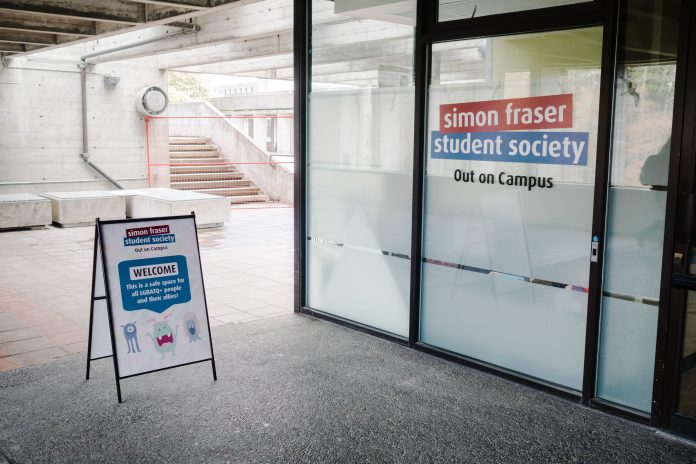
     Under this new agreement, FIC students will have access to services such as the Women’s Centre, Out on Campus, food bank services, free legal clinics, SFSS spaces on campus, and other SFSS services.

     FIC students, however, will not be members of the SFSS and thus will still not be able to vote in the student society elections.

     Sharla Reid, college director and principal of FIC, and Martin Wyant, Chief Executive Officer of the SFSS, spoke with The Peak about the importance of this agreement in creating a strong inclusive community on the university campus.

     Wyant mentioned that he had wanted to collaborate with FIC ever since he got to know about them: “I went for a walk one day and saw a place where all these students were mingling around, and I was told they were FIC students. Once I learned about FIC I was immediately interested to see how we could work together,” he said.

     Reid explained that opening such services will make FIC students feel welcome to the community and campus. She also mentioned that delivering these services early on, when the students arrive at FIC, will help in their transitioning from FIC to SFU after graduation.

“[This agreement] will bring transparency, inclusivity, and create a strong community,” – Sharla Reid, college director and principal of FIC 

     According to Wyant, the reason why this agreement has only now been made official is that, “historically, FIC students could and were availing some of the SFSS services. We did not disallow their participation. But this agreement gives recognition to their participation.”

     “Even though FIC students could participate in the community events, we could not advertise [these] events at FIC,” said Reid, concerning why an official agreement was eventually formed. “This agreement does away with any grey area and helps make FIC students feel more welcomed into the larger community.”

     The agreement is still undergoing development, with the details of the plans still being worked on. The required increase in services provided by the SFSS to accommodate the influx of FIC students will be subsidized by an amount taken from the tuition fees for FIC students. The exact cost of the services for FIC students is still under review.

     Both Reid and Wyant expressed great enthusiasm in working together towards creating a stronger student community where everyone feels welcome.