Home Blog Page 634

Bendy and the Ink Machine’s newest game is the weakest one so far

0
Image courtesy of TheMeatly Games

By Winona Young

The range of emotions I experienced when playing the newest chapter of Bendy and the Ink Machine (BATIM) went from excitement, paranoia, and fear to confusion, frustration, and outright annoyance. This newest instalment delivers a chapter with lacklustre plot, stunning visuals and designs, and frustrating gameplay.

     BATIM is a survival horror game wherein the player, Henry, tries to explore and survive in an abandoned animation studio where he is tormented by inky cartoon demons and more. In this instalment, Colossal Wonders, we take off from where last chapter’s major cliffhanger was set.

     The game begins on a high note. The player is propelled into a rescue mission, starting out afraid and alone as they explore the eerily deserted undergrounds. In this chapter of BATIM, the developers best showcase their knack for creative storytelling with chilling character designs, well-done voice acting, and meticulously detailed worldbuilding. Another selling point of BATIM as a horror game is its intrigue and mystery.  

     However, when the “gaming” aspect of BATIM is fully introduced, the fun is all but extinguished. My friend commented that while he felt that the visuals and cutscenes were quite rewarding, the game itself was a chore to get through. “It’s not fun, it’s frustrating,” he said.

     BATIM has never had a set style of gameplay in place. It has survived so far on its many puzzles, fetch quests, and rudimentary combat games. This chapter in particular introduced an array of new mini games, from carnival-esque shooting games all the way to stealth missions. While all were diverse in their own right, the gameplay overall was poorly designed, had shoddy controls, and was difficult to navigate. The design is unpolished and disjointed, leaving the player feeling confused as hell.

     Colossal Wonders would be a more enjoyable experience if the player already knew how to navigate the confusing gameplay and controls. A second run through would allow players to focus on visuals and details, but I would assume the frustrating gameplay would ward away any fan from returning to the game.

     As a standalone chapter, Colossal Wonders is by far the weakest chapter of the entire series so far. However, BATIM overall still provides an immersive and intriguing horror game that is definitely worth playing. I would recommend that new players wait until the final chapter is released to play, though, given that this chapter will leave a sour, disappointing taste in their mouth.

All four of the Bendy and the Ink Machine games are available on Steam.

Solutions lie in marine life

0
(Photo courtesy of Andreas Dietzel)
By: Agnetha de Sa, Peak Associate


‘Reefs of hope’ may help protect coral reefs from climate-change impacts

In their published article Seeking resilience in marine ecosystems, SFU alumna Emily Darling, and marine biology professor Isabelle Côté suggest a solution to help mitigate the impact of climate change on coral reef systems.

     Some of the hardest hit ecosystems across the globe due to climate change are the world’s coral reefs. Bleaching is one such consequence, where a coral becomes damaged and rejects the algae which it normally hosts from its body, resulting in a brittle white appearance. This condition can be induced by factors such as pollution, extreme low tides, excessive sunlight, and rises in water temperature. Without the algae, the afflicted coral eventually starves.

     Over the past few decades, it has been noted that coral reefs do not have as much time to recover safely from bleaching damage as they once did. While at one time coral reefs had roughly 25–30 years to recuperate, modern coral reefs die within six years if they cannot heal from the bleaching damage by then — ordinarily, it takes at leat 10–15 years for a reef to recover properly. Thus, in order to protect and help the world’s coral reef systems, scientists around the world have undertaken a variety of methods to help coral become resilient such as selective breeding or genetic engineering.

     However, Darling and Côté present an alternative strategy in which resources are spent locating and preserving coral reefs that seem to face less danger from bleaching and predators, dubbed “reefs of hope”. Taking advantage of ocean currents, these scarce reefs can transfer some of their coral larvae to other reefs with a greater need for the increased numbers to combat climate-change damage.

     The researchers advocate for this method over more mainstream methods of attempting to preserve coral reefs because, as Darling says, “Right now, it isn’t realistic to think that we can cost-effectively restore high-diversity reefs at scales of hundreds or thousands of square kilometers using these methods.”

     Darling and Côté acknowledge that fighting greenhouse gas emissions will be the key to protecting coral reefs around the world, but in terms of current available actions, they state that “finding and protecting even the smallest of resistant refugees [reefs of hope] is an urgent priority for global conservation efforts.”


Sea sponges may hold the key to future antiretroviral therapies

SFU Faculty of Health Sciences researchers Ian Tietjen, Zabrina Brumme, Mark Brockman, and colleagues have discovered chemical compounds derived from sea sponges that can be used as antiviral substances for HIV. The results were published in a study in Antiviral Research.

     Tietjen, Brumme, Brockman and colleagues worked with 252 different compounds, taken from marine sponges and microorganisms, to determine what antiviral features each of them might have. Six of them demonstrated antiretroviral capabilities. Among these compounds was bengamide A, which the research group found was able to mitigate the effects of HIV when used in the appropriate concentration.

     Bengamide A works very differently from most established antiretroviral medicines, despite achieving a very similar effect. Tietjen predicts that the fresh perspective offered by this uniqueness can help update our current scientific understanding of how viruses work, paving the path towards the innovation of new treatments for HIV and other viral infections.

     SFU News cites the following organizations as supporters of the research: “the Canadian Institutes of Health Research, Grand Challenges Canada, the International Development Research Centre of Canada, the Canadian Foundation for AIDS Research, and the Canadian HIV Cure Enterprise.”


World News Beats

0

Egypt: New artifacts from time of Cleopatra exhibited

In mid-April, the Egyptian Museum in Cairo opened a temporary exhibit displaying newly discovered artifacts dating back to Cleopatra VII’s rule. Prior to the exhibit, the 300 artifacts had never been seen by the public. Egyptian Minister of Antiquities Khaled al-Anany was present for the opening, describing it as “unprecedented and distinguished.” Elham Salah, head of the Egyptian Museums Sector, described the artifacts — which included paintings, coins, and mummies encased in gold — as a means to understand day-to-day life near the end of the Ptolemaic period.

With files from Egypt’s State Information Service and Egypt Independent.


Tanzania: President Magufuli investigates construction spending at Mkwawa University  

Tanzanian President John Magufuli has implicated a university faculty member with “unethical” spending on a construction project at Mkwawa University. Magufuli mentioned that, while  the University of Dar es Salaam spent 10 billion Tanzanian shillings to build its dormitories, Mkwawa University spent 8 billion shillings only to build a hall, and he deemed the construction of the hall a misuse of government funds. Magufuli has ordered the investigation of a figure he named as “Prof Mushi,” going on to say, “I wonder why no action has been taken against the professor. They are also liable for punishment if [they] mismanage government funds.” Magufuli insisted that legal action will be pursued.

With files from The Citizen.


Mars: Nasa’s Mars InSight mission

On Saturday, May 5, NASA launched Mars InSight. The unprecedented mission will involve delving into and investigating Mars’ interior, gauging both its seismic activity and its magnetic field, as well as the use of small satellites in deep space. Catherine Johnson, a co-investigator on the team measuring seismic activity and a professor at UBC, called the mission exciting. “We’ve waited a long time to put a geophysical mission on Mars,” she said to CBC News. She went on to say, “We’d like to know something about where quakes happen and how big they are and how often, if we’re going to send astronauts to Mars in the future.”

With files from CBC News.


Hawaii: Volcanic eruption forces evacuation

After the recent eruption of the Kilauea volcano, nearby rural areas are facing sulphur gas, lava, and smoke. On Friday, May 4, over 1,700 residents of the surrounding area had to evacuate due to the dangers posed by the volcano. “We knew we were building on an active volcano,” said a resident of an evacuated street. Most people in the area did not believe that volcanic activity was a significant concern. The National Guard were activated to assist in evacuations and to prevent looting in abandoned areas. No one was hurt as an immediate result of the eruption; however, 26 homes have been destroyed at the time of this writing.

With files from CBC News and CNN.

The ethics of big data analytics and governmental responsibility

1

Written by Umer Altaf

If you thought our troubles with Cambridge Analytica ended with the Facebook scandal, you are regrettably wrong. It seems that the company is impossible to keep out of the news. Not only have they recently declared bankruptcy, but the data that they have collected may potentially be sold off to the highest bidder.

In the United States, a company that has declared bankruptcy may sell off any assets it has listed to settle the debts that it has. Personally identifiable information as it is known in legal literature is an asset and the aforementioned data collected is an example of such a legal entity.

Whilst the company claims that the relevant data collected has been destroyed, we do not as of yet know this for certain. If it turns out that Cambridge Analytica does in fact have this information stored somewhere, then the game has just started.

What is perhaps most troubling about all of this is the revelation that the executives at Cambridge Analytica have set up a new company called Emerdata, to which they may be able to transfer the data. The court decision that will determine the legitimacy of such transactions will undoubtedly dominate the news in the days to come.

What might not, however, is the question of the ethicality of this technology in the first place. Forget for a moment the legal debate, and imagine a context where Cambridge Analytica’s information gathering was confirmed to be 100% legally sound. Does the ability of a private, for-profit company to potentially impact global political events not raise ethical questions on the limits of power any entity can have? I would argue that it does.

If we have learned one thing in the past few years, it is that the advancements in big data analytics are coming at us whether we are ready for them or not. Companies — technology-based or otherwise — simply have too much on the line, from a standpoint of competition and continued relevancy, for them not to want to participate. These advancements in big data have allowed us to construct our current AI renaissance, complete with self-driving cars and artificial medical diagnosticians. According to Hackernoon, one way that big data and AI can be used is to improve learning in rural and small town schools. No one wants to be left behind in this game, and so advancements in the field are all but impossible to curb.

The effectiveness of this technology will only grow with time, as more and more data becomes readily available to mine, and our analytical tools become more refined. Most crucially, many of our daily resources — such as social networks or media service providers — are things that we can only use if we surrender some degree of our personal data.

As far as I can tell, there are no perfect solutions to this ethical conundrum. Having said that, there are semi-ideal ones. I would submit that this is a potential case for government intervention in the form of support. Just as there exist social programs to allow people to afford things such as public transportation and low rent housing, perhaps we should have programs that allow people to be able to afford to keep their information private and still use the services that have become so essential to our everyday lives.

There already exist enough means for groups to manipulate people for their personal gains. Somehow, we have come to accept that being talked into things without properly consenting or being informed is a part of life. We are no longer being sold along the broad lines of demographics or tastes, but by our every defining characteristic.

Whether Cambridge Analytica is doing this legally or not is a relatively minor question that shouldn’t overshadow the truly important one; is the surrender of our private data a necessity of the modern world? No, it isn’t. Not if those with means don’t want it to be, and not if our state shields those without them.

Board Shorts

0
Irene Lo / The Peak

Board approves funds for 2018–9 board jackets

The Simon Fraser Student Society (SFSS) Board of Directors passed a motion to “approve the total of $1,128.33 for board jackets.”

     The jackets are purchased each year for Board members, according to SFSS president Jas Randhawa, and are emblazoned with the SFSS logo and individual Board members’ names. “[These jackets] are great tools for engagement when [Board members] are out on Clubs Days or any kind of SFSS-related events,” said Randhawa.


Catering list for clubs and DSUs to be published

Following the approval of the motion to “remove all restrictions on student catering” during the Board of Directors meeting held on April 6, the Board approved a motion in the latest meeting to publish a list of available caterers for student clubs and Departmental Student Unions (DSUs) to refer to when they host events in SFSS spaces.

     “Catering that we are going to be paying for in some way, shape, or form, or approving as an organization, it is important to know that it comes from a licensed, commercial establishment that has a proper kitchen and that it’s on campus,” said SFSS Chief Executive Officer Martin Wyant during the discussion of the motion. “If people are going to not use SFU [catering], then they need to use somebody that’s been licensed to be operating either on UniverCity or on our campus. Because presumably they will have met the standards that SFU traditionally sets.”

     Wyant further noted that student groups booking rooms or open spaces from SFU may need to agree to the provision that they would still be using SFU’s Meeting, Events and Conference Services (MECS) catering.

     For SFSS spaces, however, student groups are now permitted to obtain catering from any restaurant on campus, including UniverCity and Cornerstone.


Funds allocated towards design of Forum Chambers

The Board approved the motion of allocating $20,000 from their space expansion fund to pay for the initial redesign of Forum Chambers.

     The funds would pay for “an initial piece of design work,” a statement which Wyant provided context for: “SFU will bring in some support — architecture support — that they need to pay for in order to take some time and develop a basic design that will see that space that’s currently there into a space that can house both the [CJSF] radio station and [ThePeak.”

     The $20,000 cost estimate was provided by SFU Facilities, with $12,500 being used towards paying the architect, and the remaining $7,500 reserved for other consultants that may be required during the design.

     Environment representative Russell Dunsford asked about the fate of Veggie Lunch, the vegan lunch service that is set up in Forum Chambers three times a week. Wyant responded, “it’s just been an off-the-books relationship with [Veggie Lunch] a little bit. If the radio station goes in there, then yes, we’d have to tell those guys that they would need to find somewhere else on campus to go.”

     Applied sciences representative Kia Mirsalehi also mentioned the dance and music groups that often book Forum Chambers due to its mirrors and piano. It was clarified that the new Student Union Building would have a rehearsal room, which would be equipped with mirrors and a hardwood dance floor, to which these groups could relocate.

The Seagull gives its namesake play new life, but not much else

0
Image courtesy of KGB Media and Mar-Key Pictures

By: Natasha Tar

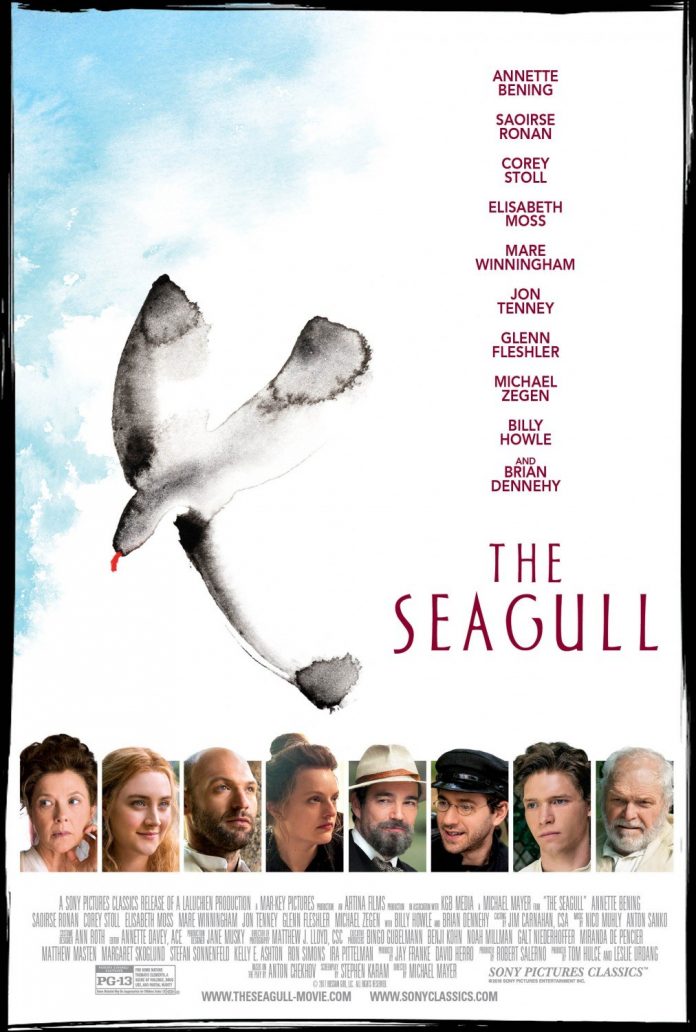
If you’re into intense love triangles, crying, and general drama, The Seagull is the movie for you. Set in a Russian country estate, the film shows the intense relationships that develop between a group of friends and family. Unfortunately, unrequited love runs rampant, and the characters struggle to win their love’s affection.

     I’m a big fan of Anton Chekhov’s 1896 play, The Seagull, that this movie is based on. Going into the movie, I was wondering what kind of twist the director would put on the original. Maybe it would be ‘modernized’ much like Baz Luhrmann’s Romeo + Juliet. A few moments into the film, however, I realized I was wrong.

     Director Michael Mayer takes Chekhov’s play and doesn’t really do much to it, other than give it all the details a stage production would lack. As someone who has read the play before, it was cool to see the characters I remembered embodied in a well-known cast. However, I believe that an audience with no knowledge of the play might struggle to keep up with the huge amount of characters and their relationships.

     That said, if you are looking for a beautiful movie with strong acting from everyone involved, this is your show. The dialogue is near-perfectly true to the play’s script, and the actors play their characters faithfully. Saoirse Ronan skips from scene to scene as the naïve, carefree, and beautiful Nina. Meanwhile, clothed in black because she’s “in mourning” for her life, Elisabeth Moss is Masha, a character who is drunk by the early afternoon and always unhappy.

     While these two characters alone provided an entertaining conflict, Billy Howle steals the show as the angsty artist Konstantin. His anger and misery is a driving force throughout The Seagull, and it made sure I didn’t miss anything that was happening on screen.

     As for visuals, the sets are gorgeous and take full advantage of the versatility of film. One of my favourite scenes shows Konstantin angrily playing piano while the guests play a game in the next room, rolling their eyes and commenting on his mood. From Nina’s trip out onto the lake to Konstantin’s disastrous attempt to put on a play, The Seagull is an undeniably beautiful film.

     The visual appeal, however, does not entirely make up for the movie’s blind obedience to the play. As much as I love the play, the film doesn’t add anything new to its foundation, which disappoints me.

     A word of warning: this movie does contain themes of suicide. Despite the fun and humour in many parts of The Seagull, this film is overall heavy and tragic. Unlike happier movies, the love triangles have convoluted and difficult endings.

     Watch The Seagull for its beauty, its unique story, and its strong performances. But if you still remember the play as strongly as I do, prepare for a carbon copy of what you’ve seen before.

SFU researchers shed light on smart charging and the cause of SIDS

1
(Maxwell Gawlick / The Peak)

By: Agnetha de Sa, Peak Associate


Smart charging isn’t as transformative as predicted

In a new study published by Dr. Jonn Axsen, Associate Professor from SFU’s School of Resource and Environmental Management, Axsen and other researchers look at the way consumers recharge electric vehicles through the use of wind or solar power suppliers.

    Specifically, consumer behaviour in relation to smart charging, a tactic predicted to increase e-vehicle adoption by offering cheaper charging when renewable suppliers are used, was examined.  This method of charging was thought to be a game changer that would result in reduced transition costs, and thus increased adoption of electric vehicles.

     However, when reviewing the literature on the preferences and how consumers interact with electric vehicle infrastructure, Axsen and colleagues emphasized five insights relating to consumer adoption of electric vehicles.

     The first was having the ability to charge an electric vehicle at home is “the most important piece of infrastructure” needed to get consumers to use electric vehicles. The second factor for consumers is the usability of the charging stations, specifically the ease of use between different charging stations. The third factor was cost. The costs of using an electric vehicle “should be lower than the refuelling cost of conventional vehicles,” Axsen and colleagues state. Fourth, the number of charging stations needed for widespread adoption of electric vehicles is currently unclear. Lastly, since there aren’t a lot of electric vehicles currently in use, it is unclear as to how widespread adoption will impact electric grids. While the literature is limited for the use of smart charging, Axsen and colleagues found a paper that suggested that consumers “respond negatively to losing control of when their vehicle is charged.”


A tool that can reveal the cause of SIDS

Dr. Glen Tibbits from SFU’s Department of Biological Physiology and Kinesiology (BPK), along with lab members Laura Dewar, Sanam Shafaat Talab and Eric Lin, are developing a tool that can predict the cause of death in Sudden Infant Death Syndrome (SIDS) cases. The team has received $100,000 in funding from the Stem Cell Network to pursue the research as well as a $160,000 grant from the Canadian Institutes of Health Research.

    According to HealthLinkBC, while SIDS is rare, it is a common cause of death for babies aged between one and 12 months. There are no warning signs before SIDS occurs, and SIDS cases can be further complicated when the cause of death cannot be determined “through autopsies, toxicology, microbiology, X-ray and other analyses,” as Tibbits stated.

    The tool that is being developed by Tibbits and his lab members will be used to determine if the cause of death was sudden cardiac arrest (SCA) in SIDS cases where the cause of death was unclear. SCA is the likely candidate since, as Tibbitts explained, “it has been theorized that fatal electrical disturbances in the heart are causal in autopsy-negative SIDS in up to 30 per cent of the cases.”

   In addition to confirming the cause of death, the tool can be used to reveal if “one or both parents and siblings may be harbouring a genetic mutation which is potentially lethal,” Tibbits explained. Appropriate intervention can then be carried out.

   Through his research, Tibbits aims to develop a “gold standard” protocol when determining if an infant whose death is ruled as SIDS was caused by a mutation related to SCA.

With files from Richmond News.


Summer Expectations vs. Reality

0

By: Nathaniel Tok

Every spring, when I see the sun for the first time since September, I become hopeful and start brainstorming ways to use the summer season wisely. Alas, those ideas remain ideas. But in my defence, making worthy excuses and alternatives takes effort too.

1) Expectation: Do the Grouse Grind and go hiking. The Lower Mainland has so many nice mountains to hike, and I have lots of inspirational quotes ready to post next to pictures of my hikes.

In reality: I’m gonna climb the stairs to Saywell Hall and consider it my exercise for the day.

2)  Expectation: Ride my bike around the Seawall at Stanley Park and watch the sunset there.

In reality: I’m going to watch YouTube videos of people biking the Seawall, and I’ll change my computer’s wallpaper to a sunset.

3) Expectation: Go to the Granville Island Farmers’ Market to find fresh, wholesome, organic ingredients with which to cook good food for myself.

In reality: I’m going to buy the expensive instant ramen, and pretend it’s better than the cheap stuff.

4) Expectation: Go to the Pemberton Music Festival.

In reality: Pemberton is just so far. . . I’m just going to create a new playlist on Spotify. It sounds like a good way to procrastinate.

5) Expectation: Check out a Whitecaps game and get some soccer games going with friends.

In reality: Playing FIFA online on Xbox counts as playing soccer with friends, right?

6) Expectation: Watch the Celebration of Light at English Bay.

In reality: Running experiments in my chem lab is basically the same thing as a firework show, right? Just different types of exothermic reactions….

7) Expectation: Go for the Canada Day celebration at Canada Place to celebrate being Canadian.

In reality: I’m pretty sure eating five boxes of maple cream cookies during Canada Day counts as celebrating being a Canadian.

8) Expectation: Go to the Richmond Night Market and sample the many different types of Asian culinary delights.

In reality: SFU has plenty of different Asian food shops. . . that’s enough variety for me.

9) Expectation: Go snorkeling with seals.

In reality: Seals are basically like dogs of the sea; I’ll throw my dog into a lake and swim with him.

10) Expectation: Do the Scotiabank Half Marathon.

In reality: I’ll probably walk 21 km in total over the entire four months of my summer. I paid for my U-pass and I’m going to use it. I should be paid to run, not the other way around.

11) Expectation: Making a list of things to do for the next summer.

This one I’ll actually do, since I just copy this year’s list into next year’s. Great job accomplishing this task! Time for a six-hour break!

Long story short: Messing up when growing up is 100% unavoidable

0
Image credit Tiffany Chan

By: Winona Young, Staff Writer 

We were standing out on the street and began what I call “the awkward after-dinner shuffle.”

We’ve all done the dance: lots of lingering, questions about commutes, checking the time, until you finally spit out what you’ve wanted to say/do the entire night. For me, it was an apology. One that’s been bottled up for  years, and in my eyes, long overdue:

“By the way, (her name), I just wanted to say: I’m sorry again for everything.”

So here’s the thing about fucking up when you’re still growing up — it is 100% inevitable that you will hurt other people’s feelings. Intentional or not, it will happen. And the thing about fucking up is that apologizing is 100% compulsory. Forgiveness is optional, but recommended.

When it comes to forgiving yourself, it really is worth doing. But I’m getting ahead of myself.

What I was apologizing for in particular happened three years ago.  It all began with being thousands of miles away from her — with different time zones, with texts, and with talks that tapered out over two or three months. It ended with an essay-long confrontation over text.

I won’t get into the messy details of “I said/she said,” but what I remember myself doing was talking behind a friend’s back, making offhand comments that weren’t true, and no apologizing. The thing about fucking up monumentally for the first time is that you don’t realize you’ve fucked up until after it all ends.

Being cut out of someone’s life is a process done slowly and very quietly. Weekly Skype calls are delayed by a few days, then by weeks. Snapchats and messages are left on “Seen.” And when you’re asked by mutual friends, “How is so-and-so?” you pause and think, “I wouldn’t really know.”

My friends counted my theory as overactive paranoia — that so-and-so wouldn’t do that, she’s too nice for shit like that. I’d nod my head, and we’d move on, but a nagging feeling would remain in the back of my mind.

Like I said before, the ending of that friendship was messy. It was done over text (pro-tip for any relationship: don’t fight over text). Our chat had paragraph-long replies that might as well have been double-spaced, MLA-formatted, and properly cited, given the amount of detail we went into. It ended with a mutual resolution that we were OK, and that come August, we’d grab a coffee and stay friends.

That August coffee date never did end up happening, and for the better part of two years, it kind of . . . haunted me. Now, while I may be extra as hell when it comes to reactions, I feel my emotions as softly as a brick to the face. But I chalked up the fact that we never met up (which came up to timing, and it being Too Soon in hindsight) to be, well, my fault.

That fall also happened to be the first year I spent at SFU, and when the fall rush of parties and hangouts simmered down with the months getting colder, I was filled with a lot of regret about how I handled our deteriorating friendship.

There wasn’t a day that went by that I thought of the friend I lost — they were someone I could see myself being friends with for as long as I’d be here (give me a break, I was 19), and it was a very sobering reality that the break happened without me wanting it, and in some part, without me even noticing.

I reached out again in October to see if we could try another coffee date and she told me that she was busy with settling and school. So was I, and I offered to go all the way to her school, but she had places and people to see that weren’t, well, me. I respected her choice, and thought maybe it was still too soon.

It was definitely too soon, and I was painfully reminded of how this entire mess was My Fault. I replayed every moment we had together, (some of the good ones, but mostly the bad,) and tried to pinpoint just which memories foreshadowed our friendship ending.

The thing about being young and in university is that we are surrounded by people going through the same things we are. This is both a good and bad thing. Pro: you have people who are going through what you’re going through, and if you’re lucky, you’ll have finally found someone who can understand. Con: you’re at risk of hurting each other when the day arrives that both of your issues come crashing into each other.

It’s inevitable that people will hurt you, but it is also inevitable that you will hurt other people. Depending on how much of a guilty conscience you have, you will feel a little ashamed of yourself. Guilt has a way of following you around — it stains memories like the smell of cigarettes sticking to your clothes, lingering and resilient. So I stayed away from messaging her for a good two years.

This wasn’t because I didn’t want to, but because I still thought that maybe what I did ruined us beyond repair. I still of course wondered how she was, if she still thought of me, and more importantly if she had forgiven me. It was the last part that held me back, because I wasn’t sure if I was ready to hear that answer.

So when I finally got the opportunity to meet with her and give her my apology in-person, my estranged-friend-turned-friend-again, her response surprised me.

“By the way, (her name), I just wanted to say, I’m sorry again for everything.”

She shook her head resolutely, and brushed my apology off. She said, “No dude, I’m sorry too. It was so long ago.”

I remember looking at my shoes and feeling relief, but my stomach was still in knots. Why? She continued.

“I mean, I was 21 back then, it was so long ago. That, and I know our falling out must’ve really hurt you too.”

I nodded, and I felt validated she recognized my pain. We said our goodbyes with a hug. There were a few cursory jokes exchanged as we parted, and made the resolution to keep in touch.

As I left, I realized how quietly and quickly that resolution between us happened. More so, I realized that, while my as-of-late estranged friend forgave me for everything that happened, I hadn’t forgiven myself in all this time.

Guilt is an unproductive emotion. You agonize and beat yourself up for what you did and you wallow in that feeling for too damn long. Forgiving yourself isn’t about giving the past you a free pass on the mistakes they made, but about recognizing that what you did was wrong, and about making the resolution to become better.

That, and forgiveness is being fair. Because while taking responsibility for your past mistakes of course is very important to do, constantly beating yourself up for what Past You did isn’t fair to Past You. That young kid didn’t know any better — they learned, they grew, and they owned up to it. More importantly, they became You.

TL;DR — I was a real dumb bitch, but I forgave myself for being a dumb bitch, and you should too.


Find your Flo and your patience will be rewarded

0
Cooking Dash is perfect for those who want to be a line cook without the burns, scalds, or misery involved. (Image courtesy of Glu Mobile.)

By: Courtney Miller

If you’ve ever wondered what would happen if you crossed Diner Dash with Hell’s Kitchen, wonder no more: Cooking Dash already exists.

     Cooking Dash will feel nostalgic to anyone who played Diner Dash back in the day. It has the same basic game structure: serve all the customers before time runs out. The only difference is that the main character, Flo, helps with cooking now instead of just serving.

     The premise is that Flo is competing on a cooking game show, though I’ve yet to see a non-player character competing against her. Each level is an episode of the show, and there are multiple venues within the show, with different themes to choose from. Every episode has a certain number of customers to serve within a time limit (usually one to four minutes), and you can upgrade items in each show to serve people faster and make more money.

     Everyone starts with the Table Steaks venue, where you prep, cook, and serve The Keg-style food, but you can unlock other venues like Hip Stir Café, Medieval Dines, and 29 others (as of April 2018) by spending gold.

     Oh, gold. The make-it-or-break-it currency of Cooking Dash. Every upgrade and almost every new venue requires some gold and coins to unlock — and, of course, you are encouraged to buy those things, even though you can earn them for free.

     When upgrades start costing 70 gold, it’s tempting to purchase some to make your life easier. But if you’ve got the capacity for patience, you don’t have to shell out any money for an enjoyable experience. Some of the customers randomly drop gold, there are daily goals you can complete for gold, you can watch ads to earn gold, and the developers recently added three prize wheels where you can win gold.

     The gameplay itself is addicting because you can always do better and you’re really just playing against yourself. You can go for hours, so long as you have enough supplies (each episode costs 10), and you’re never stuck on a level you can’t beat. You simply go to a different venue and play there, or replay episodes to improve your score, and the developers are always adding new features and venues.

     The recently-added Trial of Style lets you compete against other real people for prizes, and the new outfits feature lets you change what Flo’s wearing for certain advantages like speed. There are also special events where every customer will drop gold, or where playing requires no supplies, which pop up somewhat regularly.

     All in all, Cooking Dash is a good way to kill time, so long as you can wait for progress, or you have the money to spend on virtual currency.

     You’re a student, though, so save your coins for ramen.

     Cooking Dash is available at the App Store and Google Play for free.