Home Blog Page 626

Dress for school like you’re ready to take on the day, not like you’re ready to go back to bed

0
Dress for school like you’re ready to take on the day, not like you’re ready to go back to bed (The Peak / Chris Ho)

Written by: Eva Zhu, Peak Associate

When I’m at school, I’m  either there to participate in friendly debates or fall asleep in every single one of my lectures, not to impress people with fancy clothing. It takes me all of two minutes to pick out an outfit because I care so little. I rifle through “the chair” and find anything that doesn’t smell or have stains.

But there’s a line between “not trying and still looking semi-decent” and “wearing slides and leggings to school.”

The time it takes to put on a pair of nicer pants or a dress is not much longer than it is to pull on the cheap and safe leggings. True, you might not care about what your peers think of you, but if nothing else, is it really respectful to your professors — who still dress nice even though they’re busier than we are — to show up looking like you just rolled out of bed?

What you wear says a lot about you. Just putting effort into choosing the clothes you wear in the morning sends the message that you’re ready to take on whatever the day has in store for you, and that you respect the people around you.

I always hold myself more confidently when I’m wearing something that I both look and feel good in. I don’t have to look like a million bucks, but looking like I care also means that I don’t have to run in the opposite direction if I spot someone I want to talk to. How disheartening would it be if you finally spotted that cute person you’ve been dying to chat up, but couldn’t, because you look and feel like a hot mess?

The worst mark of bad dressing though? Socks and slides. Everytime I see someone in an otherwise great outfit — maybe jeans and a cute sweater — wearing socks and slides, I die a little inside. It’s like this generation’s version of socks and sandals, but somehow worse. To me, wearing this atrocious combination is a giant “fuck you” to the people you respect in life. It’s like saying “I tried . . . but then I gave up.”

This isn’t to say a student needs to spend hours preparing an outfit that costs more than their tuition to attend a quiet 10 a.m. lecture. There’s a time and place for dressing up, and school usually isn’t it (with the exception of some unfortunate business students wearing classy suits for presentations). Carrying your books in a $400 handbag doesn’t make you better than anyone; you look pretentious as you show off your personal wealth.

You don’t need come to school in a shirt that costs more than my entire closet, but it’s also not hard to dress like you have your life together. Put the leggings and slides back on the shelf in favour of something that you’d have a long chat with your professor in. Come to school looking like you’ve got this, and I guarantee that you and everyone around you will feel good if you do.

SFSS members continue to comment following impeachment motion

0
The 2020 SFSS Election debate was held on Wednesday March 20

Written by: Amneet Mann, News Editor


After unanimously passing the motion to recommend the impeachment of president Jas Randhawa was passed unanimously, the Simon Fraser Student Society (SFSS) announced the motion on Facebook. The impeachment will be brought to a vote during the 2018 annual general meeting (AGM). The AGM is set to be held on September 24 in the Diamond Family Auditorium, and all undergraduate SFU students are eligible to vote for or against Randhawa’s impeachment.


“SFU Dank Memes Gang” one of the first to get the news

Shortly following the passing of the motion in the board meeting, applied sciences representative Kia Mirsalehi posted the news on a Facebook page titled “SFU Dank Memes Gang.”

     “More details [regarding the impeachment] will come shortly, or you can just message me,” wrote Mirsalehi.

     The post was accompanied by an attachment of the song “Impeach the President” by The Honey Drippers.  

     Mirsalehi made a similar post in the Facebook page titled “Computing Science Student Society (CSSS) @ SFU.

     In an email interview with The Peak, vice-president external relations Jasdeep Gill wrote, “There is nothing preventing any Board members from posting publicly passed motions by the Board of Directors.

     “However, for the sake of clarity, students can expect all future information regarding the impeachment to come from the SFSS social media channels.

     The Peak reached out to Mirsalehi following his Facebook post. “In fear of being threatened with legal action, I wanted to announce the situation to the public and get the truth of the story out as soon as possible,” wrote Mirsalehi in an email interview. “This is what prompted me to make multiple posts talking about the motion passed at the public meeting on August 14th.

     “Even before the meeting where the motion for impeachment was passed, Jas had taken aggressive steps to silence members of the board from speaking out,” he added.

     On August 29, Mirsalehi made a post on his personal Facebook account summarizing the sequence of events which led to the motion to impeach Randhawa.

     “I recently was asked if I regret the decision that I, along with the rest of the board, made to start the impeachment process,” wrote Mirsalehi. “I do not regret the Board’s decision to impeach him. Any uncertainty that may have existed was replaced with a sense of anger at the actions Jas has taken since we started the impeachment process.”

     Mirsalehi then listed the actions Randhawa had taken since the impeachment motion had been passed, including “actions [taken] to try and silence certain board members from speaking out” and trying to “make secret and underhand deals with certain groups to vote against his impeachment, promising to benefit them if he retains power.”

     The Peak reached out to Randhawa for comment regarding the allegations made in Mirsalehi’s post. “I was not surprised to see this post from Kia,” Randhawa wrote in an email interview. “He has blatantly spoken about holding vendettas in the board office as soon as the board term began.”

     “As someone who would prefer for matters to be resolved in the most peaceful way as possible, I’d recommend to Kia and the directors who are making these baseless allegations to perform an independent investigation of the situation. [. . .] None of the allegations will be proven true as they hold zero base or evidence — it is entirely Kia manipulating his friends and board members to adhere to his bias,” added Randhawa.


Randhawa questions legitimacy of impeachment decision

Randhawa has alleged that the manner in which the impeachment motion was carried through was in violation of SFSS by-laws.

     In his original letter submitted to The Peak, he wrote: “In the SFSS standard operating procedures, it states the steps to progressive discipline would be to start with a verbal warning, followed by a written warning, followed by a 2-week suspension without pay before proceeding with impeachment.

     “All these procedures were skipped, and VP directors assumed on their own that it would be appropriate to bypass all of this in attempts to push me into resignation with threats of impeachment proceedings.”

     In the board meeting in which the motion for impeachment was passed, Randhawa also alleged that the board’s conduct in the move to impeach him was in violation of the BC Societies Act.

     In an email interview with The Peak conducted prior to the board meeting in which the motion to recommend impeachment was passed, Randhawa stated that at-large representative Mohammed Ali was “appointed to act as a liaison for communication with myself and also to call board meetings in a group chat created by [vice-presidents] from which I was excluded.” According to Randhawa, these actions are in violation of SFSS board policy GP-4: Officer Job Descriptions, as well as by-law 4: Powers, Duties, and Obligations of Executive Officers.

     SFSS by-law 4 states that the SFSS president shall “have the power to convene the Board and Council at any time.”

     SFSS governance process policy 4 states that the SFSS president shall “be the Chair of the Board of Directors.”

     Gill responded to the allegations made by Randhawa on behalf of the board: “The Board of Directors did not break any by-laws or the BC Societies Act during the process of impeachment. These allegations were not validated by any form of proof.

     “Every decision that the board has made regarding this impeachment has been unanimous and we continue to stand behind our decision.”

     Another concern Randhawa has brought forth is the conduct of SFSS CEO Martin Wyant during this process. Randhawa cited an incident where, in a recent discussion with Wyant, Randhawa was told Wyant would be taking a sick leave due to an upcoming surgery. Randhawa states that he later found out that Wyant had told other board members that the reason for Wyant’s sick leave was the stress that Randhawa was causing him.

     “Attempts to manipulate directors and employee concerns are not being addressed appropriately at the SFSS,” wrote Randhawa after recounting this incident.

     All faculty representatives (excluding arts and social sciences representative Kailyn Ng, who was not able to respond by the time of publication) commented that Randhawa’s comments regarding Wyant’s sick leave were false. “[Randhawa’s] comments discussing why Martin is taking his leave are not only false, but also a breach of confidentiality,” wrote Mirsalehi.

     All of the faculty representatives who responded declined to comment on what they were told regarding Wyant’s sick leave as a matter of respecting his privacy.

     “All Board members have a duty to protect the privacy of all SFSS employees,” wrote business representative Jessica Nguyen.


Leading up to AGM

Required under the BC Societies Act, the AGM is held every fall term, with the main agenda item being the overview of the fiscal reports of the student society. The meeting is open to all of the SFSS membership, and each individual has a vote on the discussion items during the meeting.

     According to the SFSS website on the AGM, “as a member, you can also take advantage of this platform to have your questions and concerns directly addressed by the elected Board of Directors, or propose motions to change what the SFSS is doing.”

     If any business above core matters is to be discussed at the AGM, at least 250 members must be present.

     Leading up to this year’s AGM on September 24, Gill has commented that “the impeachment process will not affect the regular operations of the SFSS. Students will still be receiving the same services and resources from the SFSS.”

     As the date of the AGM nears, Randhawa is “prepared to add motions onto the AGM and take action against Martin and directors who I have witnessed act negligently.” He hopes to make a formal public announcement soon.


 

SFSS president accused of violating society protocols

1
The 2020 SFSS Election debate was held on Wednesday March 20

Written by: Gabrielle McLaren, Features Editor and Amneet Mann, News Editor


This article is part of a series discussing the leaked recording provided to The Peak by Simon Fraser Student Society (SFSS) president Jas Randhawa. The recording documents a meeting between executive members of the SFSS board of directors and Randhawa in which he is urged to resign from his position as president.


Numerous times in the recording which he provided to The Peak, Randhawa was criticized for non-adherence to established protocol.

Vice-president finance Matthew Chow accused Randhawa of abusing his “power as chair to hear the opinions that [he wanted] to be hearing” and of silencing certain voices on the Board by breaching Robert’s Rules of Order, the procedure guide used by the SFSS.

One of the breaches of procedure brought up in the meeting included an incident in which Randhawa selected directors to be sent to the Student Union Development Summit 2018 conference on the basis of doing them “favours,” despite those directors not having sent in statements of interest.

“You can’t set a term of liability and then break it yourself,” said vice-president student services Samer Rihani. “If you’re going to tell people ‘accountability’ and make them send you statements of interest telling you why exactly they’re going to benefit student dollars and [the] student society on the money we’re using to send people, at least know one fact from what they can bring back.”

“I went by precedent of what happened last year. I guess that was wrong for me to do,” Randhawa responded. “I did have my own assumptions when I was choosing people [. . .] I tried to get as many faculty representatives out to the conference as possible because I felt it would be a pretty big opportunity for them.”

Executive members also accused Randhawa of controlling and withholding information from the rest of the board.

“There’s information that we haven’t gotten because you might have seen it as being sensitive or tough information,” said Rihani. “We want to be able to see these things. We’re here to help as [vice-presidents], we all have our separate skills, but there’s been many times I’ve found out now that there has been information that hasn’t hit the board table or gotten to the right ears just because you’ve been holding that back.”

According to vice-president external relations Jasdeep Gill, much of the board’s concern about information control relates to communication between Randhawa and SFSS CEO Martin Wyant to which other board members are not immediately privy.

“We need to know clearly what has been discussed and what we are supposed to do with that information,” she said. “We can’t have it coming from him and then you and then you overriding him or him saying something different.”

The Peak reached out to Randhawa for his response to the allegations of information control within the board. Randhawa maintained that the recorded meeting was the first instance in which he had heard these complaints from the board.

“Executive directors stated that they want information right as soon as it hits my inbox from every working group for the first time,” Randhawa stated. “It had never been precedent nor requested by any of the directors prior. I brought forward all agenda items to our biweekly board meeting in a timely manner, therefore I am not convinced that information was withheld.”

Randhawa also named Wyant as a prominent individual creating a divide within the board, contributing to a “toxic workplace,” and perpetuating information control within the society.

Randhawa alleged that “sometimes Martin would solely develop proposals and present them only to only certain [sic] people.” He cited an incident during the Fraser International College (FIC) service delivery transition, in which Wyant sent a copy of incoming FIC funds to only select board members.

Randhawa alleged that the scope of information control that Wyant maintained extended beyond the board office and into communications with the rest of the SFSS staff.

“Martin was controlling my responses to the union as well who at the time was trying to communicate that SFSS staff members feel as if they’re in a toxic workplace under Martin,” wrote Randhawa. “I’ve had to reach out to the union independently to find out the reality of staff issues occurring within the SFSS.”

“My theory is that Martin prefers someone in the position of President who he is easily able to manipulate or control because he easily becomes aggravated when he is not able to promote his own agenda,” he continued.

Wyant declined to comment on Randhawa’s allegations.

Sitting down with band: Hot Flash Heat Wave

0
Photo courtesy of The Young Folks

By: Andrea Renney

“Finish this sentence: If you like _______, you’ll like Hot Flash Heat Wave.”

      Sitting on a second-story patio on a warm August evening in San Diego, Hot Flash Heat Wave’s Ted Davis (bass and vocals) and Nathan Blum (guitar and vocals) look thoughtful and take a moment to consider their answers. Along with guitarist and vocalist Adam Abildgaard and drummer Nick Duffy, Davis and Blum are in town to play a sold-out show at the Irenic, one of the last dates on their summer North American tour supporting Summer Salt.

     Blum speaks first: “Coco Loco.”

     Coco Loco, according to Blum, is when you cut the top off of a coconut and fill it with rum, resulting in a rum-and-fresh-coconut-water cocktail. “It’s a great beverage,” adds Davis. “Get hydrated while you get drunk.”

The Sound of HFHW

     If the comparison to Coco Loco didn’t sell you on the band, you’ll probably like Hot Flash Heat Wave if you’re into garage rock, surf rock, and/or dream pop. With the release of their debut album Neapolitan in 2015 and 2017’s follow-up, Soaked, HFHW has proven they can span the spectrum from reverb-heavy surf tunes like “Dirty Dreamer (XXX)” to a Pixies-esque mellow jam like “Raindrop”.

     Davis agrees that the band has a somewhat varied, yet still consistent, sound. When asked which song he’d recommend to someone who hadn’t heard their music before, Davis comments, “Definitely the song we’re most known for is ‘Gutter Girl,’ but I don’t think any of them fully represents the band as a whole.”

Touring far and wide

     This spring saw HFHW supporting fellow San Francisco (now Brooklyn) dream pop band No Vacation on another North American tour, and they’ve been on this current tour with Summer Salt since July 13th. “It’s been crazy,” says Davis. “This is the longest tour we’ve done so far, and we went to a lot of places we’ve never been before. We hit Florida, North Carolina, Virginia — a lot of places on the East Coast.”

    Fresh off of playing the Outside Lands festival in San Francisco, HFHW isn’t leaving much time for rest in between the nearly back-to-back tours. “At least we don’t have to return to normal life,” Davis points out. “There’s always the post-tour blues after you get back from a long vacation.”

New sounds with a new EP

     Amid all the touring during 2018, the band has still found time to work on new music. Their latest single, “Glo Ride,” was released earlier this year. It’s more psychedelic and dreamy than their previous releases, and Davis says it’s definitely representative of what’s to come.

     “We have a lot of songs written out, but we really wanted to release something that we felt was really fresh and cohesive as a group of songs,” he says of their forthcoming release. “So, this next EP that will come out later this year is very much on a similar vibe to ‘Glo Ride,’ where they’re kind of headier, but still pop-oriented songs.”

     Changes in a band’s sound as they grow and change are inevitable, but Davis and Blum both agree that it’s less of an intentional choice and more of a response to new experiences and inspirations.

     “We all write a lot, and we’re all growing people and our influences change, so our songs also reflect […] what we’re enjoying and what we’re inspired by, without us putting in too much intention and trying to sound one way,” explains Davis. “I think in terms of writing songs, it’s more about feeling a vibe, trying to take an idea into itself, and [realizing] the idea to its fullest, which is a process of feeling more than thinking.”

Where HFHW Hangs Their Hat

     The non-stop touring this year has possibly helped ease the transition into living apart: after a few years of living together in a house in San Francisco’s Excelsior neighborhood, HFHW’s members are now spread out over the greater Bay Area. Despite the change in living situation, Davis doesn’t think their songwriting process will change much.

     “[It] kind of evolved into more of us producing demos on our own before we actually moved apart, so nowadays basically we will write ideas individually and then bring them to the table for recording the album. In that respect, I don’t think living together really affected our writing process that much,” explains Davis. “We basically are living together right now, because this past year we’ve been touring more than half the year. So, we still have a lot of time together,” he adds.

Hot Flash Heat Wave is touring the United States (and Toronto) this fall with the Frights and HUNNY. Check them out on Bandcamp here and look out for their next record later this year.


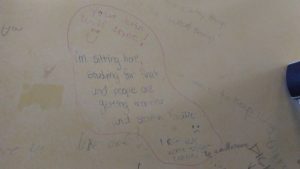
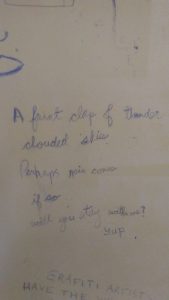
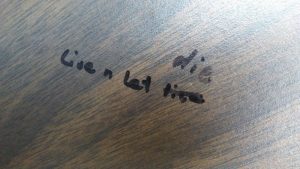
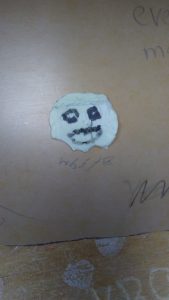
SFU Graffiti Scavenger Hunt

0

Found and submitted by Kitty Cheung, SFU Student 

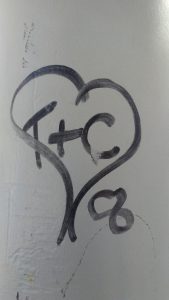
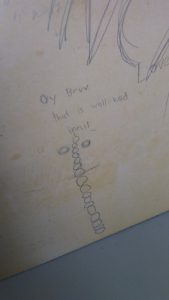
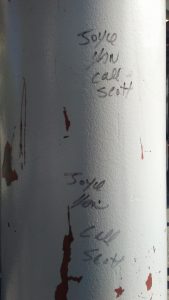
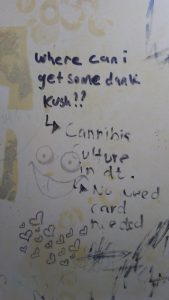
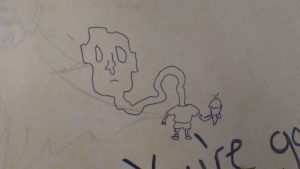
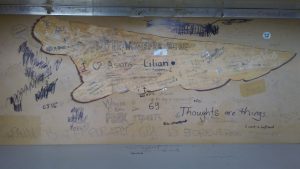
The three SFU campuses are held together by one common denominator: vandalism. The graffiti at SFU ranges from deep or adorable to disturbing and inappropriate, but still very much staring down at you as you do your work. How many have you seen on campus so far?


Join the Club: SFU Shockwave

0
SFU Shockwave. Photo by Jennifer Low

Written and photographed by Jennifer Low, Peak Associate 

If you happen to be walking along False Creek near Science World at the right time, you might just catch a glimpse of SFU’s Dragon Boat team, SFU Shockwave, out on the water. The team is a tight-knit group of both beginner and experienced paddlers. They practice together two to three times a week, and can be found representing SFU at various dragon-boating events.

Having never watched dragon boating before, I was not quite sure what to expect as I hopped off the SkyTrain at Main Street—Science World Station. It was a beautiful August evening, as the smog hadn’t set in yet, and there was barely a cloud in sight, predicting an incredible sunset. From the moment I entered the Creekside Community Center and met up with the very welcoming team, I knew I was about to witness something truly special.

For those unfamiliar with the human-powered aquatic sport, according to the International Dragon Boat Federation website, dragon boating is said to have begun in southern China more than 2,000 years ago. At that time, it was used as a way to ensure a prosperous harvest season.

In later years, Dragon Boat races honoured the sacrifice of Qu Yaun, a great warrior poet in ancient China who committed suicide in the Mi Lo river in protest of political corruption. Today, it is widely considered “one of the world’s most popular sports” and one of “the fastest growing international team water sport” by various dragon-boating organizations.

A standard dragon boat holds 18–20 team members, consisting of a group of paddlers, a caller or drummer, and a steersperson. Every position plays a vital role in the team effort and group harmony. The name of the sport comes from the intricately carved boats, each of which is adorned with a carved head at the bow, a tail in the stern, painted dragon scales along the hull, and paddles symbolizing claws.

Even though the team was merely running a practice and not competing, I was surprised by the incredible speed of the sport. It was not surprising that recreational boats, ferries, and others out on the water all seemed captivated by the sight of SFU Shockwave as they passed by. The spectators could only applaud their teamwork and skill.

I was also completely blown away by the amazing level of communication and cooperation within the team. They seemed to intuitively understand one another. Despite the fact that coaches sat on a completely different boat, their ability to converse with the students on the team seemed effortless.

One of the coaches, Earl Villarosa, who has been with the team since the beginning, shared their origin story with me. SFU Shockwave was officially started about two years ago by a group of friends who fell in love with dragon boating. Upon realizing that there was no team at SFU, they decided to start one.  Villarosa describes SFU Shockwave as a group of “fun, hardworking, and focussed” individuals.

When asked to name his favorite thing about the team, Earl said “We’re actually all, you know, friends, so that’s super nice. We always […] hang out after practice, go get food, and [go to] beaches…” The group’s close, friendly, and fun dynamic, strengthened by the team’s bonding activities, clearly translates to their performance out on the water. Their enthusiasm and positive energy is infectious.

“One of the great things about dragon boating is that it’s also super easy to pick up,” Earl says, “It’s very accessible.”  This comes as no surprise, as the sport is known for being inclusive of a wide range of skill levels. From watching the adept cooperation and synchronized movements of the paddlers, you would never guess that about half them hadn’t touched a paddle until nine months ago. Earl states that it’s merely a matter of putting in the time and effort.

“We’re all here for each other,” he adds, noting that having such a great support system helps to keep a positive mindset.

The team recently competed at the Concord Pacific Dragon Boat Festival, which drew a crowd of an “estimated 5,500 paddlers and 100,000 festival-goers.” In fact, it’s known as “North America’s biggest, best, and most competitive racing festival.” This year, on the thirtieth anniversary of the event, SFU Shockwave pulled through with an impressive first-place podium finish in the recreational grand finals, which qualified them for their first ever 2k Guts & Glory race. The team came in fifteenth in the competition overall.

In July, they were also present at the Harrison Dragon Boat Regatta. According to Earl, the team placed second out of about 50 teams in an extremely tight race; SFU Shockwave beat the third-place team by milliseconds. The outcomes of this summer’s races accurately showcase the hard work and dedication of the team.

If you are interested in getting involved with SFU’s Dragon Boat team, you can follow and message them on their Facebook page “SFU Dragon Boat” (@sfushockwave) as well as their Instagram (@sfushockwave). You can also contact them through their email ([email protected]). In addition, the team will have a booth you can visit during Clubs Days, as they will be accepting new members in the fall semester.

“Look out for us there” is the last thing Earl says before his voice is drowned out by the team’s passionate cheer as they break from their post-practice huddle.

Blurring faces and leaping salmon

0
Traditional techniques of anonymizing faces — pixelating, blurring, or blacking out faces — often lose the emotion involved. (Photo courtesy of AI Paint 360)

Written by: Agnetha de Sa, Peak Associate


Anonymizing faces without losing emotion

A team of researchers, which includes those from SFU, are working to improve the way individuals are anonymized for television.

Anonymizing faces in news broadcasts or documentaries usually involves pixelating, blurring, or blacking out an individual’s face. While this common practice leaves the voice intact, it removes a key method of communication — the human face.

Steve DiPaola and Kate Hennessy from SFU’s School of Interactive Arts and Technology (SIAT), along with Taylor Owen, from UBC’s journalism school, are working on a way to use the power of AI “painting” to anonymize an individual’s face. With this technology, facial expressions can be captured along with a voice to give emotion behind a story.

As DiPaola explains, “when artists paint a portrait, they try to convey the subject’s outer and inner resemblance [. . .] with our AI, which learns from more than 1,000 years of artistic technique, we have taught the system to lower the outer resemblance and keep as high as possible the subject’s inner resemblance — in other words, what they are conveying and they are feeling.”

With files from The Star Vancouver.


Salmon jump at the chance to get rid of lice

Two SFU researchers have uncovered a possible explanation for leaping behaviour in salmon.

Previously, researchers have proposed many reasons as to why salmon may leap out of water. Some of these include catching food and avoiding obstacles and predators. Emma Atkinson and John Reynolds, two aquatic ecologists at SFU, recently discovered a new one — that salmon may jump to get rid of lice.

In their field experiment, they studied the leaping behaviour in wild juvenile salmon. In considering juvenile salmon, they knew that previously held ideas about leaping behaviour in salmon would not be true for juvenile salmon since, according to Atkinson, their food source is “almost exclusively” comprised of “underwater zooplankton and their tendency is to scatter rather than leap when escaping from predators.”

Subsequently, Atkinson hypothesized that leaping behaviour in juvenile salmon could be attempts to remove sea lice. By comparing lice counts on two groups of fish, those that were and weren’t allowed to leap, Atkinson and her team found that the leaping salmon had lower seal lice counts compared with their non-leaping counterparts.

At The: London Pub

0

By: Winona Young

Ambience: B

For 10 p.m. on a Sunday, there’s a certain buzz of excitement in the crowd once I walk into the London Pub. Groups of people are crowded around the makeshift stage area, and the overall vibe is laid-back but lively.

     The seats are packed with a colourful crowd of all kinds of sexualities and ethnicities. Drag performers in full costume are casually walking around talking to friends and bar-goers, or else simply standing there looking stunning as all hell.

     While this venue is holding a drag show, the London Pub as a space — as made evident by its name — is all about London and football. Football paraphernalia and jerseys are displayed neatly on the walls, while mid-2000’s music plays on the speakers (read: Hannah Montana and *NSYNC). Even though the two personalities of the pub and the event clash, the bar itself is spacious and well-decorated, making it an ideal space for a night out.


Accessibility: C

There are no discernible wheelchair ramps present at the venue, but it is home to smooth, flat wood floors which theoretically could be accessible for those in wheelchairs.

     There are no gender-neutral bathrooms,  however, the bathrooms themselves are quite tidy, and well stocked.

     As for location, the pub is located right on Main Street, and is a quick walk from either the Stadium–Chinatown Skytrain station, or Main Street–Science World. The event was scheduled for 10 p.m. to 12 a.m., included a $5 cover, and was only accessible to those 19+, each of which may serve as an age, cost, or time barrier for some.


Drag performances: B+

Our host Jerri Lynn Spears and DJ Girl Fieri kick off the show with a bang (and with names like that, how could they not?) The two are comfortable up on stage talking to the crowd, bantering about yeast infections, and asking the crowd to cheer for the pub’s wait staff (everyone loves a kind queen).

     This event is part of “Commercial Drag” by Sleepy Girls Production, a drag show showcasing East Vancouver drag talent of all kinds every Sunday. The evening’s theme was “Sweet 16,” which was honoured quite well by the event’s first performer, Ryan Goshling, clad in a tux as they danced to a Robyn song. They ended their performance by handing out crowns from a giant, glittering pink egg (it was a packed three minutes, to say the least).

     Other performers like Brunch spat out Nicki Minaj verses as they strutted around the venue, beer and the audience’s wigs in hand. Props also must be given to drag performer Belladonna VonShade — even though she made guest performances for rap verses in other queens’ songs, her confidence and character was utterly magnetic to the crowd.

      But by far one of the best performances that came tonight was from Gender Spice, a drag performer who was less glitter and more goth. They slunk out on to the stage while Wheatus’ “Teenage Dirtbag” blared through the speakers. With wig changes and all, they gave one of the most entertaining and hilarious performances of the entire night. Their performance was so stellar that Jerri Lynn threw their shoe at them in support, claiming “[their] shoe was so lubed up from horniness.”


Overall: B-

     Overall, Commercial Drag delivered on a night of laughs, decently talented drag queens from East Van, and is definitely a great starter for anyone first discovering local drag talent!


Book vs Book: Lost at Sea and Seconds

0

By: Natasha Tar, Peak Associate


Lost at Sea (2003)

With its heavy doses of cats and angst, Lost at Sea was one of my favourite graphic novels when I was a teenager. The story centres on Raleigh, who apparently has no soul, as she sits through an unintentional road trip with fellow classmates she doesn’t like. Raleigh’s emotional stream of consciousness reflects how I felt in high school, and is expressed well by the simple, haunting art style. O’Malley was obviously not thinking too much about money when he published this first book, as it’s quite experimental and may seem melodramatic to older readers.

Seconds (2014)

      Over a decade later, this hardcover slab seems to have been created by a whole other person. In Seconds, O’Malley honed both his writing and art. Each page is full-colour and the level of detail is so high compared to Lost at Sea that it’s like comparing a quilt to a pillowcase. However, a lot of the deep emotion he evokes in Lost at Sea is forgotten in Seconds. The protagonist here, Katie, also shares her thoughts with the reader, but they seem more self-absorbed and flimsy when compared to Raleigh’s existential musings. Katie is also much older than Raleigh and the book focuses on career and choices, rather than growing up and questioning things. Seconds also provides a solid plot to follow, unlike the randomness of Lost at Sea.

Verdict

     While I love both books, Lost at Sea is the better work. Seconds is beautiful and polished, but it lacks the emotional depth, and doesn’t resonate with me as much Lost at Sea does. I may be less attached to it now that I’m past my teen years, but it remains one of my favourite books.

The Belittling of Black Girl Magic

0
The realm of sports is no stranger to the policing of Black bodies. (Photo courtesy of Edwin Martinez)

By: Youeal Abera

Very few athletes in the history of professional sports have achieved what Serena Williams has. Tennis fan or not, Williams’s name alone defines greatness. As a #1 ranked player, with 23 Grand Slam titles to her name, Serena Williams isn’t merely “one of the best female athletes” of all time. She’s one of the best athletes, ever.

In spite of Williams’s clear success, women are often allotted more hurdles in the workplace. At the office or on the tennis world stage, women are expected to meet a vast number of unfair standards and expectations of which their male counterparts will never have to think of. This is particularly true for women of colour, specifically Black women.

Whether receiving online ridicule for her hair’s “edges” or having her femininity belittled because of her muscular physique, Serena has had her incomparable skill and legacy depreciated simply because of the shallow, repugnant opinions of the media and sports commentators. The most recent instance in which Serena has been subjugated to such misogynistic, racially-charged treatment comes from from Bernard Giudicelli, the president of the French Open tennis tournament.

In an interview conducted within the 500th issue of Tennis Magazine, Giudicelli was asked about his desire to implement a dress code in his aim to bring “strengthening (to) the prestige and beauty of Roland-Gaross.” Translated from French, Giudicelli stated, “We will impose certain limits, we will see to what extent precisely. For 2019 it’s a bit late because the collections are already drawn, but we will still ask the equipment manufacturers to communicate them to us.”

Then, with specific reference to Serena’s famous black catsuit, Giudicelli articulated,

“I believe we have sometimes gone too far. Serena’s outfit this year, for example, would no longer be accepted. You have to respect the game and the place.

What’s frustrating about Giudicelli’s comments is that his concerns have nothing to do with the game of tennis. Rather, they have everything to do with Serena’s Blackness. As shown in this interview, Giudicelli believes that Serena’s Black body, while dressed in her black catsuit, does not “fall in line” with the “prestige” or “beauty” of the Roland-Gaross tennis tournament.

Just like in many other sectors in society, the realm of sports is no stranger to the policing of Black bodies. Eurocentric figures of authority, especially white men, have had the power to dictate how immensely skilled Black athletes must conduct themselves while playing their sport.

Just like the backlash John Carlos received for raising his fist at the 1968 Olympic Games, or the ridicule and harassment Colin Kaepernick faced from the NFL for taking a knee during the singing of the national anthem, Serena’s propensity to play the game with her own agency was nullified because of the colour of her skin. However, unlike Carlos or Kaepernick, Serena has to deal with the unjust restrictions of being both Black and a woman.

After Serena gave birth in 2017, she was inundated with blood clots. Moreover, in order to help alleviate her from experiencing any additional clots, Williams decided to wear her black catsuit at Roland-Garros, where she played her first match since giving birth. Therefore, not only did Giudicelli’s misogynistic and racist restriction prevent Serena from selecting her own fashion choice, but it also posed dangerous risks to Serena’s health and well-being.

Giudicelli disallowed Serena from ever wearing her black catsuit again because he doesn’t like how her Black body looks in it. What’s imperative in reading Giudicelli’s commentary on Serena’s fashion selection is developing the ability to critically assess and introspectively reject the impossible standards society places on women, chiefly women of colour.

Unfortunately, these repugnant perspectives and harmful comments on female athletes won’t cease any time soon. However, through being mindful of its problematic rhetoric, and by boldly repudiating its conveyed messages, commentary on the bodies of female athletes will never take precedence over what truly matters: undeniable, refined skill.