Home Blog Page 614

88rising to come to Vancouver in October

0
Photo courtesy of Live Nation Entertainment

By: Michelle Gomez, Staff Writer


Back in 2015, South Korean rapper Keith Ape’s “It G Ma” blew up the Internet, closely followed by Indonesia’s Rich Chigga (now known as Rich Brian) with “Dat $tick.” They were followed by a multitude of other new Asian hip-hop artists, and somewhere out of this frenzy, 88rising was born.

     In an interview with music magazine Pitchfork, 88rising founder Sean Miyashiro said, “A lot of people are wondering, ‘What is 88rising exactly? Is it a YouTube channel? Is it a management company? Is it a record label?’ It’s actually everything. Our general ethos is that we want to push this shit forward.” Miyashiro referred to it as “Vice for Asian culture.”

     In other words, 88rising is a movement. According to urban culture blog Highsnobiety, “the platform takes a holistic approach to artist development, working collaboratively with each talent to realize their vision rather than attempting to conform them to a particular market.” In this sense it differs from traditional record labels, which normally shape their artists into a specific image that they believe will sell.

      While one of 88rising’s main goals is to give Asian artists a platform and a voice in hip-hop culture, Miyashiro explained to Pitchfork that his main criteria for recruiting new artists is the quality of their music. In addressing fans who have been wanting to see Filipino artists on the label, Miyashiro responded, “Real talk, from a music perspective, if I don’t fuck with it, just ‘cause it’s from the Philippines, I’m not gonna put it up.” In other words, he first and foremost wants to promote talented artists.

      This new subgenre of hip-hop and rap has become so popular in Western culture that 88rising is going on a North American tour whose stops include Vancouver. The event will take place at the Pacific Colosseum on Friday, October 26 and will feature an exiting roster of artists, including Rich Brian, Joji, Keith Ape, Higher Brothers, KOHN, NIKI, AUGUST 08, and Don Krez (as a side note, it is not sold out yet).

      In an interview with  The Peak, Alicia Dang, vice-president external relations of the SFU Canadianized Asian Club (CAC) said that she has seen a lot of excitement surrounding the upcoming 88rising event in Vancouver, and around their movement in general.

     “When 88rising came out I was so excited because I had never seen anything like it . . . I thought that was really cool,” said Dang. She appreciated 88risings dedication to including Southeast Asian artists.

      “If you look at Rich Brian, he learned English by himself. I thought it was cool how he tried to immerse himself into American hip-hop culture, since there are not many Asians involved in it currently . . .  I think it’s just great that they’re blowing up.”

SVSPO brings annual #ConsentMatters campaign to all three SFU campuses

0
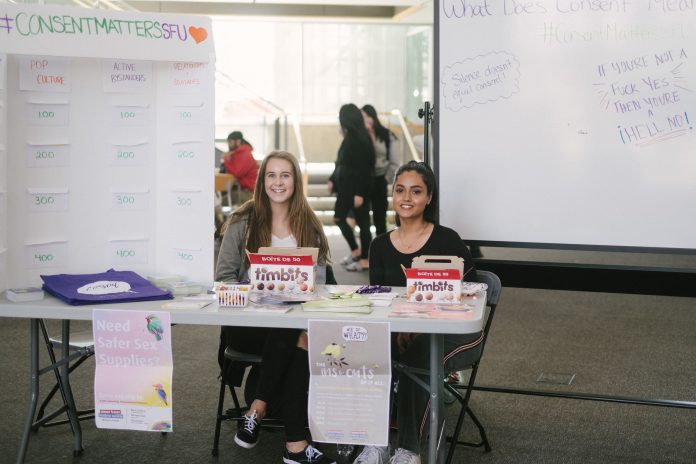
The annual campaign aims to raise awareness about sexual violence. (Chris Ho / The Peak)

Written by Youeal Abera, Staff Writer


SFU’s annual #ConsentMatters campaign took place this year from September 24 to 28. With items such as consent toolboxes (developed by the SFSS’s Women’s Centre), and pamphlets explaining the services of the SVSPO, #ConsentMatters informed individuals on the resources the university provides for those dealing with incidents of sexual violence.

The Peak also spoke with SVSPO director Dr. CJ Rowe about the impact the SVSPO and the #ConsentMatters campaign aims to make on SFU.


The Peak: Hello! Please introduce yourself.

CJ Rowe: Certainly. My name is CJ Rowe, and I’m the the director of the Sexual Violence Support and Prevention Office here at SFU. My pronouns are they/them/their.

P: The SVSPO is an imperative entity. Would you mind explaining what the SVSPO is, and how it’s been impacting SFU?

CJR: The SVSPO has been open since February 1, 2018. The office was created in response to the development of the sexual violence and misconduct policy, GP 44. It was legislated by BC that all institutions of higher education would have a stand-alone sexual violence prevention policy. So, the work that we’re doing is providing survivors (or acquaintances who have supported someone in their disclosure process of sexual violence misconduct) with an opportunity to engage with, what I hope will be, their healing process — whichever way it may look like right now, or in years to come. We really want to centre the voices and needs of the survivors so that they’re making the choices that are right for them.

P: The BC government is currently in their sexual violence prevention and support campaign for post-secondary institutions. Was the #ConsentMatters campaign created with this in mind?

CJR: To my understanding, the #ConsentMatters campaign originated two or three years ago as a partnership between SFU’s athletic department and student development services. The campaign that the provincial government’s developed, and the #ConsentMatters campaign, are two separate campaigns.  

P: What do you believe was the main incentive for creating the #ConsentMatters campaign for SFU?

CJR: I wasn’t part of that campaign, and its development a few years ago. With that said, I can speak to what our intentions are right now. Our intention with our campaign this year is to engage our campus communities in a conversation about what consent means, whether in a sexual relationship, a hook-up, a friend group, or our families. Consent matters in every aspect of our lives.  It’s about clearly articulating our wants, needs, and boundaries, as well as listening to other needs, wants, and boundaries.

P: Will the #ConsentMatters campaign be an annual event?

CJR: I would say yes. I’m excited to see what we’ve learned from this year’s conversation, and how we can start planning for next September. I’m also really excited to see where we might be able to grow partnerships so that we may be able to do a bit more next year . I wanna know: is the timing right? How do we more actively engage staff and faculty in this conversation? I would say that this year’s campaign is quite heavily student focused, but these conversations impact all of us.  


The Peak also interviewed Caitlin Doherty, a fourth-year co-op student interning with SFU’s SVSPO to learn more about the office and how it functions within the SFU community.


P: We hear of students being assaulted at universities. What are some tips for students to avoid being a bystander?

Caitlin Doherty: The SVSPO facilitates the ‘Active Bystander Network’, a network that provides strategies for how students can shift from being a bystander to an active bystander. The SVSPO and the ABN emphasizes the idea that it requires us all to challenge sexual violence on campus.

P: Where can students receive resources for help with sexual violence?

CD: We highly recommend that people come to the SVSPO. It’s in the Diamond Alumni Centre, but our case managers are available Monday to Friday to help all staff, faculty, and students navigate sexual violence-whether at any SFU campus or a safe, off-campus location. More information on support and education is available on the SVSPO’s website.


Album Reviews

0

By: Winona Young, Arts Editor


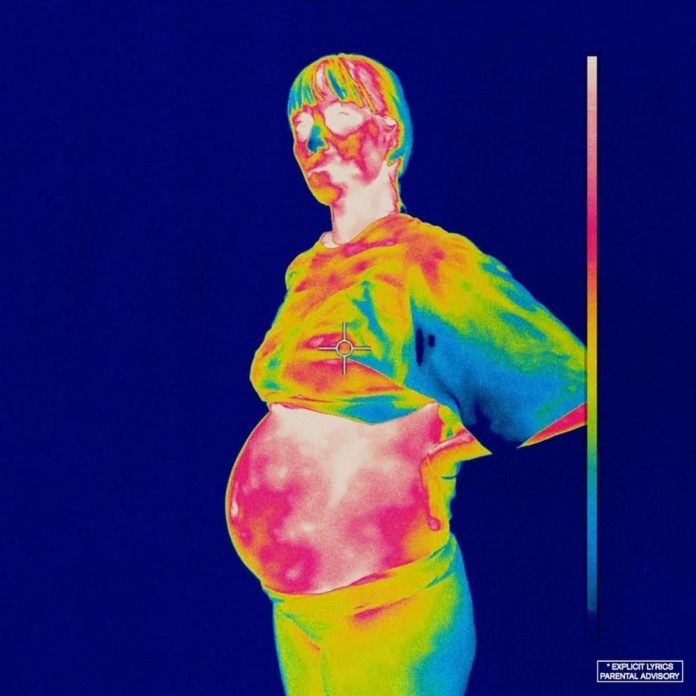
Iridescence by Brockhampton

2018 so far has been filled with many notable events for Brockhampton, like being signed to RCA Records, or dismissing former band member Ameer Vann. But the hip-hop group has since returned with iridescence, a passion filled album with bangers, and brilliance galore.

The album starts off with a hypnotic, tough, verse-centric banger that is “NEW ORLEANS.” While the album starts off with more heavy and over-saturated vocals like “BERLIN,” sweeter, almost shy tracks like “THUG LIFE” and “SOMETHING ABOUT HIM” lighten the album. “SAN MARCOS” stands as an anthemic, hopeful song on the album, and I see it as their next “BLEACH.” The album is bangers galore with infectious and heart pumping songs like “WHERE THE CASH AT” and FABRIC”.

Iridescence features some of Joba’s best verses, most notably in “J’OUVERT” as an unstoppable force of manic charisma. Something that I appreciated was the integration of band member bearface into more songs than just moody ballads, most notably on “THUG LIFE.” The album also includes some wonderful features, not only that of Jaden Smith on “NEW ORLEANS” but also serpentwithfeet on the poignant and stirring song “TONYA.”

While this stands as the beginning of THE TIME OF OUR LIVES instalment, and while diehard Brockhampton fans may have had reason to fear that after such a rocky few months that this boy band may be done for good, iridescence proves these boys will continue to be an unstoppable force in hip-hop.


No Shame by Lily Allen

No Shame stands as a long-awaited and difficult comeback for Allen. After years of turmoil struggling with addiction, a divorce, and a stalker, Allen steps back into the music scene unabashedly herself: flawed and regretful, but still full of hope and music.

“Come On Then” kicks off the album on a slow note, but with a heavy trap beat, coming with the most striking and painfully honest lyrics “Yeah I’m a bad mother, I’m a bad wife.” By far what stands as the best track which was also the leading single was “Trigger Bang,” a catchy but chill anthem that takes account of the diva’s past party days from a mature perspective.

Some songs definitely fall to the wayside — like “Higher” and “Lost My Mind,” which fall into the tired pattern of too-heavy hip-hop instrumentation and wandering, over-tuned vocals on Allen’s part. A few notable tracks also include the upbeat “Pushing Up Daisies” which is reminiscent of Allen’s pop sound, just as flirtatious but a tad more shy, and “Apples” which is a quiet, sorrowful rumination on losing her marriage.

While No Shame may not be Allen’s strongest album, it shows her at her most emotionally vulnerable, making it her most groundbreaking. 

Students comment on accessibility, accountability, and engagement during SFSS AGM

0
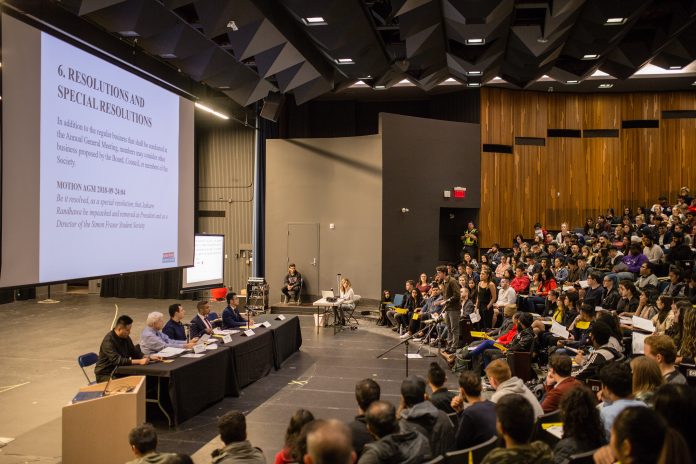
(Azat Bayandin / The Peak)

Written by Amneet Mann, News Editor


The 2018 annual general meeting (AGM) held by the Simon Fraser Student Society (SFSS) saw significant student turnout, though the number of attendees dropped following the impeachment of former SFSS president Jas Randhawa.

Following the special resolution to impeach Randhawa, the meeting’s agenda involved the receipt of the SFSS’s annual finance report by vice-president finance Matthew Chow, the receipt of the society’s audited financial statements, and an open space for SFSS members to propose discussions.


Finance reports

Chow reported on the student society’s revenues and expenses. In the 2017–18 fiscal year, the SFSS earned $11.3 million in revenue, 96.2% of which was attributed to activity fees and levies applied to students’ tuitions. 49% of those fees were dedicated to services such as the U-Pass and the healthcare plan provided by the SFSS, while 51% of those fees were allocated towards the Build SFU project, which encompasses the Student Union Building (SUB) and the stadium project.

Chow noted that revenues outside of activity fees had fallen 60.5% since the previous fiscal year owing to the surrender of the food and beverage services lease. Total revenues this fiscal year had increased by 1.47%

The society’s expenses totalled $9.2 million, which provided a net surplus of $2.15 million. While total expenses increased by 2.2%, isolating the expenses associated with the food and beverage services lease surrender led to a decrease in expenses by 2.3%.

The society incurred a $1.4 million loss on the food and beverage services, but Chow noted that the lease surrender included a 35% entitlement on the tenant’s annual minimum rent for the next decade, so the current losses were not an accurate reflection of the lease surrender’s impact on the society’s financials.

Due to the new service delivery agreement with Fraser International College (FIC), the SFSS was projecting to add an additional $789,000 to their revenue streams the following fiscal year.

Gary Wozny presented the audited financial statements on behalf of the firm Tompkins Wozny LLP, the society’s auditors. Wozny reported that the society had spent approximately $25 million to date on the BuildSFU project.

The end of the fiscal year saw the SFSS with $38 million in assets and $21.2 million in liabilities.

A SFU student who identified themselves as the president of SFU Autistics United stepped forward to note that, while the club was listed among those who had received accessibility funding from the SFSS, the club had not received any funds form the society.

“We did our work and the committee didn’t do their part,” they stated. “We received zero funding for ASL interpretation that we requested well ahead of time.”


SUB space issues revisited

A significant topic brought forward during the open discussion period was space in the SUB for the organizations that currently occupy the rotunda. The discussion was initiated by representatives from Students of Caribbean and African Ancestry (SOCA) and the First Nations Student Association (FNSA).

FNSA board member Jakob commented on the decrease in attendance following the impeachment: “This room cleared out before we were able to speak, which I think demonstrates the engagement of the student body and their real concerns for us here,” they said. “I hope the SFSS has higher aspirations for the student body, and the ball’s in your court.”

As the president seat is currently unoccupied, vice-president student services Samer Rihani noted that the presidential responsibilities would be distributed among the five vice-presidents present on board. When asked by a student which vice-president would be “responsible for fixing the relationship with your stakeholder groups,” referring to the organizations which currently operate within the rotunda, Rihani responded that the group would act collectively moving forward.

“We’re gonna be trying to make more statements collectively,” he said. “We’re going to try and answer things collectively, work with you guys as whole team rather than one or two of us sending you answers that the whole board can’t agree to.”

A SFU student who identified themselves as an active member of music groups on campus asked whether the dance studio being designed in the SUB would be appropriate for musical groups such as choir and orchestras due to sound levels. They also asked whether storage space would be provided for musical equipment.

Vice-president university relations Jackson Freedman responded that the individual directors were not aware of the restrictions on the usage of the dance studio.


Integration of FIC students discussed

Former FIC students Simran Randhawa and Martha questioned how FIC students were to be integrated into the SFSS following the new service delivery agreement.

Martha noted that FIC students had not been allowed to attend this year’s AGM.

SOCA president Giovanni Hosang asked whether FIC students would be allowed to vote in future SFSS elections. “It’s important that when you’re taking money from students [ . . . ] they have a voice,” spoke Hosang.

Freedman responded that he was not aware of whether the new service delivery agreement enabled FIC students to vote in future SFSS elections.


Concerns raised surrounding accessibility of SFSS

The accessibility of SFSS services and meeting times was discussed during the open space session of the AGM as well.

Gabrielle McLaren, SFU student and features editor for The Peak, raised concerns regarding the closure of Out on Campus for the second time this year and asked the society to consider taking steps in the future to ensure the service would be consistently available for students.

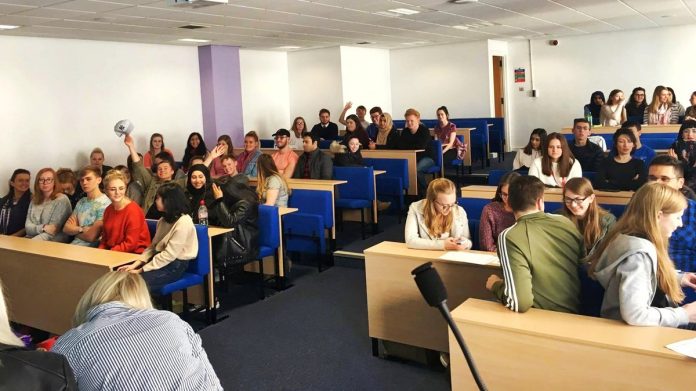
Grace Mathisen, president of SFU’s film student union, raised concerns about the suitability of the Leslie and Gordon Diamond Family Auditorium as the sole location of the AGM. “The fact that there’s 25,000 undergraduate students and this hall can only fit 250, that’s like one percent of the student body to be able to show up,” she said. She proposed that, in the future, the board consider providing students on other campuses with the option to remotely attend these meetings and make comments on the discussions.

A second-year student stepped up to ask whether the SFSS could extend its engagement with the student body beyond Clubs Days and other events to inform students more thoroughly about their student government.

In response, Rihani encouraged students to attend SFSS committee meetings and propose motions and ideas. He noted that, while the SFSS had failed to advertise these options to students, students still had a lot of power when it came to influencing committee decisions. Rihani emphasized students external to the committees could be as involved as committee members in all aspects except for voting.

“A lot of the questions that have been posed to us on the floor so far are questions that we could probably answer in committees,” he said. “What we’re going to try to do is really just reach out to people and invite them to our committee meetings. Sit down with us, hear the ideas, bring proposals to our table.”


Questions regarding by-election

Freedman noted that the SFSS board had not yet made a decision on whether a by-election will be held to replace the vacant positions on the board of directors.

During the open space discussion, a SFU student stepped forward to urge the society to hold a by-election this fall. “We have an opportunity now with all the comments that are coming in right now from these groups here [. . .] to add new perspectives to the board with all that’s happened over the last summer and with all of the changes that are happening to the way the SUB’s being handled,” they noted.

Freedman noted that the society’s first steps following the impeachment of Randhawa was to rebuild their membership’s trust in the SFSS. “I think we’re gonna put together a pretty comprehensive plan to rebuild trust in student government across the board. This kind of process [. . .] it certainly doesn’t look good on any kind of student organization,” he noted.


Meeting delayed by smoke bomb

The meeting, which was originally scheduled to begin at 1 p.m., began nearly two hours later at 2:55 p.m. due to the smoke bomb that was set off minutes before the beginning of registration.

The crowd of students waiting outside Convocation Mall for the beginning of the meeting included members of FNSA who were drumming and students holding signs for both the SOCA and SFPIRG SUB space campaigns. There were also students holding signs protesting against the impeachment of Randhawa.

We should’ve been able to vote for the impeachment online

0
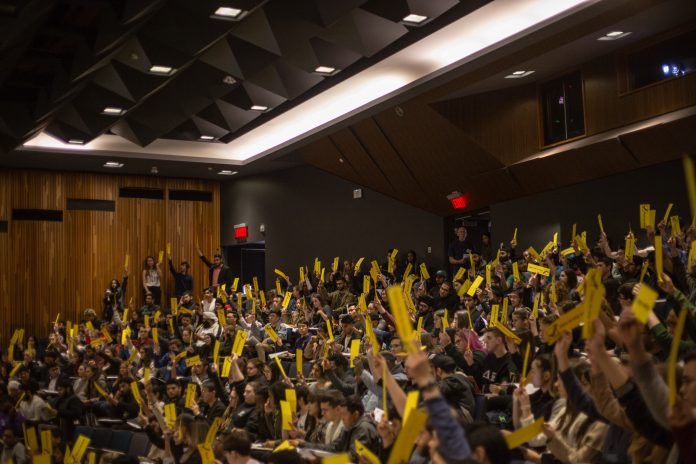
Photo by Azat Bayandin / The Peak

Written by: Gene Cole, Opinions Editor

The recent annual general meeting (AGM) for the Simon Fraser Student Society (SFSS) was a circus. Someone set off a smoke bomb in the Leslie and Gordon Diamond Family Auditorium right before voting registration, forcing attendees to wait over two hours for the meeting to begin. Convocation Mall was full of cold, anxious students who took time out of their day to listen, speak, and vote on various issues, particularly the impeachment of former SFSS president Jas Randhawa. Once underway, the meeting contained emotional speeches, speaking rules conflicts, and complex legislation.

While I was waiting among the crowd to enter, I overheard someone asking their friend, “Can’t we vote for this online instead?” While this AGM was massively important, I can’t help but agree with this student’s frustration.

To discuss this, it’s important to know the legislative reasoning for why an impeachment has to be in-person is unclear. The closest that seems to be present is the SFSS bylaws requiring impeachments be done by special resolution (by-law 17), which seem to imply an in-person quorum.

There’s also plenty of potential reasons for this outside of policy. Impeachment is a serious issue, and it’s important to allow people’s voices to be heard through the process. Board members of the SFSS and passionate students spoke at this AGM — many of them wouldn’t have had as good of an outlet to talk to voters if all of them voted remotely.

There’re also plenty more things that came up at the AGM besides the impeachment —  particularly concerns regarding space allotted to student groups on campus. This is not an argument against AGMs, but rather against the inability to cast proxy votes for this special resolution — which, based on the wide attendance, was a major decision that many people wanted to participate in.

However, while students may want to participate, they don’t necessarily have the time to go through it all. This meeting was not something most students could have reasonably dedicated time towards. This isn’t to say the smoke bomb was handled improperly, or that the SFSS should have foreseen so many statements of different tones and subjects throughout the meeting. Nobody could have predicted the range of things that happened. But even under typical circumstances, this meeting would still have taken at least two hours out of our Monday afternoon, which is a tough sell.

Unexpected problems aside, the SFSS has severely failed to provide support for this scheduling need. While it seems reasonable for someone to be excused from lectures or tutorials, this has not been advertised by the SFSS whatsoever before this meeting. The only information about academic accommodation on their website is a page with a letter that you can send to your profs in-advance of the meeting, but it’s dated for the 2015 AGM on September 22nd and has no indication whether it can still be used.

Even if you were to go through that effort for an AGM though, there’s no guarantee that it would pay off. Many profs don’t record their lectures, tutorials may have discussions that can’t be noted down, and it’s not even certain if they’ll approve of your letter as a valid excuse to begin with. We are here spending tuition to go to class, and we can’t just ignore it if the AGM happens to be inconvenient.

This also doesn’t include other responsibilities held by students including work, family obligations, social obligations, et cetera, and it’s unfair to say that they need to plan around this. Being online for a yes/no question cuts the time immensely and guarantees a greater voterbase. Ensuring maximum participation is part of why we elect these representatives online in the first place; impeachment is just as important a decision as election.

For those who had the opportunity to go without missing anything, or those who skipped responsibilities to attend, the meeting itself wasn’t entirely worthwhile.

This isn’t to say I think the results of the vote would be different online, or that the decision was made in an improper fashion. But by having it online, we wouldn’t have had to listen to all the confusion of rules surrounding how to speak in the meeting. We wouldn’t have had to sit through a moderator who couldn’t even pronounce Jas Randhawa’s name while resolving the impeachment. We could have determined a verdict with greater ease and more voters.

There absolutely is value to the impeachment being an in-person vote. It was an incredible moment to witness students wanting to make their voices heard. But making this decision dependent on AGM attendance was risky, and it damaged a lot of other important parts of this AGM. We got lucky that the vote was able to reach quorum and come to a firm decision, because it did this against so many odds. Participation in student government should not rely on this unreasonable standard of attendance.

SFU women’s soccer battle hard for 1–0 victory against Central Washington University

0
Jenna-lee Baxter leads the GNAC with 14 points. (Photo courtesy of SFU Athletics)

By: Sebastian Barreto

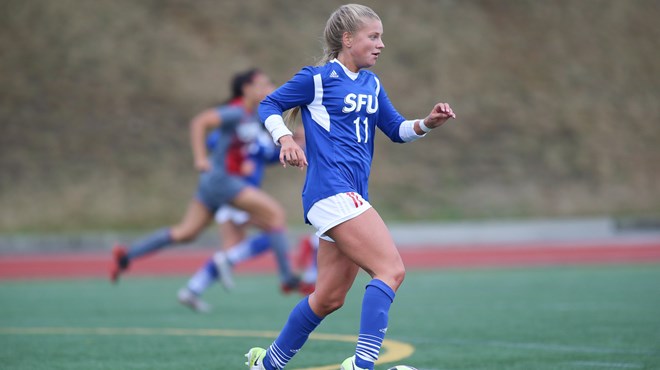
SFU women’s soccer team ground out a hard-fought win against the Central Washington University Wildcats at Terry Fox Field Saturday afternoon. SFU’s Jenna-lee Baxter broke parity and secured the victory with a brilliant finish four minutes into the second half. Saturday’s victory earned SFU’s women their first consecutive wins of the season after defeating Seattle Pacific University two days prior.

The first half was incredibly tight; both squads defended resolutely, with a raging midfield battle fiercely ensuing as neither team wavered. SFU goalkeeper Nicole Anderson impressively stopped a long-range effort from outside the box, diving to her right to parry the ball away from her net.

The match featured SFU freshman Teagan Mackay wrecking havoc against Central Washington’s defenders. Her relentless pressing and effective hold up play proved effective in the 28th minute as Mackay won the ball high up the pitch and tested the Wildcat keeper.

Immediately after the break, Mackay made her presence felt again. Wonderful close control and a burst of speed saw Mackay drive down the right wing and send a low cross into the box. Senior SFU midfielder Baxter met the cross, expertly controlling it, and with a swivel and strike, she banged the ball beyond CWU’s goalkeeper. Securing her fourth goal of the season, Baxter’s strike proved to be the game winning goal.

Mackay’s creative influence was essential to the goal, and head coach Annie Hamel touched on it post-game.

“Teagan McKay is getting better every single game,” said Hamel. “She is coming in as a freshman; it is tough. But seeing her grow and get better every game is amazing.

“She had an amazing performance, she is so strong and is starting to be less shy, making her presence felt out there, and it’s lovely to see.”

Immediately after going up 1–0, SFU came under immense pressure. An error at the back forced a goal line clearance from midfielder Hollis Roeske. Wildcat attackers swamped SFU’s penalty box as the ball trickled behind Anderson and towards the goal mouth. Roeske arrived in dramatic fashion to hoof the ball away from the unguarded net. This was the start of a good spell for the Wildcats as they went in search of an equalizer. Despite this near-goal, Anderson was composed for the rest of the match and kept a clean sheet.

As the Wildcats attempted to claw their way back into the match, SFU’s veterans stepped up to steer the team over the line. Katelyn Erhardsen had a motivated second-half display, oozing confidence on the ball while beating opposition players continuously with sumptuous skill. Her influence in the middle of the park was crucial as SFU maintained a strong shape while defending their lead.

Coach Hamel spoke of her midfield general’s performance after the match. “I directly addressed the seniors at halftime in the dressing room and they responded. Katelyn came out with a mentality of ‘I will help us and be the solution,’ and it was awesome to see. She was immense for us; her control of the midfield was significant. She has amazing feet and when she gets by somebody it’s typically fun to watch.”

SFU defender Carli Grosso was another standout performer on the day, Grosso offered a tower-like presence at the helm of the defence: rarely putting a foot wrong, tackling hard, and clearing everything that came her way. Grosso was calm and self-assured throughout the match.

Grosso, Erhardsen and Mackay were pivotal pieces to SFU’s success. When asked about positive takeaways from Saturday’s victory, Coach Hamel expressed delight at her team’s improvement and ability to grind out wins. “We didn’t play very well, and we were still able to get all three points. In the conference it is a massive result and we have had a tough stretch. I’m pleased with where we’re at right now, the girls have been getting better every week, it has been enjoyable to watch.”

Peak player of the game: Carli Grosso

Grosso was a key player for the Clan in this one, consistently preventing Central Washington University from getting scoring chances. She was definitely the best defender in the game, and was a major reason for SFU’s clean sheet.

What’s next:

SFU will be looking to ride their recent form into games against Concordia and Western Oregon on the road before returning to Terry Fox Field on October 11 for a clash against Northwest Nazarene University at 5 p.m.

Bringing dad jokes to the board: an SFYou with Samer Rihani

0
Samer Rihani, Image courtesy of the Simon Fraser Student Society

By: Gabrielle McLaren, Features Editor 

Fast Facts

Name: Samer Rihani

Pronouns: He/Him/His

Department Affiliation: Health Sciences (Populative and quantitative stream; fourth year)

Hometown: Surrey, B.C.

Hobbies: Self-described social butterfly. His brother is currently trying to teach him about Fortnite.

Fun Fact: Samer can cross one eye and flip his tongue.  


“Have you ever tried to eat a clock? As it turns out, it’s quite time-consuming.”

That’s what came out of Samer Rihani’s mouth when I asked him for his favourite joke, although he did have to think long and hard to pick his absolute favourite.

“[My clock joke] never gets a laugh, it never does anything, but it shows people I have really low standards for jokes,” Rihani explains. And there’s plenty more where that came from. Seriously: he has a note on his phone full of dad jokes.  Apparently, he’s that guy in the SFSS’ office.

This is Rihani’s first year on the SFSS’ board of directors. In his first year at SFU, Rihani ran for the SFU senate. He admits to having had no idea what he was doing, and was only known at the time as “first-year senate guy,” and was “decimated to a pulp” (his words, not mine).

“But I put myself out there,” Rihani says. “And I realised how fun it is to get to know people.”

“I [didn’t] want to graduate from school and just have academic knowledge,” Rihani explains. “I wanted to know that when you go into the real world this is what you expect.”

He ran for senate and lost again in second year, but had a much stronger campaign and presence. After getting the feel for what political participation on campus was like and getting involved in clubs, Rihani turned his attention elsewhere: the SFSS.

“I’d always had issues with the SFSS,” Rihani admits. He’d complain about the SFSS and get teased about joining them. And eventually, by his third year, he told himself: “Why don’t I go in and fix it? Why don’t I go and act on the things I complain about?”

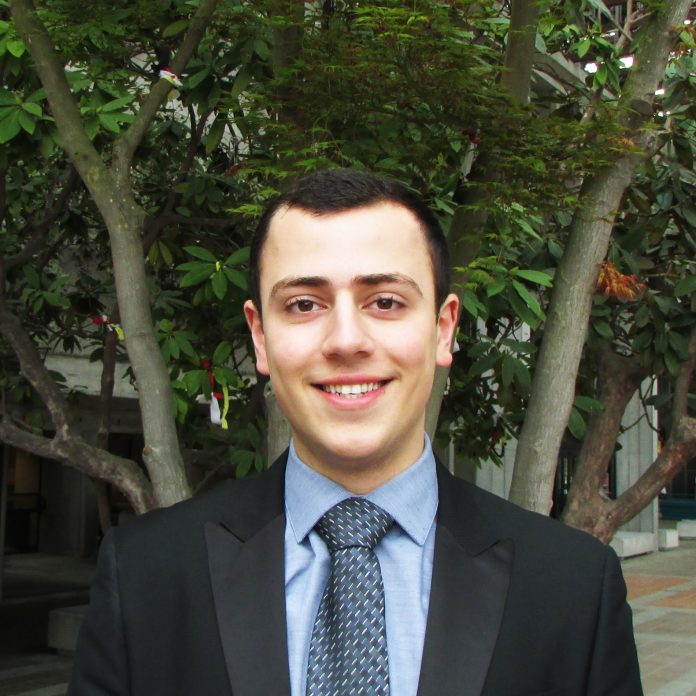
Since the September 24 impeachment of Jas Randhawa, Samer Rihani is the acting president of the SFSS (according to SFSS by-law 4). But Rihani had originally been elected as the vice-president of student services.

One of the things that attracted him most to that position was that “student services” encompassed the health and dental plan for students. For someone who aspires to dentistry, this chance to work with insurance providers and healthcare professionals and consultants was alluring.    

“Before [I worked at the] SFSS I worked at Starbucks . . . I’d never had a chance to really see what it was like to be the lowest on the totem pole . . . I wanted that exposure to really challenge myself.”

Just last summer, the health and dental plan for students has changed. Rihani is proud to tell me that the SFSS has saved students over $300,000, but it’s no secret that things have in many other ways been turbulent for the SFSS, to say the least. Still, Rihani says he has reason to believe that there are good things on the horizon. He’s looking forwards to “a great team dynamic.”  

“We have a team now of people who have stuck it through the worst,” Rihani says. “We pushed through the hardest month of, arguably, our lives and came out of it. People stuck together, we’ve had challenges, and excruciating meetings, and all-nighters . . . but now we know that the people who are around are the people who want change to happen.”

According to Rihani, restabilizing the board is an integral part of the SFSS’ journey onwards. But after the AGM, the board is conscious that they’ve got hundreds of extra pairs of eyes on them. The SFSS’ to-do list, outlined by Rihani, includes getting in touch with the groups who spoke up at the AGM, and strengthening communication within the SFSS, as well as with its clubs, and student unions, and Council. The issue of the Student Union Building looms on the horizon as well.

“The name of the SFSS is mainly known for all the drama,” Rihani admits, well aware of the image the society has amongst students. He even has a favourite impeachment meme from the SFU Dank Memes Gang (which was fresh off the meme press, the morning of our interview).

“It’s so weird to see so much engagement from the student body, by just random people commenting the letter ‘f’ over and over and over again,” Rihani said. And while Rihani is a big believer in showing a sense of humour, these exemplify how “people have no idea what to expect from us now.”

“I like the light-hearted nature,” Rihani said. “Of course, when it comes down to student dollars you have to take it really seriously. But if you don’t know how to have some fun and take care of yourself and of the people around you, you get nothing done.”

Rekindling the SFSS’ relationship to the student body will be no easy feat, but Rihani has a slew of ideas: tabling, handing out food to people, asking people about their day, going to student union meetings, attending club events, mass candy distribution, coffee with board members and students . . . “We need our name to be known on campus.”

Rihani also thinks that students want to see transparency from the SFSS, especially those who are heavily involved in campus life. Rihani admits that the SFSS can do better in makings its committee and board meetings accessible and public to SFU students. He hopes that social media will be able to fill that role.

“For me, my big initiative will be telling people what’s going on,” Rihani says.

Still, it’s a challenge that Rihani trusts his fellow board members to embark on. He remains optimistic, citing the creativity of the memes and of the name submissions for the SUB as positive signs that the student body is engaged. While Rihani didn’t leak any hot details regarding name selections, he did share that “Subby McSubFace” came up as a suggestion “too many times.” He concedes that “maybe this is what the people want,” but his personal favourite? “The Highland SUB.”   

“I showed my Mom that one,” he says. “Whoever did it: kudos.”

And what will Rihani’s role be in this reconstruction process?

According to the SFSS’ by-laws, the duties of the SFSS’ presidency now falls on him. However, Rihani makes it very clear to me that the board is going to try something new and separate the president’s role amongst the VPs.

“There are a lot of people on that board who are more qualified in a lot of things than I am, and I want to take full advantage of that.” Rihani says.

According to Rihani, his new responsibilities will be redistributed to the most appropriate and qualified board member. He hopes that this will also help to build a sense of trust, communication, and camaraderie within the board as well. The board has already discussed this at length since the AGM, and students can expect a more concrete statement in the future.

For Rihani, being on the board was a humbling experience. “I’ve had a lot of chances to learn about myself and what I’m comfortable with and how to do things…” To students who may also be interested in running for a position on Board next May or who are new to SFU, Rihani recommends talking to Board members to find out more about the SFSS and opportunities on campus.

“Our office, right there, the door is open,” Rihani said. He acknowledges that in the past, the SFSS could be difficult to reach. But he’s hoping to change that, and make things easier. For Rihani, his unconventional presidency will be focused on getting back in synch with the student body.


 

What Grinds our Gears: Icebreaker activities in lectures and tutorials

1
Photo by GCU Optical Society

Written by: Tiffany Chang, SFU Student

I’m pretty sure that all SFU students have endured the painfully awkward icebreakers forced upon us by TAs or professors at the start of every semester. As someone who’s entering my third year, I’ve had enough of these repetitive, boring, and cringe-worthy activities supposedly helping you “get to know each other better.”

It always goes like this: “We’ll start from the left side. Tell us your name, major, and something interesting about yourself.” Once the time comes and my turn is fast approaching, I always groan inwardly and think: “Just kill me now!” For crying out loud, there are so many other ways to break the ice than these cookie-cutter introductory circles.

To illustrate how much better it could be, when I went to a co-op workshop, the advisors running it actually had us stand up, walk around, shake hands, and introduce ourselves to at least five different people. Even though the handshaking was more of an exercise on how to greet potential employers, doesn’t that sound a lot better than sitting in an uncomfortable chair with 20 or more people staring silently at you while you say yet another version of the exact same thing for the umpteenth time?

Why on earth do icebreakers for classes and tutorials need to be nothing but monotonous, unnecessary crap? Did it ever occur to university instructors that the traditional “icebreaker” is a euphemism for boredom and discomfort? Elementary schools use better methods! At this rate, I definitely won’t be able to handle one more icebreaker without screaming in pure frustration and sprinting out of the room like a madman.

Renowned Canadian author and storyteller Ivan Coyote begins new position at SFU

0
(Photo courtesy of SFU News)

Written by Srijani Datta, Assistant News Editor


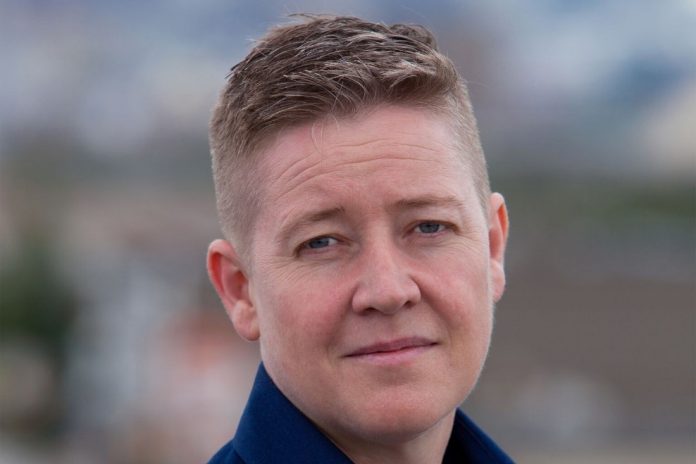
Beginning this fall, Canadian storyteller and filmmaker Ivan Coyote took over as the SFU english department’s 2018–19 writer in residence.

Discussing their new role at SFU, Coyote told The Peak that they will be on campus each week to meet with writers and students and faculty to do one-on-one consultations. They will also be doing some classroom visits for readings and question and answer sessions.

Although the writer-in-residence position is based in the English department, Coyote explained to The Peak that anyone in the SFU community and beyond is able to access the one-on-one consultations with the writer in residence.

“All you have to do is send in a writing sample (10 pages max) and book a session with me by emailing Laura Walker, the English Department Head Organizer of Many Things,” Coyote stated.

On September 27, Coyote held their inaugural reading as the year’s writer-in-residence at SFU Downtown Campus.

Coyote has had a longstanding relation with SFU. “I did one of my first professional writer gigs up at SFU in about 1997, I think, just before my first book (co-authored by Zoe Eakle, Anna Camilleri and Lyndell Montgomery (Press Gang, 1998)). That was over 20 years ago, believe it or not,” wrote Coyote to The Peak.

Following their association with SFU in 1997, Coyote then taught as the non-fiction instructor in the Writer’s Studio at the SFU downtown campus in 2009/2010. In the fall of 2017 SFU awarded them an honorary Doctor of Laws and in February 2018, Coyote’s book Tomboy Survival Guide was selected as SFU Library’s One Book last February.

“So, in a way, I’ve had ties to SFU for a while now,” remarked Coyote.

Coyote has authored 11 books, created four short films, approximately six full-length live shows, and around three albums that combine storytelling with music. Over the last two decades Coyote has also earned widespread popularity and acclaim for being a seasoned storyteller in different continents.

“Live performance has always been a driving element of my work,” wrote Coyote, describing the main motivation behind their work. “Live performance ties me to constant learning and expanding the craft of writing and storytelling. I think storytelling is the single most powerful tool we have as humans to learn about and understand each other and build a better world to live alongside and with each other.”

Talking about what is next on their plate, Coyote mentioned that they are predominantly a live performer, a theatre artist, and a public speaker, and that they hope to keep touring in the future.

“I’m also going to start building a little cabin in the Yukon next June, after I finish my residency gig,” said Coyote.

Their new book is also set to be finished during their residency at SFU and bound to hit the shelves in the fall of 2019. Coyote told The Peak that they are working on a mystery novel and booking a national and then international tour of their new collaboration, a live show called Trader Time, with musician and composer Sarah MacDougall.


World News Beats

0

Written by Kayli Jamieson, SFU Student


Mangkhut typhoon battered the Philippines and Hong Kong

Mangkhut, the super typhoon formed in the Western Pacific, recently ravaged the northern Philippines.

The mid-September typhoon, which according to statistics reported on CNN News is the most powerful storm in the world this year, first consumed the northern Philippines on its path to southern China, killing approximately 127 people and counting with winds that reached over 240 kilometres per hour. Almost three million people were affected by its direct hit, and another 11 million have been affected by the subsequent flooding.

Its strength was compared to that of a category five hurricane, uprooting trees and tearing apart buildings. There were reportedly four deaths in China, and long-term damage to infrastructure.

Over 889 delays and cancellations at the Hong Kong International Airport were also incurred as a result.

With files from The Washington Post , CNN News and Voice of America.


NAFTA deadline looms, negotiations drag on

The October 1 deadline for the North American Free Trade Agreement (NAFTA) is approaching rapidly, as negotiations between the United States and Canada drag on.

U.S. President Donald Trump has threatened numerous times to exclude Canada on the basis of what he deems to be unfair trade terms. Trump has instead proposed an alternative two-nation deal with Mexico.

The issues prolonging the current NAFTA negotiation between the two nations revolve around the Canadian tariffs on U.S. dairy products, and the proposed time-limit on the agreement. In terms of the time-limit, the U.S. wishes to have the agreement last only five years, whereas Canada wants at least a ten-year agreement.

Trump additionally refuses to recognize and acknowledge that the United States has a trade surplus with Canada. Whether the negotiations reach an impasse and Trump forges on with a two-nation deal remains to be seen.

With files from Global News, Global Trade Magazine, and Macleans.


Pound drops significantly after Theresa May’s statement

Negotiations between the European Union (EU) and the UK regarding the Brexit agreement are still ongoing. The pound declined after EU leaders asserted the need for UK to make “compromises” on the Brexit trade deals.

With UK Prime Minister Theresa May stating “no deal is better than a bad deal,” hopes of a faster finalization of the Brexit deal have been lost, leading the pound to drop one percent to 1.5% lower. As of September 27, the sterling stood at $1.3068 against the U.S. dollar.

May also used the term “impasse” to describe the current state between the UK and EU.

The comment is indicative how both sides are nowhere close to reaching an agreement that is satisfactory in a possible post-Brexit world.

With files from BBC News and Deutsche Welle.


Post-bailout Greece witnesses increased unemployment in young adults

After the European Union (EU) bailed out a bankrupt Greece, the nation was forced to cut government spending as a condition. These cuts to government spending have worsened unemployment in youth and further decreased job availability.

Due to austerity programs, the country is restricted in its economic growth and social programs. This has resulted in large-scale unemployment, especially among young adults.

Greeks in their mid-to-late twenties are emigrating out of the country in search of better job prospects. With the unemployment rate at almost 58% for those under 25, the future looks bleak for Greek youths.

Even in 2017, around four in 10 young Greeks were jobless.

With files from BBC News.