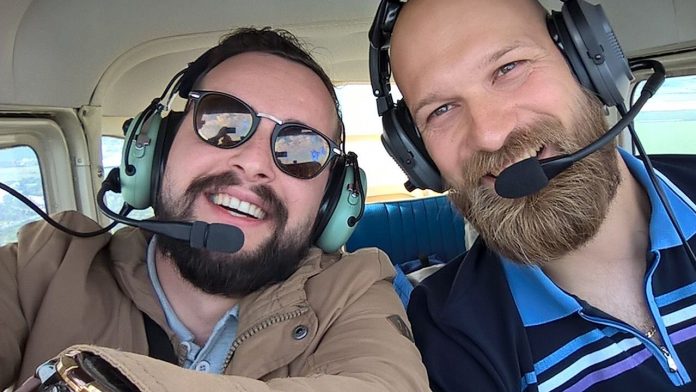
SFU researchers have debunked the myth that beards are threatening in low-oxygen situations, allowing pilots to grow facial hair.
The research was done for Air Canada by Sherri Ferguson, director of the environmental medicine and physiology unit at SFU, and her team. The researchers studied how beard length affects facemask effectiveness, as the company deliberated on whether or not to repeal their policy requiring pilots to be clean-shaven.
The team first examined whether Air Canada’s current masks give bearded pilots enough oxygen during depressurization to prevent hypoxia (oxygen deficiency in the bodily tissues).
The team also looked to see if bearded mask-wearers would be protected against carbon monoxide inhalation in the event of smoke or fire.
Participants were split up based on beard length and placed in SFU’s hypobaric chamber to simulate different altitudes.
Ferguson found that beard length did not affect the participants’s oxygen levels. Participants also did not exhibit signs of smoke inhalation when Ferguson’s team simulated the smoky conditions of a fire using stannic chloride, because the masks created a tight seal irrespective of facial hair length.
The study’s results prompted Air Canada to change its policy on facial hair, letting pilots keep short beards; the maximum length is 12.5 mm.
Air purifiers can help improve fetal growth in polluted settings
In a unique study, SFU health sciences researchers Prabjit Barn and Ryan Allen found that air purifiers inside pregnant women’s homes can help fetal growth, especially if the women lived in polluted environments.
This study was done in Mongolia’s capital Ulaanbaatar. Ulaanbaatar, with fine particulate matter levels high above recommended levels by the World Health Organization, is one of the world’s most polluted regions.
Barn and Allen had about 540 pregnant women take part in a randomized controlled trial study. They provided high-efficiency particulate arresting (HEPA) air purifiers in the houses of half the participants, which lowered indoors fine particulate matter levels by almost 30%.
The women whose homes had the HEPA purifiers during their pregnancy tended to give birth to heavier babies than those whose homes did not.
Barn and Allen believe that this is evidence that air pollution adversely affects fetal development, and that controlling it could be favorable for fetal growth.
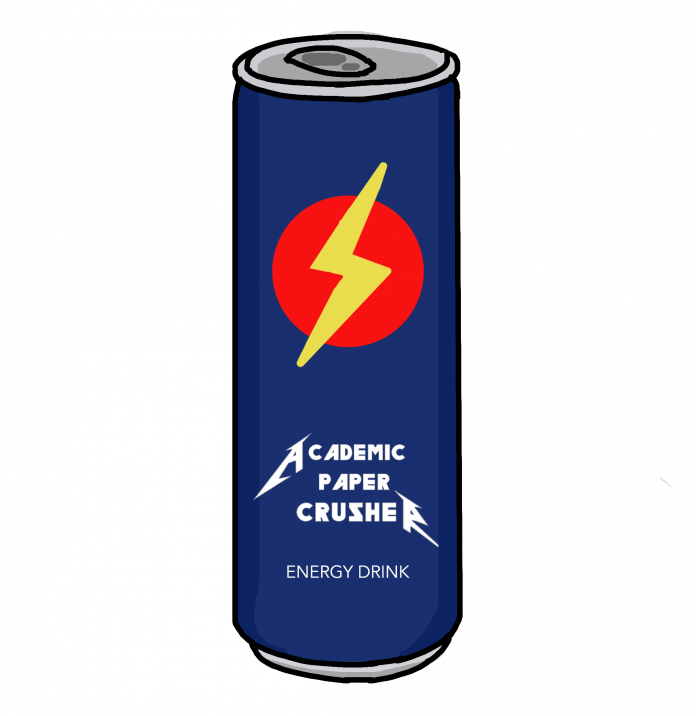
Looking for that perfect drink to keep you sleep-deprived during the Fall Semester? Want a boost to get your brain going after a chaotic week of final papers and exams? Looking for a reason to stay at school longer than necessary? If your answer is yes, maybe, or an uncaring shrug to all three questions, then SFU’s new energy drink is the right choice for you!
Known as the Academic Paper Cruncher, this new energy drink was founded by Too Tired Inc. (TT) and with its bizarre ingredients, it has made people question their ridiculous consumer habits. The drink blends energy and past experiences from previous midterms, essays, and other tedious projects for the ultimate academic rush. The Cruncher is served in a cup made of coffee-stained syllabi and misaligned MLA formatting sheets. For two extra dollars, the drink can even be paired with a side of used USB Drives and broken iClickers that beautifully compliment the Cruncher’s amazing academic benefits:
Perfect midterm marks that make your peers question what it means to study.
Easier time coping with the ego-crushing realities of multiple papers due the same week.
Better memory to deal with lousy cramming for a test worth 99% of your final grade.
Perfect essay-writing that makes each of your drafts look like the next Mona Lisa.
With its popularity growing, the Cruncher even gives Starbucks and Tim Hortons a run for their money. The success of this new product is due to the high-quality ingredients listed below:
7 ml of copious optimism for the nihilistic abyss called the future.
13 weeks of lecture notes from a lonely, sleep-deprived lifestyle.
Your shredded term papers filled with unreadable feedback.
22 grams of classes with overbearing grading curves.
1 teaspoon of unacceptable office hours.
2 tablespoons of stress-inducing midterm study sessions.
For an extra kick, add these exciting toppings:
10 pounds of excessive participation on the first week of semester.
8 mg of pencil shavings, white-out tape, and eraser bits rolled up into a final grade email.
15 scholarships whose arduous requirements call into question the point of their existence.
So if you want to try something new this year, then go out there and buy the Academic Paper Cruncher at a cliff near you. Get your energy into overdrive while supplies last, or you might just fail your class.
Since September 7, one line from “Jet Fuel” — a track on Swimming, Mac Miller’s final album — always makes the breath catch in my throat: “Well Imma be here for a while, longer than I did expect to.”
For an artist who often saw his own death as an impending inevitability, this was a remarkably hopeful sentiment. Mac Miller had, over his career, ascended from radio-friendly frat-rap beginnings into the upper echelons of hip-hop. After releasing a string of beloved, acclaimed albums over the past five years, his position in the future of hip-hop seemed firmly entrenched. But on September 7, Mac Miller passed away from an overdose.
Death, and overdosing in particular, was a recurring motif in Mac’s music, yet it was always balanced with a kind of boastful optimism. 2013’s Watching Movies with the Sound Off was the first real introduction to a more experimental, artistic, and deeply tormented Mac Miller. It opens hopefully, with a sentiment similar to that on “Jet Fuel” (“Hallelujah, thank God I have a future”) but, like many of his albums, concludes with an aural representation of dying. His 2014 mixtape Faces is so fraught with demons, addictions, and suicidal tendencies that fans genuinely wondered if Mac would survive the year. In 2015, Mac released GO:OD AM, which, in an ironic twist, stands for “Go O.D. in the AM”. On “Perfect Circle / God Speed,” Mac terrifyingly, prophetically, described the events of his eventual overdose three years before it occurred.
Over the past couple of years, Mac was getting better — 2016’s The Divine Feminine found him at perhaps his happiest, crafting a beautiful album on the concepts of love and divinity. Swimming, released roughly two months ago, was his most concise project to date. It’s a small masterpiece from an artist who was only getting better, centred on the concept of survival: you have to keep swimming if you don’t want to drown. Swimming was never supposed to be Mac’s goodbye letter, but in terms of distilling his message into its purest form, it’ll certainly do.
Mac was one of the most important artists hip-hop has seen, and not just for his remarkable music or the role he played in helping dozens of artists reach fame. Mac Miller symbolized the fact that, no matter how terrifying the voice in your head got, not matter how hopeless life seemed, you were never alone. He put so many of my greatest fears and darkest thoughts into words, but he also gave voice to hope and perseverance that have been so necessary over the past five years. At 26, he is gone far too soon. Like many others, I grew up alongside Mac Miller, and to lose such an important artist so young hurts deep in the soul.
Pretend you are in your last lecture of the day. Your professor has said that once they
finish the lecture slides, they’ll let you out early. Good! You have an hour-long commute home and another four hours of homework afterwards due at midnight.
So what happens? Some jerk starts asking question after question, each of them being either redundant or plain asinine. All they seem to be doing is eating up time to make the lecture last as long as possible. But are their questions really all that foolish and uncalled for?
Well, yes and no. To that individual, those questions could be a matter of academic life and death. They might need that odd comparative story they are telling to be able to place the material into a context they better understand, or they might really need that confirmation about what you just learned. Maybe they can’t hear the professor and they simply need them to repeat themselves.
Regardless, they need it. They wouldn’t brave the animosity of their fellow students — who they know they’re inconveniencing — without good reason. They need their questions answered. Chances are, someone else has the same queries and is just too nervous to speak up. You’re all paying for this content, so you may as well get your money’s worth.
But there comes a flip side to this — to everyone who does understand what’s going on, this individual is causing a disservice. You have places to be, things to do, and you completely understand what the professor was saying.
At some level, you have to tolerate questions others pose that you don’t have. That’s OK, and more often than not, the material will be more ingrained in your memory because of it. However, there is also a burden of time that needs to come when asking basic or unnecessary questions.
As a student, you are expected to pay attention in lecture and have a general idea of what’s going on. If you’re meeting that expectation, good! If you aren’t, then understand that you’re interrupting and extending the class by asking these questions. If you do need to interrupt a lecture with questions, please just be brief and respect your peers’ time.
Trottier Observatory, image courtesy of Jennifer Low
By: Jennifer Low, Peak Associate
Despite a reputation of being a prison fortress, SFU is undeniably beautiful. With lush courtyards, stunning works of public art, picturesque views of the city skyline, and magnificent forest scenery, SFU is an Instagrammer’s paradise.
SFU Burnaby Campus
AQ Garden: A selfie in the Academic Quadrangle garden located at the very heart of SFU’s
Burnaby campus is the classic, MUST-HAVE photo for your Facebook profile picture that shows off your school pride. Some great spots in this area include:
AQ Courtyard, image courtesy of Jennifer Low
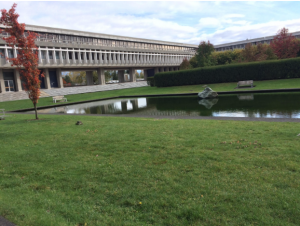
The Reflecting Pond: Located at the center of the AQ’s interior courtyard, the Reflecting Pond serves as one of SFU’s most defining features. Beautiful at all times of the year, it is often home to koi fish during the spring, summer, and fall. It is also known to freeze over completely during the winter months, often looking as if it could be the school’s unofficial skating rink.
The Mosaic Mural: Composed of two tile mosaics by Vancouver Painter Gordon Smith, the mural is locatedMosaic Wall, image courtesy of Mosaic Art Source
within the Academic Quadrangle and is a great place to showcase your appreciation of SFU’s beautiful collection of public art. This spot is very popular during Convocation, known for providing a background for cap and gown photos. The mural is located undercover making it possible to take perfect selfies rain or shine.
The Avocado The Egg Oval Reflections: The infamous sculpture by Carlos Basanta, located within the Academic Quadrangle garden, is a must-have photo backdrop. Its reputation precedes it, and no SFU student can seem to resist walking by without taking a photo with the concrete egg. With its polished inner surface inscribed with SFU’s core values, one might even call it the greatest mirror selfie on campus.
West Mall Centre: The rooftop of West Mall is one of my favorite spaces on the Burnaby campus. With scenic views of the city skyline and the surrounding forest, it is a perfect place to capture a picture from the very top of Burnaby Mountain.
Convocation Mall: Located on the west of the Academic Quadrangle and walled by the
Convocation Mall, image courtesy of Jennifer Low
Maggie Benson Center, Traffic Center and W.A.C. Bennett Library, this glass-roofed open area is where it’s at. While your Wi-Fi signal might not be strong, your selfie game will be. Between the numerous events and various holiday decorations, the Convocation Mall is a dynamic backdrop guaranteed to make any selfie an amazing one.
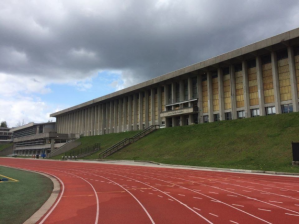
Terry Fox Field: Home to the Simon Fraser Clan and located next to the Lorne Davies Complex, Terry Fox Field is a great spot to get that coveted athletics selfie. Whether it’s a
Terry Fox Field, image courtesy of Jennifer Low
post-work-out photo or one taken at an SFU sporting event, Terry Fox field never fails to deliver on providing a great background.
The Rotunda bus loop: Just a hop, skip, and a jump up the stairs from the transportation centre, there is a fantastic little spot just beneath the Rotunda study area. Nestled between the stairs leading to the Convocation Mall and the stairs to West Mall, the Rotunda bus loop features a great plant centerpiece that will make any photo amazing. Sometimes the fire pits are located in this spot, making the ambience even more Instagram-worthy. It can get a little bit dark in this space, as cloudy days and limited natural light make these shots tricky, but the extra effort of turning on your camera flash is completely worth the results.
Trottier Observatory and Science Courtyard: The Trottier Observatory and Science Courtyard, located between the AQ and the bus loop, is a great place for catching amazing
Trottier Observatory, image courtesy of Jennifer Low
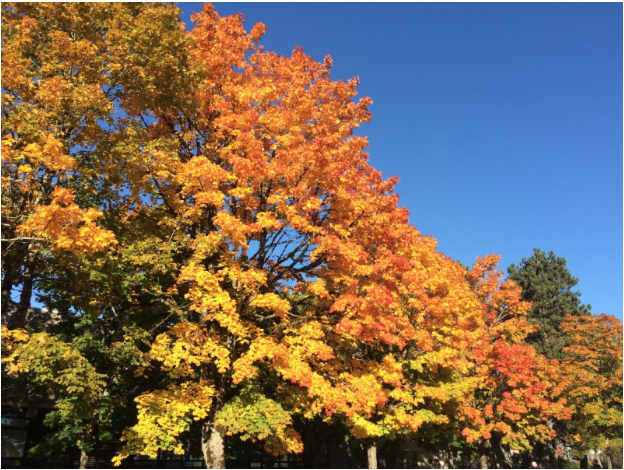
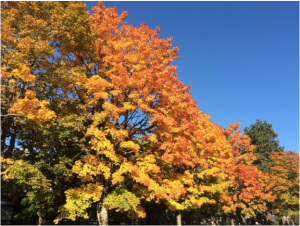
pictures both during the day and at night. During daytime, the walk through the courtyard is stunning especially during autumn when the space is filled with the season’s vibrant colours. Of course, construction these days makes it a little tricky, but this just gives you another opportunity to let your creative side out through strategic angles and cleverly selected filters. At night, the observatory is host to “Starry Nights,” a popular public outreach program that is free and open to the public. The observatory is lit up beautifully, creating a great opportunity to make all your friends jealous of your Instagram feed.
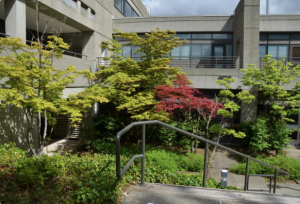
SFU courtyards: We’ve already discussed the beauty of the Academic Quadrangle garden,
One of SFU’s courtyard, image courtesy of Jennifer Low
but if you haven’t done it yet, be sure to check out the various little courtyards scattered all over campus. From the one featuring a secluded pond near Robert C. Brown Hall to the fountains near Saywell Hall, SFU is simply filled with photo opportunities in these little pockets of nature. These spots are prime locations year-round. For example, the courtyard located just off the South Concourse of the AQ has the most amazing tree blossoms in the spring and summer months while also proving to be a great quiet spot for photos with the snow that SFU is so well-known for during winter.
SFU Surrey Campus
Galleria: My favorite selfie spot at SFU’s Surrey Campus has to be the view of the Galleria. Between the natural light streaming in through the floor-to-ceiling windows and the modern, vibrant architecture, there is no better place to take a back-to-school selfie. This space can be amazing from just about every angle, whether you want to capture the Central City Shopping Center below, aim the lens upward towards the boat-shaped roof, or just capture the intricate bridges and circular collection of study rooms and lecture halls, the Galleria has it all.
Mezzanine: It’s your first point of contact at the Surrey Campus and it definitely makes a great impression. This large space is basically the indoor equivalent of Burnaby’s Convocation Mall, as the Mezzanine hosts a large number of Surrey Campus events. With an abundance of natural lighting and wooden accents, the Mezzanine should definitely be your next photoshoot location.
Atwood’s dystopian novel, The Handmaid’s Tale, is the story of a young “handmaid” in the Republic of Gilead, formerly known as the U.S., whose only job is to provide a wealthy household with an offspring.
Even though the novel tells a unique story, it is socially relevant today. While a lot has changed since its publication, it’s not hard to imagine a future similar to that of Gilead where men use women as vessels to carry out their “duties” and fulfill their “biological destiny.”
The novel explores themes such as patriarchy, love, and femininity. It is a thought-provoking and disturbing story that serves as a cautionary tale to all.
The Handmaid’s Tale (2017)
The TV show remains faithful to Atwood’s novel to quite an extent, whilst updating itself with more diverse characters, as well as modern-day technology. It’s suspenseful, and it’ll get you hooked from the first episode. The cast are the highlight of the show, especially the actors portraying Aunt Lydia and Serena Joy. Occasionally, the show deviates from its titular character Offred and follows other characters, a positive change from the novel.
The haunting imagery compels one to draw parallels between the show and modern-day American society. Dealing with issues such as sexism and sexual assault, it’s not always easy to watch, but the end result is worth enduring some of its brutality.
Verdict
It is rare that an adaptation is as good, if not better, than its novel. The Handmaid’s Tale (2017) achieves just that. In fact, season 2 of the show, which goes completely off-book, is even stronger than season 1. I highly recommend checking both the novel and the TV show out.
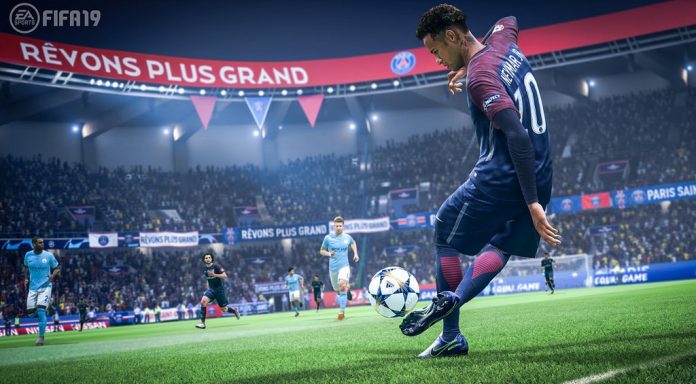
Experience the most realistic sports gameplay in FIFA 19. (Photo courtesy of steamXO via flickr)
On Thursday, September 28, the new instalment of FIFA officially launched across the world. I had the pleasure of getting the early, early access on September 20, and this is what I think.
Gameplay:
After the first few days of early access, EA made a patch to the game. Why? Pace up the middle was irrelevant. For my first 10 games or so in the game, I don’t think I saw one breakaway as defenders (particularly centre backs) would catch up to any player that went past them. This was the complete opposite of last year’s instalment when it first came out, when defending was virtually impossible.
So EA fixed it, and while pace is not as important as previous installments of the game, it’s still one of the most important stats. The most important stat, however, is passing. Since FIFA players are now given more ability to change tactics than ever before – from build-up tactics, to defensive depth and width, to pressing style – you are likely to have little time on the ball. This results in games often looking more like ping pong than soccer, as it is very hard to maintain possession unless you have players with good passing stats, especially in the midfield.
All in all, it’s the most engaging FIFA that there’s ever been in terms of gameplay, whether you’re competitive or just looking for a fun sports game to play with your friends.
New features:
It is quite clear that EA cares more about Ultimate Team than any other game mode, and it’s better than ever. The new addition of division rivals allows you to play competitive games throughout the week. After your first five games, you will be placed in a division and face off against other players in the same division. Every week, you will be ranked in this division and be given rewards as a result of where you placed (obviously, the better you did the better the rewards). This makes for some competitive gameplay as soon as you start ultimate team rather than having to advance from division 10 like you use to have to. Weekend league has also been slightly altered, as it is now 30 games rather than 40, which was way too many in my opinion.
While Ultimate Team is great, other game modes like Career Mode and Virtual Pro have essentially been forgotten. It makes sense for EA to do this, as Ultimate Team is what makes them so much money, but if you play these other game modes, you’ll be disappointed. I wasn’t able to find any significant differences in Career Mode and Virtual Pro from FIFA 18.
It also offers a ton of other game modes in the kickoff menu, such as one in which you lose a player every time you score. Games modes like this make FIFA more entertaining for people who don’t want to play online. Even my girlfriend started playing, and she hates FIFA.
Overall rating: 8.5/10
While I am disappointed in what’s happened to Career Mode, FIFA is still FIFA. Ultimate Team is fantastic, and the new kickoff menu adds an arcade-like feel to the game. It’s lived up to the hype.
“The Cannabis Act has received Royal Assent.” Nothing better than a statement from the government of Canada to make it all the more official; marijuana is finally about to become legal.
With Bill C-45 approaching in about a month, October 17 to be exact, the future is looking bright for ganja, and it doesn’t care whether it is received well or not. For those who remain undecided on the issue, however, we at The Peak have decided to gather some opinions from various Vancouverites to gain some diverse and valuable insight on the matter.
Harold, a student of 23, responds: “You know . . . all the greats smoked dank kush. Steve Jobs, Hendrix, Huxley . . . They used it to get creative. The Doors of Perception was written on mescaline, but, you know, same thing, and it was one of the best books ever written. As for me, sometimes it works and sometimes it doesn’t. Either I come up with a great idea as a thesis for a paper, or I end up spending eight hours building a ridiculously extravagant and intricate castle on Minecraft.”
When asked about the quality of the paper that resulted from such a process, Harold refused to comment any further.
Another Vancouver local, Kumar, mildly surprised, remarks that she “thought it was already legal.” After inquiring the date of legalization, Jane proceeded to stare stoically into the distance. In fact, upon seeking the opinion of 19 Vancouverites, more than half were under the same impression, claiming to have already been “smoking it on a regular basis,” and that it “helped them sleep.”
While most seemed open to the idea to the idea of legal marijuana, and a few even rather ecstatic, others were not so keen on the popular herb. An unnamed student is more adamant on the issue, claiming that marijuana “rots the brain” and “makes one slow” and that Trudeau’s “premature age of 46 is really the root of it all.”
Mary, age 45, argues that legalizing marijuana will only “get more people to smoke more weed, and those that do to smoke weed to smoke it even more.” Indeed, as is confirmed by the inevitably large attendance of civilians each year at Vancouver’s infamous 4/20 festival, there seems to be no stopping the propelling wheels of the devil’s lettuce— whether it is restricted by law or not.
As Mary’s friend Jane retorts: “People are going to smoke weed anyway. Have you been out walking in downtown Vancouver lately? There’s seem to be a lot more skunks around . . . but it’s not skunk you’re smelling. Anyway, those who don’t like it are just going to have to accept it. It’s just one of those things Vancouver’s going to get known for.”
. . . which seems to be quite fitting to the definitive list of things comprising Vancouver’s reputation, we suppose, considering that already consists of avocado toast, yoga, and naked bike riding.
In case you haven’t heard, Burnaby’s municipal elections are on October 20, and there are four mayoral candidates running this term. Included are Derek Corrigan, Mike Hurley, Sylvia Gung, and Helen Chang. Eight city councillors and seven school trustees will also be elected.
Students at SFU Burnaby need to be informed about their municipal government. We often look at federal issues like the Kinder Morgan pipeline, or hyper-local issues like SFU’s student government, but forget to look closer to home in our own neighbourhood. It’s saddening how some students I talk to haven’t even heard of the upcoming election. Some don’t even know who the current mayor of Burnaby is. Those who’ve heard of Derek Corrigan may be vaguely aware of his current actions within the city, or they may be completely apathetic.
However, we shouldn’t be. The choices that happen now in Burnaby will affect and change your future more than you realize. Being informed on where our mayoral candidates stand on key issues might alter your perspective entirely.
For those who don’t know, this election is somewhat centered around candidate Derek Corrigan. Corrigan’s already served Burnaby for five terms, but might lose his seat to Mike Hurley over the controversial housing issues plaguing the municipality — especially the recent “demovictions” around Metrotown. Demoviction is a term for when older low-income housing complexes located near high-density areas are demolished to build larger condos that can accommodate more residents.
Previous tenants of these demovicted buildings are finding it very difficult to find affordable new homes. This has been the central issue of the election for Corrigan and Hurley, with Corrigan receiving extensive backlash over it.
Retired firefighter Hurley first stepped up as a candidate in late June to challenge Corrigan’s approach to Burnaby housing, describing him as having “no empathy” for the stressed evicted residents. Corrigan blames Burnaby’s inability to prevent demolitions on provincial legislation and zoning bylaws.
Recently, new legislation has given B.C. municipalities to have more power over rental zoning, and Corrigan suggests the new housing could have the same rental prices as the demolished properties. He ultimately suggests a “one-to-one replacement.”
Is this merely a political move to regain supporters for the upcoming election? Hurley finds it “suspicious” that Corrigan is only now showing “real concern”. In an article by Burnaby Now, SFU political scientist Paddy Smith also suspects this move is a counter to Hurley’s campaign. I myself am suspicious of sudden promises or political moves right before an election.
No matter the reasoning behind the turnaround, the real issue at hand are the displaced residents who have nowhere to go. Hurley’s recently proposed solution is to place a moratorium on demovictions unless it’s certain that those displaced would have a guaranteed new residence with the same rent. Although his housing plans are not cemented in detail, his main platform is focused on addressing housing affordability.
Corrigan has stated that Hurley “knows nothing” about how municipal politics work and criticizes his lack of experience of being on a city council. These criticisms only come off as petty. By bringing down someone with these kind of statements, what does that say about the speaker themselves?
While it appears that some citizens of Burnaby are already taking sides, the official platforms for all four candidates have not been released at the time of this writing. Candidate profiles are at least on the City of Burnaby’s website, with a segment of Sylvia Gung’s description stating “abolishing municipal election campaigns can solve housing problems.” This comes off as very ironic considering she’s running in the elections. She’s perhaps most well-known for wishing to ban public displays of affection to supposedly prevent violence toward gay and lesbian couples — some odd logic to say the least.
More information has yet to be released as well for candidate Helen Chang. She was elected as a Burnaby school trustee for three years in 2005, and wishes to make Burnaby safe and inclusive. Chang and Gung aren’t directly involved yet with the demovictions drama between Corrigan and Hurley, but they may possibly bring proposals to the table of how Burnaby can be improved. This is something to look out for as well, as they’re all still active characters in this elections.
At the end of the day, remember that your vote does matter. This election has real and visible consequences, and people need to be as informed and active as they are for any other election. Place meaning behind your vote and create conversations with others about it. Nothing bad comes from being informed about the changes within your most local community, and who’s behind them
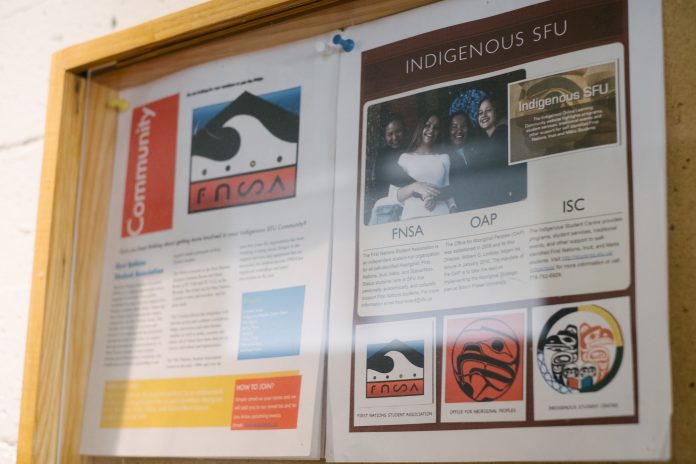
The FNSA has allied with Students of Caribbean and African Ancestry and the Simon Fraser Public Interest Research Group as part of the rotunda organizations seeking SUB space. (Chris Ho / The Peak)
Written by Amneet Mann, News Editor
The First Nations Student Association (FNSA) posted a public letter on their Facebook page detailing their concerns with the conduct of the Simon Fraser Student Society (SFSS).
The letter, posted on September 21, cited examples of alleged mistreatment of the FNSA by the student society, such as the SFSS avoiding consultations regarding space in the Student Union Building (SUB), “denying cheque requisitions, and forcing the students who lead the organization to shoulder financial burdens,” and demonstrating “outright racism in denial of events and responses to FNSA governance initiatives.”
The letter noted that the FNSA’s communication with their members over the summer had been limited due to the “circumstances surrounding our negotiations and communications with the SFSS.”
“Now that our membership and council have had the chance to discuss, we have agreed that our treatment by SFSS has been problematic, to say the least, and our attempts to reconcile with their board and leadership have been met with resistance and bad faith for years,” the letter stated.
“We hope that our struggle will continue to reveal SFSS’s disregard for the wellbeing of SFU’s marginalized communities — in particular, its students of colour.”
The letter went on to propose initiatives for the SFSS that would allow them to work towards becoming allies of the FNSA. These initiatives included “culturally appropriate” and “spatially accommodating” space in the SUB, “reliable financial security,” and direct consultation with the SFSS in all plans that involve the FNSA moving forward.
“Our dealings with SFSS is but one example of the asymmetrical distribution of power between institutions and Indigenous students and faculty at SFU.” – FNSA public letter
SFSS vice-president student services Samer Rihani spoke on behalf of the board to respond to the statements made in the public letter, stating in an email interview with The Peak that the society’s relationship with the FNSA had been complicated by the presidential impeachment.
According to Rihani, former SFSS president Jas Randhawa and vice-president external relations Jasdeep Gill had been the two main SFSS representatives in contact with the FNSA, “but were on both sides of the page.”
Rihani noted that further complications had arisen when Randhawa petitioned to provide SUB space for the FNSA while the SFSS was currently in negotiations with the student association.
Following the impeachment, Rihani wrote that “the [SFSS] board stands firmly on how we want to engage in meaningful conversation with FNSA, as well as other external groups. We are certain that we have a lot of good dialogue ahead of us, and groups can expect a total overhaul on what the SFSS is about.”
Following the impeachment of Randhawa, FNSA board member Matt asked whether the society would be held accountable for the work that had been done prior to the SFSS internal struggles. Jakob, also a FNSA board member, commented that the FNSA was “concerned about Jas’s impeachment because he’s been the first person from SFSS to come forward to us by his own accord and open up what we felt to be a productive dialogue.”
Gill responded on behalf of the SFSS, stating that the board was currently looking to set up a meeting time with the FNSA to continue their conversations and work with the student association. “We do want to sit down with you and see where we left off because that was a month and a half ago,” she said. “So if we can continue that conversation, we’re definitely ready for that.”
Matt raised concerns regarding the lack of funding and staff provided for the FNSA by the SFSS. “All the work that students put in, that’s all volunteer time,” he said. “All these students doing unpaid work, working with financials, bringing up annual budgets — all the work that we’ve done, it’s not compensated.”
He also brought up an incident regarding a bilateral agreement which has been drafted by FNSA membership and detailed how the student association was treated within the SFSS. According to Matt, the agreement was leaked online on May 25 without the consent of the FNSA. At the time of this article’s publication, The Peak was unable to find the bilateral agreement online.
The SFSS did not comment on the bilateral agreement during the meeting.



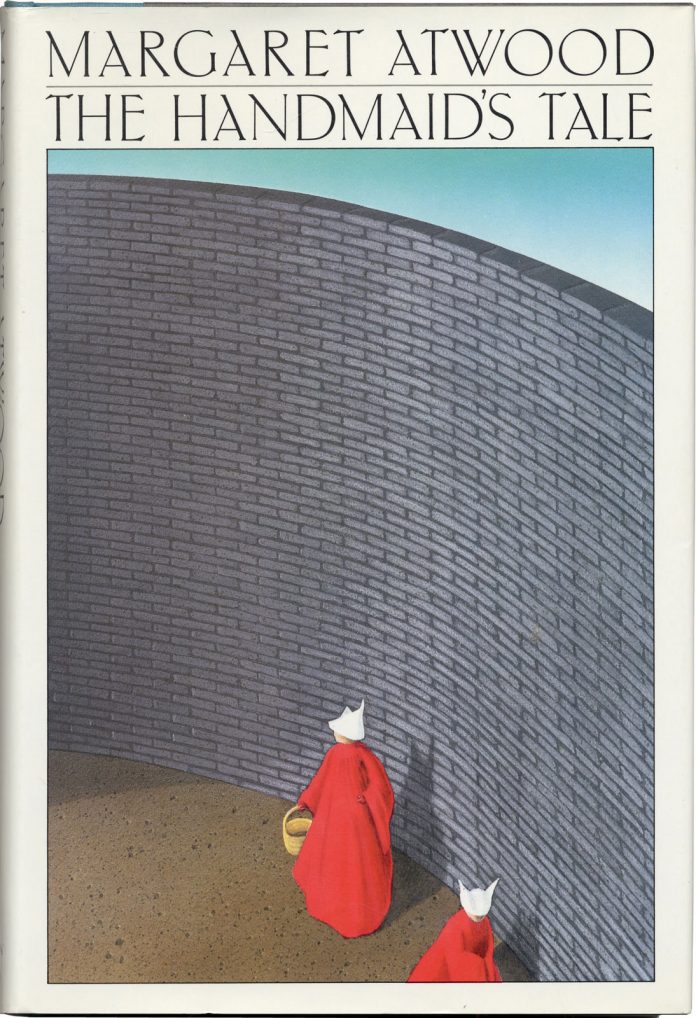
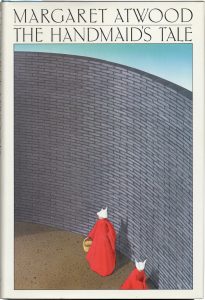 The Handmaid’s Tale by Margaret Atwood (1985)
 The Handmaid’s Tale (2017)