Home Blog Page 611

SFU Senate changes academic conduct policy to remove barriers for complainants

0
(Photo from Peak archives)

Written by: Srijani Datta, Assistant News Editor


The October session of the SFU Senate moved to revise the Code of Academic Integrity and Good Conduct into two separate policies — one for student academic integrity and another for non-academic student conduct.

The original policy dealt with cases of academic dishonesty and general student misconduct. However, with SFU’s Sexual Violence and Misconduct Prevention, Education and Support policy (GP 44) now in place, the university plans to address sexual violence cases through the newly split-off student conduct policy. Subsequently, the memorandum to change the Code of Academic Integrity and Good Conduct to reflect this intention was put in place.

The new policy also changes how cases of non-academic conduct are decided. The current one-policy system requires the students involved in any misconduct case, academic or non-academic, to appear before the University Board on Student Discipline (UBSD). Under the new policy, only matters of academic misconduct will mandate this. This is intended to make the process more sensitive to survivors.

The procedures under the new policy aim to address the behaviour in question “after a preliminary review by the university” and resolve issues informally where possible.

The new policy will also remove UBSD’s jurisdiction on issues involving non-academic student misconduct. The Senate Committee on Disciplinary Appeals (SCODA) will also not be involved in non-academic misconduct matters.

As both UBSD and SCODA include student representatives with other staff and faculty members in their panels, Senator Colin Percival opposed the motion and raised concerns that “it might bar students (involved in matters of non-academic misconduct) from being heard by other students if they so desire.”

However, the motion carried, and the resource team on the policy reiterated the reasoning from the Senate memorandum sent in by Peter Keller, SFU’s vice-president, academic and provost.

“In recent years the use of tribunals for conduct has been identified as a barrier for those reporting misconduct such as sexual violence as the survivor/complainant must face the respondent/perpetrator at the tribunal and there is an expectation of cross examination,” reads one section of the proposed procedural changes in the memorandum.

The revised policies will take effect on January 1, 2019.

At the: Rickshaw Theatre

0

By: Natasha Tar, Peak Associate


Ambience: B

RED. That’s what I first saw when I entered Rickshaw Theatre at 10:20 p.m. The walls are completely red, and so is basically everything else.

      Thankfully, the next thing I saw was the bar, which is situated comfortably in the lobby. The venue hosts a chalkboard of upcoming shows along with a variety of posters such as The Kung-Fu Massacre (“Wholesale murder by a one-man kung-fu army”).

     The Rickshaw also has a balcony (which seemed closed during this show) as well as lots of theatre-like seating, a high ceiling, and a sizeable dance floor. The floor is slanted and reflects the hundreds of beers that have been spilled on it over the years. The seats are cushioned, but you’re going to want to stand up as the night goes on if you actually want to see the performers. There were also anti-smoking ads being projected on the screen the whole night, which felt like a waste of projector use.

      My general view of the place was well-kept but grungy. However, I did feel comfortable and warm inside throughout the show.


Accessibility: C

      The 95 B-Line to SFU stops right outside the venue, making it easy to reach. Patrons in wheelchairs will find it easy to enter the venue and get into the back row of seats. However, the dance floor in front of the stage, the other seats, and the washrooms are only accessible by stairs.

       There are no gender-neutral washrooms, but the ones available are relatively clean and remind me of the washrooms in Bon’s Off Broadway (see: great graffiti).

Bar service: B+

       Take note that the bar here is cash only. All the prices and drinks are neatly listed in front of the bar. I started with a peach-flavoured Hey Y’all to be extra, and also because I’ve never tried one before. It tasted like peach water, which is not what I was looking for, but I’m sure someone out there would like them. My friend and I also shared a Lone Tree apple cider, whose alcohol content matched the price better.


Music: A

       Bamboo Star from Hong Kong started the night off. At first I found their use of a megaphone cringey, but as I continued to listen, their hard rock grew on me. Frontman Wilfred Chung (Wolf Red) has some of the most beautiful hair you’ll ever encounter. Chung explaining the band’s music video “It’s Just Business” provided one of the night’s best quotes: “It’s all about cartoon butts finding cartoon dicks.” After the show, he gave out free pins and stickers.

       Following them were Vancouver’s The Matchstick Skeletons. I didn’t realize until after the show that two of the members are also from the Vancouver band Head of the Herd. When the band first came on stage, I could’ve sworn in the low light that they all looked exactly alike. The same could be said for their songs. All the tunes blended into each other for me, resulting in a high-energy set of which I couldn’t make out a single lyric or defining melody. However, they seemed exciting and the audience loved them, so maybe I was just becoming deaf because of the venue’s insanely loud speakers.

      Before Hotel Mira came on, I stood outside to help the buzzing subside from my ears. If you’re someone with sensitive hearing, I highly recommend earplugs. Mira, an alt-rock band also from Vancouver, did incredible as always, and frontman Charlie Kerr is such an experience to see live. They played a mix of old and new songs, but had to wrap up by 1 a.m., making their set feel a bit rushed.


Overall: B+

      The show was pretty much worth the almost-$25 ticket price. The acts were talented and diverse, but the venue was so loud I couldn’t appreciate the music fully. There are also definite problems with the venue’s accessibility. Other than that, a smooth check-in, comfortable atmosphere, and great performances let the Rickshaw provide a solid time.

All Night Gas Bar illuminates the hardships of a working Vancouver class

0

By: Jill Mandrake, SFU Alumni


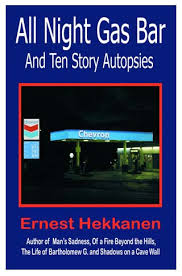
The collection of memoirs called All Night Gas Bar began its its journey in the mid-1970s: author Ernest Hekkanen sent it around to dozens of publishers, only to receive just as many rejections.  Then the manuscript sat at the bottom of an archival box for almost forty years, until Hekkanen eventually dusted off the pages and had them published, for the benefit of university students across the ages.  

      All Night Gas Bar chronicles a struggling, twenty-something writer, enrolled in UBC’s Creative Writing Department.  In order to support his wife and infant, he works the graveyard shift at a gas station on Hastings.  In those days, if someone did a gas-and-dash (that is, filled the gas tank and then took off in a cloud of exhaust), the employee’s already-paltry paycheque was docked.

      But the author hangs in there: working the night shift in this menacing environment actually inspires his writing.  As Hekkanen writes, “I would take my old Underwood typewriter to work in the trunk of the car and, at the station, I would set it up on a stack of wooden Coke boxes in the bay and spend part of my shift pecking out stories in between serving customers at the pumps.”  That’s a noteworthy difference between the 1970s and today; you don’t drag a typewriter around now to sneak in a little writing. But this surreptitious typing leads to self-doubt, not to mention flak from his in-laws. “By the age of twenty-five or twenty-six, I had come to the conclusion that I was, indeed, a kind of failure.”

      At this point, the author’s wife enrols in professional development at SFU, with the goal of obtaining a teaching certificate.  The author has to drop out of UBC, and while he is looking for safer, more lucrative job, he has no choice but to stay at the gas bar.  By now, he’s been the victim of numerous robberies, and other hair-raising incidents.

After one such experience, he says, “Upon getting out of the hospital after being stabbed at the service station . . . I went to a café I knew would be open, namely, The Top Hat, which used to exist near the intersection of Granville and Broadway . . .”  That quote is from the story, “I Work in the City,” a title evocative of “I Die Slowly” by the great Canadian crime writer Ross Macdonald. In addition to the similar title, Hekkanen’s story possesses the same hard-boiled, film noir style, where savage events come across as matter-of-fact.

All Night Gas Bar demonstrates the timeless triumph of working all night, taking classes during the day, raising a family, collecting a jumble of rejection slips, and skillfully surviving to tell the tale.


A real page of my philosophy midterm

0
Image courtesy of scienceforstudents.org

Written by Natasha Tar

PHIL 100W MIDTERM

Instructions: This is an 100-question, open-book, multiple-choice test. Please fill out you’re Scantron sheet fully. Good luck! Your gonna need it ‘cause you pickle ticklers are all at a C- rn lmfao.

1) What is the definition of philosophy?
a) Love of long, confusing articles and poorly photocopied book pages
b) Love of TAs who talk about their hangover and/or smoking withdrawal symptoms
c) Love of Philosophy
d) Love of Wisdom
e) a and b
*Note: I accidentally put the answers in the wrong order on the Scantron answer key, so mark answer a as e, c as d, b as a, d as c, and e as b.*

2) What is epistemology?
a) The study of knowledge
b) The study of how to make beer taste like piss
c) “(/ɪˌpɪstɪˈmɒlədʒi/ (About this sound listen); from Greek ἐπιστήμη, epistēmē, meaning ‘knowledge’, and λόγος, logos, meaning ‘logical discourse’) is the branch of philosophy concerned with the theory of knowledge.[1].”
*Note: Was on a time crunch so shout-out to Wikipedia.
d) It means the same as ideology, that other word you hear in all your classes but still don’t know the meaning of
e) Since I said this is an open book exam you fools should be whipping out your dictionaries right around now

3) In Daniel C. Dennett’s Where Am I? argument, that we went over for several lectures that were so monotonous and similar that you probably barely remember one of them, what was Dennett’s brain called?
a) Either Fortinbras, Firtinbra, Fortinbars, Fortenbras, Forrtinbras, or Fort5inbrAS because I couldn’t spell his name right on more than one slide apparently
b) Yorick
c) Hamlet
d) Poisonous bunch-backed toad!
e) Named it after his Fortnite bud HYp3 B3AST C1UTCH HAz3

4) Who was Socrates famous student?
a) Sockrates
b) Aristotole
c) NPC philosophy dude #4 in Kerning City, MapleStory
d) Pluto (not the planet, but the fake dog from Looney Toons)
e) Plato

5) What is epistemology?
a) Knowledge study!
b) When first-years at a party can’t stop telling you about how sloshed they are
c) Why was I at a first-year party
d) Oh right because the TA is dating one of them
e) Whoops

6) Remember the lecture I spent talking about my gerbil? What was his name?
a) Jackson
b) Greg
c) Arnold
d) Michael
e) both d and a

7) What is epistemology?
a) Jackson
b) Greg
c) Arnold
d) Michael
e) both d and a
*Note: Sorry guys I accidentally copy-pasted the answers for the wrong question so just choose a random letter and I’ll give you a bonus mark.

People should never be mocked for being vocal about their hobbies

0
Illustration by Cora Fu / The Peak

Written by: Alexander Kenny, Peak Associate

“I’m so excited for this tournament that I have this weekend, I’ve been looking forward to it for a month, I’m pleased with how I built the army for it, and I’ve just finished up all the painting. I tried all these new techniques, and I’m so happy with how it all looks!”

“Wow, you almost put me to sleep, that was really lame.”

I’ve had a fair number of encounters like this when getting excited about hobbies close to my heart. It usually starts with someone showing interest and enthusiasm to see you talk about something you enjoy. Quickly, though, the other person is treating this conversation like an 8 a.m. lecture for a prerequisite class they didn’t want to take — a pure annoyance and disinterest that screams “are you done yet?”

I once went on a date with a woman, and told her about some of my hobbies, which at the time covered war-gaming, collecting hockey cards, writing, studying history, and more. She later told me, “You’re cutest when you get all excited about something you like.”

Considering the tendency to mock or judge people for their passions, I’ve kept that memory close to me, and I deeply appreciate and want to pass it forward. People are most beautiful when they’re sharing their hobbies and what makes them happy. Let them enjoy things.

We should never be making people feel as though their knowledge of a television or book series, or their social experiences with fandoms, art, and fictitious worlds, are things to be ashamed of or mocked. These things aren’t the main focus of someone’s life — they’re called hobbies for a reason — but that doesn’t make it OK to mock a person for them. We have enough misery and stress in the world. Someone’s specialized knowledge of a trivial topic shouldn’t bother you so much.

Sharing these passions is also just an important social tool that we shouldn’t be shamed for using. Getting in-depth in your interests and comparing yours with others is a conversation goldmine, and lets people with different interests find things to relate to.

More than that though, talking about interests openly is also the primary way to find people who share your interests. This is why we have clubs for special interests on campus — to bring together those with similar passions, hobbies, and interests in a space where you know others are willing to share. There is no reason not to express enthusiasm about hobbies around others, so long as they don’t hurt anyone. Doing this in our social circles is the only way to further “normalize” enthusiasm and eliminate mockery for it.

Please, if you have a hobby that you love, share it. The world is a less colourful place without them. Ultimately, the change that we need to make is to create a mindset where people find beauty in each other getting excited about the little things in our lives. It shouldn’t be something “annoying” to hide, but something to share a part of.

Competition gives undergraduates opportunity to present research to the SFU community

0
(Nathaniel Tok / The Peak)

rWritten by: Nathaniel Tok, Peak Associate


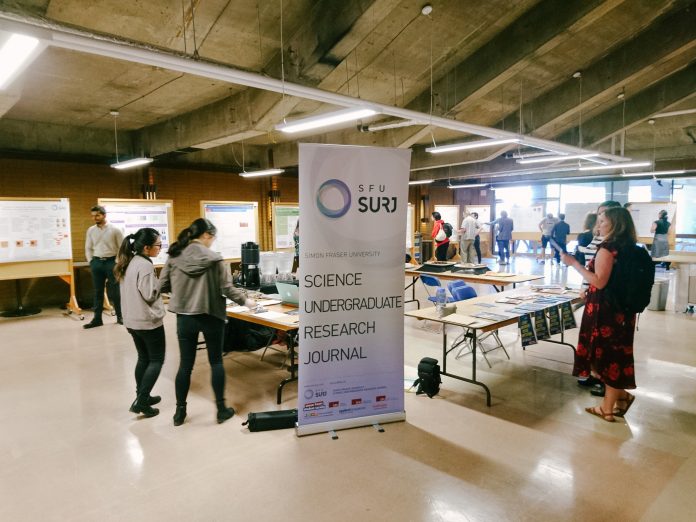
Undergraduate students presented their original research findings to colleagues, graduate students, faculty members, and other members of the SFU community during the second annual poster competition of the SFU Science Undergraduate Research Journal (SURJ). Around 21 groups set up posters describing their research in the James Douglas Safe Study Area for the event.

SFU SURJ is a publication run by undergraduate students, and it is currently in its third volume. It aims to give other undergraduates the chance to undergo peer review with experts and professors and publish their research. SFU SURJ’s online blog also provides opportunities for students to publish more informal opinion pieces.

This year, their poster competition had entries from all over SFU. Students from the biological sciences, molecular biology and biochemistry (MBB), statistics, chemistry, physics, and health sciences departments competed.

Competitors set up their posters in the James Douglas Safe Study Area and were judged by a panel of graduate students and faculty members who walked around looking at the poster layouts. The judges listened to the students’ presentations and asked questions to establish how much the presenter knew about their topic.

Olivia Tsai, a fourth-year MBB student and one of SURJ’s senior editors, hailed this year’s poster competition as a success.

“The location had a lot of traffic,” said Tsai, who was one of the event’s organizers. “We saw a lot of students come [ . . . ] the presenters had a good time showcasing their research.”

Tsai thought the contest helped the students “reflect on their work,” work on their presentation skills, and see the wide variety of undergraduate research going on in SFU.

Participants echoed Tsai’s assessment. Dasha Iskakova, a fourth-year MBB student, noted that “it was really interesting seeing everyone’s else research.” Iskakova found the competition to be a good source of experience in presenting research in a formal setting.

Cassandra Mah and Tess Marusyk, health sciences students, presented on the effects of opening a new greenway in Vancouver. They added that beyond the experience, it was satisfying to show their research to people whom it would affect.

Nicole Whittle, a second-year kinesiology student, found that her research and presentation was in line with her goal of becoming an occupational therapist. Although she found the research process difficult at times, she noted that it was also rewarding. Whittle hopes that her work helps her lab’s next undergraduate researcher plan clinical trials.

Kristen Bystrom and Zhi Yuh Ou Yang, statistics majors who presented on using classification models to study weather data, also enjoyed the process. The two remarked that “we did this research for fun and we wanted to showcase it.”

“It gave us a great opportunity to work with real data [ . . . ] to use the math and statistics we learned in school in an applied sense.” – Kristen Bystrom and Zhi Yuh Ou Yang, SURJ poster competition participants 

“It gave us a great opportunity to work with real data [ . . . ] to use the math and statistics we learned in school in an applied sense,” they noted.

Tsai encouraged students from various disciplines, such as psychology, mathematics, the physical sciences, life sciences, computing science, engineering, and others to publish their work with the SURJ and to participate in future poster competitions.

Tsai hopes that the poster competitions continue, but she acknowledges that it could be hard to recruit judges, as graduate students and faculty members are often busy with their own projects. She also looks forward to doing more to increase SURJ’s outreach to SFU students. Tsai is presently looking to continue recruiting students who are interested in research and in connecting with experts across Canada to become editors for the journal.


Seth Rogen’s deleted transit announcements

0
Illustrated by Marissa Ouyang

Written by: Trevor Roberts

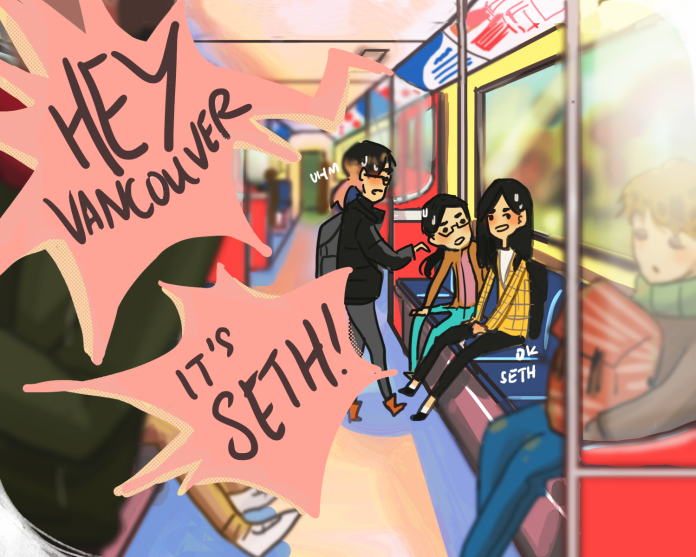
Unless you’re one of those people that drives to school every day (yes, I said those people) you’ve probably heard one of Seth Rogen’s marginally humourous transit-etiquette announcements. Love them or hate them, you may be surprised that many more didn’t make the cut, some of which might have provided a somewhat different feel to the campaign.

“Hey Vancouver, it’s Seth. If a person asks you if the current train is for Production Way or King George, tell the truth. Let’s be honest, anyone who still hasn’t figured out the Expo Line at this point probably isn’t a great problem-solver, and will likely end up having to live at whatever station you send them to.”

“Hey Vancouver, it’s Seth. If you lose something in transit, don’t panic. Just talk to the nearest TransLink employee or call the TransLink help line. Unless you left weed on the Canada Line. In that case, I can assure you that I have it, and you will not be getting it back.”

“Hey Vancouver, it’s Seth. Make sure you’re aware that the last SkyTrains leave between 12:30 and 1:30 a.m. Why is that you ask? Because TransLink hates you and doesn’t want you to have any fun, that’s why.”

“Hey Vancouver, it’s Seth. Remember that some SkyTrains have extra seats at either end of the car that fold down. Not only does that mean you can give up your seat if it’s reserved for those who need it, but you can also look like a total badass to your friend from out of town.”

“Hey Vancouver, it’s Seth. Does anyone here remember that the SeaBus is a thing? Weird, eh?”

“Hey Vancouver, it’s Seth. This one’s for all you bus drivers out there. I know you guys do really great work, but my voice is annoying enough as it is; please kindly only play my message once. Trust me, your passengers will thank you for it.”

*sniffles* “Hey Vancouver, it’s Seth,” *sobs* “A reminder that even after cannabis is legal in Canada, it will be still be prohibited to smoke on transit property.” *bursts into tears*

“Hey Vancouver, it’s Seth. Above all the other advice I’ve given you, remember the golden rule of transit: if you’re sitting in a SkyTrain that has a “driver” seat, and there’s a kid anywhere near you, you give that kid your seat. Just because the world has stripped you of your childhood wonder doesn’t give you the right to do the same to others. Asshole.”

“[30 seconds of Seth Rogen laughing as you go through a tunnel]”

What grinds our gears: Bus bunching

0
Photo by Stephen Rees / Flickr

Written by: Michelle Gomez, Staff Writer

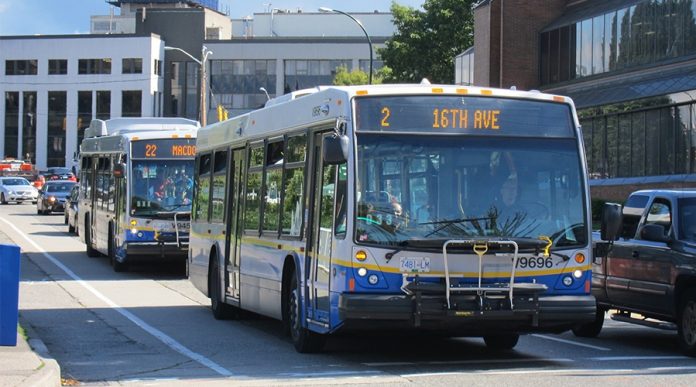
As university students, most of us spend a lot of time taking buses, and a lot of time waiting for them to arrive. Much  of the wait time can be attributed to bus bunching, which is when buses on the same route clump together in traffic. Many people may not have heard the term before, but most of us have experienced it through infrequent buses that are either early or late (I’m looking at you, 95 B-line).

Mathematically, some degree of bus bunching is unavoidable, especially during high traffic times. However, the level it has gotten to in Vancouver is ridiculous. After I have waited for 45 minutes for a bus, I’m already pretty pissed. Then all of a sudden, three show up at the same time. Between these three, the one that pulls up to the stop is packed full, forcing me to physically fight my way on just to make it home.

Meanwhile, the bus with a haven of leg room passes right by, trying to jump ahead towards what’s probably a less populated stop. I could always gamble on whether the vacuous bus is kind enough to let me in for once, but if a bus sees a crowd, the driver sometimes just thinks “eh, they’re probably fine” and it’s too often a losing bet.

All I want is a little more predictability in my trip home. Is that too much to ask?

Two SFU students injured during campus incident

1
(Anderson Wang / The Peak)

Written by: Amneet Mann, News Editor


Note: Due to new information regarding the subject of this article coming to light, The Peak is currently looking deeper into the matter and will be posting an update to this story.

An incident involving a student in Robert C. Brown Hall left two other SFU students with minor injuries on Wednesday, October 3.

According to SFU Chief Safety Officer Mark Lalonde, SFU campus security arrived within three minutes, and the student was removed from campus by the RCMP.

SFU Campus Security did not disclose further information regarding the nature of the incident.

Lalonde noted that SFU Health and Counselling Services was notified and began providing support to all individuals involved in the incident the following morning.

“Other students in the class who were witness to the event are encouraged to reach out to Campus Security for support if they would like,” wrote Lalonde.


Justin Traviss is taking political science from the classroom to city hall

1
Photo courtesy of Justin Traviss

By: Zach Siddiqui, Copy Editor 

Name: Justin Traviss

Pronouns: He/him/his

Hometown: Port Coquitlam, B.C.

Major: Political science

Fun fact: He loves Dungeons and Dragons


Port Coquitlam is one of those Vancouver-adjacent cities you don’t think about much if you’re not from there. But it has its charm — just like its residents, particularly those of us who attend SFU.

As a PoCo-raised boy myself, it was a pleasure to chat with Justin Traviss, a fourth-year political science student aiming to be elected as one of Port Coquitlam’s six city councillors on October 20. Perched at a patio table at the Waves Coffee on Shaughnessy Street, we talked about his campaign, what it’s like to be running for a government job while still a student at SFU, and what motivated him to dive into the contention.

“I had no real idea how to get my foot in the door — how to get into politics,” Traviss says. “But after I did some research . . . it takes time and effort, but it’s time I’m very willing to put in. It’s been a very great time just these last few months; I’ve learned so much more than I would reading about it or anything like that.”

It’s Traviss’ first time dipping into a city election, and he’s running on a platform of bringing better transit and more reasonably priced housing to Port Coquitlam. He wants to preserve the diverse and amiable atmosphere of the town where he grew up. At the same time, he hopes to represent his up-and-coming generation of PoCo residents, as a candidate open to brand-new ideas and perspectives. Notably, Traviss is visibly the youngest candidate in the election, at only 23 years old.

“I’ve had a few detractors saying, ‘oh, this person doesn’t have any life experience,’” Traviss confides when I ask him about the issue of age. He hasn’t let it get to him though: “Life experience does have a part to play, but it’s not the whole picture. There’s other things in life. I want to be able to bring that fresh voice.”

Though you won’t find many people who’ve run in a municipal election while still in school, Traviss doesn’t believe himself to be particularly unique. He asserts that the key reason most people don’t involve themselves in city politics, Port Coquitlam or otherwise, is lack of information about what happens there. Who handles the water infrastructure? Who pays for new roads? These are the sorts of questions Traviss believes go unanswered for many, especially in our young-adult age demographic.

“A lot of people our age don’t understand how important the city is to their daily life,” says Traviss. “We’re getting into real estate, we’re getting into the market, we’re getting into the economy. Our city — we’re going to be interacting with that more so than the other two levels of government.”

Traviss notes that putting political theory into practice is something he’s been excited about, although that’s not just because of his background as a political science major. In fact, he admits that most of the political science course material is “bigger picture,” and that he only knows three or four political science professors at SFU who are experts in municipal politics. He sends up a shoutout to professors Patrick Smith and Aude-Claire Fourot.

Traviss admits, a little bashfully, that he’s not particularly involved in SFU’s campus life.

“It’s just . . . it seems so detached from your life,” he says of SFU’s student club scene and student politics. “It’s a little bit contained in a bubble. [ . . . ] You don’t see the fruits of your labour when you do things up there. That’s why I’m much more interested in doing things down on the ground.”

Regardless, Justin certainly seems to have the needs of students in mind as he campaigns in his city. I ask him what the biggest motivation is for SFU students from Port Coquitlam to come out and vote.

“If you are living in PoCo, it’s an affordable city; it’s still affordable. I want to keep it that way. You, as a student, probably want to keep it that way too,” Traviss tells me.

“Even if you’re living in your parent’s house [and] you’re not going to move out in [the next] five years, in five years, things can get more expensive. [ . . . ] We want to stem that as much as possible. We want to make sure you have a place to live.”

If Traviss were to be elected, he’d still be just one member of the council. With that in mind, we talk a little about the politics of the city council, and how much ability Traviss would have to bring his campaign visions to fruition. He explains that the council differs from some other levels of government in that there are no party politics: “Every vote is technically independent,” he explains.

“It’s more about your character. If you’re able to present yourself as a character that can actually get things done, other people are more likely to follow you. [ . . . ] If you have facts and stats to back up your points, you’re much more likely to get other councillors on board with your ideas.”

Traviss thinks it would be excellent to see more younger candidates campaign in elections and otherwise get involved in their cities. That said, there are plenty of opportunities to get involved in the community outside of election season, he emphasizes to me. He suggests looking for volunteer opportunities with the cities, or speaking to your local MP or MLA about ways to engage.

As we wrap up, he encourages SFU students — regardless of where they live — to keep an eye on their local politics, figure out who they align with, and go out and vote.