Home Blog Page 602

A Tale of Missing Halloween Candy

0
Illustrated by Momo Lin

Written by: Youeal Abera

One of the great things about Halloween is that we all can think of spooky stories to share with each other. Some of us may even be lucky enough to harbour a particularly scary experience, one that we can share to really frighten our loved ones each Halloween.

If you’re in to Halloween tales that start scary but end up being hella funny, then you’re in the right place.

Growing up, my siblings and I would trick-or-treat like it was a part of our religion. Do you know how fun it was to draw maps and mark down the houses in our neighbourhood that were infamous for giving out the biggest candy bars?! Some years, we’d even be so extra that we’d wear two different sets of costumes so that we could go around and collect candy twice. If trick-or-treating was the NBA, we’d have more championship rings than fingers.

Deadass, trick-or-treating was always the most fun experience! Although, every year, the most mysterious occurrence would take place. Granted, these incidents weren’t as frightening as a Tobe Hooper movie or a US election. However (from the perspective of an 8 year old child), this story was definitely a nightmare.

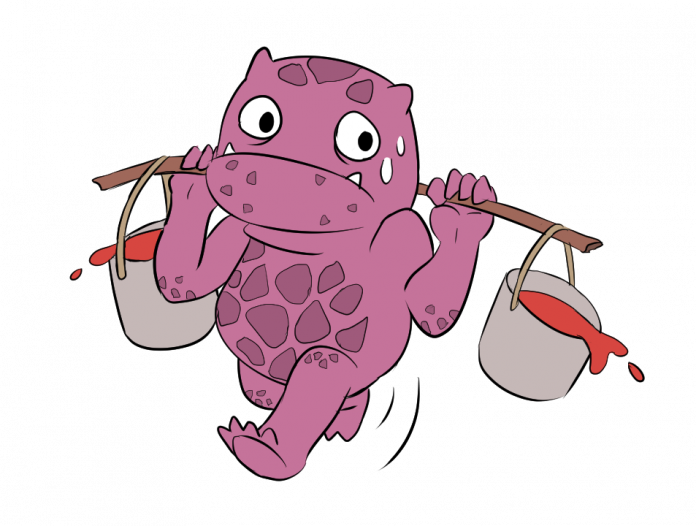
See, I was once haunted by Argusto, the candy-stealing monster from Cedar Hills.

Every Halloween, before I’d go to bed, my parents would tell me a scary story of how a monster, one who resided in our neighbourhood, would go around to each house and steal candy from children. His name was Argusto. My parents told me that no child knew if Argusto would visit them. You can only imagine the fear that Argusto’s arbitrary candy-stealing would instill.  

Year after year, I’d grow terrified from this story. Nevertheless, I would be most terrified when I woke up the next morning to find not a single lollipop or Reese’s peanut butter cup left behind. As the years passed, my fear eventually turned into frustration. I thought, “How the hell would this bunk-ass monster think he could steal all my candy when I’M the one putting in the hard work of trick-or treating? He’s not even a scary monster, he’s just straight-up lazy!”

One Halloween,  I did what I should have done years earlier: I stayed up all night with a rolling-pin and shaving cream. I was ready to fight this monster. In spite of my best efforts, I fell asleep before midnight. I woke up the next morning and my candy was, once again, gone.

Two days after that Halloween was my 11th birthday party. Having a birthday on November 2nd means that the week of Halloween is truly the best week of the year.  On this particular birthday, however, I was fairly upset. I kept asking myself,  “How did I not catch him? How much longer will this crap happen?”

Before leaving for my birthday party, I asked my parents where my favourite hat was, and they told me it was in their closet. When I went into their room to find my hat, I solved the greatest mystery of my boyhood.

This was the day I left my childhood behind. I became a man.

Strewn out in my parents’ closet was a number of goodie bags for the guests of my birthday party. Every goodie-bag was completely filled with an eclectic array of candy. At the corner of my parents’ closet was my favourite, trusty, trick-or treat bag.  It was completely empty.

I was shook. Do you know how mad I was?! There was no monster! My PARENTS were Argusto.

You better believe that, in order to make up for experiencing the worst betrayal known to man (disregarding Kevin Durant joining the Warriors), I ended up with a fairly extravagant Christmas gift that year.

Medical research breakthroughs at SFU

0
(Justin Sullivan/Getty Images)

Written by: Trevor Steele, Peak Associate


Cannabis may help provide pain and seizure relief

Recent research led by SFU faculty revealed how cannabis may help relieve pain and seizures. The study was led by Reza Ghovanloo and Peter Ruben from SFU’s department of biomedical physiology and kinesiology. They partnered with scientists from Burnaby-based Xenon Pharmaceuticals to conduct their research.

The researchers examined proteins that control electricity in the nervous system, finding that cannabidiol (CBD), which is present in cannabis in significant amounts, interacted with proteins that control pain and seizure signals. CBD halted the activity of the proteins, therefore providing relief from pain and seizures.

The researchers hope their findings will lead to further research on the use of cannabis to help patients with epilepsy.

The study was published in the Journal of Biological Chemistry.


New genetic mutation related to Non-Hodgkin Lymphoma identified

A new study has given further insight into Non-Hodgkin Lymphoma (NHL).The lead authors of the study are Ryan Morin, professor and researcher at SFU’s department of molecular biology and biochemistry, and PhD candidate Sarah Arthur.

NHL is one of the most common types of cancer in Canada. The researchers focused on the most common form of NHL, diffuse large B-cell lymphoma (DLBCL), and looked at the genetic mutations that can cause it.

According to Morin, mutations in over 100 genes can trigger the onset of DLBCL. Researchers in the field of cancer genetics have traditionally concentrated on the mutations that occur in the “coding” areas. However, these areas make up only about 2% of the genome. Morin and Arthur took a different approach and examined whole genomes, leading them to their findings.

They found that a third of participants in the study, who had a specific sub-type of DLBCL, had a mutation in a region of the gene known as the three prime untranslated region. This mutation resulted in an abundance of a protein which Morin and Arthur believe may make patients resistant to certain cancer treatments.

The study was published in the journal Nature Communications.

The lost campus of SFU

0
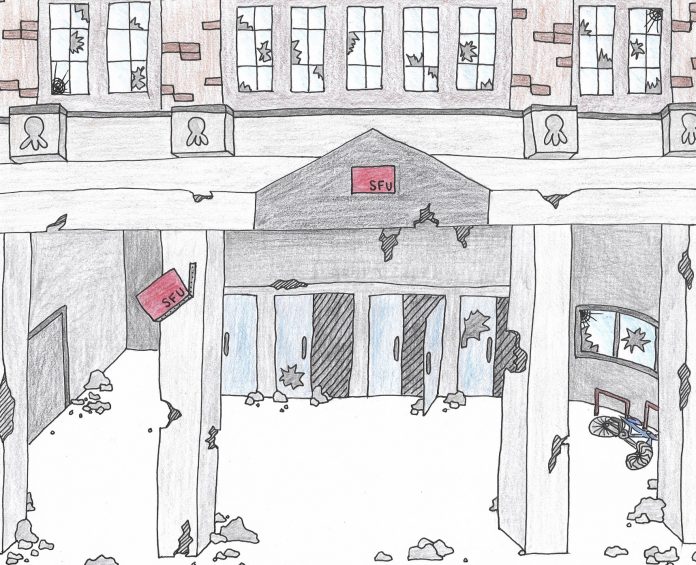
Illustrated by Shannon Foss

Written by: Aaron Richardson

October 3, 2018

I first heard rumours of the lost campus of SFU a couple months ago, but I dismissed the idea instantly. A campus that wasn’t on Burnaby Mountain? Preposterous. However, over the past few days, I’ve heard of students supposedly taking classes on this lost campus. It was a ridiculous idea, but one I couldn’t get out of my head. Against my better judgement, the search begins tomorrow.

October 8, 2018

I’ve been scouring documents left by SFU Administration looking for any mention of this lost campus or its location, but to no avail. There has been no mention of its existence by those who run the school. If it exists, they do not know of it. The search continues.

October 12, 2018

I thought that perhaps the SFSS might make some reference to the campus, as they claim to represent and provide aid for all students. But once again, no luck. In fact, I seem to have found evidence that there is only one campus. To pay for the new Student Union Building, the SFSS is charging all students. If all students are paying for the Student Union Building, and the building is on Burnaby campus, then surely all students go to class in Burnaby. It would be such an odd decision otherwise!

Once again, I must look somewhere else.

October 23, 2018

A break in the case! I decided that perhaps speaking to students might be the best option. If it does exist, there are bound to be some students who would know of it. It took over a week of walking around campus and talking to students before a single one had any knowledge of a campus other than Burnaby Mountain. But finally I found them! Students in the Publishing program told me that it resides in Vancouver, and in Harbour Centre of all places! Right under my nose. I begin my voyage tomorrow.

October 24, 2018

Making my way downtown, I kept my eyes on the tower of Harbour Centre, waiting to discover what treasures may await me there.  When I arrived, I stood in awe at the entrance. It was indeed abandoned. No more than a handful of people would file in and out of the doors in a couple minutes. Inside, there were barely more than a dozen people on the main floor, and a library that actually had vacant chairs and computers.

Where were the throngs of cramped students running from class in one building to another over a kilometre away? Where were the students unloading out of the sardine cans we call buses sweating from the latent heat of strangers’ sticky bodies pressed up against them? Where was the omnipresent noise of construction and screaming children that filled the campus from one end to another? There was no question about it: this place had been abandoned for a long time. But at least I found it. Finally, I can forget all about its existence once again.

October 29, 2018

My victory did not last. Once again, I heard rumours of another SFU campus — this time in Surrey. I don’t know how reliable these rumours are. But they are worth investigating. The search begins again.


What grinds our gears: Jump scares and unnecessary gore in horror movies

0
Illustration by Irene Lo / The Peak

Written by: Winona Young, Arts Editor

When I tell people I like horror movies, I mean horror movies. I want the horrific, the macabre, and the downright disturbing.

What I don’t want is gore so graphic that it borders on kinky. Too often, the blood and guts seem like they’re there purely for shock value, rather than genuine audience terror.

The same goes for jump scares. They’re a lazy way of scaring the audience that just makes for an unmemorable kind of adrenaline. I want to feel emotionally uncomfortable, not just as if my roommate snuck up on me in the kitchen.

These tired-ass tropes hardly constitute a horror movie. At best, they’re barely bearable, and the movie will only be remembered for odd torture porn. At worst, they make a movie tedious and nauseating to watch. Few horror movies know the right ways to build tension and fear, and the films that fail at this also fail to separate themselves from the cheap scares you could find across the Internet.

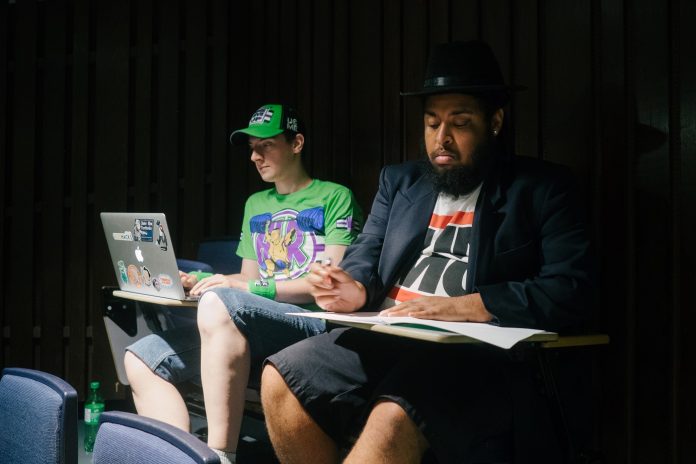
Have some fun and wear your Halloween costumes to class

0
Photo by Chris Ho / The Peak

Written by: Youeal Abera, Staff Writer

I think it’s safe to assume that we’re all exhausted from midterm season. The luxuries of reading for fun, nutritional meals, and eight hours of sleep are replaced by lecture notes, coffee, and power naps on transit.

The campus itself becomes just as dreary as the students feel. September’s exciting start-of-semester events are long gone. Now, the campus is once again the site of a daily grind where we all just attend lectures and tutorials. Needless to say, October at SFU is fairly sombre.

Halloween, and all the goofy dressing up that comes with it, should be a good way to get rid of this melancholy. Instead, though, lots of us just hold onto our outfits until we party in the evening.

Halloween only comes once a year. It’s the only holiday where we can dress up as different characters and be as silly as we want to be. Sure, we may have grown too old to continue the fun tradition of trick-or-treating, but we can still have fun through the personalities we choose to embody. Not that you need to imitate Dracula while you ask your prof to explain an equation, but you might as well get some use out of your costume while you can.

Besides, the lectures in October are almost always half-empty, since people have finally realized they may not be as motivated as they thought they’d be in September. People are tired from the hours of studying they put in the night before, and odds are they may not notice your wig and powerful colours. Those classmates who do will have something other than coffee to give them a bit of energy to start their class.

For those who think that wearing a Halloween costume to class is a vacuous, childish act: would you rather have Tim come to lecture in his regular Fila shirt and sweatpants, or a two-piece suit, a floppy toupé, and a Michael Scott nametag? I get the need to treat school seriously, especially with work piling up at this point in the semester. But briefly encountering a cryptid in MBC won’t kill you. If you wanna worry about yourself, go right ahead, but Tim’s doing nothing wrong and you should let him run.

Of course, like with any outfit you wear, there’s still an etiquette to what you bring to school. You shouldn’t be taking up an extra seat with eight spider legs, or wearing offensive costumes — though the latter shouldn’t be welcome anywhere to begin with.

Wearing a Halloween costume, or seeing someone in theirs, won’t magically erase the hells of school. But getting to be a TV character, a movie monster, or even a celebrity can make campus a far cheerier place. I’m tired of friends and peers who only associate Halloween with parties and trick-or-treating. Putting on a costume is the best part, and it’s a perfect opportunity to bring more energy and flair to our daily grinds.

If nothing else, I plan to lighten up Burnaby campus with a backwards hat, Jordans, and an inside-out uniform blazer to proudly bring some Fresh Prince into my morning class. I’d love not to be the only one.

Political Corner: Journalist Jamal Khashoggi’s death should have been the tipping point for relations with Saudi Arabia

1
Photo courtesy of Getty Images

After the weeks following his disappearance, the Saudi Arabian government confirmed that journalist Jamal Khashoggi was killed on October 2 after entering the Saudi consulate in Istanbul. Now, Saudi Arabia’ leadership is in the spotlight.

Since becoming crown prince, Mohammed bin Salman bin Abdulaziz Al-Saud has introduced a cultural reform campaign called Saudi Vision 2030. This effort has attempted to establish faith in the Saudi government and change Saudi culture’s global reputation. So far, it has been credited with removing the ban on women driving and investing in businesses to lessen Saudi Arabia’s dependence on oil.

But beneath this campaign, Saudi Arabia’s leadership is still far from improved or trustworthy. Saudi has already shown its true colours by severing diplomatic relations with Canada over our questions regarding a detained human rights activist. In fact, detention has been Saudi’s constant response to critics. News and disagreements with the country seem to be something they’re disturbingly willing to silence.

The murder of Khashoggi could cast permanent doubt on the public image Salman is trying to create. However, despite this recent example of a persistent problem, international relationships with Saudi Arabia don’t appear to be changing significantly any time soon.

Saudi still has one of the largest oil reserves, oil reserves to which tons of countries are financially connected. Canada has considered freezing armoured vehicle exports, but aren’t distancing themselves much further. America especially is failing to take action, and while they’re directly discouraging Saudi Arabia’s actions, they aren’t cancelling any America-Saudi contracts.

Saudi Arabia’s recent and historic actions ought to be enough for countries to cut ties immediately, regardless of the costs. It’s worrisome that many countries are still waiting for a bigger crisis before taking action.

Hudson Bay’s cancelled “Make Canada Great Again” hats disrespect Canadian consumers

0
Image from thebay.com

Written by: Gene Cole, Opinions Editor

Make America Great Again (MAGA) has become a meme of uncomfortable proportions. Made popular as a slogan in President Trump’s 2015 election campaign, it continues to be worn by celebrities and Trump rally attendants to show their passion for Trump. Even in Canada, it’s been seen as a symbol of the more hostile attitudes of the right-winged, some individuals going as far as to deny restaurant service to those wearing clothing that bears the slogan.

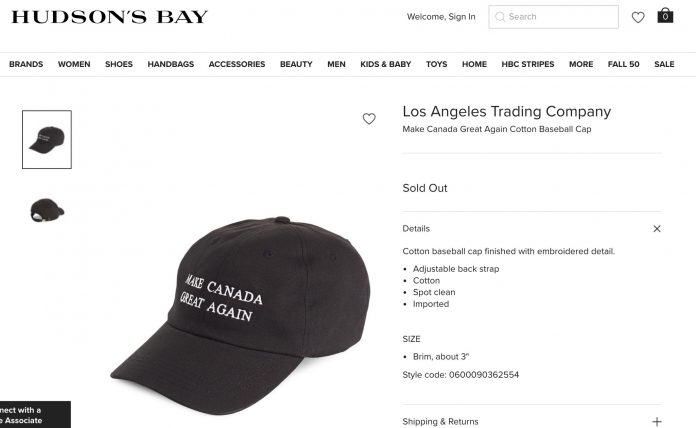
With this context, it astonishes me that Hudson’s Bay very briefly sold a “Make Canada Great Again” hat on their online store. This hat, manufactured by the Los Angeles Trading Company, was available to purchase online at the Hudson’s Bay website for an incredibly short time. Within this time, there were several tweets requesting removal of the item or boycotts of Hudson’s Bay before it being listed as “sold out” to prevent sales.

While it’s good to see this hat not lasting more than a day, the fact that it existed in the first place is concerning. At worst, it’s a horrible example of these companies being blatant with their political attitudes towards this particular right-wing group. Regardless of Hudson’s Bay and Los Angeles Trading Company’s political leanings, putting a variation of MAGA in a public store shows a willingness to support this political identity. They very well could be showing interest in giving this group a stronger presence in Canada.  

Although the best-case scenario may be just as disappointing — that these companies genuinely didn’t expect such a response from selling a product embroidered with the slogan.

This is something that both of these companies are implying with their statements about the hat. In an email statement from Hudson’s Bay (reported by Huffington Post) they claimed it “was never their intention to offend” and avoided making further comments.

This very well may be true, but this lack of oversight is immensely bizarre. This slogan is strongly associated with an extreme political stance — one that involves a large amount of blatant discrimination. In a company as large as Hudson’s Bay, it should be fully embarrassing that nobody said, “Hey, this might not be a great idea,” at any point in the process.

The Los Angeles Trading Company that actually manufactured the hat may be more astounding in its lack of foresight. Owner Jonny Tucker claimed the hat wasn’t a political statement, and just a pop culture reference. He goes further to say “it seems that it’s a sensitive subject, from what I’m learning,” as if he had no recognition of the effect or reputation this hat has.

Especially for someone running a company in the US, not foreseeing a negative reaction to this is baffling to say the least. The attitudes held by those wearing MAGA clothing are far from subtle and secretive. Tucker may genuinely not have known how people would, but it’s a definite failure for him to have not seen this coming.

MAGA is a horrid symbol that I’m thankful not to see in Canada often. It represents an identity of discrimination and discomfort to countless people, and it’s wonderful to see such a public outcry towards the Hudson’s Bay’s hat. To see this show up on a massive Canadian storefront for even just a brief moment is massively concerning. It’s a painful reminder that these companies are either unaware of the world they’re in, or just as hateful as we’d expect a corporation to be.

Don’t dismiss ADHD as an excuse to get drugs

0
Photo by Chris Ho / The Peak

Written by: Eva Zhu, Peak Associate

Attention Deficit Hyperactivity Disorder (ADHD) is a disorder that causes difficulty in brain function and development. Two common symptoms are hyperactive-impulsive thought and difficulty maintaining attention — symptoms with which I am all too familiar.

I could be listening to a professor speaking two feet away from me, or working on an Excel spreadsheet at work, only to literally fall asleep in disinterest. Sometimes I forget chunks of my day, month, or even year. Sometimes I might not even remember what I was doing five minutes ago.

ADHD has been acknowledged in the Diagnosis and Statistical Manual, the primary guideline for mental illnesses in America, since its third edition in 1980. The disorder itself is found in at least 4% of adults and 5% of children. But this hasn’t stopped people from doubting its existence, even in professional neurology and psychology. We may be much better at treating ADHD than we used to be, but people still don’t take it seriously, and that’s a problem.

This is something disputed even in the professional psychological setting. Dr. Richard Saul is one of these individuals, writing a book in 2014 called ADHD Doesn’t Exist. Elsewhere, he’s further claimed that ADHD is merely an excuse for individuals to obtain stimulants. This has been echoed by Harvard psychologist Jerome Kagan, and has created a questionable debate out of many identified symptoms.   

If I could live my life without needing medication that temporarily rewires my brain, I would. My meds are expensive, they come with awful side effects, and they take time to start working. It’s far from something to take lightly, and these professional arguments frame this disorder as an excuse to get drugs, rather than an actual disorder. In reality, meds assist in a way that other methods (such as therapy) simply can’t always accomplish.

This perception of ADHD is determined by more than just professionals though. Much of the skepticism also comes from its use and reputation in post-secondary specifically. This is because many post secondary students use stimulants used to treat ADHD, such as Adderall or Ritalin, just to study longer and more effectively. It’s resulted in becoming known as a “study drug” rather than a prescription medication.

Recreational use is horrible enough by being a serious health risk, but it has also made it harder for college students who actually have ADHD to be diagnosed by adding to this reputation. After all, it’s fully reasonable for doctors to doubt people who claim these symptoms if those claims are a common ploy to get drugs. It’s unfair to have this additional challenge of skepticism for those with ADHD who need treatment.

What this all leads to is a perception of ADHD as just being an excuse for being fidgety or lazy, and want drugs for quick fix. In reality, they typically have a million ideas in their head at once, but are more easily distracted. This distraction makes it hard to start or continue tasks, and this medication helps maintain focus.

The relationship that students have with drugs, and the perspectives it causes in professionals, make it difficult for people to take ADHD seriously in so many respect. I should feel open to talk about it without feeling that someone is going to doubt my problems, or view them as an excuse. ADHD is real, and its drugs are more than a student trend.

Provincial government launches two-pronged probe on money laundering

0
(Maxwell Gawlick / The Peak)

Written by Srijani Datta, Assistant News Editor

September 27 marked the start of Attorney General David Eby’s early-June promise of a second phase of investigation into money laundering in B.C.

Based on a recent provincial news release, Eby is fulfilling that promise with a “two-pronged review aimed at shutting down avenues for money laundering in real estate and other sectors.”

The first part is to be led by the Ministry of Finance, and it aims to recognize “systemic risks” which increase the sectoral vulnerability of real estate and financial services to money laundering.

As a part of the first phase, the Ministry of Finance has brought in criminal law expert and SFU professor Maureen Maloney as the chair of an advisory panel called the Expert Panel on Money Laundering in Real Estate. This panel is in charge of making recommendations to the government by March 2019.

Maloney expressed enthusiasm for her new appointment and highlighted the need to address money laundering immediately.

“I am looking forward to reviewing the systemic laundering risks in the real estate market,” Maloney said. “The panel hopes to provide solutions to curbing these disturbing issues and providing recommendations that work.”

“Our examination of money laundering in casinos uncovered troubling evidence suggesting strongly that dirty money is circulating in other places in our communities.” – David Eby, acting Attorney General, B.C.

“Our examination of money laundering in casinos uncovered troubling evidence suggesting strongly that dirty money is circulating in other places in our communities,” said Eby.

The investigations come in the wake of an inquiry into money laundering in B.C.’s casinos by Dr. Peter German. German is a lawyer and former RCMP executive, hired by Eby in late 2017 to probe B.C. Lottery casinos. German’s probe had led to big regulatory changes in the province’s casinos in June.

“Our overheated housing market has attracted speculators, criminals, and others that are abusing the system. This needs to end,” Maloney stressed

During the announcement made at the end of September, the provincial government reported the start of the second part of the investigation, which aims to tackle province-wide money laundering in real estate, luxury cars, and horse racing, specifically. The second phase will be headed by Eby.

The B.C. government announced that the multi-pronged strategy is meant to quickly capture and close down new paths for money laundering in the province.

With files from Business Vancouver and Global News

Long story short: When life gives you strangers, make puns

0
Image credit Tiffany Chan

By: Melanie Hiepler 

Making friends takes effort — that’s one of the first life lessons I learned on exchange a few summers ago. I was in Prague, the capital city of the Czech Republic, for Charles University’s Central and Eastern European Studies program. It was to be four weeks of cultural immersion, quality European beer, and endless inaccurate attempts at pronouncing the Czech letter “ř.”

But I digress. The second life lesson I learned that summer is that puns are a great way to sift through the crowd and find your people. Yes, puns. The worse the pun, the better.

Acquiring this wisdom went something like this.

On the second day of orientation, our program coordinators gathered our jet-lagged, culture-shocked cohort together and took us on a tour of Prague’s castle (side note: if you’re travelling to Prague soon, a tour of the castle is well worth your pennies). The tour included St. Vitus Cathedral, the massive gothic structure that dominates the castle grounds and that is arguably one of the most beautiful churches in all Europe.

Who was St. Vitus? I have to confess that I don’t know much about him, but at some point in antiquity, his arm bones became a highly prized relic in the Catholic Church. In 925 CE, Wenceslas I, Duke of Bohemia, acquired the saint’s appendage from Henry I of Germany. The arrival of Vitus’ arm in Prague was evidently a big deal, because it later featured in one of the bas-relief panels that decorates the doors to the cathedral’s west entrance. The panel in question shows Vitas’ arm resting on top of a large wooden chest, on either side of which stand Wenceslas I and Henry I.

Now, you have to remember that at this point, my soon-to-be friends and I are jet-lagged out of our minds. Hailing from Vancouver, Singapore, and all over the USA, we’re adjusting to Central European Time at different rates. Factor in Europe’s general disdain towards takeout coffee, and some folks are in really rough shape.

So we’re standing in front of St. Vitus Cathedral, listening as our tour guide shares the story behind these ornate doors, clumped together. The awkward, new-kid-in-the-room feeling persists, but though we fear each other, we are each other’s safeguard against getting lost or left behind, so we throw personal space out the wind and cozy up.

It’s at this point that I am seized by the sudden urge to crack a pun.

“These relics sure cost an arm and a leg,” I said. I whispered it just under my breath, just loud enough for the people around me to hear. I wait a beat, then go in for round two.

“Look, they’re handing over Vitus’ arm.”

The girl to my left stifles a snicker.

“That’s what you call ‘extending the hand of friendship,’” I continue.

In front of me, a guy’s shoulders are twitching in suppressed laughter.

“It must have been handy to have friends in high places.”

Several nearby mouths twist upwards in wry smiles.

Aha! I think to myself, I see you. My fellow punsters, I have found you at last! I am on a roll, and the sotto voce puns keep coming.

“Anybody need a hand?”

“Relics were quite rare, so I bet you couldn’t find one in a second-hand store.”

By now, I have the full attention of the people around me. They continue to face our tour guide politely, but I can tell by the slight smiles and tilts of heads that I have a rapt audience.

As the tour guide wraps up his story about St. Vitus and we move on to the next site, the girl next to me turns and introduces herself, still laughing. Within 10 minutes, I’ve met every person who cracked up at my puns, and I can tell we’re going to get along just fine. Anyone who can handle my rapid-fire tirade of puns must be a kindred spirit.

Indeed, for the next four weeks, these pun-loving people would be my community. Together, we slogged through culture shock and language barriers. We banded together for late-night study sessions and last-minute group presentations. We were bound by our mutual and shameless love of bad puns and dad jokes. The awkwardness of the first few days was gone; I had found my tribe.

A little piece of life wisdom: never underestimate the power of a good pun. It might just come in handy someday.