Home Blog Page 596

SFU obtains poster collection covering 40 years of Vancouver culture

1
Photo collage of a select few posters from the collection. Photos: Michelle Gomez / The Peak

Written by: Michelle Gomez, Staff Writer

SFU has received a poster collection which documents the past 40 years of Vancouver history, mainly through event promotion posters.

The poster collection belonged to Perry Giguere, a Vancouverite who spent the past four decades putting up posters for different organizations across the city. Each time Giguere put up a poster, he kept a copy to add to his collection. Over time, Giguere collected what he claimed was 150,000 posters.

In an interview with The Peak, SFU special collections archivist Melanie Hardbattle explained that Giguere came to Vancouver in the mid-70s. He volunteered for the very first Vancouver Folk Music Festival, during which he was offered the side job of putting up posters for the event. From there, Giguere picked up jobs putting up posters for different events through word of mouth. His collection spans a large variety of festivals, organizations, bands, artists, dancers, protests, theatre, and benefits posters, among others.

Hardbattle has been working with Giguere for the past few years, going through his posters in the basement of the Vancouver Tap Dance Society, a space which he rented for storage. In February 2018, Giguere formally agreed to give SFU all of his posters, mainly as a donation. Hardbattle noted that Giguere unfortunately passed away in July, at the age of 67.

Over the few years that Hardbattle was working with Giguere SFU had obtained 1,400 posters, and has acquired 5,000-10,000 from his house since. While the final paperwork is not yet completed, Hardbattle estimates the university will end up with between 30,000 and 40,000 posters.

While Hardbattle noted that the posters were mainly given to the university as a donation, she maintained that any monetary sum that SFU may have paid for the collection is confidential.

Hardbattle explained that this collection is significant to SFU and to the community in general because “it captures, so comprehensively, the cultural, social, and political history of Vancouver over the last 40 years.

“A lot of the underground movements and activism are captured here that otherwise we wouldn’t have a record for,” she said. In particular, SFU is interested in obtaining activism posters relating to the LGBTQ+ community and Indigenous communities.

Posters are usually considered ephemera, said Hardbattle, meaning that they are usually thrown out after having served their purpose, and for this reason, many of the posters are not dated. She also noted that, since many organizations now use social media to advertise their events, fewer and fewer physical posters get put up.

“It’s really significant that Perry kept copies because many of the posters in this collection are going to be the only ones that exist,” said Hardbattle.

Some of the posters will eventually be viewable online, as SFU received a grant to digitize about 800 of the posters. While the SFU Library hopes to make a display in their special collections by next year, any student or member of the general public who wants to see the posters in the meantime can make an appointment to visit in-person.

In speaking about Giguere, Hardbattle said, “so many people knew him or had him put up their posters [ . . . ] He could always tell you a story about every poster or the person that was on the poster.” The BC Alliance for Arts and Culture wrote in a memorial post for him, stating that “Perry’s legacy lies not only in the physical documents he archived, nor in his tireless work promoting Vancouver’s arts and culture scene, but in his warmth, kindness, and generosity of spirit.”

TEDxSFU: Uncharted elicits inspiration in Vancouver

0
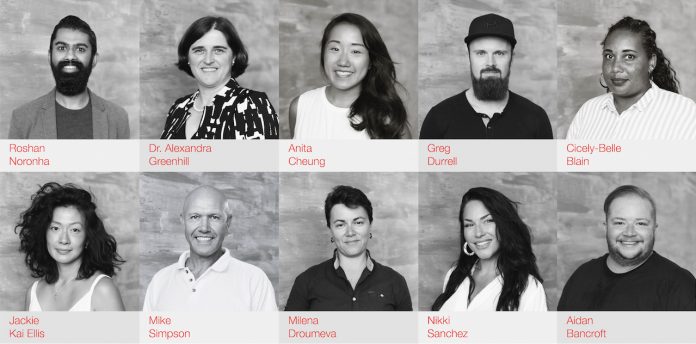
Image courtesy of TEDxSFU

By: Youeal Abera


TEDxSFU: Uncharted comprised an eclectic group of speakers, each offering rich insights from a wide array of ideological (and even philosophical) schools of thoughts. Each speaker had 30–45 minutes to present ideas that, in theory, could help solve some of humanity’s fundamental issues.

However, within the eight-hour timespan of TEDxSFU: Uncharted, two presenters stood out. Their enlightening material, dynamic discourse, and charming charisma made them the highlights of the stimulating conference.


Jackie Kay Ellis

One of the night’s most inspiring voices, Jackie Kay Ellis stirred the audience with her moving story. As the author of The Measure Of My Powers: a memoir of food, misery and Paris, she shared her experiences with mental health, and how she discovered the strength needed to persevere in her life.

        Ellis told us that, in a time where she didn’t want to live, a small incentive that motivated her to keep going would be the chocolate chip cookie she’d have each day. Soon, Ellis began baking and sharing her baked goods with friends and family. Ultimately, as evidenced by her Vancouver-based establishment, Beaucoup Bakery, Ellis started working within the culinary world so that the same treats that helped her in her darkest moments could assist others in theirs.  

       As a result of her bravery and congeniality, Jackie Kai Ellis was certainly a fan favourite.


Cicely-Belle Blain:

Cicely-Belle Blain, one of the founders of Black Lives Matter – Vancouver, gave an electrifying presentation which centred on the importance of intersectionality within the Black community.

       In courageously sharing their experiences of racism and homophobia while in Vancouver, Cicely-Belle spoke about how essential it is for Black individuals to create and occupy spaces that celebrate and protect the intersectional demographics within their collective Afrocentric community. When creating Vancouver’s chapter of Black Lives Matter, Cicely-Belle kept this desire of intersectional inclusion in mind.

       As an individual who who is part of both the LGBTQ+ and Afrocentric community, Cicely-Belle used their presentation to educate and enlighten the audience on just how much further Vancouver still needs to go to eradicate racist and homophobic ideologies.

       Although Jackie Kay Ellis and Cicely-Belle Blain were two highlights at this year’s TEDxSFU event, there were a number of other great presentations given by equally greater individuals individuals. Here are some honourable mentions from the conference:

Honourable Mentions:


Greg Durrell

Greg Durrell, a partner at Hulse & Durrell (a design firm based in Vancouver), emphasized the significance of logos and how integral they can be for the marketing success of businesses and corporations. Greg also used his presentation to give a detailed history lesson on how Canada’s flag arrived at its current design.


Roshan Noronha

The scientist gave a memorable presentation on the significance of insects, and how they are the key to resolving a number of our ecological issues. For example, Roshan stated that instead of fish farmers feeding their stock with fishmeal, providing their fish with mealworms could have a positive impact on the dire issue of overfishing. The founder of the student-facilitated research group EnTomorrow even ate insects live on stage!

The truth behind SFU’s “morgue”

0
Image courtesy of The National

By: Michelle Gomez, Staff Writer 

If you are an SFU student, you have probably heard the rumors regarding a secret morgue hidden within the depths of the mountain. What students have been referring to as the “SFU Morgue” for years is actually called the Autopsy Suite.

Located in Saywell Hall, the Autopsy Suite is part of SFU’s Centre for Forensic Research. The centre is used by a small interdisciplinary group of faculty members from the criminology, archaeology, and biology departments. SFU’s online profile of the centre describes it as “designed to create new knowledge in the forensic sciences for the purpose of solving crimes, identifying human remains, determining elapsed time since death, and circumstances of death on local and global scales.”

Dr Hugo Cardoso, an archaeology professor at SFU, is one of the co-directors of the centre and, among other things, is the principal investigator (PI) of the Autopsy Suite— which is what you and I would call “the morgue.” He elaborated on what the suite is in an interview with The Peak.

“Forensics is almost exclusively related to medical legal death examination,” Cardoso explained. “Forensics is any examination that relies on evidence that is analyzed by scientific means in any discipline and that is applied to a dispute in a court of law. That’s forensics. So an engineer can be a forensic engineer if he has to make an assessment of the integrity of a structure.”

The research in the Centre for Forensic Research includes Dr Gill Anderson’s forensic entomology (the ways that insects can indicate cause and time of death), Dr Lynne Bell’s work on bone biochemistry and degradation, Dr Dongya Yang’s work on ancient DNA, and much more.

Cardoso tells us that he researches forensic anthropology, analyzing remains to help identify them and determine a cause of death, and he and his grad students are the Autopsy Suite’s main users. In lieu of experimenting on human remains, they use animal models for their research, and the Autopsy Suite lets them prepare samples for experimentation.

“I do a lot of things,” Cardoso admits. But right now, he is interested in two main kinds of experiences.

“I’m interested in how immature juvenile bone degrades over time and how juvenile bone responds to different kinds of chemical forces,” Cardoso says. “I also work with a faculty member in mechatronics to carry out chemical tests on experimental fracturing of pig bones.”

In addition to research, Cardoso explained that the centre carries out forensic services, working closely with the RCMP, the BC Coroners Service, and even the Yukon Coroner’s Service.

“When human remains are found, typically decomposed or scattered in a way that the body cannot be normally identified through visual means, we assist the BC Coroners Service,” Cardoso said. “Those remains are brought to SFU, to the Autopsy Suite, and that is where we prepare the remains and carry out the first examination before we take them to another lab to complete the analysis.”

The first analysis mainly ascertains the subject’s identity and cause of death. This includes identifying their subject’s age and sex, as well as any injuries that could indicate how the person died.

As another example of what goes on in the Autopsy Suite, Cardoso explained that SFU researchers helped with the high-profile case in which a sled dog company killed 100 of their dogs following a decrease in demand after the 2010 Winter Olympics.

“Over time, there’s been a networking effort creating a fairly cohesive group of people that are connected to SFU or that eventually become connected to SFU to work on all of these issues,” Cardoso notes.

Cardoso is clear about the variety of work done at the The Centre for Forensic Research, some of which falls outside of research. The centre also organizes a symposium every year that brings together forensic experts, researchers, academics, and students from all across the Lower Mainland. This year’s will be on December 4, and the event will be open to the public, though you must register in advance.

“You’re welcome to come and be fed,” Cardoso jokes.

As far as what doesn’t go on in the autopsy suite — it’s not a morgue. A morgue is defined as “a place where the bodies of dead persons are kept temporarily pending identification or release for burial or autopsy.” Although there may or may not be human remains in the Centre for Forensic Research at any given time, they would be there to assist the BC Coroners Service.

TL;DR: there is no morgue at SFU.

WWE disrespected its audience, performers, and country with its Crown Jewel pay-per-view

0
Photo courtesy of WWE.com

Written by: Gene Cole, Opinions Editor

World Wrestling Entertainment (WWE) is a prime example of entertainment being inherently political. Being historically right-wing, WWE has shown its fair share of racist slurs, transphobic promos, and villains defined entirely by their ethnicity, among countless other issues.

While these moments have been infuriating, they’ve certainly become rarer over the years, and many fans still enjoy WWE at its core. A much wider audience, along with the Internet as a place where they can speak, has allowed for much more thorough criticism, and the WWE does often listen.

This is especially evident by the greatly improved women’s division. Back in the 80s and 90s, female performers were exclusively for titillation for men, being hired exclusively on appearance and often featuring ‘bra and panty’ matches. This has shifted dramatically, as the division has had increasingly diverse body types, wrestling styles, and match types. Furthermore, they’ve been consistently advertised by WWE on the same level as the men’s division.

WWE’s programming certainly has problems, but it’s made monumental strides and is far from unwatchable.

Unfortunately though, this trait was abandoned over the course of Crown Jewel, a WWE pay-per-view held in Saudi Arabia earlier this month, following the murder and dismemberment of journalist Jamal Khashoggi in the Saudi consulate in Istanbul.

WWE’s personal politics didn’t just influence Crown Jewel — they defined this event. WWE’s actions imply that they care infinitely more about the money they receive than the entertainment they provide, as they’ve disrespected nearly everyone involved with this show besides the country of Saudi Arabia.

Crown Jewel is the second pay-per-view of a 10-year deal with Saudi Arabia, who offered WWE $450 million to host regular televised events in the country. These shows are meant to promote Saudi Vision 2030, a promotional campaign intended to reduce Saudi Arabia’s economic dependence on oil and improve Saudi culture’s global reputation. However, as is especially evident in Saudi Arabia’s recent actions, their leadership is far from trustworthy in this campaign.

Ever since this deal was made back in April, much of the WWE audience has been avidly against these events. Part of this is because Saudi Arabia’s political reputation has always been concerning, but much of it was also due to Saudi’s condition that none of the women’s wrestlers were to be on the showthe Saudi Sports Authority even apologized for the inclusion of an ad featuring women during the first pay-per-view in Saudi Arabia back in April 2018.

WWE never directly acknowledged this, despite advertising and supporting its “women’s revolution.” This was the first of several subsequent act in ignoring its viewers and content in exchange for Saudi Arabia’s money.

Perhaps a better proof of audience disdain was in subsequent episodes of WWE’s programming, as monumental boos from the crowd followed any mention of Crown Jewel in several events. This was something that people were visibly infuriated by, and WWE continuing with it is nothing short of a disrespect to its audience.

The WWE fanbase is far from the only group of people who weren’t heard. Following the reveal of Khashoggi’s murder, multiple US senators also demanded the event be moved or cancelled, as the company would be going as a representative of America. Holding this event sends a horrible message that the US doesn’t care about Saudi’s actions or leadership, and that their money is simply more important than Khashoggi’s life. Much like the WWE audience, these senators deserve to have their voices heard better — after all, these are leaders of the country that contains most of their audience.

WWE’s inability to listen even extends to its own performers, many of whom refused to work the event. Most notably of these are John Cena and Daniel Bryan, who were originally scheduled for matches before being written out of the event in the week prior to Crown Jewel. They’re paid to provide entertainment, and are forced into an unfair position where their loyalty to the company has to come first.

WWE’s inability to listen is even reflected in the quality of the show itself. Several storyline decisions in this pay-per-view were massively unpopular, particularly a championship title reclaimed by the rarely present Brock Lesnar. Crown Jewel also included the return of Hulk Hogan as a host for the event, despite huge controversy around his inclusion in the WWE Hall of Fame after recordings of him using sexist language were released. People were already frustrated with this show in the first place, but making these unpopular story decisions feel like WWE was almost rubbing it in.

I would be lying if I said I could view the WWE the same after Crown Jewel. This event disrespects everyone: fans, WWE’s employees, US political figures, the fun of professional wrestling, and Jamal Khashoggi. Any one of these should’ve been a reason to cancel this event.

For me, watching WWE is a different experience now that we know just how little the company really cares about the people who watch it.

SFU’s safety and security services: what we can change and what we can’t

1
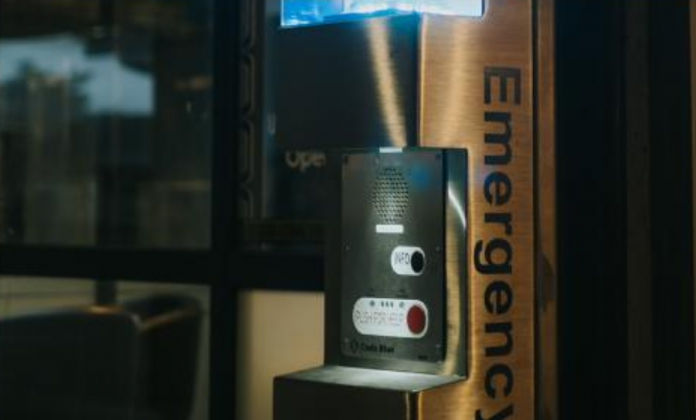
Photo by Chris Ho / The Peak

Written by: Gene Cole, Opinions Editor

Recently, SFU students got an email reminding them of proper procedure in an emergency, providing the phone numbers for security on each campus. This came after two separate safety and security crises on Burnaby campus. In one case, an assault occurred in a classroom; in another, a student passed away in a sudden mid-exam medical emergency.

Many students reacted to the assault on Facebook and SFU’s Reddit community. These ranged from concern for their peers’ safety to frustration with SFU and its security service. When a student passed away later that month, it directed even more student eyes toward SFU’s general emergency services and protocol. The questions students have been asking along the lines of “Why don’t all classrooms have lockable doors?” to “Why didn’t the students or security get more involved?”

I wasn’t present for or affected by these events, but in reading through these recent criticisms leveled at SFU, I fully agree that our emergency services have shown major problems. I know many who have had ongoing challenges with security outside of these situations, but these have been examples of significant problems with how our school responds to major emergencies.

That said, while these events have certainly pointed out areas of improvement for the school, I don’t think there’s much we’re likely to see change. There are a long list of limitations on what SFU can actually do differently that come from the nature of our emergency policy, our security system, and Burnaby campus itself.

Security responded properly, but not fast or effective enough

Campus Public Safety (CPS) functions as a response system to contact regular authorities. It supplies private security guards and manages the situation until police, paramedics, or the fire department can take over. According to the safety email, students are supposed to call security before 9-1-1. This was also mentioned by Tim Rahilly, vice-provost and associate vice-president, students and international, in response to the medical emergency.

The problem with this protocol on who to call first, though, is that it requires students to put more trust into our security service than emergency services that can take greater action, which is hard to do when there’s a limit to how much CPS can intervene. Unlike cops or paramedics, CPS personnel don’t have the resources or legal ability to deal with every situation themselves.

Unfortunately, SFU Burnaby is located on a mountaintop and is far away from police, fire, and hospital services, which means calling 9-1-1 is not always a time-effective solution. On the other side, it would be unreasonably costly to try and establish on-campus resources that are as effective as police officers and paramedics. The campus public safety personnel we have is the most reasonable middle ground.

If security really can’t work much faster in the moment, then we can at least do better in the aftermath

What the school can and should do is give proper care and concern to situations like these afterward, ensuring that they quickly and consistently follow up with students, staff, and others affected.

After the assault case, Ashley Lee, a student present during the assault incident, spoke out on Facebook about how there was no communication with her peers or the prof immediately after the event. SFU did eventually respond, but only after Lee’s professor requested that they do so.

What they did receive was reportedly fully insufficient. According to Lee on Facebook, “A psychologist who was supposedly the head of SFU Health and Counselling along with a security officer came to our class and basically told us the situation wasn’t that bad and we were all overreacting. They made us feel small and insignificant.”

Eergency protocol absolutely has to change so that the school can send greater health and counselling resources. The school’s health and counselling representatives should be more sympathetic and empathetic to what students have gone through. The school needs to be more proactive in delegating those representatives, and I’m confident the school is capable of this change.

That being said, the school seems to have provided such resources much faster to students present during the medical emergency. In an interview with The Peak, Rahilly claimed that SFU claimed had reached out to affected students to offer health and counselling services after the event, and also stated that they would be willing to make academic accommodations for those unable to complete their exam properly. Maybe this is a sign of improvement, or maybe not — it’s hard to say with just two incidents — but it might be a reason to have hope.

SFU also claimed to be putting together a larger review of safety and security protocol following the medical emergency, which will ideally help emergency responding to be far more consistent. SFU does seem to be trying to learn how to better support students, but under the circumstances, it feels like too little, too late.

It’s easy to criticize students’ inaction, but honestly, students shouldn’t be expected to know how to react

Some comments in the Facebook post on the assault talk about how people should have taken action and how disappointing it was that nobody helped. I do think there’s a rationality to it, but I would still consider these to be unfair responses.

An emergency situation is difficult to handle as a bystander. The bystander effect is a real psychological phenomenon; it’s challenging for people in the middle of an emergency to intervene, and some may also be concerned about making things worse. As a result, there’s only so much that we can do as witnesses at times, and it isn’t a student’s responsibility to take charge.

Even so, giving students more information and resources couldn’t hurt

It’s fair to say many students aren’t instructed well as to how they should respond in an emergency. Few people know what numbers to call, and one of the only ways those have been actively provided was in the SFU-wide email that was sent out after the recent emergencies took place.

A way to remedy this would be to give safety information in each lecture at the start of the semester. This way, students will know the best available courses of action in any given room of the school, either for their own safety or for the safety of others. In practice, most students might tune out, treating it as another dull part of reviewing the syllabus, but even so, something this minor could teach people what they need to know if worst comes to worst.

Final thoughts

While there are a lot of reasonable safety measures students could ask SFU to implement, our current system is far from nothing. There isn’t a big easy fix for SFU’s less-than-ideal emergency responses; despite that, there are definitely flaws we can address.

Board Shorts

0
Irene Lo / The Peak

Written by: Amneet Mann, News Editor


SFSS extends Mini Mart lease in MBC

A motion to extend the Mini Mart convenience store lease in the Maggie Benston Center (MBC) was passed in the latest Simon Fraser Student Society (SFSS) Board of Directors meeting.

The original lease deadline was December 21, 2018. Following this motion, the lease may be extended on a month-to-month basis to correspond with the expected opening of the Student Union Building (SUB). Applied science representative Kia Mirsalehi spoke to the reasoning behind the extension, stating that “[the SFSS has] no plans for the space otherwise.”

Following the opening of the SUB, Mini Mart — along with the other tenants of MBC holding SFSS leases — will be evicted from the building. SFSS CEO Martin Wyant noted that, if there is space available in the SUB for a convenience store, the vendor that will occupy that space will be decided via a competitive process.


Board debriefs fall lobbying trip

Vice-president external relations Jasdeep Gill, FCAT representative Amrita Mohar, and environment representative Russell Dunsford presented a debrief of their fall lobbying trip to Victoria to the rest of the Board. The directors were accompanied by SFSS campaigns and policy research coordinator Sarah Edmunds.

The SFSS partnered with UBC Alma Mater Society and the British Columbia Federation of Students (BCFS) during the trip. The partnering organizations presented three joint recommendations on open education resources, sexual violence and misconduct policies, and student financial aid.

Dunsford noted that the group had garnered support for a one-time $5 million funding to BCcampus to provide materials and support to open-access resources for students.

Mohar elaborated on the lobbying done on the sexual violence and misconduct policies. A recommendation was made by partnering organizations for a total review of the sexual violence policies of all post-secondary institutions to make the different policies consistent with each other.

Gill noted that garnering support for student financial aid was a “bit of a tougher topic” as it required significant policy changes on a provincial level, which would eliminate interest on BC student loans. Based on research done by the BCFS, the group made a joint recommendation for a $200 billion annual investment by the province to ensure that ancillary fees — such as engagement fees or facilities fees — charged to post-secondary students do not keep rising as they have been since 1990.

The groups noted steps forward that the SFSS was planning to take regarding lobbying. Gill mentioned that the SFSS hopes to involve SFU student groups in many of the topics that they are looking to address —  such as involving the First Nations Student Association in their reconciliation-through-education initiative and the Fraser International College in their goals to lobby to regulate international tuition.

“It’s really important to bring these groups along as well because I can sit here and talk about the research, but I think it’s their experience that’s what makes these advocacy efforts important,” said Gill.

Federal lobbying was mentioned as another step that the board was hoping to take, specifically to lobby for the safety of SFU students with respect to the Kinder Morgan tank farm expansion project.

Gill and Mohar also noted that they hoped to increase communication with the student body to better convey the intents and results of the board’s lobbying.

SFU men’s soccer fall to Cal Poly Pomona for third straight year in West Regional Championships

0

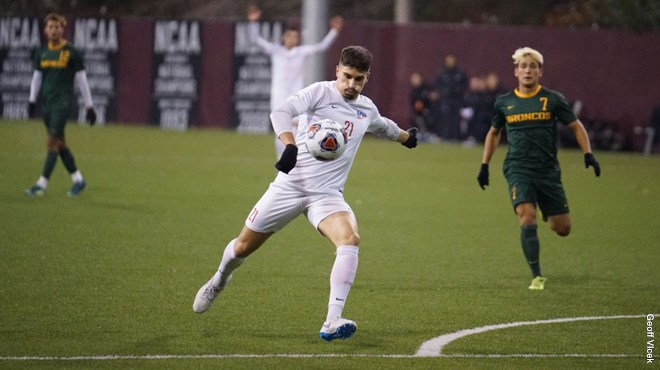
No matter how well the Clan play in the GNAC (having won three straight championships), they cannot seem to escape the curse of playing Cal Poly Pomona in the West Regional Championships. On Saturday in Seattle, this curse continued in another heartbreaking loss to the SFU men’s soccer team’s Achilles’ heel. The Clan fell 1–0 to their rivals in an overtime loss, one that probably stings more than any other loss that SFU has ever faced.

The Clan were ranked #1 in NCAA men’s soccer DIV II for a majority of the season, but given that they are the only Canadian team in the NCAA, are not able to host playoff games on Canadian soil. For that reason, the game was held at Seattle Pacific University’s Interbay Stadium — a much different atmosphere than Burnaby Mountain. Not to make excuses, but this rule has very little reasoning behind it, as the team is able to play home games during the regular season. It must be changed for the sake of fairness in the NCAA.

For the most part, the Clan outplayed Cal Poly Pomona and should be disappointed that the result did not reflect that. They dominated possession and created more scoring chances than their opponents, but many of these offensive opportunities were countered by timely defensive plays. Nevertheless, the Clan attempted nine shots, five of which were on target, while the Broncos attempted six shots, with the only one on target being the lone goal of the game.

The golden goal happened in the first overtime period, as Cal Poly Pomona midfielder Eduardo Faria dribbled into the box and crossed the ball to teammate Eduard Lucas who had an easy tap-in. There really was nothing goalkeeper Luciano Trasolini could’ve done, but still, allowing one goal on one shot on target is harsh for the entire team.

For Cal Poly Pomona, this is a fantastic story, as the team has now defeated the Clan in three straight West Regional Championship games despite not being favoured in any of the matchups. For perspective, when the teams met in out-of-conference play at the beginning of the season, SFU won 3–0 and looked comfortable the entire match.

For the Clan, this is an incredibly disappointing end to the season, especially considering that the team was a legitimate National Title contender this campaign. Nonetheless, the team will need to use this loss for motivation next season, as they look poised to have another strong year in 2019.

Not much more can be said about the loss. It’s just hard to believe that this happened again.

SFU Hockey stifled by suffocating Spartan defense in 3–0 loss

0
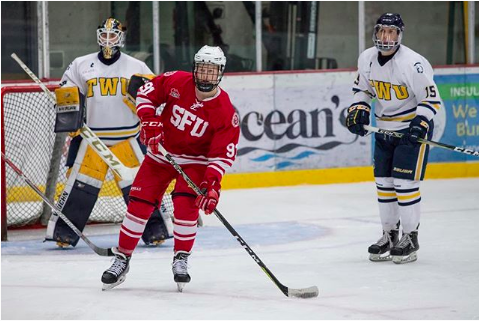
The game was scoreless through two periods. (Photo courtesy of SFU Hockey)

By: Dylan Webb

The Simon Fraser University hockey team saw their hot streak come to an end Friday night at the Langley Events Centre with a 3–0 loss to the Trinity Western University Spartans. With the loss, the Clan has now dropped both head-to-head matchups with TWU this season, despite beating them in the final exhibition game of the pre-season in late September.

The Clan now sits at 5–3 on the season, and remain tied for first in the BCIHL standings with Trinity Western. However, the Spartans, along with their lead in the season series, now have three games in hand over the Clan as the teams creep closer to the halfway point of the regular season schedule.

The teams played extremely tight, neutral-zone-dominated hockey for the first two periods of play. No goals were scored, only 34 shots were taken between the two teams, and there was a general lack of offensive opportunity. For the first two frames, the Clan did an outstanding job of limiting the Spartan offensive attack by allowing a paltry 11 shots on goal against.  The 0–0 deadlock would carry into a third period that would finally see some opening up of offensive opportunities, albeit opportunities that were only capitalized on by the home team.

In the third, the Spartans would finally break through the deadlock five minutes into the period with two quick goals from forwards Logan Casavant and Evan Last. Elijah Villo would add an insurance marker with eight minutes remaining in the game as the Spartans locked down the defensive end to secure the win and keep up their perfect record on the season against SFU.

Between the pipes, Michael Lenko started his sixth game of the season, taking the loss to fall to 3–3 on the year. Lenko stopped 25 of 28 shots.

Following the game, coach Mark Coletta emphasized that there “were definitely a lot of positives to build off of in this game” despite the loss.  He continued by saying that he was impressed by the defensive effort in the first two periods, while admitting that most of the Clan’s dissatisfaction should be related to its dismal performance on the power play and general lack of ability to bury opportunities.

Assistant coach Jimmy Camazzola added to this interpretation, arguing that the team needs to improve its emotional composition in the face of adversity, especially when giving up the first goal of the game late.

Looking ahead to their next game action, the Clan will now prepare for a two-game Vancouver Island road trip with matchups against the last-place UVIC Vikes in Victoria and the VIU Mariners in Nanaimo. The trip represents two of the three remaining regular season games for the Clan in the first half of the season. SFU will face an unusual three full weeks without game action before concluding their first half with another matchup against TWU, this time, at home at the Bill Copeland Sports Centre on December 7.

Bohemian Rhapsody shows why Freddie Mercury is the champion of the world

0
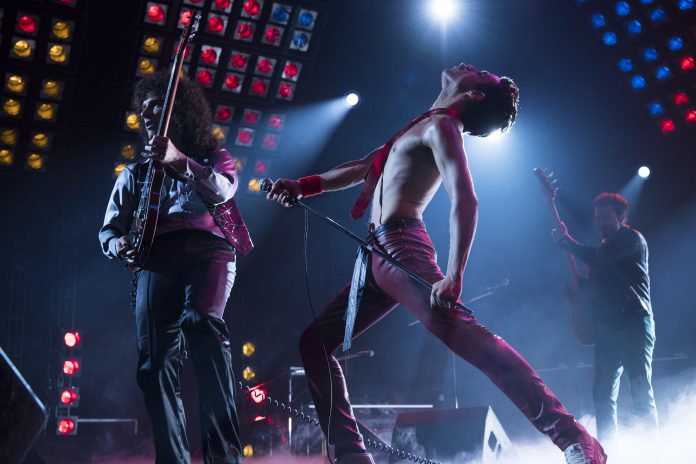
Photo Credit: Alex Bailey TM & © 2018 Twentieth Century Fox Film Corporation

By: Jonathan Pabico, Peak Associate


Fans of Queen, are you ready to rock? If you are, then Bohemian Rhapsody will definitely reawaken your inner rocker. The film not only offers an enthralling narrative but also beautifully balances Freddie Mercury’s emotional strife with his band’s humble beginnings and majestic triumphs.

        Rami Malek (best known for Mr. Robot) delivers an Oscar-worthy performance as Queen’s legendary powerhouse, Freddie Mercury. Malek perfectly portrays Mercury as a fierce rocker and charismatic misfit. His performance is enriched by Mercury’s iconic concert outfits, bold mannerisms onstage, and witty banter.

       However, Malek shapes him as a lonely individual, striving to know his place in the world while coming to terms with his identity as a musician. Combined with gloomy close-ups and distant camera shots, Malek’s performance also evokes Mercury’s humanizing pain, coming from the singer’s personal struggles with AIDS and his strained relationships with friends and loved ones. Although Malek authentically portrays the rock star’s musical genius, the film does not accurately explore Mercury’s sexuality due to limited or obscure details about how much it affected his private life.

       X-Men director Bryan Singer impressively retells the tale of Queen’s larger-than-life music career. With Anthony McCarten’s energetic script, Singer uses the band’s upbeat social dynamics to perfectly convey their relatable bond as a family. He uses the film’s underground music culture as a stunning backdrop. Moreover, Singer uses Queen’s recording sessions as chaotic set pieces imbued with satisfying tensions and volatile fun, reflecting the band’s impassioned drive to not only discover themselves but also subvert the musical conventions of their era.

       However, the film’s crown jewel is Queen’s legendary performance during the 1985 Live Aid concert. Immense wide shots of the event’s crowds, balanced with looming camera angles and fluid close-ups of Mercury and his bandmates, provide glorious nostalgia for any hardcore Queen fan.

      While the film excels in many avenues, the story has events and secondary characters that, unless you have an extensive knowledge of Queen’s history, will be unfamiliar to the average moviegoer. Still, this biopic is accessible for any classic-rock fan who simply wants to have fun and tap their feet to the movie’s rollicking soundtrack. Aside from this aspect, a set of scenes intended to give the film closure end up ruining any sense of anticipation for the film’s ending. These scenes seem more like abrupt benchmarks to meet before the movie comes full circle, but they deliver enough heartfelt tones to ground the narrative.

     Overall, Bryan Singer creates an exuberant biopic about the complex relationships between Queen’s band members and their historical performances. With Rami Malek’s powerful portrayal which honours Mercury’s legacy, Singer crafts an unforgettable story that forever reinforces Queen as one of the most famous rock bands in rock ’n roll history.

Join the Club: SFU Bhangra Club

0

By: Simran Randhawa

Canada is known for being a land of immigrants, and along with that comes multiculturalism and diversity. As clearly as anywhere else in this country, we see this at SFU. SFU Bhangra is one club that helps students stay in touch with their culture through its own brand of musical athleticism.    

Bhangra is a traditional dance form originating from Punjab, in northwestern India and northeastern Pakistan, and it came about as a way of celebrating the harvest season. Traditionally, Bhangra was performed by all-male groups in conjunction with a separate dance form called Giddha, which was performed by all-female groups.

The Bhangra club at SFU involves people of all genders and identities as members in their dance troop. The club is attempting to take on the traditional version of this dance form and add modern values to it. Members perform dance steps on upbeat music, and all in all, they create a friendly, uplifting vibe.

In the past, the club has performed in various events and are now hoping to compete in competitions. They are open to be booked for performances, and if you want to see an amazing Punjabi dance performance, this might be the way to go.

Whether this is your first time shaking your boots or you’ve been dancing since your first steps, this club has a place for you. The club meets every Tuesday at SFU Surrey campus. To be a member, you do not need prior experience; members of the executive team themselves will teach you how to dance and perform with you.

Aside from being a place to dance, this club is a community in itself. The executive team hopes to maintain a safe space of sorts, bringing people together for their love of cool dance moves and fun workouts and keeping them there because of the bonds they make. You know what they say: “If you sweat together, you stay together.”

Upon attending their icebreaker on September 25, I was taken aback by the number of people interested in SFU Bhangra. They had good pizza and great music, which was a blend of songs from three languages: English, Hindi, and, of course, Punjabi.

They played a few games to welcome new members. They started with the age-old game of musical chairs, and they topped it off with a game which was more of a workout than I personally liked (or expected!), but which was a lot of fun regardless. In this particular game, you got on your toes and crouched down to a squatting position. You had to stay in that position while simultaneously trying to push other people off their toes. The last one crouching wins the game.

These two games really put everyone at ease and tore down the silent demeanour which we all usually develop after even a week of classes. They really created a welcoming environment where people would feel confident enough to try out a new dance form.

We could all use some dance in our life, especially when it helps us spend some quality time with others. This can be hard for students with ever-changing schedules, especially in the fall, which is when many folks are just getting started at SFU. In lonely places like this, it is always a beneficial experience to have a place to unwind in, work up some sweat, release endorphins, and just dance. The Bhangra club is exactly that opportunity — not to mention the delicious pizzas.