Home Blog Page 557

Need to Know, Need to Go: May 6-12

0
courtesy sfu galleries

By: Alison Wick, Arts Editor

seams — SCA MFA Spring Festival

seams is a 10-day spring festival at SFU Woodward, put on by the School of Contemporary Arts’ Master of Fine Arts students. Centred around the gallery exhibition at SFU’s Audain Gallery, this interdisciplinary showcase explores how different mediums and practices relate to one another, examples including performance, installation, and photography.

Performance A (which featured Kourosh Ghamsari-Esfahani, Casper Leerink, and Meagan Woods) shows May 3 and 4, and Performance B (featuring Luciana Fortes, ilvs strauss, and Tomoyo Yamada) will perform on May 10 and 11. Not to be missed is the free lecture performance at 6 p.m. on May 8, Talking to Strangers, by Lebanese interdisciplinary artist Ghinwa Yassine, whose art explores cultures and people in transition.

The festival and exhibition are on until May 11. Tickets to Performance B are $7 for students and entrance to the Audain Gallery is free.

Image courtesy of SFU School of Contemporary Arts

Sense, Reset — Lief Hall’s MFA Graduating Project

Another graduate project from SFU MFA students, Sense, Reset is an installation work that builds on its artist’s research into media and soundscapes. The piece is created by prolific musician and artist Lief Hall, who has been shown in galleries across Canada and performed internationally. This particular work uses video and vocalizations to look at the ways in which health and spirituality have been incorporated into and shaped by mass media.

The project will be shown in room 4365 at the SFU Goldcorp Centre for the Arts on Thursday May 9 from 6–9 p.m, and on May 10 and 11 from 1–7 p.m. Entrance to see the work is free.

SFU event shows LGBTQ+ movement falls short of full inclusivity

0
Photo by Cecilie Johnsen via Unsplash

06/05/19: This article was corrected from an older version. Ashley was identified as a PhD candidate. He is instead a PhD student.

By: Ashley Moore, Peak Contributor

“Has the LGBTQ+ movement failed?”

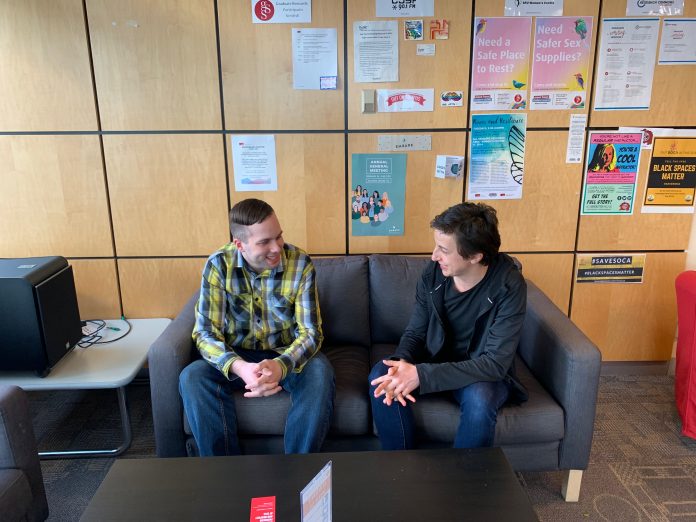
This was the provocative question posed to a diverse panel of academics, politicians, activists, and artists during a public event organized by SFU students, held on April 7 at the university’s Harbour Centre. While most panellists noted the hard-earned progress that has benefited the lives of many queer Canadians, some pointed out a number of ways in which the movement might be said to have “failed.”

This conversation was wide-ranging and it would be impossible to do it full justice here. But to speak on it concisely, it touched on how the concerns and wellbeing of trans* folk have been largely neglected, and how most progress has been achieved through, and thus perpetuates, the machinery of ongoing colonialism across these lands we now call Canada. It explored the movement’s increasing complicity with late capitalism and institutions that harm people of colour. It highlighted the danger of Western queer complacency while so many queer people are suffering across the globe.

With palpable emotion, experienced activists in the audience reminded us that we stand on their shoulders, and that to simply dismiss their efforts as “failed” is ignorant at the very least, if not ungrateful and offensive. But while listening to and learning from the discussion, as an applied linguist, it also became apparent to me that a great deal of talk revolved around telling others within the community how they should conduct themselves as LGBTQ+ individuals.

At one point, a panellist implored the audience to shut homophobic and transphobic people out of their lives. An audience member later questioned this approach and instead advocated for engaging in dialogue with such people.

Like a modern-day Harvey Milk, another panellist encouraged everyone to come out. Another audience member, based on their experience with employment discrimination, advised people to stay closeted until they had enough power to stay safe and protect themselves.

Who among us hasn’t similarly mistaken their own experience for that of others? I am as guilty of that as anyone else (apologies to an ex-boyfriend I once pressured to come out to his family). But on the walk home, it occurred to me that these prescriptive edicts, while well-intentioned, were actually symptoms of one of the ways in which the LGBTQ2S+ movement in Canada (and other places) could do better.

We need to remind ourselves of the importance of intersectionality — a teaching, a gift, that Black feminist scholars like Kimberlé Williams Crenshaw and bell hooks first conceptualized, alerting us to the various dimensions along which oppression and privilege shape our lives differently.

For example, the ability to pass — meaning the ability to be accepted within a space without being identified as queer — is a form of privilege and, for many queer people, an impossibility. Likewise, while coming out can be a positive experience with an “it gets better” ending for many, for some it can lead to ostracization, homelessness, and violence.

While I personally try to engage homophobic and transphobic people in dialogue, I do so while reminding myself that I have particular privileges that help me to do so. These privileges might not be available to others who are just coming to terms with their identities, or who are living with depression, or who are simply exhausted from the emotional labour involved in constantly having to explain and defend who they are.

While a growing number of people find shelter and solidarity under the umbrella of the LGBTQ2S+ movement, we should not forget the unique tensions of privilege and oppression that converge upon the particular ground where we each find ourselves.

The irony of advising others not to give advice is not lost on me. At the same time, I offer a suggestion to help us move forward. The LGBTQ2S+ movement here in Canada has not failed. There is merely more work to be done. That work is probably best done through collective, coherent action.

Going forward, rather than advise each other on how to live our best queer lives, we might better spend that time listening attentively and empathetically to each other and learning about the diversity among us.

Ashley Moore is a PhD candidate in the Faculty of Education at UBC.

What Grinds Our Gears: Respect the people around you when you light up, even on 4/20

0
Photo by Luther Bottrill via Unsplash

By: Ruth Leavitt, SFU Student

On 4/20, a group of teenagers lit up their weed on a SkyTrain car. It was late at night, so the car was full but not crowded. I had to flee to the next car to escape the smoke, and I wasn’t alone.

I don’t object to weed. I know people who use it medicinally. But I also experience anxiety symptoms when exposed to it.

Lighting up on SkyTrains is an extreme form of people failing to think about others when they smoke. On a good day, I’m already dodging cigarette smoke at transit exchanges so I don’t spend the next hour with my chest tight and my throat sore. The incident on April 20 was unfortunately another example of this inconsiderate behaviour. It left me with symptoms similar to anger or the start of a panic attack — I couldn’t tell which.

4/20 should not be the St. Patrick’s Day of weed. You don’t get to go out, get high, and get it all over the seat next to you because it’s “just a little fun.” It’s not. Just like alcohol and cigarettes, weed can have unpredictable results for different people, and people have the right to control their exposure. Taking away that right by taking your pot out in spaces that people cannot escape is not just rude but dangerous.

Enjoy your holiday. Take it to the park or your own private space. But don’t bring it out in a place where the person next to you cannot choose to leave. 4/20 should be about the right to choose to use weed or not. Respect that, and keep both options open for others too.

Samer Rihani’s parting thoughts on his time as acting SFSS president

0
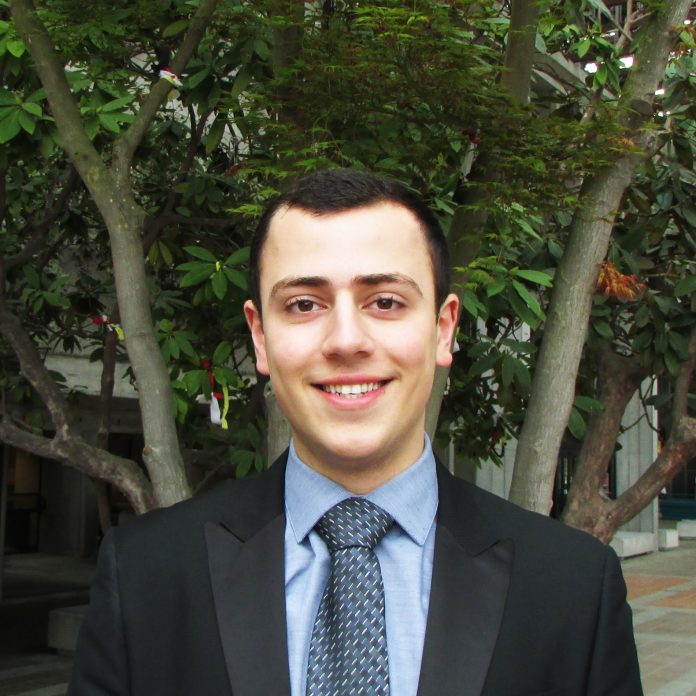
Samer Rihani, Image courtesy of the Simon Fraser Student Society

Written by: Youeal Abera, News Team Member

The Peak: Please introduce yourself, your position within the SFSS, and what your responsibilities were.

Samer Rihani: When I was first elected back in March of 2018, I was elected as the VP for student services. This was kind of to oversee the health and dental plan, services that are available to students [such as the U-Pass], the legal clinic that we provide, and food bank services. As of September 2018, following the presidential impeachment, I took over as the acting president. So, alongside the help of the other VPs, I could of oversaw all of the operations of our directors of the SFSS.

P: Can you list some highlights of your time with the SFSS?

SR: From the beginning of the year, we looked into something called the Reserve Fund, which is an amount of money set aside [ . . . ] any time you need to access it for really expensive medication for life-threatening diseases for specific students, you’ll have a reserve to tap into. We realized that students were putting in too much into the reserve. Our reserve was getting too high and it was unnecessary, so by dropping the prices for students, we saved students over $300,000.00 this year alone.

Just by digging and asking a few simple questions and just looking at the numbers from the audits, you start to realize that there’s really simple changes you can make for students sometimes that makes a big difference at the end of the day.

P: What were some of your biggest challenges in your time with the SFSS?

SR: The infamous thing is we started with 16 members and now we’re at 13 members. We started the year out with everyone filling their roles. Kailyn Ng  was our FASS rep, and she left to go to a different school. Of course, in September we had our notorious impeachment. So, you get to this point now where you’ve never seen anything like this before. The only thing that was pretty similar was in 2006 when the entire executive team of the SFSS got impeached. We kind of had to pick up for things we never really signed up for, but you can’t complain about that. You sign up for a role in the SFSS, you can’t be expected to just do your 9-5 and then go home. There is no hours, no bare minimum for what you can do. You have to pick up some of the slack for other people, and you got to check in.

Ever since I took the acting presidency, my job was less about hunting down everyone to make sure they’re doing their work, but job was more like, “Hey, we’ve had a pretty crazy year. How have you been doing with your mental health? What’s your headspace like? Is there anything I could help you with?” I had to pick up a really interesting leadership role that I never would have seen myself doing.

P: What would you like to see the new SFSS Board or President do within the coming year?

SR: I want to see the new president, specifically, give room for his team to flourish. Often times, what happens is that the president comes in and has trouble asking for help, giving a hand off to his team. What happens is board members who get elected are elected for some reason. People just don’t elect you because of posters. Essentially, what I always tell people is that your job as president is to do the least, because that means your team is functioning and doing their best.

I think one of the problems that we faced specifically this year with our president was that there was a little involvement in things that didn’t need involvement. That became problematic. Jas Randhawa [former SFSS president], for example, had really good intent. He was a hardworking guy, but I would say in the wrong categories. So, if there’s one thing I ask, it’s that a president needs to know that their team is stronger than they are. I want to see a board that’s unified.

With Giovanni [HoSang] coming in now [as the new SFSS president], it’s going to be really interesting perspective. I think, in a way, this is kind of needed. We have an activist in the role of SFSS president, which is something we’ve never really seen. I think, frankly, he can bring a lot of good to the society. However, people need to put aside biases and conflicts. You don’t have to be best friends with everybody on the board, but you should put the work in the students first before any kind of bias or conflict.

Meet the 2019 GSS candidates

0

Written By: Youeal Abera

On Tuesday, March 26, candidates for the 2019 Graduate Student Society (GSS) elections met at SFU’s Burnaby campus to host a meet-and-greet. Candidates were able to introduce themselves, the positions they were running for, and their key motivations for running. Through conversations with The Peak, this is what the candidates had to say.

Candidate Name: Matthew McDonald

Running for: Director of External Relations

The Peak: What’s your main incentive in running for the GSS Director of External Relations?

Matthew McDonald: I’m living in Vancouver in the middle of this affordability crisis [ . . . ] especially amongst] people at the grad student age, there’s people that are starting families so child care costs are coming up. People are having to move into bigger apartments and they’re finding that to be very difficult. Additionally, the price of tuition has gone up while TA pay hasn’t kept up with the cost of living. There’s all of these financial pressures.

Also, people have been talking about mental health more and more…whether or not you can say financial problems cause mental health issues  (or not), they certainly exasperate it. So, I’d like to do what I can – I’d like to get involved by lobbying the provincial government or municipal government to try to make a difference in these issues.

P: How do you think you can handle the pressures of your academic and GSS responsibilities?

MM: I think I’m good at time management. For the GSS, I think it’s about  50 hours of work a month. That’s basically like a TA’s job. So, I think that if you’re good with time management, that’s not too bad. I’m not just about to graduate next semester or in a rush to finish a thesis. Maybe I wouldn’t want to do this if I was going out the door in the next few months. I’m not too worried. I worked full time jobs in my undergrad while taking a full course-load. I don’t let stress get to me.

P: What do you think you can improve in the GSS upon being elected?

MM: I appreciate the work Noortje de Weers has done as the Director of External Relations in the GSS. She’s done a lot of good stuff, and is someone who’s quite organized.

I’d like to continue on that. My philosophy does differ from her (that’s not necessarily positive or negative) but I think what I’ll do in this position is continue the lobbying efforts that she’s been making. However, I also want to bring in more student activist groups and movements. So I think my approach to this position is a little bit different . Lobbying for student priorities is a long term project.

Candidate Name: Marina Khonina

Running for: Director of Student Life

P: What’s your main incentive in running for the GSS Director of Student Life?

Marina Khonina: I got involved with the GSS by getting involved in the affordability working group. Personally, I felt like I was under a lot of financial pressures as an international graduate student. What I discovered was that getting involved in something like this actually made a huge difference in my own experience and made me feel more connected to the SFU graduate student community. That’s why I think the position of the Director of Student Life offers a chance for graduate students to get more involved and hopefully improve their well-being. I think a graduate student’s well-being is something that’s really high in all of the graduate students’ agendas. So, I feel that this is a position that can really make a difference.

P: How do you think you can handle the pressures of your academic and GSS responsibilities?

MK: I’ve been balancing quite a few things — even before coming to graduate school-, such as working multiple jobs, training as an athlete, and continuing my education. Right now, I’m working several jobs (as many graduate students are). I feel I have the skills and experience for this position. I also take commitments very seriously, so I thought long and hard before deciding to run and whether I can do this. I’m confident that I can.

P: What do you think you can improve in the GSS upon being elected?

MK: I do think that Dylan [Flint, the current director of student life] has done a great job. I did meet with him before I submitted my nomination just to understand what has been done so far. I think for me, the main focus would be students’ mental health and well-being- not just mental well-being but also physical well-being. I think as graduate students, we live too much in our heads. I also hear from other students that mental health is a big issue — especially with the financial pressures, as Matt said. I do hope to make this more of a focus at student life events.

I think getting engaged with different groups and organizations within SFU can provide graduate students with the ability to be more connected.  A lot of students talk about being isolated, so I think getting engaged can contribute to better mental health and well-being.

As somebody with a background in sports, and who studies sports, I do think that we can do more to promote physical well-being and more active lifestyles.

Joining Matthew in the race for the GSS director of external relations is graduate student Daljot Singh. Although Singh wasn’t able to attend the GSS candidate meet and greet, they talked about their motivation to run through their candidate statement on the GSS website.

My motivation for running for the position of director of external relations is my vision for the future,” wrote Singh. “I wish to work with organizations such as the United Nations to work on strengthening the India-Pakistan-China relationships. As this role [within the] GSS primarily [involves] doing advocacy [work] and working with various levels of government, it would [serve] as a foundation for me to [engage in] advocacy in the future.”

Luciana Fortes, who is running for the GSS director of internal relations, was also not able to attend the GSS candidate meet and greet.

As director of internal relations, I would be committed to enhancing the efficiency of the caucuses [as well as] amplifying their resources within every department,” Fortes said through their candidate statement.

As a former SFU caucus secretary and TSSU steward, Fortes also spoke on their strengths and what they can bring to the GSS. “I have a fair bit of experience as a director of an organization, and as a consequence I have developed strong proactivity, communication, and problem-solving skills,” they explained.

The voting period for the GSS elections runs from April 2-5, and the winning candidates will be announced on April 8.

With files from sfugradsociety.ca


SFU graduate student helps fix cancer-fighting protein

0

Written by: Youeal Abera, News Team Member

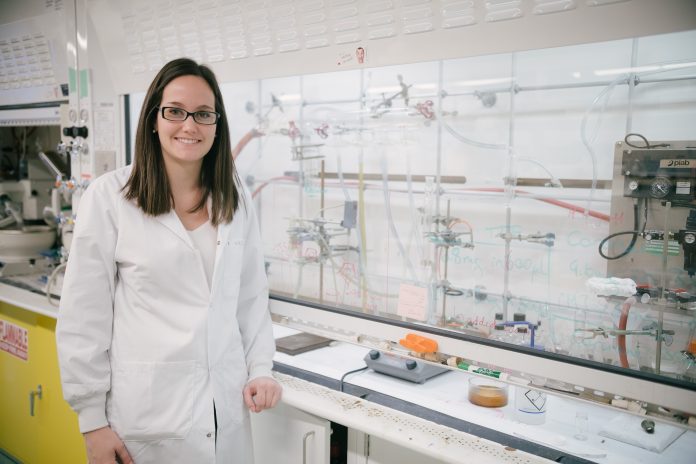
An SFU chemistry graduate student and her team of chemists have found success in fixing the gene p53, a protein known to subdue tumours.

According to SFU News, the p53 human protein is widely referred to as “the guardian of the human genome.” The p53‘s primary function is to suppress the creation of tumours. Mutations, however, can significantly impair the function of the P53 which, in turn, leads to the rapid division of cells and the creation of tumours. Thus, the malfunction of p53 protein is correlated with the causation of “more than 50 percent of cancers.”

The press release stated that through their research, graduate student and team leader Jessica Miller, along with SFU chemistry professors Jeffrey Warren and Timothy Storr, successfully restructured the function of the p53 protein by focusing on Y220C, a mutation of the protein found in 75,000 cancer diagnoses every year.

Miller, in describing the Y220C mutation in more depth, shared with university that: “The Y220C mutation creates a cavity on the surface of the protein, which causes it to unfold and lose function.”

When discussing their team’s experimentation on the Y220C mutation,  Miller elaborated by saying, “We sought to design small molecules that would sit in the exposed mutant pocket and stabilize the protein to restore its function.”

The Peak reached out to Miller via email about her team’s extensive research on the p53 protein. When asked about the incentive behind their selection of Y220C, Miller said that the p53’s tendency to produce open cavities gave the team a chance to implement stabilizing compounds.

“This mutation specifically creates an open cavity at the surface of the protein which leads to an instability, and therefore provided an exciting opportunity to design compounds that could fit nicely in and stabilize the mutant pocket.” said Miller.

In summing up their experience of working on the mutation, Miller shared: “Finding the right fit felt a bit like doing a jigsaw puzzle!”

As mentioned by SFU News, although the p53 protein is normally stabilized by a zinc ion, the Y220C mutation damages the protein by depleting this stored zinc. To counter this, Miller’s team used a bonding agent to raise the cell’s iron levels which, in turn, helped restore the function of the p53 protein. The chemistry team’s success let the p53 protein destroy cancer cells three times more efficiently than the best chemotherapy treatments.

Storr shared with SFU that their team’s next goal is to guarantee that their lead compound isn’t toxic towards an organism’s normal cells. When The Peak asked if the compound could be proven safe for humans if it’s found to be non-toxic to the cells of an animal, Miller stated, “That is a great question but a difficult one to answer. Of course, humans and mice are very different species with different metabolic pathways, and so toleration of a drug in one species doesn’t always translate to toleration in another – [the] prediction of this is quite difficult.”

However, Miller also expressed that its potential non-toxicity to mice could provide indication that the compound will be successful to the cells of humans.

“These studies can usually tell us how the drug is absorbed and distributed throughout the body, how it affects the targeted tissues, and how the body eliminates the drug,” Miller elaborated. “Toleration of a drug in mice is usually the biggest challenge prior to entering clinical trials so this would be very exciting for us.”

The medical achievement of Miller’s research team was one that took years of work, she noted. “This project took about three years to get to where we are today. The first year was spent designing the compounds based on chemical fragments that we thought could stabilize the mutant protein and then actually making them [ . . . ] During the second year, we spent a lot of time characterizing the metal-binding properties of our compounds and determining whether they could redistribute zinc to mutant p53.”

Although she expressed great excitement on their team’s newfound medical findings, Miller spoke to The Peak about the lengthy process that medical and drug discoveries typically take before they can provide assistance to the general public.

“Overall, the field of drug design and medicinal chemistry can be a lengthy process and if a drug makes it to clinical trials, it takes an average of 12 years to go from the bench to the clinic,” Miller concluded.

The research of Miller’s team, as well as their corresponding findings, can be observed within Chemistry — A European Journal.

With files from SFU News.

Board Shorts

0
Irene Lo / The Peak

Surrey pub night approved for end of semester

The SFSS will host a pub night near Surrey campus on the last day of exams on Wednesday, April 24. The event will be held in partnership with the Software Systems Student Society (SSSS) and the Mechatronic Systems Engineering Student Society (MSESS) with which they will split the cost.

Applied sciences representative Kia Mirsalehi explained that the event will occur at a pub beside Surrey Central, which is the same place they held it last year. Additionally, Mirsalehi explained that they have arranged with the bar to have happy-hour prices for the entire night, from 7 p.m. to 1 a.m.

The pub night will cost $5,000 in total, with the expectation of making $1,000-$2,000 back in ticket sales. Mirsalehi explained that while last year’s pub night only cost $3,000, this one will be more expensive for a number of reasons, including starting the event earlier and ending it later, and the fact that it is being held on a Wednesday, which is a busier night compared to a Monday or Tuesday.

Mirsalehi said they will have early bird ticket sales in addition to regular price tickets, with prices likely ranging between $5 and $20. Additionally, ticket sales might be opened up to non-SFU students due to the large capacity in the pub.

Russel Dunsford, environment representative, noted, “I don’t think we do enough events in Surrey, and even though it looks like it might be a little bit expensive, I think that it’s going to provide a lot of value to the Surrey campus and the students there.”

The motion to approve up to $5,000 on the pub night was carried.

Draft MOU for GP44: SFU’s Sexual Violence and Misconduct Prevention, Education, and Support policy

The SFSS has been working on a draft memorandum of understanding (MOU) with SFU for SFU’s sexual violence and misconduct prevention, education, and support policy (GP44). Jasdeep Gill, vice-president external relations, explained the status of the MOU as a discussion item at the board meeting.

Gill explained that this MOU would extend GP44 to apply to all SFSS members that are students, including board members and student staff. It will apply to all SFSS spaces on campus.

Gill noted “an additional ask that we had was for this policy to be extended off campus. At the moment, they have not included this in the MOU because there aren’t really any event guidelines that SFU has at the moment that would make it applicable [ . . . ] but that is something that we can continue to look into.”

Jackson Freedman, vice-president university relations, noted that “this has been something we’ve worked on for I think over two years now [ . . . ] good job to everyone who worked on this because this was a really important thing that we got done. Reading this MOU it seems to contain pretty much everything that we wanted it to contain.”

BC Ministry grants SFU money for peer mental health support program

Gill explained that the BC Ministry of Advanced Education, Skills, and Training has granted SFU $40,000 for a peer mental health support program.

“It’s on us to make sure that the school is accountable for how they are using this money and what this peer support program looks like,” said Gill.

She added that “we can provide students with some sort of recognition that the province is actually taking some action. We do have a long way to go, but I think this $40 000 is a good start for this program.”

SPOOF: Pkea Commercial

0

An interview with the 2019 3M National Teaching Fellowship Recipient: Dr. Sheri Fabian

0
Image courtesy of SFU School of Criminology

By: Mishaa Khan 

Dr. Sheri Fabian, a lecturer at the School of Criminology, has always had a passion for teaching. In an interview with The Peak, she shared her story of writing an essay in grade one, all about wanting to become a teacher when she grew up. She laughed at the memory and said, “Teaching has always been in my soul. Everything I have done has involved teaching, even if it has not been formal.”

For her, the most important part of teaching is “encouraging students to think critically about the world around them. It’s about getting them to understand the assumptions they make everyday and unpacking those assumptions, and often the privilege that comes with the assumptions that we make with other people and . . . understanding that there are multiple perspectives in the world and they all have value.”

Out of the 14 classes she’s taught, her favourite courses to teach are CRIM 131: Introduction to the Criminal Justice System, CRIM 311: Minorities and the Criminal Justice System (CRIM311), and research methodology courses. The reason? She’s able to watch students learn to think critically, grow, and challenge their assumptions.

“I get to see them grow as human beings, as academics, as young people, and it’s really rewarding,” Dr. Fabian said.

When asked what is one thing she would want SFU students to know about the criminal justice system, Dr. Fabian said she wants students to exercise caution and critical thinking when consuming the media.

“How about instead of don’t believe the media; be cautious about what the media tells you, and be critical about it.”

Her talent for teaching is evident in the number of awards she has received. In 2016, she received SFU’s Excellence in Teaching Award and recently, she received the 3M National Teaching Fellowship awarded by the Society for Teaching and Learning in Higher Education. Dr. Fabian says that receiving the prestigious 3M National Teaching Fellowship is “an honour and privilege,” and she looks forward to meeting the other recipients in June to work with other researchers on a national level.

“I didn’t expect to get it so when I got the phone call, I was over the moon. It was really exciting [ . . . ] and ironically I had to teach 90 minutes later.” When asked what her plans to do with the award were, she said that there is not anything confirmed yet, but also that it will be about Indigenous experiences.

One of Dr. Fabian’s current research projects, alongside colleague Dr. Tamar O’Doherty, is a collaboration with the Indigenous Student Centre to learn from Indigenous students about their experiences. She also conducted another project about resiliency.

“We were interested in building resiliency in our students,” Dr. Fabian said. Studying and working in criminology and related fields can be difficult because of the nature of the content. “We were looking at techniques that we could use to teach our students how to take in difficult materials without actually traumatizing.” She continues on to say that “it’s not just applicable to crim students; it is applicable to everybody.”

Despite all her accomplishments, Dr. Fabian’s journey to becoming a lecturer was not a “traditional trajectory.”

It began in 1984 when she graduated with a BA in Sociology and English. She went on from there to work in probation, with individuals who were taking part in community service. Within three years, she set out to understand the system better by pursuing a post-baccalaureate program in criminology, followed by a master’s degree at SFU.

She continued on with her career by working with an HIV/AIDs education program where she worked with marginalized populations, at a time when “HIV was very much a fatal disease.” Dr. Fabian explained that the amount of death and pain that she saw caused her to burn out. After five years, she left that job, she worked with the police services for the provincial government where she was responsible for running statistics and crime data.

In 2001, after being laid off, she returned to SFU to pursue her education and earned her PhD in Criminology at SFU in 2011. While she was studying, there was a vacancy available as a continuing lecturer in the criminology department at SFU and she decided to apply.

Another important aspect of Dr. Fabian’s career was contract work for the Truth and Reconciliation Committee, validating the claims of residential school survivors. This aspect of her work also included research, overseeing the research of others as quality control, and leading workshops.  

“I looked at thousands of claims,” Dr. Fabian said. “So you read their accounts and then you put together the evidence to show that they were there.”

Dr. Fabian includes the history of residential schools in her classes. She says that while these topics can be triggering and troubling, it is important to shed light on the subject because “it is a very real part of Canadian history and we need to own it and acknowledge it.”

“It is about being forthright about our history, understanding out history, talking about it in terms of settler responsibilities (…) and trying to be as frank as possible about our history, but in a respectful way…. I do want them to understand that our history of colonialism is not over. We continue to act in very colonial ways.”

The responses to this in classrooms have been overwhelmingly positive, though she has also seen people roll their eyes whenever the topic has come up. Overall, however, she has seen the impact it has on students. She continues on to say, “For me, there is nothing more rewarding than talking about it in one of my classes and having a student acknowledge what we have done.”

Dr. Fabian’s research interests, like her teachings, include looking at Indigenous peoples’ experiences. She has recently received a second Teaching and Learning Development Grant to continue her work. She also works as a facilitator with the Decolonizing Teaching Seminar series through the Institute for the Study and Teaching and Learning in the Disciplines.

Her path to becoming a lecturer serves as a reminder that no experience is ever wasted, and that it is OK to try different things outside of school and comfort zones. She also shows the importance of shedding light on matters that can be difficult to talk about, but must be done because of the impact they have in society. By broadening the minds of her students one at a time, she is able to increase the understanding of her students and colleagues and the individuals they will teach, creating a better space for us all.


What if being a student paid minimum wage?

0
Image courtesy of meetingsnet.com

By: Gabrielle McLaren, Features Editor

Participants: Hannah Davis, Mishaa Khan, Gabrielle McLaren, Sakina Nazarali, and Amena Salman.

Have you ever filled in a form and listed your occupation as “student”? The irony of this hit me last semester: an occupation is a job or a profession, something you do for a living. Being a student definitely keeps you occupied, but you aren’t compensated for all the time you put in. In fact, an increasing amount of students are running around the job market to finance their studies (48.8% of us in 2016-2017). But for the sake of argument, let’s say that being a student is an occupation: how much would we professional students hypothetically be getting paid?

Well, here’s a rough estimate. Five participants tracked our hours for a week, tallied up a week’s worth of unpaid labour, multiplied that by B.C.’s $12.65 minimum wage, and filled in a short survey to reflect on our experience. And that’s considering that a minimum wage is different from a living wage, which is calculated from “the hourly rate at which a household meets its needs” according to Policy Alternative Canada, whose living wage calculator generated a $20.15 living wage for those in Metro Vancouver.


What wasn’t counted

Granted, our methodology isn’t perfect. All five participants are human; perhaps we forgot to write something down, note a bathroom break, or maybe consider a few unacademic tabs that might’ve magically opened on Google Chrome while we were working. Additionally, transit to and from class didn’t get included in our final hours, and that changes things. Volunteer hours aren’t seen in the table below, nor are the hours we spent working our actual paid jobs since technically we’d already been compensated for that labour.

Additionally, our tracked hours were affected by one-off events and due dates. The time of the semester where we “punched our clock” also affected our business. Overall though, we all reported back that we’d had an average week (with an average “6” on a scale of 1-10).  

You’ll also see from our fast facts that we’re all unique. We take a different amount of classes, get there differently, some of us work or volunteer while some of us don’t, some of us live at home while others manage households . . .  Ultimately, if we were going to push this experiment further, this would effect the dispensable income we would all get.


Fast facts about our participants

Mishaa Mishaa volunteers as a lab assistant and is an exec of the SFU Muslim Student Associaton, works part time, writes casually for The Peak, and lives on residence. She is taking four classes.
Amena Amena lives at home, and is dedicated to school full-time. She is taking four classes.
Sakina Sakina lives on campus, works part-time, writes casually for The Peak, and volunteers with SFU UNICEF. She is taking four classes.
Hannah Hannah Davis lives on campus, works three part-time jobs, and is part of SFU’s Kin Games Team. She also volunteers with the SFU Dance team. She is taking four classes.
Gabrielle Gabrielle lives off-campus, works two part-time jobs, and volunteers with the World Literature Student Conference and the Student Learning Commons. She is taking five classes.


You can have a look at our results here: Student Hour Data Chart

Closing thoughts from participants

“I am quite lucky that I currently do not have a job [ . . . ] it makes me upset that we [students] have no time to enjoy the day and take time to our self. Being a full time student is the same as working full/part time, it is an occupation. We spend time each day working on our projects and assignments, with constant pressure and stress. Being a student is like working but instead of making thousands of dollars we pay thousands of dollars.” – Amena

“I realized how much time I was wasting and how easily I would get distracted because I would constantly have to click pause my timer every time I took a break.” – Mishaa

‘[My tracked time was] way over expected. I never thought that I would be spending so much time studying and doing study related stuff. [ . . . ] What stuck out to me the most is how many hours a day I was busy doing things to progress academically, forgetting to give time to myself and caring for myself. By far, the work hours I spent per day especially during the weekdays stuck out to me the most.” – Sakina

“I wonder what professors would think looking over this information. It’s not their job to soften up their classes or make them easy for us, but I think this sheds light on why students as a collective are so stressed, so tired, and sometimes so pushy about our grades. This is what we do, and we do a lot of it on top of a lot of other stuff.” – Gabrielle