Home Blog Page 513

Long story short: I learned to make friends with my future self by putting me first

0
Image credit Tiffany Chan

By: Kitty Cheung, Staff Writer

Spring terms have usually been pretty shitty for me. School stress, combined with the wrath of allergy season, has typically led to burnout detrimental to both my physical and mental health. Ironically, during the spring of my first year of university, I achieved a 4.0 GPA. 

As a fresh-faced first-year, I was eager to get involved in the university community and excel in my academics. Having entered school in autumn, I had decided to spend the fall term taking it easy and focusing on transitioning into university life. Come spring, I was buzzing to take on all sorts of volunteer and employment opportunities alongside schoolwork. I signed up to volunteer for a large-scale event in my program, applied for jobs, and continued attending club events for organizations that I had joined after Clubs Day.

While I was proud of the work that I had put towards school, I had frequently been experiencing nosebleeds and stress headaches during that time. My seasonal allergies were causing me to sneeze often, and my lack of regard for self-care meant that I was blowing my nose so often that I would induce nosebleeds. At times, I would be experiencing a handful of nosebleeds in the same day. The symptoms of my allergies also include dry eyes, and so I remember finding it difficult to even study because keeping my irritated eyes open long enough to read a sentence was a struggle. 

I kept a high standard for myself in terms of work ethic and productivity, but I was sacrificing my basic needs for sleep and nutrition, not even making time to invest in allergy medicine, and generally keeping unsustainable work habits. I felt as trapped as the helium balloons stuck in the roof of Convocation Mall, gradually deflating over time.

This most recent spring, I took on three jobs along with four courses. Despite the stresses that I had faced during first-year, I told myself that I had learned from my earlier burnout. The jobs that I had chosen all had flexible schedules, which I figured would allow for adequate work-life balance. 

One of these jobs involved acting as a peer mentor of sorts, which included connecting students with resources to help support their university experiences. I felt like a fraud. If a fellow student admitted that they felt stressed from school, I would give self-care tips or recommend campus resources such as Health and Counselling or MySSP ー tips and resources which I could have benefitted from but felt that I didn’t “need” just yet. I wasn’t practicing what I preached when I tried to promote positive mental health or self-care.

These experiences led me to promise myself that I would prioritize my health and basic needs over my academics, creating a more self-care-oriented mindset. This line of thinking meant that, for example, on a given night, going to sleep early would be better than staying up late to stressfully work on an assignment. 

I failed a class that term.

And to my great surprise, the world didn’t end. Thanks to the hard work that I had put in earlier in my degree to build up my CGPA, the effect of this failure was marginal ー not ideal but by no means devastating. My degree did not come crashing down, I did not lose my scholarship or my somewhat GPA-dependent job, and my mother did not disown me. 

I took this as a lesson to be kind to myself. On a day-to-day basis, prioritizing my health would be so much more rewarding and valuable than a few GPA points. As someone who had previously put a lot of my self-worth in my academic performance, this failure came as a definite blow. However, my sense of self-worth is so much stronger than a mere letter grade. It was alright to pride myself on my work ethic, and I still do, but I could also put more trust in my earlier diligence. 

Overall, my advice is to make friends with your future self. Work hard now to make work easier for your future self, but most importantly, take care of yourself (i.e. get enough sleep) so that Future You can kick ass tomorrow. 

Start keeping track of candidates’ policies ahead of the election

0
Millennial voters make up a large chunk of the voting bloc. Illustration by: Momo Lin/The Peak

By: Naaz Sekhon, SFU Student

The next Canadian federal election will be held this October, and the three major party leaders are preparing their campaigns. Only three months remain until an election that has voters uneasy about the future of our nation, and it’s crucial that young voters pay attention to the policies our federal candidates are offering.

Current prime minister and leader of the Liberal party, Justin Trudeau, has focused his campaign on helping the middle-class family once again. The Liberals have also chosen to focus on climate change — a cause that aligns with that of many millennials. All that aside, given the ongoing and harsh criticism he has received from the SNC-Lavalin scandal, it’s not unreasonable to assume that the allegations of Liberal government corruption could potentially hurt his votes.

Jagmeet Singh, leader of the New Democratic Party (NDP) party, is the first federal party leader in Canadian political history to come from a visible minority. Singh’s campaign touches on making education accessible to all, as he is advocating to eliminate tuition fees for post-secondary students. His campaign also proposes putting a stop on tax loopholes used by the wealthy, and diverting the otherwise lost revenue to supplementing aid for prescription drug costs. As a local politician, Singh has visited SFU in the recent past, where he spent time listening to students and engaging in different student-led activities.  

Conservative party leader Andrew Scheer is focusing his campaign on core conservative values. Scheer’s campaign goals include reducing the tax burden on Canadian families as part of a broader economic plan that also addresses budget waste in government. Scheer has been openly critical of Trudeau and his lax trade practices with China. Thus, he has promised to right what damage he claims Trudeau has done to Canada’s relationship with foreign allies. 

It is especially important that young voters, a significant demographic in the upcoming election, stay informed about policies of party leaders. Young voters need to be able to make decisions that will suit their needs and concerns. Especially when it comes to students — whether or not our issues (tuition fees, high cost of living, or the current job market) get resolved is highly dependent on which party is elected. 

As one third of the electorate in this election, millennials hold immense power in deciding what the future of our nation will look like. This October, remember to vote and to vote wisely.


Board Shorts: July 11, 2019

1
Irene Lo / The Peak

By: Onosholema Ogoigbe, News Team Member

BCFS presents their campaign about interest on federal student loans to board 

Tanysha Klassen and Jenelle Davies, respectively the chairperson and organizer of the British Columbia Federation of Students (BCFS), presented to the board a federal campaign titled Knockout Interest

This campaign is focused on eliminating the interest charged on federal student loans, and aims to gain the attention of Prime Minister Justin Trudeau. Through extensive research, lobbying, and mobilizing, BCFS hopes to get student support by endorsing letters of support, co-branded posters and pledges, and encouraging students to spread the word on social media. 

“[We] hope to bring the biggest message as possible to the members of the federal government,” said Davies. 

BCFS represents students of all types throughout the province, such as undergraduates and graduates, including part-time students. Klassen and Davies both expressed BCFS’s interest to gain more partnerships for this campaign, such as other student unions. 

SFU Lifeline presentation addresses the assertion of SFSS’s pro-choice policy

SFU Lifeline president and vice president Lois Umali and Lily Moric presented to the board to address previous discussions on the society’s adoption of a pro-choice stance, and how this may affect their club. 

This led to a general discussion on abortion through the lens of the Canadian Charter of Rights and Freedoms. Osob Mohamed, health sciences faculty representative, highlighted that there have been several cases where the Supreme Court is protected by the charter. 

“Do you feel that your interpretation of the charter kind of goes against what was decided by the Supreme Court of Canada?” Mohamed asked the presenters.

In response, Moric stated that they would question what the charter considers a human life. 

“The sort of purity of the personhood of the fetus is also being challenged,” Moric said. “Just because it can’t speak. But their personhood is being challenged if we’re saying that abortion directly kills that fetus.”

The discussion was cut short by at-large representative and acting chair Rayhaan Khan due to shortage of time.

For a more detailed article on this discussion, visit the-peak.ca.

SFSS plans to collaborate with production company Crescendo 1 for the Fall Kickoff

Lastly, the SFSS also disclosed that they are planning to work with music and entertainment company, Crescendo 1, to plan the annual Fall Kickoff event. While previous kickoffs have been made possible with the production company Blueprint,  who will assist in artist relations, artist contracts and bookings, staging, and ticketing for the event.

Johnny Black, co-founder of Crescendo 1, emphasized that the production company is looking to help universities expand their brands, and create a music community in Vancouver.

“Our plan of action… is to help universities in Western Canada [to expand] their events and engage with their audience,” Black stated.

Crescendo 1, although a newer company, has hosted various Breakout festivals, presenting artists such as Migos and Tory Lanez


Museums need to be updated to reflect integrated rather than segmented histories

0
Updating the ways that museums curate their content is a crucial part of decolonization. Photo courtesy of Trip Advisor

By: Kelly Chia, Staff Writer

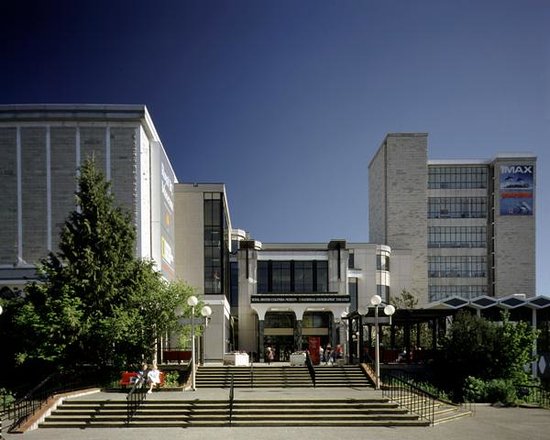
Museums are crucial cultural depictions of history. To represent history responsibly, they should be updated to reflect a more inclusive history. Recently, Victoria’s Royal B.C. Museum has planned to modernize its building to address structural issues, and, more importantly, to reassess how the museum represents history in order to move away from a dominant white settler perspective. 

Typically, museums present history through a colonial context. Unfortunately, this means that when museums show a version of non-European history, they frame it through a lens of progress toward civilization, often putting Western achievements at the end of this linear progression scale. This implies that non-European civilizations are less advanced, as if their growth is somehow stuck in the past, which is untrue. Museums need to take steps to responsibly present history by not assuming European culture as the objective end standard, but rather including the perspective of other non-European communities with equal weight. 

Currently, the prevailing themes in the “Becoming B.C.” exhibit — discovery, adventure, frontiers, and pioneering — focus on a white, male settler perspective of the colonization process of British Columbia. This alienates non-European communities’ perspectives while creating the impression that there is a divide between white and Indigenous history. In the end, although the museum’s one section on Indigenous history is generally well-regarded and informative, the primacy given to the settler perspective in the “Becoming B.C.” exhibit erases Indigenous contributions to the formation of British Columbia, and relegates Indigenous peoples to the past. 

That museums curate history in favour of the European settlers is no surprise, given their roots in colonial expansion and so-called “cabinets of curiosities” — collections of items brought back to Europe during the age of exploration. However, other communities’ histories are appended as accents to the dominant Western colonial history in this presentation. 

Museums should move away from colonial framing and toward including non-European history as part of dominant history. This is something that should be handled thoroughly, in consultation with non-European parties to best decide how to represent history without placing primacy on the West as “modern” and the progressive end point. They must support efforts to help people learn about the land that they are on by giving Indigenous communities space and power to make suggestions on how museums can move forward to be inclusive and accurate.

We at SFU have not been exempt from presenting history by putting colonial actors in the forefront. The Charles Comfort mural, recently taken down after having been on display since 2004, has been blasted for its distasteful glorification of a false colonial history — something that has rankled SFU students for years. The painting depicted European explorers with the Indigenous people in the background of the colonial narrative. 

This depiction was not only inaccurate, but incredibly offensive, as it framed Indigenous people as passive. When the painting was acquired, the school’s vice-president university relations, Warren Gill, said that it could be used to provoke discussion on fundamental issues such as colonialism and First Nations’ experiences. However, this hurt the students more than it taught, and served as a lesson that a people’s trauma should not be treated as a teachable moment.  

SFU still has a long way to go in decolonizing its art collection, as the corridor where the Comfort mural had been still has “Indigenous” art provided by a non-Indigenous artist. We can better present the history of the land around us by being inclusive and accurate to all the actors who helped shape it. To do this, we must give space to people whose voices have been excluded or minimized by Western conceptions of history.

Adulthood 101: An international student’s quick tips for living alone

0
Illustration credit, Tiffany Chan

By: Karina Danielle Lim de León, SFU Student

I moved away from my home in the Philippines when I was just 17 as an international student. Transitioning into both an independent lifestyle and a different cultural environment was a tumultuous and struggle-laden journey. Facing cold weather, deciphering Canadian slang, navigating the public transit system, filing my taxes on my own . . . there were many facets of my new life I needed to figure out how to manage. 

My biggest challenge was the daily maintenance and organization of an adult life — keeping my kitchen reasonably clean, doing laundry, paying bills on time, and financial planning (AKA not spending the majority of my paycheck on vodka crans at Fortune or on concert tickets). Here are some adulting lessons I’ve learned along the way.

Groceries: get them delivered. This was a game-changer for me — for the first two years of my college life, I commuted for 40 minutes both ways to get to the nearest Safeway. I eventually caved into using the “Asian grandma grocery cart” to make these trips easier. Weekly grocery trips, without a parent to drive me, was exhausting, so I started using Instacart to get my groceries delivered. It’s amazing-I pay a few extra dollars, do all my shopping online, and the next day my groceries are right at my door. Long gone were my days of hoping my rotisserie chicken didn’t tear a hole through the plastic bag on the 95. Thank goodness. 

Dishes: do them ASAP. Pretty basic advice, but if you have a full schedule of classes and a part-time or full-time job, they pile up real fast. If you can’t get to them the day of, rinse them off at least to save your future self the time it would have taken to scrub off that dried sriracha. Plus, if you have a roommate, this is just good manners. 

Laundry: do it strategically. I could never find a day in my week to block off a couple of hours to wash my clothes, sheets, rugs, towels, etc. I found that as the semesters flew by, I only got busier, and despite needing all those things to be clean to use, doing laundry was a burden on my schedule. So I timed doing laundry between other chores like making dinner or cleaning my bathroom.

Clutter: Marie Kondo everything. Let’s face it, there are so many things you have lying around that you don’t need. Dig through your closets, cabinets, drawers, etc. and toss out what you don’t need. The things you can’t use, but someone else may be able to, set aside to donate to a local organization. They may not spark joy for you, but they could be necessities for others. Big Brother Vancouver has a free pick-up service for donations, saving you the hassle of dropping off garbage bags of old-you clothes, and helps out a great cause.

Money I: keep track. We can all agree that Vancouver is an expensive city. No one wants to go through their monthly expenses, but when you’re saving up for that Asia backpacking trip or want to be a generally better spender, it does help to be aware of how much you’re spending and on what. I use an app called Koho that helps me manage my monthly budget so I spend mindfully. It has these cool features too like “RoundUps” that round up your expenses to the nearest dollar or ten, and moves this to a piggy bank of savings that you can cash out any time. There are tons of apps, or even a simple Google Sheet, that can help you lay out your spending habits and budget efficiently. Set budgets for things like groceries, entertainment, etc. I even narrowed down my budgets based on my frequent purchases like bubble tea and Starbucks coffees.

Money II: use deals. I love deals – I’m that crazy deal kind of girl who has all the apps like Groupon, Honey, and Mobile Bandit. Sometimes the money I save using these apps is just a few bucks, but some deals can save you a significant amount of cash, and if you don’t have a ton of disposable income, that’s extra funds to use on other things. Lots of popular food delivery/pick-up apps like UberEats, Ritual, Skip the Dishes, and DoorDash have $10 sign-up specials too that are convenient for lazy days in. Extra pro tip: birthday deals are a big thing too. Visit Sephora and Starbucks for free treats on your special day.

Weekly planning: use a damn calendar. I would be lost without my calendar to plan out my work shifts, classes, and time for other activities during the week. My manager once told me that during a job interview, if the candidate didn’t mention using a calendar or to-do list she would feel doubtful about their organization skills. It’s a great way to plan ahead and make sure you have time set aside for the necessary commitments, as well as planning your leisure activities without double-booking yourself or rushing around to get to your next appointment.

Learning how to take care of yourself as an adult, or maintain your home if you live alone, is a challenge for both domestic and international students and is easy to leave on the back-burner in sight of impending school deadlines or work commitments. Despite life being busy and student responsibilities increasing the further you delve into your program, remember to always take care of yourself. Schedule some me-time, make sure you get your eight hours of sleep, and prioritize your well-being just as much as your tangible adult responsibilities.


Reserved seats at enrolment makes internal transfers frustrating

0
Sampling other disciplines is necessary but often difficult. Photo courtesy of Daniil Kuželev via Unsplash

Author: Kitty Cheung, Staff Writer

As enrolment comes around, my love/hate relationship with the School of Computing Science rears its ugly head. I’ve had my fair share of enrolment difficulties as an intended internal transfer student. To give a bit of background, I entered university with an intended program of world literature. While exploring other courses and pursuing my WQB requirements, I decided I wanted to switch majors into computing science (CMPT).

Part of what makes this particular transfer process difficult is the number of seats in CMPT courses that are reserved for declared students in CMPT or associated programs, such as engineering, data science, and mathematics and computing science. As a designated arts student, when it comes to course enrolment, I can only add myself to the waitlist. It won’t be until the second week of classes that I’ll actually be added to the course. This is assuming there will still be space at that time.

I do not say this to boast, but my enrolment date is usually pretty damn early. Despite placing myself on the waitlist early though, enrolment priority still goes to the students listed above (those studying engineering, data science, etc.). This means that if I place myself on the waitlist at spot number one and someone declared in engineering waitlists after me, they will get pushed in front to spot number one and I get bumped below.

The irony that many intended internal transfer students face is that you’re not allowed to directly enroll in your program’s courses unless you’re a declared student in that program. The thing is, in order to complete the transfer process and declare your major, you need to have completed a certain number of courses . . . the ones you can’t get into because of these bureaucratic processes.

It’s a headache, for sure. If SFU prides itself on being “Canada’s leading comprehensive university,” specifically by making it a requirement for students to take Writing, Quantitative, and Breadth (WQB) courses to give us a more well-rounded breadth of knowledge and generally prepare us for our careers, why is it so difficult to explore different options? 

I do believe that space should be made for declared students to enroll in their required courses. However, this system makes it difficult for intended transfer students or even students merely wanting to explore different subjects to actually try out these courses.

In a perfect world abstracted from budget constraints and university politics, we could solve these issues by hiring more professors and expanding course offerings to accommodate students trying to get into obviously popular classes. 

Working within the realm of reality, however, SFU could do more to work with students at the course planning phase so that students looking to internally transfer or explore other academic avenues aren’t necessarily disadvantaged by declared students. This could involve polling the student body on its intended academic pathways either via web survey or as part of the course evaluation process. The university could also set percentage limitations for courses that don’t have them and adjust them for the courses that do (60% for declared students, 20% for students in associated programs, and 20% for students who fall outside of these characteristics, for example).

Students shouldn’t feel pigeonholed into their first program of choice due to course allocation limitations. The ability to sample a wide variety of courses and disciplines is one of SFU’s advertised strengths. It should do more to make internal transfers easier for its students.


100 Braid St Studios: an interview with founder Susan L. Greig

1
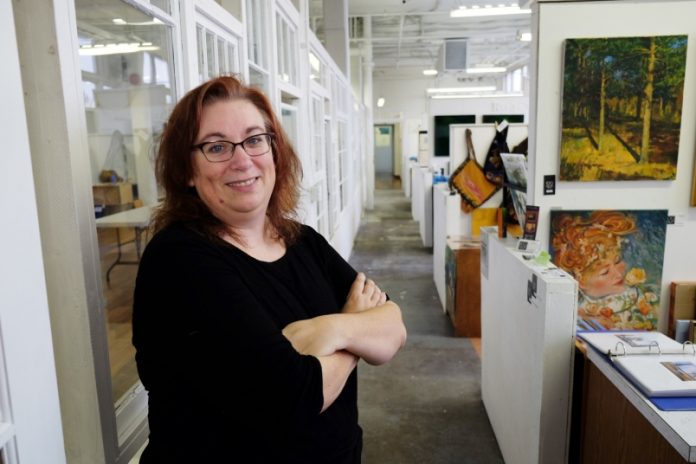
Susan Greig in her studio art Gallery. Courtesy of Record Files via Vancouver Courier

By: Yelin Gemma Lee, Peak Associate

On June 8, Susan L. Greig (Métis), the founder and owner of 100 Braid St. Studios, celebrated the gallery’s triumphant five-year anniversary. 100 Braid St. is a mixed gallery, studio, and private rental space. It is often used for special events — like First Saturday Open studios — where the public can see artists’ work and workspaces as well as host their own events. 

The gallery boasts high ceilings, cascading natural light, and a renovated space made almost entirely from reused and up-cycled materials — with the exception of floors, two toilets, and the sink! 100 Braid St. hosts monthly open mics (taking advantage of the impeccable acoustics), Paint & Sip Nights, and private events. In August, it will host the opening night for this year’s New Westminster Cultural Crawl. The main floor holds 16 studio spaces for resident artists. Since it took over the third floor of the building, the space is now a whopping 12,000 square feet with a total of 44 working art studios. The space is also used for more than just art, as 100 Braid St. transforms into a magical wedding venue and is available for private rental.

A story about 100 Braid St. Studios, however, is not done right if it doesn’t involve Greig’s personal journey of founding this beautiful gallery.

Susan Greig’s career did not start in the arts. She had 12 to 15 years of wedding and event planning experience under her belt when she switched careers to work for the BC Children’s Hospital. She worked as an advocate for patient and family centred care, in commemoration of her oldest daughter who passed away from a rare genetic disease, for 9 years before having to stop.

“We grew the whole program to have over 250 parent volunteers and it was really great, but then I saw a little girl that looked like my daughter, and I don’t remember the next four hours.” After devoting nearly a decade to this work, Greig was diagnosed with PTSD and resigned.

“I asked myself, ‘If I wasn’t afraid to fail, what would I do?’ [And my answer] was to create an arts community and to paint and write full-time,” says Greig.

She also emphasizes that running the studio is more than just a job or a source of income. “This may be my business, but first and foremost, my ‘why’ is to help people live lives of courage in harmony with their values through creativity,” she stresses.

Greig has been an artist since she was a child. Now, having created the multi-use artist space, she is looking forward to being able to put more time into her own projects — namely Moods of Mount Baker, a series of 36 paintings inspired by Hokusai’s concept of landscape series and a commentary on how Instagram has changed her life and her painting practice.

Before she started 100 Braid St Studios, she researched online to find a mentor and people who had already created what she was envisioning. Through this search, Greig discovered a woman in Chicago who had a store that had five studio spaces in the back for resident artists. She read a review for the store that really aligned with her values, and recalls how the reviewer expressed that seeing the artists working in their space, inspired them. Greig then had the idea for a passion project that would combine her love of art, writing, community, and wedding/event planning.

“I called the woman in Chicago who had this store, I asked her about 30 questions and she offered me some really great advice . . . I always tell people if you want to do something, find someone who is doing it successfully then just copy what they do. I didn’t listen to all of her advice, but . . . she was right about everything,” Greig says with a laugh.

When Greig started looking for a building, it was always going to be New Westminster.

“I had a studio with a friend down in Vancouver at the time, and I thought, you know what, I need to be here in New Westminster. This is where the arts are happening, it’s only going to grow from here and I wanted to be a part of that.”

Within the last five years, Greig has celebrated many triumphs, milestones, obstacles, and changes with 100 Braid St Studios, and she projects that it’s only going to keep getting better from here. Greig has not had an empty studio space for more than one or two months since opening the gallery’s doors in 2014, and is booking more events by the month. She’s also working on more community collaborations and strengthening her team of resident artists and staff.

“[Filling studio spaces] is not first come, first served — it’s about fit and diversity because we are truly a community,” says Greig. She adds that “there’s nothing [she] wanted more than to have music and art here, to have this as a community hub” and to “be surrounded by a community of creative people.”

“It’s been my dream for five years,” she concluded.

You can visit the gallery on the first Saturday of every month when they open their doors to the public for free or by attending events like their next Paint & Sip Nights ($40 per person) and their Open Mic Nights (on the first Monday of every month).

Find 100 Braid St. Studios on Instagram, Facebook, and Twitter @100braidst for updates on events, submission calls, and studio rentals.

Gaglardi needs protected bike lanes and more consideration from drivers

1
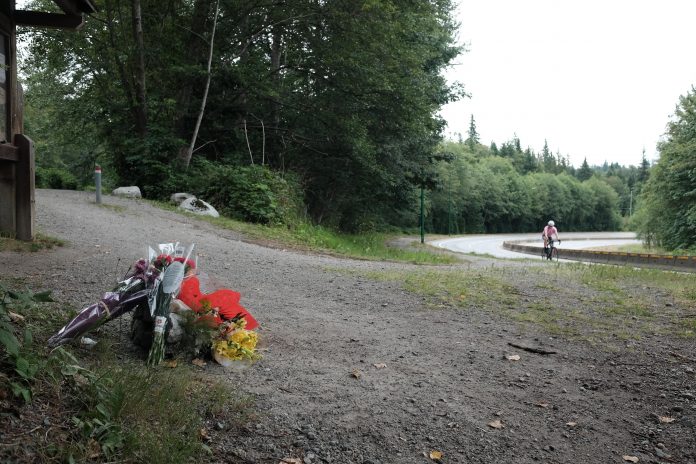
A memorial near the accident site honours the cyclist who was killed. Photo by Chris Ho/The Peak

By: Nicole Magas, Opinions Editor

On June 29, a cyclist was struck and killed by a vehicle on Gaglardi Way. The incident is undoubtedly a tragedy, and doubly unsettling due to its proximity to our university community, but it’s not surprising. Anyone who commutes up and down the mountain by any form of transportation can easily see that the cyclist/vehicle relationship on Gaglardi is an accident waiting to happen.

High speeds on the winding road are such an issue that a speed trap was installed to politely remind motorists that the speed limit is 60 km/h. This has hardly stopped drivers from whipping down the mountain as though they are fleeing a Hollywood-style natural disaster, however. Even some of the buses zip down Gaglardi at white-knuckle speeds. And all the while, the cyclists who share the roads have only a white line of symbolic safety to protect them on a road that both encourages dangerous driving and has poor visibility conditions. 

Gaglardi Way is a popular road for cyclists who use it to commute to the university or take advantage of the many hiking trails that branch off from the street. Why then, on a road with frequent dangerous driving conditions and a high population of unprotected commuters, are there not secure bike lanes to delineate a clear boundary between motor vehicle traffic and cyclists? This is not the first time this question has been raised, and it certainly won’t be the last, as the City of Burnaby admits that implementing such infrastructure changes isn’t currently in the plans.

To be fair, the responsibility isn’t on the City of Burnaby alone. Drivers also need to be more aware and considerate of other people sharing the road space, including cyclists, pedestrians, and individuals in motorized wheelchairs. The accident on June 29 was the fifth serious pedestrian road accident Burnaby has suffered in the month of June alone. The temptation to dominate road spaces from a place of relative safety needs to be addressed among motor vehicle drivers so that more vulnerable travelers aren’t put at risk by aggressive or inconsiderate driving practices.

SFU has an active cycling community, nurtured by the beautiful scenery we are surrounded by, a keen sense of environmental preservation, and the more well-developed cycling infrastructure in neighbouring municipalities. 

But our detached location on Burnaby Mountain also distances us somewhat from the public safety concerns that occur in more dense urban environments. Until the City of Burnaby physically makes roads safer for cyclists, we must demand that motorists respect the rules of the road, and all the people who share the space with them.


GSS Council Corner: July 10

0
Chris Ho/The Peak

By: Onosholema Ogoigbe, News Team Member

SFU gives a presentation about the gondola project during GSS meeting 

Joanne Curry, SFU’s vice-president external relations, and Navjot Sanghera, SFU’s external relations coordinator, gave a presentation to answer the  Graduate Student Society’s (GSS) previous questions about the Burnaby Mountain Urban Transit Gondola. The potential for having representatives from the university present to the GSS was discussed at the previous GSS meeting.

This presentation was prompted by questions asked at a previous GSS meeting, such as how a gondola would affect bus routes, specifically the 145 and 143, and the project’s environmental impact. Curry stated that upon the return of their main technical representative, questions that require answers from TransLink would be answered if required. Curry went on to ask the GSS to support the project.

“We would love to have the GSS, a very important part of our student body… support this project.”

Editor’s note: The Peak is working on a more comprehensive summary of the material presented, to be published in the future. 

New International Students Working Group (ISWG) introduces themselves to GSS 

The ISWG is a new GSS working group addressing issues concerning graduate international students. Such issues include working to aid graduate students with visa extensions and providing graduate students with MSP coverage during implied status.

A written statement in the agenda stated  the new working groups goals.

“Our intent is not to compete with or duplicate any of the resources already offered by the university [ . . .] but to help fill in any gaps that may exist, identify the barriers of international students, and raise awareness for them.”

The ISWG intends to establish a constructive relationship with the GSS that both groups could benefit fro.m

The group is made up of SFU students Rahil Adeli, Cameron Pearson, Mona Mehdiza, a mixture of domestic and international students in addition to SFU alumnus Zachary Strom. 

GSS discusses possible involvement in 2019 federal elections 

Matt McDonald, director of external relations, raised the possibility of GSS co-sponsoring an all-party debate for this fall’s federal election. McDonald believes the SFSS is already working on setting up a debate, citing SFSS president Giovanni HoSang’s Twitter activity. 

“He’s been tweeting at people and getting them to agree, so I think that the local MP, the liberal party, NDP Canada, and the Green Canada have already agreed in principle to a debate,” McDonald said.

While  many GSS members are neither permanent residents nor citizens of Canada, there are up to 3000 members who are. 

“In the coming weeks and months . . . I’d like to delve into the possibilities of public-spirited GSS involvement in the federal elections,” McDonald wrote in the agenda. 

Aside from the proposed debate co-sponsorship, McDonald suggested other initiatives like supporting graduate students who want to register as voters and get involved.

Following this discussion, McDonald told Council that he planned to bring a clearer proposal to the GSS in August. 

Parcel 21 wins NZERC along with 10 other construction projects

0
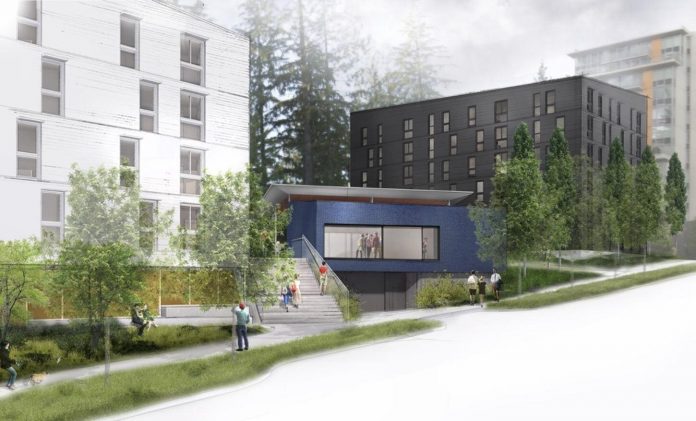
Artist rendering: Courtesy of Local Practice Architecture

By: Paul Choptuik, Coordinating News Editor

On July 4, 2019, the Parcel 21 housing project, also known as Lot 21, won the Net-Zero Energy-Ready Challenge (NZERC), along with 10 other housing projects in the province.

Parcel 21 will be built for graduate students and mature students with young children. The NZERC award is part of the Net-Zero Energy-Ready Challenge, an incentive-based program that, according to Better Builds BC, rewards buildings “that are designed to achieve the top tier of the BC Energy Step Code.” The latter is an optional code, that according to its website, “goes above and beyond the requirements of the BC Building Code.”

The Peak reached out to SFU Community Trust for comment on the announcement and spoke to Dale Mikkelsen, vice-president of development for SFU Community Trust.

“We were excited to apply for it. We’re always looking for opportunities to bring additional value to a project, which either helps us create more energy-efficiency or more value to the project itself,” Mikkelsen said.

The Net-Zero Energy-Ready Challenge program, administered by Integral Group Consulting, carries a value of $2.5 million and will give up to $390,000 in incentives to its winners. 

In addition to meeting a number of criteria, those who were interested in being considered for this program had to send an expression of interest by November 30, 2018. Financial incentives were offered to 16 projects during this preliminary phase according to Mikkelsen.

“16 projects received that phase one incentive, which was $18,000 to do all of that extra modelling and energy design that typically isn’t included in a normal project budget,” he recounted.

 After the preliminary phase, participants then had to submit a full application by March 30, 2019. 

“As noted, there [were] 11 projects out of the 16 that did the preliminary work that were awarded the full incentive value,” Mikkelsen stated.

The $390,000 is comprised of design incentives capped at $40,000 that all full applications were eligible to receive, and $350,000 of NZER incentives which only the 11 winners will receive.

The value awarded to each winner is directly tied to the type of building and its size. As such, Parcel 21 will receive approximately $100,000 from the province, which Mikkelsen says is different than other funding sources.

“What we appreciated with this one versus other funding is that it truly is cash into the project, so we’re allowed to take the $100,000 and use it for those energy performance standards within the building itself.”

According to the backgrounder attached to the press release, Parcel 21 will be mainly framed with wood, built with Forest Stewardship council-certified local timber. It will also have outdoor dining space, a common courtyard, and shared commons.

Some of the energy improvements that will be in Parcel 21 include high performance windows, sunshades, a heat-recovery ventilation system, and a super-insulated building envelope.

Other recipients of the ward included construction projects at the University of Victoria and the University of British Columbia’s Okanagan campus. All the winners will showcase their projects at an open house later this year.

The full press release can be found on the B.C. government’s website. More information on the Parcel 21 project, including a few artist renderings, can be found through the engineering firm Associated’s website, which has been retained to provide structural and electrical engineering services on the project. 

The project team working on Parcel 21 is composed of Local Practice, Space2place, Associated Engineering, Rocky Point, Gage Babcock, RDH, Heatherbrae, and Peak Construction Group.