Home Blog Page 50

Student protests gaining traction in Serbia after 15 killed in train station collapse

0
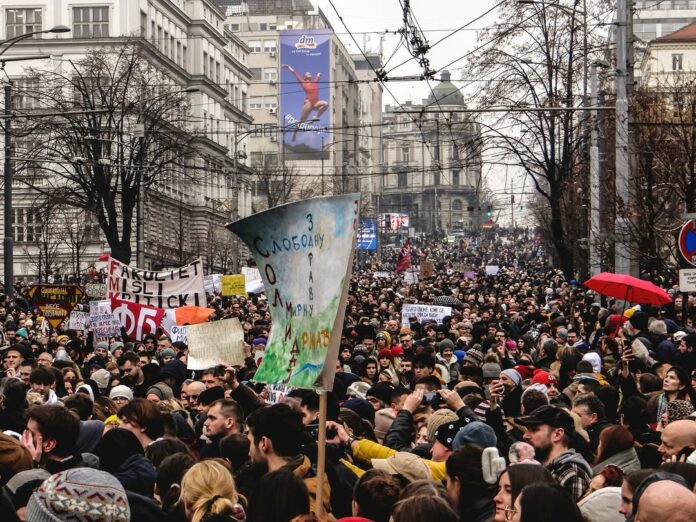
This is a photo flooded with people in the streets protesting, holding some signs written in Serbian. There are so many people that not a single inch of the ground can be seen.
PHOTO: Courtesy of @f666 / Instagram

By: Kaja Antic, Sports Writer

Content warning: mentions of violence against protestors.

Editor’s note: The quotes taken from the interview conducted for this piece were translated from Serbian to English independently by the writer, who is fluent in Serbian.

On November 1, 2024, a concrete roof collapsed in Novi Sad, Serbia’s second largest city, killing 15 people. Since then, mass protests have erupted across the country, alleging government corruption and incompetence caused this tragedy. These protests have been organized largely by students, with the support of the broader Serbian population, as the collapse “has come to symbolize a wider discontentwith government corruption

The Guardian called the protests “the biggest student-led movement in Europe since 1968.” They also called it the largest movement since the 2000 overthrow of former Yugoslavian president Slobodan Milošević. He was accused of corruption and facilitating war crimes during the Yugoslav Wars of the 1990s. The recent protests have pointed out that those in power have “blood on their hands,” supposing corrupt government processes led to the collapse. 

The Peak spoke with two students from Belgrade — Teodor and Mateja — who are acting as security for the protests. The Peak has only published the students’ first names to protect their identities. During the interview, the pair was on duty for a student blockade at their college in Serbia’s capital, as schools have been on strike for weeks.

“The most important thing is to fight against corruption in this country. If we hadn’t stood up, [the government] would have just gone over it,” said Mateja.

Peaceful protests have been ongoing since the initial collapse of the train station entrance. This includes 15-minute traffic blockades — a minute per fatality in the Novi Sad incident. Minutes of silence begin at 11:52 a.m. during protest activities (the same time the concrete roof collapsed) and have also been observed by the international Serbian diaspora. There have also been multiple student-led marches that go on for days as hundreds walk over 80 kilometres from Belgrade to Novi Sad. 

The protesters have made multiple demands from the Serbian government, the first being a release of all documentation related to the Novi Sad station’s recent renovation. The second demand is for those who approved the allegedly insufficient renovation to be held accountable for their negligence.

“The most important thing is to fight against corruption in this country. If we hadn’t stood up, [the government] would have just gone over it.” — Mateja, security for the Serbian protests

“All authorities who were involved in that project should be sanctioned adequately with the provisions of the law,” said Mateja. “Those people who approved such a project [ . . . ] should be responsible.”

The third demand from protestors is the prosecution of groups attacking the protesters. These attacks involved physical beatings and cars driven into the traffic blockades by those displeased with the movement. It has been alleged by protesters that some of these attackers are affiliated with President Aleksandar Vučić and the conservative nationalist Serbian Progressive Party (SNS). 

“They were not arrested. They were not taken into custody. Confirm their identity from the footage and start the appropriate procedure,” Teodor explained. “Not only for them but also for all the people who went out after that or in any way endangered the students.”

The fourth demand is the release of arrested protestors who students allege have been arrested without due process. Mateja alleged the police arrive once the anti-student attackers have fled, resulting in the students being the ones arrested. “It’s more like they don’t want to find them,” Teodor added, concerning the police’s seeming inaction in finding those attacking the students.

The fifth demand is a 20% increase in government funding for post-secondary education, giving opportunities for more students across the country. More recently, on February 26, the government followed through with this increase, which granted a “50% reduction in tuition fees for self-financing students.”

On January 28, Serbian Prime Minister Milos Vučević resigned, following reports of a young woman being hospitalized after an alleged attack by pro-SNS assailants during a protest. Vučević remains in power as prime minister as the National Assembly has yet to confirm his resignation, and he has yet to pick a new prime minister or call a snap election.

Protests continue across the country. The protestors, as a group, have been nominated for a Nobel Peace Prize, though the movement has not been widely acknowledged outside of the Balkans.

“I think it’s nice to see that someone supported you from some other country,” Mateja commented, regarding international support for the movement. While celebrities like tennis player Novak Djokovic and musical artist Madonna have shown support for the students, there is still a long way to go in the student’s eyes to topple Vučić’s government and get justice for those affected by the roof collapse.

SFU professor develops guidelines for social connection

0
This is a photo of someone with medium-length hair and a brown jacket walking along the shore of the ocean alone.
PHOTO: Sergii Mostovyi / Adobe Stock

By: Lucaiah Smith-Miodownik, News Writer

When sick or injured, we’re told to go to the doctor. But what about when we’re lonely? As cited by SFU News, a 2023 study from the US Department of Health and Human Services found that social disconnection, or being socially isolated and lonely, increases the likelihood of premature death just as much as smoking 15 cigarettes a day does.

Now, an initiative led by SFU assistant professor of health sciences Kiffer Card is trying to eliminate the public health issue of loneliness. Card, also the scientific director for the Canadian Alliance for Social Connection and Health (CASCH), headed a project focused on developing national guidelines for improving social connection for individuals and groups. These guidelines were designed in collaboration with GenWell — an organization that creates programs and campaigns aimed at strengthening social connections for Canadians. Similarly, CASCH works “to combat loneliness and social isolation by fostering collaboration among institutions.”

While “loneliness and social isolation can lead to stress [and] depression,” they can also lead to a weaker immune system, according to the project. Cortisol, known as the stress hormone, tends to go up when we’re lonely. For one, cortisol reduces bodily functions that are not absolutely necessary in a moment of high stress, like digestion. If sustained for long periods, this state of stress can lead to an increased risk of issues like heart disease, digestive issues, muscle pain, and more. Cortisol also reduces inflammation. While this may be positive in the short term, it can ultimately suppress the immune system over time. 

The recent study, which informed these guidelines, recruited “expert consultants” on loneliness. These consultants were found by contacting known authors within the academic field of loneliness and emailing professional organizations. Through iterative interviews, researchers asked these consultants how the guidelines should look. 

“By prioritizing social connection, we can combat the rising mental health crises, reduce healthcare costs, and build a more resilient and cohesive society.” — Kiffer Card, assistant professor of health sciences, SFU

Results from the first round of interviews were converted into thematically similar groups, which were then presented to participants as statements. Individuals were asked how much they agreed with the statements, and how much importance they attributed to them. Next, researchers created a set of guidelines based on data from these two rounds. A focus group with people who are 2SLGBTQIA+, non-white, immigrants, and live with disabilities also rated their level of support for these guidelines, which were then fine-tuned. 

Ultimately, researchers settled on six individual and community guidelines for improving social connection. Individual guidelines include emphasizing social connection, focusing on social confidence, and building multiple kinds of relationships. Community guidelines include prioritizing social connection “in policies and practices,” emphasizing “accessibility and inclusion,” and creating spaces that lend themselves well to social connection.

In a recent SFU News release, Card stated “the guidelines are a crucial advancement in public health.” He noted, “Implementing these guidelines may present challenges, but the potential benefits for individual and societal health are immense.

“By prioritizing social connection, we can combat the rising mental health crises, reduce healthcare costs, and build a more resilient and cohesive society.” He also acknowledged that transforming these guidelines from paper to people’s lives can come with challenges. Social inequalities like lack of housing, transportation, and suitable outdoor spaces can make social connections harder.

For a full list of individual and community guidelines, and to learn more about the project, visit socialconnectionguidelines.org.

Vancouver Rise FC represents growing women’s sports in Canada

0
A group of women and trans individuals wearing toques, shirts, and scarves with Vancouver Rise FC’s green logo: an emblem of a mountain with the words ‘RISE’ in the middle.
ILLUSTRATION: Bithi Sutradhar / The Peak

By: Quin Kohlman, SFU Student

The newly established women’s soccer team, Vancouver Rise FC, is ready to move mountains in the Vancouver sporting world. As part of the Northern Super League (NSL), the first women’s soccer league in Canada, this team isn’t just about scoring goals and winning matches; it’s about promoting gender equality and the inclusion of the 2SLGBTQIA+ community in sports. With Canadian soccer icons like Christine Sinclair and Stephanie Labbé on the Rise’s executive team and Canadian national team star, Quinn, on the pitch, this team is sure to turn heads in their spring 2025 debut. 

Although there is still a long way to go, women’s sports have been steadily gaining traction in Canada. According to Statistics Canada, women and girls represent 49% of all sports participants in the country, yet they receive less media coverage and fewer sponsorships than men. There are two professional men’s soccer leagues in Canada, the MLS and the CPL both of these leagues have a team in Vancouver, Vancouver Whitecaps FC (MLS) and Vancouver FC (CPL). The Rise will be the first independent women’s professional team of any sport in Vancouver. 

“The establishment of the Vancouver Rise brings more than just a new team to cheer for; it represents a powerful movement towards inclusivity in Vancouver.”

The Rise’s establishment brings more than just a new team to cheer for. This team has the potential to inspire young girls and 2SLGBTQIA+ individuals who may have previously felt marginalized by the men’s sports teams in Vancouver. With many other professional women’s sporting leagues across the world fostering a safe place for women and 2SLGBTQIA+ athletes and fans, we can hope to see the same from the NSL and the Rise. 

The success of women’s sports in Vancouver in the Canadian Women’s National Soccer team and the Professional Women’s Hockey League (PWHL) Takeover Tour shows promise for high interest in women’s sports and proves why Vancouver can support a professional women’s team. On December 5 2024, Rise part-owner and Canadian soccer legend, Sinclair, played her last game with the Canadian Women’s Soccer Team and drew record-breaking numbers of over 48,000 fans to BC Place. Earlier this year, the PWHL Takeover Tour brought 19,038 fans to Rogers Arena, surpassing the Vancouver Canucks’ January 2025 average of 18,942 fans. With the continued outcry of support for women’s sports in Vancouver, it is clear to see the Rise can succeed. 

In a city renowned for its breathtaking landscapes and cultural richness, the Vancouver Rise is crafting a new narrative one where everyone has the opportunity to thrive, and rise.

Trump appoints Onijah Robinson as USAID administrator

0
Illustration of Donald Trump and Onijah Robinson shaking hands in the Oval Office.
ILLUSTRATION: Cliff Ebora / The Peak

By: Mason Mattu, member of the SFU <3 Onijah Fan Club

WASHINGTON, DC — In a hastily-called press conference on March 3, US President Donald Trump announced American philanthropist and viral internet sensation Onijah Robinson as the next United States Agency for International Development (USAID) administrator. Vice president Elon Musk had previously announced the dismantling of the agency due to “reckless spending.” In a surprising twist of fate, the Trump Administration has resumed normal operations of USAID under the leadership of Robinson.  

Robinson has recently gained popularity after her humanitarian efforts in Pakistan, demanding $100K to reconstruct the allegedly failed state. The philanthropist had originally come to Pakistan to reunite with her alleged husband, but had given up after hearing the “cries of children on the street begging for better infrastructure.” 

Pakistanis rallied behind Robinson, with even members of the diaspora getting behind her and her vision to fix the country. The Peak polled 10,000 people in Karachi, Pakistan to see their reaction to Robinson — 99.1% said, “What the fuck.” Despite her efforts, she was sent back to America on a flight paid for by US tax dollars.

“You people and your situation is so disgusting,” Robinson said in an interview with Pakistani news outlet Dunya News before boarding her flight home. “Y’all don’t even have scrumpdillyicious fast food options, a broken healthcare system, or Fourth of July! This is very unfortunate. I see people on the streets crying, begging for my help. Your government didn’t want to help me, give me Pakistani citizenship, or complete dictatorial powers over Pakistan? That’s fine, I’ll be back, y’all.” 

And back she was. “Oneejah, Onaja, Oligarkey, what a fabulous name and what a fabulous woman — don’t tell Melania I said that,” whispered President Trump at the press conference. “For far too long, the United States has been crushed by poor Zimbabwean children who rely on our country to provide funding for education. Their evil intentions are hurting our economy! What are their intentions with our money? Oneejahka will fix this and Make American Foreign Policy Great Again — MAFPGM!” 

Robinson refused to speak during the press conference, requesting that each news outlet directly wire her $20K “or more” for a chance to speak with her. “I’m not talking unless y’all are giving me land, money, or real estate!” she shouted at the press. The Peak wired this money over in monopoly cash and was able to connect with the new administrator.

According to Robinson, the MAGA Malls Program will see malls constructed in the world’s “poorest nations” such as Pakistan, Greenland, Britain, the Democratic People’s Republic of Canada, and Ohio.

“A big change is coming to USAID. No more of that giving money to prevent global health situations. Okay? Malaria sucks, I get it. I want to speak to its manager to stop it from happening without our money. Got it?” said Robinson. “I am pleased to announce a new development scheme for the US — MAGA Malls Program.”

The Peak has also learned that the US Government has issued an internal order to change the definition of development to “start big business there, extract money, boom, slam, wham, development.” 

According to Robinson, the MAGA Malls Program will see malls constructed in the world’s “poorest nations” such as Pakistan, Greenland, Britain, the Democratic People’s Republic of Canada, and Ohio. She says that the office will begin reaching out to potential storefront renters such as Sears, Blockbuster Home Videos, and Enron. Each mall must also include a Buc-ee’s gas station equipped with 15 soda stations. 

“We are helping these nations, especially communist Britain and Greenland, because they have very high poverty levels. OK? Their roads are not good. Have you seen the roads? They drive on the left side because the right side has too many pot holes,” said Robinson. “Pot holes are the leading cause of death internationally — next to windmills — so we’ve gotta defund the other stuff. Got it? Comprendo?”   

In a statement to The Peak, Prime Minister of Canada Justin Trudeau called Robinson “unstable and unfit to lead the free world.” When asked for a response to this, Robinson smiled loud and proud like Kim Kardashian in front of a brand new Cyber Truck: “I am a Muslim and it is against my religion to tell y’all my business.” 

For more information about the new USAID Administrator, please visit: thisisamessagefromUSAIDemployeeshelpuswearescaredshitless.org

Flowing verses at Black Futures Open Mic

0
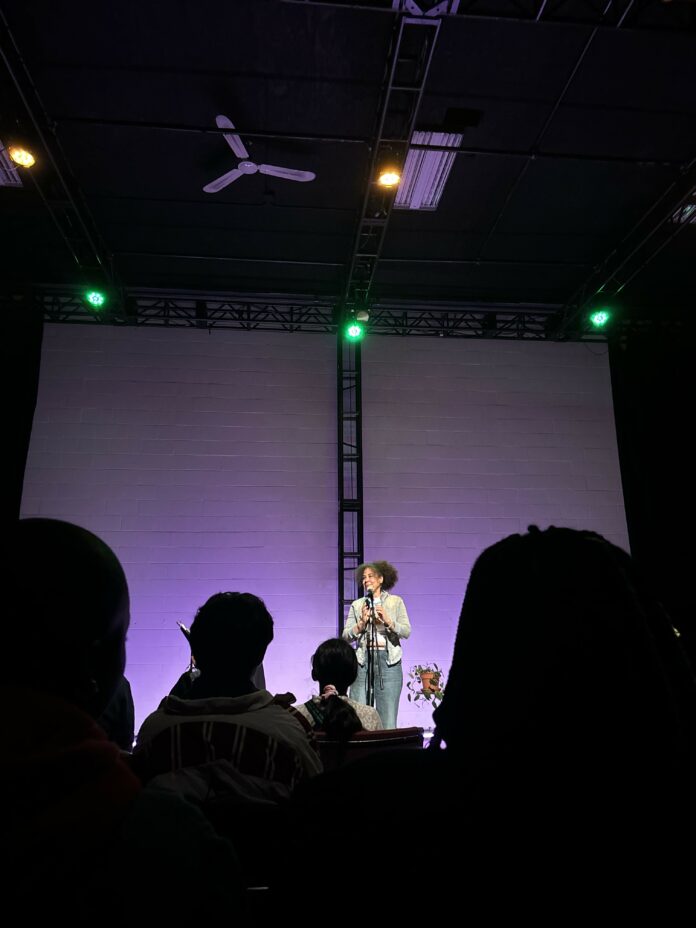
A woman stands at a microphone while lit up by purple spotlights.
PHOTO: Lucaiah Smith-Miodownik / The Peak

By: Lucaiah Smith-Miodownik, News Writer

A gentle wash of purple and green clung to a white brick wall, as if the colours themselves were intent on listening to the evening’s poems. Behind the microphone sat a few modest armchairs and an accompanying coffee table with a house plant perched atop. The space felt warm and welcoming, a place where wise words, subtle quips, and heartfelt truths might flow effortlessly.

Vancouver’s Progress Lab was set for a beautiful night of poetry. Host Harrison Mooney, author of the award-winning memoir Invisible Boy, introduced the show, titled Black Futures Open Mic. The production was a joint effort between local organizations Neworld Theatre and Unbound Reading Series to showcase the talent of Black writers, storytellers, and artists.

The first poet to perform was Siobhan Barker. Their work traversed many topics, beginning with an homage to artist and civil rights activist Nina Simone. Sio then delivered an intimate story of growing up and taking space, weaving the homophones sole and soul to tell a tale of shoes on concrete and her accompanying body navigating the world. 

Cascading around the space with steps forward-backward and side-to-side, arms spread open then closed, her words themselves seemed to smile.

They also recounted memories of childhood — her mom’s near-magic ability to do their hair in a perfect but all-too-tight afro puff, with a giant pink polka-dotted bow as the finishing touch. I felt honoured to be welcomed into a space where I could appreciate art that so many audience members resonated with on an intimate level, as evidenced by the crowd’s intermittent soft laughter of understanding.

Next up was Sonya Littlejohn. She began by taking a step away from the microphone, letting their voice expand and envelop the room with its seemingly effortless gravitas. Cascading around the space with steps forward-backward and side-to-side, arms spread open then closed, her words themselves seemed to smile. As they spoke about nature, the purples and greens on stage melded into a luscious forest. To borrow from Maurice Sendak’s Where the Wild Things Are, “The walls became the world all around.” I was pulled out of my woodland fantasy when Littlejohn stepped to the mic and let her tone fall to a quaint whisper, only to raise it again in what could only be described as a . . . dolphin voice?

Poetry continued to flow from other speakers through the night. From masks of self-pity, to raccoons eating chicken soup with turmeric off the front porch steps, to reluctantly killing spiders, the art remained unique to each performer’s worldly experience. The evening was made complete by an alluring display of Black authored books from Wildfires Bookshop, and the best Jamaican patties you’ll ever taste from Rise Up Marketplace. The open mic was a heartening showcase of the power behind the authentically spoken word, and I was lucky enough to attend.

How artistic pursuits help develop soft skills

0
Illustration of a palette with different colours, surrounded by paint tubes and brushes
ILLUSTRATION: Victoria Xi / The Peak

By: Manal Kashif, SFU Student

Imagine this: you found a great job opportunity, made it through the first couple of interviews, and are now starting the final interview. Your manager-to-be asks the typical, “Tell me about a time you solved a problem by thinking outside of the box?” However, your mind is racing. You’re wondering when you ever solved anything creatively in your life — absolutely blank. Then, that time you painted a portrait using only shades of blue — not because that was the plan, but because you had no other colours to use — rushes into your head. Who would have known, the answer wasn’t in a textbook or assignment, but in the simple joy of your favourite hobby.

We are told to curate our resumes to the job description, making sure skills like coding in a specific language or being proficient in a certain technique are front and center. We sideline skills like problem solving or collaborative work, yet these are the very skills that can set you apart from a pile of resumes. Employers generally look for two types of skills: hard and soft. Hard skills are often specific to the job you are applying for and include skills such as computer programming, social media marketing, and laboratory techniques. While these are valuable and practical in today’s society, oftentimes hard skills can be taught or improved upon once you are trained for your job. However, there are many personality traits and qualities that play a huge role in being successful at any given role. These are known as soft skills and they cover a wide range of traits, including critical thinking, time management, and creative thinking. What makes these harder to develop is the difficulty in pinpointing when you’ve achieved a “high” level of proficiency in them. You have to work on them on a daily basis but how would one do that? Well, you’re probably already doing so in the form of your hobbies and passions. Painting, baking, and pottery; hobbies like these are far more than just fun — they’re training camps for developing soft skills. 

Problem solving is a practical skill that would benefit anybody at any point in their life. Interestingly, you don’t need a structured or traditional approach to develop it — chances are you’re already working on it while having fun. It may be hard for some to envision how splashing colours on a blank canvas could teach you how to overcome everyday obstacles, but that’s what the whole creative process is all about. Transforming a blank canvas and turning it into an explosion of colours with a unique story is a journey filled with decision after decision. You may not be consciously aware of it, but you’re in charge of the decision making, which is the first step to developing problem-solving skills. You might make mistakes while painting, or colours won’t blend as you’d like, but you’ll adapt, change course or refine your approach — this is problem-solving and adaptability, and they’re invaluable skills in the workplace and for any position. A painting at its root is just a series of decisions and techniques made to create something beautiful. Art education wouldn’t be a part of many school programs if there weren’t something to be learned from it. 

Who would have known, the answer wasn’t in a textbook or assignment, but in the simple joy of your favourite hobby.

Not all art pieces hang on walls to be admired; some end up on our plates. Some of our greatest masterpieces and disasters are likely to have been created in our kitchens. Baking requires creativity and focus, both essential soft skills for problem-solving. Whether you need to find a substitute for eggs, because of course you’re out of eggs, or you need to figure out why the sourdough is not rising — baking demands adaptability and quick thinking. Studies have even shown how baking can be beneficial for older adults, as following recipes, and troubleshooting helps improve memory, problem-solving skills, and creativity. In a fast-paced work environment, being able to balance multiple tasks and adjust on the fly to unexpected obstacles is incredibly helpful — just like following a recipe when, of course, you realize you’re still out of eggs. Next time your cookies come out extra crispy, remember, you’re not just baking, you’re also building problem-solving skills — enjoy your overbaked cookie for now and plan for next time improvements.

Hobbies such as crocheting and knitting offer far more than just creating soft and cozy scarfs or intricate designs; these hobbies can improve cognitive performance and overall mental well-being. Additionally, by having to go over complex stitches and patterns, you strengthen your brain and help with your memory. Having the patience and precision needed to craft complex patterns can easily translate to any job environment in terms of being thorough and attentive to details. So, next time you decide to knit a cute blanket for your home, know that you’re not just crocheting — you’re boosting your cognitive function and learning ways to manage your anxiety at the same time. 

This is why interest in our artistic passions is not just a pastime but a good investment in personal development. Whether you’re painting, knitting, playing music, or any other creative pursuit, you’re developing invaluable soft skills. These activities build a foundation of skills that can be applied to work, academia, and everyday life.

The rise of economic nationalism sidelines reconciliation

0
this is an illustration; the exchange of bloodied money for the canadian flag
ILLUSTRATION: Kristin Lee / The Peak

By: Zainab Salam, SFU Student

On the windy afternoon of January 19, I drove down to Bellingham to go shopping. I wanted some fridge necessities from renowned American grocer Trader Joe’s. The next day, Donald Trump was inaugurated, and since then, it feels as though the world has been thrown off its axis. With one executive order following another, Trump destabilized countless foreign relations, and Canada is no exception. Trump’s proposed tariffs are set out to alter the shopping habits of Canadians, including those who regularly cross the Canadian-American border to shop in accessible American cities. Canadians are after Canadian products, and it’s all over the news.

With support from politicians across various parties, the surge in economic nationalism in Canada is fueled by consumer campaigns such as the “Buy Canadian” movement. The rhetoric is compelling: by buying Canadian, we ensure Canada’s economic resilience in the face of proposed tariffs and put pressure on the American economy. The idea is that we should prioritize Canadian-made goods and protect our industries from American competition, and this quest has seemingly been bringing Canadians together in a shared goal across party and ideological lines. 

While it does make sense to avoid tariffs which only exacerbate the high cost of living, these efforts tend to reinforce the colonial structures Canada created to dig its claws into the land. The industries that benefit most from economic nationalism are deeply intertwined with Canada’s colonial past and present. Industries such as oil and hydroelectric power are the lifeblood of Canada’s exports, and they all operate through the exploitation of unceded Indigenous land. The pipelines built atop Wedzin Kwa (Morice River) stand witness to Canada’s exploitation of Indigenous lands. The Wet’suwet’en Nation and their allies protested the Coastal Gaslink Pipeline in 2019, and the resistance to colonial expansion was met with violence.

“The more Canadians understand their economic well-being as dependent on the continued exploitation of land and resources, the more the political will to meet Indigenous demands will further disintegrate.”

Beneath the patriotic fervor lies an uncomfortable contradiction. It does seem incredibly ironic that Canada is fighting to preserve rights over land that was violently stolen. While Canada fights to assert its economic sovereignty, it does so by further exploiting unceded Indigenous land. This is the truer cost of economic nationalism, one that is often ignored in mainstream discussions. As nationalism strengthens, so too does the risk that reconciliation efforts will become little more than symbolic gestures. The more Canadians understand their economic well-being as dependent on the continued exploitation of land and resources, the more the political will to meet Indigenous demands will further disintegrate. Contributing to the local economy by supporting small businesses, specifically those owned and operated by Indigenous people, is a much more meaningful way to use the power which money provides.

Economic nationalism in Canada is a double-edged sword. While it may foster a sense of unity on a volatile world stage, it sidelines Indigenous sovereignty and the importance of reconciliation efforts. If Canadians are truly committed to reconciliation, then we must be willing to question the economic foundation of our country, and by extension, our institutions as a whole. Reconciliation is not something we can put on hold every time there is an economic crisis or a foreign dispute; it has to be central to how we operate our country, not an afterthought. This includes rethinking what national identity means, because if our only sense of it is built on the continued exploitation of stolen land, then what are we truly proud of?

Kwiakah Nation to convert salmon farm into research facility

0
This is a photo of a man standing on a dock, pointing somewhere with his left hand as he talks to several other people. A mountain in the background and a multicoloured dog are also pictured.
PHOTO: Courtesy of Nature United / Facebook

By: Mason Mattu, News Writer

With 19 members, Kwiakah First Nation makes up “the West Coast’s smallest First Nation.” With territory spanning across the Wənałdəmsa sa Kwiakah (Phillips Arm) and Frederick Arm region, the Nation has made strides toward an Indigenous-led conservation economy. A conservation economy involves communities taking “the lead in deciding how to manage land and natural resources while creating new employment opportunities and stewarding ecosystems for the benefit of future generations.”

The Kwiakah Nation recently announced its plans to open a “floating research facility” by summer 2025. Dubbed the Kwiakah Centre for Excellence, the facility will feature a “dedicated research station, an experimental kelp farm, regenerative forest operations, and its territorial guardian program.” It will also include lodging for researchers. The facility will be repurposed from a decommissioned open-net pen salmon farm.

The Kwiakah Nation have titled the floating research facility their “return home.” They were “displaced from its traditional coastal villages” in the early 20th century and did not return for 100 years. The research centre will be anchored in their traditional territory. The Peak reached out to the Kwiakah and the First Nations Centre for Excellence for more information but did not receive a response by the deadline.

The Kwiakah Nation was previously involved in a legal challenge alongside several other Nations to shut down the nowdecommissioned open-net pen salmon farm that operated in the Discovery Island area. They “expressed concerns regarding the declines of Fraser River salmon and the impact of salmon farming on wild stocks.” In 2022, the Federal Court ruled in favour of continuing salmon farming. Fast-forward to 2024, the federal government announced a “ban on open net-pen aquaculture” by 2029.

“Eventually, revenue will be created by protecting the environment, by conserving forests and by not cutting them.” — Frank Voelker, manager and economic development officer, Kwiakah Nation

According to the Kwiakah Nation’s manager and economic development officer Frank Voelker, the opening of the Kwiakah Centre for Excellence will continue the Nation’s “path to building a ‘stewardship economy’ that puts the environment first when it comes to economic development.”

The Kwiakah have set a strategic plan to create revenue through regenerative forestry practices. According to Island Coastal Trust, a donor to the Kwiakah Centre for Excellence, an example of regenerative forestry may include “forest farming and non-timber forest product development” such as “botanicals, essential oils, medicinal herbs,” and produce. This is part of the Nation’s vision to create a sustainable economy. 

“Eventually, revenue will be created by protecting the environment, by conserving forests and by not cutting them,” Voelker told IndigiNews. 

As for the future of the floating research centre, the Nation is looking forward to deepening research with the University of British Columbia, the University of Victoria, and the University of Calgary. 

Postcards from Congo is an artful graphic history

0
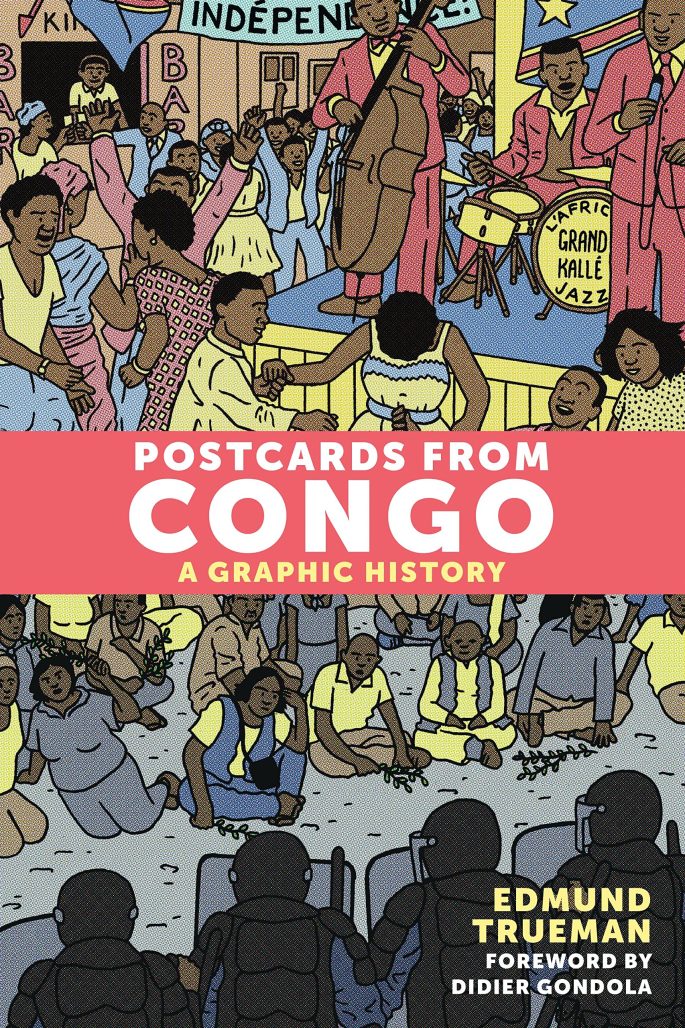
A book lying on a wooden table with an illustrated cover. The top half depicts colourful visuals of people dancing and playing music, while the bottom half shows police and guards trapping people with shields.
ILLUSTRATION: Courtesy of Arsenal Pulp Press

By: Petra Chase, Editor-in-Chief

Content warning: brief mentions of slavery, child soldiers, and war.

The Democratic Republic of Congo (DRC) is the second largest country in Africa, yet its rich, enduring history is often overlooked. Postcards from Congo is an easy-to-digest graphic novel and entry point into everything from the Bantu migrations of 500 BCE to the COVID-19 pandemic. It exposes the violent legacy of colonialism, which persists to this day. It is also a testament to the pride and hope Black and African histories offer through countless stories of resilience, ingenuity, joy, and self-determination.

DRC is often confused with the Republic of Congo. In an introductory map, we see the two countries are connected with the vast Congo River and Rainforest they both touch, as well as the pre-colonial Kingdom of Kongo. While both countries go by the Congo shorthand, Postcards from Congo and this article are solely about DRC, sometimes referred as Congo (Kinshasa), after the capital city, or Zaire, one of its post-independence names. 

Knowing African history is often omitted in popular education and culture, Edmund Trueman, a European settler, was inspired to create this novel after learning in depth about Congo’s history. This is while the world is largely ignorant that their technology — like phones and laptops — use coltan, a mineral extracted from Eastern Congo. A country with ongoing corruption and war after a brutal colonial history, the situation is exacerbated by greed for natural resources by western and global superpowers and technology giants. Apple, Tesla, Dell, Google, and Microsoft deny responsibility while continuing to profit off Congolese lives.

Trueman’s art is based on careful study of Congolese visual sources, translating in vignette paneling. Each chapter of history starts with a two-page introduction to the time period, followed by a collection of “postcards” with short descriptions focusing on a specific event, person, movement, community, or place. This pacing, which lets you pause and take in the still drawings after learning the context behind them, makes the book easy to follow, despite covering so much ground.

In style and content, Trueman also critiques the well-known Belgian cartoonist Hergé, creator of the children’s Adventures of Tin Tin comic series. With this series, Hergé invented ligne claire, the pleasant cartoon style Trueman uses, characterized by simple lines and a lack of shading. Tin Tin au Congo (1930), Tin Tin’s patronizing second book, sent the “adventurer” to Belgian Congo to game hunt. It depicted the Congolese through a dehumanizing and colonial gaze of needing to be “civilized.” Postcards from Congo flips the narrative on its head. There are multiple scenes where Congolese fight back. In one postcard, a Tin Tin lookalike, a Belgian soldier with a gun, gets killed in a revolt by a member of the Pende Indigenous tribe. 

The smooth, bright colours of ligne claire also make depictions of Congolese culture, urban life, and natural landscapes especially vibrant in the novel. This is a fitting representation for underrepresented Indigenous tribes, including the Mbuti, who traded and shared skills with the pre-colonial Bantu civilization, and have maintained a complex hunter-gatherer lifestyle in the rainforest. We learn that recently, they fought for their right to stay on part of their ancestral lands of Itombwe, and are working with conservationists to protect it. 

“The smooth, bright colours of ligne claire also make depictions of Congolese culture, urban life, and natural landscapes especially vibrant in the novel.”

Lively tapestry-like illustrations feature the spirit of Congolese rumba music and dance, joyful jazz clubs, art, and “évolués” — Black, educated middle-class men in Congo who learned fluent French and conformed to western culture in hopes of achieving equality. However, they continued to be treated as the rest of the Congolese, segregated from whites, barred for high-skilled positions, and heavily controlled while Belgians lived in luxury. Soon these men and the country began rallying the cry for independence.

As Central African historian Didier Gondola writes in the novel’s foreword, “Colonization afforded [the Congolese] opportunities to carve out agency in a context of a state of violence and white supremacy.” One of the most well-known exemplifiers of this was évolué Patrice Lumumba, a Congolese man who climbed the ranks at a postal office, wrote in local newspapers, and eventually stepped up to achieve equality and basic rights. He founded his own political party and wrote compelling speeches that resounded across ethnic lines, calling for unified, free Congo. 

Belgium reluctantly handed over power in 1960, making Lumumba the first prime minister. However, in the concession ceremony, Belgian King Baudouin commended the “humanitarian” work of his late King Leopold II. Lumumba, who was not scheduled to speak, took to the podium to deliver a powerful speech that has immortalized him as a hero. He called attention to Belgium’s violent mistreatment of the Congolese for 75 years, including a dark period in which gruesome acts of violence and coercion were used to extract valuable rubber to fuel Belgian wealth, which the King tried to hide from the world. Lumumba also made sure everyone listening knew that independence was achieved by the demand of the Congolese, who persevered through these hardships. Too powerful a figure for the US empire during the Cold War, Lumumba was assassinated by the CIA a year later, but he will always be remembered for his courage.

Since then, the country has seen a slew of corrupt leaders and civil wars, propped up by colonial powers. Ever since the country’s borders were drawn up by Belgian settlers in 1885, without consideration for the hundreds of ethnic groups that existed there, Congo has endured crisis after crisis. In some areas, child soldiers grow up in rebel groups, institutionalized into violence. China has not yet fulfilled its promise of improving the country’s infrastructure in exchange for heaps of coltan and cobalt which it owns and profits from, extracted through slave labour. From rubber to minerals, oppression and greed continues to decide the fate of the population of 100 million.

Meanwhile, the people of Congo are resilient and take agency, and the book features countless postcards of Congolese inventors, activists, and humanitarians. We learn about heroes like Balezi Bagunda, a former child soldier who became a boxer and advocated for boys’ rights. Congolese continue to resist and advocate for change, and support and awareness are needed. In one of Congo’s darkest periods, the 19th century, the international community put an end to the violence of the rubber trade when they found out about Belgium’s crimes against humanity and protested. This is one example of history acting as a blueprint for the future.

Trueman ends the novel with a depiction of a bar in Goma, a city which has survived volcanic eruptions, Ebola outbreaks, and has lived amid rebel wars for three decades. Despite these conditions, they continue to live life, finding culture and joy, commodities which cannot be stolen from them.

Get a copy of Postcards from Congo from an independent bookstore.

To learn more about Lumumba’s legacy, watch the moving spoken word poem, “The Rise of Patrice Lumumba | What REALLY Happened?” by George the Poet on YouTube.


Non-Black minorities need to stop using the N-word

0

By: Kamal Nagi, SFU Student

Black contributions have helped shape much of contemporary pop culture. Instead of recognition, however, non-Black influencers continuously take credit for its introduction to the mainstream. True appreciation is not just consuming Black culture, but addressing anti-Black racism in everyday life, including the exploitation of Black culture. One example of cultural aspects being stolen and exploited is the casual use of the N-word by non-Black individuals, particularly within some South Asian and Latinx communities. Appropriation ignores the history of anti-Black oppression and the efforts of Black communities to reclaim their identities.

African American Vernacular English (AAVE) is often pirated by non-Black people who overlook its cultural significance; it is a language system that’s constantly evolving, with strong historical origins in Black American communities. Just as AAVE is more than internet slang, the N-word has a derogatory history that can’t be disconnected from its roots. Many non-Black people of colour use the term casually, justifying its use with references to hip-hop culture or shared racial discrimination. The word’s frequent use by Black artists does not grant listeners permission to use it with the excuse of singing along. Black communities have reclaimed the word as an act of resistance against their shared experiences of oppression, and non-Black people’s ignorance of this renovates remaining structures of white supremacy.

Black communities have reclaimed the word as an act of resistance against oppression, and non-Black people’s usage of it renovates remaining structures of white supremacy.

Social media has become a faceless space where AAVE words and Black cultural markers such as clothing, music, and language often lose historical importance and become trends. Non-Black people who use the same language are quick to claim and dismiss it as slang and are seen as “cool” among peers, yet Black people are discriminated against for using AAVE in legal, professional, and educational contexts. This worrying trend of stealing AAVE without acknowledgement turns into more than language appropriation; it reinforces oppression and the silencing of Black voices rather than solidarity. 

Though Black culture through music, fashion, and social movements have had a tremendous impact on global pop culture, the lack of recognition or credit leads to casual appropriation. White supremacy produces a dichotomy of whiteness and non-whiteness; non-Black youth gravitate towards Black culture, which is markedly “othered” in North American society, in search of belonging or to position themselves as anti-establishment in relation to white people. Still, recognizing the cause does not excuse appropriation, especially considering the violent history of slavery, segregation, and anti-Black oppression behind the N-word. 

Criticizing this rising norm is sometimes met with mockery or scorn alongside labels of being “too sensitive” or “overreacting.” Below the surface, gaslighting those who call out this offensive behaviour is a refusal to hold themselves accountable. Despite the uncomfortable conversation, holding each other responsible for using the derogatory term is the first step to acknowledging the issue. The next step is to educate ourselves and show real solidarity by respecting the boundaries set by Black communities. We must challenge those around us and advocate, as true allyship isn’t just listening and learning, but also taking action.